|
시장보고서
상품코드
2117578
실험실용 AI 솔루션 시장 : 점유율 분석, 업계 동향과 통계, 성장 예측(2026-2031년)AI In Laboratory Solution - Market Share Analysis, Industry Trends & Statistics, Growth Forecasts (2026 - 2031) |
||||||
 Mordor Intelligence
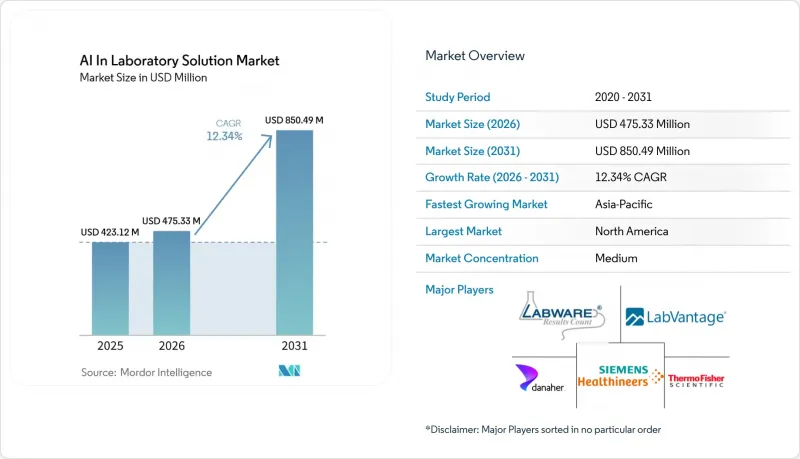
Mordor Intelligence에 의하면, 실험실용 AI 솔루션 시장 규모는 2025년 4억 2,312만 달러에서 2026년에는 4억 7,533만 달러로 확대되어 2026년부터 2031년까지 CAGR 12.34%로 성장을 지속하여, 2031년에는 8억 5,049만 달러에 이를 것으로 예측됩니다.
본 보고서는 솔루션 유형(하드웨어 장비, 소프트웨어 및 시스템), AI 기능(예측 분석, GenAI 코파일럿, 기타), 도입 형태(On-Premise, 프라이빗 클라우드, 기타), 최종 사용자(제약·바이오기술,CRO/CDMO, 기타)별로 세분화되어 있으며, 지역별로는 북미, 유럽, 아시아태평양, 중동 및 아프리카, 남미로 분류되어 있습니다. 시장 예측은 금액(미 달러) 기준으로 제시되어 있습니다.
전 세계 실험실용 AI 솔루션 시장 동향 및 인사이트
AI를 활용한 고처리량 실험에 대한 수요 증가
AI를 활용한 고처리량 실험은 전문적인 기능에서 제약, 소재, 유전체학 분야의 보다 광범위한 연구실 워크플로로 전환되고 있습니다. 자동화 플랫폼은 연구팀이 수작업으로 작성한 일정보다 더 신속하게 AI가 설계한 실험 큐를 실행할 수 있습니다. 이를 통해 연구실은 인력을 그만큼 늘리지 않고도 더 많은 후보 조건을 평가할 수 있게 됩니다. 2026년 『Scientific Reports』지에 게재된 연구에 따르면, 자가 수정형 다중 에이전트 AI 시스템은 복잡한 합성 작업에서 수치 오차를 85% 이상 줄였으며, 멀티플레이트 합성 벤치마크에서 F1 점수 0.89 이상을 달성했습니다. 이러한 결과는 연구자가 복잡한 실험 절차를 보다 확실하게 처리해야 하는 연구실 환경에서 AI 시스템의 활용을 뒷받침합니다. 또한, 연구실의 조달 동향이 장비, 데이터 플랫폼, 워크플로우 소프트웨어를 결합한 ‘커넥티드 패키지’로 전환됨에 따라, 실험실용 AI 솔루션 시장도 혜택을 보고 있습니다.
연구실 인력 부족과 분석 담당자의 생산성 압박
연구실의 인력 부족은 AI를 활용한 연구실 시스템의 비즈니스 사례를 변화시키고 있습니다. 현재 많은 연구실에서는 AI 도구 도입을 단순한 품질 개선책이 아닌, 생산성 향상을 지원하는 수단으로 보고 있습니다. 독일, 일본, 미국의 노동력 고령화로 인해 경험이 풍부한 연구실 과학자를 확보하기가 어려워지고 있습니다. 동시에, 오믹스 연구와 다중 매개변수 분석의 발전으로 인해 복잡한 데이터 세트를 해석할 수 있는 인력에 대한 수요가 높아지고 있습니다. 소규모 수탁 조사 기관이나 대학의 핵심 시설에서는 전문 분석 담당자가 부족하기 때문에 가장 큰 업무 부담에 직면하는 경우가 많습니다. 따라서 데이터를 구조화하고, 분석을 지원하며, 반복적인 검토 작업을 줄일 수 있는 AI 시스템에 대한 관심이 높아지고 있습니다.
AI를 활용한 워크플로우에서의 GxP 검증 부담
규제 대상인 제약 및 생명공학 연구소에서 AI를 활용한 워크플로우에 있어 검증 요건은 여전히 큰 제약으로 작용하고 있습니다. GxP 관련 업무에 AI를 활용하는 연구소는 데이터, 모델, 의사 결정 및 검토 기록이 추적 가능하고 재현 가능함을 입증해야 합니다. FDA는 2025년 9월에 ‘컴퓨터 소프트웨어 보증(Computer Software Assurance)’ 지침을 최종 확정하고, 2026년 2월에 이를 업데이트했습니다. 이 지침은 위험 기반 프레임워크를 채택하고 있으며, 환자 안전 및 제품 품질에 영향을 미치는 기능에 테스트의 중점을 두고 있습니다. 이를 통해 위험이 낮은 소프트웨어 기능의 검증은 간소화될 수 있지만, 배치 릴리스, 감사 추적 및 품질과 관련된 워크플로우에 대해서는 여전히 광범위한 증거가 요구됩니다. 따라서 실험실용 AI 솔루션 시장에서는 버전 관리, 감사 추적, 사람에 의한 검토 기록 및 AI 기반 의사 결정에 관한 명확한 문서화를 제공할 수 있는 벤더가 우위를 점하고 있습니다.
부문 분석
2025년, 실험실용 AI 솔루션 시장에서 ‘소프트웨어 및 시스템’ 부문은 64.41%의 점유율을 차지했습니다. 이 부문에는 LIMS 플랫폼, 전자연구노트(ELN), AI 분석 도구 및 실험실 워크플로우 오케스트레이션 시스템이 포함됩니다. 소프트웨어는 지속적인 구독 수익을 창출하고 장기적인 고객 관계 구축을 지원합니다. 또한, 연구실이 동일한 데이터 환경에서 더 많은 AI 기능을 활용할수록 그 가치는 더욱 높아집니다. 하드웨어 장비는 나머지 수익 점유율을 차지했습니다. 이 범주에는 AI 지원 실험실 장비, 연결형 센서, 환경 모니터링 장비 및 AI 기능이 내장된 자동화 플랫폼이 포함됩니다.
‘소프트웨어 및 시스템’ 분야는 2031년까지 연평균 성장률(CAGR) 13.27%를 나타낼 것으로 예측됩니다. 이 부문에서 실험실용 AI 솔루션 시장 규모가 확대되는 것은 연구소들이 구형 정보학 도구를 AI 지원 플랫폼으로 교체하고 있기 때문입니다. Benchling은 2026년 5월, Baseten과의 제휴를 통해 ‘Benchling Inference’를 발표하며 자사의 연구개발 플랫폼 내에서 과학적 AI 모델과 멀티클라우드 GPU 용량을 제공했습니다. 또한, 장비 공급업체들은 주요 소프트웨어 플랫폼과 연동 가능한, 실시간으로 기계가 읽을 수 있는 데이터 출력에 대한 수요 증가에도 직면하고 있습니다. 인증된 통합 기능을 갖추지 못한 하드웨어 공급업체는 조달 결정 과정에서 불리한 입장에 처할 가능성이 있습니다. 소프트웨어 플랫폼은 연구실의 데이터, 워크플로우 및 AI 지원 의사결정에서 사실상 핵심 시스템으로 자리 잡고 있습니다.
2025년, 실험실용 AI 솔루션 시장 규모 중 예측 분석 및 예측이 35.16%의 점유율을 차지했습니다. 실험실에서는 안정성 시험 모니터링, 장비 유지보수, 품질 모니터링 및 계획 수립 활동에 예측 모델이 활용되고 있습니다. 이러한 용도는 확립된 실험실 프로세스와 부합하며, 일반적으로 연구자의 업무 관행을 변경하는 것을 최소화할 수 있습니다. 이상 감지 및 예외 검토 도구 또한 중요한 기능 영역 중 하나입니다. 이를 통해 시스템은 비정상적인 결과를 식별하면서도 최종 검토에 대해서는 사람의 확인을 유지할 수 있게 됩니다.
생성형 AI 코파일럿 및 자연어 지원은 2026년부터 2031년까지 연평균 성장률(CAGR) 16.57%를 나타낼 것으로 예측됩니다. 각 벤더사는 대규모 언어 모델(LLM) 인터페이스를 LIMS 및 전자연구노트(ELN)(ELN) 플랫폼에 통합하고 있습니다. Benchling은 2026년 4월 ‘AI Connectors’를 출시하여 연구자들이 외부 AI 도구나 자연어 쿼리를 통해 과학 기록에 접근할 수 있도록 했습니다.
이 플랫폼은 머크, 모더나, 사노피를 포함한 1,300개 이상의 기업을 지원하고 있습니다. 연구소가 고립된 AI 도구에서 벗어나면서 워크플로우 자동화, 의미론적 검색, 품질 신호 감지의 중요성도 커지고 있습니다. 통합형 플랫폼이 개별 단일 기능 제품을 대체하는 추세가 강해지고 있습니다.
지역별 분석
2025년, 북미는 전 세계 실험실용 AI 솔루션 시장 점유율의 46.38%를 차지했습니다. 이 지역은 제약 연구비, 생명공학 기업, 연구 기관 및 실험 장비 공급업체가 고도로 집중되어 있다는 이점을 가지고 있습니다. 미국은 대규모 제약 및 생명공학 산업 기반을 바탕으로 해당 지역의 매출 대부분을 차지했습니다. 또한, NIH(미국 국립보건원)가 자금을 지원하는 연구 프로그램도 첨단 실험실 데이터 시스템의 도입을 촉진하고 있습니다. 북미 전역공급망 전반에 걸쳐 수탁 연구개발 및 제조 역량이 발전함에 따라, 캐나다와 멕시코도 수요 증가에 기여하고 있습니다.
아시아태평양은 2031년까지 15.28%라는 지역별 최고 연평균 성장률(CAGR)을 기록하며 성장할 것으로 전망됩니다. 중국의 생명과학 투자 프로그램과 확대되는 수탁 연구 부문이 AI 지원 LIMS 플랫폼 및 멀티오믹스 분석에 대한 수요를 뒷받침하고 있습니다. 일본은 실험실 자동화 역량과 견고한 산업용 로봇 기반을 모두 갖추고 있습니다. MGI Tech와 상하이 AI 연구소는 2026년 7월 ‘ProtoPilot’과 ‘BioLab Bench’를 발표하며, 생명과학 분야 실험실 환경에서 다중 에이전트 AI 시스템의 활용을 지원하고 있습니다. 인도는 유전체 진단 및 관련 실험실 서비스에 대한 투자를 통해 이 지역에서 중요한 기여자로 부상하고 있습니다. 따라서 아시아태평양은 실험실용 AI 시스템의 고객 기반에서 실험실용 AI 기술을 생산하는 지역으로 확대되고 있습니다.
유럽은 독일, 영국, 프랑스, 스위스에 주요 의약품 제조 거점을 보유하고 있어 실험실용 AI 솔루션 시장에서 중요한 위치를 차지하고 있습니다. 이 지역의 조달에서는 데이터 무결성, 감사 가능성 및 AI 거버넌스 요건을 지원하는 플랫폼이 점점 더 중요시되고 있습니다. 중동 및 아프리카는 여전히 초기 단계 시장이며, 도입은 정부 표준 검사실, 연구소, 다국적 제약 기업의 거점에 집중되어 있습니다. 걸프협력회의(GCC)의 의료 디지털화 프로그램은 임상 실험실용 소프트웨어 및 커넥티드 진단 기기에 대한 수요를 뒷받침하고 있습니다. 남미는 브라질이 주도하고 있으며, 이 나라에서는 제약 제조, 연구 대학, 검사실 네트워크가 기술 도입을 뒷받침하고 있습니다. 클라우드 인프라의 확대와 검사실용 AI 규제의 명확화에 따라 두 지역 모두에서 추가적인 발전이 예상됩니다.
기타 혜택:
- 엑셀 형식 시장 예측(ME) 시트
- 3개월간의 애널리스트 지원
목차
제1장 서론
제2장 조사 방법
제3장 주요 요약
제4장 시장 구도
제5장 시장 규모와 성장 예측
제6장 경쟁 구도
제7장 시장 기회와 향후 전망
JHSAccording to Mordor Intelligence, the AI in laboratory solution market size is expected to grow from USD 423.12 million in 2025 to USD 475.33 million in 2026 and is forecast to reach USD 850.49 million by 2031 at 12.34% CAGR over 2026-2031.
This report is Segmented by Solution Type (Hardware Equipment, Software and Systems), AI Capability (Predictive Analytics, Genai Copilots, Others), Deployment (On-Premise, Private Cloud, Others), End User (Pharma/Biotech, CROs/CDMOs, Others); and by Geography Into North America, Europe, Asia-Pacific, Middle East and Africa, and South America. The Market Forecasts are Provided in Terms of Value (USD).
Global AI In Laboratory Solution Market Trends and Insights
Rising Need for AI-Guided High-Throughput Experimentation
AI-guided high-throughput experimentation is moving from a specialist capability into broader pharmaceutical, materials, and genomics laboratory workflows. Automated platforms can run AI-designed experiment queues faster than schedules prepared manually by research teams. This allows laboratories to assess more candidate conditions without a matching increase in laboratory staffing. A 2026 Scientific Reports study found that self-correcting multi-agent AI systems reduced numerical errors by more than 85% in complex synthesis tasks and achieved an F1-score above 0.89 in multi-plate synthesis benchmarks. These results support the use of AI systems in laboratory settings where researchers need more reliable handling of complex experimental steps. The AI in laboratory solution market is also benefiting as laboratory procurement moves toward connected packages that combine instruments, data platforms, and workflow software.
Laboratory Workforce Shortages and Analyst Productivity Pressure
Laboratory workforce shortages are changing the business case for AI-enabled laboratory systems. Many laboratories now consider productivity support a primary reason to adopt AI tools, rather than treating it only as a quality improvement measure. Aging workforces in Germany, Japan, and the United States are limiting the availability of experienced laboratory scientists. At the same time, omics research and multi-parameter assays are creating greater demand for people who can interpret complex datasets. Smaller contract research organizations and academic core facilities often face the greatest workload pressure because they have fewer specialized analysts. This is increasing their interest in AI systems that can structure data, support analysis, and reduce repetitive review work.
GxP Validation Burden for AI-Enabled Workflows
Validation requirements remain a major constraint for AI-enabled workflows in regulated pharmaceutical and biotechnology laboratories. Laboratories using AI for GxP-related activities must demonstrate that data, models, decisions, and review records can be traced and reconstructed. The FDA finalized its Computer Software Assurance guidance in September 2025 and updated it in February 2026. The guidance uses a risk-based framework that focuses testing on functions that affect patient safety or product quality. This can simplify validation for lower-risk software functions, but batch release, audit trail, and quality-related workflows still require extensive evidence. The AI in laboratory solution market, therefore, favors vendors that can provide version control, audit trails, human review records, and clear documentation for AI-supported decisions.
Other drivers and restraints analyzed in the detailed report include:
- Multi-Omics and High-Dimensional Data Complexity
- Closed-Loop Automation Across Instruments, LIMS, and ELN
- Legacy LIMS, LIS, and Instrument Integration Debt
For complete list of drivers and restraints, kindly check the Table Of Contents.
Segment Analysis
Software and Systems held 64.41% of the AI in laboratory solution market share in 2025. This segment includes LIMS platforms, electronic laboratory notebooks, AI analytics tools, and laboratory workflow orchestration systems. Software captures recurring subscription revenue and supports long-term customer relationships. It also gains value as laboratories use more AI capabilities on the same data environment. Hardware Equipment accounted for the remaining share of revenue. This category includes AI-enabled laboratory instruments, connected sensors, environmental monitoring equipment, and automation platforms with embedded AI functions.
Software and Systems is projected to grow at a 13.27% CAGR through 2031. The AI in laboratory solution market size for this segment is supported by laboratories replacing older informatics tools with AI-enabled platforms. Benchling introduced Benchling Inference in May 2026 through a partnership with Baseten to provide scientific AI models and multi-cloud GPU capacity inside its research and development platform. Instrument vendors are also facing greater demand for real-time, machine-readable data outputs that can connect to leading software platforms. Hardware vendors without certified integrations may face weaker positions in procurement decisions. Software platforms are becoming the operational system of record for laboratory data, workflows, and AI-assisted decisions
Predictive analytics and forecasting held 35.16% share of the AI in laboratory solution market size in 2025. Laboratories use predictive models for stability-study monitoring, instrument maintenance, quality monitoring, and planning activities. These uses align with established laboratory processes and generally require less change in scientist behavior. Anomaly detection and review-by-exception tools also represent an important capability area. They allow systems to identify unusual results while retaining human confirmation for final review.
Generative AI copilots and natural language assistance are forecast to grow at a 16.57% CAGR between 2026 and 2031. Vendors are embedding large language model interfaces into LIMS and electronic laboratory notebook platforms. Benchling launched AI Connectors in April 2026 to allow researchers to access scientific records through external AI tools and natural language queries.
The platform supports more than 1,300 companies, including Merck, Moderna, and Sanofi. Workflow automation, semantic search, and quality-signal detection are also gaining importance as laboratories move away from isolated AI tools. Integrated platforms are increasingly replacing separate single-function products.
Complete Report Scope:
- By Solution Type
- Hardware Equipment
- Software and Systems
- By AI Capability
- Predictive Analytics and Forecasting
- Anomaly Detection and Review by Exception
- Generative AI Copilots and Natural Language Assistance
- Intelligent Workflow Automation and Orchestration
- Knowledge Retrieval and Semantic Search
- Quality Signal Detection and Risk Scoring
- Others
- By Deployment
- On-Premise
- Private Cloud and Single-Tenant
- Public Cloud and Multi-Tenant SaaS
- Hybrid
- By End User
- Pharmaceutical and Biotechnology Labs
- CROs and CDMOs
- Clinical Diagnostics and Molecular Labs
- Biobanks and Genomics Labs
- Academic and Translational Research Labs
- Other End Users
- By Geography
- North America
- United States
- Canada
- Mexico
- Europe
- Germany
- United Kingdom
- France
- Italy
- Spain
- Rest of Europe
- Asia-Pacific
- China
- Japan
- India
- Australia
- South Korea
- Rest of Asia-Pacific
- Middle East and Africa
- GCC
- South Africa
- Rest of Middle East and Africa
- South America
- Brazil
- Argentina
- Rest of South America
- North America
Geography Analysis
North America held 46.38% of the global AI in laboratory solution market share in 2025. The region benefits from a high concentration of pharmaceutical research spending, biotechnology companies, research institutions, and laboratory instrument providers. The United States accounted for most regional revenue because of its large pharmaceutical and biotechnology base. NIH-funded research programs also support the adoption of advanced laboratory data systems. Canada and Mexico are contributing to demand as contract research and manufacturing capacity develop across the North American supply chain.
Asia-Pacific is projected to grow at the fastest regional CAGR of 15.28% through 2031. China's life sciences investment programs and expanding contract research sector are supporting demand for AI-enabled LIMS platforms and multi-omics analytics. Japan combines laboratory automation capabilities with a strong industrial robotics base. MGI Tech and the Shanghai AI Laboratory introduced ProtoPilot and BioLab Bench in July 2026, supporting the use of multi-agent AI systems in life sciences laboratory settings. India is becoming an important regional contributor through investment in genomic diagnostics and related laboratory services. Asia-Pacific is therefore expanding from a customer base for laboratory AI systems into a region that also produces laboratory AI technologies.
Europe holds a significant position in the AI in laboratory solution market because of its major pharmaceutical manufacturing centers in Germany, the United Kingdom, France, and Switzerland. Regional procurement increasingly favors platforms that support data integrity, auditability, and AI governance requirements. The Middle East and Africa remain early-stage markets, with adoption focused on government reference laboratories, research centers, and multinational pharmaceutical sites. Gulf Cooperation Council healthcare digitization programs are supporting demand for clinical laboratory software and connected diagnostics. South America is led by Brazil, where pharmaceutical manufacturing, research universities, and laboratory networks support technology adoption. Both regions are expected to develop further as cloud infrastructure expands and laboratory AI regulations become clearer.
- Agilent Technologies
- AIFORIA TECHNOLOGIES OYJ
- Benchling, Inc.
- Bio-Rad Laboratories
- Clinisys
- CloudLIMS
- Danaher
- Dassault Systemes SE
- Dotmatics, Inc.
- eLabNext
- Illumina
- L7 Informatics, Inc.
- Labguru
- LabVantage Solutions, Inc.
- LabWare
- PathAI, Inc.
- QBench
- QIAGEN
- Revvity, Inc.
- Sapio Sciences LLC
- Scispot
- Siemens Healthineers
- STARLIMS Corporation
- Thermo Fisher Scientific
- Waters Corporation
Additional Benefits:
- The market estimate (ME) sheet in Excel format
- 3 months of analyst support
TABLE OF CONTENTS
1 Introduction
- 1.1 Study Assumptions & Market Definition
- 1.2 Scope of the Study
2 Research Methodology
3 Executive Summary
4 Market Landscape
- 4.1 Market Overview
- 4.2 Market Drivers
- 4.2.1 Rising Need for AI-Guided High-Throughput Experimentation
- 4.2.2 Laboratory Workforce Shortages and Analyst Productivity Pressure
- 4.2.3 Multi-Omics and High-Dimensional Data Complexity
- 4.2.4 Closed-Loop Automation Across Instruments, LIMS, and ELN
- 4.2.5 Regulatory-Ready Traceability and Audit Trail Automation
- 4.2.6 Decentralized Testing and Point-of-Care Workflow Expansion
- 4.3 Market Restraints
- 4.3.1 GxP Validation Burden for AI-Enabled Workflows
- 4.3.2 Legacy LIMS, LIS, and Instrument Integration Debt
- 4.3.3 Data Provenance Gaps and Model Drift Risk
- 4.3.4 Cybersecurity and IP Leakage Concerns in Cloud-Connected Labs
- 4.4 Supply Chain Analysis
- 4.5 Regulatory Landscape
- 4.6 Technological Outlook
- 4.7 Porter's Five Forces Analysis
- 4.7.1 Threat of New Entrants
- 4.7.2 Bargaining Power of Suppliers
- 4.7.3 Bargaining Power of Buyers
- 4.7.4 Threat of Substitutes
- 4.7.5 Intensity of Competitive Rivalry
5 Market Size & Growth Forecasts (Value, USD)
- 5.1 By Solution Type
- 5.1.1 Hardware Equipment
- 5.1.2 Software and Systems
- 5.2 By AI Capability
- 5.2.1 Predictive Analytics and Forecasting
- 5.2.2 Anomaly Detection and Review by Exception
- 5.2.3 Generative AI Copilots and Natural Language Assistance
- 5.2.4 Intelligent Workflow Automation and Orchestration
- 5.2.5 Knowledge Retrieval and Semantic Search
- 5.2.6 Quality Signal Detection and Risk Scoring
- 5.2.7 Others
- 5.3 By Deployment
- 5.3.1 On-Premise
- 5.3.2 Private Cloud and Single-Tenant
- 5.3.3 Public Cloud and Multi-Tenant SaaS
- 5.3.4 Hybrid
- 5.4 By End User
- 5.4.1 Pharmaceutical and Biotechnology Labs
- 5.4.2 CROs and CDMOs
- 5.4.3 Clinical Diagnostics and Molecular Labs
- 5.4.4 Biobanks and Genomics Labs
- 5.4.5 Academic and Translational Research Labs
- 5.4.6 Other End Users
- 5.5 By Geography
- 5.5.1 North America
- 5.5.1.1 United States
- 5.5.1.2 Canada
- 5.5.1.3 Mexico
- 5.5.2 Europe
- 5.5.2.1 Germany
- 5.5.2.2 United Kingdom
- 5.5.2.3 France
- 5.5.2.4 Italy
- 5.5.2.5 Spain
- 5.5.2.6 Rest of Europe
- 5.5.3 Asia-Pacific
- 5.5.3.1 China
- 5.5.3.2 Japan
- 5.5.3.3 India
- 5.5.3.4 Australia
- 5.5.3.5 South Korea
- 5.5.3.6 Rest of Asia-Pacific
- 5.5.4 Middle East and Africa
- 5.5.4.1 GCC
- 5.5.4.2 South Africa
- 5.5.4.3 Rest of Middle East and Africa
- 5.5.5 South America
- 5.5.5.1 Brazil
- 5.5.5.2 Argentina
- 5.5.5.3 Rest of South America
- 5.5.1 North America
6 Competitive Landscape
- 6.1 Market Concentration
- 6.2 Market Share Analysis
- 6.3 Company Profiles (includes Global Level Overview, Market Level Overview, Core Segments, Financials as available, Strategic Information, Market Rank/Share, Products and Services, Recent Developments)
- 6.3.1 Agilent Technologies, Inc.
- 6.3.2 AIFORIA TECHNOLOGIES OYJ
- 6.3.3 Benchling, Inc.
- 6.3.4 Bio-Rad Laboratories, Inc.
- 6.3.5 Clinisys
- 6.3.6 CloudLIMS
- 6.3.7 Danaher Corporation
- 6.3.8 Dassault Systemes SE
- 6.3.9 Dotmatics, Inc.
- 6.3.10 eLabNext
- 6.3.11 Illumina, Inc.
- 6.3.12 L7 Informatics, Inc.
- 6.3.13 Labguru
- 6.3.14 LabVantage Solutions, Inc.
- 6.3.15 LabWare
- 6.3.16 PathAI, Inc.
- 6.3.17 QBench
- 6.3.18 QIAGEN N.V.
- 6.3.19 Revvity, Inc.
- 6.3.20 Sapio Sciences LLC
- 6.3.21 Scispot
- 6.3.22 Siemens Healthineers AG
- 6.3.23 STARLIMS Corporation
- 6.3.24 Thermo Fisher Scientific Inc.
- 6.3.25 Waters Corporation
7 Market Opportunities & Future Outlook
- 7.1 White-Space and Unmet-Need Assessment