

|
시장보고서
상품코드
2155662
마스터 환자 인덱스 소프트웨어 : 시장 점유율 분석, 업계 동향과 통계, 성장 예측(2026-2031년)Master Patient Index Software - Market Share Analysis, Industry Trends & Statistics, Growth Forecasts (2026 - 2031) |
||||||
 Mordor Intelligence
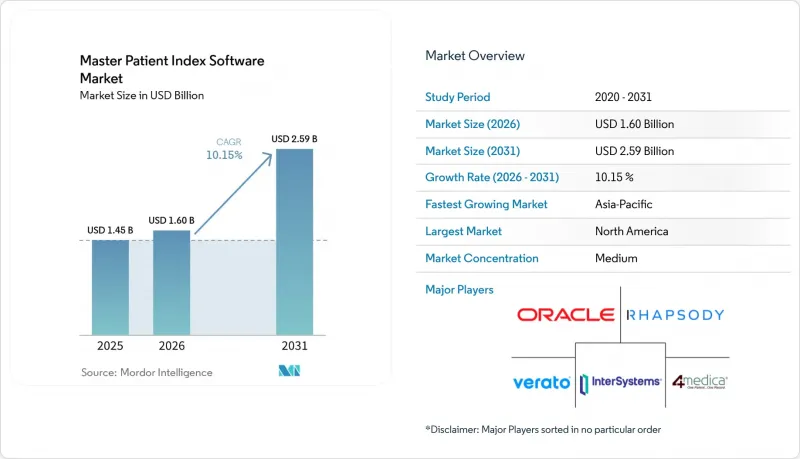
에 따르면 마스터 환자 인덱스(MPI) 소프트웨어 시장 규모는 2025년 14억 5,000만 달러에서 2026년에는 16억 달러로 확대되어 2031년까지 25억 9,000만 달러에 달할 것으로 예상되며, 2026년부터 2031년까지 CAGR 10.15%로 성장할 것으로 전망됩니다.
세계 마스터 환자 인덱스(MPI) 소프트웨어 시장의 동향 및 인사이트
전자건강기록(EHR) 및 건강정보교환 네트워크의 확대
북미에서는 2025년 이전에 EHR 도입이 성숙 단계에 도달했습니다. 현재, 이미 도입된 시스템들은 연결된 시스템 간에 환자 ID를 통합적으로 해결해야 할 필요성을 낳고 있습니다. 의료 정보 교환 네트워크와의 연결이 늘어날수록, 서로 다른 소스 시스템의 기록을 통합해야 할 필요성이 커지고 있습니다. 기록의 중복은 환자 안전상의 위험이나 행정적 부담을 초래할 수 있습니다. 2025년 'BMJ Quality & Safety' 보고서에 따르면, 중복된 의료 기록을 가진 환자는 입원 중 사망할 확률이 5배 더 높았으며, 기록이 일치하는 환자에 비해 입원 기간이 32% 더 길었던 것으로 밝혀졌습니다. 따라서 마스터 환자 인덱스(MPI) 소프트웨어 시장은 임상 정보학, 수익 주기, 엔터프라이즈 아키텍처 각 팀에 동시에 기여하고 있습니다.
상호 운용성 의무화 및 디지털 헬스 프로그램
미국의 상호운용성 요건으로 인해 환자 식별은 규정 준수와 관련된 데이터 기능이 되었습니다. ONC(미국 국립의료정보기술조정국)의 인증 프로그램에서는 인증을 받은 의료 IT가 표준화된 애플리케이션 프로그래밍 인터페이스(API)를 지원하고, 정보 차단 관행을 해결해야 한다고 요구하고 있습니다. 유럽의 ‘유럽 건강 데이터 공간 규정’(규정(EU) 2025/327)은 2025년 3월에 발효되어 국경을 초월한 의료 데이터 교환을 위한 프레임워크를 확립했습니다. 이러한 요건으로 인해 모든 의료 현장에서 신뢰할 수 있는 신원 확인 프로세스의 필요성이 높아지고 있습니다. HL7은 2025년 ‘상호 운용 가능한 디지털 ID 및 환자 대조 구현 가이드’ 버전 2.0.0을 공개했습니다. 플랫폼이 이러한 공통 교환 패턴을 지원할 것으로 기대됨에 따라 마스터 환자 인덱스(MPI) 소프트웨어 시장이 혜택을 보고 있습니다.
높은 도입 비용과 데이터 수정 비용
엔터프라이즈 MPI 도입에는 데이터 평가, 중복 제거 및 지속적인 관리가 필요합니다. 주소 형식이 일관되지 않거나, 성명 필드가 축약되어 있거나, 인구통계학적 코딩 관행이 서로 다른 의료 시스템의 경우, 이 작업은 어렵습니다. 매칭 도구가 확실하게 작동하기 위해서는 참조 데이터의 정규화가 필요한 경우가 많습니다. 중규모 의료 기관은 환자 수가 많아 신원 정보의 파편화에 직면할 가능성이 있지만, 장기적인 데이터 수정 프로그램을 수행할 예산이나 인력이 부족한 경우가 있습니다. 이러한 상황은 프로젝트 일정을 연장하고, 취약한 레거시 플랫폼의 교체를 지연시킬 가능성이 있습니다. 따라서 마스터 환자 인덱스(MPI) 소프트웨어 시장에서는 제한된 도입 역량에 맞춘 단계적 도입 및 서비스 모델을 제공해야 합니다.
부문 분석
2025년, 마스터 환자 인덱스(MPI) 소프트웨어 시장 매출 중 소프트웨어가 78.31%를 차지했습니다. 이러한 위상은 이전 전자건강기록(EHR) 프로그램에서 MPI 기능을 도입한 대규모 병원 네트워크 전반에 걸친 엔터프라이즈 소프트웨어 도입을 반영한 것입니다. 엔터프라이즈 MPI 플랫폼은 여러 의료 기관으로 구성된 의료 시스템 및 지역 간 데이터 교환을 지원합니다. 또한, 다양한 임상 소스 시스템에 걸쳐 환자 신원 정보를 일관되게 유지합니다. 로컬 MPI 소프트웨어는 여전히 단일 시설 환경에 적합합니다. 하이브리드 MPI 제품은 로컬 아키텍처와 엔터프라이즈 아키텍처 사이를 오가는 조직을 지원합니다.
서비스 부문은 2031년까지 연평균 성장률(CAGR) 12.65%로 성장할 것으로 예측됩니다. 서비스 부문의 마스터 환자 인덱스(MPI) 소프트웨어 시장 규모는 데이터 스튜어드십, 중복 기록 수정, 그리고 AI 활용을 위한 데이터세트 준비에 대한 수요에 힘입어 성장하고 있습니다. 이러한 활동은 소프트웨어의 초기 도입 후에도 지속됩니다. 일부 벤더는 중복 기록의 검증된 감축과 연계된 성과 기반 서비스 계약을 채택하고 있습니다. 이 구조를 통해 제공 위험의 일부가 구매자에서 벤더로 이전됩니다. 2025년 12월, 4medica는 ‘IdentiMatch Worklist Automation’을 발표하며, 이 제품을 통해 수동 환자 대조 작업을 최대 90%까지 줄일 수 있다고 밝혔습니다.
2025년, 마스터 환자 인덱스(MPI) 소프트웨어 시장에서 클라우드 기반 도입은 시장 점유율의 46.24%를 차지했습니다. 또한 2031년까지 연평균 성장률(CAGR) 14.42%로 성장할 것으로 예측됩니다. 이러한 상황은 클라우드 플랫폼이 신규 구매자 및 조직에 서비스를 제공하며 기존의 온프레미스형 시스템을 대체하고 있음을 보여줍니다. 클라우드 기반 제공은 로컬 인프라 유지 관리의 필요성을 줄여줍니다. 또한, 관련 조직 간의 API 기반 연결도 지원합니다. 이러한 기능은 의료 시스템이 여러 거점에 걸쳐 공통된 ID 계층을 필요로 할 때 유용합니다.
온프레미스 배포는 대학 부속 병원, 정부 기관 및 엄격한 데이터 거주지 규제의 적용을 받는 조직에게 여전히 중요한 선택지입니다. 이러한 사용자들은 보안 및 국가의 의료 데이터 요건을 평가하는 동안 클라우드로의 전환을 연기할 가능성이 있습니다. 하이브리드 아키텍처를 통해 중앙 집중식 대조 로직을 구현하면서도 각 조직이 일부 데이터 저장소를 자체적으로 관리할 수 있습니다. 이러한 접근 방식은 유럽 의료 현장 간의 안전한 데이터 교환을 지원합니다. 마스터 환자 인덱스(MPI) 소프트웨어 시장에서도 클라우드 도입이 진행되고 있습니다. 이는 의료 서비스 제공자가 커넥티드 헬스 애플리케이션을 위해 접근 가능한 데이터 기반이 필요하기 때문입니다. 도입 방식의 선택은 각 조직의 보안 체계, 통합 요구 사항 및 현지 거버넌스 규정에 따라 달라집니다.
지역별 분석
2025년, 북미는 마스터 환자 인덱스(MPI) 소프트웨어 시장 매출의 46.61%를 차지했습니다. 이 지역에는 인증된 전자건강기록(EHR) 시스템의 도입 기반이 널리 보급되어 있으며, 거점 간 환자 대조가 필요한 활발한 의료 제공자 네트워크가 존재합니다. 미국에서는 전국적인 의료 데이터 교환을 지원하기 위해 TEFCA 및 관련 상호 운용성 이니셔티브에 의존하고 있습니다. 참여자 간에 기록을 확실하게 교환하기 위해서는 정확한 환자 신원 확인이 필수적입니다. 캐나다에서는 주 차원의 디지털 헬스 프로그램이 추진되고 있는 반면, 멕시코에서는 MPI 보급률이 낮은 편이지만 국경을 넘는 데이터 교환 기능에 대한 수요가 증가하고 있습니다.
유럽에서는 2026년 규정의 시행이 활발히 진행되고 있습니다. 규정(EU) 2025/327에 따라 유럽연합(EU) 전역에 걸친 ‘유럽 건강 데이터 공간(EHDS)’의 틀이 구축되었습니다. 프랑스는 국가 디지털 헬스 기관을 통해 ‘MyHealth&EU’ 시행 자료를 발행하고 있습니다. 독일은 전자 환자 기록 관련 노력을 상호 운용성 및 사이버 보안 요건과 조화시키고 있습니다. 영국은 EHDS(유럽 헬스 데이터 스페이스) 프레임워크와는 별도로 독자적인 환자 ID 및 디지털 헬스 프로그램을 추진하고 있습니다. 중동 및 아프리카는 여전히 초기 단계의 시장이며, 각국의 디지털 헬스 프로그램이 향후 통합된 ID 인프라에 대한 수요를 창출할 가능성이 있습니다.
아시아태평양은 2031년까지 연평균 성장률(CAGR) 13.25%를 기록하며 가장 빠르게 성장하는 지역이 될 것으로 예측됩니다. 각국의 디지털 헬스 프로그램, 병원 네트워크의 확대, 그리고 AI에 초점을 맞춘 헬스 이니셔티브가 이러한 전망을 뒷받침하고 있습니다. 인도는 디지털 헬스 생태계와 의료 기록 교환 체계를 제공하기 위해 ‘아유슈만 바라트 디지털 미션’을 수립했습니다. 중국은 의료 기관 간 일관된 신원 확인을 가능하게 하는 환자 ID 관리 기준을 도입했습니다. 호주는 국가 디지털 헬스 인프라 현대화를 위한 노력을 지속하고 있습니다. 이러한 동향은 민간 사업자가 국가 정보 교환 시스템에 연결해야 하는 ‘마스터 환자 인덱스(MPI) 소프트웨어 시장’에 새로운 기회를 가져오고 있습니다.
기타 혜택:
- 엑셀 형식의 시장 예측(ME) 시트
- 3개월간의 애널리스트 지원
자주 묻는 질문
목차
제1장 소개
- 조사 가정과 시장 정의
- 조사 범위
제2장 조사 방법
제3장 주요 요약
제4장 시장 구도
- 시장 개요
- 시장 성장 촉진요인
- 시장 성장 억제요인
- 밸류체인 분석
- 규제 상황
- 기술 전망
- Porter's Five Forces 분석
제5장 시장 규모와 성장 예측
- 구성요소별
- 전개별
- 용도별
- 최종사용자별
- 지역별
- 북미
- 미국
- 캐나다
- 멕시코
- 유럽
- 독일
- 영국
- 프랑스
- 이탈리아
- 스페인
- 기타 유럽 국가
- 아시아태평양
- 중국
- 일본
- 인도
- 호주
- 한국
- 기타 아시아태평양 국가
- 중동 및 아프리카
- GCC
- 남아프리카공화국
- 기타 중동 및 아프리카 국가
- 남미
- 브라질
- 아르헨티나
- 기타 남미 국가
- 북미
제6장 경쟁 구도
- 시장 집중도
- 시장 점유율 분석
- 기업 개요
- 4medica, Inc.
- CareEvolution, Inc.
- eClinicalWorks LLC
- Epic Systems Corporation
- Health Catalyst, Inc.
- Infor, Inc.
- InterSystems Corporation
- Just Associates, Inc.
- McKesson Corporation
- MEDITECH
- Merative
- OpenEMPI
- Oracle Corporation
- QuadraMed Affinity Corporation
- Reltio, Inc.
- Rhapsody Health
- Veradigm Inc.
- Verato, Inc.
- VisionWare Limited
제7장 시장 기회와 향후 전망
KSM 26.10.30According to Mordor Intelligence, the master patient index software market size is expected to increase from USD 1.45 billion in 2025 to USD 1.60 billion in 2026 and reach USD 2.59 billion by 2031, growing at a CAGR of 10.15% over 2026-2031.
Global Master Patient Index Software Market Trends and Insights
Expansion of EHR and Health Information Exchange Networks
EHR adoption had reached a mature level in North America before 2025. The installed base now creates demand for shared patient identity resolution across connected systems. Each connection to a health information exchange increases the need to resolve records from different source systems. Duplicate records can create patient-safety risks as well as administrative burden. A 2025 BMJ Quality & Safety report found that patients with duplicate medical records were 5 times more likely to die during an inpatient admission and had hospital stays that were 32% longer than matched patients. The Master Patient Index Software Market, therefore, serves clinical informatics, revenue cycle, and enterprise architecture teams at the same time.
Interoperability Mandates and Digital Health Programs
United States interoperability requirements have made patient matching a compliance-linked data capability. The ONC certification program requires certified health IT to support standardized application programming interfaces and address information-blocking practices. The European Health Data Space Regulation, Regulation (EU) 2025/327, entered into force in March 2025 and established a framework for cross-border health data exchange. These requirements increase the need for reliable identity processes across care settings. HL7 published version 2.0.0 of its Interoperable Digital Identity and Patient Matching Implementation Guide in 2025. The Master Patient Index Software Market benefits as platforms are expected to support these common exchange patterns.
High Implementation and Data Remediation Costs
Enterprise MPI deployment requires data assessment, deduplication, and ongoing stewardship. The work is difficult for health systems that have inconsistent address formats, shortened name fields, or different demographic coding practices. Reference data often needs normalization before matching tools can work reliably. Mid-sized providers may have enough patient volume to experience identity fragmentation but lack the budget or staffing for a long remediation program. These conditions can extend project timelines and delay the replacement of weak legacy platforms. The Master Patient Index Software Market must therefore offer phased deployment and service models that fit constrained implementation capacity.
Other drivers and restraints analyzed in the detailed report include:
- Value-Based Care and Longitudinal Patient Data Requirements
- Healthcare Mergers, Acquisitions, and Network Consolidation
- Patient Privacy, Cybersecurity, and Regulatory Exposure
For complete list of drivers and restraints, kindly check the Table Of Contents.
Segment Analysis
Software held 78.31% of the Master Patient Index Software Market revenue in 2025. Its position reflects enterprise software deployments across large hospital networks that adopted MPI capabilities during earlier EHR programs. Enterprise MPI platforms support multi-entity health systems and regional exchanges. They maintain patient identity across many clinical source systems. Local MPI software remains suitable for single-facility environments. Hybrid MPI products support organizations moving between local and enterprise architectures.
Services are projected to grow at a 12.65% CAGR through 2031. The Master Patient Index Software Market size for Services is supported by demand for data stewardship, duplicate remediation, and preparation of datasets for AI use. These activities continue after the initial software implementation. Some vendors are using outcome-linked service contracts tied to verified reductions in duplicate records. This structure shifts part of the delivery risk from the buyer to the vendor. In December 2025, 4medica introduced IdentiMatch Worklist Automation, and the company stated that the product could reduce manual patient matching tasks by up to 90%.
Cloud-based deployment accounted for 46.24% of the Master Patient Index Software Market share in 2025. It is also projected to grow at a 14.42% CAGR through 2031. This position shows that cloud platforms are serving new buyers and organizations, replacing older on-premises systems. Cloud delivery reduces the need for local infrastructure maintenance. It also supports API-based connections across affiliated entities. These capabilities are useful where health systems need a shared identity layer across multiple sites.
On-premises deployment remains relevant for academic medical centers, government agencies, and organizations subject to strict data-residency rules. These users may delay cloud migration while they assess security and national health data requirements. Hybrid architectures allow centralized matching logic while local organizations keep some data stores under their own control. This approach can support secure data exchange across European care settings. The Master Patient Index Software Market industry also sees cloud adoption, where providers need an accessible data foundation for connected health applications. The deployment choice remains linked to the security posture, integration needs, and local governance rules of each organization.
Complete Report Scope:
- By Component
- Software
- Enterprise Master Patient Index Software
- Local Master Patient Index Software
- Hybrid MPI Software
- Services
- Software
- By Deployment
- Cloud-Based
- On-Premises
- Hybrid Deployment
- By Application
- Patient Data Management
- Identity Management and Record Linkage
- Data Integration and Interoperability
- Patient Demographics Management
- Health Information Exchange
- Population Health and Care Coordination
- Other Applications
- By End User
- Hospitals and Integrated Delivery Networks
- Clinics and Ambulatory Care Centers
- Healthcare Payers
- Government and Public Health Agencies
- Other End Users
- By Geography
- North America
- United States
- Canada
- Mexico
- Europe
- Germany
- United Kingdom
- France
- Italy
- Spain
- Rest of Europe
- Asia-Pacific
- China
- Japan
- India
- Australia
- South Korea
- Rest of Asia-Pacific
- Middle East and Africa
- GCC
- South Africa
- Rest of Middle East and Africa
- South America
- Brazil
- Argentina
- Rest of South America
- North America
Geography Analysis
North America accounted for 46.61% of Master Patient Index Software Market revenue in 2025. The region has a large installed base of certified EHR systems and active provider networks that require patient matching across sites. The United States relies on TEFCA and related interoperability work to support nationwide health data exchange. Accurate patient identity is necessary before records can move reliably between participants. Canada is advancing provincial digital health programs, while Mexico has lower MPI penetration and a growing need for cross-border exchange capabilities.
Europe is in an active regulatory implementation phase in 2026. Regulation (EU) 2025/327 created the European Health Data Space framework across the European Union. France has issued MyHealth@EU implementation material through its national digital health agency. Germany is aligning its electronic patient record work with interoperability and cybersecurity requirements. The United Kingdom is pursuing its own patient identity and digital health programs outside the EHDS framework. The Middle East and Africa remain earlier-stage opportunities where national digital health programs can create future demand for unified identity infrastructure.
Asia-Pacific is projected to be the fastest-growing region at a 13.25% CAGR through 2031. National digital health programs, hospital network expansion, and AI-focused health initiatives support this outlook. India has developed the Ayushman Bharat Digital Mission to provide a digital health ecosystem and health records exchange framework. China has introduced patient identity management standards that support consistent verification across medical institutions. Australia is continuing work to modernize its national digital health infrastructure. These developments create opportunities for the Master Patient Index Software Market where private providers need to connect to national exchange systems.
- 4medica, Inc.
- CareEvolution, Inc.
- eClinicalWorks LLC
- Epic Systems
- Health Catalyst, Inc.
- Infor, Inc.
- Intersystems
- Just Associates, Inc.
- Mckesson
- Meditech
- Merative
- OpenEMPI
- Oracle
- QuadraMed Affinity Corporation
- Reltio, Inc.
- Rhapsody Health
- Veradigm Inc.
- Verato, Inc.
- VisionWare Limited
Additional Benefits:
- The market estimate (ME) sheet in Excel format
- 3 months of analyst support
TABLE OF CONTENTS
1 Introduction
- 1.1 Study Assumptions and Market Definition
- 1.2 Scope of the Study
2 Research Methodology
3 Executive Summary
4 Market Landscape
- 4.1 Market Overview
- 4.2 Market Drivers
- 4.2.1 Expansion of EHR and Health Information Exchange Networks
- 4.2.2 Interoperability Mandates and Digital Health Programs
- 4.2.3 Value-Based Care and Longitudinal Patient Data Requirements
- 4.2.4 Healthcare Mergers, Acquisitions and Network Consolidation
- 4.2.5 FHIR-Based Patient Matching and API Adoption
- 4.2.6 Demand for AI-Ready, Trusted Healthcare Data
- 4.3 Market Restraints
- 4.3.1 High Implementation and Data Remediation Costs
- 4.3.2 Patient Privacy, Cybersecurity and Regulatory Exposure
- 4.3.3 False-Positive Matching and Patient Safety Liability
- 4.3.4 Cross-Jurisdiction Identity Governance and Reference-Data Dependency
- 4.4 Value Chain Analysis
- 4.5 Regulatory Landscape
- 4.6 Technological Outlook
- 4.7 Porter's Five Forces Analysis
- 4.7.1 Bargaining Power of Suppliers
- 4.7.2 Bargaining Power of Buyers
- 4.7.3 Threat of New Entrants
- 4.7.4 Threat of Substitutes
- 4.7.5 Competitive Rivalry
5 Market Size & Growth Forecasts (Value, USD)
- 5.1 By Component
- 5.1.1 Software
- 5.1.1.1 Enterprise Master Patient Index Software
- 5.1.1.2 Local Master Patient Index Software
- 5.1.1.3 Hybrid MPI Software
- 5.1.2 Services
- 5.1.1 Software
- 5.2 By Deployment
- 5.2.1 Cloud-Based
- 5.2.2 On-Premises
- 5.2.3 Hybrid Deployment
- 5.3 By Application
- 5.3.1 Patient Data Management
- 5.3.2 Identity Management and Record Linkage
- 5.3.3 Data Integration and Interoperability
- 5.3.4 Patient Demographics Management
- 5.3.5 Health Information Exchange
- 5.3.6 Population Health and Care Coordination
- 5.3.7 Other Applications
- 5.4 By End User
- 5.4.1 Hospitals and Integrated Delivery Networks
- 5.4.2 Clinics and Ambulatory Care Centers
- 5.4.3 Healthcare Payers
- 5.4.4 Government and Public Health Agencies
- 5.4.5 Other End Users
- 5.5 By Geography
- 5.5.1 North America
- 5.5.1.1 United States
- 5.5.1.2 Canada
- 5.5.1.3 Mexico
- 5.5.2 Europe
- 5.5.2.1 Germany
- 5.5.2.2 United Kingdom
- 5.5.2.3 France
- 5.5.2.4 Italy
- 5.5.2.5 Spain
- 5.5.2.6 Rest of Europe
- 5.5.3 Asia-Pacific
- 5.5.3.1 China
- 5.5.3.2 Japan
- 5.5.3.3 India
- 5.5.3.4 Australia
- 5.5.3.5 South Korea
- 5.5.3.6 Rest of Asia-Pacific
- 5.5.4 Middle East and Africa
- 5.5.4.1 GCC
- 5.5.4.2 South Africa
- 5.5.4.3 Rest of Middle East and Africa
- 5.5.5 South America
- 5.5.5.1 Brazil
- 5.5.5.2 Argentina
- 5.5.5.3 Rest of South America
- 5.5.1 North America
6 Competitive Landscape
- 6.1 Market Concentration
- 6.2 Market Share Analysis
- 6.3 Company Profiles (includes Global Level Overview, Market Level Overview, Core Segments, Financials as available, Strategic Information, Market Rank/Share, Products and Services, Recent Developments)
- 6.3.1 4medica, Inc.
- 6.3.2 CareEvolution, Inc.
- 6.3.3 eClinicalWorks LLC
- 6.3.4 Epic Systems Corporation
- 6.3.5 Health Catalyst, Inc.
- 6.3.6 Infor, Inc.
- 6.3.7 InterSystems Corporation
- 6.3.8 Just Associates, Inc.
- 6.3.9 McKesson Corporation
- 6.3.10 MEDITECH
- 6.3.11 Merative
- 6.3.12 OpenEMPI
- 6.3.13 Oracle Corporation
- 6.3.14 QuadraMed Affinity Corporation
- 6.3.15 Reltio, Inc.
- 6.3.16 Rhapsody Health
- 6.3.17 Veradigm Inc.
- 6.3.18 Verato, Inc.
- 6.3.19 VisionWare Limited
7 Market Opportunities and Future Outlook
- 7.1 White-Space and Unmet-Need Assessment


