
|
시장보고서
상품코드
2117606
개인화 엔진 소프트웨어 시장 : 점유율 분석, 업계 동향과 통계, 성장 예측(2026-2031년)Personalization Engine Software - Market Share Analysis, Industry Trends & Statistics, Growth Forecasts (2026 - 2031) |
||||||
 Mordor Intelligence
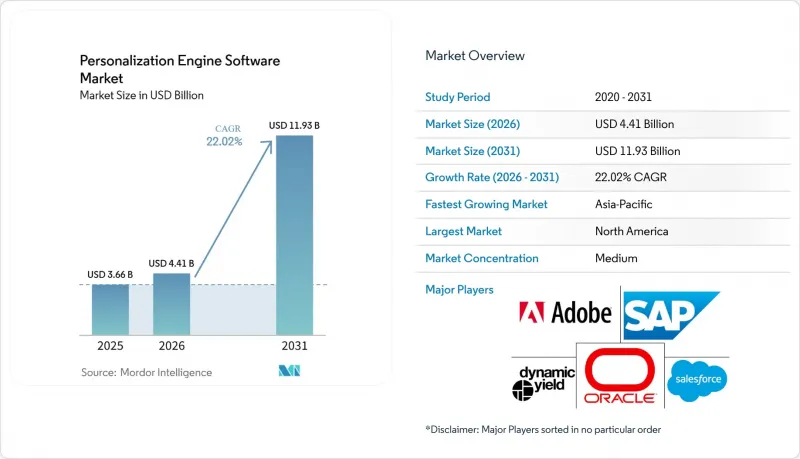
Mordor Intelligence에 의하면, 개인화 엔진 소프트웨어 시장 규모는 2025년에 36억 6,000만 달러로 평가되었고 2026년 44억 1,000만 달러에서 2031년까지 119억 3,000만 달러에 이를 것으로 추정되고 있어 2026년부터 2031년까지의 예측 기간에서 CAGR은 22.02%를 나타낼 전망입니다.
본 보고서는 구성 요소(플랫폼 및 서비스), 도입 형태(클라우드, On-Premise, 하이브리드),기업 규모(대기업 및 중소기업), 용도(웹사이트 개인화, 모바일 앱 개인화 등), 최종 사용자(IT 및 통신, 소매 및 전자상거래 등), 지역별로 분류되어 있습니다. 시장 예측은 금액(미 달러) 기준으로 제시되어 있습니다.
세계 개인화 엔진 소프트웨어 시장 동향 및 인사이트
실시간 맞춤형 고객 경험에 대한 수요 증가
실시간 의사 결정은 과거 활동이 아닌 현재의 고객 행동에 대응해야 하는 조직에게 중요한 요건이 되고 있습니다. 개인화 엔진 소프트웨어 시장은 플랫폼이 고객과의 상호작용 과정에서 실시간 데이터, 인공지능 및 인간 주도형 비즈니스 규칙을 결합할 수 있을 때 혜택을 받습니다. 스트리밍 시스템은 입찰을 위한 100밀리초 미만의 의사 결정부터 푸시 알림이나 캠페인 트리거와 같은 더 긴 응답 시간에 이르기까지 다양한 응답 창을 지원할 수 있습니다. 배치 처리 기반 프로세스의 경우, 마지막 데이터 업데이트 이후 고객의 상황이 변경된 경우 관련성이 없는 추천이 생성될 가능성이 있습니다. 이 문제는 열람, 구매, 서비스 상호작용이 빈번하게 이루어지는 상거래 환경에서 특히 두드러집니다. 따라서 실시간 이벤트 처리를 지원하는 제공업체는 보다 신속한 고객 참여를 추구하는 조직의 명확한 업무적 요구를 충족시킬 수 있습니다.
AI를 활용한 추천 엔진의 급속한 보급
AI를 활용한 추천 도구는 단순한 상품 제안의 범위를 넘어, 컨텐츠, 타이밍, 채널, 고객 대응에 관한 의사결정을 지원하기 위해 점점 더 많이 활용되고 있습니다. 그 결과, 개인화 엔진 소프트웨어 시장은 라이프사이클 참여, 고객 이탈 방지, 교차 판매 및 ‘차선책(NBA)’ 프로세스를 지원할 수 있는 시스템으로 전환되고 있습니다. 이러한 추세로 인해 도입, 모델 거버넌스, 통합 및 맞춤화 서비스의 중요성이 높아지고 있습니다. 많은 조직이 플랫폼의 초기 도입 후에도 지속적인 지원이 필요하기 때문에 서비스 시장은 2026년부터 2031년까지 연평균 성장률(CAGR) 25.83%로 확대될 것으로 예측됩니다. 조직이 충분한 데이터 품질, 승인된 컨텐츠 및 거버넌스 관리 체계를 갖추고 있다면, 자율적인 의사결정을 통해 고정된 여정 템플릿에 대한 의존도를 낮출 수 있습니다. 그 결과 얻어지는 가치는 조직이 성과를 지속적으로 평가하고, 그 인사이트력을 후속 상호작용에 반영할 수 있는지 여부에 달려 있습니다.
고객 접점에서의 데이터 단편화
데이터의 파편화는 모델이 고객에 대한 불완전한 정보만 수신하게 되어 개인화의 효과를 제한합니다. 데이터 소스 간의 연동이 불충분하면 프로파일 중복, 동의 기록의 불일치, 채널 간 고객 상호작용의 모순이 발생할 수 있습니다. 개인화 엔진 소프트웨어 시장은 데이터 웨어하우스, 고객 데이터 플랫폼, 고객 관계 관리(CRM) 시스템 및 상거래 용도과의 연결성을 향상시킴으로써 이러한 제약을 해결해야 합니다. Databricks는 2026년 6월, Databricks Lakehouse에 내장된 에이전트형 고객 데이터 플랫폼 ‘CustomerLake’를 발표했습니다. 이는 데이터 마이그레이션 없이 고객 데이터, ID 해결, 세분화 및 개인화를 통합한 솔루션입니다. 또한 Insider One도 2026년 6월 Snowflake용 ‘Zero Copy Segmentation’을 발표하여, 브랜드가 거버넌스가 적용된 Snowflake 데이터 환경에서 직접 타겟 고객층을 구축하고 활성화할 수 있도록 했습니다. 이러한 접근 방식은 서로 연결되지 않은 플랫폼 간에 추가 복사본을 생성하는 대신, 거버넌스가 적용된 데이터를 직접 사용하는 아키텍처에 대한 수요를 반영하고 있습니다.
부문 분석
2025년, 개인화 엔진 소프트웨어 시장에서 플랫폼 소프트웨어가 72.41%의 점유율을 차지했습니다. 이는 데이터 수집, 오디언스 생성, 실험, 의사 결정, 컨텐츠 전달을 통합한 환경에 대한 기업 수요를 반영한 것입니다. 통합 플랫폼을 활용하면 고객 참여를 위해 여러 개의 고립된 포인트 제품을 사용할 때 발생하는 동기화 지연을 줄일 수 있습니다. 데이터 마이그레이션에 일관성이 없으면 실시간 의사 결정이 약화되므로, 기업들은 공통의 오케스트레이션 계층을 점점 더 요구하고 있습니다. 플랫폼 도입은 조율된 일련의 워크플로우를 통해 끊임없이 늘어나는 고객 채널을 관리해야 할 필요성도 반영하고 있습니다. 플랫폼에 대한 수요가 집중된다고 해서 전문적인 도입 지원의 필요성이 사라지는 것은 아닙니다. 오히려 도입에는 사내 시스템, 데이터 소스, 비즈니스 프로세스 간의 연동이 필요하기 때문에 도입의 품질이 더욱 중요해집니다.
조직이 도입, 데이터 통합, 워크플로우 설계, 모델 거버넌스 및 지속적인 최적화에 대한 지원을 요구함에 따라, 서비스 시장은 2026년부터 2031년까지 연평균 성장률(CAGR) 25.83%로 확대될 것으로 예측됩니다. 개인화 엔진 소프트웨어 시장의 서비스 규모는 기술을 고객 데이터 처리 관행 및 승인된 참여 정책과 조화시키는 실무상의 복잡성에 의해 뒷받침되고 있습니다. 전문 서비스 팀과 공인 파트너 네트워크는 공급업체가 소프트웨어 판매 후에도 장기적인 고객 관계를 유지하는 데 도움이 됩니다. 또한, 공급업체가 고객의 데이터 및 참여 업무에 깊이 관여하게 되면 이러한 관계는 전환 비용을 높이는 요인이 될 수도 있습니다. 조직들이 AI 시스템 관리에 대한 문서화를 점점 더 요구함에 따라 거버넌스 요건도 새로운 고려 사항이 되고 있습니다. 따라서 강력한 도입 역량을 갖춘 공급업체는 소프트웨어 기능뿐만 아니라 운영 지원 측면에서도 경쟁력을 발휘할 수 있습니다.
클라우드 배포는 모델 훈련, 실시간 추론, 이벤트 처리, 컨텐츠 전달을 위한 확장 가능한 컴퓨팅 리소스를 제공하므로, 2025년에는 시장의 68.19%를 차지했습니다. 실시간 개인화를 실현하려면 신속한 응답 시간을 유지하면서 대량의 고객 활동을 처리해야 할 수도 있습니다. 클라우드 환경이라면 각 기업이 대규모 사내 인프라를 구축·운영할 필요 없이 이러한 워크로드를 처리할 수 있습니다. 또한 이 모델을 통해 조직은 소프트웨어 업데이트나 관리형 서비스를 통해 새로운 기능을 도입하기가 더 쉬워집니다. 클라우드를 통한 제공은 여러 채널에서 사업을 전개하고, 공유된 고객 데이터에 대한 일관된 접근이 필요한 기업에게 특히 중요합니다. 이러한 이점 덕분에 클라우드 배포는 개인화 엔진 소프트웨어 시장에서 주류 배포 형태로 자리 잡았습니다.
조직이 클라우드의 확장성과 데이터 저장 위치 및 보안 의무 간의 균형을 맞추어 감에 따라, 하이브리드 도입은 2026년부터 2031년까지 연평균 성장률(CAGR) 24.43%를 나타낼 것으로 예측됩니다. AWS는 유럽 내 주권 및 규정 준수 요구 사항을 가진 고객을 지원하기 위해 2026년 1월 ‘European Sovereign Cloud’를 출시했습니다. 금융 서비스, 의료, 정부 기관 및 기타 규제 대상 사용자는 기밀성이 높은 신원 데이터를 사설 환경 또는 관리형 환경 내에 보관할 수 있습니다. 또한 기밀성이 낮은 처리, 집계 데이터, 모델 훈련 또는 컨텐츠 배포에는 클라우드 리소스를 활용할 수 있습니다. 이러한 분할형 아키텍처는 모든 고객 데이터를 퍼블릭 클라우드 환경으로 이전할 수 없는 조직을 지원합니다. 하이브리드 시스템은 서로 다른 환경에 걸쳐 신원 확인, 동의 관리 및 이벤트 처리를 지원할 수 있는 벤더에게 중요한 차별화 요소가 될 수 있습니다.
지역별 분석
북미는 2025년 개인화 엔진 소프트웨어 시장 점유율의 36.42%를 차지했습니다. 이는 해당 지역에 클라우드 제공업체, 엔터프라이즈용 기술 구매자, 디지털 상거래 사업자 및 고객 데이터 인프라가 대거 존재하기 때문입니다. 미국은 많은 대기업이 성숙한 고객 관계 관리(CRM), 분석, 마케팅 자동화 및 상거래 시스템을 보유하고 있기 때문에 여전히 주요 수요 시장으로 남아 있습니다. 클라우드 인프라의 밀도가 높아 빈번한 모델 훈련 및 고객 이벤트의 실시간 처리가 가능합니다. 또한, 이 지역의 기업들은 고객 참여도를 높이기 위해 에이전트형 인공지능(AI) 도구를 적극적으로 도입하고 있습니다. 어도비, 세일즈포스, 옵티마이즈리, 블레이즈 등공급업체들은 기업 고객을 대상으로 AI를 활용한 오케스트레이션 기능을 지속적으로 개발하고 있습니다. 캐나다에서는 ‘동의 우선’ 접근 방식에 대한 수요가 증가하고 있으며, 멕시코에서는 클라우드 네이티브 플랫폼을 활용하는 대형 소매 기업 및 금융 서비스 기업들 사이에서 도입이 확대되고 있습니다.
유럽은 소비자의 디지털 참여도가 높고, 조직이 엄격한 개인정보 보호 및 거버넌스 요건을 충족하는 도구를 점점 더 필요로 하고 있어, 개인화 엔진 소프트웨어 시장에서 주요 지역으로 부상하고 있습니다. 유럽 데이터 보호 위원회(EDPB)의 ‘익명화에 관한 지침 02/2026’은 조직이 행동 이벤트 데이터를 평가하는 방식과 익명화 관행에 영향을 미치고 있습니다. 독일, 영국, 프랑스는 디지털 상거래 활동이 성숙해 있으며, 충분한 자원을 갖춘 엔터프라이즈 기술 팀을 보유한 주요 국내 시장으로 자리매김하고 있습니다. EU의 AI법은 자동화된 고객 프로파일링 및 의사결정이 수반되는 이용 사례에 대해 공급업체가 어떻게 대비해야 하는지에 영향을 미치고 있습니다. 공급업체들은 이에 대응하여 설명 가능성 기능, 감사 기록, 동의 절차 및 모니터링 옵션 개발을 추진하고 있습니다. 남미는 소규모 기반에서 확장하고 있으며, 브라질의 전자상거래 생태계가 소매, 금융 서비스, 디지털 미디어에 걸친 수요를 뒷받침하고 있습니다. 아르헨티나를 비롯한 남미 국가들도 대규모 현지 기술 인프라의 필요성을 줄여주는 클라우드 기반 시스템을 도입하고 있습니다.
아시아태평양은 2026년부터 2031년까지 연평균 성장률(CAGR) 25.18%를 나타낼 것으로 예측되며, 가장 빠르게 성장하는 지역 부문이 될 전망입니다. 인도의 전자상거래 및 핀테크 부문에서는 고객 유치, 상품 탐색, 고객 지원, 참여 프로그램 등 각 분야에서 개인화 플랫폼이 도입되고 있습니다. ‘인도 스택(India Stack)’은 관련 상업 및 금융 접점 전반에 걸쳐 동의에 기반한 데이터 공유를 지원하는 디지털 ID 인프라를 제공합니다. 한국과 일본은 커넥티드 커머스 및 기기 생태계가 고도로 발달해 있어, 기기 간을 아우르는 지속 가능한 ID 솔루션에 대한 필요성이 높아지고 있습니다. 동남아시아에서는 지역에 따라 언어, 문화, 구매 행동이 크게 다르기 때문에 현지화에 대응한 모델이 요구되고 있습니다. 중국의 플랫폼 사업자들은 매일 방대한 사용자 기반에 서비스를 제공하는 슈퍼앱 생태계에 추천 기능을 통합하고 있습니다. 중동 및 아프리카는 아직 도입 초기 단계에 있습니다. 사우디아라비아와 아랍에미리트에서는 국가 차원의 디지털 전환 우선순위를 통해 수요를 뒷받침하고 있는 반면, 남아프리카공화국과 나이지리아에서는 주로 모바일 커머스 및 금융 포용 용도에서 개인화가 활용되고 있습니다.
기타 혜택:
- 엑셀 형식 시장 예측(ME) 시트
- 3개월간의 애널리스트 지원
자주 묻는 질문
목차
제1장 서론
제2장 조사 방법
제3장 개요
제4장 시장 구도
제5장 시장 규모와 성장 예측
제6장 경쟁 구도
제7장 시장 기회와 향후 전망
JHS 26.09.01According to Mordor Intelligence, the personalization engine software market size was valued at USD 3.66 billion in 2025 and estimated to grow from USD 4.41 billion in 2026 to reach USD 11.93 billion by 2031, at a CAGR of 22.02% during the forecast period from 2026 to 2031.
This report is Segmented by Component (Platform, and Services), Deployment Mode (Cloud, On-Premise, and Hybrid), Enterprise Size (Large Enterprises, and Small and Medium Enterprises), Application (Website Personalization, Mobile App Personalization, and More), End User (IT and Telecom, Retail and E-Commerce, and More), and Geography. The Market Forecasts are Provided in Terms of Value (USD).
Global Personalization Engine Software Market Trends and Insights
Rising Demand for Real-Time Personalized Customer Experiences
Real-time decisioning has become an important requirement for organizations that need to respond to current customer behavior rather than past activity. The Personalization Engine Software Market benefits when platforms can combine live data, artificial intelligence, and human-led business rules during a customer interaction. Streaming systems can support different response windows, ranging from sub-100 millisecond decisions for bidding to longer response times for push notifications and campaign triggers. Batch-based processes can produce irrelevant recommendations when a customer's circumstances have changed since the prior data refresh. This issue is particularly material in commerce settings where browsing, purchasing, and service interactions occur frequently. Providers that support live event processing can therefore address a clear operational need for organizations seeking more responsive customer engagement.
Rapid Adoption of AI-Powered Recommendation Engines
AI-powered recommendation tools are moving beyond product suggestions and are increasingly being used to support decisions on content, timing, channel, and customer treatment. The Personalization Engine Software Market is therefore moving toward systems that can support lifecycle engagement, churn prevention, cross-selling, and next-best-action processes. This development increases the importance of implementation, model governance, integration, and customization services. Services are projected to expand at a CAGR of 25.83% from 2026 to 2031, as many organizations require ongoing support after initial platform deployment. Autonomous decisioning can reduce dependence on fixed journey templates when organizations have sufficient data quality, approved content, and governance controls. The resulting value depends on whether the organization can continuously evaluate outcomes and apply those learnings to subsequent interactions.
Data Fragmentation Across Customer Touchpoints
Data fragmentation limits the effectiveness of personalization because the model receives an incomplete view of the customer. Disconnected data sources can create duplicate profiles, inconsistent consent records, and conflicting customer interactions across channels. The Personalization Engine Software Market must address this constraint through better connectivity with data warehouses, customer data platforms, customer relationship management systems, and commerce applications. Databricks introduced CustomerLake in June 2026 as an agentic customer data platform embedded within the Databricks Lakehouse, combining customer data, identity resolution, segmentation, and personalization without requiring data movement. Insider One also introduced Zero Copy Segmentation for Snowflake in June 2026, enabling brands to build and activate audiences directly from governed Snowflake data environments. These approaches reflect demand for architectures that use governed data directly instead of generating additional copies across disconnected platforms.
Other drivers and restraints analyzed in the detailed report include:
- Expansion of First-Party Data Activation
- Omnichannel Commerce and Cross-Device Identity Resolution
- Regulatory Constraints on Profiling and Consent
For complete list of drivers and restraints, kindly check the Table Of Contents.
Segment Analysis
Platform software held 72.41% of the Personalization Engine Software Market share in 2025, reflecting enterprise demand for integrated environments that combine data ingestion, audience creation, experimentation, decisioning, and content delivery. A unified platform can reduce the synchronization delays that arise when multiple disconnected point products are used for customer engagement. Enterprises are increasingly seeking a common orchestration layer because inconsistent data movement can weaken real-time decisions. Platform adoption also reflects the need to manage a growing number of customer channels from a coordinated set of workflows. The concentration of platform demand does not remove the need for specialized implementation support. It instead makes implementation quality more important because deployment requires connections across internal systems, data sources, and business processes.
Services are projected to grow at a CAGR of 25.83% from 2026 to 2031 as organizations seek support for implementation, data integration, workflow design, model governance, and ongoing optimization. The Personalization Engine Software Market size for services is supported by the practical complexity of aligning technology with customer data practices and approved engagement policies. Professional services teams and certified partner networks can help providers maintain longer customer relationships after the original software sale. These relationships may also raise switching costs when the provider becomes embedded in the customer's data and engagement operations. Governance requirements are adding another consideration, as organizations increasingly expect documentation for AI system management. Providers with strong implementation capabilities can therefore compete on operational support as well as software functionality.
Cloud deployment held 68.19% of the market in 2025 because it provides scalable computing resources for model training, live inference, event processing, and content delivery. Real-time personalization can require organizations to process high volumes of customer activity while maintaining rapid response times. Cloud environments support this workload without requiring every customer to build and operate large internal infrastructure estates. The model also helps organizations introduce new features through software updates and managed services. Cloud delivery is particularly relevant for companies that operate in several channels and need consistent access to shared customer data. These benefits have made cloud deployment the dominant deployment mode in the Personalization Engine Software Market.
Hybrid deployment is projected to grow at a CAGR of 24.43% from 2026 to 2031 as organizations balance cloud scalability with data residency and security obligations. AWS launched its European Sovereign Cloud in January 2026 to support customers with sovereignty and compliance needs in Europe. Financial services, healthcare, government, and other regulated users may retain sensitive identity data within private or controlled environments. They can then use cloud resources for less sensitive processing, aggregated data, model training, or content delivery. This split architecture supports organizations that cannot move all customer data to a public cloud environment. Hybrid systems may become a meaningful differentiator for vendors that can support identity resolution, consent controls, and event processing across separate environments.
Complete Report Scope:
- By Component
- Platform
- Services
- By Deployment Mode
- Cloud
- On-Premise
- Hybrid
- By Enterprise Size
- Large Enterprises
- Small and Medium Enterprises
- By Application
- Website Personalization
- Mobile App Personalization
- Email and Campaign Personalization
- Personalized Search and Recommendations
- Omnichannel Customer Journey Orchestration
- By End-User
- IT and Telecommunication
- BFSI
- Healthcare and Life Sciences
- Retail and E-Commerce
- Education and Research Institutions
- Media and Entertainment
- Government and Administration
- Other End-User Industries
- By Geography
- North America
- United States
- Canada
- Mexico
- South America
- Brazil
- Argentina
- Rest of South America
- Europe
- Germany
- United Kingdom
- France
- Russia
- Spain
- Rest of Europe
- Asia-Pacific
- China
- Japan
- India
- South Korea
- Southeast Asia
- Rest of Asia-Pacific
- Middle East and Africa
- Middle East
- Saudi Arabia
- United Arab Emirates
- Rest of Middle East
- Africa
- South Africa
- Nigeria
- Rest of Africa
- Middle East
- North America
Geography Analysis
North America held 36.42% of the Personalization Engine Software Market share in 2025 because the region has a substantial base of cloud providers, enterprise technology buyers, digital commerce operators, and customer-data infrastructure. The United States remains the central demand market because many large organizations have mature customer relationship management, analytics, marketing automation, and commerce systems. High cloud infrastructure density supports frequent model training and the real-time processing of customer events. Companies in the region are also actively introducing agentic artificial intelligence tools for customer engagement. Adobe, Salesforce, Optimizely, Braze, and other providers continue to develop AI-supported orchestration capabilities for enterprise customers. Canada is supporting demand for consent-first approaches, while Mexico is seeing adoption among large retail and financial services organizations using cloud-native platforms.
Europe is a major region for the Personalization Engine Software Market because consumer digital engagement is high, and organizations increasingly need tools that meet strict privacy and governance requirements. The European Data Protection Board's Guidelines 02/2026 on Anonymization affects how organizations evaluate behavioral event data and anonymization practices. Germany, the United Kingdom, and France remain major national markets with mature digital commerce activity and well-resourced enterprise technology teams. The EU AI Act is influencing how vendors prepare for use cases involving automated customer profiling and decisioning. Providers are responding by developing explainability features, audit records, consent processes, and oversight options. South America is expanding from a smaller base, with Brazil's e-commerce ecosystem supporting demand across retail, financial services, and digital media. Argentina and other South American countries are also adopting cloud-based systems that reduce the need for extensive local technology infrastructure.
Asia-Pacific is projected to grow at a CAGR of 25.18% from 2026 to 2031, making it the fastest-growing regional segment. India's e-commerce and fintech sectors are deploying personalization platforms across customer acquisition, product discovery, customer support, and engagement programs. India Stack provides a digital identity infrastructure that supports consent-based data sharing across relevant commercial and financial touchpoints. South Korea and Japan have advanced connected commerce and device ecosystems that increase the need for persistent cross-device identity resolution. Southeast Asia requires localization-aware models because languages, cultures, and purchasing behaviors vary widely across the region. Chinese platform operators are embedding recommendation intelligence into super-app ecosystems that serve large daily user bases. The Middle East and Africa remain at an earlier stage of adoption, with Saudi Arabia and the United Arab Emirates supporting demand through national digital transformation priorities, while South Africa and Nigeria are primarily using personalization in mobile commerce and financial inclusion applications.
- Adobe Inc.
- Salesforce, Inc.
- SAP SE
- Oracle Corporation
- Microsoft Corporation
- IBM Corporation
- Optimizely, Inc.
- Bloomreach, Inc.
- Dynamic Yield Ltd.
- Insider Technology, Inc.
- Braze, Inc.
- Twilio Inc.
- Sitecore Corporation A/S
- Evergage, Inc.
- Coveo Solutions Inc.
- Nosto Solutions Ltd.
- SAP Emarsys
- Unbxd Inc.
- RichRelevance, Inc.
- Insider
- Barilliance Ltd.
- VWO Software Pvt. Ltd.
- Qubit Digital Ltd.
- Kibo Commerce, Inc.
- Yotpo Ltd.
- Algolia, Inc.
Additional Benefits:
- The market estimate (ME) sheet in Excel format
- 3 months of analyst support
TABLE OF CONTENTS
1 INTRODUCTION
- 1.1 Study Assumptions and Market Definition
- 1.2 Scope of the Study
2 RESEARCH METHODOLOGY
3 EXECUTIVE SUMMARY
4 MARKET LANDSCAPE
- 4.1 Market Overview
- 4.2 Market Drivers
- 4.2.1 Rising Demand for Real-Time Personalized Customer Experiences
- 4.2.2 Expansion of First-Party Data Activation
- 4.2.3 Rapid Adoption of AI-Powered Recommendation Engines
- 4.2.4 Omnichannel Commerce and Cross-Device Identity Resolution
- 4.2.5 Privacy-Safe Personalization Architectures
- 4.2.6 Migration From Rule-Based Segmentation to Autonomous Decisioning
- 4.3 Market Restraints
- 4.3.1 Data Fragmentation Across Customer Touchpoints
- 4.3.2 Regulatory Constraints on Profiling and Consent
- 4.3.3 Integration Complexity with Legacy MarTech and CDP Stacks
- 4.3.4 Model Drift And Limited Explainability in High-Stakes Use Cases
- 4.4 Impact of Macroeconomic Factors on the Market
- 4.5 Industry Value-Chain Analysis
- 4.6 Technology Outlook
- 4.7 Regulatory Landscape
- 4.8 Porter's Five Forces Analysis
- 4.8.1 Threat of New Entrants
- 4.8.2 Bargaining Power of Suppliers
- 4.8.3 Bargaining Power of Buyers
- 4.8.4 Threat of Substitutes
- 4.8.5 Intensity of Competitive Rivalry
5 MARKET SIZE AND GROWTH FORECASTS (VALUE)
- 5.1 By Component
- 5.1.1 Platform
- 5.1.2 Services
- 5.2 By Deployment Mode
- 5.2.1 Cloud
- 5.2.2 On-Premise
- 5.2.3 Hybrid
- 5.3 By Enterprise Size
- 5.3.1 Large Enterprises
- 5.3.2 Small and Medium Enterprises
- 5.4 By Application
- 5.4.1 Website Personalization
- 5.4.2 Mobile App Personalization
- 5.4.3 Email and Campaign Personalization
- 5.4.4 Personalized Search and Recommendations
- 5.4.5 Omnichannel Customer Journey Orchestration
- 5.5 By End-User
- 5.5.1 IT and Telecommunication
- 5.5.2 BFSI
- 5.5.3 Healthcare and Life Sciences
- 5.5.4 Retail and E-Commerce
- 5.5.5 Education and Research Institutions
- 5.5.6 Media and Entertainment
- 5.5.7 Government and Administration
- 5.5.8 Other End-User Industries
- 5.6 By Geography
- 5.6.1 North America
- 5.6.1.1 United States
- 5.6.1.2 Canada
- 5.6.1.3 Mexico
- 5.6.2 South America
- 5.6.2.1 Brazil
- 5.6.2.2 Argentina
- 5.6.2.3 Rest of South America
- 5.6.3 Europe
- 5.6.3.1 Germany
- 5.6.3.2 United Kingdom
- 5.6.3.3 France
- 5.6.3.4 Russia
- 5.6.3.5 Spain
- 5.6.3.6 Rest of Europe
- 5.6.4 Asia-Pacific
- 5.6.4.1 China
- 5.6.4.2 Japan
- 5.6.4.3 India
- 5.6.4.4 South Korea
- 5.6.4.5 Southeast Asia
- 5.6.4.6 Rest of Asia-Pacific
- 5.6.5 Middle East and Africa
- 5.6.5.1 Middle East
- 5.6.5.1.1 Saudi Arabia
- 5.6.5.1.2 United Arab Emirates
- 5.6.5.1.3 Rest of Middle East
- 5.6.5.2 Africa
- 5.6.5.2.1 South Africa
- 5.6.5.2.2 Nigeria
- 5.6.5.2.3 Rest of Africa
- 5.6.5.1 Middle East
- 5.6.1 North America
6 COMPETITIVE LANDSCAPE
- 6.1 Market Concentration
- 6.2 Strategic Moves
- 6.3 Market Share Analysis
- 6.4 Company Profiles (includes Global Level Overview, Market Level Overview, Core Segments, Financials as available, Strategic Information, Market Rank/Share, Products and Services, Recent Developments)
- 6.4.1 Adobe Inc.
- 6.4.2 Salesforce, Inc.
- 6.4.3 SAP SE
- 6.4.4 Oracle Corporation
- 6.4.5 Microsoft Corporation
- 6.4.6 IBM Corporation
- 6.4.7 Optimizely, Inc.
- 6.4.8 Bloomreach, Inc.
- 6.4.9 Dynamic Yield Ltd.
- 6.4.10 Insider Technology, Inc.
- 6.4.11 Braze, Inc.
- 6.4.12 Twilio Inc.
- 6.4.13 Sitecore Corporation A/S
- 6.4.14 Evergage, Inc.
- 6.4.15 Coveo Solutions Inc.
- 6.4.16 Nosto Solutions Ltd.
- 6.4.17 SAP Emarsys
- 6.4.18 Unbxd Inc.
- 6.4.19 RichRelevance, Inc.
- 6.4.20 Insider
- 6.4.21 Barilliance Ltd.
- 6.4.22 VWO Software Pvt. Ltd.
- 6.4.23 Qubit Digital Ltd.
- 6.4.24 Kibo Commerce, Inc.
- 6.4.25 Yotpo Ltd.
- 6.4.26 Algolia, Inc.
7 MARKET OPPORTUNITIES AND FUTURE OUTLOOK
- 7.1 White-Space and Unmet-Need Assessment