

|
시장보고서
상품코드
2117627
양자 컴퓨팅 소프트웨어 플랫폼 시장 : 점유율 분석, 업계 동향과 통계, 성장 예측(2026-2031년)Quantum Computing Software Platform - Market Share Analysis, Industry Trends & Statistics, Growth Forecasts (2026 - 2031) |
||||||
 Mordor Intelligence
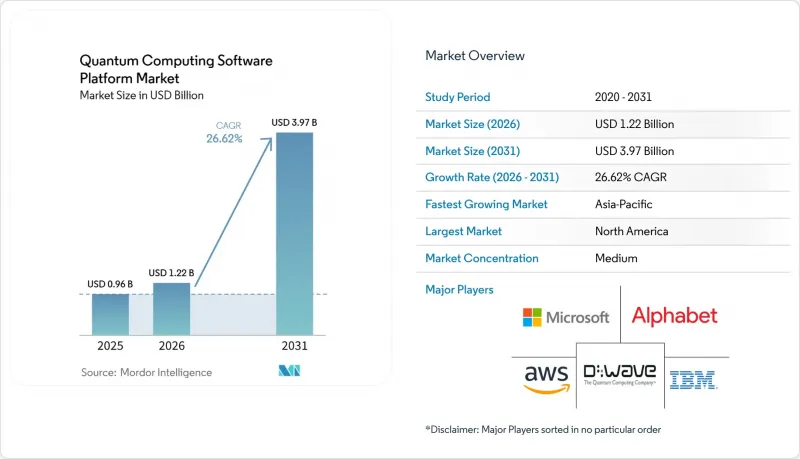
Mordor Intelligence에 의하면, 양자 컴퓨팅 소프트웨어 플랫폼 시장 규모는 2025년 9억 6,000만 달러, 2026년 12억 2,000만 달러에서 2031년까지 39억 7,000만 달러로 확대된다고 예측되고 있어 2026년부터 2031년까지 연평균 성장률(CAGR)은 26.62%를 나타낼 전망입니다.
본 보고서는 플랫폼 유형(개발 키트, 알고리즘 설계 플랫폼,양자 에뮬레이터 및 시뮬레이터 등), 도입 모델(클라우드 기반, On-Premise형, 하이브리드형), 용도(시뮬레이션 및 모델링, 머신러닝 등), 최종 사용자 산업(헬스케어 및 생명과학 등), 지역별로 분류되어 있습니다. 시장 예측은 금액(달러) 기준으로 제시되어 있습니다.
세계 양자 컴퓨팅 소프트웨어 플랫폼 시장 동향 및 인사이트
‘Quantum-As-A-Service’ 개발 스택으로의 기업 전환
양자 컴퓨팅 소프트웨어 플랫폼 시장에서 파편화된 개념 증명(PoC) 환경은 장기적으로 관리, 확장 및 유지하기 어렵기 때문에 기업 팀들은 양자 관련 작업을 관리형 개발 스택으로 전환하고 있습니다. 이러한 전환은 기존 소프트웨어 거버넌스 모델에 부합하며, 이를 통해 대기업은 양자 실험을 주류 개발 및 검증 프로세스와 쉽게 연계할 수 있습니다. 2026년에 출시된 IBM의 Qiskit SDK v2.5에는 맞춤형 컴파일러 파이프라인, C API 및 LightSabre 라우팅 개선 사항이 추가되어 100큐비트 이상의 회로에서 전환 시간이 단축되었습니다. 이는 대규모 기술 팀에게 엔터프라이즈용 도구가 점점 더 실용적으로 변하고 있음을 보여줍니다. 이러한 관리형 스택이 개선됨에 따라, 양자 컴퓨팅 소프트웨어 플랫폼 시장의 전환 비용은 기반이 되는 하드웨어 계층이 아닌 소프트웨어 워크플로우 및 컴파일러 계층으로 이동하고 있습니다. 이러한 추세에 따라 플랫폼 오케스트레이터는 특히 하이브리드 양자·고전 개발 환경의 기본 인터페이스가 될 경우, 장기적인 고객 관계에 대해 더 큰 통제권을 갖게 될 것입니다.
정부 자금에 의한 양자 소프트웨어 조달 및 국가 프로그램
직접적인 공공 조달은 장기적인 연구 목표를 자금 지원을 받는 소프트웨어 개발, 벤치마킹 및 통합 작업으로 전환하기 때문에 양자 컴퓨팅 소프트웨어 플랫폼 시장에 있어 가장 명확한 수요 신호 중 하나로 남아 있습니다. 2026년 5월, 미국 상무부는 IBM, Quantinuum, D-Wave, Rigetti를 포함한 9개 양자 기업에 대해 ‘CHIPS and Science Act’에 근거한 20억 1,300만 달러의 인센티브에 관한 의향서에 서명했습니다. 이를 통해 기업 소프트웨어가 의존하는 하드웨어 기반이 강화될 것입니다. 또한, 미국 에너지부는 5개의 국립 양자 정보 연구센터에 6억 2,500만 달러의 예산을 배정하여 지원을 갱신했습니다. 여기에는 오픈소스 양자·고전 워크플로우 소프트웨어와 관련된 오크리지 국립연구소의 임무도 포함되어 있으며, 미들웨어 및 오케스트레이션 수요를 뒷받침하는 것입니다. 2026년 6월 22일에 서명된 백악관 대통령령에 따라 QC-ADDS 프로그램이 신설되었습니다. 또한, ‘2026년 국가 양자 이니셔티브 재승인법’에서는 2030년까지 NIST의 양자 관련 활동에 대해 연간 8,500만 달러의 예산이 승인되었으며, 상용 아키텍처 선택에 영향을 미치는 표준화 및 성능 평가 노력이 강화되었습니다. 일본의 JHPC-quantum 프로그램은 2027년까지 시행되는 5년 동안 100억 엔(2025년 평균 환율 기준 6,700만 달러)의 예산을 투입하는 것으로, 양자·HPC 하이브리드 워크플로우를 위한 소프트웨어 기반을 구축하고 있으며, 이는 조달 주도형 수요가 북미에만 국한되지 않음을 보여줍니다.
내결함성 큐비트공급 부족이 실용 수준의 소프트웨어를 통한 가치 창출을 지연시키고 있다.
시중에서 구할 수 있는 내결함성 하드웨어가 부족하기 때문에 양자 컴퓨팅 소프트웨어 플랫폼 시장에서 벤더가 대규모로 판매할 수 있는 워크로드의 범위와 깊이는 여전히 제한되어 있습니다. 2026년 7월 『Nature』지에 발표된 Quantinuum사의 98큐비트 ‘Helios’ 프로세서는 기술적으로 큰 진전을 이루었지만, 여전히 본격적인 기업용 실제 운영이라기보다는 연구나 시범 단계에서의 활용을 주된 목적으로 하고 있습니다. 또한 소프트웨어 개발자는 초전도, 트랩 이온, 중성 원자, 포토닉 및 기타 아키텍처 등 매우 다양한 하드웨어 접근 방식을 지원해야 하며, 이는 양자 컴퓨팅 소프트웨어 플랫폼 시장 전체에서 컴파일러와 오류 완화 조치의 복잡성을 가중시키고 있습니다. IBM과 Quantinuum은 모두 확장 가능한 내결함성을 실현하기 위한 중요한 목표 연도로 2029년을 제시하고 있습니다. 이는 예측 기간의 대부분 동안 소프트웨어 계층이 하이브리드 환경이나 양산 전 이용 사례로 제한된 상태가 지속될 것임을 의미합니다. 그때까지 각 벤더는 하드웨어 고유의 양자 이점이 아닌, 시뮬레이션 품질, 워크플로우 통합 및 벤치마크 지원을 통해 구독 서비스의 가치를 입증해야 합니다.
부문 분석
2025년, 개발 키트는 플랫폼 매출의 39.23%를 차지하며, 플랫폼 유형별 양자 컴퓨팅 소프트웨어 플랫폼 시장 점유율에서 가장 큰 비중을 차지했습니다. 이러한 주도적인 위상은 기업의 지출이 여전히 고차원적인 오케스트레이션이 아닌 프로그래밍 인프라, 컴파일러 접근 및 테스트 계층에 집중되어 있음을 보여줍니다. 양자 컴퓨팅 소프트웨어 플랫폼 시장에서 구매자들은 여전히 기초적인 기능 구축을 진행하고 있습니다. 여기에는 회로 컴파일 검증, 에뮬레이터 동작 확인, 그리고 더 광범위한 프로덕션 환경으로의 배포에 앞서 재현 가능한 개발 워크플로우 확립이 포함됩니다. IBM은 2026년에 Qiskit을 연속적으로 출시하여 C API 지원을 확대하는 한편, 대규모 회로를 위한 컴파일러 기능을 개선함으로써 이 계층을 강화했습니다. 이러한 추세는 개발자가 처음 습득하는 도구가 양자 컴퓨팅 소프트웨어 플랫폼 시장 전체에서 향후 통합 옵션의 기반이 되는 경우가 많다는 시장 구조를 뒷받침합니다.
미들웨어 및 오케스트레이션은 가장 빠르게 성장하는 부문으로, 2031년까지 연평균 성장률(CAGR) 27.18%를 나타낼 것으로 예측됩니다. 이는 하이브리드 워크플로가 더욱 중심적인 역할을 하게 됨에 따라 가치 창출의 방식이 점차 변화하고 있음을 시사합니다. 하드웨어가 성숙해짐에 따라, 기업들은 실용적인 운영 환경에서 양자 프로세서를 CPU 및 GPU와 연결하기 위해 더욱 강력한 스케줄링, 라우팅 및 작업 관리 계층을 필요로 하게 될 것입니다. 알고리즘 설계 플랫폼과 양자 에뮬레이터 및 시뮬레이터는 사용자가 실제 하드웨어 큐로 작업을 이전하기 전에 로직과 리소스 요구 사항을 검증하는 데 도움이 되므로 여전히 중요한 역할을 하고 있습니다. 양자 제어 소프트웨어는 여전히 매출 규모가 작은 분야이지만, 대규모 시스템에서는 보다 정밀한 보정, 타이밍 제어 및 오류 피드백 루프가 요구되므로 그 중요성이 높아지고 있습니다. 일본의 대규모 연구 인프라에 NVIDIA의 CUDA-Q가 도입된 것은 양자 컴퓨팅 소프트웨어 플랫폼 시장에서 시뮬레이션, 오케스트레이션 및 제어가 얼마나 긴밀하게 연계되고 있는지를 보여줍니다.
2025년에는 클라우드 기반 도입이 63.81%의 점유율을 차지하며, 양자 컴퓨팅 소프트웨어 플랫폼 시장의 주요 접근 모델이 되었습니다. 이러한 우위는 하드웨어 소유에 따르는 비용과 복잡성을 반영한 것입니다. 대부분의 기업은 양자 워크플로우 테스트를 시작하기 위해서만 전용 시스템을 구축하거나 임대하기를 원하지 않기 때문입니다. 또한 클라우드 도입은 직접적인 인프라 관리보다 도입하기 쉬운 소프트웨어 인터페이스를 통해 구매자가 서로 다른 하드웨어 형태를 비교할 수 있게 해줍니다. 이러한 접근 방식은 평가 주기를 가속화하고, 개발자의 참여를 통해 물리학에 정통한 사내 팀에 대한 의존도를 낮춥니다. 클라우드 액세스가 지닌 강점은 양자 컴퓨팅 소프트웨어 플랫폼 시장이 연구 주도 기관 이외의 사용자층으로 확대되고 있는 이유 중 하나입니다.
On-Premise 배포는 광범위한 접근성보다 보안, 지연 시간, 시스템 제어가 중시되는 정부, 국방 및 특정 연구 환경에서 여전히 전략적으로 중요한 위치를 차지하고 있습니다. 하이브리드 부문은 가장 빠르게 성장하는 배포 형태이며, 2031년까지 연평균 성장률(CAGR) 29.52%를 나타낼 것으로 예측됩니다. 이는 많은 사용자가 반복적인 워크로드를 위해 로컬의 고전적 인프라와 원격 양자 처리 간의 긴밀한 통합을 필요로 하기 때문입니다. 이는 왕복 지연으로 인해 최적화 루프가 지연되거나, 규제 대상 사용자가 워크플로우의 일부를 통제된 환경 내에 유지하고자 하는 경우에 더욱 중요해집니다. 일본의 ‘ROQUO’ 플랫폼은 실제 운영 환경에서 양자 시스템과 슈퍼컴퓨터 ‘후가쿠’를 연동하고 있어, 하이브리드 설계가 어떻게 운영 단계에 접어들었는지를 보여줍니다. 데이터 거주지 등의 분야에서 발생하는 규제적 압력으로 인해 클라우드가 양자 컴퓨팅 소프트웨어 플랫폼 시장의 주요 진입 경로로 남아 있을 것이지만, 비공개 도입 모델의 중요성은 앞으로도 유지될 것입니다.
지역별 분석
2025년, 북미는 양자 컴퓨팅 소프트웨어 플랫폼 시장 점유율의 37.26%를 차지하며 매출 측면에서 1위를 유지했습니다. 이 지역은 주요 클라우드 사업자, 전문 소프트웨어 벤더, 국립 연구소가 집중되어 있을 뿐만 아니라, 양자 컴퓨팅 소프트웨어 플랫폼 시장의 표준화 및 통합 작업에 자금을 지원하는 정책 지원 메커니즘의 혜택을 받고 있습니다. 2026년 5월의 ‘CHIPS 법’에 관한 의향서, 2026년 6월의 양자 혁신에 관한 백악관 대통령령, 그리고 2026년의 ‘국가 양자 이니셔티브 재승인법’은 모두 이 분야에서 미국이 가장 자원 집약적인 정책 환경을 갖추고 있음을 뒷받침합니다. 캐나다는 연구 기반과 전문 기업의 존재를 통해 지역의 깊이를 뒷받침하고 있는 반면, 멕시코는 도입 초기 단계에 머물러 있으며, 국내 플랫폼 구축보다는 클라우드 접근에 의존하는 경향이 강합니다.
아시아태평양은 2031년까지 연평균 성장률(CAGR) 31.71%로 확대될 것으로 예측되며, 양자 컴퓨팅 소프트웨어 플랫폼 시장에서 가장 빠르게 성장하는 지역 클러스터가 되고 있습니다. 일본이 주요 견인 역할을 하고 있는 것은 리켄(RIKEN)이 2026년 6월에 양자 HPC 하이브리드 슈퍼컴퓨터 ‘ROQUO’를 가동하고, Quantinuum 및 IBM의 시스템을 ‘후가쿠’ 슈퍼컴퓨터와 운영 환경에서 연결했기 때문입니다. 또한, 후지쯔와 오사카 대학도 2026년 3월에 ‘STAR 아키텍처 ver. 3’을 발표하여, 초기 단계의 내결함성 양자 컴퓨터에서 분자 에너지 계산의 정확도를 10배 이상 향상시켰습니다. 후지쯔와 이화학연구소는 2025년에 이미 일본의 256큐비트 초전도 양자 컴퓨터를 외부 사용자에게 개방했으며, 이를 통해 재료 및 과학 분야 용도를 위한 해당 지역의 소프트웨어 수요 기반이 강화되고 있습니다. 또한, 싱가포르도 QAI Ventures가 지원하는 전용 액셀러레이터를 통해 상용화 역량을 구축하고 있으며, 이는 양자 컴퓨팅 소프트웨어 플랫폼 시장이 아시아 내 최대 규모의 국가 프로그램을 넘어 확장되고 있음을 보여줍니다.
유럽은 여전히 양자 컴퓨팅 소프트웨어 플랫폼 시장에서 중요한 지역이며, 영국과 독일이 연구 및 상용화의 거점으로 두각을 나타내고 있습니다. 영국은 Riverlane사의 Deltakit 사업과 오크리지 국립연구소의 ‘Frontier’ 슈퍼컴퓨터와의 Deltaflow 2 통합을 통해 오류 정정 소프트웨어 분야에서의 입지를 강화했습니다. 독일에 본사를 둔 ParityQC와 이스라엘에 본사를 둔 Classiq는 2026년 7월, 하드웨어 최적화와 고수준 소프트웨어 엔지니어링을 통합하기 위한 제휴를 발표했습니다. 이는 유럽이 순수한 하드웨어에 집중하기보다 상호 운용성을 중시하고 있음을 반영합니다. 남미, 중동 및 아프리카는 여전히 초기 단계에 있는 지역으로, 도입은 광범위한 상업적 규모라기보다는 선택적인 조사나 금융·공공 부문의 전문적인 이용 사례에 집중되어 있습니다.
기타 혜택:
- 엑셀 형식 시장 예측(ME) 시트
- 3개월간의 애널리스트 지원
자주 묻는 질문
목차
제1장 서론
제2장 조사 방법
제3장 개요
제4장 시장 구도
제5장 시장 규모와 성장 예측
제6장 경쟁 구도
제7장 시장 기회와 향후 전망
JHS 26.09.01According to Mordor Intelligence, the quantum computing software platform market size is projected to expand from USD 0.96 billion in 2025 and USD 1.22 billion in 2026 to USD 3.97 billion by 2031, registering a CAGR of 26.62% between 2026 to 2031.
This report is Segmented by Platform Type (Development Kits, Algorithm Design Platforms, Quantum Emulators and Simulators, and More), Deployment Model (Cloud-Based, On-Premises, and Hybrid), Application (Simulation and Modeling, Machine Learning, and More), End User Industry (Healthcare and Life Sciences, and More), and Geography. The Market Forecasts are Provided in Terms of Value (USD).
Global Quantum Computing Software Platform Market Trends and Insights
Enterprise Migration to Quantum-As-A-Service Development Stacks
Enterprise teams are moving quantum work onto managed development stacks because fragmented proof-of-concept environments are harder to govern, scale, and maintain over time in the quantum computing software platform market. This shift fits existing software governance models better, which makes it easier for large organizations to connect quantum experimentation with mainstream development and validation processes. IBM's Qiskit SDK v2.5 release in 2026 added custom compiler pipelines, a C API, and LightSabre routing improvements that reduced transpiration time on circuits of 100 or more qubits, which shows how enterprise tooling is becoming more practical for larger technical teams. As these managed stacks improve, switching costs move toward the software workflow and compiler layer rather than the underlying hardware layer in the quantum computing software platform market. That dynamic gives platform orchestrators more control over long-term customer relationships, especially when they become the default interface for hybrid quantum and classical development environments.
Government-Funded Quantum Software Procurement and National Programs
Direct public procurement remains one of the clearest demand signals for the quantum computing software platform market because it turns long-horizon research goals into funded software, benchmarking, and integration work. In May 2026, the U.S. Department of Commerce signed letters of intent for USD 2.013 billion in CHIPS and Science Act incentives to 9 quantum companies, including IBM, Quantinuum, D-Wave, and Rigetti, which strengthens the hardware base that enterprise software depends on. The U.S. Department of Energy also renewed 5 National Quantum Information Science Research Centers with USD 625 million, including an Oak Ridge mandate tied to open-source quantum-classical workflow software, which supports middleware and orchestration demand. The White House Executive Order signed on June 22, 2026, created the QC-ADDS program, while the National Quantum Initiative Reauthorization Act of 2026 authorized USD 85 million per year for NIST quantum activities through 2030, reinforcing standards and performance assessment work that shapes commercial architecture choices. Japan's JHPC-quantum program, a 5-year JPY 10 billion program running through 2027, or USD 67 million at 2025 average exchange rates, is building the software foundation for quantum-HPC hybrid workflows and shows that procurement-led demand is not limited to North America.
Limited Fault-Tolerant Qubit Availability Slows Production-Grade Software Value Capture
The lack of commercially available fault-tolerant hardware still limits the range and depth of workloads that vendors can sell at scale in the quantum computing software platform market. Quantinuum's 98-qubit Helios processor, published in Nature in July 2026, marked a major technical step, but it still supports research and pilot-stage use more than full production enterprise deployment. Software developers also have to support very different hardware approaches, including superconducting, trapped-ion, neutral atom, photonic, and other architectures, which raises compiler and mitigation complexity across the quantum computing software platform market. IBM and Quantinuum have both pointed to 2029 as a meaningful target for scalable fault tolerance, which means the software layer will remain tied to hybrid and pre-production use cases through much of the forecast window. Until then, vendors must justify subscriptions through simulation quality, workflow integration, and benchmarking support rather than hardware-native quantum advantage.
Other drivers and restraints analyzed in the detailed report include:
- Quantum Cloud Provider Ecosystem Expansion and SDK Integration
- Rising Demand for Quantum Error Mitigation and Benchmarking Tools
- High Talent Scarcity in Quantum Algorithms, Compilers, and Control Software
For complete list of drivers and restraints, kindly check the Table Of Contents.
Segment Analysis
Development Kits accounted for 39.23% of platform revenue in 2025, representing the largest slice of the quantum computing software platform market share by platform type. This leadership shows that enterprise spending is still concentrated in programming infrastructure, compiler access, and testing layers rather than higher-order orchestration. Buyers are still building foundational capability, which includes validating circuit compilation, checking emulator behavior, and establishing repeatable development workflows before wider production deployment in the quantum computing software platform market. IBM strengthened this layer through consecutive Qiskit releases in 2026 that expanded C API support and improved compiler functionality for larger circuits. That pattern supports a market structure where the first tool a developer learns often becomes the foundation for later integration choices across the quantum computing software platform market.
Middleware and orchestration was the fastest-growing segment, projected to record a 27.18% CAGR through 2031, which points to a gradual shift in value creation as hybrid workflows become more central. As hardware matures, enterprises will need stronger scheduling, routing, and job management layers to connect quantum processors with CPUs and GPUs in practical operating environments. Algorithm Design Platforms and Quantum Emulators and Simulators remain important because they help users validate logic and resource requirements before moving work onto live hardware queues. Quantum Control Software is still a smaller revenue layer, yet it is gaining importance as larger systems require tighter calibration, timing control, and error feedback loops. NVIDIA's CUDA-Q deployment within Japan's large-scale research infrastructure shows how simulation, orchestration, and control are moving closer together inside the quantum computing software platform market.
Cloud-Based deployment held 63.81% share in 2025, making it the leading access model in the quantum computing software platform market. This lead reflects the cost and complexity of hardware ownership, since most enterprises do not want to build or lease specialized systems just to begin testing quantum workflows. Cloud deployment also helps buyers compare different hardware modalities through software interfaces that are easier to adopt than direct infrastructure management. That approach speeds up evaluation cycles and makes developer participation less dependent on a physics-heavy internal team. The strength of cloud access is one reason the quantum computing software platform market is reaching users outside research-led institutions.
On-Premises deployment remains strategically relevant for government, defense, and certain research environments where security, latency, and system control carry more weight than broad accessibility. The Hybrid segment is the fastest-growing deployment path, projected to record a 29.52% CAGR through 2031, as many users now need tight integration between local classical infrastructure and remote quantum processing for iterative workloads. This becomes more important when round-trip latency can slow optimization loops or when regulated users want part of the workflow to remain inside controlled environments. Japan's ROQUO platform illustrates how hybrid design is becoming operational, because it links quantum systems with the Fugaku supercomputer in a working production environment. Regulatory pressure in areas such as data residency will keep non-public deployment models relevant even as cloud remains the main entry point for the quantum computing software platform market.
Complete Report Scope:
- By Platform Type
- Development Kits
- Algorithm Design Platforms
- Quantum Emulators and Simulators
- Middleware and Orchestration
- Quantum Control Software
- By Deployment Model
- Cloud-Based
- On-Premises
- Hybrid
- By Application
- Optimization
- Simulation and Modeling
- Machine Learning
- Cryptography and Cybersecurity
- Drug Discovery and Materials Science
- Supply Chain and Logistics Optimization
- By End User Industry
- Banking, Financial Services, and Insurance (BFSI)
- Government and Defense
- Healthcare and Life Sciences
- Energy and Utilities
- Automotive and Transportation
- IT and Telecommunication
- Chemical and Materials
- Other End User Industries
- By Geography
- North America
- United States
- Canada
- Mexico
- South America
- Brazil
- Argentina
- Rest of South America
- Europe
- United Kingdom
- Germany
- France
- Rest of Europe
- Asia-Pacific
- China
- Japan
- India
- South Korea
- Australia
- Rest of Asia-Pacific
- Middle East and Africa
- Middle East
- United Arab Emirates
- Saudi Arabia
- Rest of Middle East
- Africa
- South Africa
- Kenya
- Rest of Africa
- Middle East
- North America
Geography Analysis
North America held 37.26% of the quantum computing software platform market share in 2025, which kept the region in the leading position by revenue. The region benefits from the concentration of major cloud players, specialist software vendors, national labs, and policy support mechanisms that fund standards and integration work in the quantum computing software platform market. The May 2026 CHIPS Act letters of intent, the June 2026 White House Executive Order on quantum innovation, and the National Quantum Initiative Reauthorization Act of 2026 all reinforced the United States as the most resource-intensive policy environment for this field. Canada supports regional depth through its research base and specialist company presence, while Mexico remains earlier in adoption and is more tied to cloud access than domestic platform creation.
Asia-Pacific is projected to expand at a 31.71% CAGR through 2031, which makes it the fastest-growing regional cluster in the quantum computing software platform market. Japan is a major driver because RIKEN launched the ROQUO quantum-HPC hybrid supercomputer in June 2026, connecting Quantinuum and IBM systems with the Fugaku supercomputer in an operational environment. Fujitsu and the University of Osaka also announced STAR Architecture ver. 3 in March 2026, improving computational accuracy by more than 10 times for molecular energy calculations on early fault-tolerant quantum computers. Fujitsu and RIKEN had already made Japan's 256-qubit superconducting quantum computer available to external users in 2025, which strengthens the region's software demand base for materials and scientific applications. Singapore is also building commercialization capacity through a dedicated accelerator backed by QAI Ventures, which shows that the quantum computing software platform market is broadening beyond the largest national programs in Asia.
Europe remains an important region in the quantum computing software platform market, with the United Kingdom and Germany standing out as research and commercialization hubs. The United Kingdom has strengthened its position in error correction software through Riverlane's Deltakit activity and its Deltaflow 2 integration with Oak Ridge's Frontier supercomputer. Germany-based ParityQC and Israel-based Classiq announced a partnership in July 2026 to integrate hardware optimization and higher-level software engineering, which reflects Europe's emphasis on interoperability rather than pure hardware concentration. South America and the Middle East and Africa remain earlier-stage regions, with adoption still centered on selective research and specialized financial or public-sector use cases rather than broad commercial scale.
- IBM Corporation
- Microsoft Corporation
- Alphabet Inc.
- Amazon Web Services, Inc.
- D-Wave Quantum Inc.
- Quantinuum Ltd.
- QC Ware Corporation
- Classiq Technologies Ltd.
- Zapata Computing Holdings Inc.
- 1QBit Information Technologies Inc.
- Riverlane Ltd.
- Q-CTRL Pty Ltd.
- Xanadu Quantum Technologies Inc.
- Pasqal S.A.
- Aliro Technologies, Inc.
- QuandCo B.V.
- Horizon Quantum Computing Pte. Ltd.
- Rigetti Computing, Inc.
- IonQ, Inc.
- Fujitsu Limited
- Toshiba Corporation
- Hitachi, Ltd.
- NVIDIA Corporation
Additional Benefits:
- The market estimate (ME) sheet in Excel format
- 3 months of analyst support
TABLE OF CONTENTS
1 INTRODUCTION
- 1.1 Study Assumptions and Market Definition
- 1.2 Scope of the Study
2 RESEARCH METHODOLOGY
3 EXECUTIVE SUMMARY
4 MARKET LANDSCAPE
- 4.1 Market Overview
- 4.2 Market Drivers
- 4.2.1 Enterprise Migration to Quantum-As-A-Service Development Stacks
- 4.2.2 Rising Demand for Quantum Error Mitigation and Benchmarking Tools
- 4.2.3 Quantum Cloud Provider Ecosystem Expansion and SDK Integration
- 4.2.4 Government-Funded Quantum Software Procurement and National Programs
- 4.2.5 Fragmented Toolchains Creating Demand for Interoperability Layers
- 4.2.6 Early Commercialization of Domain-Specific Quantum Applications in Finance, Chemistry, and Logistics
- 4.3 Market Restraints
- 4.3.1 Limited Fault-Tolerant Qubit Availability Slows Production-Grade Software Value Capture
- 4.3.2 High Talent Scarcity in Quantum Algorithms, Compilers, and Control Software
- 4.3.3 Vendor Lock-In Fears Around Proprietary Quantum SDKs and Closed Ecosystems
- 4.3.4 Unclear ROI for Most Enterprise Workloads Beyond Pilot Use Cases
- 4.4 Industry Value-Chain Analysis
- 4.5 Impact of Macroeconomic Factors on the Market
- 4.6 Regulatory Landscape
- 4.7 Technological Outlook
- 4.8 Porter's Five Forces Analysis
- 4.8.1 Bargaining Power of Buyers
- 4.8.2 Bargaining Power of Suppliers
- 4.8.3 Threat of New Entrants
- 4.8.4 Threat of Substitutes
- 4.8.5 Intensity of Competitive Rivalry
- 4.9 Strategic Moves Analysis
- 4.10 Patent and Intellectual Property Landscape
5 MARKET SIZE AND GROWTH FORECASTS (VALUE)
- 5.1 By Platform Type
- 5.1.1 Development Kits
- 5.1.2 Algorithm Design Platforms
- 5.1.3 Quantum Emulators and Simulators
- 5.1.4 Middleware and Orchestration
- 5.1.5 Quantum Control Software
- 5.2 By Deployment Model
- 5.2.1 Cloud-Based
- 5.2.2 On-Premises
- 5.2.3 Hybrid
- 5.3 By Application
- 5.3.1 Optimization
- 5.3.2 Simulation and Modeling
- 5.3.3 Machine Learning
- 5.3.4 Cryptography and Cybersecurity
- 5.3.5 Drug Discovery and Materials Science
- 5.3.6 Supply Chain and Logistics Optimization
- 5.4 By End User Industry
- 5.4.1 Banking, Financial Services, and Insurance (BFSI)
- 5.4.2 Government and Defense
- 5.4.3 Healthcare and Life Sciences
- 5.4.4 Energy and Utilities
- 5.4.5 Automotive and Transportation
- 5.4.6 IT and Telecommunication
- 5.4.7 Chemical and Materials
- 5.4.8 Other End User Industries
- 5.5 By Geography
- 5.5.1 North America
- 5.5.1.1 United States
- 5.5.1.2 Canada
- 5.5.1.3 Mexico
- 5.5.2 South America
- 5.5.2.1 Brazil
- 5.5.2.2 Argentina
- 5.5.2.3 Rest of South America
- 5.5.3 Europe
- 5.5.3.1 United Kingdom
- 5.5.3.2 Germany
- 5.5.3.3 France
- 5.5.3.4 Rest of Europe
- 5.5.4 Asia-Pacific
- 5.5.4.1 China
- 5.5.4.2 Japan
- 5.5.4.3 India
- 5.5.4.4 South Korea
- 5.5.4.5 Australia
- 5.5.4.6 Rest of Asia-Pacific
- 5.5.5 Middle East and Africa
- 5.5.5.1 Middle East
- 5.5.5.1.1 United Arab Emirates
- 5.5.5.1.2 Saudi Arabia
- 5.5.5.1.3 Rest of Middle East
- 5.5.5.2 Africa
- 5.5.5.2.1 South Africa
- 5.5.5.2.2 Kenya
- 5.5.5.2.3 Rest of Africa
- 5.5.5.1 Middle East
- 5.5.1 North America
6 COMPETITIVE LandSCAPE
- 6.1 Market Concentration
- 6.2 Strategic Moves
- 6.3 Market Share Analysis
- 6.4 Company Profiles (includes Global Level Overview, Market Level Overview, Core Segments, Financials as available, Strategic Information, Market Rank/Share, Products and Services, Recent Developments)
- 6.4.1 IBM Corporation
- 6.4.2 Microsoft Corporation
- 6.4.3 Alphabet Inc.
- 6.4.4 Amazon Web Services, Inc.
- 6.4.5 D-Wave Quantum Inc.
- 6.4.6 Quantinuum Ltd.
- 6.4.7 QC Ware Corporation
- 6.4.8 Classiq Technologies Ltd.
- 6.4.9 Zapata Computing Holdings Inc.
- 6.4.10 1QBit Information Technologies Inc.
- 6.4.11 Riverlane Ltd.
- 6.4.12 Q-CTRL Pty Ltd.
- 6.4.13 Xanadu Quantum Technologies Inc.
- 6.4.14 Pasqal S.A.
- 6.4.15 Aliro Technologies, Inc.
- 6.4.16 QuandCo B.V.
- 6.4.17 Horizon Quantum Computing Pte. Ltd.
- 6.4.18 Rigetti Computing, Inc.
- 6.4.19 IonQ, Inc.
- 6.4.20 Fujitsu Limited
- 6.4.21 Toshiba Corporation
- 6.4.22 Hitachi, Ltd.
- 6.4.23 NVIDIA Corporation
7 MARKET OPPORTUNITIES and FUTURE OUTLOOK
- 7.1 White-Space and Unmet-Need Assessment
- 7.2 Adjacent Ecosystem Opportunities
- 7.3 Adoption Barriers and Commercialization Pathways


