

|
시장보고서
상품코드
2117992
양자 소프트웨어 툴체인 시장 : 점유율 분석, 업계 동향과 통계, 성장 예측(2026-2031년)Quantum Software Toolchain - Market Share Analysis, Industry Trends & Statistics, Growth Forecasts (2026 - 2031) |
||||||
 Mordor Intelligence
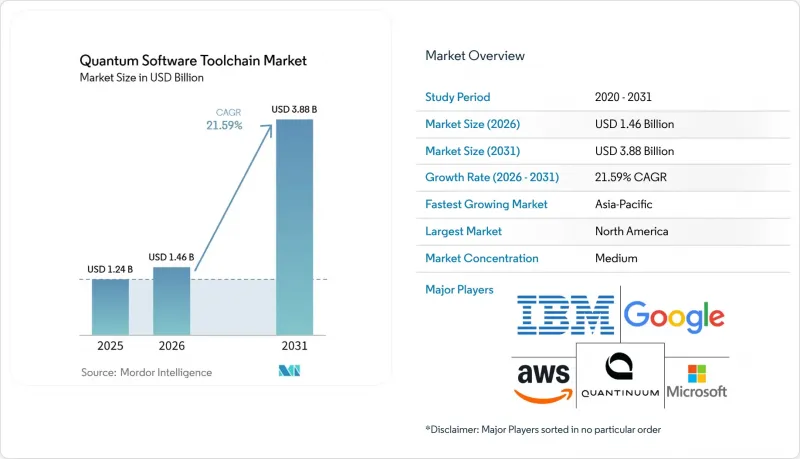
Mordor Intelligence에 의하면, 양자 소프트웨어 툴체인 시장 규모는 2025년에 12억 4,000만 달러로 평가되었고 2026년 14억 6,000만 달러에서 2031년까지 38억 8,000만 달러에 이를 것으로 예측되며, 예측 기간(2026-2031년) CAGR은 21.59%를 나타낼 전망입니다.
본 보고서는 툴체인의 구성 요소(소프트웨어 솔루션 및 서비스), 도입 형태(클라우드 기반, On-Premise, 하이브리드), 용도(최적화, 시뮬레이션, 머신러닝 등), 최종 사용자(IT 및 통신, 은행, 금융서비스 및 보험(BFSI), 헬스케어 및 생명과학,소매 및 전자상거래 등) 및 지역별로 분류되어 있습니다. 시장 예측은 금액(달러) 기준으로 제시되어 있습니다.
전 세계 양자 소프트웨어 툴체인 시장 동향 및 인사이트
양자 클라우드 마켓플레이스를 통한 기업의 접근
클라우드 마켓플레이스는 IT 팀이 이미 사용하고 이해하고 있는 조달 채널 내에 전문적인 제품을 배치함으로써, 조직이 양자 개발 도구를 확보하는 방식을 혁신하고 있습니다. 구매자는 기존 클라우드 계정, ID 관리, 과금 체계, 거버넌스 프로세스를 활용할 수 있습니다. Classiq는 2025년에 AWS 마켓플레이스를 통해 이용 가능해졌으며, 기업들은 AWS 크레딧을 활용하여 해당 회사의 소프트웨어 개발 플랫폼을 사용할 수 있게 되었습니다. 이러한 방식을 통해 연간 예산 범위 내에서 업무를 수행하는 팀의 조달 장벽을 제거할 수 있습니다. 특히, 별도의 벤더 심사를 진행함으로써 제한된 파일럿 도입이나 초기 가치 입증(PoV)이 지연되는 경우, 그 효과는 현저합니다. 따라서 양자 소프트웨어 및 툴체인 시장에서는 확립된 클라우드 환경을 통해 고객에게 접근할 수 있는 벤더가 유리합니다. 주요 클라우드 생태계에 진입하지 않은 벤더는 기업의 파일럿 도입 과정에서 불리한 입장에 처할 가능성이 있습니다. 이는 구매자가 기존의 접근, 비용 관리 및 보안 프로세스와 호환되는 도구를 우선시하는 경향이 있기 때문입니다.
정부 자금 지원 양자 프로그램 및 조달
정부 프로그램은 양자 하드웨어뿐만 아니라 소프트웨어 스택과 공통 인터페이스도 지원하고 있습니다. 이는 공공 부문 사용자가 연구자, 개발자 및 상업적 파트너가 연결되어 일관되게 이용할 수 있는 시스템을 필요로 하기 때문입니다. 독일은 2025년 12월, 개방형 인터페이스를 갖춘 모듈식 양자 소프트웨어 참조 아키텍처를 지원하기 위해 ‘QC Next’를 출범시켰습니다. 영국은 2026년 3월, 20억 파운드(25억 4,000만 달러 상당) 규모의 지원 패키지를 발표했으며, 여기에는 ProQure와 에든버러의 Quantum Software Lab에 대한 지원이 포함되어 있습니다. 일본의 IPA는 2026년도 ‘미토 타겟 프로그램’의 일환으로 10건의 양자 소프트웨어 프로젝트를 선정했습니다. 이러한 프로그램은 지역 개발자를 지원하고 연구 그룹 및 공급업체에 명확한 조달 경로를 제공하는 한편, 그 결과로 탄생하는 레퍼런스 디자인을 통해 향후 사용자가 호환 가능한 도구를 쉽게 선택할 수 있게 해줍니다. 또한, 공공 기관의 약속을 통해 민간 기업이 대규모 도입을 결정하기 전에 기술적 우선순위를 검증할 수 있으므로, 새로운 양자 용도를 시험하는 조직이 직면하는 상업적 위험의 일부를 완화할 수도 있습니다.
양자 하드웨어의 오류율과 내결함성 기능의 가용성 한계
하드웨어 오류는 결과의 신뢰성, 실행 비용, 그리고 사용자가 안심하고 실행할 수 있는 작업의 범위에 영향을 미치기 때문에 소프트웨어 상용화의 근본적인 제약으로 남아 있습니다. 완화 조치를 하나 추가할 때마다 지연 시간, 회로 깊이 및 샘플링 요구 사항이 증가할 가능성이 있습니다. 현재의 툴은 잡음이 많은 중규모 양자 시스템, 얕은 회로 및 제한된 코히어런스 시간을 처리해야 합니다. 이로 인해 현재 하드웨어에 최적화할지, 아니면 미래의 내결함성 환경에 대비할지라는 어려운 설계상의 선택이 발생합니다. 특히, 툴이 계속 진화하는 여러 세대의 디바이스에 걸쳐 유용성을 유지해야 하는 경우, 그 선택은 더욱 어렵습니다. IBM과 NVIDIA는 이 문제에 대한 소프트웨어적 해결책을 제시하고 있지만, 이러한 접근 방식은 물리적 큐비트의 충실도를 높여야 할 필요성을 대체하지는 못합니다. 규제 대상 사용자는 양자 소프트웨어 툴체인 시장의 용도에서 신뢰할 수 있는 내결함성이 입증될 때까지 중요한 워크로드를 연기할 가능성이 있습니다.
부문 분석
2025년, 소프트웨어 솔루션은 툴체인 구성 요소 부문의 74.18%를 차지했습니다. 이 범주에는 양자 소프트웨어 툴체인 시장 전체에서 사용되는 개발 플랫폼, 컴파일러, 트랜스파일러, 미들웨어, 런타임 소프트웨어, 시뮬레이터, 오류 관리 도구 및 알고리즘 라이브러리가 포함됩니다. 이러한 점유율은 사용자가 각 하드웨어 플랫폼의 세부적인 제어나 제약 사항을 직접 처리해야 하는 대신, 양자 시스템의 프로그래밍 및 기존 워크플로우와의 통합을 용이하게 하는 소프트웨어에 높은 가치가 부여되고 있음을 반영합니다. 많은 구매자에게 있어 양자 실험을 재현 가능한 개발 프로세스로 만들기 위해서는 이러한 추상화가 필수적입니다. 각 카테고리는 회로 설계부터 실행, 오류 처리에 이르기까지 사용자 여정의 서로 다른 단계에 해당합니다. 개발 팀은 이러한 구성 요소를 조합하여 사용할 수 있으므로, 개별 제품의 기능뿐만 아니라 이러한 구성 요소들의 통합 품질도 중요합니다. 양자 소프트웨어 툴체인 시장은 하드웨어에 대한 접근만으로는 실용적인 엔터프라이즈 워크플로우를 구축할 수 없기 때문에 이러한 계층에 의존하고 있습니다.
서비스 부문은 2031년까지 연평균 성장률(CAGR) 24.82%를 나타낼 것으로 예측되며, 가장 빠르게 성장하는 구성 요소가 될 것입니다. 사내에 양자 팀을 보유하지 않은 조직은 라이선스를 효과적으로 활용하기 전에 통합 지원, 맞춤형 알고리즘, 워크플로우 설계가 필요한 경우가 많습니다. 또한 적절한 과제 선정, 데이터 준비, 그리고 시범 운영을 지속 가능한 프로그램으로 확대할 수 있는지 여부에 대한 평가에 대해서도 지원이 필요할 수 있습니다. 후지쯔, 오사카 대학, SEC 및 TIS는 2025년 3월에 ‘Open Quantum Toolchain for Operators and Users’를 오픈소스로 공개하고, 오사카 대학의 양자 클라우드 서비스와 통합했습니다. 오픈소스화를 통해 기본적인 개발 구성 요소를 더 폭넓은 계층이 쉽게 이용할 수 있게 되었습니다. 이에 따라 공급업체의 관심은 전문적인 서비스, 도메인별 최적화, 그리고 복잡한 도입에 대한 지원으로 이동하고 있습니다. 소프트웨어 라이선스 수익은 여전히 성장할 전망이지만, 사용자가 직접적인 전문 지식을 필요로 하는 상황에서는 서비스 중심의 참여가 점점 더 중요해지고 있습니다.
2025년, 도입 방식 부문에서 클라우드 기반 솔루션이 71.24%를 차지했습니다. 클라우드에 접속함으로써 조직은 양자 하드웨어를 구매하거나 운영하지 않고도 실험을 수행할 수 있게 되었습니다. 이를 통해 팀은 최소한의 투자로 시작하여, 단일 공급업체에 장기적으로 얽매이지 않고 여러 시스템을 테스트할 수 있게 되었습니다. 또한 프로비저닝 속도 향상과 기존 클라우드 거버넌스 관행과의 일관성도 촉진되었습니다. 이러한 이점은 사업 부서가 개별적인 접근 체계를 구축하는 대신, 승인된 기술 프로세스를 통해 조사 작업을 시작해야 하는 경우에 여전히 중요합니다. 이 모델은 연구팀이나 잠재적인 이용 사례를 평가 중인 기업에게 계속해서 유용합니다. 양자 소프트웨어 툴체인 시장은 조기 도입을 위한 이러한 접근하기 쉬운 경로를 통해 계속해서 혜택을 받고 있습니다.
양자 소프트웨어 툴체인 시장의 하이브리드 배포는 2031년까지 연평균 성장률(CAGR) 23.69%를 나타낼 것으로 예측됩니다. 퍼블릭 클라우드 환경에서 처음 양자 도구를 테스트한 조직들은 기밀 데이터, 주권 관련 요건 및 지연 시간이 중요한 워크로드에 대해 On-Premise 환경과의 연동을 점점 더 고려하고 있습니다. 이러한 변화로 인해 클라우드 사용이 사라지는 것은 아니지만, 두 가지 접근 모델을 모두 지원할 수 있는 아키텍처에 대한 수요가 증가하고 있습니다. IQM 보고서에 따르면, 구매자의 46%가 3년 이내에 On-Premise 인프라를 액세스 모델의 일부로 도입할 계획인 반면, 퍼블릭 클라우드만을 선호한다고 응답한 비율은 24%에 그쳤습니다. On-Premise 배포는 데이터 소재지 제한이 있는 항공우주 및 방위 분야나 정부 기관 사용자에게 여전히 중요한 선택지입니다. 따라서 벤더는 클라우드와 로컬 환경 간 워크로드 이동을 지원해야 합니다. 이러한 요구 사항으로 인해 회로 성능을 저하시키지 않으면서 하드웨어의 차이를 처리할 수 있는 미들웨어의 중요성이 커지고 있습니다.
지역별 분석
2025년, 북미는 양자 소프트웨어 툴체인 시장의 34.62% 점유율을 차지했습니다. 이 지역은 양자 하드웨어, 소프트웨어 인재, 클라우드 플랫폼이 고도로 집중되어 있다는 이점을 가지고 있습니다. 또한, 북미의 양자 소프트웨어 툴체인 시장은 미국의 포스트 양자암호화 프로그램의 혜택을 받고 있으며, 이 프로그램이 기존의 상업적 수익성 계산을 뛰어넘는 수요를 견인하고 있습니다. 2026년 6월에 발령된 OMB 각서 M-26-15는 연방 기관에 2026년 10월까지 포스트 양자암호화로의 전환 계획을 제출할 것을 의무화하고 있으며, 2035년까지의 5단계 전환 과정을 규정하고 있습니다. 이러한 요건은 암호화 감사, ML-KEM 구현 및 디지털 서명 전환 도구에 대한 수요를 뒷받침하고 있습니다.
양자 소프트웨어 툴체인 시장에서 아시아태평양은 2031년까지 연평균 성장률(CAGR) 24.91%를 나타낼 것으로 예측됩니다. 일본, 중국, 한국에서는 공공 투자와 국내 플랫폼 개발, 그리고 공공 부문 수요가 맞물려 시장을 견인하고 있습니다. 리켄(RIKEN)은 2026년 3월 양자 컴퓨터 ‘Ei-II’의 운영을 시작하며, 양자·고전 융합 연구를 위한 클라우드 접근성을 확대했습니다. Origin Quantum사는 기업공개(IPO) 준비의 일환으로 2026년 6월 30억 위안(4억 1,900만 달러) 규모의 자금 조달 라운드를 완료했습니다. 중국은 2025년에 양자 컴퓨팅 서비스 플랫폼 아키텍처에 관한 최초의 국가 표준을 공표하고, 5개 계층으로 구성된 상호 운용성 프레임워크를 확립했습니다. 또한, IonQ사와 KISTI는 2026년 3월, 한국 내 양자 HPC 하이브리드 기술 개발을 위한 양해각서를 체결했습니다.
유럽에서는 ‘호라이즌 유럽(Horizon Europe)’ 이니셔티브와 ‘QC Next’, ‘FullStaQD’ 프로그램을 통해 양자 소프트웨어 툴체인 시장을 위한 하드웨어 독립형 소프트웨어 기능 개발이 진행되고 있습니다. 이 지역의 노력은 개방형 인터페이스와 학술 기관 및 산업계 파트너 간의 협력을 중시하고 있습니다. 영국의 20억 파운드(25억 4,000만 달러) 규모 지원 패키지에는 에든버러에 위치한 ‘Quantum Software Lab’에 대한 지원도 포함되어 있습니다. 남미는 계속해서 연구에 주력하고 있으며, 브라질이 IBM 및 유럽 기관들과의 협력을 통해 지역 내 노력을 주도하고 있습니다. 중동 및 아프리카은 UAE와 사우디아라비아의 기술 다각화 프로그램을 통해 주목받고 있습니다. 당분간 수익 기여도는 여전히 미미하지만, 정부의 기술 투자 공약이 향후 툴체인 조달을 위한 기반을 마련하고 있습니다.
기타 혜택:
- 엑셀 형식 시장 예측(ME) 시트
- 3개월간의 애널리스트 지원
자주 묻는 질문
목차
제1장 서론
제2장 조사 방법
제3장 개요
제4장 시장 구도
제5장 시장 규모와 성장 예측
제6장 경쟁 구도
제7장 시장 기회와 향후 전망
JHS 26.09.01According to Mordor Intelligence, the quantum software toolchain market size was valued at USD 1.24 billion in 2025 and is estimated to grow from USD 1.46 billion in 2026 to reach USD 3.88 billion by 2031, at a CAGR of 21.59% during the forecast period (2026-2031).
This report is Segmented by Toolchain Component (Software Solutions, and Services), Deployment Mode (Cloud-Based, On-Premises, and Hybrid), Application (Optimization, Simulation, Machine Learning, and More), End User (IT and Telecommunication, BFSI, Healthcare and Life Sciences, Retail and E-Commerce, and More), and Geography. The Market Forecasts are Provided in Terms of Value (USD).
Global Quantum Software Toolchain Market Trends and Insights
Enterprise Access Through Quantum Cloud Marketplaces
Cloud marketplaces are changing how organizations obtain quantum development tools by placing specialist products inside purchasing channels that information technology teams already use and understand. Buyers can use existing cloud accounts, identity controls, billing arrangements, and governance processes. Classiq became available through AWS Marketplace in 2025, allowing enterprises to use AWS credits for its software development platform. This route can remove a procurement obstacle for teams working within annual budgets, especially where a separate vendor review would delay a limited pilot or an initial proof of value. The Quantum Software Toolchain Market, therefore, favors vendors that can reach customers through established cloud environments. Vendors without a presence in a major cloud ecosystem may face a weaker position in enterprise pilots, as buyers may favor tools that align with their existing access, cost-control, and security processes.
Government-Funded Quantum Programs and Procurement
Government programs are supporting software stacks and common interfaces, not only quantum hardware, because public users need systems that researchers, developers, and commercial partners can connect to and use consistently. Germany launched QC Next in December 2025 to support a modular quantum software reference architecture with open interfaces. The United Kingdom announced a GBP 2 billion package in March 2026, equivalent to USD 2.54 billion, including support for ProQure and the Quantum Software Lab in Edinburgh. Japan's IPA selected 10 quantum software projects under its 2026 Mitou Target Program. These programs support local developers and give research groups and suppliers clearer procurement paths, while the resulting reference designs can make it easier for later users to select compatible tools. They also reduce some of the commercial risk facing organizations that are testing new quantum applications, since public commitments can validate technical priorities before a private buyer makes a larger deployment decision.
Quantum Hardware Error Rates and Limited Fault-Tolerant Availability
Hardware errors remain a basic limit on software commercialization because they affect the reliability of results, the cost of execution, and the range of tasks that users can confidently run. Each added mitigation step can increase latency, circuit depth, and sampling requirements. Current tools must work with noisy intermediate-scale quantum systems, shallow circuits, and limited coherence times. This creates a difficult design choice between optimizing for current hardware and preparing for future fault-tolerant environments, particularly when a tool must remain useful across multiple generations of evolving devices. IBM and NVIDIA have introduced software responses to this problem, but these approaches do not replace the need for higher physical qubit fidelity. Regulated users may delay critical workloads until they can show dependable fault tolerance in the Quantum Software Toolchain Market applications.
Other drivers and restraints analyzed in the detailed report include:
- Hybrid Classical-Quantum Workflow Adoption
- Rising Demand for Quantum Error Suppression and Correction
- Shortage of Quantum Software and Systems Talent
For complete list of drivers and restraints, kindly check the Table Of Contents.
Segment Analysis
Software Solutions held 74.18% of the toolchain component segment in 2025. The category includes development platforms, compilers, transpilers, middleware, runtime software, simulators, error management tools, and algorithm libraries used across the Quantum Software Toolchain Market. Its position reflects the value placed on software that makes quantum systems easier to program and integrate with existing workflows, rather than requiring users to work directly with the detailed controls and limitations of each hardware platform. For many buyers, this abstraction is necessary before a quantum experiment can become a repeatable development process. Each category addresses a separate part of the user journey, from circuit design to execution and error handling. Development teams may use several of these components together, which makes the quality of their integration as important as the capabilities of individual products. The Quantum Software Toolchain Market depends on these layers because hardware access alone does not, by itself, create a usable enterprise workflow.
Services are projected to grow at a 24.82% CAGR through 2031, making it the fastest-growing component. Organizations without internal quantum teams often need integration support, custom algorithms, and workflow design before they can use licenses effectively. They may also need help selecting suitable problems, preparing data, and measuring whether a trial can be expanded into a durable program. Fujitsu, Osaka University, SEC, and TIS open-sourced the Open Quantum Toolchain for Operators and Users in March 2025 and integrated it with Osaka University's quantum cloud service. Open releases can make basic development components more accessible to a wider audience. This shifts supplier attention toward specialized services, domain optimization, and support for complex deployments. Software license revenue can still grow, but service-led engagement is becoming more important where users need direct expertise.
Cloud-based solutions accounted for 71.24% of the deployment mode segment in 2025. Cloud access enabled organizations to experiment without buying or operating quantum hardware. It allowed teams to begin with limited commitments and to test several systems without making a long-term decision on a single provider. It also supported faster provisioning and alignment with existing cloud governance practices. These benefits remain important where business units need to start research work through approved technology processes rather than create a separate access arrangement. This model remains useful for research teams and enterprises assessing potential use cases. The Quantum Software Toolchain Market continues to benefit from this accessible route to early adoption.
Hybrid deployment in the Quantum Software Toolchain Market is projected to grow at a 23.69% CAGR through 2031. Organizations that first tested quantum tools in public cloud settings are increasingly considering on-premises links for sensitive data, sovereignty needs, and workloads where latency matters. The change does not eliminate cloud use, but it increases the need for an architecture that can support both access models. IQM reported that 46% of buyers expected on-premises infrastructure to be part of their access model within 3 years, compared with 24% that favored public cloud alone. On-Premises deployment remains relevant for aerospace and defense and government users with data residency restrictions. Vendors must therefore support workload movement between cloud and local environments. That requirement raises the importance of middleware that can handle hardware differences without reducing circuit performance.
Complete Report Scope:
- By Toolchain Component
- Software Solutions
- Quantum Development Platforms
- Quantum Compilers and Transpilers
- Quantum Middleware and Workflow Orchestration
- Quantum Runtime Software
- Quantum Simulation Software
- Quantum Error Correction and Mitigation Software
- Quantum Algorithm Libraries and Domain-Specific Software
- Services
- Software Solutions
- By Deployment Mode
- Cloud-Based
- On-Premises
- Hybrid
- By Application
- Optimization
- Simulation
- Machine Learning
- Cryptography and Post-Quantum Security
- Drug Discovery and Life Sciences
- Materials Science
- Other Applications
- By End User
- IT and Telecommunication
- BFSI
- Healthcare and Life Sciences
- Retail and E-Commerce
- Aerospace and Defense
- Chemical and Materials Industries
- Industrial Manufacturing
- Education and Research Institutions
- Media and Entertainment
- Government and Administration
- Energy and Utilities
- Other End Users
- By Geography
- North America
- United States
- Canada
- Mexico
- South America
- Brazil
- Argentina
- Rest of South America
- Europe
- Germany
- United Kingdom
- France
- Russia
- Spain
- Rest of Europe
- Asia-Pacific
- China
- Japan
- India
- South Korea
- Southeast Asia
- Rest of Asia-Pacific
- Middle East and Africa
- Middle East
- Saudi Arabia
- United Arab Emirates
- Rest of Middle East
- Africa
- South Africa
- Nigeria
- Rest of Africa
- Middle East
- North America
Geography Analysis
North America held 34.62% of the Quantum Software Toolchain Market share in 2025. The region benefits from a high concentration of quantum hardware, software talent, and cloud platforms. The Quantum Software Toolchain Market in North America also benefits from the United States' post-quantum cryptography program, which is driving demand beyond traditional commercial return calculations. OMB Memorandum M-26-15, issued in June 2026, requires federal agencies to submit post-quantum cryptography migration plans by October 2026 and sets a 5-phase migration through 2035. This requirement supports demand for cryptographic auditing, ML-KEM implementation, and digital signature migration tools.
Asia-Pacific is projected to grow at a 24.91% CAGR through 2031 in the Quantum Software Toolchain Market. Japan, China, and South Korea are combining public investment with domestic platform development and public-sector demand. RIKEN began operating the Ei-II quantum computer in March 2026 and expanded cloud access for quantum-classical research. Origin Quantum completed a CNY 3 billion (USD 419 million) funding round in June 2026 as it prepared for an initial public offering. China issued its first national standard for the architecture of quantum computing service platforms in 2025, establishing a 5-layer interoperability framework. IonQ and KISTI also signed a March 2026 memorandum to develop quantum-HPC hybrid technologies in South Korea.
Europe is developing hardware-agnostic software capabilities for the Quantum Software Toolchain Market through Horizon Europe initiatives, QC Next, and the FullStaQD program. The region's approach favors open interfaces and collaboration among academic and industrial partners. The United Kingdom's GBP 2 billion (USD 2.54 billion) package includes support for the Quantum Software Lab in Edinburgh. South America remains focused on research, with Brazil leading regional efforts through collaborations with IBM and European institutions. The Middle East and Africa are gaining attention through technology diversification programs in the UAE and Saudi Arabia. Its revenue contribution remains modest in the near term, but public technology commitments are laying the groundwork for future toolchain procurement.
- International Business Machines Corporation
- Microsoft Corporation
- Alphabet Inc.
- Amazon Web Services, Inc.
- NVIDIA Corporation
- Quantinuum Ltd.
- D-Wave Quantum Inc.
- IonQ, Inc.
- Rigetti Computing, Inc.
- Xanadu Quantum Technologies Inc.
- Pasqal SAS
- Quantum Computing Inc.
- Classiq Technologies Ltd.
- Q-CTRL Pty Ltd.
- Riverlane Limited
- QC Ware Corp.
- Zapata Computing Holdings Inc.
- Strangeworks, Inc.
- Quantum Machines Ltd.
- QuEra Computing Inc.
- 1QB Information Technologies Inc.
- QunaSys Inc.
- Fujitsu Limited
- Atos SE
Additional Benefits:
- The market estimate (ME) sheet in Excel format
- 3 months of analyst support
TABLE OF CONTENTS
1 INTRODUCTION
- 1.1 Study Assumptions and Market Definition
- 1.2 Scope of the Study
2 RESEARCH METHODOLOGY
3 EXECUTIVE SUMMARY
4 MARKET LANDSCAPE
- 4.1 Market Overview
- 4.2 Market Drivers
- 4.2.1 Enterprise Access Through Quantum Cloud Marketplaces
- 4.2.2 Government-Funded Quantum Programs and Procurement
- 4.2.3 Hybrid Classical-Quantum Workflow Adoption
- 4.2.4 Rising Demand for Quantum Error Suppression and Correction
- 4.2.5 Quantum-Ready Cybersecurity and Cryptographic Migration
- 4.2.6 Open-Source and High-Level Developer Toolchain Expansion
- 4.3 Market Restraints
- 4.3.1 Quantum Hardware Error Rates and Limited Fault-Tolerant Availability
- 4.3.2 Shortage of Quantum Software and Systems Talent
- 4.3.3 Fragmented Toolchains and Limited Interoperability Standards
- 4.3.4 Uncertain Near-Term Return on Enterprise Quantum Investment
- 4.4 Impact of Macroeconomic Factors on the Market
- 4.5 Industry Value-Chain Analysis
- 4.6 Technology Outlook
- 4.7 Regulatory Landscape
- 4.8 Porter's Five Forces Analysis
- 4.8.1 Threat of New Entrants
- 4.8.2 Bargaining Power of Suppliers
- 4.8.3 Bargaining Power of Buyers
- 4.8.4 Threat of Substitutes
- 4.8.5 Intensity of Competitive Rivalry
5 MARKET SIZE AND GROWTH FORECASTS (VALUE)
- 5.1 By Toolchain Component
- 5.1.1 Software Solutions
- 5.1.1.1 Quantum Development Platforms
- 5.1.1.2 Quantum Compilers and Transpilers
- 5.1.1.3 Quantum Middleware and Workflow Orchestration
- 5.1.1.4 Quantum Runtime Software
- 5.1.1.5 Quantum Simulation Software
- 5.1.1.6 Quantum Error Correction and Mitigation Software
- 5.1.1.7 Quantum Algorithm Libraries and Domain-Specific Software
- 5.1.2 Services
- 5.1.1 Software Solutions
- 5.2 By Deployment Mode
- 5.2.1 Cloud-Based
- 5.2.2 On-Premises
- 5.2.3 Hybrid
- 5.3 By Application
- 5.3.1 Optimization
- 5.3.2 Simulation
- 5.3.3 Machine Learning
- 5.3.4 Cryptography and Post-Quantum Security
- 5.3.5 Drug Discovery and Life Sciences
- 5.3.6 Materials Science
- 5.3.7 Other Applications
- 5.4 By End User
- 5.4.1 IT and Telecommunication
- 5.4.2 BFSI
- 5.4.3 Healthcare and Life Sciences
- 5.4.4 Retail and E-Commerce
- 5.4.5 Aerospace and Defense
- 5.4.6 Chemical and Materials Industries
- 5.4.7 Industrial Manufacturing
- 5.4.8 Education and Research Institutions
- 5.4.9 Media and Entertainment
- 5.4.10 Government and Administration
- 5.4.11 Energy and Utilities
- 5.4.12 Other End Users
- 5.5 By Geography
- 5.5.1 North America
- 5.5.1.1 United States
- 5.5.1.2 Canada
- 5.5.1.3 Mexico
- 5.5.2 South America
- 5.5.2.1 Brazil
- 5.5.2.2 Argentina
- 5.5.2.3 Rest of South America
- 5.5.3 Europe
- 5.5.3.1 Germany
- 5.5.3.2 United Kingdom
- 5.5.3.3 France
- 5.5.3.4 Russia
- 5.5.3.5 Spain
- 5.5.3.6 Rest of Europe
- 5.5.4 Asia-Pacific
- 5.5.4.1 China
- 5.5.4.2 Japan
- 5.5.4.3 India
- 5.5.4.4 South Korea
- 5.5.4.5 Southeast Asia
- 5.5.4.6 Rest of Asia-Pacific
- 5.5.5 Middle East and Africa
- 5.5.5.1 Middle East
- 5.5.5.1.1 Saudi Arabia
- 5.5.5.1.2 United Arab Emirates
- 5.5.5.1.3 Rest of Middle East
- 5.5.5.2 Africa
- 5.5.5.2.1 South Africa
- 5.5.5.2.2 Nigeria
- 5.5.5.2.3 Rest of Africa
- 5.5.5.1 Middle East
- 5.5.1 North America
6 COMPETITIVE LANDSCAPE
- 6.1 Market Concentration
- 6.2 Strategic Moves
- 6.3 Market Share Analysis
- 6.4 Company Profiles (includes Global Level Overview, Market Level Overview, Core Segments, Financials as available, Strategic Information, Market Rank/Share, Products and Services, Recent Developments)
- 6.4.1 International Business Machines Corporation
- 6.4.2 Microsoft Corporation
- 6.4.3 Alphabet Inc.
- 6.4.4 Amazon Web Services, Inc.
- 6.4.5 NVIDIA Corporation
- 6.4.6 Quantinuum Ltd.
- 6.4.7 D-Wave Quantum Inc.
- 6.4.8 IonQ, Inc.
- 6.4.9 Rigetti Computing, Inc.
- 6.4.10 Xanadu Quantum Technologies Inc.
- 6.4.11 Pasqal SAS
- 6.4.12 Quantum Computing Inc.
- 6.4.13 Classiq Technologies Ltd.
- 6.4.14 Q-CTRL Pty Ltd.
- 6.4.15 Riverlane Limited
- 6.4.16 QC Ware Corp.
- 6.4.17 Zapata Computing Holdings Inc.
- 6.4.18 Strangeworks, Inc.
- 6.4.19 Quantum Machines Ltd.
- 6.4.20 QuEra Computing Inc.
- 6.4.21 1QB Information Technologies Inc.
- 6.4.22 QunaSys Inc.
- 6.4.23 Fujitsu Limited
- 6.4.24 Atos SE
7 MARKET OPPORTUNITIES AND FUTURE OUTLOOK
- 7.1 White-Space and Unmet-Need Assessment


