

|
시장보고서
상품코드
2124674
커넥티드 TV 시장 : 시장 점유율 분석, 업계 동향 및 통계, 성장 예측(2026-2031년)Connected TV - Market Share Analysis, Industry Trends & Statistics, Growth Forecasts (2026 - 2031) |
||||||
 Mordor Intelligence
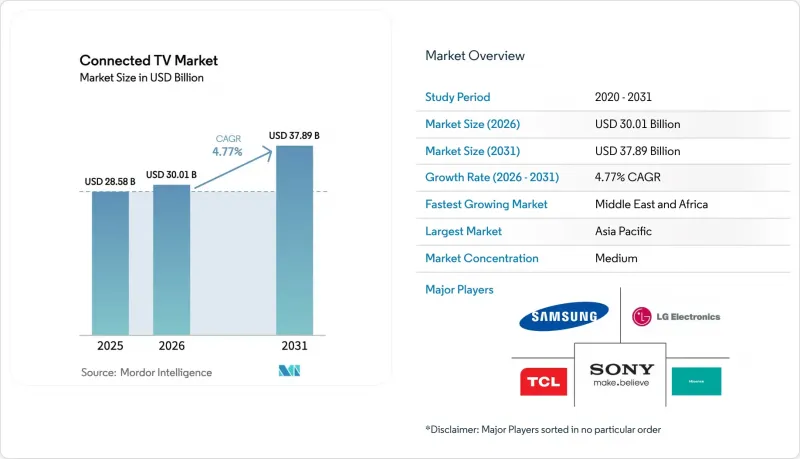
Mordor Intelligence에 의하면, 커넥티드 TV 시장 규모는 2025년 285억 8,000만 달러로 평가되었고, 2026년 300억 1,000만 달러에서 2031년까지 378억 9,000만 달러로 확대될 것으로 예측되며, 2026-2031년 연평균 복합 성장률(CAGR)은 4.77%를 나타낼 전망입니다.

본 보고서는 기기별(스마트 TV 등), 운영체제별(Android TV/Google TV, Tizen 등), 화면 크기별(32인치 이하 등), 해상도별(4K UHD, 8K, FHD 및 HD), 패널 기술별(LED/미니 LED, OLED, QLED), 판매 채널별(온라인, 오프라인), 용도별(가정용, 업무용) 및 지역별로 분류되어 있습니다. 시장 전망은 금액(달러) 기준으로 제시되어 있습니다.
세계의 커넥티드 TV 시장 동향 및 인사이트
광고 지원형 FAST 채널의 보급이 북미의 ARPU를 끌어올리며
2025년, 광고 수익형 무료 스트리밍 TV 시장 규모는 103억 9,000만 달러에 달했습니다. 이는 미국에서 9,640만 가구가 전년 대비 43% 증가한 시청 시간을 기록했기 때문입니다. 광고주들은 결정론적 타겟팅에 대해 프리미엄 CPM을 지불하고 있으며, 이로 인해 사용자 1인당 평균 수익(ARPU)은 시청자 수 증가율을 상회하는 속도로 상승하고 있습니다. Roku는 같은 해 354억 플랫폼 시간을 기록하며, 숏폼 소셜 동영상에 비해 시청 체류 시간이 길다는 장점을 부각시켰습니다. FAST의 성장세는 벤더들이 기기 가격을 보조하는 인센티브가 되고 있으며, 이는 Amazon과 Roku가 대규모로 입증한 비즈니스 모델입니다. 따라서 광고 수익률의 상승은 하드웨어 보급, 참여도 심화, 그리고 지속적인 수익 창출을 모두 동시에 뒷받침하고 있습니다.
기기 내 GenAI를 통한 업스케일링이 중국과 한국에서 4K로의 교체 주기를 촉진
Samsung Electronics와 LG전자는 2025년 스마트 TV 라인업에 HD 스트림을 4K에 가까운 화질로 업스케일링하고 클라우드 지연을 해소하는 신경망 프로세서를 탑재했습니다. 미디어텍의 MT9638 칩은 TCL과 하이센스의 중급 기종에도 유사한 기능을 제공하여 AI 시청의 비용 장벽을 낮췄습니다. 기존 HD 컨텐츠를 풍부하게 보유한 중국 가정에서는 새로운 4K 패널의 구체적인 이점을 느끼기 시작했으며, 한편 한국의 구매자들은 AI를 미래를 내다보는 투자로 인식하고 있습니다. 주요 도시 지역에서는 교체 주기가 7년에서 5년으로 단축되었으며, 프리미엄층의 판매 대수와 평균 판매 가격(ASP)이 상승하고 있습니다.
분산된 CTV OS 생태계로 인해 OTT 제공업체의 앱 이식 및 품질 보증(QA) 비용이 증가하고 있다.
OTT 사업자는 Tizen, Android TV, webOS, Roku OS, Fire OS와 같은 각 플랫폼의 코드베이스를 동시에 관리해야 합니다. 각 플랫폼마다 독자적인 SDK, 인증, 회귀 테스트 주기가 필요하기 때문에 소규모 팀에게는 큰 부담이 되고 있습니다. Pluto TV는 2025년 말에 구형 기기에 대한 지원을 종료했는데, 이는 파편화가 제품의 노후화를 얼마나 가속화하는지를 보여줍니다. 플랫폼별 애드테크 구현은 비용을 증가시키고, 틈새 서비스의 롱테일 성장을 억제하는 동시에, 다중 OS 개발 부담을 떠안아 줄 수 있는 기존 기업에 권력을 집중시키고 있습니다.
부문 분석
스트리밍용 동글 및 박스는 2031년까지 연평균 성장률(CAGR) 5.12%라는 비교적 높은 성장률을 보일 것으로 예상되는 반면, 스마트 TV는 여전히 78.12%라는 압도적인 출하 대수 점유율을 유지하고 있습니다. 스트리밍 기업용 커넥티드 TV 시장 규모는 기존 TV에 저렴한 동글을 추가하는 가구와 내장 스토리지 및 OS의 노후화에 직면한 ‘코드 커터’ 수요에 의해 지탱되고 있습니다. 아마존은 3억 대 이상의 Fire TV 기기를 판매하고 있으며, 최근에는 대화형 검색을 구현하는 알렉사(Alexa)와 생성형 AI를 결합한 ‘알렉사+(Alexa+)’를 통해 UI를 개편했습니다. 2025년 초 미국, 캐나다, 멕시코에서 판매량 1위를 차지한 Roku OS는 내장형과 외장형 프로파일을 모두 지원하여, TV 본체를 전면적으로 교체할 필요 없이 커넥티드 TV 시장의 확장을 뒷받침하고 있습니다.
게임을 주된 목적으로 하는 구매자는 콘솔이나 클라우드 게임 클라이언트가 통합된 TV를 선호합니다. 마이크로소프트는 2025년에 ‘Xbox Cloud Gaming’을 LG TV로 확대했으며, TCL은 2026년에 네이티브 144Hz 클라우드 게임을 지원하는 ‘X11L’을 출시했습니다. 콘솔은 여전히 틈새 시장이지만, 세션 시간을 연장하고 프리미엄 계층의 평균 판매 가격(ASP)을 끌어올리며, 엔트리 레벨 하드웨어가 상당한 보조금을 받고 있는 경우에도 공급업체의 이익률을 보완하고 있습니다.
Android TV와 Google TV는 부상하고 있으며, 2026-2031년 연평균 성장률(CAGR) 5.89%로 성장을 지속할 전망입니다. 이러한 변화는 각 제조업체가 독자적인 시스템에서 전환하여 Google Play 접근성과 Gemini AI의 이점을 추구하고 있기 때문입니다. Android TV OS 10 이상 사양의 도입으로 성능과 내구성이 현저히 향상되었으며, 기존의 파편화 문제가 효과적으로 해결되었습니다. 이러한 진보로 인해 일관되고 고성능의 사용자 경험을 제공하고자 하는 제조업체들에게 Android TV와 Google TV의 매력은 점점 더 커지고 있습니다.
이러한 플랫폼의 채택 확대는 진화하는 소비자의 기대에 부응하기 위해 업계가 표준화와 기능 강화에 주력하고 있음을 여실히 보여줍니다. webOS와 Roku OS는 모두 시장 점유율에서 한 자릿수 중반대를 차지하고 있으며, 직관적인 사용자 인터페이스 제공과 광고 수익 극대화에 중점을 두고 있습니다. 안드로이드를 기반으로 하는 아마존의 파이어 OS는 아마존 스트리밍 스틱 및 일부 타사 기기를 구동하며, 광고를 통한 수익 창출에 명확한 중점을 두고 있습니다. 특히 중소규모 브랜드들은 자체 소프트웨어 개발의 필요성을 피하기 위해 로쿠 OS나 파이어 OS를 채택하는 경향이 강해지고 있습니다. 이러한 추세는 제품 차별화보다 신속한 시장 진입이 우선시되는 신흥 시장에서 더욱 가속화되고 있습니다. 중소규모 브랜드들이 이러한 플랫폼을 선호하는 현상은 경쟁 환경에서 비용 효율성과 시장 출시 기간 단축이 얼마나 중요한지를 여실히 보여줍니다.
거실의 형태가 변화하고 100인치급 제품의 가격이 하락하는 가운데, 66인치를 초과하는 패널 시장은 연평균 성장률(CAGR) 5.21%로 성장을 지속하고, 있습니다. Omdia는 80인치 이상 출하 대수 증가를 예측하고 있으며, 2025년 900만 대에서 2029년에는 1,300만 대에 달할 것으로 전망하고 있습니다. 이러한 성장은 특히 홈 엔터테인먼트 환경에서 시청 경험을 향상시키는 대형 스크린에 대한 소비자 수요에 의해 주도되고 있습니다. 2025년, 삼성, 하이센스, TCL은 홈 시어터 애호가와 기존에는 프로젝터에 의존하던 상업시설을 모두 타겟으로 115인치 모델을 출시했습니다. 이러한 대형 스크린은 몰입감 있는 경험을 추구하는 소비자나 디스플레이 솔루션 업그레이드를 목표로 하는 기업에게 점점 더 매력적인 선택지가 되고 있습니다. 2025년 32.16%의 점유율을 차지한 46-55인치 부문은 가격과 시청 거리의 균형이 잘 잡혀 있어 계속해서 시장을 주도하고 있습니다.
46-55인치 부문은 합리적인 가격과 일반적인 거실 크기에 적합하다는 점으로 인해 일반 가정에서 여전히 인기를 끌고 있습니다. 한편, 생산 효율성 향상으로 65인치 TV가 보급형 가격으로 제공되는 사례가 늘어나면서, 일반 가정의 대형 화면으로의 교체 수요를 촉진하고 있습니다. 한편, 32인치 미만의 디스플레이는 공간이나 예산 제약으로 인해 크기가 제한되는 주방, 침실 및 호스피탈리티 업계에서 여전히 입지를 유지하고 있습니다. 이러한 소형 디스플레이는 틈새 용도에 대응하고 있으며, 대형 디스플레이에 대한 선호도가 높아지는 상황 속에서도 특정 이용 사례에서 그 중요성을 유지하고 있습니다.
지역별 분석
2025년에는 중국의 생산 규모, 인도의 통신 사업자 보조금, 그리고 한국의 프리미엄 시장에서의 리더십 덕분에 아시아태평양이 44.53%의 시장 점유율을 차지했습니다. 샤오미(Xiaomi), 하이얼(Haier), TCL 등의 중국 브랜드는 국내 시장에서 적극적인 가격 정책을 펼치는 한편, 공장 가동률을 안정시키기 위해 수출도 진행했습니다. 인도에서는 Reliance Jio와 Airtel의 번들 요금제 덕분에 1급 도시 이외의 지역으로의 보급이 확대되었습니다. 한국은 독자적인 패널과 운영 체제를 통해 OLED 및 QLED 매출에서 압도적인 점유율을 차지했습니다.
중동 및 아프리카은 아랍에미리트(UAE)와 사우디아라비아의 광섬유망 구축으로 대역폭 병목 현상이 해소됨에 따라 연평균 성장률(CAGR) 5.72%로 가장 높은 성장이 예상됩니다. ‘사우디 비전 2030’에 기반한 정부의 광대역 정책이 UHD 스트리밍 및 대형 TV의 보급을 뒷받침하고 있습니다. 북미는 높은 광고 수익 덕분에 계속해서 높은 가치를 유지하고 있습니다. 컴스코어(Comscore)의 조사에 따르면, 2025년에는 커넥티드 TV를 도입한 가구 수가 9,640만 가구에 달할 것으로 예상되며, OpenAP와 CFlight의 등장으로 광고주는 중복 제거된 도달 지표(reach)를 활용해 플랫폼 전반에 걸쳐 광고 공간을 구매할 수 있게 되어,예산이 선형 TV에서 점차 이동하고 있습니다.
유럽에서는 8K 및 초고휘도 패널의 보급을 억제하는 엄격한 에너지 규제에 직면해 있습니다. 그러나 스웨덴에서 광섬유 보급률이 90%를 넘고, 노르웨이, 스웨덴, 덴마크에서 스트리밍 서비스 가입자가 견조한 북유럽 국가들에서는 UHD 보급이 순조롭게 진행되고 있습니다. 남미와 아프리카는 여전히 보급형 스마트 TV 시장에 머물러 있습니다. 도시화와 모바일 광대역의 확대가 새로운 기회를 창출하고 있지만, 가격에 대한 민감성과 유통망의 취약성으로 인해 현재로서는 프리미엄 제품의 보급은 제한적입니다.
기타 혜택:
- 엑셀 형식 시장 예측(ME) 시트
- 3개월간의 애널리스트 지원
자주 묻는 질문
목차
제1장 서론
제2장 조사 방법
제3장 주요 요약
제4장 시장 구도
제5장 시장 규모 및 성장 예측
제6장 경쟁 구도
제7장 시장 기회 및 향후 전망
AJY 26.09.15According to Mordor Intelligence, the connected TV market size is projected to expand from USD 28.58 billion in 2025 and USD 30.01 billion in 2026 to USD 37.89 billion by 2031, registering a CAGR of 4.77% between 2026 to 2031.
This report is Segmented by Device (Smart TV, and More), Operating System (Android TV/Google TV, Tizen, and More), Screen Size (Up To 32 Inch, and More), Resolution (4K UHD, 8K, and FHD and HD), Panel Technology (LED/Mini-LED, OLED, and QLED), Distribution Channel (Online, and Offline), End-Use (Residential, A Dn Commercial), and Geography. The Market Forecasts are Provided in Terms of Value (USD).
Global Connected TV Market Trends and Insights
Proliferation of Ad-Supported FAST Channels Elevating ARPU in North America
Free ad-supported streaming television generated USD 10.39 billion in 2025 as 96.4 million U.S. homes streamed 43% more hours than a year earlier. Advertisers pay premium CPMs for deterministic targeting, lifting average revenue per user faster than audience growth. Roku logged 35.4 billion platform hours that year, highlighting dwell-time advantages over short-form social video. FAST momentum incentivizes vendors to subsidize device prices, a model Amazon and Roku have proven at scale. Higher advertising yield therefore supports hardware penetration, deeper engagement, and recurring revenue all at once.
On-Device GenAI Upscaling Spurs 4K Upgrade Cycle in China and South Korea
Samsung and LG fitted 2025 smart-TV lineups with neural processors that upscale HD streams into near-4K images, eliminating cloud latency. MediaTek's MT9638 chip pushed similar capability into mid-tier sets from TCL and Hisense, lowering the cost barrier for AI viewing. Chinese homes rich in legacy HD libraries now see tangible benefits in new 4K panels, while South Korean buyers view AI as futureproofing. Replacement cycles shortened from seven to five years in major metros, raising premium-tier volumes and ASPs.
Fragmented CTV OS Ecosystem Escalates App Porting and QA Costs for OTT Providers
OTT players juggle codebases for Tizen, Android TV, webOS, Roku OS, and Fire OS. Each platform demands its own SDK, certification, and regression testing cycle, stretching smaller teams. Pluto TV ceased support for older devices in late-2025, showing how fragmentation accelerates obsolescence. Platform-specific ad-tech implementations multiply costs, curbing the long-tail of niche services and concentrating power with incumbents that can shoulder multi-OS development burdens.
Other drivers and restraints analyzed in the detailed report include:
- Subsidised Operator-Bundled Smart TVs Accelerating First-Time Adoption in India and Indonesia
- Advertising Measurement Standardisation Driving Brand Budgets to CTV in United States
- Restrictive EU Energy-Efficiency Caps Curb 8K Panel Shipments
For complete list of drivers and restraints, kindly check the Table Of Contents.
Segment Analysis
Streaming dongles and boxes claim a faster 5.12% CAGR through 2031 while smart TVs still hold a dominant 78.12% unit share. The connected TV market size for streaming players benefits from households adding cheap dongles to legacy panels and from cord-cutters whose embedded storage or OS age out. Amazon has sold more than 300 million Fire TV devices, recently refreshing UI with Alexa+ generative AI for conversational discovery. Roku OS, topping sales in United States, Canada, and Mexico in early 2025, straddles both embedded and external profiles, helping the connected TV market expand without waiting for full-set replacement.
Gaming-centric buyers favour consoles or TVs with integrated cloud-gaming clients. Microsoft broadened Xbox Cloud Gaming to LG sets in 2025, and TCL introduced X11L with native 144 Hz cloud-gaming support in 2026. While consoles remain niche, their presence extends session length and lifts premium-tier ASPs, cushioning vendor margins even when entry hardware is heavily subsidized.
Android TV and Google TV are on the rise, boasting a 5.89% CAGR during 2026 to 2031. This shift comes as manufacturers pivot from proprietary systems, seeking access to Google Play and the advantages of Gemini AI. With the introduction of mandatory Android TV OS 10+ specifications, performance and longevity have seen marked improvements, effectively tackling past fragmentation issues. These advancements have made Android TV and Google TV increasingly attractive to manufacturers aiming to deliver consistent and high-performing user experiences.
The growing adoption of these platforms highlights the industry's focus on standardization and enhanced functionality to meet evolving consumer expectations. Both webOS and Roku OS, each capturing a mid-single-digit share, focus on delivering an intuitive user interface and maximizing ad revenues. Amazon's Fire OS, a derivative of Android, powers both Amazon's streaming sticks and select third-party devices, with a clear emphasis on advertising monetization. Notably, smaller brands are increasingly leaning towards Roku OS or Fire OS, sidestepping the need for in-house software development. This trend is gaining momentum in emerging markets, where rapid market entry is prioritized over extensive product differentiation. The preference for these platforms among smaller brands underscores the importance of cost efficiency and faster time-to-market in competitive and resource-constrained environments.
As living rooms evolve and 100-inch class prices decline, panels exceeding 66 inches are witnessing a 5.21% CAGR. Omdia forecasts an increase in units of 80 inches and above, projecting 13 million by 2029, a rise from 9 million in 2025. This growth is driven by consumer demand for larger screens that enhance the viewing experience, particularly in home entertainment setups. In 2025, Samsung, Hisense, and TCL introduced 115-inch models, targeting both home-theater enthusiasts and commercial venues that previously relied on projectors. These larger screens are increasingly appealing to consumers seeking immersive experiences and businesses aiming to upgrade their display solutions. The 46-55-inch segment, commanding a 32.16% share in 2025, continues to dominate, striking a balance between price and viewing distance.
The 46-55-inch segment remains popular among households due to its affordability and suitability for average living room dimensions. Meanwhile, with improving yields, 65-inch sets are increasingly being offered at entry-level prices, encouraging households to upgrade to larger screens. Sub-32-inch screens, on the other hand, maintain their presence in kitchens, bedrooms, and hospitality settings, where space and budget limitations dictate size. These smaller screens cater to niche applications, ensuring their relevance in specific use cases despite the growing preference for larger displays.
Complete Report Scope:
- By Device
- Smart TV
- 4K and UHD Smart TV
- 8K Smart TV
- HD/FHD Smart TV
- Streaming Media Player
- Gaming Console (Streaming Enabled)
- Smart TV
- By Operating System
- Android TV / Google TV
- Tizen
- webOS
- Roku OS
- Fire OS
- By Screen Size
- Up to 32 inch
- 33-45 inch
- 46-55 inch
- 56-65 inch
- Above 66 inch
- By Resolution
- 4K UHD
- 8K
- FHD and HD
- By Panel Technology
- LED / Mini-LED
- OLED
- QLED
- By Distribution Channel
- Online
- Offline (Speciality, Mass-Retail)
- By End-Use
- Residential
- Commercial (Hospitality, Education, Corp-Lobby, Digital-Signage)
- Geography
- North America
- United States
- Canada
- Mexico
- Europe
- Germany
- United Kingdom
- France
- Italy
- Spain
- Rest of Europe
- Asia Pacific
- China
- Japan
- South Korea
- India
- South East Asia
- Australia
- Rest of Asia Pacific
- South America
- Brazil
- Rest of South America
- Middle East
- United Arab Emirates
- Saudi Arabia
- Rest of Middle East
- Africa
- South Africa
- Rest of Africa
- North America
Geography Analysis
Asia Pacific owned 44.53% market share in 2025 thanks to China's output scale, India's operator subsidies, and South Korea's premium leadership. Chinese brands such as Xiaomi, Haier, and TCL priced aggressively at home while exporting to stabilize factory loads. Reliance Jio and Airtel's bundles drove penetration beyond tier-1 cities in India. South Korea commanded outsized OLED and QLED revenue through proprietary panels and operating systems.
The Middle East and Africa is set for the fastest 5.72% CAGR as United Arab Emirates and Saudi Arabia fibre rollouts remove bandwidth bottlenecks. Government broadband initiatives under Saudi Vision 2030 stimulate UHD streaming and large-screen uptake. North America stays high value due to advertising yield. Comscore counted 96.4 million connected-TV households in 2025, and OpenAP plus CFlight now let advertisers buy across platforms with de-duplicated reach metrics, moving budgets from linear TV.
Europe grapples with strict energy rules throttling 8K and ultra-bright panels. Yet Nordic nations, with fiber penetration above 90% in Sweden and strong streaming subscriptions across Norway, Sweden, and Denmark, enjoy robust UHD take-up. South America and Africa remain entry-level smart-TV territories. Urbanization and mobile-broadband expansion open opportunities, but price sensitivity and weaker distribution limit premium penetration for now.
- Samsung Electronics Co. Ltd.
- LG Electronics Inc.
- TCL Technology Group Corp.
- Hisense Group Co. Ltd.
- Sony Group Corporation
- Vizio Inc.
- Skyworth Group Ltd.
- Panasonic Holdings Corp.
- Sharp Corp.
- Xiaomi Corp.
- Haier Group Corp.
- Amazon.com Inc. (Fire TV)
- Apple Inc. (Apple TV)
- Roku Inc.
- Alphabet Inc. (Chromecast / Google TV)
- Philips (TPV Technology)
- Vestel Elektronik Sanayi ve Ticaret A.S.
- Funai Electric Co. Ltd.
- Konka Group Co. Ltd.
- Nvidia Corp. (Shield TV)
- Huawei Technologies Co. Ltd.
- Alibaba Group (Tmall Magic Box)
- Realme (BBK Electronics)
- OnePlus Technology (Shenzhen) Co. Ltd.
Additional Benefits:
- The market estimate (ME) sheet in Excel format
- 3 months of analyst support
TABLE OF CONTENTS
1 INTRODUCTION
- 1.1 Study Assumptions and Market Definition
- 1.2 Scope of the Study
2 RESEARCH METHODOLOGY
3 EXECUTIVE SUMMARY
4 MARKET LANDSCAPE
- 4.1 Market Overview
- 4.2 Market Drivers
- 4.2.1 Proliferation of Ad-Supported FAST Channels Elevating ARPU in North America
- 4.2.2 Subsidised Operator-Bundled Smart TVs Accelerating First-Time Adoption in India and Indonesia
- 4.2.3 On-Device GenAI Upscaling Spurs 4K Upgrade Cycle in China and South Korea
- 4.2.4 Household Fibre Roll-outs Above 100 Mbps Boosting UHD Streaming in Nordics
- 4.2.5 Advertising Measurement Standardisation (OpenAP, CFlight) Driving Brand Budgets to CTV in US
- 4.2.6 Cloud-Rendered Gaming Partnerships Creating New Use-Cases
- 4.3 Market Restraints
- 4.3.1 Fragmented CTV OS Ecosystem Escalates App Porting and QA Costs for OTT Providers
- 4.3.2 Restrictive EU Energy-Efficiency Caps Curb 8K Panel Shipments
- 4.3.3 Persistent Mid-Tier TV SoC Shortages Inflating BOM Costs
- 4.3.4 Heightened Consumer Data-Privacy Scrutiny Limits Cross-Device Targeting
- 4.4 Impact of Macroeconomic Factors on the Market
- 4.5 Industry Supply Chain Analysis
- 4.6 Regulatory Landscape
- 4.7 Technological Outlook
- 4.8 Porter's Five Forces Analysis
- 4.8.1 Bargaining Power of Suppliers
- 4.8.2 Bargaining Power of Buyers
- 4.8.3 Threat of New Entrants
- 4.8.4 Threat of Substitutes
- 4.8.5 Intensity of Competitive Rivalry
- 4.9 Industry Stakeholder Analysis
5 MARKET SIZE AND GROWTH FORECASTS (VALUES)
- 5.1 By Device
- 5.1.1 Smart TV
- 5.1.1.1 4K and UHD Smart TV
- 5.1.1.2 8K Smart TV
- 5.1.1.3 HD/FHD Smart TV
- 5.1.2 Streaming Media Player
- 5.1.3 Gaming Console (Streaming Enabled)
- 5.1.1 Smart TV
- 5.2 By Operating System
- 5.2.1 Android TV / Google TV
- 5.2.2 Tizen
- 5.2.3 webOS
- 5.2.4 Roku OS
- 5.2.5 Fire OS
- 5.3 By Screen Size
- 5.3.1 Up to 32 inch
- 5.3.2 33-45 inch
- 5.3.3 46-55 inch
- 5.3.4 56-65 inch
- 5.3.5 Above 66 inch
- 5.4 By Resolution
- 5.4.1 4K UHD
- 5.4.2 8K
- 5.4.3 FHD and HD
- 5.5 By Panel Technology
- 5.5.1 LED / Mini-LED
- 5.5.2 OLED
- 5.5.3 QLED
- 5.6 By Distribution Channel
- 5.6.1 Online
- 5.6.2 Offline (Speciality, Mass-Retail)
- 5.7 By End-Use
- 5.7.1 Residential
- 5.7.2 Commercial (Hospitality, Education, Corp-Lobby, Digital-Signage)
- 5.8 Geography
- 5.8.1 North America
- 5.8.1.1 United States
- 5.8.1.2 Canada
- 5.8.1.3 Mexico
- 5.8.2 Europe
- 5.8.2.1 Germany
- 5.8.2.2 United Kingdom
- 5.8.2.3 France
- 5.8.2.4 Italy
- 5.8.2.5 Spain
- 5.8.2.6 Rest of Europe
- 5.8.3 Asia Pacific
- 5.8.3.1 China
- 5.8.3.2 Japan
- 5.8.3.3 South Korea
- 5.8.3.4 India
- 5.8.3.5 South East Asia
- 5.8.3.6 Australia
- 5.8.3.7 Rest of Asia Pacific
- 5.8.4 South America
- 5.8.4.1 Brazil
- 5.8.4.2 Rest of South America
- 5.8.5 Middle East
- 5.8.5.1 United Arab Emirates
- 5.8.5.2 Saudi Arabia
- 5.8.5.3 Rest of Middle East
- 5.8.6 Africa
- 5.8.6.1 South Africa
- 5.8.6.2 Rest of Africa
- 5.8.1 North America
6 COMPETITIVE LANDSCAPE
- 6.1 Market Concentration
- 6.2 Strategic Moves (M&A, JV, Licensing, Content Bundling)
- 6.3 Market Share Analysis
- 6.3.1 Global Connected TV Unit Shares
- 6.3.2 Smart TV Vendor Share Analysis
- 6.3.3 Streaming Media Player Vendor Share Analysis
- 6.4 Company Profiles (includes Global-Level Overview, Market-Level Overview, Core Segments, Financials as Available, Strategic Information, Market Rank / Share, Products and Services, Recent Developments)
- 6.4.1 Samsung Electronics Co. Ltd.
- 6.4.2 LG Electronics Inc.
- 6.4.3 TCL Technology Group Corp.
- 6.4.4 Hisense Group Co. Ltd.
- 6.4.5 Sony Group Corporation
- 6.4.6 Vizio Inc.
- 6.4.7 Skyworth Group Ltd.
- 6.4.8 Panasonic Holdings Corp.
- 6.4.9 Sharp Corp.
- 6.4.10 Xiaomi Corp.
- 6.4.11 Haier Group Corp.
- 6.4.12 Amazon.com Inc. (Fire TV)
- 6.4.13 Apple Inc. (Apple TV)
- 6.4.14 Roku Inc.
- 6.4.15 Alphabet Inc. (Chromecast / Google TV)
- 6.4.16 Philips (TPV Technology)
- 6.4.17 Vestel Elektronik Sanayi ve Ticaret A.S.
- 6.4.18 Funai Electric Co. Ltd.
- 6.4.19 Konka Group Co. Ltd.
- 6.4.20 Nvidia Corp. (Shield TV)
- 6.4.21 Huawei Technologies Co. Ltd.
- 6.4.22 Alibaba Group (Tmall Magic Box)
- 6.4.23 Realme (BBK Electronics)
- 6.4.24 OnePlus Technology (Shenzhen) Co. Ltd.
7 MARKET OPPORTUNITIES AND FUTURE OUTLOOK
- 7.1 White-Space and Unmet-Need Assessment


