

|
시장보고서
상품코드
2118166
중동 및 아프리카의 관개용 펌프 시장 : 시장 점유율 분석, 업계 동향 및 통계, 성장 예측(2026-2031년)Middle East and Africa Irrigation Pumps - Market Share Analysis, Industry Trends & Statistics, Growth Forecasts (2026 - 2031) |
||||||
 Mordor Intelligence
Mordor Intelligence에 의하면, 중동 및 아프리카의 관개용 펌프 시장 규모는 2025년 80억 3,000만 달러로 평가되었고, 2026년 86억 1,000만 달러에서 2031년까지 121억 4,000만 달러로 확대될 것으로 예측되며, 2026-2031년 연평균 복합 성장률(CAGR)은 7.11%를 나타낼 전망입니다.
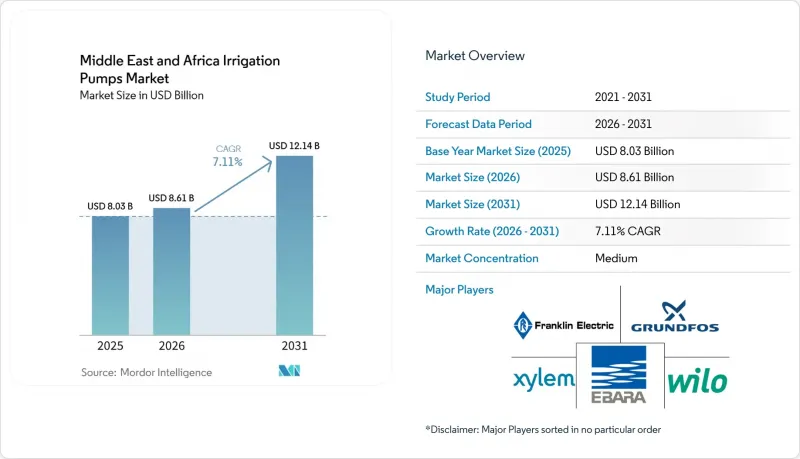
본 보고서는 유형별(수중 펌프, 원심 펌프, 소용돌이 펌프, 기타 관개용 펌프) 및 지역별(중동 및 아프리카)로 분류되어 있습니다. 본 보고서에서는 시장 규모 및 전망을 금액(달러) 기준으로 제시하고 있습니다.
중동 및 아프리카의 관개용 펌프 시장 동향 및 인사이트
물 부족에 시달리는 농장에서의 가압 관개 확대
이 지역의 많은 농업 지대에서 침수 관개는 점적 관개, 스프링클러 관개 및 미세 관개 시스템에 점차 그 자리를 내주고 있습니다. 이러한 변화가 중요한 이유는 가압 관개에는 기본적인 침수 관개 시스템보다 더 높은 신뢰성의 펌프 성능과 더 정밀한 압력 제어가 필요하기 때문입니다. 사우디아라비아 관개 기구와 국제관개배수위원회(ICID)는 2024년에 ‘지속 가능한 개발을 위한 관개 부문 통합 관리’를 추진하여, 사우디아라비아 농가들의 효율적인 관개와 물 생산성 향상을 도모했습니다. 또한 모로코에서는 2025년에 시작된 ‘사이스 관개 프로젝트 3’을 통해 배수 인프라를 확충하고, M&Dez 댐에서 연간 1억 2,500만 입방미터의 물을 공급할 계획입니다. 이러한 프로젝트로 인해 표준 원심 펌프뿐만 아니라 부스터 시스템, 압력 조절 펌프 세트, 배수 펌프에 대한 수요가 증가하고 있습니다. 이러한 변화는 중동 및 아프리카 관개용 펌프 시장의 판매 구성을 개선하고 있습니다. 이는 더 높은 기술을 요하는 시스템일수록 일반적으로 단가가 높아지기 때문입니다. 또한 구형 펌프는 현대 관개 시스템의 압력 및 유량 안정성 요건을 충족하지 못하는 경우가 많기 때문에 이러한 변화는 교체 수요도 촉진하고 있습니다. 그 결과, 절수형 관개 기법이 펌프 시스템에 대한 수요 증가 및 농장 수준의 기술 요건 고도화로 직접 이어지는 시장이 형성되고 있습니다.
Off-grid 관개 클러스터에서의 태양광 발전식 펌프 도입 확대
태양광 발전식 펌프는 중동 및 아프리카의 관개용 펌프 시장에서 가장 뚜렷한 성장 테마 중 하나로 자리 잡고 있습니다. 이는 광대한 농업 지역에서 여전히 신뢰할 수 있는 송전망을 통한 전력 공급이 부족하고, 농촌 지역의 관개 사업에서 디젤 연료비가 여전히 부담으로 작용하고 있기 때문입니다. 에티오피아에서는 산발적인 시범 사업에서 본격적인 확대 단계로 넘어가고 있으며, 국제수자원관리연구소(IWMI)가 2026년까지 1,750대의 태양광 발전식 펌프를 도입하기 위한 전국적인 플랫폼을 마련하고 있습니다. 모로코에서도 태양광 발전 기반 관개용 펌프의 운영 실적이 두드러집니다. 사우디아라비아에서는 2025년 10월 Nuuko Power사가 리야드에서 완공한 4.58 MW 규모의 태양광 발전식 양수 설비가 2,560에이커에 달하는 관개를 수행하면서 연간 운영 비용을 절감했습니다. 또한, 태양광 발전 도입이 진행됨에 따라 공급업체 기반도 확대되고 있습니다. 이는 저비용 제조업체들이 투자 회수 및 연료비 절감을 중시하는 구매자들과 더 효과적으로 경쟁할 수 있게 되었기 때문입니다. 이러한 확산이 지속됨에 따라 중동 및 아프리카의 관개용 펌프 시장은 전 세계 펌프 브랜드, 현지 판매 파트너, 그리고 태양광 발전에 특화된 신규 진출기업을 포함한 다양한 경쟁 구도로 변화하고 있습니다.
농촌 지역 관개 회랑의 전력망 신뢰성 부족
많은 관개 지역에서 전력 공급의 불안정성은 전동 펌프의 더 빠른 보급을 저해하는 가장 명백한 장벽 중 하나로 남아 있습니다. 전압 변동이나 정전은 모터와 제어 부품에 손상을 줄 수 있으며, 이는 유지보수 비용을 증가시키고 생산자의 신뢰를 떨어뜨리게 됩니다. 전력 공급이 불안정한 지역에서는 농가들이 디젤 펌프를 계속 사용하거나, 더 첨단적인 전기 시스템으로의 교체를 미루는 경우가 많습니다. 이로 인해 안정적인 전압이 필요한 가변 속도 드라이브나 지능형 제어 시스템의 보급이 제한되고 있습니다. 또한 관개 확대가 가장 시급한 지역에서도 도입이 지연되고 있습니다. 그 결과, 중동 및 아프리카의 관개용 펌프 시장에서는 많은 농촌 지역에서 최첨단 전기 기술의 혜택을 충분히 누리지 못하고 있습니다. 실질적인 결과로, 전력 품질, 자금 조달, 기술 지원이 잘 갖춰진 지역에서만 최신 장비에 대한 수요가 가장 빠르게 증가하고 있는 양극화된 시장 상황이 발생하고 있습니다. 게다가 불안정한 전력 공급은 관개 일정 수립을 어렵게 하고, 생육기 성수기의 운영 효율을 저하시키며, 자동 관개 인프라에 대한 투자를 저해함으로써 농업 지역 전체의 장기적인 현대화 노력을 더욱 제약하고 있습니다.
부문 분석
2025년, 중동 및 아프리카의 관개용 펌프 시장에서 수중 펌프는 41.8%의 점유율을 차지하며 주요 유형 부문이 되었습니다. 이는 사우디아라비아, 이집트 및 북아프리카의 일부 건조 농경지에서 심정 관개가 여전히 중심적인 역할을 하고 있기 때문입니다. 이러한 확고한 지위는 특히 지표수 접근이 제한적이거나 불균일한 지역에서 해당 지역이 관개용으로 지하수에 계속 의존하고 있음을 반영합니다. 원심 펌프는 수로를 이용한 농업이나 지표 관개 시스템에서 여전히 중요한 역할을 하고 있는 반면, 와류 펌프는 침전물이 포함된 수질 조건에서 사용되었습니다. 그 밖의 관개용 펌프 유형들도 농업 분야의 특수한 유량 요구 사항을 계속해서 충족시키고 있습니다.
수중 펌프는 더 깊은 우물의 이용, 태양광 발전의 도입 확대, 그리고 지하수에 의존하는 농업 지역의 지속적인 관개 수요에 힘입어 2026-2031년 연평균 성장률(CAGR) 8.5%라는 가장 높은 성장률을 보일 것으로 예측됩니다. 이러한 성장은 사막 지대의 농업 및 외딴 지역의 관개 회랑에서 신뢰할 수 있는 고양정 펌프에 대한 수요와도 밀접한 관련이 있습니다. 원심 펌프는 새로운 배수 네트워크와 지표수 관개 프로젝트가 개발되고 있는 지역, 특히 모로코의 사이스(Saiss) 프로젝트와 같은 체계적인 계획에서 꾸준한 확장이 예상됩니다. 와류 펌프는 부유 물질이 포함된 용도에서 규모는 작지만 안정적인 역할을 유지할 것으로 예측됩니다. 한편, 그 밖의 관개용 펌프 유형은 틈새 시장인 대유량 농업 용도에서 계속해서 활용될 것입니다.
기타 혜택 :
- 엑셀 형식 시장 예측(ME) 시트
- 3개월간의 애널리스트 지원
자주 묻는 질문
목차
제1장 서론
제2장 조사 방법
제3장 주요 요약
제4장 시장 역학
제5장 시장 규모 및 성장 예측
제6장 경쟁 구도
제7장 시장 기회 및 향후 전망
AJY 26.09.03According to Mordor Intelligence, the Middle East and Africa irrigation pumps market size is projected to expand from USD 8.03 billion in 2025 and USD 8.61 billion in 2026 to USD 12.14 billion by 2031, registering a CAGR of 7.11% between 2026 and 2031.
This report is Segmented by Type (Submersible Pump, Centrifugal Pump, Vortex Pump, and Other Irrigation Pump Types) and by Geography (Middle East and Africa). The Report Offers Market Size and Forecasts in Terms of Value (USD).
Middle East and Africa Irrigation Pumps Market Trends and Insights
Expansion of Pressurized Irrigation in Water-Stressed Farms
Flood irrigation is steadily losing ground to drip, sprinkler, and micro-irrigation systems across many farming zones in this region. That change matters because pressurized irrigation needs more reliable pumping performance and tighter pressure control than basic flood systems. The Saudi Irrigation Organization and the International Commission on Irrigation and Drainage (ICID) worked on an Integrated Irrigation Sector Management for Sustainable Development in 2024 to promote efficient irrigation and better water productivity among farmers in Saudi Arabia. Morocco is also expanding distribution infrastructure through the Saiss irrigation project 3, initiated in 2025, to convey 125 million cubic meters of water each year from the M'Dez dam. These projects raise demand for booster systems, pressure-regulated pump sets, and distribution pumps rather than only standard centrifugal units. That shift improves the sales mix in the Middle East and Africa irrigation pumps market because more engineered systems usually carry a higher unit value. It also supports replacement demand, as older pumps often do not meet the pressure and flow stability requirements of modern irrigation layouts. The result is a market where water-saving irrigation methods are directly tied to stronger demand for pump systems and higher technical requirements at the farm level.
Rising Solar-Powered Pump Adoption in Off-Grid Irrigation Clusters
Solar pumping is becoming one of the clearest growth themes in the Middle East and Africa irrigation pumps market. This is because large agricultural areas still lack reliable grid electricity, and diesel costs remain a burden for irrigation operations in rural areas. Ethiopia is moving from scattered pilots to scale, with the International Water Management Institute coordinating a national platform to mobilize 1,750 solar pumps in 2026. Morocco also shows a strong operating case, with solar irrigation pumping. In Saudi Arabia, a 4.58 MW solar water-pumping installation completed in Riyadh by Nuuko Power in October 2025 irrigated 2,560 acres while reducing annual operating costs. Solar adoption is also widening the supplier base, as lower-cost manufacturers can compete more effectively with buyers who focus on payback and fuel savings. As this spread continues, the Middle East and Africa irrigation pumps market is moving closer to a mixed competitive structure that includes global pump brands, local channel partners, and solar-focused entrants.
Limited Grid Reliability in Rural Irrigation Corridors
Unreliable electricity supply remains one of the clearest barriers to faster adoption of electric pumps in many irrigation zones. Voltage fluctuations and outages can damage motors and control components, increasing maintenance costs and eroding growers' confidence. Where supply is unstable, farmers often stay with diesel or delay upgrades to more advanced electric systems. This limits the spread of variable-speed drives and intelligent control systems that need stable voltage to perform well. It also slows adoption in the very corridors where irrigation expansion is most needed. As a result, the Middle East and Africa irrigation pumps market cannot fully benefit from premium electric technologies in many rural areas. The practical outcome is a split market in which modern equipment demand grows fastest only where power quality, financing, and technical support are available. In addition, unreliable grid access complicates irrigation scheduling, reduces operational efficiency during peak growing periods, and discourages investment in automated irrigation infrastructure, further constraining long-term modernization efforts across agricultural regions.
Other drivers and restraints analyzed in the detailed report include:
- Government Subsidy Support for Irrigation Modernization
- Groundwater Dependence in Arid and Semi-Arid Farming Belts
- High Upfront Cost of Solar and Variable-Speed Pump Systems
For complete list of drivers and restraints, kindly check the Table Of Contents.
Segment Analysis
Submersible pumps accounted for 41.8% of the Middle East and Africa irrigation pump market share in 2025, making them the leading type segment, as deep-borehole irrigation remains central across Saudi Arabia, Egypt, and several arid farming zones in North Africa. Their strong position reflects the region's continued reliance on groundwater for irrigation, particularly in areas with limited or uneven access to surface water. Centrifugal pumps remained important in canal-fed agriculture and surface irrigation systems, while vortex pumps were used for sediment-laden water conditions. Other irrigation pump types continued to support specialized agricultural flow requirements.
Submersible pumps are anticipated to grow at the fastest rate, at a CAGR of 8.5% from 2026 to 2031, supported by deeper borehole use, rising solar integration, and continued irrigation demand across groundwater-dependent farming belts. Their growth is also tied to the need for reliable high-head pumping in desert agriculture and remote irrigation corridors. Centrifugal pumps are likely to see steady expansion where new distribution networks and surface-water irrigation projects are being developed, especially in organized schemes such as Morocco's Saiss project. Vortex pumps should retain a smaller but stable role in applications with suspended solids, while other irrigation pump types will continue serving niche high-flow agricultural uses.
Complete Report Scope:
- By Type
- Submersible Pump
- Centrifugal Pump
- Vortex Pump
- Other Irrigation Pump Types
- By Geography
- Middle East
- United Arab Emirates
- Saudi Arabia
- Qatar
- Kuwait
- Oman
- Bahrain
- Israel
- Rest of Middle East
- Africa
- Egypt
- South Africa
- Nigeria
- Kenya
- Morocco
- Algeria
- Ethiopia
- Rest of Africa
- Middle East
List of Companies Covered in this Report:
- Grundfos Holding A/S
- Xylem Inc.
- Franklin Electric Co., Inc.
- Ebara Corporation
- Wilo Group
- KSB SE and Co. KGaA
- Sulzer Ltd
- The Gorman-Rupp Company
- Kirloskar Brothers Limited
- Shakti Pumps (India) Limited
- Jain Irrigation Systems Ltd.
- Davey Water
- Valmont Industries, Inc
- LEO Group Pump (Zhejiang) Co., Ltd.
- Shimge Pump Industry Group Co., Ltd.
Additional Benefits:
- The market estimate (ME) sheet in Excel format
- 3 months of analyst support
TABLE OF CONTENTS
1 INTRODUCTION
- 1.1 Study Assumptions and Market Definition
- 1.2 Scope of the Study
2 RESEARCH METHODOLOGY
3 EXECUTIVE SUMMARY
4 MARKET DYNAMICS
- 4.1 Market Overview
- 4.2 Market Drivers
- 4.2.1 Expansion of pressurized irrigation in water-stressed farms
- 4.2.2 Rising solar-powered pump adoption in off-grid irrigation clusters
- 4.2.3 Government subsidy support for irrigation modernization
- 4.2.4 Replacement of diesel pumping with energy-efficient electric systems
- 4.2.5 Groundwater dependence in arid and semi-arid farming belts
- 4.2.6 Precision irrigation deployment on high-value crops
- 4.3 Market Restraints
- 4.3.1 Limited grid reliability in rural irrigation corridors
- 4.3.2 High upfront cost of solar and variable-speed pump systems
- 4.3.3 Borehole depletion increasing pump downtime and replacement burden
- 4.3.4 Fragmented farm sizes slowing standardized equipment adoption
- 4.4 Regulatory Landscape
- 4.5 Technological Outlook
- 4.6 Porter's Five Forces Analysis
- 4.6.1 Bargaining Power of Buyers
- 4.6.2 Bargaining Power of Suppliers
- 4.6.3 Threat of New Entrants
- 4.6.4 Threat of Substitute Products
- 4.6.5 Intensity of Competitive Rivalry
5 MARKET SIZE AND GROWTH FORECASTS (Value)
- 5.1 By Type
- 5.1.1 Submersible Pump
- 5.1.2 Centrifugal Pump
- 5.1.3 Vortex Pump
- 5.1.4 Other Irrigation Pump Types
- 5.2 By Geography
- 5.2.1 Middle East
- 5.2.1.1 United Arab Emirates
- 5.2.1.2 Saudi Arabia
- 5.2.1.3 Qatar
- 5.2.1.4 Kuwait
- 5.2.1.5 Oman
- 5.2.1.6 Bahrain
- 5.2.1.7 Israel
- 5.2.1.8 Rest of Middle East
- 5.2.2 Africa
- 5.2.2.1 Egypt
- 5.2.2.2 South Africa
- 5.2.2.3 Nigeria
- 5.2.2.4 Kenya
- 5.2.2.5 Morocco
- 5.2.2.6 Algeria
- 5.2.2.7 Ethiopia
- 5.2.2.8 Rest of Africa
- 5.2.1 Middle East
6 COMPETITIVE LANDSCAPE
- 6.1 Market Concentration
- 6.2 Strategic Moves
- 6.3 Market Share Analysis
- 6.4 Company Profiles (Includes Global Level Overview, Market Level Overview, Core Segments, Financials as Available, Strategic Information, Market Rank/Share, Products and Services, and Recent Developments)
- 6.4.1 Grundfos Holding A/S
- 6.4.2 Xylem Inc.
- 6.4.3 Franklin Electric Co., Inc.
- 6.4.4 Ebara Corporation
- 6.4.5 Wilo Group
- 6.4.6 KSB SE and Co. KGaA
- 6.4.7 Sulzer Ltd
- 6.4.8 The Gorman-Rupp Company
- 6.4.9 Kirloskar Brothers Limited
- 6.4.10 Shakti Pumps (India) Limited
- 6.4.11 Jain Irrigation Systems Ltd.
- 6.4.12 Davey Water
- 6.4.13 Valmont Industries, Inc
- 6.4.14 LEO Group Pump (Zhejiang) Co., Ltd.
- 6.4.15 Shimge Pump Industry Group Co., Ltd.


