
|
시장보고서
상품코드
2118181
원격 환자 모니터링 소프트웨어 시장 : 시장 점유율 분석, 업계 동향 및 통계, 성장 예측(2026-2031년)Remote Patient Monitoring Software - Market Share Analysis, Industry Trends & Statistics, Growth Forecasts (2026 - 2031) |
||||||
 Mordor Intelligence
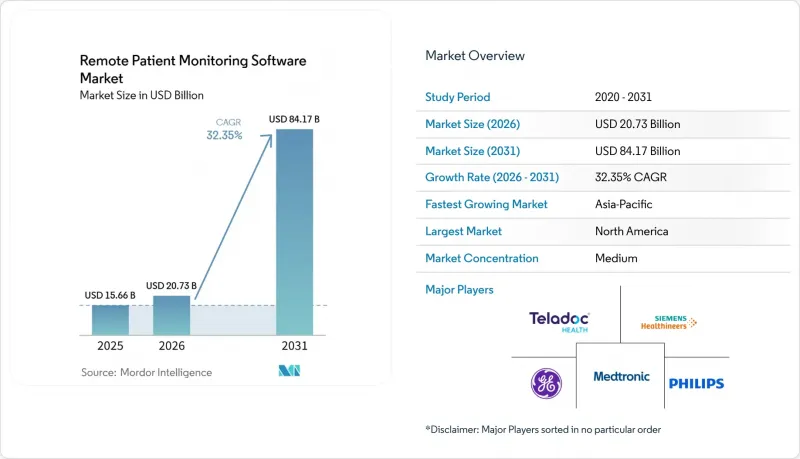
Mordor Intelligence에 의하면, 원격 환자 모니터링 소프트웨어 시장 규모는 2025년에 156억 6,000만 달러로 평가되었고, 2026년 207억 3,000만 달러에서 2031년까지 841억 7,000만 달러에 이를 것으로 예측되며, 예측 기간(2026-2031년)에서 CAGR은 32.35%를 나타낼 전망입니다.
본 보고서는 제공 형태별(소프트웨어, 기기, 서비스), 도입 형태별(클라우드, 온프레미스, 하이브리드), 용도별(심혈관, 당뇨병, 호흡기, 종양학, 기타), 데이터 유형별(혈압, 혈당, SpO2, 심전도, 기타), 최종 사용자별(병원, 외래, 의사, 재택치료, 기타), 지역별(북미, 유럽, 아시아태평양, 중동 및 아프리카, 남미)로 분류되어 있습니다. 예측치는 금액(달러)으로 표시되어 있습니다.
세계의 원격 환자 모니터링 소프트웨어 시장 동향 및 인사이트
가치 기반 의료의 확산
가치 기반 지불 모델로 인해 의료 제공업체는 단순한 활동 기록에 그치지 않고 치료 성과를 입증해야 할 필요가 생겨, 지속적인 환자 데이터에 대한 필요성이 높아졌습니다. CMS는 2026년 7월 5일, 만성 질환 관리를 위한 자발적 참여형 10년 프로그램으로 ‘ACCESS 모델’을 시작했습니다. ‘결과 연계형 지불(Outcome-Aligned Payments)’에서는 의료 제공업체가 등록된 환자에 대해 지침에 기반한 목표를 달성해야 하므로, 시간 경과에 따른 건강 지표를 추적하는 소프트웨어의 가치가 높아졌습니다. 이 모델로 인해 원격 환자 모니터링 소프트웨어 시장은 참여 기관 내 핵심적인 케어 관리 기능에 가까워지는 위치를 차지하게 되었습니다. 또한, 2026년 ACO REACH 사이클에서도 품질 성과 향상을 위한 가상 및 원격 모니터링이 지원되었습니다.
모니터링 간격 단축이 새로운 상환 경로를 가능하게 함
CMS의 2026 회계연도(CY 2026) 의사 보상 일정에 관한 최종 규정에 따라 원격 환자 모니터링 소프트웨어 시장의 보상 구조가 확대되었습니다. 이 규정에서는 2일에서 15일간의 데이터 전송을 수반하는 기기 제공에 대해 CPT 99445가, 치료 관리의 첫 10분에 대해 CPT 99470이 도입되었습니다. CPT 99445의 지급액은월52.11달러이며,CPT 99470은월26.05달러로 책정되었으며, 이에 따라 많은 고령자, 인지 기능 장애 환자, 급성기 이후 환자 및 복약 순응도가 낮은 환자를 배제했던 기존의 16일 기준이 철폐되었습니다. 새롭게 자격을 획득한 500명의 환자를 수용한 의료기관에서는 이 두 코드를 통해 월 3만 9,000달러의 수익을 창출할 수 있습니다. 한편, 독일에서는 2025년 말까지 64건의 DiGA 용도이 승인되었으며, 법정 보험에 의한 환급액은 1억 2,500만 유로 이상에 달하며, 2025년 평균 환율로 환산하면 1억 3,700만 달러에 해당합니다.
사이버 보안, 개인정보 보호 및 데이터 현지화와 관련된 위험
원격 모니터링 시스템은 환자 데이터를 지속적으로 전송 및 저장하기 때문에 광범위한 위험을 초래합니다. 미국 보건복지부(HHS)는 2025년 1월 6일, 다단계 인증, 암호화, 네트워크 세분화 및 연 2회 이상의 취약점 스캔을 포함하는 HIPAA 보안 규정의 대대적인 개정안을 제안했습니다. 이러한 요건은 확립된 보안 체계를 갖추지 못한 소규모 공급업체의 경우 운영 비용 증가로 이어질 가능성이 있습니다. 유럽의 의료 데이터 마이그레이션성에 관한 규정과 국가별 호스팅 요건이 점점 더 복잡해지고 있어, 미국 클라우드 환경을 위해 설계된 플랫폼은 독일이나 프랑스에서 서비스를 제공하기 위해 대대적인 재설계가 필요할 수 있습니다. 이로 인해 시장 진입까지의 기간이 12-24개월 연장되어 세계 확장의 효율성이 저하될 우려가 있습니다.
부문 분석
2025년 기준, 원격 환자 모니터링 소프트웨어 시장 규모의 63.22%를 소프트웨어가 차지했으며, 이는 미국 병원, 보험사 프로그램 및 유럽의 환급 시범 사업에서 플랫폼 인프라에 대한 선행 투자가 뒷받침되고 있습니다. 서비스 부문은 2031년까지 연평균 성장률(CAGR) 33.93%를 나타낼 것으로 예측됩니다. 원격 환자 모니터링 소프트웨어 시장의 성장은 벤더들이 의료 시스템을 위해 프로그램을 운영하는 관리형 서비스 계약으로 점차 전환되고 있습니다.
소프트웨어 전용 계약은 일반적으로 환자 1인당 구독 모델을 채택하고 있는 반면, 관리형 서비스 계약은 라이선싱에 더해 임상 및 운영 측면의 지원이 결합되어 있습니다. 이러한 구조로 인해 계약 총액은 2배에서 3배까지 증가할 가능성이 있습니다. 성과 기반 치료 모델을 채택하는 의료 서비스 제공업체는 24시간 임상 지원을 제공할 수 있는 공급업체를 선호하는 경향이 있습니다. 그 결과, 원격 환자 모니터링 소프트웨어 업계에서는 독립형 라이선스보다 통합된 운영 기능에 대한 수요가 증가하고 있습니다.
2025년 기준, 클라우드 기반 도입은 원격 환자 모니터링 소프트웨어 시장 규모의 58.77%를 차지했습니다. 병원에서는 클라우드 시스템을 활용하여 처리 능력을 확장하고, 정기적인 업데이트를 받으며, 대량의 데이터를 관리하고 있습니다. 의료 기관이 기밀성이 높은 환자 정보 관리를 유지하면서 클라우드의 유연성을 추구함에 따라, 하이브리드 도입은 2031년까지 연평균 성장률(CAGR) 34.86%를 나타낼 것으로 예측됩니다.
Oracle Health는 2025년 12월까지 Cerner에서 FHIR DSTU2 지원을 종료하고, 고객을 FHIR R4로 전환시켰습니다. 이러한 전환을 통해 온프레미스 HL7 v2 시스템을 계속 운영하면서 원격 모니터링 데이터에는 최신 API를 활용하는 병원을 위한 하이브리드 모델이 지원됩니다. 온프레미스형 시스템은 높은 수준의 보안이 요구되는 정부 및 군사 현장에서 계속 사용되고 있으며, 네트워크 지연이 허용되지 않는 실시간 심전도 모니터링 분야에서도 여전히 중요한 역할을 하고 있습니다. 프랑스의 2026년부터 2028년까지의 원격의료 로드맵에서는 국가 전자건강기록 환경과의 통합이 요구되고 있으며, 엣지 처리, 클라우드 분석, 로컬 스토리지를 결합한 모듈형 시스템이 지지를 받고 있습니다.
지역별 분석
북미는 2025년 원격 환자 모니터링 소프트웨어 시장 점유율의 42.76%를 차지했습니다. 이는 메디케어의 보험 적용, 통합 의료 제공 네트워크, 그리고 확립된 청구 체계에 힘입은 결과입니다. 미국은 만성 질환 관리를 위한 10년간의 ‘ACCESS 모델’에 힘입어 계속해서 지역별 최대 기여국이 되었습니다. 캐나다에서는 주별 원격의료 환급 프로그램이 마련되었으나, 적용 범위는 주마다 달랐습니다. 멕시코는 여전히 초기 단계에 있으며, 몬테레이와 멕시코시티의 민간 병원 네트워크가 고용주가 제공하는 보험을 통해 원격 모니터링을 도입하고 있었습니다.
유럽에서는 각국 고유의 보험 환급 제도에 의존하고 있었기 때문에 도입이 더욱 복잡해졌습니다. 독일은 2025년 1월, 옵트아웃 방식의 전자 건강 기록 도입을 시작하고, 데이터 교환을 개선하기 위한 전국적인 의료 데이터 프레임워크를 구축했습니다. ‘호스피탈 퓨처 펀드(Hospital Future Fund)’는 독일 내 1,900개 병원에서 사이버 보안 및 상호 운용성 향상을 지원했습니다. 프랑스는 2025년 12월 ‘2026년 사회보장재정법’을 통과시켜, 디지털 헬스 자금 지원의 일부를 아슈랑스 말라디(건강보험)에서 입증된 비용 절감과 연계했습니다. 아시아태평양은 중국, 인도, 일본, 한국의 디지털 헬스 이니셔티브를 견인력으로 삼아 2031년까지 연평균 성장률(CAGR) 34.56%를 나타낼 것으로 예측됩니다.
중동 및 아프리카은 걸프 국가들의 스마트 병원 투자와 UAE의 디지털 헬스 전략에 힘입어 소규모 기반에서 발전을 이루었습니다. 남아프리카 및 일부 프랑스어권 아프리카 국가들은 모바일 네트워크를 통해 운영되는 하이브리드 시스템의 이용자로서 부상했습니다. 남미에서는 브라질과 아르헨티나가 주도적인 역할을 하고 있으며, 이 지역에서는 민간 의료 사업자가 주요 구매자로 자리 잡고 있습니다. 브라질의 ANVISA(국가보건감독청) 체계와 아르헨티나의 민간 보험 그룹이 공급업체에게 주요 진입 창구로 작용하고 있으나, 2031년까지의 도입 상황은 보험 급여 선례, 인프라 투자 및 규제 성숙도에 따라 좌우될 것입니다.
기타 혜택 :
- 엑셀 형식 시장 예측(ME) 시트
- 3개월간의 애널리스트 지원
자주 묻는 질문
목차
제1장 서론
제2장 조사 방법
제3장 개요
제4장 시장 구도
제5장 시장 규모 및 성장 예측
제6장 경쟁 구도
제7장 시장 기회 및 향후 전망
AJY 26.09.01According to Mordor Intelligence, the remote patient monitoring software market size was valued at USD 15.66 billion in 2025 and is estimated to grow from USD 20.73 billion in 2026 to reach USD 84.17 billion by 2031, at a CAGR of 32.35% during the forecast period (2026-2031).
This report is Segmented by Offering (Software, Devices, Services), Deployment (Cloud, On-Premises, Hybrid), Application (Cardiovascular, Diabetes, Respiratory, Oncology, Others), Data Type (BP, Glucose, Spo2, ECG, Others), End User (Hospitals, Ambulatory, Physicians, Home Healthcare, Others), and Geography (North America, Europe, Asia-Pacific, MEA, South America). Forecasts in Value (USD).
Global Remote Patient Monitoring Software Market Trends and Insights
Rising Adoption of Value-Based Care
Value-based payment models increased the need for continuous patient data, as providers had to demonstrate outcomes rather than only document activity. CMS launched the ACCESS Model on July 5, 2026, as a voluntary 10-year program for chronic-condition care. Outcome-Aligned Payments required providers to meet guideline-based targets for enrolled patients, increasing the value of software that tracked health measures over time. The model positioned the remote patient monitoring software market closer to a core care-management function within participating organizations, while the 2026 ACO REACH cycle also supported virtual and remote monitoring for quality performance.
Shorter-Interval Monitoring Enabling New Reimbursement Pathways
The CMS CY 2026 Physician Fee Schedule final rule expanded the reimbursement structure for the remote patient monitoring software market. The rule introduced CPT 99445 for device supply with 2 to 15 days of data transmission and CPT 99470 for the first 10 minutes of treatment management. CPT 99445 paid USD 52.11 per month, while CPT 99470 paid USD 26.05 per month, removing the prior 16-day threshold that excluded many older, cognitively impaired, post-acute, and less adherent patients. A practice enrolling 500 newly eligible patients could generate USD 39,000 in monthly revenue from these two codes, while Germany had 64 approved DiGA applications by the end of 2025, with more than EUR 125 million in statutory insurance reimbursements, equal to USD 137 million at the 2025 average exchange rate.
Cybersecurity, Privacy, and Data-Localization Exposure
Remote monitoring systems create broad exposure because they continuously transmit and store patient data. HHS proposed major updates to the HIPAA Security Rule on January 6, 2025, including multifactor authentication, encryption, network segmentation, and vulnerability scans at least twice a year. These requirements can increase operating costs for smaller vendors that lack established security capabilities. European health data portability rules and country-level hosting requirements add complexity, and platforms designed for the U.S. cloud environment may require substantial redesign to serve Germany or France, extending entry timelines by 12 to 24 months and reducing global deployment efficiency.
Other drivers and restraints analyzed in the detailed report include:
- Increasing Chronic Disease Burden and Aging Population
- Advances in Connected Sensors and AI-Based Risk Stratification
- Alert Fatigue and Clinician Workflow Burden
For complete list of drivers and restraints, kindly check the Table Of Contents.
Segment Analysis
Software held 63.22% of the remote patient monitoring software market size in 2025, supported by earlier investments in platform infrastructure across U.S. hospitals, payer programs, and European reimbursement pilots. Services are projected to grow at a CAGR of 33.93% through 2031. Growth in the remote patient monitoring software market is shifting toward managed-service contracts, where vendors operate programs for health systems.
A software-only contract generally follows a per-patient subscription model, while managed-service arrangements combine licensing with clinical and operational support. This structure can increase total contract value by 2 to 3 times. Providers adopting outcome-based care models may prefer vendors that can deliver round-the-clock clinical support. As a result, the remote patient monitoring software industry is seeing stronger demand for integrated operating capabilities than for stand-alone licenses.
Cloud-based deployment held 58.77% of the remote patient monitoring software market size in 2025. Hospitals use cloud systems to scale capacity, receive regular updates, and manage large data volumes. Hybrid deployment is projected to grow at a CAGR of 34.86% through 2031, as health systems seek cloud flexibility while maintaining control over sensitive patient information.
Oracle Health ended support for FHIR DSTU2 in Cerner by December 2025 and moved customers toward FHIR R4. This shift supports hybrid models for hospitals that still operate on-premises HL7 v2 systems while using modern APIs for remote monitoring data. On-premises systems continue to serve high-security government and military settings and remain relevant where real-time cardiac monitoring cannot tolerate network delays. France's 2026-2028 telemedicine roadmap required integration with the national electronic health record environment, supporting modular systems that combine edge processing, cloud analysis, and local storage.
Complete Report Scope:
- By Offering
- Software
- Devices With Embedded Software
- Services
- By Software Deployment
- Cloud-Based
- On-Premises
- Hybrid
- By Application and Indication
- Cardiovascular Disease
- Diabetes Management
- Respiratory and Pulmonary Disorders
- Chronic Obstructive Pulmonary Disease
- Asthma
- Oncology
- Others
- By Data Type
- Blood Pressure
- Blood Glucose
- Weight
- Oxygen Saturation
- Heart Rate and Electrocardiogram
- Temperature
- Respiratory Rate
- Activity, Mobility and Sleep Data
- Others
- By End User
- Healthcare Providers
- Hospitals and Health Systems
- Ambulatory Care Centers
- Physician Practices
- Home Healthcare Providers
- Long-Term Care and Assisted Living Facilities
- Others
- By Geography
- North America
- United States
- Canada
- Mexico
- Europe
- Germany
- United Kingdom
- France
- Italy
- Spain
- Rest of Europe
- Asia-Pacific
- China
- India
- Japan
- Australia
- South Korea
- Rest of Asia-Pacific
- Middle East and Africa
- GCC
- South Africa
- Rest of Middle East and Africa
- South America
- Brazil
- Argentina
- Rest of South America
- North America
Geography Analysis
North America held 42.76% of the remote patient monitoring software market share in 2025, supported by Medicare coverage, integrated delivery networks, and established billing structures. The United States remained the largest regional contributor, backed by the 10-year ACCESS Model for chronic-condition care. Canada developed provincial telehealth reimbursement programs, although coverage varied by province. Mexico remained at an earlier stage, with private hospital networks in Monterrey and Mexico City deploying remote monitoring through employer-sponsored insurance offerings.
Europe relied on country-specific reimbursement systems, which made deployment more complex. Germany began rolling out its opt-out electronic patient record in January 2025, creating a national health-data framework to improve data exchange. The Hospital Future Fund supported cybersecurity and interoperability improvements across 1,900 German hospitals. France adopted its 2026 Social Security Finance Act in December 2025, linking some digital health financing to documented savings for Assurance Maladie. Asia-Pacific is forecast to grow at a CAGR of 34.56% through 2031, led by digital health activity in China, India, Japan, and South Korea.
The Middle East and Africa developed from a smaller base, supported by smart-hospital investments in the Gulf states and the UAE's digital health strategy. South Africa and selected francophone African countries emerged as users of hybrid systems operating through mobile networks. Brazil and Argentina led South America, where private health operators were key purchasers. Brazil's ANVISA framework and Argentina's private insurance groups served as central entry points for suppliers, while reimbursement precedent, infrastructure investment, and regulatory maturity will determine adoption through 2031.
- Abbott Laboratories
- American Well
- Baxter
- BioIntelliSense, Inc.
- Boston Scientific
- CareSimple Inc.
- Dexcom
- GE HealthCare Technologies Inc.
- Health Recovery Solutions, Inc.
- Koninklijke Philips
- Medtronic
- Nihon Kohden
- OMRON Healthcare, Inc.
- Optum
- Oracle
- Siemens Healthineers
- Teladoc Health
- Validic Inc.
- VitalConnect, Inc.
- VivaLNK, Inc.
Additional Benefits:
- The market estimate (ME) sheet in Excel format
- 3 months of analyst support
TABLE OF CONTENTS
1 INTRODUCTION
- 1.1 Study Assumptions and Market Definition
- 1.2 Scope of the Study
2 RESEARCH METHODOLOGY
3 EXECUTIVE SUMMARY
4 MARKET LANDSCAPE
- 4.1 Market Overview
- 4.2 Market Drivers
- 4.2.1 Rising Adoption of Value-Based Care
- 4.2.2 Expansion of Home-Based and Hospital-at-Home Care
- 4.2.3 Increasing Chronic Disease Burden and Aging Population
- 4.2.4 Advances in Connected Sensors and AI-Based Risk Stratification
- 4.2.5 Interoperability-Driven Consolidation of Fragmented Patient Data
- 4.2.6 Shorter-Interval Monitoring Enabling New Reimbursement Pathways
- 4.3 Market Restraints
- 4.3.1 Fragmented Reimbursement and Billing Requirements
- 4.3.2 Cybersecurity, Privacy and Data-Localization Exposure
- 4.3.3 Alert Fatigue and Clinician Workflow Burden
- 4.3.4 Inconsistent Clinical Evidence Across Patient Groups
- 4.4 Value/Supply-Chain Analysis
- 4.5 Regulatory Landscape
- 4.6 Technological Outlook
- 4.7 Porter's Five Forces Analysis
- 4.7.1 Threat of New Entrants
- 4.7.2 Bargaining Power of Suppliers
- 4.7.3 Bargaining Power of Buyers
- 4.7.4 Threat of Substitutes
- 4.7.5 Rivalry Among Existing Competitors
5 MARKET SIZE AND GROWTH FORECASTS (VALUE, USD)
- 5.1 By Offering
- 5.1.1 Software
- 5.1.2 Devices With Embedded Software
- 5.1.3 Services
- 5.2 By Software Deployment
- 5.2.1 Cloud-Based
- 5.2.2 On-Premises
- 5.2.3 Hybrid
- 5.3 By Application and Indication
- 5.3.1 Cardiovascular Disease
- 5.3.2 Diabetes Management
- 5.3.3 Respiratory and Pulmonary Disorders
- 5.3.4 Chronic Obstructive Pulmonary Disease
- 5.3.5 Asthma
- 5.3.6 Oncology
- 5.3.7 Others
- 5.4 By Data Type
- 5.4.1 Blood Pressure
- 5.4.2 Blood Glucose
- 5.4.3 Weight
- 5.4.4 Oxygen Saturation
- 5.4.5 Heart Rate and Electrocardiogram
- 5.4.6 Temperature
- 5.4.7 Respiratory Rate
- 5.4.8 Activity, Mobility and Sleep Data
- 5.4.9 Others
- 5.5 By End User
- 5.5.1 Healthcare Providers
- 5.5.2 Hospitals and Health Systems
- 5.5.3 Ambulatory Care Centers
- 5.5.4 Physician Practices
- 5.5.5 Home Healthcare Providers
- 5.5.6 Long-Term Care and Assisted Living Facilities
- 5.5.7 Others
- 5.6 By Geography
- 5.6.1 North America
- 5.6.1.1 United States
- 5.6.1.2 Canada
- 5.6.1.3 Mexico
- 5.6.2 Europe
- 5.6.2.1 Germany
- 5.6.2.2 United Kingdom
- 5.6.2.3 France
- 5.6.2.4 Italy
- 5.6.2.5 Spain
- 5.6.2.6 Rest of Europe
- 5.6.3 Asia-Pacific
- 5.6.3.1 China
- 5.6.3.2 India
- 5.6.3.3 Japan
- 5.6.3.4 Australia
- 5.6.3.5 South Korea
- 5.6.3.6 Rest of Asia-Pacific
- 5.6.4 Middle East and Africa
- 5.6.4.1 GCC
- 5.6.4.2 South Africa
- 5.6.4.3 Rest of Middle East and Africa
- 5.6.5 South America
- 5.6.5.1 Brazil
- 5.6.5.2 Argentina
- 5.6.5.3 Rest of South America
- 5.6.1 North America
6 COMPETITIVE LANDSCAPE
- 6.1 Market Concentration
- 6.2 Market Share Analysis
- 6.3 Company Profiles (includes Global Level Overview, Market Level Overview, Core Segments, Financials as available, Strategic Information, Market Rank/Share, Products and Services, Recent Developments)
- 6.3.1 Abbott Laboratories
- 6.3.2 American Well Corporation
- 6.3.3 Baxter International Inc.
- 6.3.4 BioIntelliSense, Inc.
- 6.3.5 Boston Scientific Corporation
- 6.3.6 CareSimple Inc.
- 6.3.7 DexCom, Inc.
- 6.3.8 GE HealthCare Technologies Inc.
- 6.3.9 Health Recovery Solutions, Inc.
- 6.3.10 Koninklijke Philips N.V.
- 6.3.11 Medtronic plc
- 6.3.12 NIHON KOHDEN CORPORATION
- 6.3.13 OMRON Healthcare, Inc.
- 6.3.14 Optum, Inc.
- 6.3.15 Oracle Corporation
- 6.3.16 Siemens Healthineers AG
- 6.3.17 Teladoc Health, Inc.
- 6.3.18 Validic Inc.
- 6.3.19 VitalConnect, Inc.
- 6.3.20 VivaLNK, Inc.
7 MARKET OPPORTUNITIES AND FUTURE OUTLOOK
- 7.1 White-Space and Unmet-Need Assessment