|
시장보고서
상품코드
2118211
갈색세포종 시장 : 시장 점유율 분석, 업계 동향 및 통계, 성장 예측(2026-2031년)Pheochromocytoma - Market Share Analysis, Industry Trends & Statistics, Growth Forecasts (2026 - 2031) |
||||||
 Mordor Intelligence
Mordor Intelligence에 의하면, 갈색세포종 시장 규모는 2025년에 22억 5,000만 달러로 평가되었고, 2026년 23억 6,000만 달러에서 2031년까지 29억 9,000만 달러에 이를 것으로 추정되며, 예측 기간(2026-2031년) CAGR은 4.84%를 나타낼 전망입니다.
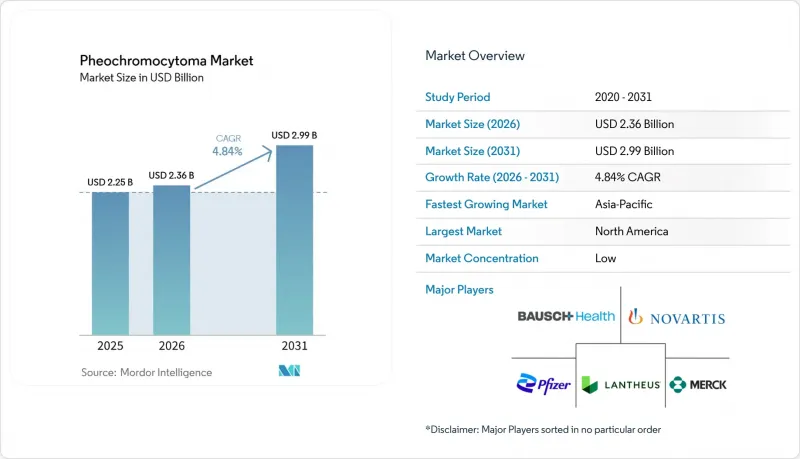
본 보고서는 제공 서비스별(진단(임상 검사 등), 치료(수술 등)), 질환 유형별(부신 갈색세포종, 부신외 갈색세포종, 부신외 갈색세포종), 원인별(산발성, 유전성), 질환 단계별(국소성, 전이성 등), 최종 사용자(병원 등), 지역(북미, 유럽 등)별로 분류되어 있습니다. 시장 예측은 금액(달러)으로 표시되어 있습니다.
세계의 갈색세포종 시장 동향 및 인사이트
그동안 인식되지 않았던 종양의 발견 증가
다른 질환의 진단을 위해 실시된 영상 검사 과정에서 많은 종양이 발견됨에 따라, 우발적 발견이 갈색세포종 시장에 변화를 가져오고 있습니다. 2026년 SEER 분석에 따르면, 1975-2022년 미국의 사례 수는 연평균 5.8% 증가율을 기록했습니다. 2025년 총설에서는 자주 인용되는 ‘100만 명 연당 1.9건’이라는 발생률 추정치가 영상 진단에 대한 접근성이 확대됨에 따라 확인되는 사례 수를 과소평가하고 있다는 지적이 제기되었습니다. 또한, 2025년 유럽 학회 보고서에 따르면, 두 병원에서 PPGL의 연간 발생률은 2020년 이후 1.92건에서 5.25건으로 증가했으며, 사례의 51.9%가 우연히 발견된 것으로 밝혀졌습니다. 따라서 다른 임상 적응증을 위한 영상 진단, 부신 우발성 종양의 수술, 그리고 코로나19 회복 후의 경과 관찰로 인해 PPGL 전용 선별 검사 캠페인을 실시하지 않더라도 환자 수가 증가할 가능성이 있습니다. 이러한 추세는 갈색세포종 시장 전반에 걸쳐 생화학적 검사, 기능적 영상 진단, 외과적 평가 및 후속 치료에 대한 수요를 뒷받침합니다.
생식세포 계통 유전자 검사 및 캐스케이드 스크리닝의 확대
PPGL 환자의 30%에서 40%는 유전적 요인이 확인되므로, 다른 많은 고형 종양에 비해 유전학적 평가가 더욱 중요합니다. 2024년 국제 합의 성명에서는 모든 소아 PPGL 환자 및 확인된 돌연변이 보균자의 1촌 친족에 대해 생식세포 계통 유전자 검사를 권장하고 있습니다. 이에 따라 임상적으로 적절하다고 판단되는 경우, 제한적인 유전자별 검사에서 보다 광범위한 평가로 진료 방침이 전환되고 있습니다. 유전성 사례가 1건 확인될 때마다 2-5명의 친족에 대한 검사가 실시되며, 그 후 다유전자 시퀀싱 및 지속적인 생화학적·영상 진단을 통한 경과 관찰이 이루어집니다. 2025년 9월의 연구에서는 일본 PPGL 환자를 대상으로 한 생식세포 계통 다유전자 패널 검사의 실현 가능성과 임상적 유용성이 입증되었습니다. 유전성 부문의 연평균 성장률(CAGR) 7.22%는 변이 유병률 증가라기보다는 페오크로모시토마 시장에서 가이드라인에 기반한 검사 및 경과 관찰 활동이 반영된 결과라고 할 수 있습니다.
극히 희귀한 질환이기 때문에 상업적 임상시험의 규모에는 한계가 있습니다.
환자 수가 적기 때문에 임상시험에 등록되는 피험자 수, 상업적 규모 및 증거 생성 속도가 제한됩니다. 미국에서는 매년 2,000건에 가까운 PPGL 신규 진단이 기록되고 있지만, 2025년 체계적 문헌고찰에 따르면 전 세계 통합 발병률은 100만 명당 연간 1.9건으로 보고되었습니다. FIRSTMAPPP는 PPGL을 대상으로 한 최초의 무작위 대조 시험으로, 주요 평가 변수를 평가하기 위해 수년에 걸친 다국적 피험자 등록이 필요했습니다. SDHB 상태, VHL 경로의 활성, 또는 SSTR2 발현에 기반한 적격 기준에 따라, 원래 적은 환자 집단이 더욱 작은 그룹으로 분할됩니다. 이 때문에 질병의 진행 단계에서는 단일군 임상시험이나 대체 평가 지표를 사용한 연구가 더 일반적입니다. 그 결과 도출된 근거 기반은 보험사의 승인을 지연시킬 가능성이 있으며, 갈색세포종 시장은 국제 임상시험에 참여할 수 있는 전문 의료 센터에 계속 의존하게 될 것입니다.
부문 분석
2025년, 치료는 갈색세포종 시장의 64.31%를 차지했으며, 이는 국소성 질환 환자에 대한 부신 절제술 및 수술 전후의 약물 안정화 요법에 의해 뒷받침되고 있습니다. 복강경 또는 로봇 보조 부신 절제술은 여전히 핵심 치료법이며, 수술 전 α-아드레날린 수용체 차단제 투여가 혈역학적 조절을 돕고 있습니다. 진행성 PPGL에 대한 177Lu-DOTATATE의 효능이 밝혀짐에 따라, 방사성 의약품에 의한 치료의 중요성이 높아지고 있습니다. 또한, 벨즈티판은 2025년에 절제 불가능 및 전이성 질환에 대한 승인을 획득하여 새로운 전신 치료 옵션을 제공했습니다. 시클로포스파미드, 빈크리스틴, 다카르바진으로 이루어진 화학요법은 수술이 불가능한 유전성 질환, 특히 SDHB 변이를 동반한 전이 사례에서 제한적인 역할을 유지하고 있습니다. 칼슘 채널 차단제 및 β-차단제는 α-차단 치료의 유용한 보조 요법으로 여전히 활용되고 있지만, 제네릭 의약품과의 경쟁으로 인해 매출 기여도는 제한적입니다.
진단 분야는 가장 빠르게 성장하는 분야이며, 갈색세포종 진단 시장 규모는 2026-2031년 연평균 성장률(CAGR) 5.58%로 확대될 것으로 예측됩니다. 68Ga-DOTATATE PET/CT를 이용한 기능적 영상 진단 및 다유전자 시퀀싱 패널은 갈색세포종 시장의 이러한 성장에 중심적인 역할을 하고 있습니다. 2024년 스코핑 리뷰에 따르면, 68Ga-DOTA-SST PET/CT는 알려진 생식세포 돌연변이가 없는 환자의 병변 중 90% 이상을 식별할 수 있는 것으로 보고되었습니다. 검사 비용의 감소에 따라, SDHA, SDHB, SDHC, SDHD, VHL, RET, NF1 및 TMEM127을 포괄하는 패널이 순차적으로 수행되는 단일 유전자 검사를 대체하고 있습니다. 유전성 질환으로 진단받은 후 친족을 대상으로 한 검사는 새로운 질환의 발생률에 좌우되지 않는 지속적인 검사 및 경과 관찰 활동을 유발합니다. 또한 유전 상담, 동의 획득 및 정보 공개 요건 역시 전문 프로그램과의 지속적인 접촉을 유도하고 있습니다.
2025년에는 부신 종양의 발생 빈도가 높고 확립된 수술 경로가 마련되어 있기 때문에 부신 갈색세포종이 수익의 83.44%를 차지했습니다. 생화학적 검사에서는 혈장 분획 메타네프린이 일반적으로 사용되며, 이는 3차 의료기관에서 재현성 있는 검사를 가능하게 합니다. 2024년에 발표된 포르투갈의 의뢰 의료기관 연구에 따르면, 2012년부터 2024년까지의 발생률 추세는 100만 명당 5.3건으로 기록되었습니다. 이 연구에서는 전이성 질환이 유전성 사례에서만 확인되어, 진단 시 유전자 평가의 중요성이 입증되었습니다. 부신 질환은 2031년까지 주요 질환 유형으로 남아 있을 것으로 예측됩니다. 다만, 영상 진단을 통해 부신 이외의 병변이 더 많이 확인됨에 따라 그 비중은 점차 축소될 가능성이 있습니다.
갈색세포종 시장에서 부신외 갈색세포종 및 부신외 신경절종은 2026-2031년 연평균 성장률(CAGR) 7.52%로 확대될 것으로 예측됩니다. 2024년 스코핑 리뷰에 따르면, 알려진 생식세포 돌연변이가 없는 부신 외 갈색세포종 및 부신외신경절종 병변에서 68Ga-DOTA-SST PET/CT의 검출률은 91%에서 93%였습니다. 라틴아메리카에서는 68Ga의 입수가 제한적이기 때문에 치료가 18F-FDOPA로 전환되고 있으며, 해당 리뷰에서는 이에 따른 검출 효율이 74%로 보고되었습니다. 이러한 차이는 영상 진단 능력이 지역 내 진단 접근성에 어떻게 영향을 미치는지를 보여줍니다. 두경부 부신경절종은 대부분의 경우 비분비성이며, 다른 PPGL 형태에 비해 진단이 지연될 가능성이 있습니다. 따라서 이 질환 유형의 사례 수가 증가하고 있는 만큼, 기능적 영상 진단에 대한 접근성을 확대하는 것이 중요합니다.
지역별 분석
2025년, 북미는 갈색세포종 시장의 42.61%를 차지했습니다. 이 지역은 대규모 학술 소개 센터의 존재, 68Ga-DOTATATE PET/CT에 대한 확립된 보험 환급 제도, 그리고 2025년 5월 FDA 승인 후 벨즈티판의 조기 상용화 등의 혜택을 받고 있습니다. 미국의 의료 서비스는 기능적 영상, SSTR2 평가, 방사성 동위원소 치료 및 방사선 안전 지원을 제공할 수 있는 의료 기관에 점점 더 집중되고 있습니다. 이로 인해 복잡한 증상을 가진 환자에 대한 협진이 개선될 가능성이 있지만, 한편으로는 제한된 수의 시설에 의료 역량이 집중될 가능성도 있습니다. 캐나다의 경우, 주별 의약품 목록에 대한 협상이 미국 승인보다 12-24개월 늦어질 수 있어 접근 상황이 다릅니다. Perspective Therapeutics사의 서머셋 시설은 미국 북동부 지역의 알파 입자 방사성 리간드 공급 인프라가 얼마나 집중되어 있는지를 보여줍니다.
유럽은 독일, 프랑스, 영국의 국가 참조 네트워크를 통해 전 세계 갈색세포종 시장의 상당 부분을 차지하고 있습니다. 프랑스의 COMETE 네트워크 및 기타 의뢰 시스템은 다학제적 협력을 통한 의료 서비스를 통합하고, 환자의 장기적인 진료 기록을 관리하고 있습니다. EU의 공동 임상 평가 프레임워크로 인해, 각국의 가격 협상이 이루어지기 전에 단일군 희귀질환 임상시험을 통해 입증된 치료법에 대한 접근이 복잡해질 수 있습니다. 이 과정으로 인해 EU 5개국에서 실질적인 치료 접근이 시작되기까지 12-18개월의 지연이 발생할 수 있습니다. 스페인, 이탈리아 및 중동부 유럽 국가에서는 승인된 위장-췌장 신경내분비종양의 적응증 범위를 넘어 PPGL에 PRRT를 적용하는 경우, 자비적 접근(compassionate access)이나 특정 환자 프로그램에 의존해야 할 수 있습니다. 이러한 차이로 인해 유럽의 의료 제도 간에는 접근 격차가 지속되고 있습니다.
아시아태평양은 가장 빠르게 성장하는 지역이며, 갈색세포종 시장 규모는 2026-2031년 연평균 성장률(CAGR) 6.85%로 확대될 것으로 예측됩니다. 일본의 2025년 개정판 임상 지침에는 업데이트된 종양 분류, 소아 유전자 검사에 관한 권고 사항, 방사성 동위원소 요법에 대한 설명, 그리고 두경부 부신외종양의 관리 방법이 포함되었습니다. 중국의 종양학 인프라와 인도에서 유전성 종양에 대한 인식 제고 또한 갈색세포종 시장의 지역적 확장을 뒷받침하고 있습니다. 일본에서 131I-MIBG에 대한 보험 적용은 향후 방사성 동위원소 요법 도입을 위한 보험 급여의 선례가 되고 있습니다. 중동 및 아프리카 및 남미 지역에서는 전문의 및 핵의학 인프라의 부족으로 인해 여전히 제약이 나타나고 있습니다. 브라질에서는 암 치료를 대상으로 한 투자 프로그램과 유전체 의학에 대한 자금 지원 확대를 통해 추가적인 성장 가능성이 있습니다.
기타 혜택 :
- 엑셀 형식 시장 예측(ME) 시트
- 3개월간의 애널리스트 지원
자주 묻는 질문
목차
제1장 서론
제2장 조사 방법
제3장 개요
제4장 시장 구도
제5장 시장 규모 및 성장 예측
제6장 경쟁 구도
제7장 시장 기회 및 향후 전망
AJY 26.09.01According to Mordor Intelligence, the pheochromocytoma market size was valued at USD 2.25 billion in 2025 and is estimated to grow from USD 2.36 billion in 2026 to reach USD 2.99 billion by 2031, at a CAGR of 4.84% during the forecast period (2026-2031).
This report is Segmented by Offering (Diagnosis [Laboratory Tests and More], Treatment [Surgery and More]), Disease Type (Adrenal Pheochromocytoma, Extra-Adrenal Pheochromocytoma and Paraganglioma), Etiology (Sporadic, Hereditary), Disease Stage (Localized, Metastatic, and More), End User (Hospitals and More), and Geography (North America, Europe, and More). The Market Forecasts are Provided in Value (USD).
Global Pheochromocytoma Market Trends and Insights
Rising Detection of Previously Unrecognized Tumors
Incidental identification is changing the pheochromocytoma market because many tumors are now found during imaging ordered for other conditions. The 2026 SEER analysis recorded a 5.8% annual increase in United States case counts from 1975 through 2022. A 2025 review argued that the often-cited incidence estimate of 1.9 cases per million person-years understates the number of cases identified as imaging access expands. A 2025 European congress report also found that annual PPGL incidence at 2 hospitals increased from 1.92 to 5.25 cases after 2020, and 51.9% of cases were identified incidentally. Imaging for other clinical indications, adrenal incidentaloma procedures, and post-COVID surveillance can therefore add patients without a dedicated PPGL screening campaign. This pattern supports demand for biochemical testing, functional imaging, surgical evaluation, and follow-up care across the pheochromocytoma market.
Expansion of Germline Genetic Testing and Cascade Screening
PPGL has a hereditary component in 30% to 40% of patients, which makes genetic evaluation more important than for many other solid tumors. The 2024 international consensus statement recommends germline testing for all pediatric PPGL patients and for first-degree relatives of confirmed mutation carriers. This shifts practice away from limited, gene-by-gene testing toward broader evaluation when clinically appropriate. Each confirmed hereditary case can lead to testing of 2 to 5 relatives, followed by multigene sequencing and continued biochemical or imaging surveillance. A September 2025 study demonstrated the feasibility and clinical utility of germline multigene panel testing in Japanese PPGL patients. The hereditary segment's 7.22% CAGR reflects guideline-driven testing and surveillance activity within the pheochromocytoma market, rather than an increase in mutation prevalence.
Ultra-Rare Population Limits Commercial Trial Scale
The small patient population limits trial enrollment, commercial scale, and the speed of evidence generation. The United States records nearly 2,000 new PPGL diagnoses each year, while a 2025 systematic review reported pooled global incidence of 1.9 cases per million person-years. FIRSTMAPPP was the first randomized controlled PPGL trial and required multinational enrollment over multiple years to evaluate its primary endpoint. Eligibility rules based on SDHB status, VHL pathway activity, or SSTR2 expression divide an already small population into smaller groups. This makes single-arm studies and surrogate endpoints more common in advanced disease development. The resulting evidence base can delay payer acceptance and keeps the pheochromocytoma market dependent on specialist centers that can participate in international trials.
Other drivers and restraints analyzed in the detailed report include:
- Growth in Precision Therapies for Molecularly Defined Disease
- Radioligand Manufacturing and Theranostic Platform Investment
- Reimbursement Friction for Off-Label and Orphan Therapies
For complete list of drivers and restraints, kindly check the Table Of Contents.
Segment Analysis
Treatment held 64.31% of the pheochromocytoma market share in 2025, supported by adrenalectomy and perioperative pharmacological stabilization for patients with localized disease. Laparoscopic or robotic adrenalectomy remains a core approach, with preoperative alpha-adrenergic blockade supporting hemodynamic control. Radiopharmaceutical treatment is gaining importance as 177Lu-DOTATATE evidence develops for advanced PPGL. Belzutifan also opened a new systemic treatment option after its 2025 approval for unresectable and metastatic disease. Cyclophosphamide, vincristine, and dacarbazine chemotherapy retains a narrower role in inoperable hereditary disease, particularly in SDHB-mutated metastatic cases. Calcium channel blockers and beta-blockers remain useful adjuncts to alpha-blockade, but generic competition limits their revenue contribution.
Diagnosis is the fastest-growing offering, with the pheochromocytoma market size for diagnosis forecast to rise at a 5.58% CAGR from 2026 to 2031. Functional imaging with 68Ga-DOTATATE PET/CT and multigene sequencing panels are central to this expansion in the pheochromocytoma market. A 2024 scoping review reported that 68Ga-DOTA-SST PET/CT can identify more than 90% of lesions in patients without known germline variants. Panels covering SDHA, SDHB, SDHC, SDHD, VHL, RET, NF1, and TMEM127 are replacing sequential single-gene testing as testing costs decline. Testing of relatives after a hereditary diagnosis creates repeat laboratory and surveillance activity that does not depend on new disease incidence. Genetic counseling, consent, and disclosure requirements also create recurring contact with specialist programs.
Adrenal pheochromocytoma held 83.44% of revenue in 2025 because adrenal tumors occur more often and follow a more established surgical pathway. Its biochemical workup commonly uses plasma fractionated metanephrines, which supports reproducible testing at tertiary centers. A Portuguese referral-center study published in 2024 recorded an incidence trend of 5.3 cases per million from 2012 through 2024. The study found metastatic disease only among hereditary cases, reinforcing the value of genetic assessment at diagnosis. Adrenal disease is expected to remain the majority disease type through 2031. Its share may narrow gradually as imaging identifies more lesions outside the adrenal gland.
Extra-adrenal pheochromocytoma and paraganglioma is forecast to grow at a 7.52% CAGR from 2026 to 2031 within the pheochromocytoma market. The 2024 scoping review reported 91% to 93% detection rates for 68Ga-DOTA-SST PET/CT in extra-adrenal and paraganglioma lesions without known germline variants. Limited 68Ga availability in Latin America shifts care toward 18F-FDOPA, which the same review associated with 74% detection efficiency. This difference shows how imaging capacity can influence local access to diagnosis. Head and neck paragangliomas are often non-secreting and may be identified later than other PPGL forms. Wider access to functional imaging is therefore important for the disease type's faster growth.
Complete Report Scope:
- By Offering
- Diagnosis
- Laboratory Tests
- Imaging Tests
- Genetic Testing
- Treatment
- Preoperative Medical Stabilization
- Surgery
- Radiopharmaceutical Therapy
- Systemic Targeted Therapy
- Chemotherapy
- Local and Supportive Therapy
- Diagnosis
- By Disease Type
- Adrenal Pheochromocytoma
- Extra-Adrenal Pheochromocytoma and Paraganglioma
- By Etiology
- Sporadic
- Hereditary
- By Disease Stage
- Localized
- Regional or Locally Advanced
- Metastatic
- Recurrent
- By End User
- Hospitals
- Specialty Endocrinology Centers
- Oncology Centers
- Diagnostic Laboratories
- Other End Users
- By Geography
- North America
- United States
- Canada
- Mexico
- Europe
- Germany
- United Kingdom
- France
- Italy
- Spain
- Rest of Europe
- Asia-Pacific
- China
- Japan
- India
- Australia
- South Korea
- Rest of Asia-Pacific
- Middle East and Africa
- GCC
- South Africa
- Rest of Middle East and Africa
- South America
- Brazil
- Argentina
- Rest of South America
- North America
Geography Analysis
North America held 42.61% of the pheochromocytoma market share in 2025. The region benefits from high-volume academic referral centers, established reimbursement for 68Ga-DOTATATE PET/CT, and early commercial use of belzutifan after FDA approval in May 2025. United States care is increasingly concentrated in institutions that can provide functional imaging, SSTR2 assessment, radionuclide therapy, and radiation safety support. This can improve coordination for complex patients, but it can also concentrate capacity in a limited number of centers. Canada has a different access pattern because provincial formulary negotiations can trail United States approvals by 12 to 24 months. Perspective Therapeutics' Somerset facility illustrates the concentration of alpha-particle radioligand supply infrastructure in the northeastern United States.
Europe represents a substantial part of the global pheochromocytoma market through national reference networks in Germany, France, and the United Kingdom. France's COMETE network and other referral systems centralize multidisciplinary care and support longitudinal patient records. The EU joint clinical assessment framework can complicate access for therapies supported by single-arm orphan studies before national price negotiations take place. This process can add 12 to 18 months to effective access in the EU5. Spain, Italy, and Central and Eastern European countries may rely on compassionate access or named-patient programs for PPGL use of PRRT beyond the approved gastroenteropancreatic neuroendocrine tumor indication. These differences maintain an access gap among European health systems.
Asia-Pacific is the fastest-growing geography, with the pheochromocytoma market size projected to grow at a 6.85% CAGR from 2026 to 2031. Japan's 2025 revised clinical guideline incorporated updated tumor classification, pediatric genetic testing recommendations, radionuclide therapy descriptions, and head and neck paraganglioma management. China's oncology infrastructure and rising hereditary tumor awareness in India also support regional expansion in the pheochromocytoma market. Japan's 131I-MIBG insurance coverage has provided a reimbursement precedent for later radionuclide therapy adoption. The Middle East, Africa, and South America remain limited by gaps in specialist and nuclear medicine capacity. Brazil has potential for further growth because of targeted oncology investment programs and greater genomic medicine funding.
- AstraZeneca
- Bausch Health
- Bayer
- Curium Pharma
- Exelixis, Inc.
- GE HealthCare Technologies Inc.
- Hikma Pharmaceuticals
- ITM Isotope Technologies Munich SE
- Jazz Pharmaceuticals plc
- Lantheus Holdings, Inc.
- Merck
- Novartis
- Nxera Pharma Co., Ltd.
- Ono Pharmaceutical
- Perspective Therapeutics, Inc.
- Pfizer
- Siemens Healthineers
- Teva Pharmaceutical Industries
Additional Benefits:
- The market estimate (ME) sheet in Excel format
- 3 months of analyst support
TABLE OF CONTENTS
1 Introduction
- 1.1 Study Assumptions and Market Definition
- 1.2 Scope of the Study
2 Research Methodology
3 Executive Summary
4 Market Landscape
- 4.1 Market Overview
- 4.2 Market Drivers
- 4.2.1 Rising Detection of Previously Unrecognized Tumors
- 4.2.2 Expansion of Germline Genetic Testing and Cascade Screening
- 4.2.3 Adoption of Advanced Functional Imaging
- 4.2.4 Growth in Precision Therapies for Molecularly Defined Disease
- 4.2.5 Referral to High-Volume Multidisciplinary Centers
- 4.2.6 Radioligand Manufacturing and Theranostic Platform Investment
- 4.3 Market Restraints
- 4.3.1 Ultra-Rare Population Limits Commercial Trial Scale
- 4.3.2 Specialist and Nuclear-Medicine Capacity Gaps
- 4.3.3 Genotype-Dependent Treatment Response Variability
- 4.3.4 Reimbursement Friction for Off-Label and Orphan Therapies
- 4.4 Value Chain Analysis
- 4.5 Regulatory Landscape
- 4.6 Technological Outlook
- 4.7 Porter's Five Forces Analysis
- 4.7.1 Threat of New Entrants
- 4.7.2 Bargaining Power of Suppliers
- 4.7.3 Bargaining Power of Buyers
- 4.7.4 Threat of Substitutes
- 4.7.5 Competitive Rivalry
5 Market Size & Growth Forecasts (Value, USD)
- 5.1 By Offering
- 5.1.1 Diagnosis
- 5.1.1.1 Laboratory Tests
- 5.1.1.2 Imaging Tests
- 5.1.1.3 Genetic Testing
- 5.1.2 Treatment
- 5.1.2.1 Preoperative Medical Stabilization
- 5.1.2.2 Surgery
- 5.1.2.3 Radiopharmaceutical Therapy
- 5.1.2.4 Systemic Targeted Therapy
- 5.1.2.5 Chemotherapy
- 5.1.2.6 Local and Supportive Therapy
- 5.1.1 Diagnosis
- 5.2 By Disease Type
- 5.2.1 Adrenal Pheochromocytoma
- 5.2.2 Extra-Adrenal Pheochromocytoma and Paraganglioma
- 5.3 By Etiology
- 5.3.1 Sporadic
- 5.3.2 Hereditary
- 5.4 By Disease Stage
- 5.4.1 Localized
- 5.4.2 Regional or Locally Advanced
- 5.4.3 Metastatic
- 5.4.4 Recurrent
- 5.5 By End User
- 5.5.1 Hospitals
- 5.5.2 Specialty Endocrinology Centers
- 5.5.3 Oncology Centers
- 5.5.4 Diagnostic Laboratories
- 5.5.5 Other End Users
- 5.6 By Geography
- 5.6.1 North America
- 5.6.1.1 United States
- 5.6.1.2 Canada
- 5.6.1.3 Mexico
- 5.6.2 Europe
- 5.6.2.1 Germany
- 5.6.2.2 United Kingdom
- 5.6.2.3 France
- 5.6.2.4 Italy
- 5.6.2.5 Spain
- 5.6.2.6 Rest of Europe
- 5.6.3 Asia-Pacific
- 5.6.3.1 China
- 5.6.3.2 Japan
- 5.6.3.3 India
- 5.6.3.4 Australia
- 5.6.3.5 South Korea
- 5.6.3.6 Rest of Asia-Pacific
- 5.6.4 Middle East and Africa
- 5.6.4.1 GCC
- 5.6.4.2 South Africa
- 5.6.4.3 Rest of Middle East and Africa
- 5.6.5 South America
- 5.6.5.1 Brazil
- 5.6.5.2 Argentina
- 5.6.5.3 Rest of South America
- 5.6.1 North America
6 Competitive Landscape
- 6.1 Market Concentration
- 6.2 Market Share Analysis
- 6.3 Company Profiles (includes Global Level Overview, Market Level Overview, Core Segments, Financials as available, Strategic Information, Market Rank/Share, Products and Services, Recent Developments)
- 6.3.1 AstraZeneca PLC
- 6.3.2 Bausch Health Companies Inc.
- 6.3.3 Bayer AG
- 6.3.4 Curium Pharma
- 6.3.5 Exelixis, Inc.
- 6.3.6 GE HealthCare Technologies Inc.
- 6.3.7 Hikma Pharmaceuticals PLC
- 6.3.8 ITM Isotope Technologies Munich SE
- 6.3.9 Jazz Pharmaceuticals plc
- 6.3.10 Lantheus Holdings, Inc.
- 6.3.11 Merck & Co., Inc.
- 6.3.12 Novartis AG
- 6.3.13 Nxera Pharma Co., Ltd.
- 6.3.14 Ono Pharmaceutical Co., Ltd.
- 6.3.15 Perspective Therapeutics, Inc.
- 6.3.16 Pfizer Inc.
- 6.3.17 Siemens Healthineers AG
- 6.3.18 Teva Pharmaceutical Industries Ltd.
7 Market Opportunities and Future Outlook
- 7.1 White-Space and Unmet-Need Assessment