

|
시장보고서
상품코드
2118873
에틸렌 : 시장 점유율 분석, 업계 동향 및 통계, 성장 예측(2026-2031년)Ethylene - Market Share Analysis, Industry Trends & Statistics, Growth Forecasts (2026 - 2031) |
||||||
 Mordor Intelligence
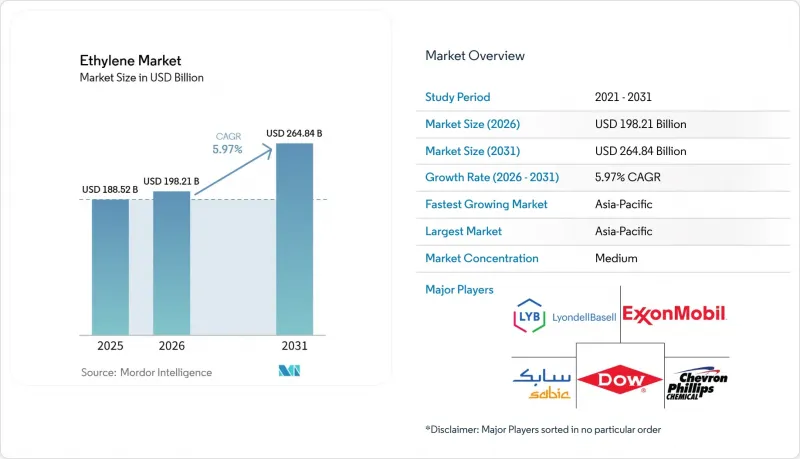
Mordor Intelligence에 의하면, 에틸렌 시장 규모는 2025년에 1,885억 2,000만 달러로 평가되었습니다. 2026년 1,982억 1,000만 달러에서 성장을 계속해 2031년에는 2,648억 4,000만 달러에 이를 것으로 추정되고 있습니다.
예측 기간(2026-2031년) 동안 연평균 성장률(CAGR)은 5.97%가 될 것으로 전망됩니다.
본 보고서는 원료(나프타, 에탄, 프로판 등), 용도(폴리에틸렌, 에틸렌옥사이드 등), 최종 이용 산업(포장, 건축 및 건설, 자동차, 섬유, 화학,농업, 소비재 등) 및 지역(아시아태평양, 북미, 유럽, 남미, 중동 및 아프리카)별로 분류되어 있습니다. 시장 예측은 금액(달러) 기준으로 제시되어 있습니다.
세계의 에틸렌 시장 동향 및 인사이트
포장 용도에서의 폴리에틸렌 수요 증가
폴리에틸렌은 연질 필름, 용기, 팔레트 랩, 보호재 등에 널리 사용되고 있기 때문에 포장 분야 수요가 계속해서 에틸렌 시장을 지탱하고 있습니다. 전자상거래 물류에서는 스트레치 필름 및 팔레트 랩 수요가 증가하고 있으며, 이에 따라 물류 분야에서의 폴리에틸렌 사용량이 증가하고 있습니다. 또한, 식품 안전 규제도 수분 이동을 억제하고 포장된 상품을 보호하는 소재에 대한 수요를 촉진하고 있습니다. EU의 포장 및 포장 폐기물 관련 규정은 재활용 가능한 설계를 장려하고 있어, 단일 소재 폴리에틸렌 포장의 사용 확대로 이어질 가능성이 있습니다. 보레알리스(Borealis)는 2025년 3월, 비식품용 연포장용 ‘Borcycle M CWT120CL’을 출시하며, 재생 선형 저밀도 폴리에틸렌 분야에서의 지속적인 상업적 활동을 보여주었습니다. 이러한 변화는 폴리에틸렌 수요를 뒷받침하는 한편, 생산자들에게는 재생 소재 함유율 및 재활용 적합성 향상을 요구하고 있습니다.
순환 경제와 저탄소 에틸렌 생산에 대한 관심 고조
고객들이 공급망 전반의 배출량을 평가함에 따라, 저탄소 생산은 에틸렌 시장에서 점점 더 중요해지고 있습니다. China National Petroleum Corporation(CNPC)은 2026년 7월 콜라에서 전 공정에 걸친 친환경적이고 저탄소적인 에틸렌 프로젝트를 시작했습니다. 이 프로젝트는 태양광 발전, 크래커로 배기가스에서 이산화탄소 포집, 그리고 수소 재활용을 결합하고 있습니다. CNPC에 따르면, 이 프로젝트는 연간 10억 kWh의 태양광 발전 전력을 활용하여 연간 137만 메트르톤의 이산화탄소 배출량을 감축할 수 있다고 합니다. 또한, 재생에너지를 활용한 전기화학적 첨단 전환 기술(REACT) 프로그램이 2026년 5월에 시작되어, 재활용된 이산화탄소를 에틸렌으로 전환하는 전해 장치 개발이 진행되고 있습니다. 이러한 프로젝트들은 생산자들이 기존의 크래킹과 저배출 경로를 별개의 사업으로 취급하는 것이 아니라, 두 가지를 병행하여 추진하고 있음을 보여줍니다.
원유 및 천연가스 액체(NGL) 원료 가격 변동
원료 가격 변동은 하류 수요가 안정적인 경우에도 크래커의 마진을 압박할 가능성이 있습니다. 특히 원유 가격 상승이 폴리머 가격 상승을 상회할 경우, 나프타를 원료로 하는 플랜트는 큰 영향을 받습니다. 또한 중동산 원유에 의존하는 생산자는 해당 지역의 해상 운송 경로가 혼란을 겪을 경우 더 큰 위험에 직면합니다. 그 결과 발생하는 마진 변동은 유지보수 연기, 가동률 저하, 혹은 신규 생산 능력 결정의 지연을 초래할 수 있습니다. 멀티피드형 크래커는 실용적인 해결책이 될 수 있지만, 설비 투자와 적절한 물류 체계가 필요합니다. 따라서 운영사가 생산을 중단하지 않고 공급 체계를 다각화하며 원료 사용을 조정할 수 있다면, 에틸렌 시장은 그 혜택을 누리게 될 것입니다.
부문별 분석
2025년, 나프타는 에틸렌 시장 점유율의 42.57%를 차지했으며, 이는 유럽 및 아시아 대부분 지역에 확립된 나프타 크래커 기반을 반영합니다. 에탄은 가장 빠르게 성장하는 원료로, 2031년까지 연평균 성장률(CAGR) 6.84%로 확대될 것으로 예측됩니다. 미국 멕시코만 연안의 생산자들은 풍부한 천연가스 액체(NGL) 공급과 확립된 에탄 인프라의 혜택을 받고 있습니다. 이로 인해 원유 가격이 급등하는 상황에서도 에탄 기반 크래커는 지속적인 원료 측면의 우위를 확보하고 있습니다. 에탄 기반 에틸렌 생산 시장 규모는 아시아 및 유럽의 수입 능력 확대에 힘입어 성장하고 있습니다. 또한, 에탄은 나프타에 비해 보고된 생산 배출 강도가 낮아, 탄소 규제 준수 비용이 중요한 요소가 되는 상황에서는 그 매력이 더욱 높아집니다.
미국 내 에탄 크래킹과 유럽 내 나프타 크래킹의 비용 차이는 각각 톤당 123달러 및 792달러였습니다. 이러한 차이로 인해 아시아 및 유럽의 구매자들은 보다 장기적인 에탄 공급 확보를 추진하고 있습니다. 반면, 정유시설와의 통합이나 기존 인프라로 인해 석유 유래 원료가 유리한 지역에서는 나프타가 여전히 필요합니다. 프로판과 부탄은 수반 가스를 확보할 수 있는 중동의 생산자들에게도 중요합니다. 유연성이 높은 크래커는 상대적 가격이 변동할 때 이러한 원료 중에서 선택할 수 있습니다. 이러한 유연성으로 회복력은 향상되지만, 물류상의 제약이나 지역적 공급 위험에 대한 노출이 사라지는 것은 아닙니다.
지역별 분석
아시아태평양은 2025년에 에틸렌 시장 점유율의 46.72%를 차지했으며, 2031년까지 연평균 성장률(CAGR) 6.81%로 성장할 것으로 전망됩니다. BASF의 잔장(Zhanjiang) 복합 시설은 2026년 3월에 본격 가동을 시작하여 연간 100만 메트르톤 규모의 에틸렌 크래커가 추가되었습니다. 이 지역은 대규모 수요 거점과 상당한 신규 공급이 결합되어 있습니다. 인도의 포장 및 건설 활동은 에틸렌 소비의 추가 확대를 뒷받침하고 있습니다. 한국의 경우, 주요 신규 프로젝트가 가동을 시작하는 반면, 구형 나프타 크래커가 압박을 받고 있어 전망은 엇갈리고 있습니다.
S-OIL의 샤힌(Shaheen) 프로젝트는 2026년 7월에 기계적 완공을 맞이하며, 연간 180만 미터톤의 에틸렌을 생산하도록 설계되었습니다. 이 프로젝트는 원유에서 화학제품을 제조하는 기술을 채택하고 있으며, 2027년에 상업 가동을 시작할 전망입니다. 싱가포르는 2026년 5월 Aster가 부콤(Bukom)의 수출 능력 확대를 결정함에 따라 물류 거점으로서의 역할을 강화하고 있습니다. 북미는 셰일 생산이 에탄 공급을 뒷받침하고 있어 여전히 비용 경쟁력을 유지하고 있습니다. 캐나다는 미국공급망과 통합되어 있지만, 멕시코는 에틸렌 유도체 생산 재개를 목표로 하고 있습니다. 페멕스(Pemex)는 2025년부터 2035년까지의 계획에서 칸그레헤라 및 모레로스 복합 시설의 생산을 재개하기 위해 42억 달러를 배정했습니다.
유럽은 나프타 가격 급등, 탄소 배출 규제 대응, 그리고 에너지 비용 급등의 영향을 받고 있습니다. 비용 면에서 불리한 입장에 놓여 있어, 유럽의 에틸렌 시장 규모는 에탄을 원료로 하는 지역에 비해 더욱 제약을 받고 있습니다. 유럽연합 집행위원회의 개정된 벤치마크에 따라, 현지 자산에 있어 배출 성능의 중요성이 더욱 커지고 있습니다. 중동은 사우디아라비아, 아랍에미리트, 카타르가 경쟁력 있는 가격의 천연가스를 이용할 수 있어 원료 면에서 우위를 점하고 있습니다. Tasnee는 2026년 7월, Saudi Ethylene and Polyethylene Company의 확장 공사를 완료하여 알주바이르의 생산 능력을 증강했습니다. 남미에서는 원료 비용이 높아지고 있지만, Braskem은 리우데자네이루에서 연간 22만 톤의 생산 능력 확장을 위해 42억 브라질 레알(7억 4,000만 달러)의 투자를 승인했습니다.
기타 혜택 :
- 엑셀 형식 시장 예측(ME) 시트
- 3개월간의 애널리스트 지원
자주 묻는 질문
목차
제1장 서론
제2장 조사 방법
제3장 주요 요약
제4장 시장 구도
제5장 시장 규모 및 성장 예측
제6장 경쟁 구도
제7장 시장 기회 및 향후 전망
KTH 26.09.04According to Mordor Intelligence, the ethylene market was valued at USD 188.52 billion in 2025 and is estimated to grow from USD 198.21 billion in 2026 to reach USD 264.84 billion by 2031, at a CAGR of 5.97% during the forecast period (2026-2031).
This report is Segmented by Feedstock (Naphtha, Ethane, Propane, and More), Application (Polyethylene, Ethylene Oxide, and More), End-Use Industry (Packaging, Building & Construction, Automotive, Textile, Chemicals, Agriculture, Consumer Goods, and More), and Geography (Asia-Pacific, North America, Europe, South America, and Middle-East and Africa). The Market Forecasts are Provided in Terms of Value (USD).
Global Ethylene Market Trends and Insights
Growing Demand for Polyethylene in Packaging Applications
Packaging demand continues to support the ethylene market because polyethylene is widely used in flexible films, containers, pallet wrap, and protective materials. E-commerce distribution requires more stretch film and pallet wrap, which raises polyethylene use in logistics. Food safety rules also support demand for materials that limit moisture transfer and protect packaged goods. The EU Packaging and Packaging Waste Regulation supports recyclable designs and can increase the use of mono-material polyethylene packaging. Borealis introduced Borcycle M CWT120CL in March 2025 for flexible non-food packaging, showing continued commercial activity in recycled linear low-density polyethylene. These changes support polyethylene demand while requiring producers to improve recycled-content and recyclability credentials.
Rising Focus on Circular Economy and Low-Carbon Ethylene Production
Low-carbon production is becoming more relevant to the ethylene market as customers assess emissions across their supply chains. China National Petroleum Corporation launched its full-chain green and low-carbon ethylene project in Korla in July 2026. The project combines photovoltaic electricity, carbon capture from cracker furnace flue gas, and hydrogen recycling. CNPC stated that the project uses 1 billion kWh of photovoltaic electricity each year and can reduce carbon emissions by 1.37 million metric tons annually. The Renewable Electrochemical Advanced Conversion of CO2 to Target products (REACT) program began in May 2026 to develop an electrolyzer that converts recycled carbon dioxide into ethylene. These projects show that producers are pursuing lower-emission routes alongside conventional cracking rather than treating them as separate businesses.
Volatility in Crude Oil and Natural Gas Liquid Feedstock Prices
Feedstock volatility can compress cracker margins even when downstream demand remains stable. Naphtha-based plants are particularly exposed when crude oil prices rise faster than polymer prices. Producers that rely on Middle Eastern cargoes also face greater risk when regional shipping routes are disrupted. The resulting margin changes can delay maintenance, reduce operating rates, or postpone new capacity decisions. Multi-feed crackers offer a practical response, but they require capital investment and suitable logistics. The ethylene market, therefore, benefits when operators can diversify supply arrangements and adjust feedstock use without interrupting production.
Other drivers and restraints analyzed in the detailed report include:
- Advancements in Feedstock Flexibility and Digital Optimization of Steam Cracking Operations
- Increasing Demand for Ethylene Glycol in Electric Vehicle Cooling and Thermal Management Systems
- Stringent Carbon Emission Regulations for Naphtha-Based Ethylene Production
For complete list of drivers and restraints, kindly check the Table Of Contents.
Segment Analysis
Naphtha accounted for 42.57% of the ethylene market share in 2025, reflecting the established naphtha cracker base in Europe and much of Asia. Ethane is the fastest-growing feedstock and is expected to expand at a 6.84% CAGR through 2031. United States Gulf Coast producers benefit from a substantial natural gas liquids supply and established ethane infrastructure. This gives ethane-based crackers a durable feedstock advantage when crude oil prices are elevated. The ethylene market size for ethane-based output is supported by growing import capacity in Asia and Europe. Ethane also has a lower reported production-emissions intensity than naphtha, which adds to its appeal where carbon compliance costs are material.
The cost difference between United States ethane cracking and European naphtha cracking was USD 123 per metric ton and USD 792 per metric ton, respectively. This difference encourages Asian and European buyers to secure longer-term ethane supplies. Naphtha remains necessary where refinery integration and legacy infrastructure favor oil-derived feedstocks. Propane and butane are also important for Middle Eastern producers with access to associated gas. Flexible crackers can choose among these feedstocks when relative prices change. This flexibility improves resilience, but it does not remove exposure to logistics limits and regional supply risks.
Complete Report Scope:
- By Feedstock
- Naphtha
- Ethane
- Propane
- Butane
- Other Feedstocks
- By Application
- Polyethylene
- Ethylene Oxide
- Ethyl Benzene
- Ethylene Dichloride (EDC)
- Vinyl Acetate Monomer (VAM)
- Other Applications
- By End-Use Industry
- Packaging
- Building & Construction
- Automotive
- Textile
- Chemicals
- Agriculture
- Healthcare & Pharmaceuticals
- Consumer Goods
- Other End-Use Industries
- By Geography
- Asia-Pacific
- China
- India
- Japan
- South Korea
- Rest of Asia-Pacific
- North America
- United States
- Canada
- Mexico
- Europe
- Germany
- United Kingdom
- France
- Italy
- Russia
- Rest of Europe
- South America
- Brazil
- Argentina
- Rest of South America
- Middle-East and Africa
- Saudi Arabia
- South Africa
- Rest of Middle-East and Africa
- Asia-Pacific
Geography Analysis
Asia-Pacific accounted for 46.72% of the ethylene market share in 2025 and is projected to grow at a 6.81% CAGR through 2031. BASF's Zhanjiang complex entered full operation in March 2026 and added a 1 million metric ton-per-year ethylene cracker. The region combines large demand centers with substantial new supply. India's packaging and construction activity supports further ethylene consumption. South Korea faces an uneven outlook because older naphtha crackers are under pressure while major new projects enter service.
S-OIL's Shaheen Project reached mechanical completion in July 2026 and is designed to produce 1.8 million metric tons of ethylene per year. The project uses crude-to-chemicals technology and is expected to begin commercial operations in 2027. Singapore is strengthening its logistics role after Aster's May 2026 investment decision to expand export capacity at Bukom. North America remains cost-competitive because shale production supports ethane supply. Canada is integrated with the United States supply chains, while Mexico is seeking to reactivate ethylene derivative production. Pemex allocated USD 4.2 billion in its 2025 to 2035 plan to revive output at the Cangrejera and Morelos complexes.
Europe is affected by high naphtha costs, carbon compliance, and utility costs. A weaker cost position constrains the ethylene market size in Europe more than in ethane-based regions. The European Commission's revised benchmark makes emissions performance more important for local assets. The Middle East has a more favorable feedstock position because Saudi Arabia, the United Arab Emirates, and Qatar can use competitively priced gas. Tasnee completed its Saudi Ethylene and Polyethylene Company expansion in July 2026, adding capacity at Al Jubail. South America has higher feedstock costs, but Braskem approved BRL 4.2 billion, USD 740 million, for a 220,000 metric tons-per-year expansion in Rio de Janeiro.
- SABIC
- Borealis AG
- Braskem
- Chevron Phillips Chemical Company LLC
- China Petrochemical Corporation
- Exxon Mobil Corporation
- Formosa Plastics Corporation
- INEOS Group Limited
- LG Chem Ltd.
- Lotte Chemical Corporation
- LyondellBasell Industries Holdings B.V.
- Mitsubishi Chemical Corporation
- NOVA Chemicals Corporation
- PetroChina Company Limited
- PTT Global Chemical Public Company Limited
- Reliance Industries Limited
- Sasol Limited
- Shell plc
- TotalEnergies
Additional Benefits:
- The market estimate (ME) sheet in Excel format
- 3 months of analyst support
TABLE OF CONTENTS
1 Introduction
- 1.1 Study Assumptions and Market Definition
- 1.2 Scope of the Study
2 Research Methodology
3 Executive Summary
4 Market Landscape
- 4.1 Market Overview
- 4.2 Market Drivers
- 4.2.1 Growing Demand for Polyethylene in Packaging Applications
- 4.2.2 Rising Focus on Circular Economy and Low-Carbon Ethylene Production
- 4.2.3 Advancements in Feedstock Flexibility and Digital Optimization of Steam Cracking Operations
- 4.2.4 Increasing Demand for Ethylene Glycol in Electric Vehicle Cooling and Thermal Management Systems
- 4.2.5 Increasing Investments in Integrated Petrochemical Complexes Across Asia-Pacific and the Middle East
- 4.3 Market Restraints
- 4.3.1 Volatility in Crude Oil and Natural Gas Liquid (NGL) Feedstock Prices
- 4.3.2 Stringent Carbon Emission Regulations for Naphtha-Based Ethylene Production
- 4.3.3 Lengthy Regulatory Approval and Permitting Processes for New Ethylene Production Facilities
- 4.4 Value Chain Analysis
- 4.5 Porter's Five Forces Analysis
- 4.5.1 Threat of New Entrants
- 4.5.2 Bargaining Power of Suppliers
- 4.5.3 Bargaining Power of Buyers
- 4.5.4 Threat of Substitutes
- 4.5.5 Competitive Rivalry
- 4.6 Production Capacity Analysis
5 Market Size and Growth Forecasts (Value)
- 5.1 By Feedstock
- 5.1.1 Naphtha
- 5.1.2 Ethane
- 5.1.3 Propane
- 5.1.4 Butane
- 5.1.5 Other Feedstocks
- 5.2 By Application
- 5.2.1 Polyethylene
- 5.2.2 Ethylene Oxide
- 5.2.3 Ethyl Benzene
- 5.2.4 Ethylene Dichloride (EDC)
- 5.2.5 Vinyl Acetate Monomer (VAM)
- 5.2.6 Other Applications
- 5.3 By End-Use Industry
- 5.3.1 Packaging
- 5.3.2 Building & Construction
- 5.3.3 Automotive
- 5.3.4 Textile
- 5.3.5 Chemicals
- 5.3.6 Agriculture
- 5.3.7 Healthcare & Pharmaceuticals
- 5.3.8 Consumer Goods
- 5.3.9 Other End-Use Industries
- 5.4 By Geography
- 5.4.1 Asia-Pacific
- 5.4.1.1 China
- 5.4.1.2 India
- 5.4.1.3 Japan
- 5.4.1.4 South Korea
- 5.4.1.5 Rest of Asia-Pacific
- 5.4.2 North America
- 5.4.2.1 United States
- 5.4.2.2 Canada
- 5.4.2.3 Mexico
- 5.4.3 Europe
- 5.4.3.1 Germany
- 5.4.3.2 United Kingdom
- 5.4.3.3 France
- 5.4.3.4 Italy
- 5.4.3.5 Russia
- 5.4.3.6 Rest of Europe
- 5.4.4 South America
- 5.4.4.1 Brazil
- 5.4.4.2 Argentina
- 5.4.4.3 Rest of South America
- 5.4.5 Middle-East and Africa
- 5.4.5.1 Saudi Arabia
- 5.4.5.2 South Africa
- 5.4.5.3 Rest of Middle-East and Africa
- 5.4.1 Asia-Pacific
6 Competitive Landscape
- 6.1 Market Concentration
- 6.2 Strategic Moves
- 6.3 Market Share (%)/Ranking Analysis
- 6.4 Company Profiles (includes Global Overview, Market Overview, Core Segments, Financials as available, Strategic Information, Products and Services, and Recent Developments)
- 6.4.1 SABIC
- 6.4.2 Borealis AG
- 6.4.3 Braskem
- 6.4.4 Chevron Phillips Chemical Company LLC
- 6.4.5 China Petrochemical Corporation
- 6.4.6 Exxon Mobil Corporation
- 6.4.7 Formosa Plastics Corporation
- 6.4.8 INEOS Group Limited
- 6.4.9 LG Chem Ltd.
- 6.4.10 Lotte Chemical Corporation
- 6.4.11 LyondellBasell Industries Holdings B.V.
- 6.4.12 Mitsubishi Chemical Corporation
- 6.4.13 NOVA Chemicals Corporation
- 6.4.14 PetroChina Company Limited
- 6.4.15 PTT Global Chemical Public Company Limited
- 6.4.16 Reliance Industries Limited
- 6.4.17 Sasol Limited
- 6.4.18 Shell plc
- 6.4.19 TotalEnergies
7 Market Opportunities and Future Outlook
- 7.1 White-Space and Unmet-Need Assessment


