|
시장보고서
상품코드
2123978
에틸렌 카보네이트 시장 : 점유율 분석, 업계 동향과 통계, 성장 예측(2026-2031년)Ethylene Carbonate - Market Share Analysis, Industry Trends & Statistics, Growth Forecasts (2026 - 2031) |
||||||
 Mordor Intelligence
Mordor Intelligence에 의하면, 에틸렌 카보네이트 시장 규모는 2025년 11억 3,000만 달러에서 2026년에는 12억 3,000만 달러로 확대되어 2026년부터 2031년까지 CAGR 9.12%로 성장을 지속하여, 2031년까지 19억 1,000만 달러에 이를 것으로 예측됩니다.
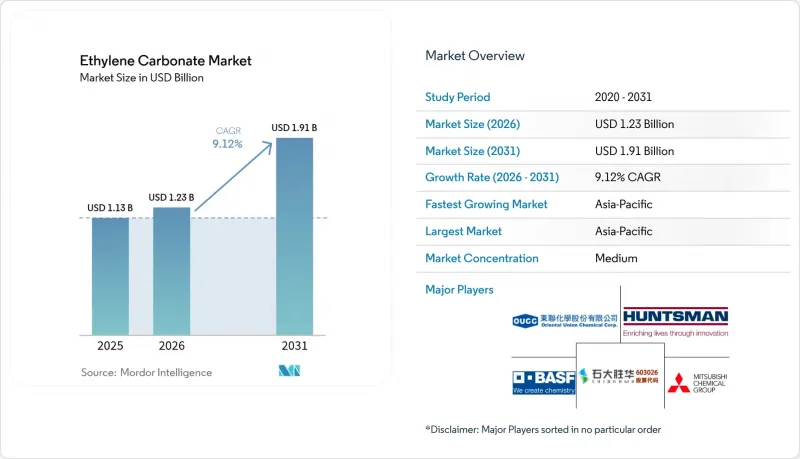
본 보고서는 형태(고체, 액체), 용도(리튬 이온 배터리, 윤활제, 의료 제품, 중간체 및 의약품, 기타 용도), 최종 사용자 산업(자동차, 제약, 석유 및 가스,기타 최종 사용자 산업), 지역(아시아태평양, 북미, 유럽, 남미, 중동 및 아프리카)별로 분류되어 있습니다. 시장 예측은 금액(달러) 기준으로 제시되어 있습니다.
세계 에틸렌 카보네이트 시장 동향 및 인사이트
전기차(EV)용 고에너지 밀도 리튬 이온 배터리 수요 급증
세계 전기차(EV)의 보급을 위해서는 급속 충전 성능을 실현하면서도 셀 전압을 4.4V 이상으로 유지할 수 있는 전해질 시스템이 요구됩니다. 에틸렌 카보네이트는 흑연 음극을 용매의 공삽입으로부터 보호하는 안정적인 SEI 층을 형성합니다. 이 특성은 프로파일렌 카보네이트를 대체재로 사용했을 때와 비교하여 용량 저하가 현저히 적다는 것을 보여준 Skoltech의 연구를 통해 입증되었습니다. 따라서 자동차 제조업체와 배터리 제조업체는 공급 계약에 장기적인 인수 조항을 포함시켜 단기적인 가격 변동으로부터 수요를 보호하고 있습니다. 승용차, 상용차, 고정형 에너지 저장 시스템에 배터리 도입이 확대됨에 따라, 이러한 누적 효과가 예측 연평균 성장률(CAGR)을 3.20% 끌어올릴 것으로 전망됩니다.
프리미엄 산업용 및 자동차용 윤활유의 성장
금속 가공용, 엔진 오일, 풍력 터빈 기어박스용 고성능 윤활유의 경우, 200°C를 초과하는 온도에서도 점도를 유지하는 극성 카보네이트계 첨가제의 채택이 점점 더 늘어나고 있습니다. 유지화학 유래 탄산염에 대한 실험실 데이터에 따르면, 에틸렌 카보네이트의 짧은 탄소 사슬이 뛰어난 용해성과 피막 형성 특성을 부여하여 극압 내성을 높이는 것으로 확인되었습니다. OEM에 의한 오일 교환 주기 20,000 km로의 연장으로 인해 배합당 첨가제 사용량이 증가하고 있으며, 이는 배터리 분야 이외에서도 이익률 향상으로 이어지는 꾸준한 수요 증가로 이어지고 있습니다.
에틸렌옥사이드 원료 가격 변동
원료 비용은 비통합형 제조업체의 변동 생산 비용에서 큰 비중을 차지합니다. 현재 시장 침체기에 전 세계 에틸렌 생산 능력의 상당 부분이 가동 중단 위험에 노출되어 있어 가격 변동이 심화되고, 탄산염 제조업체의 이익률이 하락하고 있습니다. 자체적으로 에틸렌 옥사이드 제조 설비를 보유한 생산자는 위험을 헤지하고 있지만, 소규모 하류 기업에 공급하는 무역사는 이익률의 급격한 변동을 겪고 있으며, 이로 인해 해당 부문의 연평균 성장률(CAGR)이 2.10% 하락하고 있습니다.
부문 분석
고체 부문은 2025년 매출의 51.60%를 차지하며 계속해서 주도적인 위치를 유지했습니다. 이는 순도 99% 이상의 플레이크를 전 세계로 운송하여 현지에서 용해하는 데 사용하는 수십 년에 걸친 물류 네트워크에 의해 뒷받침되고 있습니다. 한편, 액체 배터리 등급 용액은 수분 함량이 관리되어 20ppm 미만으로 여과된 상태로 납품되므로, 오염 위험이 수반되는 공장 내 취급 공정이 필요 없어져 2031년까지 연평균 성장률(CAGR) 9.55%로 확대되고 있습니다. 이러한 구조적 전환을 통해 공급업체는 가공 마진을 확보할 수 있을 뿐만 아니라, 기가팩토리의 전해액 라인에서 자동 충진이 가능해집니다. 고체 제품은 드럼통이나 봉투를 통한 취급 속도가 병목 현상이 되지 않는 벌크 산업용도에서 계속해서 중요하며, 규모는 크지만 완만한 성장을 지속하는 시장 기반을 유지하게 될 것입니다.
99.0%의 테크니컬 등급 고체와 99.7%의 배터리 등급 액체 간의 성능 격차는 결정화나 이온 교환을 통한 정제가 업스트림 공정에 통합됨에 따라 줄어들고 있으며, 배터리 이외의 분야에서 액체가 차지하는 시장 점유율이 확대되고 있습니다. 미국 헌츠맨(Huntsman)사가 최근 텍사스주의 E-GRADE 정제 라인에 투자한 것은 유럽과 미국공급업체들이 고순도·고부가가치 제품을 공급함으로써 시장 점유율을 지키고 있음을 보여주는 좋은 예입니다. 이에 반해 아시아의 경쟁사들은 운임을 10-12% 절감할 수 있는 ISO 탱크를 이용한 벌크 운송으로 대응하고 있어, 2031년까지 운송 형태를 둘러싼 경쟁이 격화되고 있습니다.
지역별 분석
아시아태평양의 ‘화학제품에서 배터리로의 통합 회랑’은 2025년에 전 세계 매출의 54.05%를 차지하며, 2031년까지 연평균 성장률(CAGR) 9.48%를 나타낼 것으로 전망됩니다. 이는 비용 우위를 뒷받침하는 중국 본토의 2,600만 톤 에틸렌 크래커 계획 생산 능력에 힘입은 결과입니다. 현지 탄산염 제조업체들은 일반적으로 기가팩토리 근처에 공장을 입지시켜 운송 시간을 2-3일 단축할 수 있을 뿐만 아니라, 자동차 업계의 추적성 프로토콜을 준수하는 온콜(on-call) 방식의 품질 보증 실험실을 병설하고 있습니다. 일본의 에틸렌 생산량은 2024년에 35년 만에 최저 수준을 기록했는데, 이는 국내 배터리 프로젝트가 확대되고 있음에도 불구하고 고부가가치 특수 화학제품으로의 전환이 진행되고 있음을 반영한 것으로, 그 결과 중국의 지역적 생산 우위가 더욱 확대되고 있습니다.
북미에서는 헌츠맨(Huntsman)사가 국내 최대 공급업체임에도 불구하고, 배터리 등급 탄산염은 여전히 구조적인 공급 부족이 지속되고 있습니다. ‘인플레이션 억제법’에 따른 미국 배터리 공장에 대한 우대 조치가 수년에 걸친 공급 계약을 유도하고 있으며, 이를 통해 태평양을 횡단하는 공급 리스크가 부분적으로 헤지되고 있습니다. 그러나 셰일가스의 혜택을 받는 에탄 크래커가 폴리에틸렌을 우선시함에 따라 원료 비용은 상승하고 있으며, 탄산염 제조업체는 지수 연동형 프리미엄을 지불하고 에틸렌 옥사이드를 확보해야 합니다.
유럽의 엄격한 REACH 규제는 규정 준수 비용을 상승시키고 있지만, 완전히 문서화된 원료에는 프리미엄이 보장되고 있습니다. BASF가 미국에서 6곳의 케어 케미컬 공장을 재생 가능 전력만으로 가동하겠다는 공약은 성숙한 시장에서 지속가능성 노력이 부드러운 차별화 요인으로 전 세계적으로 활용되고 있음을 여실히 보여줍니다. 한편, 중동 및 아프리카 및 남미는 총 판매량에서 차지하는 비중은 작지만, 석유화학제품의 다각화 프로그램과 전기차(EV) 수입 보급률 확대를 통해 성장 여지를 가지고 있습니다. ISO 탱크와 지역별 재고 허브를 활용한 유연한 물류 시스템은 이러한 신흥 시장에서 수익성 높은 시장 점유율을 확보하기 위한 핵심 요소로 계속 작용하고 있습니다.
기타 혜택:
- 엑셀 형식 시장 예측(ME) 시트
- 3개월간의 애널리스트 지원
자주 묻는 질문
목차
제1장 서론
제2장 조사 방법
제3장 주요 요약
제4장 시장 구도
제5장 시장 규모와 성장 예측
제6장 경쟁 구도
제7장 시장 기회와 향후 전망
JHS 26.09.07According to Mordor Intelligence, the ethylene carbonate market size is expected to grow from USD 1.13 billion in 2025 to USD 1.23 billion in 2026 and is forecast to reach USD 1.91 billion by 2031 at 9.12% CAGR over 2026-2031.
This report is Segmented by Form (Solid, Liquid), Application (Lithium-Ion Batteries, Lubricants, Medical Products, Intermediates and Agents, Other Applications), End-User Industry (Automotive, Pharmaceuticals, Oil and Gas, Other End-User Industries), and Geography (Asia-Pacific, North America, Europe, South America, Middle East and Africa). The Market Forecasts are Provided in Terms of Value (USD).
Global Ethylene Carbonate Market Trends and Insights
Surging Demand for High-Energy-Density Li-ion Batteries in EVs
Global electric-vehicle rollouts require electrolyte systems that sustain cell voltages above 4.4 V while enabling fast-charge performance. Ethylene carbonate forms a stable SEI layer that protects graphite anodes from solvent co-intercalation, a property validated in Skoltech research showing markedly lower capacity fade versus propylene carbonate alternatives. Automakers and cell makers therefore embed long-term offtake clauses into supply contracts, shielding demand from short-term price swings. The cumulative effect adds 3.20 percentage points to the forecast CAGR as battery deployments scale across passenger cars, commercial fleets, and stationary storage.
Growth in Premium Industrial & Automotive Lubricants
High-performance lubricants in metal-working, engine oils, and wind-turbine gearboxes increasingly specify polar carbonate additives that maintain viscosity at temperatures above 200 °C. Laboratory data on oleochemical carbonates confirm that the short carbon chain of ethylene carbonate confers superior solubility and film-forming properties, enhancing extreme-pressure resistance. OEM warranty extensions to 20,000 km oil-change intervals amplify additive loading per formulation, translating into steady, margin-accretive demand beyond the battery sector.
Volatility in Ethylene-Oxide Feedstock Prices
Feedstock costs constitute a significant portion of variable production costs for non-integrated manufacturers. A substantial share of global ethylene capacity is at risk of closure during the current market downturn, intensifying price volatility and reducing carbonate converters' profit margins. Producers with captive ethylene-oxide units hedge exposure, but merchants supplying smaller downstream players experience margin whiplash, dragging the sector CAGR by 2.10 percentage points.
Other drivers and restraints analyzed in the detailed report include:
- Expansion of Asian Battery-Manufacturing Capacity
- Emergence of Solid-State Battery Precursor Requirements
- Substitution by Dimethyl & Propylene Carbonate Blends
For complete list of drivers and restraints, kindly check the Table Of Contents.
Segment Analysis
The solid segment retained leadership with 51.60% revenue in 2025, supported by a decades-old logistics network that ships greater than or equal to 99% purity flakes worldwide for on-site dissolution. Liquid battery-grade solutions, however, are expanding at a 9.55% CAGR to 2031 because they arrive moisture-controlled and filtered to less than 20 ppm water, eliminating in-plant handling steps that risk contamination. This structural pivot lets suppliers capture processing spreads while enabling automated filling in gigafactory electrolyte lines. Solid products will remain relevant for bulk industrial uses where drum or bag handling is not rate-limiting, preserving a sizeable, slow-growing base.
The performance gap between 99.0% technical-grade solids and 99.7% battery-grade liquids is narrowing as crystallization and ion-exchange polishing are embedded upstream, raising the addressable share of liquids in non-battery segments. US-based Huntsman's recent investment in a Texan E-GRADE purification line exemplifies how Western suppliers defend market share with higher-purity, value-added volumes. Asian competitors counter with bulk ISO-tank shipments that cut freight costs by 10-12%, intensifying form-factor competition through 2031.
Complete Report Scope:
- By Form
- Solid (greater than or equal to 99% purity flakes)
- Liquid (battery-grade solution)
- By Application
- Lithium-ion Batteries
- Lubricants
- Medical Products
- Intermediates and Agents
- Other Applications
- By End-user Industry
- Automotive
- Pharmaceuticals
- Oil and Gas
- Other End-user Industries
- By Geography
- Asia-Pacific
- China
- Japan
- India
- South Korea
- Rest of Asia-Pacific
- North America
- United States
- Canada
- Mexico
- Europe
- Germany
- United Kingdom
- France
- Italy
- Russia
- Rest of Europe
- South America
- Brazil
- Argentina
- Rest of South America
- Middle East and Africa
- Saudi Arabia
- South Africa
- Rest of Middle East and Africa
- Asia-Pacific
Geography Analysis
Asia-Pacific's integrated chemical-to-battery corridor yielded 54.05% of global revenues in 2025 and is expected to clock a 9.48% CAGR to 2031, buoyed by 26 million t of planned ethylene cracker capacity in mainland China that underpins cost leadership. Local carbonate producers typically site plants near gigafactories, shaving 2-3 days off transit times and embedding on-call quality-assurance labs that align with automotive traceability protocols. Japan's ethylene output hit a 35-year low in 2024, reflecting a shift toward high-value specialty chemicals even as domestic battery projects grow, which widens China's regional production advantage.
North America remains structurally short in battery-grade carbonate despite Huntsman's position as the largest domestic supplier. The Inflation Reduction Act's incentives for US cell factories have triggered multi-year offtake agreements that partially hedge trans-Pacific supply risks. Feedstock costs, however, are higher because shale-gas-advantaged ethane crackers prioritize polyethylene, requiring carbonate makers to secure ethylene oxide at index-linked premiums.
Europe's stringent REACH environment raises compliance costs yet secures a premium for fully documented material. BASF's pledge to power six US care-chemical sites entirely with renewable electricity underscores how sustainability credentials are being deployed globally as soft differentiators in mature markets. Meanwhile, Middle East & Africa and South America collectively account for smaller share of volume but present upside through petrochemical diversification programs and growing EV import penetration. Logistics flexibility-using ISO tanks and regional stocking hubs-remains the route to profitable share capture in these emerging destinations.
- BASF SE
- Guangzhou Tinci Materials Technology Co., Ltd.
- Huntsman International LLC
- Liaoning Honggang Chemical Co., Ltd.
- Merck KGaA
- Mitsubishi Chemical Group Corporation
- OUCC
- Shandong Lixing Advanced Material Co., Ltd.
- Shandong Senjie Cleantech Co.,Ltd.
- Shenzhen Xinzhoubang Technology Co., Ltd.
- Shida Shenghua New Materials Group Co., Ltd.
- TOAGOSEI CO.,LTD.
- ZIBO DONGHAI INDUSTRIES CO.,LTD.
Additional Benefits:
- The market estimate (ME) sheet in Excel format
- 3 months of analyst support
TABLE OF CONTENTS
1 Introduction
- 1.1 Study Assumptions and Market Definition
- 1.2 Scope of the Study
2 Research Methodology
3 Executive Summary
4 Market Landscape
- 4.1 Market Overview
- 4.2 Market Drivers
- 4.2.1 Surging demand for high-energy-density Li-ion batteries in EVs
- 4.2.2 Growth in premium industrial and automotive lubricants
- 4.2.3 Expansion of Asian battery-manufacturing capacity
- 4.2.4 Favourable regulations for safer electrolyte solvents
- 4.2.5 Emergence of solid-state battery precursor requirements
- 4.3 Market Restraints
- 4.3.1 Health and environmental toxicity classification of EC
- 4.3.2 Volatility in ethylene-oxide feedstock prices
- 4.3.3 Substitution by dimethyl and propylene carbonate blends
- 4.4 Value Chain Analysis
- 4.5 Porter's Five Forces Analysis
- 4.5.1 Bargaining Power of Suppliers
- 4.5.2 Bargaining Power of Buyers
- 4.5.3 Threat of New Entrants
- 4.5.4 Threat of Substitute Products and Services
- 4.5.5 Degree of Competition
5 Market Size and Growth Forecasts (Value)
- 5.1 By Form
- 5.1.1 Solid (greater than or equal to 99% purity flakes)
- 5.1.2 Liquid (battery-grade solution)
- 5.2 By Application
- 5.2.1 Lithium-ion Batteries
- 5.2.2 Lubricants
- 5.2.3 Medical Products
- 5.2.4 Intermediates and Agents
- 5.2.5 Other Applications
- 5.3 By End-user Industry
- 5.3.1 Automotive
- 5.3.2 Pharmaceuticals
- 5.3.3 Oil and Gas
- 5.3.4 Other End-user Industries
- 5.4 By Geography
- 5.4.1 Asia-Pacific
- 5.4.1.1 China
- 5.4.1.2 Japan
- 5.4.1.3 India
- 5.4.1.4 South Korea
- 5.4.1.5 Rest of Asia-Pacific
- 5.4.2 North America
- 5.4.2.1 United States
- 5.4.2.2 Canada
- 5.4.2.3 Mexico
- 5.4.3 Europe
- 5.4.3.1 Germany
- 5.4.3.2 United Kingdom
- 5.4.3.3 France
- 5.4.3.4 Italy
- 5.4.3.5 Russia
- 5.4.3.6 Rest of Europe
- 5.4.4 South America
- 5.4.4.1 Brazil
- 5.4.4.2 Argentina
- 5.4.4.3 Rest of South America
- 5.4.5 Middle East and Africa
- 5.4.5.1 Saudi Arabia
- 5.4.5.2 South Africa
- 5.4.5.3 Rest of Middle East and Africa
- 5.4.1 Asia-Pacific
6 Competitive Landscape
- 6.1 Market Concentration
- 6.2 Strategic Moves
- 6.3 Market Share(%)/Ranking Analysis
- 6.4 Company Profiles (includes Global level Overview, Market level overview, Core Segments, Financials as available, Strategic Information, Market Rank/Share for key companies, Products and Services, and Recent Developments)
- 6.4.1 BASF SE
- 6.4.2 Guangzhou Tinci Materials Technology Co., Ltd.
- 6.4.3 Huntsman International LLC
- 6.4.4 Liaoning Honggang Chemical Co., Ltd.
- 6.4.5 Merck KGaA
- 6.4.6 Mitsubishi Chemical Group Corporation
- 6.4.7 OUCC
- 6.4.8 Shandong Lixing Advanced Material Co., Ltd.
- 6.4.9 Shandong Senjie Cleantech Co.,Ltd.
- 6.4.10 Shenzhen Xinzhoubang Technology Co., Ltd.
- 6.4.11 Shida Shenghua New Materials Group Co., Ltd.
- 6.4.12 TOAGOSEI CO.,LTD.
- 6.4.13 ZIBO DONGHAI INDUSTRIES CO.,LTD.
7 Market Opportunities and Future Outlook
- 7.1 White-space and Unmet-need Assessment