

|
시장보고서
상품코드
2118927
WPW 증후군 시장 : 시장 점유율 분석, 업계 동향 및 통계, 성장 예측(2026-2031년)Wolff Parkinson White Syndrome - Market Share Analysis, Industry Trends & Statistics, Growth Forecasts (2026 - 2031) |
||||||
 Mordor Intelligence
Mordor Intelligence에 의하면, WPW 증후군 시장 규모는 2025년에 12억 7,000만 달러로 평가되었고, 2026년에 13억 4,000만 달러로 추정되고, 2031년까지 17억 2,000만 달러에 이를 것으로 예측되며, 2026-2031년 CAGR 5.22%로 성장할 전망입니다.
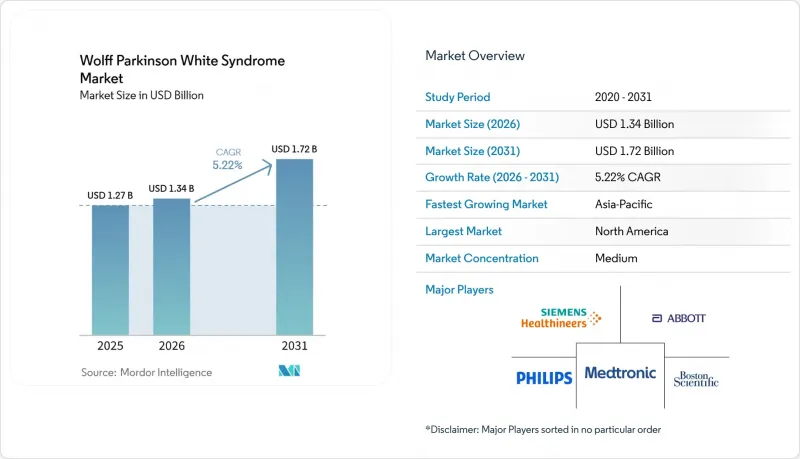
본 보고서는 유형별(유형 A, 유형 B), 진단 방법별(안정 시 심전도, 홀터 심전도, 전기생리학적 검사, 심초음파 검사), 치료법별(고주파 절제술, 냉동 절제술, 약물 요법, 전기적 제세동, 외과적 치료, 심박조율기), 환자층별(신생아·영아, 소아, 18-64세 성인), 최종 사용자별(병원 등), 지역별(북미, 유럽, 아시아태평양, 중동 및 아프리카, 남미)로 분류되어 있습니다. 예측치는 금액(달러)으로 표시되어 있습니다.
세계의 WPW 증후군 시장 동향 및 인사이트
근치적 카테터 절제술로의 첫 번째 선택으로의 전환
임상의들은 약물 치료에 저항성을 보이는 사례로만 제한하지 않고, 증상이 있는 환자에 대한 1차 치료법으로 카테터 절제술을 점점 더 많이 활용하고 있습니다. 임상 지침에서는 증상이 있는 WPW 증후군에 대한 카테터 절제술을 클래스 I 치료 옵션으로 권장하고 있으며, 전기생리학 전문의에게 조기에 의뢰할 것을 권장하고 있습니다. 1,239명의 환자를 대상으로 한 연구에서는 고주파 절제술 후 급성 시술 성공률이 94.2%, 완전 방실 차단 발생률이 0.32%, 재발률이 2.42%로 보고되었습니다. 이러한 결과는 조기 개입의 임상적 및 경제적 타당성을 뒷받침하는 한편, 의료진이 고위험 부전도 경로의 특징을 보이는 무증상 환자에 대해 예방적 절제술을 고려하게 됨에 따라 WPW 증후군 시장도 혜택을 보고 있습니다. 또한, 체계적 문헌 인사이트에 따르면 예방적 카테터 절제술이 보존적 치료에 비해 부정맥 재발을 감소시키는 것으로 나타났으며, 위험비는 0.27, 95% 신뢰 구간은 0.09-0.82로 보고되었습니다.
심전도 및 부정맥 사례 발견의 확대
심전도 선별 검사의 이용 확대에 따라, 지금까지 발견되지 않았던 WPW 증후군 양상을 보이는 환자의 식별이 증가하고 있습니다. 안정 시 심전도는 널리 이용 가능하고 비용이 비교적 저렴하며, 특징적인 델타파를 식별할 수 있기 때문에 여전히 표준적인 초기 검사 수단으로 자리 잡고 있습니다. 운동선수, 군인, 조종사, 전문 운전자를 대상으로 한 선별 프로그램을 통해 심각한 부정맥 관련 사건이 발생하기 전에 환자를 발견할 수 있습니다. 웨어러블 기기나 휴대용 심전도 측정 도구가 조기 발견을 도울 수는 있겠지만, 임상의는 진단을 확정하기 위해 여전히 정식 심혈관 평가나 기존 검사가 필요하며, 이로 인해 안정 시 심전도, 홀터 심전도, 운동 부하 검사, 심초음파 검사 및 전기생리학적 검사 서비스에 대한 수요가 유지되고 있습니다.
높은 치료 비용과 불균등한 보험 급여
카테터 절제술 비용이 고액이기 때문에 WPW 증후군을 단독 적응증으로 보험 환급 정책이 명확하게 보장하지 않는 지역에서는 치료 접근성이 제한될 가능성이 있습니다. 시술 비용에는 매핑 시스템 사용료, 일회용 카테터, 전기생리학 검사실 인건비, 마취 및 시술 후 모니터링 비용이 포함됩니다. 미국에서는 더 광범위한 상심실성 빈맥 시술 코드가 절제술을 보장할 수 있기 때문에 고가의 매핑 플랫폼 도입을 고려 중인 병원들에게는 불확실성이 발생하고 있습니다. 동결 절제술 시스템은 대부분의 경우 표준 고주파 시스템보다 비용이 더 많이 들지만, 유럽 전역에 걸쳐 서로 다른 환급 관행이 병원의 구매 결정과 환자의 접근성에 영향을 미치고 있습니다.
부문 분석
2025년, A형이 WPW 증후군 시장 점유율의 58.88%를 차지했습니다. 이러한 선두 위치는 좌측 부전도 경로(대부분 좌측 외측 및 후방 중격의 승모판 고리를 따라 위치)로 인한 임상적 부담을 반영한 것입니다. 임상의들은 일반적으로 중격 접근법 또는 역행성 대동맥 접근법을 통해 이러한 전도로를 치료해 왔습니다. 표준 고주파 절제술을 통해 90% 이상의 사례에서 좌측 외측 전도 경로가 제거됨에 따라, 유형 A는 카테터 및 매핑용 소모품의 주요 수요원이 되고 있습니다.
유형 B는 2026-2031년 연평균 성장률(CAGR) 8.15%를 나타낼 것으로 예측됩니다. 이 부문에는 파라히시안형 및 후중격형과 같은 우측 부전도 경로가 포함되며, 주요 전도 조직에 인접해 있어 치료가 더 복잡해질 수 있습니다. 투시 검사가 필요 없는 전기해부학적 매핑의 경우, 우측 부전도로의 절제술에서 97%의 급성 성공률이 보고되었습니다. 오픈 윈도우 매핑은 투시 검사 시간과 고주파 조사 시간을 단축할 수 있는 반면, 냉동 절제술은 히스 속 근처에서의 안전성을 향상시킬 수 있습니다.
2025년에는 안정 시 심전도 검사가 진단 관련 수익의 44.34%를 차지했습니다. 일반 순환기과, 1차 진료, 산업 보건, 응급 의료 현장에서 널리 이용되고 있어 여전히 주요 진단 도구로서의 위상을 유지하고 있습니다. 심전도 소견은 사전 흥분(pre-excitation)을 식별하고 추가 평가를 위한 지침이 되어, WPW 증후군 진단 서비스 시장 규모를 뒷받침하고 있습니다. AI를 활용한 소견 해석은 델타파 감지를 지원할 가능성이 있지만, 여전히 공식적인 임상적 검토가 필요합니다.
전기생리학적 검사는 2031년까지 연평균 성장률(CAGR) 6.80%를 나타낼 것으로 예측됩니다. 임상의들은 운동선수, 조종사 및 기타 고위험 직업군에서 위험도 계층화를 위해 이 검사를 점점 더 많이 활용하고 있습니다. 전기생리학적 평가에 기반한 예방적 절제술은 무증상 환자의 부정맥 재발을 감소시켰으나, 보고된 합병증은 1%에 그쳤으며, 여기에는 기흉 및 천자 부위 합병증이 포함되었습니다. 홀터 심전도, 운동 부하 검사 및 심초음파 검사는 에브스타인 기형과 같은 구조적 이상을 포함한 추가 평가에서 여전히 중요한 역할을 하고 있습니다.
지역별 분석
2025년, 북미는 WPW 증후군 시장의 39.89%를 차지했습니다. 미국이 이 지역을 주도하고 있으며, 보험 적용 범위, 전기생리학 검사실 밀도, 그리고 시술 건수를 뒷받침하는 임상 지침의 채택이 이를 뒷받침했습니다. 확립된 심장내과 의뢰 경로에는 증상이 있는 환자에 대한 카테터 절제술이 포함되었습니다. 2026년 1월, 스테레오타크시스(Stereotaxis)는 심장 매핑 및 심내막 병변 형성을 위한 ‘MAGiC 카테터’에 대해 FDA 승인을 획득했으며, 2026년 4월에는 이 카테터를 사용한 미국 최초의 상업적 시술이 발표되었습니다. 캐나다는 학술 의료 과학 센터를 통해 기여했으며, 멕시코는 주요 도시의 민간 의료 투자를 통해 시장을 확대했습니다.
유럽은 전기생리학적 치료 및 의료기기 도입에 있어 계속해서 중요한 지역 거점으로 자리매김했습니다. 독일, 영국, 프랑스에서는 높은 시술 건수가 기록되고 확립된 전기생리학 검사실이 운영된 반면, 이탈리아와 스페인에서는 경험이 풍부한 단일 기관의 프로그램을 통해 기여했습니다. 유럽 의료기기 규정(MDR)의 요건에 따라 제조업체에 대한 증거 및 인증 기준이 강화되었으며, 시판 후 감시 및 규제 준수 능력이 뛰어난 공급업체가 우위를 점했습니다. 애보트(Abbott)는 2026년 1월, 센서 탑재형 ‘TactiFlex Duo 어블레이션 카테터’의 CE 마크를 획득하여 유럽 전기생리학 기기 분야에서의 입지를 확고히 했습니다.
아시아태평양은 2031년까지 연평균 성장률(CAGR) 8.58%를 기록하며, 지역별로는 가장 빠른 성장세를 보일 것으로 예측됩니다. 중국은 국내 카테터 제조업체와 광범위한 심장 의료 인프라에 힘입어 아시아태평양에서 가장 큰 시장 기회를 지니고 있습니다. 한편, 인도에서는 정부 및 민간 병원의 투자를 통해 전기생리학 대응 능력이 향상되었습니다. 일본, 한국, 호주는 성숙한 전문 프로그램과 첨단 매핑 도구의 조기 도입을 통해 지역 전체의 성장을 뒷받침하고 있습니다. 2026년 10월 부산에서 개최될 ‘아시아태평양 심장 리듬 학회(APHRS) 제19차 학술대회’는 이 지역 내 전문가 네트워크가 확대되고 있음을 반영합니다. 중동 및 아프리카에서는 발전 수준에 편차가 나타나고 있으며, 걸프협력회의(GCC) 회원국들은 3차 심장 의료에 대한 투자를 진행하는 반면, 사하라 이남 아프리카의 대부분 지역에서는 여전히 의료 접근성이 제한적입니다. 남미에서는 브라질과 아르헨티나가 주도적인 역할을 수행하고 있으며, 의뢰 네트워크를 통해 많은 환자가 지방 도시에서 잘 갖춰진 도시 지역의 전기생리학 센터로 지속적으로 이송되고 있습니다.
기타 혜택 :
- 엑셀 형식 시장 예측(ME) 시트
- 3개월간의 애널리스트 지원
자주 묻는 질문
목차
제1장 서론
제2장 조사 방법
제3장 개요
제4장 시장 구도
제5장 시장 규모 및 성장 예측
제6장 경쟁 구도
제7장 시장 기회 및 향후 전망
AJY 26.09.01According to Mordor Intelligence, the wolff parkinson white syndrome market size is projected to be USD 1.27 billion in 2025, USD 1.34 billion in 2026, and reach USD 1.72 billion by 2031, growing at a CAGR of 5.22% from 2026 to 2031.
This report is Segmented by Type (Type A, Type B), Diagnosis (Resting ECG, Holter, EP Study, Echocardiography), Treatment (RFA, Cryoablation, Pharmacological, Cardioversion, Surgical, Pacemaker), Patient Demographics (Neonates and Infants, Children, Adults 18-64), End User (Hospitals, and More), and Geography (North America, Europe, Asia-Pacific, MEA, South America). Forecasts in Value (USD).
Global Wolff Parkinson White Syndrome Market Trends and Insights
First-Line Shift Toward Curative Catheter Ablation
Clinicians increasingly use catheter ablation as a first-line curative option for symptomatic patients, rather than reserving it for drug-refractory cases. Clinical guidance supports catheter ablation as a Class I treatment option for symptomatic Wolff-Parkinson-White syndrome, encouraging earlier referrals to electrophysiology specialists. A study of 1,239 patients reported a 94.2% acute procedural success rate, a 0.32% complete atrioventricular block rate, and a 2.42% recurrence rate after radiofrequency ablation. These outcomes strengthen the clinical and economic case for earlier intervention, while the Wolff-Parkinson-White syndrome market benefits as providers consider prophylactic ablation for asymptomatic patients with high-risk accessory pathway features. A systematic review also found that prophylactic catheter ablation reduced arrhythmia recurrence compared with conservative management, with a reported risk ratio of 0.27 and a 95% confidence interval of 0.09 to 0.82.
Broader ECG and Arrhythmia Case Finding
Greater use of ECG screening is increasing the identification of patients with previously undetected Wolff-Parkinson-White patterns. Resting ECG remains the standard entry point because it is widely available, relatively low cost, and can identify the characteristic delta wave. Screening programs among athletes, military personnel, pilots, and professional drivers can detect patients before serious rhythm-related events occur. Wearable devices and mobile ECG tools may support early identification, but clinicians still require formal cardiology assessment and conventional testing to confirm diagnosis, sustaining demand for resting ECG, ambulatory monitoring, exercise testing, echocardiography, and electrophysiology study services.
High Procedure Cost and Uneven Reimbursement
High catheter ablation costs can limit access in regions where reimbursement policies do not clearly cover Wolff-Parkinson-White syndrome as a standalone indication. Procedure costs include mapping-system use, single-use catheters, electrophysiology laboratory staffing, anesthesia, and post-procedure monitoring. In the United States, broader supraventricular tachycardia procedure codes can cover ablation, creating uncertainty for hospitals evaluating expensive mapping platforms. Cryoablation systems often cost more than standard radiofrequency systems, while varied reimbursement practices across Europe affect hospital purchasing decisions and patient access.
Other drivers and restraints analyzed in the detailed report include:
- 3D Mapping, High-Density Mapping, and Fluoroscopy Reduction
- Expansion of Electrophysiology Capacity in Emerging Markets
- Electrophysiologist and EP-Lab Capacity Shortage
For complete list of drivers and restraints, kindly check the Table Of Contents.
Segment Analysis
Type A accounted for 58.88% of the Wolff-Parkinson-White syndrome market share in 2025. Its lead reflected the clinical burden of left-sided accessory pathways, often located along the left lateral and posteroseptal mitral annulus. Clinicians commonly treated these pathways through transseptal or retrograde aortic access. Standard radiofrequency ablation eliminated left-lateral pathways in more than 90% of cases, making Type A a key demand source for catheters and mapping consumables.
Type B is projected to grow at a CAGR of 8.15% from 2026 to 2031. This segment includes right-sided pathways, such as parahisian and posteroseptal forms, which can be more complex due to their proximity to key conduction tissue. Fluoroscopy-free electroanatomical mapping reported a 97% acute success rate for right-sided accessory pathway ablation. Open-window mapping can reduce fluoroscopy time and radiofrequency delivery duration, while cryoablation can improve safety near the His bundle.
Resting electrocardiography represented 44.34% of diagnostic revenue in 2025. It remained the primary diagnostic tool due to wide use in general cardiology, primary care, occupational health, and emergency settings. ECG findings helped identify pre-excitation and guide further assessment, supporting the Wolff-Parkinson-White syndrome market size for diagnostic services. AI-assisted interpretation may support delta-wave detection, but formal clinical review remains necessary.
Electrophysiology study is expected to grow at a CAGR of 6.80% through 2031. Clinicians increasingly use it for risk stratification in athletes, pilots, and other high-risk occupational groups. Prophylactic ablation following electrophysiology assessment reduced arrhythmia recurrence in asymptomatic patients, while reported complications stood at 1%, including pneumothorax and access-site complications. Holter monitoring, stress testing, and echocardiography remain important for additional assessment, including structural conditions such as Ebstein's anomaly.
Complete Report Scope:
- By Type
- Type A
- Type B
- By Diagnosis
- Resting Electrocardiogram
- Ambulatory and Holter Monitoring
- Exercise Stress Testing
- Electrophysiology Study
- Echocardiography and Structural-Heart Assessment
- By Treatment
- Radiofrequency Catheter Ablation
- Cryoablation
- Pharmacological Therapy
- Electrical Cardioversion
- Surgical Ablation and Other Surgery
- Artificial Pacemaker and Adjunctive Rhythm Management
- By Patient Demographics
- Neonates and Infants
- Children and Adolescents
- Adults Aged 18-64 Years
- Adults Aged 65 Years and Older
- Male Patients and Female Patients
- By End User
- Hospitals
- Cardiac Specialty Centers
- Ambulatory Surgical Centers
- Academic and Research Institutions
- Emergency and Acute-Care Facilities
- By Geography
- North America
- United States
- Canada
- Mexico
- Europe
- Germany
- United Kingdom
- France
- Italy
- Spain
- Rest of Europe
- Asia-Pacific
- China
- India
- Japan
- Australia
- South Korea
- Rest of Asia-Pacific
- Middle East and Africa
- GCC
- South Africa
- Rest of Middle East and Africa
- South America
- Brazil
- Argentina
- Rest of South America
- North America
Geography Analysis
North America accounted for 39.89% of the Wolff-Parkinson-White syndrome market share in 2025. The United States led the region, supported by reimbursement coverage, electrophysiology laboratory density, and clinical guideline adoption that sustained procedure volumes. Established cardiology referral pathways included catheter ablation for symptomatic patients. In January 2026, Stereotaxis received FDA approval for its MAGiC catheter for cardiac mapping and endocardial lesion creation, and the first U.S. commercial procedures using the catheter were announced in April 2026. Canada contributed through academic health-sciences centers, while Mexico expanded through private healthcare investment in major cities.
Europe remained an important regional base for electrophysiology care and device adoption. Germany, the United Kingdom, and France recorded high procedure volumes and operated established electrophysiology laboratories, while Italy and Spain contributed through experienced single-center programs. European Medical Device Regulation requirements raised evidence and certification standards for manufacturers, favoring suppliers with strong post-market surveillance and regulatory compliance capabilities. Abbott received CE Mark for the TactiFlex Duo Ablation Catheter, Sensor Enabled, in January 2026, supporting its position in the European electrophysiology device field.
Asia-Pacific is projected to record the fastest regional growth at an 8.58% CAGR through 2031. China is the largest Asia-Pacific country opportunity, supported by domestic catheter producers and wider cardiac-care infrastructure, while India increased electrophysiology capacity through government and private hospital investment. Japan, South Korea, and Australia support the regional total through mature specialist programs and early adoption of advanced mapping tools. The Asia Pacific Heart Rhythm Society's 19th Scientific Session in Busan in October 2026 reflects the region's expanding professional network. The Middle East and Africa show uneven development, with Gulf Cooperation Council countries investing in tertiary cardiac care while access remains limited across much of Sub-Saharan Africa. South America is led by Brazil and Argentina, while referral networks continue to route many patients from secondary cities to established urban electrophysiology centers.
- Abbott Laboratories
- Adagio Medical Holdings, Inc.
- Arga Medtech SA
- AtriCure
- BIOTRONIK
- Boston Scientific
- CardioFocus, Inc.
- CathRx Ltd.
- GE HealthCare Technologies Inc.
- Johnson & Johnson
- Koninklijke Philips
- LivaNova
- Medtronic
- Merit Medical Systems
- MicroPort
- Shanghai MicroPort EP MedTech Co., Ltd.
- Siemens Healthineers
- Stereotaxis, Inc.
- Terumo
- Volta Medical
Additional Benefits:
- The market estimate (ME) sheet in Excel format
- 3 months of analyst support
TABLE OF CONTENTS
1 INTRODUCTION
- 1.1 Study Assumptions and Market Definition
- 1.2 Scope of the Study
2 RESEARCH METHODOLOGY
3 EXECUTIVE SUMMARY
4 MARKET LANDSCAPE
- 4.1 Market Overview
- 4.2 Market Drivers
- 4.2.1 Broader ECG and Arrhythmia Case Finding
- 4.2.2 First-Line Shift Toward Curative Catheter Ablation
- 4.2.3 3D Mapping, High-Density Mapping, and Fluoroscopy Reduction
- 4.2.4 Expansion of Electrophysiology Capacity in Emerging Markets
- 4.2.5 Occupational and Competitive-Sport Risk Screening
- 4.2.6 Earlier Pediatric and Congenital-Heart-Disease Case Finding
- 4.3 Market Restraints
- 4.3.1 High Procedure Cost and Uneven Reimbursement
- 4.3.2 Electrophysiologist and EP-Lab Capacity Shortage
- 4.3.3 Risk-Benefit Uncertainty in Asymptomatic Patients
- 4.3.4 Under-Coding and Low Visibility of WPW-Specific Revenue
- 4.4 Value/Supply-Chain Analysis
- 4.5 Regulatory Landscape
- 4.6 Technological Outlook
- 4.7 Porter's Five Forces Analysis
- 4.7.1 Bargaining Power of Suppliers
- 4.7.2 Bargaining Power of Buyers
- 4.7.3 Threat of New Entrants
- 4.7.4 Threat of Substitutes
- 4.7.5 Competitive Rivalry
5 MARKET SIZE AND GROWTH FORECASTS (VALUE, USD)
- 5.1 By Type
- 5.1.1 Type A
- 5.1.2 Type B
- 5.2 By Diagnosis
- 5.2.1 Resting Electrocardiogram
- 5.2.2 Ambulatory and Holter Monitoring
- 5.2.3 Exercise Stress Testing
- 5.2.4 Electrophysiology Study
- 5.2.5 Echocardiography and Structural-Heart Assessment
- 5.3 By Treatment
- 5.3.1 Radiofrequency Catheter Ablation
- 5.3.2 Cryoablation
- 5.3.3 Pharmacological Therapy
- 5.3.4 Electrical Cardioversion
- 5.3.5 Surgical Ablation and Other Surgery
- 5.3.6 Artificial Pacemaker and Adjunctive Rhythm Management
- 5.4 By Patient Demographics
- 5.4.1 Neonates and Infants
- 5.4.2 Children and Adolescents
- 5.4.3 Adults Aged 18-64 Years
- 5.4.4 Adults Aged 65 Years and Older
- 5.4.5 Male Patients and Female Patients
- 5.5 By End User
- 5.5.1 Hospitals
- 5.5.2 Cardiac Specialty Centers
- 5.5.3 Ambulatory Surgical Centers
- 5.5.4 Academic and Research Institutions
- 5.5.5 Emergency and Acute-Care Facilities
- 5.6 By Geography
- 5.6.1 North America
- 5.6.1.1 United States
- 5.6.1.2 Canada
- 5.6.1.3 Mexico
- 5.6.2 Europe
- 5.6.2.1 Germany
- 5.6.2.2 United Kingdom
- 5.6.2.3 France
- 5.6.2.4 Italy
- 5.6.2.5 Spain
- 5.6.2.6 Rest of Europe
- 5.6.3 Asia-Pacific
- 5.6.3.1 China
- 5.6.3.2 India
- 5.6.3.3 Japan
- 5.6.3.4 Australia
- 5.6.3.5 South Korea
- 5.6.3.6 Rest of Asia-Pacific
- 5.6.4 Middle East and Africa
- 5.6.4.1 GCC
- 5.6.4.2 South Africa
- 5.6.4.3 Rest of Middle East and Africa
- 5.6.5 South America
- 5.6.5.1 Brazil
- 5.6.5.2 Argentina
- 5.6.5.3 Rest of South America
- 5.6.1 North America
6 COMPETITIVE LANDSCAPE
- 6.1 Market Concentration
- 6.2 Market Share Analysis
- 6.3 Company Profiles (includes Global Level Overview, Market Level Overview, Core Segments, Financials as available, Strategic Information, Market Rank/Share, Products and Services, Recent Developments)
- 6.3.1 Abbott Laboratories
- 6.3.2 Adagio Medical Holdings, Inc.
- 6.3.3 Arga Medtech SA
- 6.3.4 AtriCure, Inc.
- 6.3.5 Biotronik SE & Co. KG
- 6.3.6 Boston Scientific Corporation
- 6.3.7 CardioFocus, Inc.
- 6.3.8 CathRx Ltd.
- 6.3.9 GE HealthCare Technologies Inc.
- 6.3.10 Johnson & Johnson
- 6.3.11 Koninklijke Philips N.V.
- 6.3.12 LivaNova PLC
- 6.3.13 Medtronic plc
- 6.3.14 Merit Medical Systems, Inc.
- 6.3.15 MicroPort Scientific Corporation
- 6.3.16 Shanghai MicroPort EP MedTech Co., Ltd.
- 6.3.17 Siemens Healthineers AG
- 6.3.18 Stereotaxis, Inc.
- 6.3.19 Terumo Corporation
- 6.3.20 Volta Medical
7 MARKET OPPORTUNITIES AND FUTURE OUTLOOK
- 7.1 White-Space and Unmet-Need Assessment


