

|
시장보고서
상품코드
2119026
특수 살생물제 : 시장 점유율 분석, 산업 동향 및 통계 데이터, 성장 예측(2026-2031년)Specialty Biocides - Market Share Analysis, Industry Trends & Statistics, Growth Forecasts (2026 - 2031) |
||||||
 Mordor Intelligence
Mordor Intelligence에 의하면, 특수 살생물제 시장은 2025년에 133억 2,000만 달러 규모로 평가되었습니다. 2026년 139억 7,000만 달러에서 2031년까지 187억 2,000만 달러에 이를 것으로 예상되며, 예측 기간(2026-2031년) CAGR은 6.03%를 나타낼 전망입니다.
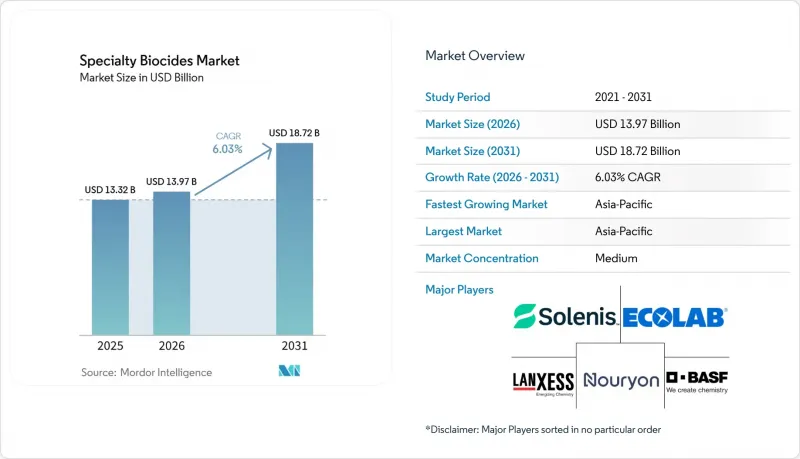
본 보고서는 살생물제의 유형(비산화성 살생물제, 산화성 살생물제), 제품 유형(할로겐계 살생물제, 유기황계 살생물제 등), 용도(공업용수 처리, 석유 및 가스,펄프·제지 등), 지역(아시아태평양, 북미, 유럽, 남미, 중동 및 아프리카)별로 분류되어 있습니다. 시장 예측은 금액(미 달러) 기준으로 제시되어 있습니다.
세계의 특수 살생물제 시장 동향 및 인사이트
물 재사용에 대한 수요 증가와 산업 폐수 규제 준수
산업 폐수 규제 및 물 재활용 요건으로 인해 특수 살생물제에 대한 수요가 증가하고 있습니다. 미국 환경보호청(EPA)의 ‘산업용 제로 액체 배출(ZLD) 물 재이용 규정’이 2026년 7월 16일에 발효됨에 따라, 퍼플루오로알킬 물질(PFAS) 및 폴리플루오로알킬 물질의 전구체, 나노은 잔류물을 포함한 미량 오염 물질에 대한 모니터링이 확대되었습니다. 2026년 7월 유럽화학물질청(ECHA)이 포스파이트를 함유한 역삼투법용 스케일 방지제에 대한 규제를 도입함에 따라, 비염소계 활성 시스템에 대한 관심이 높아지고 있습니다. 테트라키스(하이드록시메틸)포스포늄 황산염(THPS), 2,2-디브로모-3-니트릴로프로피오나미드(DBNPA),및 과아세트산 계열은 막의 파울링(오염) 우려를 완화할 수 있으므로, 제로 액체 배출 및 역삼투 전처리에 적합합니다. 따라서 처리 수량이 증가하지 않는 경우에도 특수 살생물제 시장 수요는 규제 준수 요구와 계속해서 밀접하게 연관되어 있습니다.
의료기관용 위생·감염 관리 솔루션 수요 증가
의료 관련 감염은 특수 살생물제 시장에서 효과적인 표면 소독에 대한 의료 기관 측 수요를 지속적으로 견인하고 있습니다. 세계보건기구(WHO) 보고서에 따르면, 의료 관련 감염은 고소득 국가에서는 환자 10명 중 1명, 저·중소득 국가에서는 4명 중 1명이 언제든지 영향을 받고 있는 것으로 나타났습니다. 4급 암모늄 화합물은 다제내성 클레브시엘라 뉴모니아에(Klebsiella pneumoniae) 및 아시네토박터 바우마니(Acinetobacter baumannii)를 포함한 일반적인 병원 내 병원체에 효과적이기 때문에 여전히 중요한 위치를 차지하고 있습니다. 2025년 리뷰에서는 표준화된 살생물제 감수성 시험에 미비점이 지적되었으며, 이는 내성 감시 및 향후 적정 사용 대책의 복잡화로 이어질 가능성이 있습니다. Arxada사는 2026년 6월 Clorox Healthcare사와 합의에 도달하여, EPA에 등록된 해당사의 Quanticare 살포자 기술(스포리사이드 기술)을 북미 의료시설에 도입할 것이라고 발표했습니다. 병원 내 EPA ‘Safer Choice’ 인증 제품 조달 요건은 확립된 규정 준수 실적을 보유한 공급업체를 우대할 가능성이 있습니다.
살생물제의 유효 성분을 규제하는 엄격한 독성·환경 규제
유효 성분에 대한 심사는 특히 유럽에서 특수 살생물제 시장 전반에 걸쳐 제품 승인을 지연시키고 규정 준수 비용을 증가시킬 가능성이 있습니다. 살생물제 규정(Biocidal Products Regulation)에 따른 유효 성분 심사에는 5-10년이 소요될 수 있습니다. ECHA(유럽화학물질청)와 유럽식품안전청(EFSA)의 공동 지침은 2026년 4월 1일 이후 제출되는 살생물제 신청에 적용되며, 실제 음용수 처리 조건 하에서 대사 산물의 심사를 의무화하고 있습니다. 이 평가 대상에는 염소 처리나 오존 처리 등의 공정에서 발생하는 부산물이 포함됩니다. EU 이행 규정 2026/1331은 2026년 6월 4일에 발효되어, 승인된 차아염소산 칼슘계 살생물제에 대한 행정적 및 규정 준수 요건이 변경되었습니다. 대형 공급업체는 신청 서류 작성 비용을 광범위한 제품 포트폴리오에 분산시킬 수 있지만, 소규모 지역 기업에게는 더 큰 부담이 됩니다.
부문별 분석
2025년, 비산화성 살생물제는 특수 살생물제 시장 점유율의 62.34%를 차지했습니다. 특수 살생물제 시장에서 이 제품이 차지하는 위상은 역삼투 전처리, 생산수 재이용 및 냉각탑 시스템과의 호환성을 반영합니다. 이러한 시스템은 산화성 유효 성분에 의해 손상될 가능성이 있으므로, 비산화성 제품은 막을 많이 사용하는 운영에서 실질적인 역할을 하고 있습니다. THPS 및 DBNPA는 유전 분야에서 널리 사용되고 있습니다. MIT, CMIT, BIT를 포함한 이소티아졸리논계 제제는 제조 산업 전반에 걸쳐 캔 내 보존 및 냉각수 프로그램에서 사용되고 있습니다. 글루타르알데히드를 포함한 유기황계 및 알데히드계 살생물제도 유사한 요구를 충족시키고 있지만, 일부 관할 구역에서는 규제 압력에 직면해 있습니다.
2026년부터 2031년에 걸쳐, 이 특수 살생물제 시장 부문에서 식물 유래 대체제가 더 중요한 위치를 차지하게 될 가능성이 있습니다. 2025년 조사에 따르면, 이러한 대체품들은 관련 용도에서 80-99.8%의 억제 효율을 달성한 것으로 나타났습니다. 이러한 성능 덕분에 기존 화학 물질의 재검토가 요구되는 분야에서 독성이 낮은 유효 성분 시스템을 도입할 여지가 생겨나고 있습니다. 산화계 살생물제는 2031년까지 연평균 성장률(CAGR) 6.72%를 나타낼 것으로 예측됩니다. 이러한 성장을 뒷받침하는 요인은 현장 생성 기술과 포자 살균 효과를 지닌 의료용 소독에 대한 수요입니다. EN 18087 : 2026은 이산화염소 생성 시스템을 규정하고 있는 반면, Arxada사는 2025년 10월에 특허를 취득한 현장 과아세트산 생성 기술을 도입했습니다.
지역별 분석
2025년, 아시아태평양은 전 세계 매출의 41.66%를 차지하며 지역별 최대의 특수 살생물제 시장이 되었습니다. 중국 시장 규모 확대는 수처리 수요에 더해, 흡수성 유기 할로겐 배출 규제 요건에 따라 비염소계 유효 성분으로의 전환이 진행되고 있는 점이 뒷받침하고 있습니다. 인도 수요는 제약, 섬유, 식품 가공 각 산업 클러스터의 폐수 규제 대응 필요성에 의해 뒷받침되고 있습니다. THOR China는 2025년 1월, 장쑤성 진장시에 벤지소티아졸리논(BIT) 공장을 설립했습니다. 이 시설에는 용매 재활용 공정이 도입되어 있으며, 아시아태평양의 생산 및 서비스 역량 확대를 목표로 하고 있습니다.
북미에서는 물 재사용 요건, 전력 및 화학 처리, 의료 분야에 대한 투자에 힘입어 특수 살생물제 시장에서 성숙해 가면서도 활발한 수요 기반이 형성되고 있습니다. 미국 수요는 에콜로브, 솔레니스, 케미라가 제공하는 고순도 제제 및 디지털 투여 서비스의 혜택을 받고 있습니다. 이러한 제품 및 서비스는 범용 제품에 비해 프리미엄 가격으로 판매될 수 있습니다. 유럽은 EU의 살생물제 규정(Biocidal Products Regulation)에 따라 가장 엄격한 규정 준수 환경에 놓여 있습니다. 공급업체는 규제가 비교적 완화된 수출 시장에 서비스를 제공할 때, 이러한 규정 준수 경험을 활용할 수 있습니다.
남미는 특수 살생물제 시장에서 신흥 수요 거점으로 부상하고 있으며, 브라질에서는 도시 용수 처리 및 식품 및 음료 가공을 뒷받침하고 있습니다. 아르헨티나의 바카 무에르타 개발은 유전 내 미생물 제어 수요를 뒷받침하고 있습니다. SPE 논문에서는 아르헨티나의 비전통 유전 개발에서 할라나에로비움속 미생물에 대한 맞춤형 솔루션이 소개되었습니다. 이 연구는 현지 미생물 상황에 따라 맞춤화된 프로그램이 필요한 이유를 보여줍니다. 중동 및 아프리카에서는 아라비아만 유전의 수자원 관리와 사우디아라비아 및 UAE의 해수 담수화 능력 확대가 수요를 뒷받침하고 있습니다. 살생물제는 다단계 플러시 방식이나 역삼투 방식의 해수 담수화 시스템에서 생물 부착을 억제하는 데 사용됩니다.
기타 혜택 :
- 엑셀 형식 시장 예측(ME) 시트
- 3개월간의 애널리스트 지원
자주 묻는 질문
목차
제1장 서론
제2장 분석 방법
제3장 주요 요약
제4장 시장 구도
제5장 시장 규모 및 성장률 예측
제6장 경쟁 구도
제7장 시장 기회 및 향후 전망
KTH 26.09.04According to Mordor Intelligence, the specialty biocides market was valued at USD 13.32 billion in 2025 and is estimated to grow from USD 13.97 billion in 2026 to reach USD 18.72 billion by 2031, at a CAGR of 6.03% during the forecast period (2026-2031).
This report is Segmented by Biocide Type (Non-Oxidizing Biocides and Oxidizing Biocides), Product Type (Halogen-Based Biocides, Organosulfur Biocides, and More), Application (Industrial Water Treatment, Oil and Gas, Pulp and Paper, and More), and Geography (Asia-Pacific, North America, Europe, South America, and Middle-East and Africa). The Market Forecasts are Provided in Terms of Value (USD).
Global Specialty Biocides Market Trends and Insights
Increasing Demand for Water Reuse and Compliance with Industrial Wastewater Regulations
Industrial effluent rules and water recycling requirements are strengthening demand for specialty biocides. The US Environmental Protection Agency (EPA) industrial zero liquid discharge water reuse rule took effect on July 16, 2026, and expanded monitoring for micropollutants, including per- and polyfluoroalkyl substances (PFAS) precursors and nanosilver residues. A July 2026 European Chemicals Agency (ECHA) restriction affecting phosphite-containing reverse osmosis antiscalants, which raises interest in non-chlorine active systems. Tetrakis(hydroxymethyl)phosphonium sulfate (THPS), 2,2-dibromo-3-nitrilopropionamide (DBNPA), and peracetic acid systems are suited to zero liquid discharge and reverse osmosis pretreatment because they can reduce membrane fouling concerns. Demand in the specialty biocides market, therefore, remains linked to compliance needs even when treated water volumes do not rise.
Growing Demand for Institutional Hygiene and Infection Control Solutions
Healthcare-associated infections continue to support institutional demand for effective surface disinfection in the specialty biocides market. The World Health Organization reported that healthcare-associated infections affect one in ten patients in high-income countries and 1 in 4 patients in low- and middle-income countries at any given time. Quaternary ammonium compounds remain important because they are effective against common hospital pathogens, including multidrug-resistant Klebsiella pneumoniae and Acinetobacter baumannii. A 2025 review identified gaps in standardized biocide susceptibility testing, which can complicate resistance surveillance and future stewardship measures. Arxada announced a June 2026 agreement with Clorox Healthcare to introduce its EPA-registered Quanticare sporicidal technology in North American healthcare facilities. Hospital procurement requirements for EPA Safer Choice-certified products can favor suppliers with established compliance credentials.
Stringent Toxicological and Environmental Regulations Governing Active Biocidal Substances
Active-substance reviews can slow product approvals and increase compliance costs across the specialty biocides market, especially in Europe. The Biocidal Products Regulation reviews can take 5-10 years for an active substance. Joint ECHA and European Food Safety Authority (EFSA) guidance applies to biocide applications submitted from April 1, 2026, and requires review of transformation products under realistic drinking-water treatment conditions. The required assessment covers byproducts from processes such as chlorination and ozonation. EU Implementing Regulation 2026/1331 took effect on June 4, 2026 and changed administrative and compliance requirements for authorized calcium hypochlorite biocides. Large suppliers can spread dossier-development costs across broader portfolios, while smaller regional firms face a heavier burden.
Other drivers and restraints analyzed in the detailed report include:
- Increasing Use of Specialty Biocides in Oilfield Water Management and Asset Protection
- Advancements in In-Situ Biocide Generation and Digital Biocide Dosing Technologies
- Increasing Concerns Regarding Microbial Resistance and Reduced Biocide Effectiveness
For complete list of drivers and restraints, kindly check the Table Of Contents.
Segment Analysis
Non-oxidizing biocides held 62.34% of the specialty biocides market share in 2025. Their position in the specialty biocides market reflects compatibility with reverse osmosis pretreatment, produced-water reuse, and cooling-tower systems. These systems can be damaged by oxidizing actives, which gives non-oxidizing products a practical role in membrane-intensive operations. THPS and DBNPA are used widely in oilfield applications. Isothiazolinone formulations, including MIT, CMIT, and BIT, are used in in-can preservation and cooling-water programs across manufacturing. Organosulfur and aldehyde-based biocides, including glutaraldehyde, serve similar needs but face regulatory pressure in some jurisdictions.
Plant-derived alternatives could become more relevant within this specialty biocides market segment during 2026-2031. A 2025 review found that these alternatives achieved 80-99.8% inhibition efficiency in relevant applications. This performance creates room for lower-toxicity active systems where conventional chemistries face review. Oxidizing biocides are forecast to grow at a 6.72% CAGR through 2031. In-situ generation and demand for sporicidal healthcare disinfection support that growth. EN 18087:2026 supports chlorine dioxide generation systems, while Arxada introduced a patented on-site peracetic acid generation technology in October 2025.
Complete Report Scope:
- By Biocide Type
- Non-Oxidizing Biocides
- Oxidizing Biocides
- By Product Type
- Halogen-Based Biocides
- Organosulfur Biocides
- Quaternary Ammonium Compounds (Quats)
- Aldehyde Biocides
- Phenolic Biocides
- Organic Acid Biocides
- Metallic Biocides
- Other Specialty Biocides
- By Application
- Industrial Water Treatment
- Oil and Gas
- Pulp and Paper
- Personal Care and Cosmetics
- Healthcare
- Paints and Coatings
- Food and Beverage Processing
- Other Applications
- By Geography
- Asia-Pacific
- China
- India
- Japan
- South Korea
- Rest of Asia-Pacific
- North America
- United States
- Canada
- Mexico
- Europe
- Germany
- United Kingdom
- France
- Italy
- Russia
- Rest of Europe
- South America
- Brazil
- Argentina
- Rest of South America
- Middle-East and Africa
- Saudi Arabia
- South Africa
- Rest of Middle-East and Africa
- Asia-Pacific
Geography Analysis
Asia-Pacific held 41.66% of global revenue in 2025, making it the largest regional specialty biocides market. China's contribution is supported by water treatment demand and movement toward non-chlorine actives under absorbable organic halogen discharge requirements. India's demand is supported by wastewater compliance needs in pharmaceutical, textile, and food-processing clusters. THOR China opened a Benzisothiazolinone (BIT) plant in Zhenjiang, Jiangsu, in January 2025. The facility includes a solvent-recycling process and is intended to expand production and service capacity in the Asia-Pacific.
North America has a mature but active demand base in the specialty biocides market, supported by water reuse requirements, power and chemical processing, and healthcare investment. US demand benefits from high-purity formulations and digital dosing services supplied by Ecolab, Solenis, and Kemira. These offerings can obtain premium pricing compared with commodity supplies. Europe has the most demanding compliance setting because of the EU Biocidal Products Regulation. Suppliers can use that regulatory experience when serving less-regulated export markets.
South America is an emerging demand center in the specialty biocides market, with Brazil supporting municipal water treatment and food and beverage processing. Argentina's Vaca Muerta development supports demand for oilfield microbial control. An SPE paper described a tailored solution for Halanaerobium microorganisms in Argentine unconventional operations. This work shows why local microbial conditions can require customized programs. The Middle-East and Africa are supported by oilfield water management in the Arabian Gulf and growing desalination capacity in Saudi Arabia and the UAE. Biocides are used to manage biological fouling in multi-stage flash and reverse osmosis desalination systems.
- Accepta Ltd.
- Arxada AG
- Baker Hughes Company
- BASF
- Clariant
- Dow
- Ecolab Inc.
- Kemira Oyj
- Lanxess
- Neogen Corporation
- Nouryon
- Solenis
- Thor Group Limited
- Troy Corporation
- Veolia Water Technologies
Additional Benefits:
- The market estimate (ME) sheet in Excel format
- 3 months of analyst support
TABLE OF CONTENTS
1 Introduction
- 1.1 Study Assumptions and Market Definition
- 1.2 Scope of the Study
2 Research Methodology
3 Executive Summary
4 Market Landscape
- 4.1 Market Overview
- 4.2 Market Drivers
- 4.2.1 Increasing Demand for Water Reuse and Compliance with Industrial Wastewater Regulations
- 4.2.2 Growing Demand for Institutional Hygiene and Infection Control Solutions
- 4.2.3 Increasing Use of Specialty Biocides in Oilfield Water Management and Asset Protection
- 4.2.4 Advancements in In-Situ Biocide Generation and Digital Biocide Dosing Technologies
- 4.2.5 Growing Focus on Low-Carbon and Bio-Based Specialty Biocide Formulations
- 4.3 Market Restraints
- 4.3.1 Stringent Toxicological and Environmental Regulations Governing Active Biocidal Substances
- 4.3.2 Increasing Concerns Regarding Microbial Resistance and Reduced Biocide Effectiveness
- 4.3.3 Formulation Compatibility Challenges and Variations in Regional Regulatory Labeling Requirements
- 4.4 Value Chain Analysis
- 4.5 Porter's Five Forces Analysis
- 4.5.1 Threat of New Entrants
- 4.5.2 Bargaining Power of Suppliers
- 4.5.3 Bargaining Power of Buyers
- 4.5.4 Threat of Substitutes
- 4.5.5 Competitive Rivalry
5 Market Size and Growth Forecasts (Value)
- 5.1 By Biocide Type
- 5.1.1 Non-Oxidizing Biocides
- 5.1.2 Oxidizing Biocides
- 5.2 By Product Type
- 5.2.1 Halogen-Based Biocides
- 5.2.2 Organosulfur Biocides
- 5.2.3 Quaternary Ammonium Compounds (Quats)
- 5.2.4 Aldehyde Biocides
- 5.2.5 Phenolic Biocides
- 5.2.6 Organic Acid Biocides
- 5.2.7 Metallic Biocides
- 5.2.8 Other Specialty Biocides
- 5.3 By Application
- 5.3.1 Industrial Water Treatment
- 5.3.2 Oil and Gas
- 5.3.3 Pulp and Paper
- 5.3.4 Personal Care and Cosmetics
- 5.3.5 Healthcare
- 5.3.6 Paints and Coatings
- 5.3.7 Food and Beverage Processing
- 5.3.8 Other Applications
- 5.4 By Geography
- 5.4.1 Asia-Pacific
- 5.4.1.1 China
- 5.4.1.2 India
- 5.4.1.3 Japan
- 5.4.1.4 South Korea
- 5.4.1.5 Rest of Asia-Pacific
- 5.4.2 North America
- 5.4.2.1 United States
- 5.4.2.2 Canada
- 5.4.2.3 Mexico
- 5.4.3 Europe
- 5.4.3.1 Germany
- 5.4.3.2 United Kingdom
- 5.4.3.3 France
- 5.4.3.4 Italy
- 5.4.3.5 Russia
- 5.4.3.6 Rest of Europe
- 5.4.4 South America
- 5.4.4.1 Brazil
- 5.4.4.2 Argentina
- 5.4.4.3 Rest of South America
- 5.4.5 Middle-East and Africa
- 5.4.5.1 Saudi Arabia
- 5.4.5.2 South Africa
- 5.4.5.3 Rest of Middle-East and Africa
- 5.4.1 Asia-Pacific
6 Competitive Landscape
- 6.1 Market Concentration
- 6.2 Strategic Moves
- 6.3 Market Share (%)/Ranking Analysis
- 6.4 Company Profiles (includes Global Overview, Market Overview, Core Segments, Financials as available, Strategic Information, Products and Services, and Recent Developments)
- 6.4.1 Accepta Ltd.
- 6.4.2 Arxada AG
- 6.4.3 Baker Hughes Company
- 6.4.4 BASF
- 6.4.5 Clariant
- 6.4.6 Dow
- 6.4.7 Ecolab Inc.
- 6.4.8 Kemira Oyj
- 6.4.9 Lanxess
- 6.4.10 Neogen Corporation
- 6.4.11 Nouryon
- 6.4.12 Solenis
- 6.4.13 Thor Group Limited
- 6.4.14 Troy Corporation
- 6.4.15 Veolia Water Technologies
7 Market Opportunities and Future Outlook
- 7.1 White-Space and Unmet-Need Assessment


