

|
시장보고서
상품코드
2122320
살생물제 : 시장 점유율 분석, 업계 동향과 통계, 성장 예측(2026-2031년)Biocides - Market Share Analysis, Industry Trends & Statistics, Growth Forecasts (2026 - 2031) |
||||||
 Mordor Intelligence
Mordor Intelligence에 의하면, 살생물제시장 규모는 2026년에 1,978만 톤으로 추정되며, 예측 기간(2026-2031년)에 CAGR 4.68%로 확대되어 2031년에는 2,486만 톤에 이를 전망입니다.
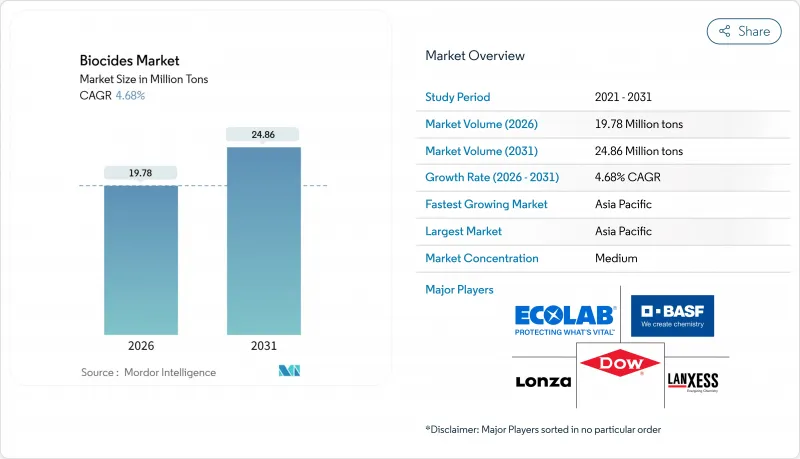
본 보고서는 유형별(할로겐 화합물, 금속 화합물, 기타), 용도별(수처리, 의약품·퍼스널케어, 목재 방부 처리, 기타),작용기전별(산화성 살생물제, 비산화성 살생물제), 지역별(아시아태평양, 북미, 유럽, 남미, 중동 및 아프리카)로 분류되어 있습니다. 시장 예측은 수량(톤) 단위로 제시되어 있습니다.
세계 살생물제 시장 동향 및 인사이트
전 세계 수처리 수요 증가
이산화염소나 차아염소산나트륨 등의 산화성 화학물질의 경우, 지자체 및 산업용 처리 시설이 여전히 최대의 단일 시장을 차지하고 있습니다. 이는 이러한 약제가 처리 리터당 비용을 최소화하면서도 확실한 미생물 제어를 실현하기 때문입니다. 2024년에 개정된 미국의 ‘3단계 소독제 규정’에 따라 허용되는 트리할로메탄 농도가 하향 조정됨에 따라, 상수도 유틸리티자들은 기존 염소 처리에 과초산이나 자외선 산화를 병행하고 있습니다. 중국에서 연안 산업용 냉각수의 ‘제로 방류’ 의무화에 따라, 사업자들은 염분 농도와 화학적 산소 요구량(COD)을 억제하는 비산화형 이소티아졸리논 계열 처리 프로그램으로의 전환을 강요받고 있습니다. 중동 전역에서는 해수 담수화의 급속한 확대에 따라, 막의 생물 오염을 최소화하고 염수 내 잔류 염소를 저감할 수 있는 모노클로라민계 시스템이 선호되고 있습니다. 인도의 ‘깨끗한 갠지스강 국가 미션’은 신규 폐수 처리 시설을 위해 자외선과 과아세트산을 결합한 하이브리드 방식에 자금을 지원하고 있으며, 이 방식에서는 살생물제를 단독 처리 공정이 아닌 2차 장벽으로 통합하고 있습니다. 이러한 움직임들이 맞물리면서 고효능·저용량 산화제의 적용 범위가 확대되고, 2031년까지 살생물제 시장의 성장세가 유지될 전망입니다.
식품 및 음료 산업 수요 증가
위생 관리 책임자는 미국과 유럽연합(EU) 간에 크게 다른 잔류 기준의 모자이크를 처리해야만 하며, 이로 인해 범용 염소 헹굼에서 고품질의 과아세트산 또는 4급 암모늄 화합물 배합제로의 전환이 가속화되고 있습니다. 2025년에 발표된 FDA 지침에 따르면, 신선 절단 채소의 경우 음용 가능한 물로 헹굴 필요 없이 80ppm의 과초산 사용이 허용되고 있으며, 이를 통해 라인당 약 15%의 물 절약이 가능해져 가공업체들의 원스텝 프로토콜 표준화가 촉진되고 있습니다. 네덜란드의 유제품 협동조합에서는 4급 암모늄계 폼으로 전환한 후 CIP(정지 세척) 사이클이 25% 단축되었다고 보고되었으며, 이러한 개선을 통해 처리 능력이 향상되고 증기 사용량이 감소하고 있습니다. 한편, 음료 공장에서는 무균 충전기 내의 효모 및 곰팡이에 대해 산성 제품 라인 전체에서 효과를 유지하는 광범위 스펙트럼의 살생물제가 사용되고 있으며, BASF의 ‘Preventol’이 pH 3-7 범위에서 성공을 거두고 있다는 점에서도 그 유효성이 분명합니다. 소매 업계의 ‘클린 라벨’에 대한 압박으로 인해 제제 개발자들은 소르빈산과 나타마이신의 시험적 도입을 추진하고 있습니다. 그러나 투여량이 증가하고 적용 기간이 엄격해짐에 따라 소비자에게 어필하는 효과가 일부 상쇄되고 있습니다. 그 결과, 유효 성분 1Kg당 평균 판매 가격이 상승하여, 살생물제 시장에서 수량이 더 비싼 틈새 시장으로 이동하더라도 수익 증대로 이어지고 있습니다.
살생물제와 관련된 환경 문제 및 건강 피해
규제 당국은 환경 및 독성에 대한 심사를 강화하고 있으며, 그 결과 승인까지의 절차가 장기화되거나 특정 유효 성분이 전면 금지되기도 하고 있습니다. 유럽화학물질청(ECHA)은 2024년에 브로노폴과 글루타르알데히드를 ‘후보 목록’에 추가하고, 더 안전한 대안이 존재할 경우 사용자에게 대체 평가를 실시할 것을 의무화했습니다. 미국 환경보호청(EPA)의 내분비 교란 물질 스크리닝에서 2025년에 트리클로산과 트리클로카반이 지목되었으며, 이에 따라 소비재 제조업체들은 두 성분을 단계적으로 폐지하고 18개월 이내에 퍼스널케어 제품에서의 사용량을 62% 감축하게 되었습니다. EU에서 산업 폐수 내 이소티아졸리논류의 수생 독성에 관한 상한치는 현재 0.1µg L-1로 설정되어 있어, 공장은 폐쇄형 처리 시스템으로의 업그레이드를 강요받거나 폐수 추가 요금을 지불해야 합니다. 캡슐화 기술은 환경으로의 유출을 억제하는 데 도움이 되지만, 생산 비용을 15-20% 상승시켜 범용 제품 라인의 이익률을 압박하고 있습니다. 이러한 규제 강화가 종합적으로 영향을 미쳐 예측 연평균 성장률(CAGR)을 0.8포인트 끌어내릴 뿐만 아니라, 제품 포트폴리오 개편이 지연되고 있는 공급업체의 규정 준수 위험을 높이고 있습니다.
부문 분석
2025년 현재, 할로겐 화합물은 전 세계 물량의 28.23%를 차지하며, 살생물제 시장에서 가장 널리 사용되는 화학물질이라는 위상을 확고히 하고 있습니다. 이 하위 부문은 2031년까지 연평균 성장률(CAGR) 5.86%를 나타낼 것으로 예측되며, 유틸리티체 및 산업 사용자들이 이미 잘 이해하고 있고 대규모로 조달 가능한 염소계 및 브롬계 시스템에 의존하고 있기 때문에 살생물제 시장 전체를 상회하는 성장이 예상됩니다. 염소는 여전히 상수도 처리 프로그램에서 중심적인 역할을 하고 있습니다. 이는 사업자가 화학 물질을 전면적으로 대체하는 대신, pH 조절 및 접촉 시간 개선을 통해 더 엄격한 소독 부산물 기준치를 충족할 수 있기 때문입니다. 한편, 브롬은 pH가 높은 환경에서 높은 효과를 발휘하기 때문에 블로우다운을 최소화해야 하는 제로 액체 배출형 냉각탑에서 선호되는 선택지가 되고 있습니다. 구리계 방부제나 은 이온계 항균제로 대표되는 금속 화합물은 틈새 시장이지만 고부가가치 수요를 충족시키고 있습니다. 반면, 페놀계 제품은 특유의 냄새나 표면 변색을 피할 수 있는 4급 암모늄계나 과산화물계 제품에 시장 점유율을 계속 빼앗기고 있습니다. 유럽연합(EU)의 이소티아졸리논류 규제 재검토로 인해 유기황계 제품에 대한 압박이 강해지고 있지만, 유기산 등의 대체 부문은 완전한 살생물제 등록이 면제되는 ‘클린 라벨’ 항균제에 대한 식품 산업 수요로 인해 혜택을 보고 있습니다.
할로겐계 제품 또한 통합된 공급망에서 강점을 얻고 있습니다. 다우(Dow) 등공급업체는 원자재 가격 변동으로부터 이익률을 보호하기 위해 자사가 소유한 염소·알칼리 설비를 운영하고 있습니다. 현장에서의 이산화염소 발생 장치 도입 확대는 수명 주기 비용과 운송 위험을 더욱 낮추며, 확고한 입지를 가진 공급업체에게 고객 유지를 위한 기반이 되고 있습니다. 그러나 지자체 상수도 유틸리티자들이 화학물질 투여량을 줄이기 위해 자외선 및 고도 산화 처리를 도입한 다단계 처리에 대한 투자를 추진함에 따라, 할로겐계 제품의 수량에는 장기적인 상한선이 생기고 있습니다. 2030년대에 살생물제 시장이 비용 및 규제 측면의 변화를 흡수해 나가는 과정에서 할로겐계 제품을 바이오 또는 캡슐화된 대체품으로 보완하는 공급업체는 수익을 지킬 수 있을 것으로 보입니다.
지역별 분석
아시아태평양은 2025년 수량의 35.32%를 차지하며, 2031년까지 연평균 성장률(CAGR) 5.22%로 가장 높은 성장세를 보이고 있는데, 이는 활발한 인프라 투자와 더욱 엄격해진 수질 규제를 반영한 것입니다. 중국의 냉각수 제로 배출 의무화로 인해 석유화학 및 금속 플랜트는 폐쇄형 루프 시스템으로의 전환을 강요받고 있으며, 미생물에 의한 부식을 억제하기 위해 살생물제의 지속적인 투여가 필요해지고 있습니다. 인도의 ‘Jal Jeevan Mission’(농촌 지역 모든 가구에 상수도를 공급하는 것을 목표로 하는 사업)에서는 물류 간소화를 위해 차아염소산나트륨 분말을 사용하는 수백만 개의 소형 투여 스테이션이 도입되었습니다. 일본에서는 냉각탑 루프 내 레지오넬라균 모니터링이 강화되면서, 인구 밀도가 높은 건물에서 시스템을 배수하지 않고도 도입 가능한 비산화성 용액에 대한 국내 수요가 증가하고 있습니다. 동남아시아의 제조 거점은 수출 인증을 확보하기 위해 EPA 또는 EU 기준을 준수하는 살생물제 사용을 의무화하고 있으며, 이에 따라 BASF는 해당 지역에 대한 공급 체제를 강화하기 위해 난징에 연간 4만 톤의 생산 능력을 증설했습니다.
북미와 유럽을 합치면 세계 소비량의 절반을 차지하지만, 시장이 성숙 단계에 있고 규제상의 제약으로 인해 수량 확대보다 제품 재조성이 우선시되므로 성장은 완만합니다. 미국은 2024년에 ‘세이퍼 초이스(Safer Choice)’ 기준을 개정하여 18가지 유형의 유효 성분을 금지하거나 제한함으로써, 공급업체들에게 가격은 비싸지만 사용량이 적은 바이오 대체품으로의 전환을 촉진하고 있습니다. 캐나다의 수분 매개 생물 안전성을 평가하는 재평가 프로그램으로 인해, 일반적으로 사용되는 몇 가지 유효 성분의 승인 갱신이 지연되고 있어 공급 불확실성이 높아지고 있습니다. 유럽의 중앙 집중화된 ‘EU 승인’ 절차에서는 승인까지의 기간이 3년에 달하게 되었으며, 이러한 부담은 강력한 규제 대응 팀을 보유한 다국적 기업에 유리하게 작용하고 있습니다. EU 내 수요는 자동차용 도료, 의약품, 도시 용수 수요에 힘입어 독일, 영국, 프랑스에 집중되어 있습니다.
남미, 중동 및 아프리카에서는 각국 정부가 수자원 및 에너지 인프라를 확충하고 있어 수요가 대폭 증가하고 있습니다. 브라질에서는 현재 음용수 내 염소의 대체제로 이산화염소와 과초산의 사용이 허용되어, 현장에서의 생성 장치 도입의 길이 열리고 있습니다. 아르헨티나 산업계에서는 더욱 엄격한 배출 규제를 준수하기 위해 냉각 시스템의 업데이트가 진행되고 있어, 비산화형 제품의 매출을 뒷받침하고 있습니다. 사우디아라비아의 ‘비전 2030’에 따른 해수 담수화 시설 확대 계획에서는 멤브레인의 생물 부착을 억제하기 위해 모노클로라민이 요구되고 있으며, 이는 산화제 제조업체에게 중요한 새로운 판로가 될 것입니다. 나이지리아와 이집트는 WHO 기준에 부합하는 염소 처리 설비 도입을 위해 아프리카 개발 은행으로부터 보조금을 확보했으며, 이는 사하라 이남 아프리카의 향후 수요 증가를 시사합니다.
기타 혜택
- 엑셀 형식 시장 예측(ME) 시트
- 3개월간의 애널리스트 지원
자주 묻는 질문
목차
제1장 서론
제2장 조사 방법
제3장 주요 요약
제4장 시장 구도
제5장 시장 규모와 성장 예측
제6장 경쟁 구도
제7장 시장 기회와 향후 전망
LSH 26.09.04According to Mordor Intelligence, the biocides market size is estimated at 19.78 million tons in 2026 and is expected to reach 24.86 million tons by 2031, at a CAGR of 4.68% during the forecast period (2026-2031).
This report is Segmented by Type (Halogen Compounds, Metallic Compounds, and More), Application (Water Treatment, Pharmaceutical and Personal-Care, Wood Preservation, and More), Mode of Action (Oxidizing Biocides and Non-Oxidizing Biocides), and Geography (Asia-Pacific, North America, Europe, South America, and Middle East and Africa). Market Forecasts are Provided in Terms of Volume (Tons).
Global Biocides Market Trends and Insights
Increasing Demand for Water Treatment Globally
Municipal and industrial treatment plants remain the single largest outlet for oxidizing chemistries such as chlorine dioxide and sodium hypochlorite, because these agents deliver reliable microbial control at the lowest cost per treated liter. The updated U.S. Stage 3 Disinfectants rule in 2024 lowered allowable trihalomethanes, prompting utilities to blend peracetic acid or ultraviolet oxidation with traditional chlorination. China's zero-discharge mandate for coastal industrial cooling water is pushing operators toward non-oxidizing isothiazolinone programs that limit salinity and chemical oxygen demand. Across the Middle East, rapid desalination expansion has favored monochloramine systems because they minimize membrane biofouling and lower residual chlorine in brine. India's National Mission for Clean Ganga funds ultraviolet-peracetic acid hybrids for new wastewater plants, which embed biocides as a secondary barrier rather than the lone treatment step. Together, these moves extend the serviceable universe for high-efficacy, low-dose oxidizers, sustaining the biocides market trajectory through 2031.
Growing Demand from the Food and Beverage Industry
Sanitation managers face a patchwork of residue limits that differ sharply between the United States and the European Union, accelerating the shift from commodity chlorine rinses to premium peracetic-acid or quaternary-ammonium blends. FDA guidance issued in 2025 allows 80 ppm peracetic acid on fresh-cut produce without a potable rinse, saving an estimated 15% water per line and encouraging processors to standardize around single-step protocols. Dutch dairy cooperatives reported 25% shorter clean-in-place cycles after switching to quaternary foams, a gain that lifts throughput and lowers steam use. Meanwhile, beverage plants fight yeast and mold in aseptic fillers with broad-spectrum biocides that remain efficacious across acidic product lines, evident in BASF Preventol's success at pH 3-7. Retail pressure for clean labels has prompted formulators to experiment with sorbic acid and natamycin; however, higher dosing rates and tighter application windows offset part of the consumer appeal. The net effect is a higher average selling price per active kilogram, bolstering revenue even when volumes shift toward costlier niches in the biocides market.
Environmental Issues and Health Hazards Related to Biocides
Regulators are elevating environmental and toxicological scrutiny, leading to longer approval pipelines and outright bans on specific actives. The European Chemicals Agency added bronopol and glutaraldehyde to its Candidate List in 2024, compelling users to run substitution assessments wherever safer options exist. The U.S. EPA's endocrine-disruption screen flagged triclosan and triclocarban in 2025, prompting consumer-goods makers to phase out both and cut usage in personal-care products by 62% within 18 months. Aquatic-toxicity caps on isothiazolinones in EU industrial discharges now stand at 0.1 µg L-1, forcing plants to upgrade to closed-loop treatments or pay wastewater surcharges. Encapsulation technologies help curb environmental release but raise production costs by 15-20%, squeezing margins on commodity lines. Collectively, tightening standards subtract 0.8 percentage points from the forecast CAGR and heighten compliance risk for suppliers that lag in portfolio renewal.
Other drivers and restraints analyzed in the detailed report include:
- Heightened Awareness of Health and Hygiene
- Rising Demand in Paints and Coatings Industry
- Fluctuating Raw Material Prices
For complete list of drivers and restraints, kindly check the Table Of Contents.
Segment Analysis
Halogen compounds accounted for 28.23% of global volume in 2025, underscoring their status as the most widely used chemistry in the biocides market share. This subsegment is forecast to grow at a 5.86% CAGR through 2031, outpacing the broader biocides market as utilities and industrial users rely on chlorine- and bromine-based systems they already understand and can purchase at scale. Chlorine remains central to potable-water programs because operators can meet stricter disinfection-by-product limits through pH control and improved contact-time protocols rather than wholesale chemistry swaps. Bromine's higher efficacy at elevated pH makes it the preferred choice for zero-liquid-discharge cooling towers where blowdown must be minimized. Metallic compounds, led by copper preservatives and silver-ion antimicrobials, satisfy niche yet high-value needs. Meanwhile, phenolics continue to lose share to quaternary ammonium and peroxide systems that avoid characteristic odor and surface staining. Regulatory reviews of isothiazolinones in the European Union pressure organosulfurs, but alternative pockets, such as organic acids, benefit from food-industry demand for clean-label antimicrobials exempt from full biocidal registration.
Halogens also derive strength from integrated supply chains; suppliers such as Dow operate captive chlor-alkali assets that hedge margin against feedstock swings. Growing installation of on-site chlorine dioxide generators further reduces lifecycle cost and transport risk, anchoring customer retention for established vendors. However, halogen volumes face a long-term ceiling as municipal utilities invest in multi-barrier treatment that incorporates ultraviolet or advanced oxidation to reduce chemical dosage. Suppliers that complement halogen products with bio-based or encapsulated alternatives will protect revenue as the biocides market absorbs both cost-driven and regulatory shifts in the 2030s.
Complete Report Scope:
- By Type
- Halogen Compounds
- Metallic Compounds
- Organosulfurs
- Organic Acids
- Phenolics
- Other Types (Quaternary Ammonium Compounds)
- By Application
- Water Treatment
- Pharmaceutical and Personal-care
- Wood Preservation
- Food and Beverage
- Paints and Coatings
- Other Applications (Oil and Gas, Agriculture, Disinfectants and Sanitization)
- By Mode of Action
- Oxidizing Biocides
- Non-oxidizing Biocides
- By Geography
- Asia-Pacific
- China
- India
- Japan
- South Korea
- Thailand
- Malaysia
- Indonesia
- Vietnam
- Rest of Asia-Pacific
- North America
- United States
- Canada
- Mexico
- Europe
- Germany
- United Kingdom
- Italy
- France
- Spain
- Russia
- Nordics
- Rest of Europe
- South America
- Brazil
- Argentina
- Rest of South America
- Middle East and Africa
- Saudi Arabia
- United Arab Emirates
- Qatar
- South Africa
- Nigeria
- Egypt
- Rest of Middle East and Africa
- Asia-Pacific
Geography Analysis
Asia-Pacific made up 35.32% of the 2025 volume and posts the fastest 5.22% CAGR through 2031, reflecting vigorous infrastructure spending and stricter water-quality laws. China's zero-discharge cooling-water mandate forces petrochemical and metals plants onto closed-loop systems that require constant biocide dosing to control microbial-induced corrosion. India's Jal Jeevan Mission, targeting universal rural water connections, rolls out millions of small dosing stations that rely on sodium hypochlorite powder for simplified logistics. Japan tightened Legionella monitoring in tower loops, lifting domestic demand for non-oxidizing solutions that can be deployed without draining systems in densely occupied buildings. Southeast Asian manufacturing hubs insist on EPA- or EU-compliant biocides to secure export certifications, prompting BASF to add 40,000 ton/year capacity at Nanjing for regional supply.
North America and Europe together account for half of global consumption, yet expand slowly because markets are mature and regulatory constraints drive reformulation rather than volume expansion. The United States advanced its Safer Choice standards in 2024, banning or limiting eighteen actives, thereby nudging suppliers toward bio-based alternatives that command higher prices but lower dose rates. Canada's re-evaluation program for pollinator safety delays renewal for several commonly used actives, adding supply uncertainty. Europe's centralized Union Authorization process now stretches approvals to three years, a burden that favors multinationals with robust regulatory teams. Demand inside the bloc concentrates in Germany, the United Kingdom, and France, driven by automotive coatings, pharmaceuticals, and municipal water.
South America and the Middle East and Africa are witnessing a significant rise in demand as governments expand water and energy infrastructure. Brazil now permits chlorine dioxide and peracetic acid as alternatives to chlorine in potable water, opening the door for on-site generation equipment. Argentina's industry upgrades cooling systems to comply with stricter discharge rules, supporting sales of non-oxidizing packages. Saudi Arabia's Vision 2030 desalination build-out calls for monochloramine to curb membrane biofouling, representing a significant new outlet for oxidizer producers. Nigeria and Egypt secure African Development Bank grants for WHO-compliant chlorination installations, signalling future upside in sub-Saharan volumes.
- Albemarle Corporation
- Arxada
- Baker Hughes Company
- BASF SE
- Dow
- Ecolab
- IRO Group Inc.
- Italmatch AWS
- Kemipex
- Kemira
- LANXESS
- Lonza
- Merck KGaA
- Nouryon
- Solvay
- Stepan Company
- The Lubrizol Corporation
- Thor Group Ltd.
- Valtris Specialty Chemicals
- Veolia
- Vink Chemicals GmbH & Co. KG
Additional Benefits:
- The market estimate (ME) sheet in Excel format
- 3 months of analyst support
TABLE OF CONTENTS
1 Introduction
- 1.1 Study Assumptions and Market Definition
- 1.2 Scope of the Study
2 Research Methodology
3 Executive Summary
4 Market Landscape
- 4.1 Market Overview
- 4.2 Market Drivers
- 4.2.1 Increasing Demand for Water Treatment Globally
- 4.2.2 Growing Demand from the Food and Beverage Industry
- 4.2.3 Heightened Awareness of Health and Hygiene
- 4.2.4 Rising Demand in Paints and Coatings Industry
- 4.2.5 Regulatory Support for Safer Alternatives
- 4.3 Market Restraints
- 4.3.1 Environmental Issues and Health Hazards Related to Biocides
- 4.3.2 Fluctuating Raw Material Prices
- 4.3.3 High Research and Development Costs
- 4.4 Value Chain Analysis
- 4.5 Porter's Five Forces
- 4.5.1 Bargaining Power of Suppliers
- 4.5.2 Bargaining Power of Buyers
- 4.5.3 Threat of New Entrants
- 4.5.4 Threat of Substitutes
- 4.5.5 Degree of Competition
5 Market Size and Growth Forecasts (Volume)
- 5.1 By Type
- 5.1.1 Halogen Compounds
- 5.1.2 Metallic Compounds
- 5.1.3 Organosulfurs
- 5.1.4 Organic Acids
- 5.1.5 Phenolics
- 5.1.6 Other Types (Quaternary Ammonium Compounds)
- 5.2 By Application
- 5.2.1 Water Treatment
- 5.2.2 Pharmaceutical and Personal-care
- 5.2.3 Wood Preservation
- 5.2.4 Food and Beverage
- 5.2.5 Paints and Coatings
- 5.2.6 Other Applications (Oil and Gas, Agriculture, Disinfectants and Sanitization)
- 5.3 By Mode of Action
- 5.3.1 Oxidizing Biocides
- 5.3.2 Non-oxidizing Biocides
- 5.4 By Geography
- 5.4.1 Asia-Pacific
- 5.4.1.1 China
- 5.4.1.2 India
- 5.4.1.3 Japan
- 5.4.1.4 South Korea
- 5.4.1.5 Thailand
- 5.4.1.6 Malaysia
- 5.4.1.7 Indonesia
- 5.4.1.8 Vietnam
- 5.4.1.9 Rest of Asia-Pacific
- 5.4.2 North America
- 5.4.2.1 United States
- 5.4.2.2 Canada
- 5.4.2.3 Mexico
- 5.4.3 Europe
- 5.4.3.1 Germany
- 5.4.3.2 United Kingdom
- 5.4.3.3 Italy
- 5.4.3.4 France
- 5.4.3.5 Spain
- 5.4.3.6 Russia
- 5.4.3.7 Nordics
- 5.4.3.8 Rest of Europe
- 5.4.4 South America
- 5.4.4.1 Brazil
- 5.4.4.2 Argentina
- 5.4.4.3 Rest of South America
- 5.4.5 Middle East and Africa
- 5.4.5.1 Saudi Arabia
- 5.4.5.2 United Arab Emirates
- 5.4.5.3 Qatar
- 5.4.5.4 South Africa
- 5.4.5.5 Nigeria
- 5.4.5.6 Egypt
- 5.4.5.7 Rest of Middle East and Africa
- 5.4.1 Asia-Pacific
6 Competitive Landscape
- 6.1 Market Concentration
- 6.2 Strategic Moves
- 6.3 Market Share/Ranking Analysis
- 6.4 Company Profiles (includes Global Overview, Market Level Overview, Core Segments, Financials, Strategic Information, Products and Services, Recent Developments)
- 6.4.1 Albemarle Corporation
- 6.4.2 Arxada
- 6.4.3 Baker Hughes Company
- 6.4.4 BASF SE
- 6.4.5 Dow
- 6.4.6 Ecolab
- 6.4.7 IRO Group Inc.
- 6.4.8 Italmatch AWS
- 6.4.9 Kemipex
- 6.4.10 Kemira
- 6.4.11 LANXESS
- 6.4.12 Lonza
- 6.4.13 Merck KGaA
- 6.4.14 Nouryon
- 6.4.15 Solvay
- 6.4.16 Stepan Company
- 6.4.17 The Lubrizol Corporation
- 6.4.18 Thor Group Ltd.
- 6.4.19 Valtris Specialty Chemicals
- 6.4.20 Veolia
- 6.4.21 Vink Chemicals GmbH & Co. KG
7 Market Opportunities and Future Outlook
- 7.1 White-space and Unmet-need Assessment


