

|
시장보고서
상품코드
2119052
혈관 절개용 캐뉼라 시장 : 시장 점유율 분석, 업계 동향 및 통계, 성장 예측(2026-2031년)Angiostomy Cannula - Market Share Analysis, Industry Trends & Statistics, Growth Forecasts (2026 - 2031) |
||||||
 Mordor Intelligence
에 의하면, 혈관 절개용 캐뉼라 시장 규모는 2025년 2억 1,552만 달러로 평가되었고, 2026년에는 2억 3,171만 달러로 추정되고, 2026-2031년 CAGR 7.51%로 성장을 지속할 전망이며, 2031년까지 3억 3,280만 달러에 이를 것으로 예측됩니다.
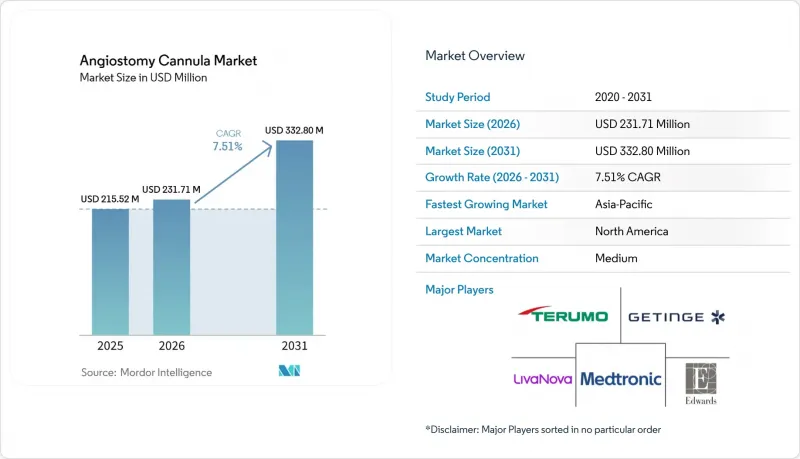
본 보고서는 제품 유형별(심장 캐뉼라, 혈관 캐뉼라, 기타), 캐뉼라 삽입 부위별(대동맥 및 동맥 부위, 기타), 소재별(폴리우레탄, 기타), 팁 형태별(스트레이트 팁, 기타), 용도별(심폐 우회술, 기타), 최종 사용자별(병원, 심장 센터, 기타), 지역별(북미, 기타)로 분류되어 있습니다. 시장 예측은 금액(달러) 기준으로 제시되어 있습니다.
세계의 혈관 절개용 캐뉼라 시장 동향 및 인사이트
심혈관 및 응급처치 시행 건수 증가
심혈관 질환은 여전히 전 세계적으로 주요 사망 및 장애 원인으로 남아 있으며, 심장 및 중환자 치료 수술에 대한 임상적 수요를 지속적으로 뒷받침하고 있습니다. 또한, 만성 질환의 부담이 증가함에 따라 고령 환자를 대상으로 한 외과적 시술 및 순환 보조 장치에 대한 수요도 높아지고 있습니다. 병원의 수용 능력, 임상 인력 확보 상황, 공공 자금 규모는 국가마다 크게 다르기 때문에 시술 수요도 국가별로 차이가 있습니다. 고소득국의 의료 시스템에서는 여전히 고성능 제품이 주류를 이루는 반면, 신흥국의 의료 현장에서는 비용 효율성이 뛰어나고 규제를 준수하는 제품이 더 폭넓은 역할을 수행하고 있습니다. 제조업체가 각 의료 현장의 임상 요건을 저해하지 않으면서 두 가지 수준의 제품을 모두 제공할 수 있다면, 혈관 절개용 캐뉼라 시장은 그 혜택을 누릴 것입니다. 일본, 이탈리아, GCC, 한국의 인구 고령화는 심장 의료 체계에 대한 장기적인 수요를 더욱 강화하고 있습니다.
ECMO 및 체외순환 능력의 확대
ECMO 프로그램이 하나 늘어날 때마다, 선택적 수술에만 국한된 수요가 아니라 환자의 전체 치료 과정에 걸쳐 사용되는 캐뉼라에 대한 지속적인 수요가 발생합니다. 심인성 쇼크에 대한 정맥-동맥 ECMO에는 높은 혈류량과 동맥압을 감당할 수 있는 대구경 동맥 캐뉼라가 필요합니다. 사전 폐쇄형 대퇴동맥 접근법에 관한 임상 보고를 통해, 난치성 심인성 쇼크에서 완전 경피적 정맥-동맥 ECMO의 실행 가능성이 입증되었습니다. 이러한 임상적 동향은 보강된 샤프트, 신뢰할 수 있는 유량 특성, 응급 사용에 적합한 접근 기능을 갖춘 설계를 뒷받침하고 있습니다. 캐뉼라와 회로의 통합은 혈액 절약 및 혈전 제거에도 기여하며, 이를 통해 장치는 단순한 일회용 소모품의 역할을 넘어 그 가치를 높일 수 있습니다. 따라서 혈관 절개용 캐뉼라 시장은 단순한 예정 수술 증가보다 중환자 치료 프로그램의 확대와 더 밀접한 관련이 있습니다.
캐뉼라 삽입에 따른 혈관 손상과 혈전 형성 위험
혈관 접근에 수반되는 합병증은 시술 시행률을 제한하고, 병원이 캐뉼라를 선정할 때의 사양에 영향을 미칠 가능성이 있습니다. 2025년에 실시된 전향적 연구에 따르면, 심폐 우회술용 캐뉼라 삽입 후 내경정맥 혈전증 발생률이 79.5%였다고 보고되었으나, 해당 코호트에서 발생한 혈전은 모두 무증상이며 비폐색성이었습니다. 이러한 위험으로 인해 생체 적합성 코팅 및 실시간 영상 촬영을 지원하는 샤프트 마킹에 대한 관심이 높아지고 있습니다. 미국 심초음파학회(ASE)의 최신 지침에서는 중심 혈관 접근 시술 시 초음파 유도를 권장하고 있습니다. 영상 장비를 통합한 의료 기관은 자원이 제한된 시설에 비해 접근과 관련된 위험을 보다 일관되게 관리할 수 있습니다. 비용, 보험 환급, 조달상의 제약으로 인해 병원이 이러한 위험을 줄이기 위한 영상, 교육 또는 전용 제품의 비용을 감당할 수 없는 경우, 도입이 더욱 지연될 가능성이 있습니다.
부문 분석
2025년, 심장 캐뉼라는 혈관 절개용 캐뉼라 시장의 28.31%를 차지했으며, 이는 심폐 우회술, 판막 수복술, ECMO 수술 건수가 지속적으로 유지되고 있음을 반영합니다. 정맥 캐뉼라 및 동맥 캐뉼라는 개흉 수술에서 대규모 수술 기반을 뒷받침하고 있습니다. 심정지 캐뉼라는 대동맥 기저부로의 전달과 관상정맥동으로의 역행성 관류를 통해 심근 보호를 지원합니다. 혈관 캐뉼라는 말초 우회술 및 혈관 재건 부문에서 수요를 주도하고 있습니다.
혈전 흡인 캐뉼라는 2026-2031년 연평균 성장률(CAGR) 9.58%를 나타낼 것으로 예측되며, 이는 제품 유형 중 가장 높은 성장률입니다. 이러한 성장은 심장 및 폐 치료 분야에서 카테터를 이용한 혈전 제거에 대한 관심이 높아지고 있음을 반영합니다. 혈관 절개용 캐뉼라 산업에서는 기존 외과 수술 용도에서 중재적 치료에 적합한 기기로 제품의 중점을 확대되고 있습니다. 병원들이 확립된 수술과 전문적인 흡인 시술 모두를 지원하는 제품을 요구하는 가운데, 공급업체의 폭넓은 제품 포트폴리오가 중요해질 것으로 보입니다.
2025년에는 대동맥 및 동맥 부위가 혈관 절개용 캐뉼라 시장의 42.24%를 차지했습니다. 이는 많은 개흉 수술에서 중심정맥 캐뉼라 삽입이 여전히 표준 기법으로 사용되고 있기 때문입니다. 관상동맥 입구 및 관상정맥동 부위는 심정지 용액 투여라는 특수한 요건을 충족합니다. 우심방, 상대정맥, 하대정맥에 대한 캐뉼라 삽입은 표준 정맥 배액 절차를 뒷받침합니다. 또한, 경정맥 및 중심정맥에 대한 캐뉼라 삽입은 호흡 부전에 대한 정맥-정맥 ECMO와도 관련이 있습니다.
심장 외과 수술에서 경피적 및 저침습적 기법이 더욱 보급됨에 따라, 대퇴 혈관 부위 시장은 2031년까지 연평균 성장률(CAGR) 8.22%로 확대될 것으로 예측됩니다. 완전 내시경 심장 수술에 관한 조사에서는 셀딩거법을 이용한 대퇴-대퇴 카누레 삽입이 지지되고 있으며, 이를 위해서는 대구경, 얇은 벽, 그리고 높은 유량 능력을 갖춘 정맥용 기기가 요구됩니다. 초음파 유도는 외과적 절개법에서 벗어나도록 촉진하는 역할을 합니다. 혈관 절개용 캐뉼라 시장은 높은 유량과 신뢰성 높은 대퇴부 접근, 안전한 삽입을 모두 갖춘 설계 덕분에 혜택을 볼 가능성이 있습니다.
지역별 분석
북미는 2025년 전 세계 혈관 절개용 캐뉼라 시장에서 45.61%의 점유율을 차지했습니다. 이는 ECMO 프로그램을 위한 탄탄한 인프라와 심장 외과 수술에 대한 확립된 지불 체계에 힘입은 결과입니다. 미국은 병원 및 외래수술센터(ASC)에서 광범위한 심장·혈관 수술이 시행되고 있어 여전히 중요한 시장으로 남아 있습니다. 2026년에 예정된 외래수술센터(ASC)에서의 심혈관 수술에 대한 보험 적용 확대는 중증도가 낮은 수술이 점차 외래 환경으로 전환되는 추세를 뒷받침할 가능성이 있습니다. 캐나다에서는 시술 수요가 증가하고 있지만, 관류 기술자 부족으로 인해 장비가 이용 가능하더라도 심장 수술의 처리 능력이 제한될 가능성이 있습니다. 이러한 인력 측면의 제약으로 인해 효율적인 임상 워크플로우를 지원하는 제품 및 시스템의 가치가 높아지고 있습니다.
유럽은 두 번째로 큰 지역 시장이며, 독일, 프랑스, 영국에서는 국가 심장외과 프로그램을 통해 수요가 뒷받침되고 있습니다. EU 의료기기 규정에 따라 심혈관용 의료기기에 대한 임상 증거 요건이 강화되어 승인 주기가 장기화될 가능성이 있습니다. 이러한 요건은 이미 인증이나 임상 문서를 갖춘 제조업체에게 유리하게 작용합니다. 동유럽의 심장 센터와 스칸디나비아 국가들의 ECMO 프로그램은 추가적인 소비 확대 가능성을 내포하고 있습니다. 병원의 수용 능력 제약이나 환자의 치료에 대한 주저함이 지속되는 지역에서는 단기적인 수술 건수의 회복이 여전히 고르지 않을 가능성이 있습니다.
아시아태평양은 2026-2031년 9.25%라는 지역별 최고 연평균 성장률(CAGR)을 나타낼 전망입니다. 중국의 조달 정책은 의료기기 가격을 인하하고 심혈관 치료에 대한 접근성을 확대할 가능성이 있어, 공급업체들은 가격과 수량 모두를 관리해야 하는 압박을 받고 있습니다. 인도에서는 2급 및 3급 도시에 위치한 민간 병원을 통해 심장 수술 역량이 확대되고 있습니다. 일본에서는 고령화에 따라 의료 기관의 심장 치료 수요가 지속적으로 발생하고 있는 반면, 한국에서는 대규모 심장 전문 의료 센터가 집중된 조달 기반을 형성하고 있습니다. 초음파 유도 하 대퇴동맥 접근법의 임상적 수용이 진전됨에 따라, 해당 지역 전체에서 경피적 시술에 최적화된 설계에 대한 수요가 뒷받침되고 있습니다. 중동 및 아프리카에서는 GCC(걸프협력회의)의 3차 심장 의료 체계에 대한 투자가 주도하고 있으며, 남미 지역에서는 브라질과 아르헨티나가 주도적인 역할을 맡아 병원 네트워크 및 의료 관광의 확대에 따라 새로운 비즈니스 기회가 창출되고 있습니다.
기타 혜택
- 엑셀 형식 시장 예측(ME) 시트
- 3개월간의 애널리스트 지원
자주 묻는 질문
목차
제1장 서론
제2장 조사 방법
제3장 주요 요약
제4장 시장 구도
제5장 시장 규모 및 성장 예측
제6장 경쟁 구도
제7장 시장 기회 및 향후 전망
AJY 26.09.03According to Mordor Intelligence, the angiostomy cannula market size is expected to grow from USD 215.52 million in 2025 to USD 231.71 million in 2026 and is forecast to reach USD 332.80 million by 2031 at 7.51% CAGR over 2026-2031.
This report is Segmented by Product Type (Cardiac Cannula, Vascular Cannula, and More), Cannulation Site (Aortic and Arterial Sites and More), Material (Polyurethane and More), Tip Design (Straight Tip and More), Application (Cardiopulmonary Bypass Surgery and More), End User (Hospitals, Cardiac Centers, and More), and Geography (North America and More). The Market Forecasts are Provided in Terms of Value (USD).
Global Angiostomy Cannula Market Trends and Insights
Rising Cardiovascular and Critical-Care Procedure Volumes
Cardiovascular disease remains a leading cause of death and disability worldwide, sustaining the clinical need for cardiac and critical-care procedures. The growing chronic disease burden also raises demand for surgical and circulatory support among older patients. Procedure demand differs by country because hospital capacity, clinical workforce availability, and public funding vary widely. Premium configurations remain more relevant in high-income systems, while cost-conscious, compliant products have a wider role in emerging care settings. The angiostomy cannula market benefits when manufacturers can offer both product tiers without compromising the clinical requirements of each setting. Aging populations in Japan, Italy, GCC countries, and South Korea reinforce the longer-term need for cardiac care capacity.
Expansion of ECMO and Extracorporeal Circulation Capability
Each additional ECMO program creates recurring demand for cannulas used across patient episodes rather than demand tied only to elective surgery. Venoarterial ECMO for cardiogenic shock requires large-bore arterial cannulas that can manage high flow and arterial pressure. A clinical report on preclosed femoral access documented the feasibility of fully percutaneous venoarterial ECMO in refractory cardiogenic shock. This clinical direction supports designs with reinforced shafts, reliable flow characteristics, and access features suited to urgent use. Cannula-circuit integration also supports blood conservation and thrombus removal, which can increase the value of a device beyond its role as a standalone consumable. The angiostomy cannula market therefore has a stronger link to intensive care program expansion than to elective procedure growth alone.
Cannulation-Related Vascular Trauma and Thrombotic Risk
Vascular access complications can limit procedure uptake and influence the specifications hospitals use when selecting cannulas. A 2025 prospective study reported a 79.5% incidence of internal jugular vein thrombosis after cannulation for cardiopulmonary bypass, although all thrombi in that cohort were asymptomatic and nonocclusive. This risk increases interest in biocompatible coatings and shaft markings that support real-time imaging. Updated American Society of Echocardiography guidance recommends ultrasound guidance for central vascular access procedures. Centers with integrated imaging can manage access risk more consistently than lower-resource facilities. Cost, reimbursement, and procurement constraints can further slow adoption where hospitals cannot fund the imaging, training, or specialized products that lower this risk.
Other drivers and restraints analyzed in the detailed report include:
- Shift Toward Minimally Invasive and Percutaneous Cannulation
- Biocompatible, Kink-Resistant, and Low-Trauma Cannula Innovation
- Shortage of Specialist Perfusion and Cannulation Personnel
For complete list of drivers and restraints, kindly check the Table Of Contents.
Segment Analysis
Cardiac cannulas accounted for 28.31% of the angiostomy cannula market in 2025, reflecting the sustained procedure volume of cardiopulmonary bypass, valve repair, and ECMO. Venous and arterial cannulas serve the large procedural base in open-heart surgery. Cardioplegia cannulas support myocardial protection through aortic root delivery and coronary sinus retrograde perfusion. Vascular cannulas contribute volume in peripheral bypass and revascularization settings.
Thrombus-aspiration cannulas are projected to grow at a 9.58% CAGR from 2026 to 2031, the fastest rate among product types. This growth reflects wider interest in catheter-based clot removal for cardiac and pulmonary care. The angiostomy cannula industry is expanding its product focus from conventional surgical use toward devices suited to interventional treatment pathways. The breadth of a supplier's portfolio will matter as hospitals seek products for both established surgery and specialized aspiration procedures.
Aortic and arterial sites commanded 42.24% of the angiostomy cannula market share in 2025 because central arterial cannulation remains standard in many open-heart procedures. Coronary ostia and coronary sinus sites serve the specialized requirements of cardioplegia delivery. Right atrium, superior vena cava, and inferior vena cava cannulation support standard venous drainage arrangements. Jugular and central venous sites are also relevant to venovenous ECMO for respiratory failure.
Femoral vascular sites are expected to expand at an 8.22% CAGR through 2031 as cardiac surgery adopts more percutaneous and minimally invasive approaches. Research on totally endoscopic cardiac surgery supports Seldinger-guided femorofemoral cannulation, which requires large-bore, thin-walled venous devices with high-flow capacity. Ultrasound guidance can support the shift away from surgical cut-down methods. The angiostomy cannula market can gain from designs that combine high flow with reliable femoral access and safe placement.
Complete Report Scope:
- By Product Type
- Cardiac Cannula
- Vascular Cannula
- Venous Cannula
- Arterial Cannula
- Cardioplegia Cannula
- Thrombus-Aspiration Cannula
- Other Product Types
- By Cannulation Site
- Aortic and Arterial Sites
- Femoral Vascular Sites
- Jugular and Central Venous Sites
- Right Atrium, Superior Vena Cava, and Inferior Vena Cava
- Coronary Ostia and Coronary Sinus
- Other Cannulation Sites
- By Material
- Polyvinyl Chloride
- Polyurethane
- Silicone
- Stainless Steel
- Other Materials
- By Tip Design
- Straight Tip
- Angled Tip
- Curved Tip
- Beveled Tip
- Funnel-Shaped Tip
- Balloon and Self-Expanding Tip
- By Application
- Cardiopulmonary Bypass Surgery
- Extracorporeal Membrane Oxygenation
- Percutaneous Thrombus and Embolus Removal
- Cardioplegia Delivery and Myocardial Protection
- Vascular Surgery and Revascularization
- Other Applications
- By End User
- Hospitals
- Cardiac Centers
- Ambulatory Surgical Centers
- Specialty Clinics
- Other End Users
- By Geography
- North America
- United States
- Canada
- Mexico
- Europe
- Germany
- United Kingdom
- France
- Italy
- Spain
- Rest of Europe
- Asia-Pacific
- China
- Japan
- India
- Australia
- South Korea
- Rest of Asia-Pacific
- Middle East and Africa
- GCC
- South Africa
- Rest of Middle East and Africa
- South America
- Brazil
- Argentina
- Rest of South America
- North America
Geography Analysis
North America held 45.61% of the global angiostomy cannula market in 2025, supported by dense ECMO program infrastructure and established payment pathways for cardiac surgery. The United States remains important because its hospitals and ambulatory surgical centers use a broad range of cardiac and vascular procedures. The 2026 expansion of cardiovascular procedure coverage in ambulatory surgical centers can support a gradual movement of lower-acuity procedures into outpatient settings. Canada adds procedural demand, but the shortage of perfusionists can restrict cardiac surgery throughput even when devices are available. This workforce constraint increases the value of products and systems that support efficient clinical workflows.
Europe is the second-largest regional market, with Germany, France, and the United Kingdom supporting demand through national cardiac surgery programs. The EU Medical Device Regulation has increased clinical evidence requirements for cardiovascular devices and can lengthen authorization cycles. These requirements favor manufacturers that already have established certifications and clinical documentation. Eastern European cardiac centers and Scandinavian ECMO programs offer incremental consumption potential. Near-term procedure recovery can remain uneven where hospital capacity constraints and patient hesitancy persist.
Asia-Pacific is projected to record the highest regional CAGR of 9.25% from 2026 to 2031. China's procurement approach lowers device prices and can broaden access to cardiovascular treatment, placing pressure on suppliers to manage price and volume together. India is expanding cardiac surgery capability through private hospitals in Tier 2 and Tier 3 cities. Japan's older population creates sustained institutional demand for cardiac care, while South Korea's high-volume cardiac centers offer a concentrated procurement base. Clinical acceptance of ultrasound-guided femoral access supports demand for percutaneous-optimized designs across the region. Middle East and Africa, led by GCC investment in tertiary cardiac capacity, and South America, led by Brazil and Argentina, provide developing opportunities as hospital networks and medical tourism expand.
- Andocor n.v.
- AngioDynamics
- B. Braun
- Beckton Dickinson
- Braile Biomedica
- Cardinal Health
- Changzhou Kangxin Medical Instruments Co., Ltd.
- Cook Group
- Edward Lifesciences
- Eurosets S.r.l.
- Freelife Medical GmbH
- Getinge
- LivaNova
- Medical Materials, Inc.
- Medtronic
- Merit Medical Systems
- Nipro
- Teleflex
- Terumo
- Vygon
Additional Benefits:
- The market estimate (ME) sheet in Excel format
- 3 months of analyst support
TABLE OF CONTENTS
1 Introduction
- 1.1 Study Assumptions and Market Definition
- 1.2 Scope of the Study
2 Research Methodology
3 Executive Summary
4 Market Landscape
- 4.1 Market Overview
- 4.2 Market Drivers
- 4.2.1 Rising Cardiovascular and Critical-Care Procedure Volumes
- 4.2.2 Expansion of ECMO and Extracorporeal Circulation Capability
- 4.2.3 Shift Toward Minimally Invasive and Percutaneous Cannulation
- 4.2.4 Biocompatible, Kink-Resistant, and Low-Trauma Cannula Innovation
- 4.2.5 Aging Population and Higher Chronic Disease Burden
- 4.2.6 Cannula-Circuit Integration for Blood Conservation and Thrombus Removal
- 4.3 Market Restraints
- 4.3.1 Cannulation-Related Vascular Trauma and Thrombotic Risk
- 4.3.2 Shortage of Specialist Perfusion and Cannulation Personnel
- 4.3.3 Procedure Cost, Reimbursement, and Procurement Constraints
- 4.3.4 Fragmented Nomenclature and Inconsistent Product Classification
- 4.4 Supply-Chain Analysis
- 4.5 Regulatory Landscape
- 4.6 Technological Outlook
- 4.7 Porter's Five Forces Analysis
- 4.7.1 Threat of New Entrants
- 4.7.2 Bargaining Power of Suppliers
- 4.7.3 Bargaining Power of Buyers
- 4.7.4 Threat of Substitutes
- 4.7.5 Rivalry Among Existing Competitors
5 Market Size & Growth Forecasts (Value, USD)
- 5.1 By Product Type
- 5.1.1 Cardiac Cannula
- 5.1.2 Vascular Cannula
- 5.1.3 Venous Cannula
- 5.1.4 Arterial Cannula
- 5.1.5 Cardioplegia Cannula
- 5.1.6 Thrombus-Aspiration Cannula
- 5.1.7 Other Product Types
- 5.2 By Cannulation Site
- 5.2.1 Aortic and Arterial Sites
- 5.2.2 Femoral Vascular Sites
- 5.2.3 Jugular and Central Venous Sites
- 5.2.4 Right Atrium, Superior Vena Cava, and Inferior Vena Cava
- 5.2.5 Coronary Ostia and Coronary Sinus
- 5.2.6 Other Cannulation Sites
- 5.3 By Material
- 5.3.1 Polyvinyl Chloride
- 5.3.2 Polyurethane
- 5.3.3 Silicone
- 5.3.4 Stainless Steel
- 5.3.5 Other Materials
- 5.4 By Tip Design
- 5.4.1 Straight Tip
- 5.4.2 Angled Tip
- 5.4.3 Curved Tip
- 5.4.4 Beveled Tip
- 5.4.5 Funnel-Shaped Tip
- 5.4.6 Balloon and Self-Expanding Tip
- 5.5 By Application
- 5.5.1 Cardiopulmonary Bypass Surgery
- 5.5.2 Extracorporeal Membrane Oxygenation
- 5.5.3 Percutaneous Thrombus and Embolus Removal
- 5.5.4 Cardioplegia Delivery and Myocardial Protection
- 5.5.5 Vascular Surgery and Revascularization
- 5.5.6 Other Applications
- 5.6 By End User
- 5.6.1 Hospitals
- 5.6.2 Cardiac Centers
- 5.6.3 Ambulatory Surgical Centers
- 5.6.4 Specialty Clinics
- 5.6.5 Other End Users
- 5.7 By Geography
- 5.7.1 North America
- 5.7.1.1 United States
- 5.7.1.2 Canada
- 5.7.1.3 Mexico
- 5.7.2 Europe
- 5.7.2.1 Germany
- 5.7.2.2 United Kingdom
- 5.7.2.3 France
- 5.7.2.4 Italy
- 5.7.2.5 Spain
- 5.7.2.6 Rest of Europe
- 5.7.3 Asia-Pacific
- 5.7.3.1 China
- 5.7.3.2 Japan
- 5.7.3.3 India
- 5.7.3.4 Australia
- 5.7.3.5 South Korea
- 5.7.3.6 Rest of Asia-Pacific
- 5.7.4 Middle East and Africa
- 5.7.4.1 GCC
- 5.7.4.2 South Africa
- 5.7.4.3 Rest of Middle East and Africa
- 5.7.5 South America
- 5.7.5.1 Brazil
- 5.7.5.2 Argentina
- 5.7.5.3 Rest of South America
- 5.7.1 North America
6 Competitive Landscape
- 6.1 Market Concentration
- 6.2 Market Share Analysis
- 6.3 Company Profiles (includes Global Level Overview, Market Level Overview, Core Segments, Financials as available, Strategic Information, Market Rank/Share, Products and Services, Recent Developments)
- 6.3.1 Andocor n.v.
- 6.3.2 AngioDynamics, Inc.
- 6.3.3 B. Braun SE
- 6.3.4 Becton, Dickinson and Company
- 6.3.5 Braile Biomedica
- 6.3.6 Cardinal Health
- 6.3.7 Changzhou Kangxin Medical Instruments Co., Ltd.
- 6.3.8 Cook Medical LLC
- 6.3.9 Edwards Lifesciences Corporation
- 6.3.10 Eurosets S.r.l.
- 6.3.11 Freelife Medical GmbH
- 6.3.12 Getinge AB
- 6.3.13 LivaNova PLC
- 6.3.14 Medical Materials, Inc.
- 6.3.15 Medtronic
- 6.3.16 Merit Medical Systems, Inc.
- 6.3.17 Nipro Corporation
- 6.3.18 Teleflex Incorporated
- 6.3.19 Terumo Corporation
- 6.3.20 Vygon SA
7 Market Opportunities and Future Outlook
- 7.1 White-Space and Unmet-Need Assessment


