

|
시장보고서
상품코드
2119085
폴리머 : 시장 점유율 분석, 업계 동향 및 통계, 성장 예측(2026-2031년)Polymers - Market Share Analysis, Industry Trends & Statistics, Growth Forecasts (2026 - 2031) |
||||||
 Mordor Intelligence
Mordor Intelligence에 의하면, 폴리머 시장 규모는 2025년에 7,800억 달러로 평가되었습니다. 예측 기간(2026-2031년) CAGR 4.87%로 확대되어 2026년 8,200억 달러에서 2031년에는 1조 400억 달러에 이를 전망입니다.
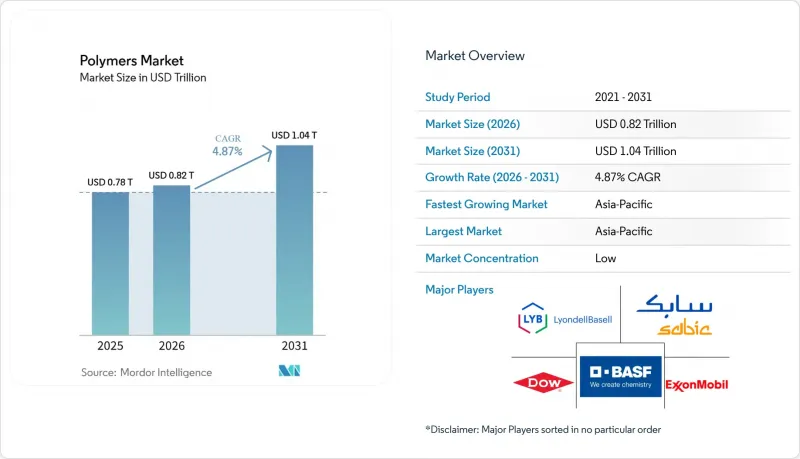
본 보고서는 폴리머 유형(열가소성 수지 등), 수지(폴리에틸렌(PE) 등),가공 기술(사출 성형 등), 용도(포장 등), 최종 사용자 산업(포장 산업 등), 지역(아시아태평양, 북미, 유럽, 남미, 중동 및 아프리카)별로 분류되어 있습니다. 시장 예측은 금액(달러) 기준으로 제시되어 있습니다.
세계의 폴리머 시장 동향 및 인사이트
전자상거래, 식품 배달 및 의료 공급망에 힘입어 포장 분야의 폴리머 수요가 확대되고 있습니다.
전자상거래용 포장은 전 세계 물류 네트워크에서 여전히 폴리머 수요의 주요 원천으로 자리 잡고 있습니다. 폴리에틸렌 필름으로 만든 우편용 봉투, 폴리프로필렌으로 만든 포장용 스트랩, 폴리에틸렌 테레프탈레이트(PET)로 만든 트레이는 상업적 규모의 라스트 마일 배송을 뒷받침하고 있습니다. 또한 의료 공급망에서도 더 높은 사양의 폴리에틸렌(PE) 및 폴리프로필렌(PP) 등급을 사용한 일회용 포장에 대한 수요가 증가하고 있습니다. 중국, 인도, 동남아시아 지역의 음식 배달 서비스 성장이 폴리프로필렌 용기 및 단열 포장재 수요를 견인하고 있습니다. 릴라이언스 인더스트리즈는 2026년 중동공급 차질이 석유화학제품 수요 전반에 영향을 미쳤을 때도 국내 포장 수요는 견조했다고 보고했습니다. 이러한 요인들이 복합적으로 작용하여, 포장 수요는 단일 최종 용도와 연계된 수요보다 폴리머 시장에 있어 더 탄력적인 모습을 보이고 있습니다.
자동차 및 전기차(EV) 제조에서 경량 폴리머의 채택 확대
전기차 생산에 따라 폴리머의 용도는 배터리 하우징, 열 관리 시스템, 구조용 부품용 엔지니어링 등급으로 전환되고 있습니다. 특정 금속 부품을 폴리머로 대체함으로써 차량의 경량화를 도모하고 주행 거리 향상에 기여할 수 있습니다. 자동차 제조업체들은 특수 폴리머 공급업체와 협력하여 성능 요건과 재생재 함유율 요건을 모두 충족하는 소재 개발에 매진하고 있습니다. 오토뉴움(Autonume)은 2026년 2월, 배터리식 전기차를 위해 재생재 함유율이 최대 70%에 달하는 폴리에스터 기반 프론트 트렁크 솔루션을 발표했습니다. 이 제품은 이미 아시아와 유럽의 주요 제조업체 3곳에서 양산용으로 채택되었습니다. Composites United의 인증을 받은 열가소성 수지 배터리 하우징은 알루미늄 기준 설계에 비해 무게를 15% 줄였으며, Euro NCAP 충돌 테스트를 통과했습니다. 이러한 용도는 폴리머 시장의 고부가가치 부문에 기여하고 있습니다.
엄격한 플라스틱 폐기물 규제와 증가하는 환경 규정 준수 비용
‘포장 및 포장 폐기물 규정(PPWR)’에 따르면, EU 시장에 유통되는 플라스틱 포장은 2030년까지 재활용 가능해야 하며, 최소한의 소비 후 재생 재료 함유율을 충족해야 합니다. 필요한 재생 재료 함유율은 식품 접촉용으로 재생 재료 사용이 제한되는 비-PET 포장의 경우 10%, 일반 플라스틱 포장의 경우 35%로 정해져 있으며, 2040년에는 더욱 높은 기준이 설정될 예정입니다. 포장 가공업체와 브랜드 소유자는 설계 재검토, 소재 적합성 평가, 그리고 인증된 재생 원료에 대한 투자를 수행해야 합니다. 식품 접촉이나 성능 요건으로 인해 사용 가능한 소재 선택지가 제한되는 경우, 이러한 비용은 고액이 될 가능성이 있습니다. 또한, 프랑스, 독일, 네덜란드의 확대 생산자 책임(EPR) 제도에 따라 해당 시장에 출시되는 포장재에 대해 연간 수수료가 부과됩니다. 따라서 폴리머 시장은 특히 유럽에서 더욱 엄격한 규정 준수 환경에 직면해 있습니다.
부문별 분석
2025년에는 열가소성 플라스틱이 매출의 68.72%를 차지하며 폴리머 시장에서 가장 큰 부문이 되었습니다. 재활용 가능성과 사출 성형 및 압출 성형과의 호환성이 광범위한 활용을 뒷받침하고 있습니다. PE, PP 및 PVC가 열가소성 플라스틱 시장의 큰 비중을 차지하고 있습니다. 폴리아미드, 폴리카보네이트, PEEK 등의 엔지니어링 열가소성 플라스틱은 고부가가치의 자동차 및 전자기기 용도로 사용되고 있습니다. 열경화성 수지는 풍력 터빈 블레이드, 항공우주용 복합재료, 전기용 적층판에서 여전히 중요한 역할을 하고 있지만, 재활용성이 낮아 지속가능성에 대한 요구 사항이 더 엄격한 지역에서는 압박을 받고 있습니다.
바이오 폴리머는 2026년부터 2031년까지 연평균 성장률(CAGR) 9.42%를 나타낼 것으로 예측됩니다. 각 브랜드의 노력과 조달 요건에 따라, 이러한 소재들은 단순한 자발적 틈새 시장의 범위를 넘어서는 추세입니다. 네이처웍스(NatureWorks)는 태국 공장의 PLA 생산 능력을 7만 5,000메트 증설함으로써, 대용량 포장용 컨버터 업체들의 비용 장벽을 낮추는 데 기여했습니다. 브라질과 핀란드에 건설된 2세대 리그노셀룰로오스 기반 원료 시설은 원자재 선택의 폭을 넓히고, 식량과 경쟁하는 작물에 대한 의존도를 낮추는 동시에, 폴리머 산업 전반에 걸쳐 저탄소 소재 옵션 개발을 촉진하고 있습니다.
2025년에는 폴리에틸렌이 매출의 28.16%를 차지하며 폴리머 시장에서 가장 큰 수지 부문이 되었습니다. HDPE, LDPE, LLDPE는 식품 접촉 적합성, 유연한 가공성, 경쟁력 있는 비용을 모두 갖추고 있어 경질 포장, 연질 필름,파이프, 소비재 등에 사용되고 있습니다. 폴리프로필렌은 건설, 자동차, 의료 분야에서 여전히 주요 수지입니다. PET는 음료 포장 및 섬유 용도를 뒷받침하고 있으며, 한편 PVC는 건축자재 및 의료용 튜브 분야에서 여전히 필수적인 소재로 자리 잡고 있습니다.
엔지니어링 플라스틱은 2031년까지 연평균 성장률(CAGR) 5.74%를 나타낼 것으로 예측됩니다. 자동차의 전동화에는 열 및 전기적 요구 사항을 충족할 수 있는 폴리카보네이트 및 폴리아미드 등급이 요구됩니다. 반도체 및 5G 용도에서도 안정성이 높고 고순도의 폴리머 소재가 필요합니다. 재활용 소재를 포함한 폴리카보네이트 공중합체는 자동차 트림 용도 및 재활용 소재 함유율 요건을 충족시킬 수 있습니다. 특수 등급을 통해 제조업체는 범용 제품 생산보다 성능에 집중할 수 있게 되어, 폴리머 시장은 고부가가치 수지 수요로 향하는 길이 열리고 있습니다.
지역별 분석
아시아태평양은 2025년에 전 세계 매출의 50.76%를 차지했으며, 2031년까지 연평균 성장률(CAGR) 6.35%로 성장할 것으로 전망되어, 이 지역은 폴리머 시장에서 가장 큰 점유율을 차지할 것으로 보입니다. 중국은 대규모 생산 능력과 막대한 국내 소비를 모두 갖추고 있습니다. BASF는 2026년 3월, 잔장에 세계적 규모의 베르분트(일관 생산) 거점을 개설했습니다. 이 거점에는 재생 가능 전력을 이용해 가동되는 100만 톤 규모의 에틸렌·스팀 크래커가 포함되어 있습니다. 인도에서는 릴라이언스 인더스트리즈(Reliance Industries)의 다헤지(Dheji) 및 나고타네(Nagotane) 프로젝트를 통해 폴리염화비닐(PVC) 및 염소화 폴리염화비닐(CPVC)의 생산 능력을 확대되고 있습니다.
동남아시아에서는 포장 자재와 소비재가 수요를 뒷받침하고 있습니다. 일본과 한국은 전자 및 자동차 용도로 사용되는 엔지니어링 폴리머의 중요한 시장입니다. 북미에서는 에탄 기반 크래커가 나프타 기반 시스템보다 저렴한 비용으로 가동되고 있어 원료 비용 면에서 우위를 유지하고 있습니다. 리요넬바셀(Lyonell Basell)은 2025년 3월 채널뷰(Channel View)의 프로파일렌 생산 능력을 40만 톤 증설하는 것을 승인했으며, 2028년 하반기 가동을 목표로 하고 있습니다. 유럽에서는 가동 중단 및 생산 능력 감축, 그리고 재활용 가능 및 재생 소재 함유 등급에 대한 투자를 통해 나프타 비용의 불리한 상황에 대응하고 있습니다. 이러한 상황은 폴리머 시장 내 지역의 무역 및 투자 패턴을 재편하고 있습니다.
남미, 중동 및 아프리카에서는 건설, 포장, 산업 개발을 통해 수요가 견인되고 있습니다. 브라질에서는 인프라 프로젝트와 가공식품 생산을 통해 지역 내 소비를 뒷받침하고 있습니다. 중동은 여전히 주요 생산 거점이며, 건축자재 및 의료 자재 수요가 확대되고 있는 지역입니다. 걸프 연안 국가들의 건설 프로젝트가 사우디아라비아, 아랍에미리트(UAE), 이집트의 소비를 뒷받침하고 있습니다. 아프리카는 포장, 관개, 건설 각 분야에서 낮은 수준에서 수요가 증가하고 있습니다. 이러한 시장은 원자재 수요와 현지 생산 능력이 서로 다르지만, 폴리머 시장의 지리적 범위를 확대되고 있습니다.
기타 혜택 :
- 엑셀 형식 시장 예측(ME) 시트
- 3개월간의 애널리스트 지원
자주 묻는 질문
목차
제1장 서론
제2장 조사 방법
제3장 개요
제4장 시장 구도
제5장 시장 규모 및 성장 예측
제6장 경쟁 구도
제7장 시장 기회 및 향후 전망
KTH 26.09.02According to Mordor Intelligence, the polymers market size was estimated at USD 0.78 trillion in 2025 and is estimated to grow from USD 0.82 trillion in 2026 to USD 1.04 trillion by 2031, at a CAGR of 4.87% during the forecast period (2026-2031).
This report is Segmented by Polymer Type (Thermoplastics and More), Resin (Polyethylene (PE) and More), Processing Technology (Injection Molding and More), Application (Packaging and More), End-User Industry (Packaging Industry and More), and Geography (Asia-Pacific, North America, Europe, South America, and Middle-East and Africa). The Market Forecasts are Provided in Terms of Value (USD).
Global Polymers Market Trends and Insights
Growing Demand for Polymers in Packaging Driven by E-Commerce, Food Delivery, and Healthcare Supply Chains
E-commerce packaging remains a major source of polymer demand across global shipping networks. Polyethylene film mailers, polypropylene strapping, and polyethylene terephthalate (PET) trays support last-mile delivery formats at commercial scale. Healthcare supply chains also require single-use packaging that uses higher-specification polyethylene (PE) and polypropylene (PP) grades. Growth in food delivery in China, India, and Southeast Asia is driving demand for polypropylene containers and insulated packaging. Reliance Industries reported healthy domestic packaging demand even when Middle-East supply disruptions affected broader petrochemical offtake in 2026. This combination makes packaging demand more resilient for the polymers market than demand tied to a single end use.
Rising Adoption of Lightweight Polymers in Automotive and Electric Vehicle Manufacturing
Electric vehicle production is shifting polymer use toward engineering grades for battery housing, thermal systems, and structural parts. Replacing selected metal components with polymers can lower vehicle weight and support driving range. Automotive manufacturers are working with specialty polymer suppliers to develop materials that meet both performance and recycled-content requirements. Autoneum introduced a polyester-based front trunk solution in February 2026 with up to 70% recycled content for battery electric vehicles. The product was already selected by three major manufacturers in Asia and Europe for serial production. A thermoplastic battery housing recognized by Composites United reduced weight by 15% against an aluminum reference design and passed Euro NCAP impact tests. These applications serve a higher-value segment of the polymers market.
Stringent Plastic Waste Regulations and Rising Environmental Compliance Costs
The Packaging and Packaging Waste Regulation (PPWR) requires that plastic packaging placed on the EU market be recyclable and contain a minimum post-consumer recycled content by 2030. Required recycled content ranges from 10% for contact-sensitive non-PET packaging to 35% for general plastic packaging, with higher thresholds planned for 2040. Packaging converters and brand owners must invest in redesign, material qualification, and certified recycled feedstock. These costs can be high when food-contact or performance requirements limit available material choices. Extended producer responsibility schemes in France, Germany, and the Netherlands also add annual fees for packaging placed on those markets. The polymers market, therefore, faces a more demanding compliance environment, particularly in Europe.
Other drivers and restraints analyzed in the detailed report include:
- Increasing Polymer Consumption in Infrastructure, Residential Construction, and Utility Pipe Applications
- Expanding Recycled Content Mandates Driving Demand for Certified Recycled Polymer Resins
- Volatility in Petrochemical Feedstock and Energy Prices
For complete list of drivers and restraints, kindly check the Table Of Contents.
Segment Analysis
Thermoplastics accounted for 68.72% of revenue in 2025, making them the largest segment of the polymers market. Their recyclability and compatibility with injection molding and extrusion support wide use. PE, PP, and PVC make up a large share of the thermoplastic market. Engineering thermoplastics such as polyamide, polycarbonate, and PEEK serve higher-value automotive and electronics applications. Thermosets remain important in wind turbine blades, aerospace composites, and electrical laminates, though their limited recyclability creates pressure in regions with stricter sustainability requirements.
Bio-based polymers are forecast to grow at a 9.42% CAGR from 2026 to 2031. Brand commitments and purchasing requirements are moving these materials beyond a voluntary niche. NatureWorks added 75,000 metric tons of PLA capacity at its Thailand facility, helping reduce the cost barrier for high-capacity packaging converters. Second-generation lignocellulosic feedstock facilities in Brazil and Finland have broadened raw material options, reducing reliance on food-competitive crops and supporting the development of lower-carbon material choices across the polymers industry.
Polyethylene accounted for 28.16% of revenue in 2025, making it the largest resin segment in the polymers market. HDPE, LDPE, and LLDPE offer food-contact suitability, flexible processing, and competitive costs, and are used in rigid packaging, flexible films, pipes, and consumer products. Polypropylene remains a major resin for construction, automotive, and healthcare applications. PET supports beverage packaging and textile fiber, while PVC remains essential in construction products and medical tubing.
Engineering plastics are projected to grow at a 5.74% CAGR through 2031. Automotive electrification requires polycarbonate and polyamide grades capable of managing heat and electrical demands. Semiconductor and 5G applications also require stable, high-purity polymer materials. Recycled-content polycarbonate copolymers can support automotive trim applications and recycled-content requirements. Specialty grades allow producers to focus on performance rather than commodity output, giving the polymers market a path toward higher-value resin demand.
Complete Report Scope:
- By Polymer Type
- Thermoplastics
- Commodity Thermoplastics
- Engineering Thermoplastics
- High-Performance Thermoplastics
- Thermosets
- Elastomers
- Bio-Based Polymers
- Other Polymer Types
- Thermoplastics
- By Resin
- Polyethylene (PE)
- High-Density Polyethylene (HDPE)
- Low-Density Polyethylene (LDPE)
- Linear Low-Density Polyethylene (LLDPE)
- Polypropylene (PP)
- Polyvinyl Chloride (PVC)
- Polyethylene Terephthalate (PET)
- Polystyrene (PS)
- Polyurethane (PU)
- Engineering Plastics
- Other Resins
- Polyethylene (PE)
- By Processing Technology
- Injection Molding
- Extrusion
- Blow Molding
- Thermoforming
- Compression Molding
- Calendering
- Rotational Molding and Casting
- Additive Manufacturing (3D Printing)
- Other Processing Technologies
- By Application
- Packaging
- Flexible Packaging
- Rigid Packaging
- Construction
- Automotive and Transportation
- Agriculture
- Electrical and Electronics
- Textile
- Healthcare and Medical
- Consumer Goods
- Other Applications
- Packaging
- By End-User Industry
- Packaging Industry
- Building and Construction
- Automotive and Transportation
- Electrical and Electronics
- Agriculture
- Healthcare and Pharmaceuticals
- Textile Industry
- Consumer Goods
- Industrial and Energy
- Other End-User Industries
- By Geography
- Asia-Pacific
- China
- India
- Japan
- South Korea
- Rest of Asia-Pacific
- North America
- United States
- Canada
- Mexico
- Europe
- Germany
- United Kingdom
- France
- Italy
- Russia
- Rest of Europe
- South America
- Brazil
- Argentina
- Rest of South America
- Middle-East and Africa
- Saudi Arabia
- South Africa
- Rest of Middle-East and Africa
- Asia-Pacific
Geography Analysis
Asia-Pacific accounted for 50.76% of global revenue in 2025 and is expected to grow at a 6.35% CAGR through 2031, giving the region the largest share of the polymers market. China combines large-scale production capacity with significant domestic consumption. BASF inaugurated its world-scale Verbund site in Zhanjiang in March 2026, which includes a 1-million-ton ethylene steam cracker powered by renewable electricity. India is expanding polyvinyl chloride (PVC) and chlorinated polyvinyl chloride (CPVC) capacity through Reliance Industries projects at Dahej and Nagothane.
Southeast Asia supports demand through packaging and consumer goods. Japan and South Korea are important markets for engineering polymers used in electronics and automotive applications. North America retains a feedstock cost advantage, as ethane-based crackers operate at lower costs than naphtha-based systems. LyondellBasell approved a 400,000-ton expansion of propylene capacity at Channelview in March 2025, with startup targeted for late 2028. Europe is adjusting to its naphtha cost disadvantage through closures, capacity reductions, and investment in recyclable and recycled-content grades. These conditions are reshaping regional trade and investment patterns in the polymers market.
South America, the Middle-East, and Africa contribute demand through construction, packaging, and industrial development. Brazil supports regional consumption through infrastructure projects and processed food production. The Middle-East remains a major production center and a growing demand area for construction and healthcare materials. Gulf construction programs are supporting consumption in Saudi Arabia, the UAE, and Egypt. Africa is growing from a lower base in packaging, irrigation, and construction. These markets expand the geographic reach of the polymers market while differing in material needs and local production capacity.
- BASF
- Arkema
- Celanese Corporation
- Chevron Phillips Chemical Company LLC
- Covestro AG
- Dow
- Eastman Chemical Company
- Evonik Industries AG
- Exxon Mobil Corporation
- Formosa Plastics Corporation
- INEOS
- LG Chem Ltd.
- LyondellBasell Industries Holdings B.V.
- Mitsubishi Chemical Group Corporation
- Reliance Industries Limited
- SABIC
- Solvay S.A.
- Toray Industries, Inc.
Additional Benefits:
- The market estimate (ME) sheet in Excel format
- 3 months of analyst support
TABLE OF CONTENTS
1 Introduction
- 1.1 Study Assumptions and Market Definition
- 1.2 Scope of the Study
2 Research Methodology
3 Executive Summary
4 Market Landscape
- 4.1 Market Overview
- 4.2 Market Drivers
- 4.2.1 Growing Demand for Polymers in Packaging Driven by E-Commerce, Food Delivery, and Healthcare Supply Chains
- 4.2.2 Rising Adoption of Lightweight Polymers in Automotive and Electric Vehicle Manufacturing
- 4.2.3 Increasing Polymer Consumption in Infrastructure, Residential Construction, and Utility Pipe Applications
- 4.2.4 Expanding Recycled Content Mandates Driving Demand for Certified Recycled Polymer Resins
- 4.2.5 Capacity Expansion in Polymer Production and Localization of Downstream Processing Facilities
- 4.3 Market Restraints
- 4.3.1 Stringent Plastic Waste Regulations and Rising Environmental Compliance Costs
- 4.3.2 Volatility in Petrochemical Feedstock and Energy Prices
- 4.3.3 Limited Availability of High-Quality Recycled Resins for Food-Contact and Automotive Applications
- 4.4 Value Chain Analysis
- 4.5 Porter's Five Forces Analysis
- 4.5.1 Threat of New Entrants
- 4.5.2 Bargaining Power of Suppliers
- 4.5.3 Bargaining Power of Buyers
- 4.5.4 Threat of Substitutes
- 4.5.5 Competitive Rivalry
5 Market Size and Growth Forecasts (Value)
- 5.1 By Polymer Type
- 5.1.1 Thermoplastics
- 5.1.1.1 Commodity Thermoplastics
- 5.1.1.2 Engineering Thermoplastics
- 5.1.1.3 High-Performance Thermoplastics
- 5.1.2 Thermosets
- 5.1.3 Elastomers
- 5.1.4 Bio-Based Polymers
- 5.1.5 Other Polymer Types
- 5.1.1 Thermoplastics
- 5.2 By Resin
- 5.2.1 Polyethylene (PE)
- 5.2.1.1 High-Density Polyethylene (HDPE)
- 5.2.1.2 Low-Density Polyethylene (LDPE)
- 5.2.1.3 Linear Low-Density Polyethylene (LLDPE)
- 5.2.2 Polypropylene (PP)
- 5.2.3 Polyvinyl Chloride (PVC)
- 5.2.4 Polyethylene Terephthalate (PET)
- 5.2.5 Polystyrene (PS)
- 5.2.6 Polyurethane (PU)
- 5.2.7 Engineering Plastics
- 5.2.8 Other Resins
- 5.2.1 Polyethylene (PE)
- 5.3 By Processing Technology
- 5.3.1 Injection Molding
- 5.3.2 Extrusion
- 5.3.3 Blow Molding
- 5.3.4 Thermoforming
- 5.3.5 Compression Molding
- 5.3.6 Calendering
- 5.3.7 Rotational Molding and Casting
- 5.3.8 Additive Manufacturing (3D Printing)
- 5.3.9 Other Processing Technologies
- 5.4 By Application
- 5.4.1 Packaging
- 5.4.1.1 Flexible Packaging
- 5.4.1.2 Rigid Packaging
- 5.4.2 Construction
- 5.4.3 Automotive and Transportation
- 5.4.4 Agriculture
- 5.4.5 Electrical and Electronics
- 5.4.6 Textile
- 5.4.7 Healthcare and Medical
- 5.4.8 Consumer Goods
- 5.4.9 Other Applications
- 5.4.1 Packaging
- 5.5 By End-User Industry
- 5.5.1 Packaging Industry
- 5.5.2 Building and Construction
- 5.5.3 Automotive and Transportation
- 5.5.4 Electrical and Electronics
- 5.5.5 Agriculture
- 5.5.6 Healthcare and Pharmaceuticals
- 5.5.7 Textile Industry
- 5.5.8 Consumer Goods
- 5.5.9 Industrial and Energy
- 5.5.10 Other End-User Industries
- 5.6 By Geography
- 5.6.1 Asia-Pacific
- 5.6.1.1 China
- 5.6.1.2 India
- 5.6.1.3 Japan
- 5.6.1.4 South Korea
- 5.6.1.5 Rest of Asia-Pacific
- 5.6.2 North America
- 5.6.2.1 United States
- 5.6.2.2 Canada
- 5.6.2.3 Mexico
- 5.6.3 Europe
- 5.6.3.1 Germany
- 5.6.3.2 United Kingdom
- 5.6.3.3 France
- 5.6.3.4 Italy
- 5.6.3.5 Russia
- 5.6.3.6 Rest of Europe
- 5.6.4 South America
- 5.6.4.1 Brazil
- 5.6.4.2 Argentina
- 5.6.4.3 Rest of South America
- 5.6.5 Middle-East and Africa
- 5.6.5.1 Saudi Arabia
- 5.6.5.2 South Africa
- 5.6.5.3 Rest of Middle-East and Africa
- 5.6.1 Asia-Pacific
6 Competitive Landscape
- 6.1 Market Concentration
- 6.2 Strategic Moves
- 6.3 Market Share (%)/Ranking Analysis
- 6.4 Company Profiles (includes Global Overview, Market Overview, Core Segments, Financials as available, Strategic Information, Products and Services, and Recent Developments)
- 6.4.1 BASF
- 6.4.2 Arkema
- 6.4.3 Celanese Corporation
- 6.4.4 Chevron Phillips Chemical Company LLC
- 6.4.5 Covestro AG
- 6.4.6 Dow
- 6.4.7 Eastman Chemical Company
- 6.4.8 Evonik Industries AG
- 6.4.9 Exxon Mobil Corporation
- 6.4.10 Formosa Plastics Corporation
- 6.4.11 INEOS
- 6.4.12 LG Chem Ltd.
- 6.4.13 LyondellBasell Industries Holdings B.V.
- 6.4.14 Mitsubishi Chemical Group Corporation
- 6.4.15 Reliance Industries Limited
- 6.4.16 SABIC
- 6.4.17 Solvay S.A.
- 6.4.18 Toray Industries, Inc.
7 Market Opportunities and Future Outlook
- 7.1 White-Space and Unmet-Need Assessment
- 7.2 Certified Recycled Resin for Food-Contact and Medical Applications


