

|
시장보고서
상품코드
2119234
데이터 클린룸 마케팅 서비스 시장 : 시장 점유율 분석, 업계 동향 및 통계, 성장 예측(2026-2031년)Data Clean Room Marketing Services - Market Share Analysis, Industry Trends & Statistics, Growth Forecasts (2026 - 2031) |
||||||
 Mordor Intelligence
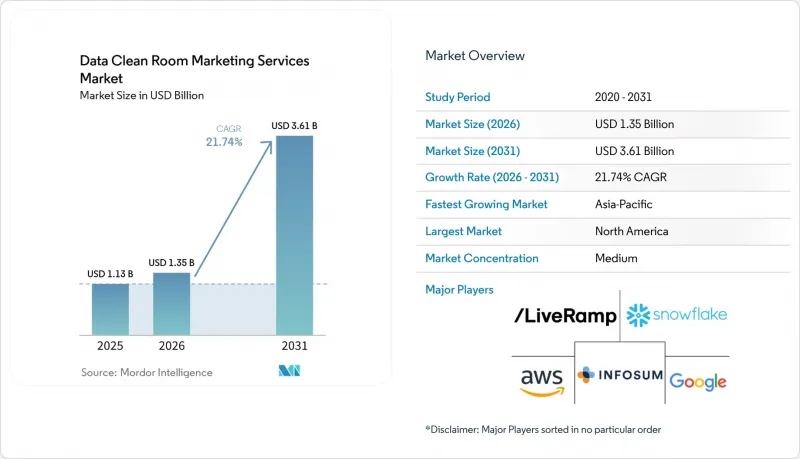
Mordor Intelligence에 의하면, 데이터 클린룸 마케팅 서비스 시장 규모는 2025년에 11억 3,000만 달러로 평가되었고, 2026년에 13억 5,000만 달러로 추정되고, 2031년까지 36억 1,000만 달러에 이를 것으로 예측되며, 2026-2031년 CAGR 21.74%로 성장할 전망입니다.
본 보고서는 서비스 유형별(클린룸 도입·통합 서비스, 개인정보 보호형 분석·측정·어트리뷰션 서비스, 매니지드 서비스·운영, 기타), 고객 기업 규모별(대기업, 중소기업), 최종 사용자별(광고주·브랜드, 기타), 지역별로 분류되어 있습니다. 시장 예측은 금액(달러) 기준으로 제시되어 있습니다.
세계의 데이터 클린룸 마케팅 서비스 시장 동향 및 인사이트
써드파티 쿠키 폐지로 퍼스트파티 간 연계 가속화
브라우저 기반 추적의 변화로 인해 기존 오디언스 측정 워크플로의 유용성은 떨어지고 있습니다. Apple의 ‘App Tracking Transparency’ 프레임워크로 인해 모바일 식별자 추적이 제한되고 있을 뿐만 아니라, Safari와 Firefox에서는 예전부터 기본적으로 써드파티 쿠키가 차단되어 왔습니다. 이러한 환경 속에서 광고주는 퍼블리셔, 소매업체, 플랫폼과 퍼스트파티 데이터를 기반으로 한 관계 구축을 추구하고 있습니다. 데이터 클린룸 마케팅 서비스 시장은 원시 데이터를 공개하지 않고 해시 처리된 레코드를 비교할 수 있게 하는 동시에, 승인된 분석 결과에 대한 통제권을 유지함으로써 이러한 변화를 뒷받침하고 있습니다. 이러한 환경에서는 이전에는 쿠키 기반 프로세스를 통해 관리되던 중복 집계, 어트리뷰션 로그, 증분 분석을 생성할 수 있습니다. 그 결과, 매칭 로직에 대한 통제권이 퍼블리셔나 플랫폼으로 이동하고 있으며, 이는 오픈 웹에서의 리타게팅에 크게 의존해 온 브랜드에 영향을 미치고 있습니다.
개인정보 보호 규제의 확대가 거버넌스가 적용된 데이터 협업에 대한 수요를 높이고 있습니다.
개인정보 보호 규정 준수는 거버넌스가 적용된 데이터 협업 도구를 도입하는 직접적인 원동력이 되고 있습니다. 캘리포니아주의 규정은 2026년 1월 1일에 발효되며, 특정 광고 활동에 대해 문서화된 위험 평가를 의무화하고 있습니다. 고의적인 위반 시 7,500달러의 벌금이 부과될 수 있어, 이에 따라 법무팀과 마케팅팀에게는 데이터 처리 관행을 공식적으로 확립해야 할 명확한 경제적 인센티브가 생겨나고 있습니다. 유럽의 요구 사항에서도 광고 데이터를 공동으로 처리하는 파트너의 역할과 책임이 더욱 강조되고 있습니다. 일본의 개인정보보호법(APPI) 체계 역시 조직 간 데이터 대조 시 동의의 중요성을 강조하고 있습니다. 데이터 클린룸 마케팅 서비스 시장이 혜택을 보고 있는 이유는 감사 가능한 분리 관리가 장기적인 파트너십 관계에서 분석 및 규정 준수 요구 사항을 모두 지원할 수 있기 때문입니다.
높은 도입 비용과 엔지니어 의존도가 높은 워크플로우
대규모 데이터 팀이나 법무 팀을 보유하지 않은 데이터 클린룸 마케팅 서비스 구매자에게는 높은 도입 비용이 여전히 장벽으로 작용하고 있습니다. 도입에는 아이덴티티 그래프 연결, 스키마 정합, 개인정보 보호 임계값 설정, 파트너 승인, 규정 준수 심사 등이 필요할 수 있습니다. 이러한 작업에는 데이터 엔지니어링, 법무, 마케팅 운영 각 팀이 동시에 관여하게 됩니다. 중소기업의 경우 사내에서 이러한 업무를 조정할 체계가 갖춰져 있지 않은 경우가 많습니다. 이러한 제약으로 인해, 도입에 드는 비용과 운영 부담을 경감시켜 주는 정액제 매니지드 서비스에 대한 수요가 발생하고 있습니다. 또한, 신규 서비스 기업은 이 구매자층에 서비스를 제공하기 전에 기술 및 인프라에 대한 투자가 필요하기 때문에 기존 통합 업체에게는 경쟁 우위가 생깁니다.
부문 분석
2025년에는 ‘클린룸 도입·통합 서비스’가 매출의 34.21%를 차지했습니다. 데이터 클린룸 마케팅 서비스 산업에서 이 부문은 데이터 환경, 스키마, ID 연결, 파트너 관리의 초기 구축을 반영합니다. 엔터프라이즈 프로젝트에서는 대개 월드가든형 플랫폼, 중립적인 환경, 사내 데이터 웨어하우스가 결합되어 3-6개월의 제공 주기를 통해 기술적, 법적, 운영상의 요구 사항이 조율됩니다. 전략·거버넌스·이용 사례 설계 서비스는 이용 사례 선정, 프라이버시 바이 디자인(Privacy by Design) 규칙 설정, 협업 파트너 선정 등 도입에 앞서 수행해야 할 작업을 포괄합니다.
개인정보 보호형 분석·측정·어트리뷰션 서비스는 2026-2031년 연평균 성장률(CAGR) 22.84%를 나타낼 것으로 예측됩니다. 이 서비스 유형의 데이터 클린룸 마케팅 서비스 시장 규모는 단일 캠페인의 범위를 넘어 도입 환경을 확대하는 지속적인 증분 효과 테스트, 타겟 고객 매출 증대 효과 측정, 지갑 점유율 분석, 예측 타겟 고객 모델링에 의해 뒷받침되고 있습니다. Amazon Marketing Cloud는 2025년 11월 룩백 기간을 13개월에서 25개월로 확대하고, 자연어 기반 쿼리 생성을 지원하는 ‘Ads Agent’를 도입했습니다. 또한, 쿼리 관리, 해석, 규정 준수 모니터링을 외부에 위탁하는 조직의 경우, 관리형 서비스 및 운영의 중요성이 높아지고 있습니다. 반면, 교육, 인증, 플랫폼 관리는 여전히 규모가 작은 부수적인 활동에 그치고 있습니다.
지역별 분석
2025년, 북미는 전 세계 매출의 47.24%를 차지했습니다. 이 지역에는 월드가든(walled garden)형 광고 활동이 고도로 집중되어 있을 뿐만 아니라, 확립된 소매 미디어 네트워크와 자사의 데이터 웨어하우스 및 외부 플랫폼을 아우르는 멀티파티 통합을 관리할 수 있는 기업들이 존재합니다. 캘리포니아주의 규제 확대가 2026년 1월 1일부터 시행됨에 따라, 위험 평가 및 데이터 연동 관행에 대한 관심이 높아지는 한편, ‘Delete Act’에 따른 통합 데이터 브로커 삭제 플랫폼의 도입으로 인해 규정 준수 측면에서 새로운 고려 사항이 추가되었습니다. Amazon Marketing Cloud의 기존 사용자 기반과 대상인 다수의 셀러에 걸친 가용성은 미국 내 데이터 클린룸 마케팅 서비스 시장 침투를 뒷받침하고 있습니다. 한편, 캐나다와 멕시코에서는 미국의 소매 미디어 프로그램 및 확대되는 퍼스트파티 데이터 활동을 통해 인접한 성장 기회가 제공되고 있습니다.
유럽에서는 GDPR(EU 개인정보보호규정) 요건이 도입 초기 단계부터 기술 설계에 영향을 미치는 형태로 작용하고 있으며, 도입 후 검증 단계로 취급되지는 않습니다. 2025년 12월 Russmedia 판결에 따라 광고 파트너십에서 명확한 공동 처리 약정의 중요성이 높아졌으며, 각 파트너사는 데이터 격리에 대한 책임을 명확히할 것을 촉구받았습니다. 독일은 도입이 활발한 지역으로, Unlimitail은 제로 카피 방식을 통해 프랑스, 스페인, 브라질에서 카르푸(Carrefour)의 사업을 지원하는 ‘세계 소매 미디어 데이터 허브’에 Snowflake 데이터 클린룸을 도입했습니다. 아시아태평양은 일본의 APPI 관련 도입, 인도의 퍼포먼스 광고 활동 확대, 한국의 모바일 우선 광고 환경, 중국의 플랫폼 주도 협업 모델에 힘입어 2031년까지 연평균 성장률(CAGR) 22.51%를 나타낼 것으로 예측됩니다.
남미는 신흥 시장이며, 브라질이 주요 수요 견인차 역할을 하고 있습니다. 또한, 브라질 카르푸(Carrefour)가 Unlimitail 도입에 참여한 것은 소매 미디어의 조기 도입 사례로 꼽힙니다. 이 지역 일부에서는 소매 미디어에 대한 지출이 이용 가능한 클린룸 서비스 인프라 구축 속도를 앞지르는 속도로 증가하고 있어, 클로즈드 루프 측정 수요와 이용 가능한 도입 능력 사이에 격차가 발생하고 있습니다. 중동은 데이터 클린룸 마케팅 서비스 시장에서 초기 단계에 있으며, 아랍에미리트와 사우디아라비아를 중심으로 각국의 디지털 전환 프로그램이 향후 클린룸 도입을 뒷받침할 클라우드 투자를 유치하고 있습니다. 아프리카는 남아프리카공화국과 나이지리아를 필두로 인지도 제고 및 파이프라인 구축 단계에 있습니다. 대상 수요는 구독 및 거래 데이터 세트를 보유한 통신 및 금융 서비스 기업에 집중되어 있습니다. 이러한 시장에서는 퍼스트파티 데이터 풀, 사내 엔지니어링 역량, 멀티파티 협력 네트워크가 북미나 유럽에 비해 미흡하기 때문에 매니지드 서비스 제공이 필요할 수 있습니다.
기타 혜택
- 엑셀 형식 시장 예측(ME) 시트
- 3개월간의 애널리스트 지원
자주 묻는 질문
목차
제1장 서론
제2장 조사 방법
제3장 주요 요약
제4장 시장 구도
제5장 시장 규모 및 성장 예측
제6장 경쟁 구도
제7장 시장 기회 및 향후 전망
AJY 26.09.03According to Mordor Intelligence, the data clean room marketing services market size is projected to be USD 1.13 billion in 2025, USD 1.35 billion in 2026, and reach USD 3.61 billion by 2031, growing at a CAGR of 21.74% from 2026 to 2031.
This report is Segmented by Service Type (Clean Room Implementation and Integration Services, Privacy-Safe Analytics, Measurement and Attribution Services, Managed Services and Operations, and More), Client Company Size (Large Enterprises, and Small and Medium Enterprises), End User (Advertisers and Brands, and More), and Geography. The Market Forecasts are Provided in Terms of Value (USD).
Global Data Clean Room Marketing Services Market Trends and Insights
Third-Party Cookie Deprecation Accelerates First-Party Collaboration
Changes in browser-based tracking have reduced the usefulness of established audience measurement workflows. Apple's App Tracking Transparency framework has limited mobile identifier tracking, while Safari and Firefox have long blocked third-party cookies by default. This environment directs advertisers toward first-party data relationships with publishers, retailers, and platforms. The data clean room marketing services market supports this shift by enabling parties to compare hashed records without releasing raw personal data, while retaining controls over the permitted analytical output. These environments can generate overlap counts, attribution logs, and incrementality analyses that were previously managed through cookie-based processes. Control over matching logic is therefore shifting toward publishers and platforms, affecting brands that relied heavily on open-web retargeting.
Privacy Regulation Proliferation Raises Demand for Governed Data Collaboration
Privacy compliance has become a direct driver for deploying governed data collaboration tools. California's regulations took effect on January 1, 2026, and require documented risk assessments for specified advertising activities. Intentional violations can carry penalties of USD 7,500, giving legal and marketing teams a clear financial incentive to formalize their data practices. European requirements also place greater focus on the roles and responsibilities of partners that process advertising data together. Japan's APPI framework similarly increases the importance of consent when data is matched across organizations. The data clean room marketing services market benefits because auditable separation controls can support both analytical and compliance needs across long-running partner relationships.
High Implementation Costs and Engineer-Heavy Workflows
High implementation costs remain a barrier for data clean room marketing services market buyers without large data and legal teams. A deployment can require identity graph connections, schema alignment, privacy threshold settings, partner approvals, and compliance reviews. These tasks involve the data engineering, legal, and marketing operations teams simultaneously. Small and medium-sized organizations often lack the capacity to coordinate this work internally. This constraint creates demand for fixed-fee managed services that lower the cost and operational burden of adoption. It also gives established integrators an advantage because new service firms must invest in skills and infrastructure before they can serve this buyer group.
Other drivers and restraints analyzed in the detailed report include:
- Retail Media Network Expansion Increases Closed-Loop Measurement Demand
- Cloud-Native and No-Code Clean Room Delivery Broadens Mid-Market Adoption
- Interoperability Gaps Across Walled Gardens and Cloud Stacks
For complete list of drivers and restraints, kindly check the Table Of Contents.
Segment Analysis
Clean Room Implementation and Integration Services accounted for 34.21% of revenue in 2025. This part of the data clean room marketing services industry reflects the initial buildout of data environments, schemas, identity connections, and partner controls. Enterprise projects often combine a walled-garden platform, a neutral environment, and an internal data warehouse, with technical, legal, and operational requirements aligned over a 3- to 6-month delivery cycle. Strategy, Governance, and Use-Case Design Services cover the work that precedes implementation, including selecting use cases, setting privacy-by-design rules, and choosing collaboration partners.
Privacy-Safe Analytics, Measurement, and Attribution Services are projected to grow at a 22.84% CAGR from 2026 to 2031. The data clean room marketing services market size for this service type is supported by recurring incrementality testing, audience sales lift measurement, share-of-wallet analysis, and predictive audience modeling that extend an installed environment beyond a single campaign. Amazon Marketing Cloud expanded its lookback window from 13 to 25 months in November 2025 and introduced Ads Agent to assist with natural-language query generation. Managed Services and Operations is also becoming more important for organizations that outsource query management, interpretation, and compliance monitoring, while training, certification, and platform administration remain smaller ancillary activities.
Complete Report Scope:
- By Service Type
- Strategy, Governance and Use-Case Design Services
- Clean Room Implementation and Integration Services
- Privacy-Safe Analytics, Measurement and Attribution Services
- Managed Services and Operations
- Other Service Types
- By Client Company Size
- Large Enterprises
- Small and Medium Enterprises
- By End User
- Advertisers and Brands
- Retailers and Retail Media Networks
- Agencies and Marketing Service Providers
- Technology Platforms and Data Providers
- Other End Users
- By Geography
- North America
- United States
- Canada
- Mexico
- South America
- Brazil
- Argentina
- Chile
- Rest of South America
- Europe
- Germany
- United Kingdom
- France
- Italy
- Spain
- Rest of Europe
- Asia-Pacific
- China
- Japan
- India
- South Korea
- Australia
- Rest of Asia-Pacific
- Middle East
- United Arab Emirates
- Saudi Arabia
- Qatar
- Rest of Middle East
- Africa
- South Africa
- Egypt
- Nigeria
- Rest of Africa
- North America
Geography Analysis
North America held 47.24% of global revenue in 2025. The region combines a high concentration of walled-garden advertising activity, established retail media networks, and enterprises capable of managing multi-party integrations across their own data warehouses and external platforms. California's expanded regulations became effective on January 1, 2026, increasing attention to risk assessments and data-collaboration practices, while the Delete Act's centralized data-broker deletion platform added another compliance consideration. Amazon Marketing Cloud's installed user base and its availability across a large base of eligible sellers support data clean room marketing services market adoption in the United States, while Canada and Mexico provide adjacent growth opportunities through U.S. retail media programs and expanding first-party data activity.
Europe is shaped by GDPR requirements that influence technical design from the outset of a deployment, rather than serving as a review step after implementation. The December 2025 Russmedia judgment increased the importance of clear joint-processing arrangements in advertising partnerships and encouraged partners to clarify data-isolation responsibilities. Germany is an active deployment location, with Unlimitail selecting Snowflake Data Clean Rooms for a Global Retail Media Data Hub that supports Carrefour operations in France, Spain, and Brazil through a zero-copy approach. Asia-Pacific is projected to grow at a 22.51% CAGR through 2031, supported by Japan's APPI-related adoption, India's expanding performance advertising activity, South Korea's mobile-first advertising landscape, and platform-led collaboration models in China.
South America is an emerging area where Brazil is the primary demand anchor, and Carrefour Brazil's participation in Unlimitail's deployment provides an early retail media adoption case. Retail media spending is increasing faster than available clean room service infrastructure in parts of the region, creating a gap between demand for closed-loop measurement and available deployment capacity. The Middle East is at an early stage in the data clean room marketing services market, centered on the UAE and Saudi Arabia, where national digital transformation programs are drawing cloud investment that can support future clean room deployments. Africa is in an awareness and pipeline-building phase, led by South Africa and Nigeria, with addressable demand concentrated in telecommunications and financial services organizations that hold subscription and transaction datasets. These markets may require managed service delivery because their first-party data pools, internal engineering capacity, and multi-party collaboration networks are less developed than those in North America and Europe.
- Google LLC
- Amazon Web Services, Inc.
- LiveRamp, Inc.
- Snowflake Inc.
- InfoSum Ltd
- Epsilon Data Management, LLC
- Acxiom LLC
- Adobe Inc.
- Databricks, Inc.
- Salesforce, Inc.
- Microsoft Corporation
- AppsFlyer Ltd.
- Decentriq AG
- OneTrust, LLC
- Lotame Solutions, Inc.
- TransUnion LLC
- Experian plc
- Circana, LLC
- SAS Institute Inc.
- Merkle, Inc.
- Zeta Global Corp.
Additional Benefits:
- The market estimate (ME) sheet in Excel format
- 3 months of analyst support
TABLE OF CONTENTS
1 INTRODUCTION
- 1.1 Study Assumptions and Market Definition
- 1.2 Scope of the Study
2 RESEARCH METHODOLOGY
3 EXECUTIVE SUMMARY
4 MARKET LANDSCAPE
- 4.1 Market Overview
- 4.2 Market Drivers
- 4.2.1 Third-Party Cookie Deprecation Accelerates First-Party Collaboration
- 4.2.2 Retail Media Network Expansion Increases Closed-Loop Measurement Demand
- 4.2.3 Privacy Regulation Proliferation Raises Demand for Governed Data Collaboration
- 4.2.4 Cloud-Native and No-Code Clean Room Delivery Broadens Mid-Market Adoption
- 4.2.5 Interoperability Standards Like PAIR and ADMaP Reduce Integration Friction
- 4.2.6 Amazon Marketing Cloud Self-Service Access Expands Usage Beyond Enterprise Brands
- 4.3 Market Restraints
- 4.3.1 High Implementation Costs and Engineer-Heavy Workflows
- 4.3.2 Interoperability Gaps Across Walled Gardens and Cloud Stacks
- 4.3.3 Output Thresholds and Match-Rate Leakage Reduce Actionability
- 4.3.4 FTC and State-Law Scrutiny Limits Clean Rooms as a Compliance Shortcut
- 4.4 Industry Value Chain Analysis
- 4.5 Regulatory Landscape
- 4.6 Technological Outlook
- 4.7 Impact of Macroeconomic Factors on the Market
- 4.8 Porter's Five Forces Analysis
- 4.8.1 Threat of New Entrants
- 4.8.2 Bargaining Power of Buyers
- 4.8.3 Bargaining Power of Suppliers
- 4.8.4 Threat of Substitutes
- 4.8.5 Industry Rivalry
5 MARKET SIZE AND GROWTH FORECASTS (VALUE)
- 5.1 By Service Type
- 5.1.1 Strategy, Governance and Use-Case Design Services
- 5.1.2 Clean Room Implementation and Integration Services
- 5.1.3 Privacy-Safe Analytics, Measurement and Attribution Services
- 5.1.4 Managed Services and Operations
- 5.1.5 Other Service Types
- 5.2 By Client Company Size
- 5.2.1 Large Enterprises
- 5.2.2 Small and Medium Enterprises
- 5.3 By End User
- 5.3.1 Advertisers and Brands
- 5.3.2 Retailers and Retail Media Networks
- 5.3.3 Agencies and Marketing Service Providers
- 5.3.4 Technology Platforms and Data Providers
- 5.3.5 Other End Users
- 5.4 By Geography
- 5.4.1 North America
- 5.4.1.1 United States
- 5.4.1.2 Canada
- 5.4.1.3 Mexico
- 5.4.2 South America
- 5.4.2.1 Brazil
- 5.4.2.2 Argentina
- 5.4.2.3 Chile
- 5.4.2.4 Rest of South America
- 5.4.3 Europe
- 5.4.3.1 Germany
- 5.4.3.2 United Kingdom
- 5.4.3.3 France
- 5.4.3.4 Italy
- 5.4.3.5 Spain
- 5.4.3.6 Rest of Europe
- 5.4.4 Asia-Pacific
- 5.4.4.1 China
- 5.4.4.2 Japan
- 5.4.4.3 India
- 5.4.4.4 South Korea
- 5.4.4.5 Australia
- 5.4.4.6 Rest of Asia-Pacific
- 5.4.5 Middle East
- 5.4.5.1 United Arab Emirates
- 5.4.5.2 Saudi Arabia
- 5.4.5.3 Qatar
- 5.4.5.4 Rest of Middle East
- 5.4.6 Africa
- 5.4.6.1 South Africa
- 5.4.6.2 Egypt
- 5.4.6.3 Nigeria
- 5.4.6.4 Rest of Africa
- 5.4.1 North America
6 COMPETITIVE LANDSCAPE
- 6.1 Market Concentration
- 6.2 Strategic Moves
- 6.3 Market Share Analysis
- 6.4 Company Profiles (includes Global Level Overview, Market Level Overview, Core Segments, Financials as available, Strategic Information, Market Rank/Share, Products and Services, Recent Developments)
- 6.4.1 Google LLC
- 6.4.2 Amazon Web Services, Inc.
- 6.4.3 LiveRamp, Inc.
- 6.4.4 Snowflake Inc.
- 6.4.5 InfoSum Ltd
- 6.4.6 Epsilon Data Management, LLC
- 6.4.7 Acxiom LLC
- 6.4.8 Adobe Inc.
- 6.4.9 Databricks, Inc.
- 6.4.10 Salesforce, Inc.
- 6.4.11 Microsoft Corporation
- 6.4.12 AppsFlyer Ltd.
- 6.4.13 Decentriq AG
- 6.4.14 OneTrust, LLC
- 6.4.15 Lotame Solutions, Inc.
- 6.4.16 TransUnion LLC
- 6.4.17 Experian plc
- 6.4.18 Circana, LLC
- 6.4.19 SAS Institute Inc.
- 6.4.20 Merkle, Inc.
- 6.4.21 Zeta Global Corp.
7 MARKET OPPORTUNITIES AND FUTURE OUTLOOK
- 7.1 White-Space and Unmet-Need Assessment


