|
시장보고서
상품코드
2119278
자율 기계용 AI : 시장 점유율 분석, 업계 동향 및 통계, 성장 예측(2026-2031년)AI For Autonomous Machines - Market Share Analysis, Industry Trends & Statistics, Growth Forecasts (2026 - 2031) |
||||||
 Mordor Intelligence
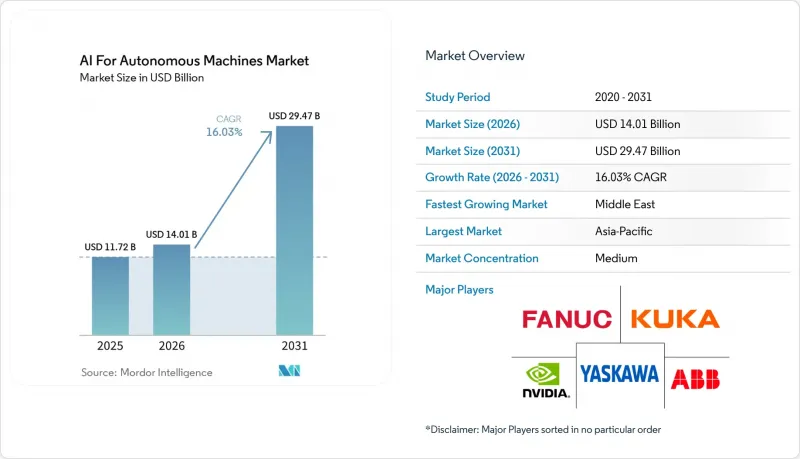
Mordor Intelligence에 의하면, 자율 기계용 AI 시장 규모는 2025년 117억 2,000만 달러로 평가되었습니다. 2026년 140억 1,000만 달러에서 2031년까지 294억 7,000만 달러로 확대되고 2026년부터 2031년까지 연평균 복합 성장률(CAGR)은 16.03%를 나타낼 전망입니다.
본 보고서는 구성 요소(하드웨어, 소프트웨어, 서비스), 자율형 기계의 유형(무인 지상 차량, 무인 항공기, 무인 선박 등), 기술(머신러닝, 딥러닝 등), 최종 사용자 산업(자동차, 일렉트로믹스 및 반도체 등), 지역별로 분류되어 있습니다. 시장 전망은 금액(달러) 기준으로 제시되어 있습니다.
세계의 자율 기계용 AI 시장 동향 및 인사이트
전자상거래 주문 처리 자동화
주문량 증가와 배송 기간 단축에 대한 기대감이 높아짐에 따라, 창고 자동화는 주요 물류 사업자들에게 핵심적인 투자 우선순위가 되고 있습니다. 아마존은 2025년까지 자사의 주문 처리 네트워크에 75만 대 이상의 로봇을 도입했으며, 이는 로봇 시스템이 현재 일상 업무를 어느 정도 규모로 뒷받침하고 있는지를 보여줍니다. 2026년 6월, 아마존은 유럽 주문 처리 네트워크에 100억 유로(116억 달러)를 투자하고 AI 지원 신규 설비를 도입할 것이라고 발표했습니다. 대규모 네트워크에서는 피킹, 경로 설정, 하역, 예외 관리 과정에서 운영 데이터가 생성되며, 이는 향후 소프트웨어 모델 개선에 기여합니다. 이러한 데이터상의 우위는 실제 운영 환경에 동등한 접근 권한을 갖지 못한 독립형 공급업체에 대한 진입 장벽을 높이고 있습니다. 또한, 중규모 물류 사업자들이 지출을 배송 실적이나 처리 능력의 성과와 연동시키는 ‘로보틱스-어즈-어-서비스(RaaS)’ 계약을 요구함에 따라, 자율 주행 기계용 AI 시장도 혜택을 보고 있습니다.
실시간 자율 주행을 위한 엣지 AI 컴퓨팅
기기의 에지 측에서 더 고성능의 연산이 가능해짐에 따라, 자율 시스템은 원격 클라우드의 응답을 기다리지 않고도 의사결정을 내릴 수 있게 됩니다. NVIDIA는 2026년 1월, 70와트 설계로 1,200 FP4 TFLOPS의 성능을 갖추고, 1,000대 단위 구매 가격이 1,999달러인 ‘Jetson T4000’ 모듈을 출시했습니다. 또한 NVIDIA는 휴머노이드 로봇, 농업용 로봇, 수술용 로봇을 위한 ‘Jetson AGX Thor’를 제공함으로써 고성능 로컬 처리를 더 많은 기계 범주로 확대했습니다. 저지연은 기계가 움직이며 장애물이나 변화하는 물리적 상황에 즉각 대응해야 하는 용도를 지원합니다. ABB는 NVIDIA Omniverse와 연동되는 자사의 ‘RobotStudio HyperReality’를 통해 도입 비용을 최대 40% 절감하고, 시장 출시까지 소요되는 시간을 최대 50% 단축할 수 있다고 밝혔습니다. 이러한 추세는 소규모 도입 프로그램에서 시뮬레이션 및 로컬 추론을 더욱 실용화함으로써 자율 기계용 AI 시장을 뒷받침하고 있습니다.
분산된 안전 및 책임 체계
안전, 설명 책임 및 책임에 관한 국가별 규정의 차이는 공급자가 동일한 플랫폼을 국경을 넘어 배포할 때 비용 증가와 지연을 초래합니다. EU AI법은 2026년 8월에 전면 시행되었으며, 인적 감독, 사고 기록, 기본권 평가 등 고위험 시스템에 대한 의무를 규정하고 있습니다. EU 제품책임지침은 AI 기반 소프트웨어에 엄격책임 원칙을 적용하는 것으로, 2026년 12월 9일까지 국내법에 반영되어야 합니다. 2025년 초 EU AI 책임지침안이 철회됨에 따라, 과실에 기반한 민사책임 문제는 EU 차원에서 여전히 미해결 상태로 남아 있습니다. IEC 61508 및 ISO 13849와 같은 규격은 유용한 지침이 되지만, 공급업체는 여전히 서로 다른 법적 체계 내에서 이를 적용해야 합니다. 자율 기계용 AI 시장에서는 이미 안전 프로세스, 인증 실적 및 문서화된 시스템 관리 체제를 갖추고 있는 기업이 유리한 입지에 설 가능성이 있습니다.
부문 분석
2025년, 구성 요소별로 보면 자율 기계용 AI 시장에서 하드웨어가 57.48%의 점유율을 차지했습니다. 기계가 물리적 환경에서 상황을 감지하고 작동하기 위해서는 엣지 컴퓨팅 모듈, LiDAR 유닛, 카메라, 힘·토크 센서, 액추에이터가 여전히 필수적이었습니다. 이러한 구매가 창고 로봇, 산업용 셀, 차량, 현장용 장비에 걸친 하드웨어 수요를 뒷받침했습니다. 로컬 컴퓨팅 하드웨어 덕분에 기계가 사용 현장에서 데이터를 처리하는 능력이 향상되었습니다. NVIDIA의 Jetson 제품은 휴머노이드 로봇, 농업용 로봇, 수술용 로봇 등 폭넓은 분야에서 이러한 목적으로 활용되고 있습니다. 서비스 하위 부문에는 설치, 유지보수, 모델 재학습 및 차량단 관리가 포함됩니다. 절대값으로는 하드웨어나 소프트웨어보다 규모가 작지만, 도입된 기계의 대수가 늘어남에 따라 성장하고 있습니다. 서비스 제공업체는 운영자가 현장 특유의 안전성 및 시스템 통합 요건을 해결할 수 있도록 지원하기도 합니다. 이러한 활동을 통해 자율 기계용 AI 시장의 반복적 도입에서 서비스는 중요한 역할을 수행하고 있습니다.
소프트웨어는 2031년까지 연평균 성장률(CAGR)이 18.53%를 나타낼 것으로 예측되어 가장 빠르게 성장하는 분야가 될 것으로 전망됩니다. 수요의 중심은 월드 파운데이션 모델, 플릿 오케스트레이션 플랫폼, 컴퓨터 비전, 그리고 개발 주기를 단축하는 시뮬레이션 도구에 있습니다. 소프트웨어를 통해 운영자는 여러 기계 유형 및 거점에 걸쳐 단일 제어 방식을 적용할 수 있습니다. 이는 기업이 기계 시스템을 재구축하지 않고도 작업을 변경해야 할 때 유용합니다. 자율 기계용 AI 시장에서 소프트웨어 시장 규모는 독자적으로 개발된 모델 자산, 운영 데이터, 그리고 이를 플릿에 연결하는 인터페이스로의 전환에 의해 뒷받침되고 있습니다. NVIDIA의 Cosmos 플랫폼은 물리적 AI 개발을 위해 합성 세계 생성, 시각 추론, 동작 시뮬레이션을 결합하도록 설계되었습니다. 소프트웨어 기업은 모델 업데이트, 분석 및 원격 플릿 지원을 통해 지속적인 수익을 창출할 수 있습니다. 하드웨어 제조업체는 자사 제품에 소프트웨어, 시뮬레이션 및 라이프사이클 서비스를 추가함으로써 이러한 추세에 대응하고 있습니다. 소프트웨어의 가치는 여전히 센서, 연산 모듈 및 물리적 안전 시스템과의 확실한 통합에 달려 있습니다.
2025년에는 산업용 로봇과 코봇이 자율형 기계 부문의 40.87%를 차지했습니다. 이러한 도입 사례는 정밀 조립, 자재 운반, 용접, 검사 및 기계 작동을 지원하고 있습니다. 반도체 제조와 물류는 모두 오차 허용 범위가 제한적이고 재현성 있는 처리가 요구되기 때문에 중요한 수요원이 되고 있습니다. 협업 로봇은 기존의 자동차 조립 분야를 넘어 더욱 다양한 생산 환경으로 확대되고 있습니다. 산업용 로봇과 협동 로봇은 광범위한 도입 실적과 적응성이 높은 제어에 대한 수요 증가를 모두 갖추고 있어, 자율 기계용 AI 시장에서 여전히 중심적인 위치를 차지하고 있습니다. 반도체 제조, 전자기기 조립 및 물류 센터에 대한 투자로 인해 이러한 장비의 단기적인 역할은 더욱 강화되고 있습니다. 도입의 성패는 여전히 통합 기술, 작업자 교육 및 인간과 기계의 상호작용에 대한 명확한 안전 대책에 달려 있습니다.
무인 해양 차량은 2031년까지 연평균 성장률(CAGR)이 17.92%를 나타낼 것으로 예측되어, 가장 빠르게 성장하는 기계 유형이 될 것으로 전망됩니다. 해군에서의 활용, 해상 에너지 시설 점검, 기후 모니터링 업무를 통해 더 장기간에 걸쳐 임무를 수행할 수 있는 기계에 대한 수요가 발생하고 있습니다. AI를 활용한 항해 지원은 운영자가 변화하는 해상 상황에 대응하고 인적 위험을 줄이는 데 도움이 됩니다. 미국 해군은 그 계획에서 대형 무인수상정 및 초대형 무인 잠수정을 중점적으로 다루고 있습니다. 무인 항공기는 물류, 인프라 점검, 국방 정찰 분야에서 계속해서 활용되고 있습니다. 무인 지상 차량은 항만, 광업 물류, 군사 작전 분야에서 활용 범위가 확대되고 있습니다. 서비스 로봇, 배송 로봇, 자율형 중장비, 농업 기계, 휴머노이드 로봇 또한 자율 기계용 AI 시장을 확대되고 있습니다. 각 카테고리에는 안전성, 센싱, 환경, 유지보수와 관련된 서로 다른 요구 사항이 있습니다. 이러한 다양성으로 인해 전용 플랫폼뿐만 아니라 물리적 시스템을 가로지르며 기능하는 공통 AI 레이어를 위한 여지가 생겨나고 있습니다.
지역별 분석
2025년, 아시아태평양은 자율 기계용 AI 시장의 42.47%를 차지했습니다. 이 지역은 대규모 제조 능력, 자동화에 대한 정부의 지원, 그리고 전자기기 생산에서 비롯된 지속적인 수요를 모두 갖추고 있습니다. 일본에서는 2025년 국내 로봇 수주 대수가 21만 8,987대로 전년 대비 20% 증가했습니다. 관련 수주액은 25.7% 증가한 1조 500억 엔(68억 8,000만 달러 상당)을 기록했습니다. 2026년 일본의 전망에 따르면, 수주액은 16.7% 증가하여 1조 2,200억 엔(80억 3,000만 달러 상당)에 달할 것으로 예측됩니다. 일본의 ‘사회 5.0’ 정책 프레임워크와 중국의 로봇 인증 기준은 인증 절차 단축 및 현지 조달을 촉진할 가능성이 있습니다. 인도에서는 전자상거래(EC) 주문 처리 및 전자기기 제조 분야에서 자율 이동 로봇의 활용이 확대되고 있습니다. 베트남, 태국, 말레이시아에서도 전자기기 생산 확대에 따라 협업 로봇 도입이 진행되고 있습니다.
북미와 유럽은 수요를 견인하는 요인은 다르지만, 두 번째 주요 지역 클러스터를 형성하고 있습니다. 북미에서의 도입은 무인 시스템 조달 및 물류 인프라에 대한 민간 투자에 힘입어 물류, 자동차, 방위 분야에 집중되어 있습니다. 아마존은 2026년 설비 투자액이 2,000억 달러를 넘어설 것으로 예측하고 있으며, 자율형 풀필먼트 인프라가 주요 투자 분야 중 하나로 꼽히고 있습니다. 캐나다와 멕시코는 자동차 공급망 통합 및 니어쇼어링의 혜택을 받고 있습니다. 한편, 유럽의 전망은 더 복잡합니다. 자동차 업계의 침체가 일부 로봇 투자에 영향을 미치고 있기 때문입니다. 독일에서는 2024년에 2만 7,000대의 로봇 도입이 기록되었으나, 이는 전년 대비 5% 감소한 수치입니다. 유럽의 규제 때문에 인증되고 문서화된 플랫폼에 대한 수요가 발생하고 있으며, 이는 경험이 풍부한 공급업체에게 유리하게 작용할 가능성이 있습니다. 이러한 상황은 규정을 준수하는 시스템을 뒷받침하는 한편, 자율형 기계의 AI 시장에 진입하는 신규 공급업체에게는 관리상의 요구 사항이 증가하게 됩니다.
중동은 2031년까지 연평균 성장률(CAGR)이 16.84%에 달하고, 가장 빠르게 성장하는 지역이 될 것으로 예측됩니다. 성장은 아랍에미리트(UAE)와 사우디아라비아에 집중되어 있으며, 이들 국가에서는 산업 다각화 및 스마트 시티 계획이 자율형 물류, 건설 검사, 의료용 로봇의 보급을 촉진하고 있습니다. 사우디아라비아 식품의약청(SFDA)은 의료기기 등록 요건을 마련하고 있으며, 이는 병원용 자동화 기기의 규제 방향을 형성하고 있습니다. 두바이, 제다, 담맘의 물류 허브에서는 인근 여러 지역보다 앞서 자율주행 차량의 운영 규모를 확대되고 있습니다. 아프리카와 남미는 자율 기계용 AI 시장에서 여전히 초기 단계에 있는 지역입니다. 이 지역들의 자율 기계용 AI 시장은 인프라, 서비스 접근성 및 현지 운영 조건에 따라 좌우됩니다. 브라질에서는 정밀 농업 및 자동 자재 운반 용도가 전개되고 있습니다. 남아프리카의 심부 광산 사업에서는 지하 환경에서의 방사선 피폭 위험을 줄여주는 검사 및 운반 시스템에 대한 수요가 발생하고 있습니다.
기타 혜택 :
- 엑셀 형식 시장 예측(ME) 시트
- 3개월간의 애널리스트 지원
자주 묻는 질문
목차
제1장 서론
제2장 조사 방법
제3장 주요 요약
제4장 시장 구도
제5장 시장 규모 및 성장 예측
제6장 경쟁 구도
제7장 시장 기회 및 향후 전망
KTH 26.09.10According to Mordor Intelligence, the AI for autonomous machines market size is projected to expand from USD 11.72 billion in 2025 and USD 14.01 billion in 2026 to USD 29.47 billion by 2031, registering a CAGR of 16.03% between 2026 to 2031.
This report is Segmented by Component (Hardware, Software, and Services), Autonomous-Machine Type (Unmanned Ground Vehicles, Unmanned Aerial Vehicles, Unmanned Marine Vehicles, and More), Technology (Machine Learning and Deep Learning, and More), End-User Industry (Automotive, Electronics and Semiconductors, and More), and Geography. The Market Forecasts are Provided in Terms of Value (USD).
Global AI For Autonomous Machines Market Trends and Insights
E-Commerce Fulfillment Automation
Rising order volumes and shorter delivery expectations have made warehouse automation a core investment priority for large logistics operators. Amazon had deployed more than 750,000 robots in its fulfillment network by 2025, showing the scale at which robotic systems now support daily operations. In June 2026, Amazon also announced a EUR 10 billion (USD 11.6 billion) investment in its European fulfillment network, alongside new AI-enabled equipment. Large networks generate operating data from picking, routing, handling, and exception management, which can improve later software models. This data advantage raises the threshold for independent providers that lack comparable access to real operating environments. The AI for autonomous machines market also benefits as mid-sized logistics providers seek robotics-as-a-service contracts that link spending to delivery and throughput outcomes.
Edge-AI Compute for Real-Time Autonomy
More capable computing at the machine edge lets autonomous systems make decisions without waiting for a remote cloud response. NVIDIA released the Jetson T4000 module in January 2026 with 1,200 FP4 TFLOPS in a 70-watt design and a USD 1,999 price at 1,000-unit volume. NVIDIA also made Jetson AGX Thor available for humanoid, agricultural, and surgical robotics, extending high-performance local processing to more machine categories. Lower latency supports applications where a machine must respond immediately to movement, obstacles, or changing physical conditions. ABB stated that its RobotStudio HyperReality, working with NVIDIA Omniverse, can reduce deployment costs by up to 40% and shorten time to market by up to 50%. This pattern supports the AI for autonomous machines market by making simulation and local inference more practical for smaller deployment programs.
Fragmented Safety and Liability Frameworks
Different national rules on safety, accountability, and liability add cost and delay when providers deploy the same platform across borders. The EU AI Act entered full applicability in August 2026 and sets out obligations for high-risk systems, including human oversight, incident records, and fundamental rights assessments. The EU Product Liability Directive extends strict liability to AI-driven software and must be transposed into national law by December 9, 2026. The withdrawal of the proposed EU AI Liability Directive in early 2025 left fault-based civil liability unresolved at the EU level. Standards such as IEC 61508 and ISO 13849 provide useful reference points, but providers still need to apply them across separate legal settings. The AI for autonomous machines market may favor firms that already have safety processes, certification experience, and documented system controls.
Other drivers and restraints analyzed in the detailed report include:
- Labor Shortages and Workforce Cost Pressure
- Industry 4.0 and Flexible Automation Adoption
- High Upfront Integration and Retrofit Costs
For complete list of drivers and restraints, kindly check the Table Of Contents.
Segment Analysis
Hardware held 57.48% of the AI for autonomous machines market share by component in 2025. Edge computing modules, LiDAR units, cameras, force-torque sensors, and actuators remained necessary for machines to sense and act in physical settings. These purchases supported hardware demand across warehouse robots, industrial cells, vehicles, and field equipment. Local computing hardware has improved the ability of machines to process data at the point of use. NVIDIA's Jetson products are used for this purpose across humanoid, agricultural, and surgical robotics. The services sub-segment includes installation, maintenance, model retraining, and fleet-management support. It remains smaller than hardware and software in absolute terms, but it grows with the installed machine base. Service providers also help operators address site-specific safety and systems integration requirements. These activities make services important for repeat deployments within the AI for autonomous machines market.
Software is projected to be the fastest-growing component, with a CAGR of 18.53% through 2031. Demand centers on world foundation models, fleet-orchestration platforms, computer vision, and simulation tools that shorten development cycles. Software helps operators deploy one control approach across several machine types and sites. This is useful when a business needs to modify tasks without rebuilding mechanical systems. The AI for autonomous machines market size for software is supported by a shift toward proprietary model assets, operating data, and interfaces that connect them to fleets. NVIDIA's Cosmos platform is designed to combine synthetic world generation, vision reasoning, and action simulation for physical AI development. Software firms can build recurring revenue through model updates, analytics, and remote fleet support. Hardware manufacturers are responding by adding software, simulation, and lifecycle services to their offerings. The value of software still depends on reliable integration with sensors, compute modules, and physical safety systems.
Industrial robots and cobots accounted for 40.87% of the autonomous-machine-type segment in 2025. Their installed base supports precision assembly, material movement, welding, inspection, and machine tending. Semiconductor manufacturing and logistics are important sources of demand because each requires repeatable handling with limited tolerance for errors. Collaborative robots have expanded beyond traditional automotive assembly into more varied production environments. Industrial robots and cobots remain central to the AI for autonomous machines market because they combine a broad installed base with growing demand for adaptable control. Their near-term role is strengthened by investment in chip fabrication, electronics assembly, and fulfillment facilities. Adoption still depends on integration skills, worker training, and clear safeguards around human-machine interaction.
Unmanned marine vehicles are projected to be the fastest-growing machine type, with a 17.92% CAGR through 2031. Naval use, offshore energy inspection, and climate monitoring work create demand for machines that can remain on missions for longer periods. AI-guided navigation helps operators manage changing sea conditions and reduce direct human exposure. The United States Navy has emphasized large unmanned surface vehicles and extra-large unmanned undersea vehicles in its planning. Unmanned aerial vehicles continue to serve logistics, infrastructure inspection, and defense reconnaissance. Unmanned ground vehicles are gaining use in ports, mining logistics, and military operations. Service robots, delivery robots, autonomous heavy equipment, farm machinery, and humanoid machines are also broadening the AI for autonomous machines market. Each category has different safety, sensing, environmental, and maintenance requirements. This diversity creates room for specialized platforms as well as common AI layers that can work across physical systems.
Complete Report Scope:
- By Component
- Hardware
- Software
- Services
- By Autonomous-Machine Type
- Unmanned Ground Vehicles
- Unmanned Aerial Vehicles
- Unmanned Marine Vehicles
- Industrial Robots and Cobots
- Other Autonomous-Machine Types (Service and Delivery Robots, Autonomous Heavy Equipment and Farm Machinery, Humanoid and General-Purpose Robots)
- By Technology
- Machine Learning and Deep Learning
- Computer Vision
- LiDAR and Radar Perception
- Sensor Fusion
- Other Technologies
- By End-User Industry
- Automotive
- Electronics and Semiconductors
- Retail and E-commerce
- Healthcare
- Food and Beverage
- Aerospace and Defense
- Other End-User Industries (Agriculture and Mining, Energy and Utilities)
- By Geography
- North America
- United States
- Canada
- Mexico
- South America
- Brazil
- Argentina
- Rest of South America
- Europe
- Germany
- United Kingdom
- France
- Italy
- Spain
- Russia
- Rest of Europe
- Asia-Pacific
- China
- Japan
- South Korea
- India
- ASEAN
- Rest of Asia-Pacific
- Middle East
- Saudi Arabia
- United Arab Emirates
- Turkey
- Israel
- Rest of Middle East
- Africa
- South Africa
- Egypt
- Nigeria
- Rest of Africa
- North America
Geography Analysis
Asia-Pacific held 42.47% of the AI for autonomous machines market in 2025. The region combines large manufacturing capacity, government support for automation, and sustained demand from electronics production. Japan reported domestic robot orders of 218,987 units in 2025, up 20% from the prior year. The related order value rose 25.7% to JPY 1.05 trillion, equivalent to USD 6.88 billion. Japan's 2026 outlook calls for a 16.7% increase in order revenue to JPY 1.22 trillion, equivalent to USD 8.03 billion. Japan's Society 5.0 policy framework and China's robotics certification standards can shorten certification processes and support local procurement. India is expanding the use of autonomous mobile robots in e-commerce fulfillment and electronics manufacturing. Vietnam, Thailand, and Malaysia are also increasing the adoption of collaborative robots as electronics production grows.
North America and Europe form the second major regional cluster, although their demand drivers differ. North American adoption is concentrated in logistics, automotive, and defense, supported by procurement for unmanned systems and private investment in fulfillment infrastructure. Amazon forecast capital expenditure above USD 200 billion in 2026, with autonomous fulfillment infrastructure among its major investment areas. Canada and Mexico benefit from automotive supply chain integration and nearshoring. Europe has a more mixed outlook because weak automotive conditions affected some robot investment. Germany recorded 27,000 robot installations in 2024, a 5% decline from the prior year. European regulations create demand for certified, documented platforms, which can favor experienced providers. This setting supports compliant systems but increases administrative requirements for newer vendors in the AI market for autonomous machines.
The Middle East is projected to be the fastest-growing geography, with a CAGR of 16.84% through 2031. Growth is concentrated in the United Arab Emirates and Saudi Arabia, where industrial diversification and smart-city programs support autonomous logistics, construction inspection, and healthcare robotics. The Saudi Food and Drug Authority has issued requirements for medical-device registration that shape the regulatory path for hospital automation equipment. Logistics hubs in Dubai, Jeddah, and Dammam are scaling autonomous fleet operations ahead of several neighboring locations. Africa and South America remain earlier-stage regions for the AI for autonomous machines market. The AI for autonomous machines market in these regions depends on infrastructure, access to services, and local operating conditions. Brazil offers applications for precision agriculture and automated material handling. South Africa's deep-mining operations create demand for inspection and handling systems that reduce exposure in underground settings.
- NVIDIA Corporation
- ABB Ltd.
- FANUC Corporation
- KUKA AG
- Yaskawa Electric Corporation
- Siemens AG
- Microsoft Corporation
- IBM Corporation
- Alphabet Inc.
- Amazon.com, Inc.
- Mobile Industrial Robots A/S
- Zebra Technologies Corporation
- Locus Robotics Corporation
- Geek+ Technology Co., Ltd.
- Boston Dynamics, Inc.
- SoftBank Robotics Group Corp.
- OMRON Corporation
- Honeywell International Inc.
- Caterpillar Inc.
- Deere & Company
- Qualcomm Technologies, Inc.
- Mobileye Global Inc.
Additional Benefits:
- The market estimate (ME) sheet in Excel format
- 3 months of analyst support
TABLE OF CONTENTS
1 INTRODUCTION
- 1.1 Study Assumptions and Market Definition
- 1.2 Scope of the Study
2 RESEARCH METHODOLOGY
3 EXECUTIVE SUMMARY
4 MARKET LANDSCAPE
- 4.1 Market Overview
- 4.2 Market Drivers
- 4.2.1 E-commerce Fulfillment Automation
- 4.2.2 Edge-AI Compute for Real-Time Autonomy
- 4.2.3 Labor Shortages and Workforce Cost Pressure
- 4.2.4 Industry 4.0 and Flexible Automation Adoption
- 4.2.5 Fleet Learning From Cross-Site Robot Data
- 4.2.6 Liability-Ready Simulation and Digital Twins
- 4.3 Market Restraints
- 4.3.1 Fragmented Safety and Liability Frameworks
- 4.3.2 High Upfront Integration and Retrofit Costs
- 4.3.3 Scarcity of Task-Specific Edge Cases for Training
- 4.3.4 Cyber-Physical Attack Surface in Connected Fleets
- 4.4 Industry Value-Chain Analysis
- 4.5 Regulatory Landscape
- 4.6 Technological Outlook
- 4.7 Porter's Five Forces Analysis
- 4.7.1 Threat of New Entrants
- 4.7.2 Bargaining Power of Suppliers
- 4.7.3 Bargaining Power of Buyers
- 4.7.4 Threat of Substitutes
- 4.7.5 Intensity of Competitive Rivalry
5 MARKET SIZE AND GROWTH FORECASTS (VALUE)
- 5.1 By Component
- 5.1.1 Hardware
- 5.1.2 Software
- 5.1.3 Services
- 5.2 By Autonomous-Machine Type
- 5.2.1 Unmanned Ground Vehicles
- 5.2.2 Unmanned Aerial Vehicles
- 5.2.3 Unmanned Marine Vehicles
- 5.2.4 Industrial Robots and Cobots
- 5.2.5 Other Autonomous-Machine Types (Service and Delivery Robots, Autonomous Heavy Equipment and Farm Machinery, Humanoid and General-Purpose Robots)
- 5.3 By Technology
- 5.3.1 Machine Learning and Deep Learning
- 5.3.2 Computer Vision
- 5.3.3 LiDAR and Radar Perception
- 5.3.4 Sensor Fusion
- 5.3.5 Other Technologies
- 5.4 By End-User Industry
- 5.4.1 Automotive
- 5.4.2 Electronics and Semiconductors
- 5.4.3 Retail and E-commerce
- 5.4.4 Healthcare
- 5.4.5 Food and Beverage
- 5.4.6 Aerospace and Defense
- 5.4.7 Other End-User Industries (Agriculture and Mining, Energy and Utilities)
- 5.5 By Geography
- 5.5.1 North America
- 5.5.1.1 United States
- 5.5.1.2 Canada
- 5.5.1.3 Mexico
- 5.5.2 South America
- 5.5.2.1 Brazil
- 5.5.2.2 Argentina
- 5.5.2.3 Rest of South America
- 5.5.3 Europe
- 5.5.3.1 Germany
- 5.5.3.2 United Kingdom
- 5.5.3.3 France
- 5.5.3.4 Italy
- 5.5.3.5 Spain
- 5.5.3.6 Russia
- 5.5.3.7 Rest of Europe
- 5.5.4 Asia-Pacific
- 5.5.4.1 China
- 5.5.4.2 Japan
- 5.5.4.3 South Korea
- 5.5.4.4 India
- 5.5.4.5 ASEAN
- 5.5.4.6 Rest of Asia-Pacific
- 5.5.5 Middle East
- 5.5.5.1 Saudi Arabia
- 5.5.5.2 United Arab Emirates
- 5.5.5.3 Turkey
- 5.5.5.4 Israel
- 5.5.5.5 Rest of Middle East
- 5.5.6 Africa
- 5.5.6.1 South Africa
- 5.5.6.2 Egypt
- 5.5.6.3 Nigeria
- 5.5.6.4 Rest of Africa
- 5.5.1 North America
6 COMPETITIVE LANDSCAPE
- 6.1 Market Concentration
- 6.2 Strategic Moves
- 6.3 Market Share Analysis
- 6.4 Company Profiles (includes Global Level Overview, Market Level Overview, Core Segments, Financials as available, Strategic Information, Market Rank/Share, Products and Services, Recent Developments)
- 6.4.1 NVIDIA Corporation
- 6.4.2 ABB Ltd.
- 6.4.3 FANUC Corporation
- 6.4.4 KUKA AG
- 6.4.5 Yaskawa Electric Corporation
- 6.4.6 Siemens AG
- 6.4.7 Microsoft Corporation
- 6.4.8 IBM Corporation
- 6.4.9 Alphabet Inc.
- 6.4.10 Amazon.com, Inc.
- 6.4.11 Mobile Industrial Robots A/S
- 6.4.12 Zebra Technologies Corporation
- 6.4.13 Locus Robotics Corporation
- 6.4.14 Geek+ Technology Co., Ltd.
- 6.4.15 Boston Dynamics, Inc.
- 6.4.16 SoftBank Robotics Group Corp.
- 6.4.17 OMRON Corporation
- 6.4.18 Honeywell International Inc.
- 6.4.19 Caterpillar Inc.
- 6.4.20 Deere & Company
- 6.4.21 Qualcomm Technologies, Inc.
- 6.4.22 Mobileye Global Inc.
7 MARKET OPPORTUNITIES AND FUTURE OUTLOOK
- 7.1 White-Space and Unmet-Need Assessment