|
시장보고서
상품코드
2119326
소성 점토 시멘트 유변성 조절제 : 시장 점유율 분석, 업계 동향 및 통계, 성장 예측(2026-2031년)Calcined-Clay Cement Rheology Modifiers - Market Share Analysis, Industry Trends & Statistics, Growth Forecasts (2026 - 2031) |
||||||
 Mordor Intelligence
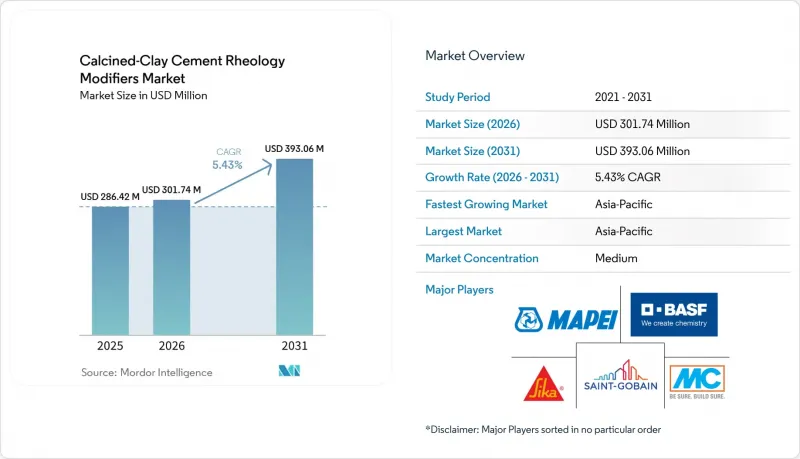
Mordor Intelligence에 의하면, 소성 점토 시멘트 유변성 조절제 시장 규모는 2025년에 2억 8,642만 달러로 평가되었습니다. 2026년 3억 174만 달러에서 2031년까지 3억 9,306만 달러에 이를 것으로 예상되며, 예측 기간(2026-2031년) CAGR은 5.43%를 나타낼 전망입니다.
본 보고서는 제품 유형(리그노설폰산계 개질제 등), 기능(감수 등),소성 점토 시멘트의 유형(메타카올린계 시멘트 등), 용도(레디믹스 콘크리트 등), 지역(아시아태평양, 북미, 유럽, 남미, 중동 및 아프리카)별로 분류되어 있습니다. 시장 예측은 금액(미 달러) 기준으로 제시되어 있습니다.
세계의 소성 점토 시멘트 유변성 조절제 시장 동향 및 인사이트
저탄소 시멘트 기준의 확대 및 조달
공공 조달 요건에 따라 프로젝트 사양 및 자금 지원 조건에 저탄소 시멘트를 직접 반영함으로써, 석회암 소성 점토 시멘트(LC3) 대응 혼화제의 도입이 가속화되고 있습니다. 아일랜드에서는 2024년 9월부터 공공기관에 저탄소 시멘트 지정을 의무화하고 있으며, 2026년 1월부터는 1,000만 유로(약 1,154만 달러)를 초과하는 국고 자금 지원 프로젝트에 대해, 전 생애 주기에 걸친 온실가스 평가를 의무화하고 있습니다. 캐나다 주택 인프라 기금은 주요 프로젝트에서 지역별 기준치와 비교하여 레디믹스 콘크리트의 내재 탄소량을 10% 감축하는 것을 조건으로 하고 있으며, 문서화가 가능하고 일관되게 공급할 수 있는 배합 설계의 중요성을 강조하고 있습니다. 독일의 ‘2025년 조달 가속화 법안(초안)’은 기후 관련 시멘트 조달 요건을 위한 로드맵을 확립한 한편, ISO 21930 및 EN 15804+A2 요건은 유럽 공급망 내에서 검증된 환경 제품 정보의 활용을 강화하고 있습니다. 세계 시멘트·콘크리트 협회는 2025년 4월, 8단계 탄소 평가 프레임워크를 도입하여 조달 팀에 저탄소 시멘트 및 콘크리트 제품을 비교할 수 있는 공통 기준을 제공했습니다. 이러한 조치들은 소성 점토 시멘트(LC3)의 유변성 조절제 시장을 뒷받침하고 있습니다. LC3 혼합물에는 성능 요건을 충족하고, 타설의 신뢰성을 유지하며, 탄소 관련 문서화를 지원하는 혼화제 시스템이 필요하기 때문입니다.
LC3 생산의 상업적 규모로의 확대
LC3 생산은 실증 프로젝트에서 산업 규모의 생산 능력으로 전환되고 있으며, 호환 가능한 유변성 조절제 패키지가 필요한 시멘트 공장의 수가 증가하고 있습니다. 2026년 중반까지 전 세계적으로 35개의 산업 규모 공장이 가동 중이며, 35개가 추가로 건설 중이고, 설비 용량은 연간 1,500만 톤에 달했습니다. CIMPOR Global은 2026년 포르투갈 수제라스에서 일일 1,500톤 규모의 소성 점토 생산 라인을 가동하며, 대규모 생산이 더 이상 소수의 초기 프로젝트에만 국한되지 않음을 입증했습니다. JK Cement사는 마하라슈트라주, 구자라트주, 마디야 프라데시주의 인프라 프로젝트를 위해 2025년 7월 라자스탄주의 망그롤 공장에서 LC3의 상업 생산을 시작했습니다. 새로운 가마가 가동될 때마다 레디믹스 콘크리트 사업자는 새로운 결합재에 대한 혼화제 패키지의 적합성을 확인하고, 현지 원자재를 평가하며, 필요한 작업성 기간을 검증해야 합니다. 이러한 과정으로 인해 소성 점토 시멘트 유변성 조절제 시장에서 시험, 기술 지원 및 제품 재검증에 대한 수요가 발생하고 있습니다. 2026년 케이프타운 회의에서는 조사 단계에서 보다 광범위한 산업으로의 전개로 전환되고 있음을 반영했습니다.
반응성 점토 표면 형성에 따른 급격한 슬럼프 손실
급격한 슬럼프 손실은 여전히 LC3의 상업적 활용에 있어 주요 기술적 제약으로 남아 있습니다. 이는 저클링커 시멘트를 지탱하는 것과 동일한 점토의 화학적 특성이 콘크리트의 작업 가능 기간을 단축시킬 가능성이 있기 때문입니다. 알루미나이트의 반응성이 높아지면 에트링가이트의 형성 및 PCE의 강력한 흡착이 촉진되어, 혼합물 내 입자를 분산시키는 데 이용 가능한 폴리머가 감소하고, 이로 인해 유동성이 급격히 저하됩니다. 지연 첨가, PCE-LDH 나노 복합재 및 인산 공동 개질제는 유동성 유지에 도움이 되지만, 배합 공정, 시험 요건 및 비용 증가를 초래합니다. 이 문제는 인도와 중동에서 더욱 두드러집니다. 이 지역에서는 높은 주변 온도로 인해 운반 및 타설 중 작업 가능한 상태가 조기에 상실됩니다. 소규모 레디믹스 콘크리트 제조업체의 경우, 현장에서 확실하게 사용하기 위해 필요한 투여 관리, 실험실 역량 및 기술 지원이 부족할 가능성이 있습니다. 배합 검증 및 환경 제품 선언(EPD) 요건으로 인해, 소성 점토 시멘트 유변성 조절제 시장에 진입하는 공급업체에게는 추가적인 적합성 확인 작업이 요구될 것입니다.
부문 분석
PCE계 개질제는 2025년 소성 점토 시멘트 유변성 조절제 시장에서 40.72%의 점유율을 차지했으며, 2031년까지 연평균 성장률(CAGR) 6.02%로 성장할 것으로 전망됩니다. 이러한 위상은 LC3 시스템에서 고효율 분산이 필요함을 반영합니다. HPEG계 폴리머는 시험된 여러 배합에서 소성 점토 시멘트에서 MPEG계 및 IPEG계 제품보다 우수한 성능을 발휘합니다. 이 차이는 중요합니다. 왜냐하면 일반 포틀랜드 시멘트에 사용되는 폴리머의 계층 구조가 반드시 소성 점토 바인더에 적용되는 것은 아니기 때문입니다. LC3-50 시스템에서는 PCE의 첨가량이 일반 포틀랜드 시멘트 혼합물보다 훨씬 많아질 가능성이 있습니다. 첨가량이 많다는 점은 시멘트 생산량이 같은 속도로 증가하지 않더라도 PCE 매출을 뒷받침하는 요인이 됩니다.
중국의 GB/T 8076-2025 규격은 2026년 8월에 시행되어 콘크리트 혼화제의 성능 기준이 강화됩니다. 이 규격에서는 기존의 나프탈렌설폰산계 제품보다 선진적인 PCE 배합이 권장되고 있습니다. 리그노설폰산계 개질제는 원자재 비용이 저렴하다는 점이 구매 결정의 지침이 되는 가격에 민감한 시장에서 계속해서 중요한 역할을 하고 있습니다. 셀룰로오스 에테르계 제품은 주로 모르타르나 그라우트의 점도를 조절하고, 보수성을 높이는 역할을 하고 있습니다. 그 밖의 제품으로는 나프탈렌설폰산염, 아크릴계 및 하이브리드 화학제품이 있으나, 이들은 포름알데히드 규제 및 고비율의 보충 시멘트계 재료 배합에서 PCE의 성능 향상을 요구하는 압박에 직면해 있습니다. 따라서 소성 점토 시멘트 유변성 조절제 시장은 특정 점토 원료 및 성능 목표에 부합할 수 있는 고분자 설계로 전환되고 있습니다.
2025년 시점에서 소성 점토 시멘트 유변성 조절제 시장의 42.35%를 감수 용도가 차지했습니다. 클링커 대체율이 높아짐에 따라 소성 점토는 물 수요를 증가시키기 때문에 감수는 많은 LC3 배합 설계에서 기본적인 요건이 되고 있습니다. 2024년 연구에 따르면, 점토를 40% 대체할 경우 물 수요는 일반 포틀랜드 시멘트에 비해 최대 18%까지 증가할 수 있습니다. 점도 조절은 자가 충진 콘크리트 및 모르타르에서 중요합니다. 이러한 재료의 경우, LC3의 높은 응집성으로 인해 신중한 제어가 필요합니다. 또한, 분리 방지 및 응결 시간 제어 제품은 타설 허용 시간이 짧은 인쇄 용도에도 활용되고 있습니다. 이러한 기능을 통해 공급업체는 단순한 감수 효과에 그치지 않고, 소성 점토 시멘트 유변성 조절제 시장에 진입할 수 있는 여러 경로를 확보할 수 있습니다.
작업성 향상과 유동성 유지는 2031년까지 연평균 성장률(CAGR) 6.18%를 나타낼 것으로 예측됩니다. 이는 콘크리트의 초기 확산뿐만 아니라 혼합 후의 작업 시간에도 대응하는 것입니다. 2026년 파라바 시에서 실시된 현장 조사에서는 3시간 동안 작업성을 유지하기 위해서는 특수한 PCE 및 인산계 개질제가 필요하다는 사실이 밝혀졌습니다. 감수제는 일반적으로 첨가량당 비용과 초기 유동성을 기준으로 평가됩니다. 반면, 유동성 유지 제품은 타설 현장에서의 확실한 작업 가능 시간을 기준으로 평가됩니다. 고객의 현지 점토를 사용하여 이 결과를 입증할 수 있는 공급업체는 단순한 표준 혼화제 판매를 더 장기적인 기술 서비스 관계로 전환할 가능성이 있습니다.
지역별 분석
아시아태평양은 2025년에 소성 점토 시멘트 유변성 조절제 시장의 41.57%를 차지했으며, 2031년까지 연평균 성장률(CAGR) 6.26%를 나타낼 것으로 예측됩니다. 인도에서는 IS 18189; 2023에 따라 LC3 생산을 확대되고 있습니다. JK 시멘트는 마하라슈트라주, 구자라트주, 마디아프라데시주의 프로젝트를 위해 2025년 7월 망그롤에서 LC3의 상업 생산을 시작했습니다. 중국의 GB/T 8076-2025 규격은 2026년 8월에 시행되어 고성능 혼화제로의 전환을 촉진하고 있습니다. 일본에서는 석회석·소성 점토 시멘트용 아민계 혼화제, 특히 내탄산화성을 높이는 메틸디에탄올아민에 대한 연구가 진행되고 있습니다. 한국과 인도네시아에서는 내구성 요건이 더욱 엄격해진 인프라 정비 계획에 따라 수요가 확대되고 있습니다.
북미와 유럽은 함침 탄소의 공개, 감축 및 인증을 촉진하는 규제가 있어 중요한 시장으로 부상하고 있습니다. 캐나다에서는 2025년 9월부터 콘크리트에 대한 함탄량 공시가 의무화되어 있으며, 캐나다 대중교통 기금에서는 2026년부터 2027년에 걸쳐 주요 프로젝트에서 레디믹스 콘크리트의 함탄량 감축을 요구하고 있습니다. 유럽의 EN 197-5 규격에서는 LC3 대응 시멘트 유형인 CEM II/C-M(Q-LL)이 인증되어 있습니다. 호주의 2025년 뉴사우스웨일스주 저탄소 콘크리트 요건 및 ACT(호주 수도 특별구) 정책에서는 성능 기반의 공공 조달이 이루어지고 있습니다. EU 시행 규칙 2026/718은 주요 인프라 계약 조달에 지속가능성 측면을 추가하고 있습니다.
남미, 중동 및 아프리카는 여전히 규모가 작은 지역이지만, 독자적인 프로젝트 기회를 제공합니다. 가나에서는 2025년 4월 Supacem사의 LC3 시설이 가동을 시작했고, 하이델베르크 머티리얼즈(Heidelberg Materials)와 CBI 가나(CBI Ghana)가 운영하는 연간 40만 톤 규모의 플래시 칼시네이터가 가동됨에 따라 서아프리카의 소성 점토 생산 기반이 강화되었습니다. 가나의 GS PAS 5 : 2024 규격에서는 클링커 함유율을 35%까지 낮게 설정하는 것이 허용되어, 현지 LC3 투자를 촉진하고 있습니다. 브라질에서는 연방대학교를 통해 LC3에 관한 조사를 확대되고 있습니다. 사우디아라비아와 아랍에미리트에서는 건설 프로그램을 저탄소 자재 요건과 연계하고 있습니다. 이 지역들의 소성 점토 시멘트 유변성 조절제 시장은 현지 시험 능력, 제품 인증, 그리고 적절한 점토의 안정적인 공급에 달려 있습니다.
기타 혜택 :
- 엑셀 형식 시장 예측(ME) 시트
- 3개월간의 애널리스트 지원
자주 묻는 질문
목차
제1장 서론
제2장 조사 방법
제3장 주요 요약
제4장 시장 구도
제5장 시장 규모 및 성장 예측
제6장 경쟁 구도
제7장 시장 기회 및 향후 전망
KTH 26.09.10According to Mordor Intelligence, the calcined-Clay cement rheology modifiers market size was valued at USD 286.42 million in 2025 and is estimated to grow from USD 301.74 million in 2026 to reach USD 393.06 million by 2031, at a CAGR of 5.43% during the forecast period (2026-2031).
This report is Segmented by Product Type (Lignosulfonate-Based Modifiers and More), Function (Water Reduction and More), Calcined-Clay Cement Type (Metakaolin-Based Cement and More), Application (Ready-Mix Concrete and More), and Geography (Asia-Pacific, North America, Europe, South America, and Middle-East and Africa). The Market Forecasts are Provided in Terms of Value (USD).
Global Calcined-Clay Cement Rheology Modifiers Market Trends and Insights
Expansion Of Low-Carbon Cement Standards and Procurement
Public procurement requirements are shortening the adoption path for Limestone Calcined Clay Cement (LC3)-compatible admixtures by directly incorporating lower-carbon cement into project specifications and funding conditions. Ireland requires public bodies to specify low-carbon cement from September 2024 and mandates whole-life-cycle greenhouse gas assessments for exchequer-funded projects above EUR 10 million (~USD 11.54 million) from January 2026. Canada's Housing Infrastructure Fund links major projects to a 10% reduction in embodied carbon from ready-mix concrete relative to regional baselines, underscoring the importance of mix designs that can be documented and delivered consistently. Germany's 2025 Draft Procurement Acceleration Act established a route for climate-related cement procurement requirements, while ISO 21930 and EN 15804+A2 requirements reinforce the use of verified environmental product information in European supply chains. The Global Cement and Concrete Association introduced an 8-tier carbon rating framework in April 2025, providing procurement teams with a common basis for comparing lower-carbon cement and concrete products. These measures support the Calcined-Clay Cement Rheology Modifiers market because LC3 mixes require admixture systems that meet performance requirements, maintain placement reliability, and support carbon-related documentation.
Commercial Scale-Up of LC3 Production
LC3 production is moving from demonstration projects to industrial capacity, increasing the number of cement plants that require compatible rheology-modifier packages. By mid-2026, 35 industrial-scale plants were operating worldwide, another 35 were under construction, and installed capacity had reached 15 million tons per year. CIMPOR Global commissioned a 1,500-tons-per-day calcined-clay line in Souselas, Portugal, in 2026, demonstrating that large-scale production is no longer confined to a small group of early projects. JK Cement began commercial LC3 production at its Mangrol works in Rajasthan in July 2025 for infrastructure projects in Maharashtra, Gujarat, and Madhya Pradesh. Each new kiln commission requires ready-mix operators to qualify admixture packages against the new binder, evaluate local raw materials, and validate the required workability period. This process creates demand for testing, technical support, and repeat product validation within the Calcined-Clay Cement Rheology Modifiers market. The 2026 Cape Town conference reflected this shift from research toward wider industrial deployment.
Rapid Slump Loss from Reactive Clay Surface Generation
Rapid slump loss remains a major technical constraint to commercial LC3 use because the same clay chemistry that supports lower-clinker cement can shorten the period during which concrete remains workable. Elevated aluminate reactivity can promote ettringite formation and strong PCE adsorption, reducing the polymer available to disperse particles in the mix and causing a rapid loss of fluidity. Delayed addition, PCE-LDH nanocomposites, and phosphoric acid co-modifiers can help retain flow, but they add formulation steps, testing requirements, and cost. The problem is more pronounced in India and the Middle-East, where high ambient temperatures accelerate the loss of workable consistency during transport and placement. Smaller ready-mix producers may lack the dosing controls, laboratory capacity, and technical support needed for reliable field use. Mix verification and environmental product declaration requirements can add further qualification work for suppliers serving the calcined-clay cement rheology modifiers market.
Other drivers and restraints analyzed in the detailed report include:
- Rising Ready-Mix and High-Performance Concrete Usage
- Clay-Source-Specific Polymer Formulation Demand
- Variability in Clay Mineralogy and Porosity
For complete list of drivers and restraints, kindly check the Table Of Contents.
Segment Analysis
PCE-based modifiers held 40.72% of the calcined-clay cement rheology modifiers market share in 2025 and are forecast to grow at a 6.02% CAGR through 2031. This position reflects the need for high-efficiency dispersion in LC3 systems. HPEG-based polymers can outperform MPEG- and IPEG-based variants in calcined-clay cement across several tested formulations. This distinction is significant because the polymer hierarchy used in ordinary Portland cement does not always apply to calcined-clay binders. In LC3-50 systems, PCE dosage can be materially higher than in ordinary Portland cement mixtures. Higher dosage supports PCE revenue even when cement output does not grow at the same rate.
China's GB/T 8076-2025 standard takes effect in August 2026 and tightens performance criteria for concrete admixtures. The standard favors advanced PCE formulations over older naphthalene sulfonate products. Lignosulfonate-based modifiers continue to play a role in price-sensitive markets where lower raw material costs guide purchasing decisions. Cellulose ether-based products primarily serve to modify viscosity and enhance water retention in mortars and grouts. Other products include naphthalene sulfonate, acrylic-based, and hybrid chemistries, which face pressure from formaldehyde controls and PCE performance in high supplementary-cementitious-material blends. The calcined-clay cement rheology modifiers market is therefore shifting toward polymer designs that can match a defined clay source and performance target.
Water reduction accounted for 42.35% of the calcined-clay cement rheology modifiers market size in 2025. Calcined clay increases water demand as clinker substitution rises, making water reduction a basic requirement for many LC3 mix designs. A 2024 study reported that water demand can be up to 18% higher than ordinary Portland cement at 40% clay substitution. Viscosity modification is important in self-compacting concrete and mortars, where LC3's higher cohesiveness requires careful control. Anti-segregation and setting-time-control products also serve printing applications that require a narrow placement window. These functions provide suppliers with several routes into the calcined-clay cement rheology-modifier market beyond simple water reduction.
Workability enhancement and flow retention are forecast to grow at a 6.18% CAGR through 2031. They address the logistics interval after mixing, not only the initial spread of concrete. The 2026 Palava City fieldwork showed that a specialized PCE and phosphoric acid modifier were needed to retain workability for 3 hours. Water-reduction products are commonly evaluated against dosage cost and initial fluidity. Flow-retention products are evaluated against a reliable time window at the placement site. Suppliers that can document this result using a customer's local clay may convert a standard admixture sale into a more durable technical service relationship.
Complete Report Scope:
- By Product Type
- Polycarboxylate Ether (PCE)-Based Modifiers
- Lignosulfonate-Based Modifiers
- Cellulose Ether-Based Modifiers
- Others (Naphthalene Sulfonate, Acrylic-Based, Specialty Modifiers)
- By Function
- Water Reduction
- Workability Enhancement and Flow Retention
- Viscosity Modification
- Others (Anti-Segregation, Setting Time Control)
- By Calcined-Clay Cement Type
- LC3 (Limestone Calcined Clay Cement)
- Metakaolin-Based Cement
- Calcined Kaolinite-Based Cement
- Others (Emerging Calcined-Clay Cement Blends)
- By Application
- Ready-Mix Concrete
- Precast Concrete
- Mortars and Grouts
- 3D Printing Concrete
- Others (Shotcrete, Infrastructure Concrete)
- By Geography
- Asia-Pacific
- China
- India
- Japan
- South Korea
- Rest of Asia-Pacific
- North America
- United States
- Canada
- Mexico
- Europe
- Germany
- United Kingdom
- France
- Italy
- Rest of Europe
- South America
- Brazil
- Argentina
- Rest of South America
- Middle-East and Africa
- Saudi Arabia
- South Africa
- Rest of Middle-East and Africa
- Asia-Pacific
Geography Analysis
Asia-Pacific held 41.57% of the Calcined-Clay Cement Rheology Modifiers market share in 2025 and is forecast to grow at a 6.26% CAGR through 2031. India is scaling up LC3 production in line with IS 18189:2023. JK Cement started commercial LC3 production at Mangrol in July 2025 for projects in Maharashtra, Gujarat, and Madhya Pradesh. China's GB/T 8076-2025 standard took effect in August 2026 and supports the transition to higher-performance admixtures. Japan is studying amine-type admixtures for limestone-calcined clay cement, including methyldiethanolamine for carbonation resistance. South Korea and Indonesia add demand through infrastructure programs with stricter durability requirements.
North America and Europe are significant markets due to regulations that promote the disclosure, reduction, and qualification of embodied carbon. Canada requires embodied-carbon disclosure for concrete from September 2025, and its Public Transit Fund requires reductions in ready-mix concrete for major projects from 2026 to 2027. Europe's EN 197-5 recognizes CEM II/C-M (Q-LL), an LC3-compatible cement type. Australia's 2025 New South Wales Low Carbon Concrete Requirement and the ACT policy use performance-based public procurement. EU Implementing Regulation 2026/718 adds a sustainability dimension to procurement for major infrastructure contracts.
South America, the Middle-East, and Africa remain smaller regions but offer distinct project opportunities. In Ghana, the April 2025 commissioning of the Supacem LC3 facility and Heidelberg Materials and CBI Ghana's 400,000-tons-per-year flash calciner strengthened West Africa's calcined-clay production base. Ghana's GS PAS 5:2024 permits clinker content as low as 35%, supporting local LC3 investment. Brazil is expanding research on LC3 through federal universities. Saudi Arabia and the United Arab Emirates are linking construction programs to lower-carbon material requirements. The Calcined-Clay Cement Rheology Modifiers market in these regions depends on local testing capacity, product qualification, and reliable supply of suitable clay.
- Arkema
- BASF
- Chembond Chemicals Limited
- Dow
- Enaspol a.s.
- Fosroc, Inc.
- GCP Applied Technologies Inc.
- Kao Corporation
- Mapei S.p.A.
- MC-Bauchemie
- MUHU (China) Construction Materials Co., Ltd.
- RPM International Inc.
- Saint-Gobain
- Sika AG
- Sobute New Materials Co., Ltd.
Additional Benefits:
- The market estimate (ME) sheet in Excel format
- 3 months of analyst support
TABLE OF CONTENTS
1 Introduction
- 1.1 Study Assumptions and Market Definition
- 1.2 Scope of the Study
2 Research Methodology
3 Executive Summary
4 Market Landscape
- 4.1 Market Overview
- 4.2 Market Drivers
- 4.2.1 Expansion of Low-Carbon Cement Standards and Procurement
- 4.2.2 Commercial Scale-Up of LC3 Production
- 4.2.3 Rising Ready-Mix and High-Performance Concrete Usage
- 4.2.4 Clay-Source-Specific Polymer Formulation Demand
- 4.2.5 Digital and Automated Admixture Dosing
- 4.2.6 Rheology Requirements in 3D-Printed and Specialty Concrete
- 4.3 Market Restraints
- 4.3.1 Rapid Slump Loss from Reactive Clay Surface Generation
- 4.3.2 Variability in Clay Mineralogy and Porosity
- 4.3.3 Higher Admixture Dosage and Formulation Cost
- 4.3.4 Incomplete Standards and Qualification Pathways
- 4.4 Value Chain Analysis
- 4.5 Porter's Five Forces Analysis
- 4.5.1 Threat of New Entrants
- 4.5.2 Bargaining Power of Suppliers
- 4.5.3 Bargaining Power of Buyers
- 4.5.4 Threat of Substitutes
- 4.5.5 Competitive Rivalry
5 Market Size and Growth Forecasts (Value)
- 5.1 By Product Type
- 5.1.1 Polycarboxylate Ether (PCE)-Based Modifiers
- 5.1.2 Lignosulfonate-Based Modifiers
- 5.1.3 Cellulose Ether-Based Modifiers
- 5.1.4 Others (Naphthalene Sulfonate, Acrylic-Based, Specialty Modifiers)
- 5.2 By Function
- 5.2.1 Water Reduction
- 5.2.2 Workability Enhancement and Flow Retention
- 5.2.3 Viscosity Modification
- 5.2.4 Others (Anti-Segregation, Setting Time Control)
- 5.3 By Calcined-Clay Cement Type
- 5.3.1 LC3 (Limestone Calcined Clay Cement)
- 5.3.2 Metakaolin-Based Cement
- 5.3.3 Calcined Kaolinite-Based Cement
- 5.3.4 Others (Emerging Calcined-Clay Cement Blends)
- 5.4 By Application
- 5.4.1 Ready-Mix Concrete
- 5.4.2 Precast Concrete
- 5.4.3 Mortars and Grouts
- 5.4.4 3D Printing Concrete
- 5.4.5 Others (Shotcrete, Infrastructure Concrete)
- 5.5 By Geography
- 5.5.1 Asia-Pacific
- 5.5.1.1 China
- 5.5.1.2 India
- 5.5.1.3 Japan
- 5.5.1.4 South Korea
- 5.5.1.5 Rest of Asia-Pacific
- 5.5.2 North America
- 5.5.2.1 United States
- 5.5.2.2 Canada
- 5.5.2.3 Mexico
- 5.5.3 Europe
- 5.5.3.1 Germany
- 5.5.3.2 United Kingdom
- 5.5.3.3 France
- 5.5.3.4 Italy
- 5.5.3.5 Rest of Europe
- 5.5.4 South America
- 5.5.4.1 Brazil
- 5.5.4.2 Argentina
- 5.5.4.3 Rest of South America
- 5.5.5 Middle-East and Africa
- 5.5.5.1 Saudi Arabia
- 5.5.5.2 South Africa
- 5.5.5.3 Rest of Middle-East and Africa
- 5.5.1 Asia-Pacific
6 Competitive Landscape
- 6.1 Market Concentration
- 6.2 Strategic Moves
- 6.3 Market Share (%)/Ranking Analysis
- 6.4 Company Profiles (includes Global Overview, Market Overview, Core Segments, Financials as available, Strategic Information, Products and Services, and Recent Developments)
- 6.4.1 Arkema
- 6.4.2 BASF
- 6.4.3 Chembond Chemicals Limited
- 6.4.4 Dow
- 6.4.5 Enaspol a.s.
- 6.4.6 Fosroc, Inc.
- 6.4.7 GCP Applied Technologies Inc.
- 6.4.8 Kao Corporation
- 6.4.9 Mapei S.p.A.
- 6.4.10 MC-Bauchemie
- 6.4.11 MUHU (China) Construction Materials Co., Ltd.
- 6.4.12 RPM International Inc.
- 6.4.13 Saint-Gobain
- 6.4.14 Sika AG
- 6.4.15 Sobute New Materials Co., Ltd.
7 Market Opportunities and Future Outlook
- 7.1 White-Space and Unmet-Need Assessment