

|
시장보고서
상품코드
2154830
무기 리올로지 개질제 : 시장 점유율 분석, 업계 동향과 통계, 성장 예측(2026-2031년)Inorganic Rheology Modifiers - Market Share Analysis, Industry Trends & Statistics, Growth Forecasts (2026 - 2031) |
||||||
 Mordor Intelligence
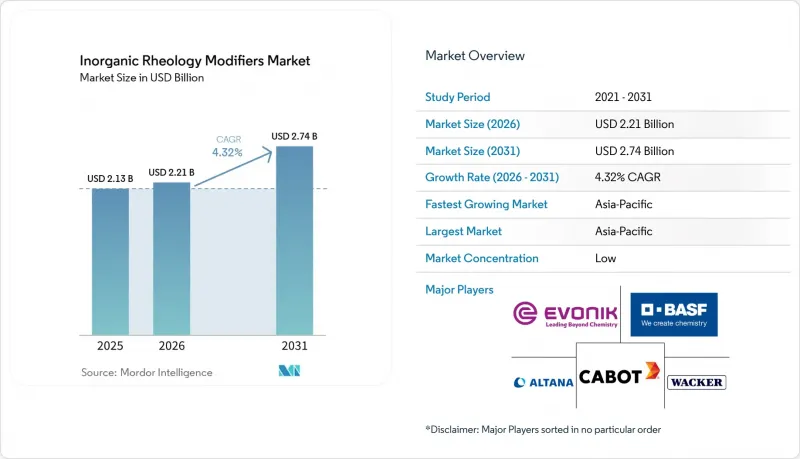
에 따르면 무기 리올로지 조정제 시장 규모는 2025년에 21억 3,000만 달러로 추계되고 있으며, 2026년 22억 1,000만 달러에서 2031년까지 27억 4,000만 달러로 확대하며, 예측 기간(2026-2031년)에 CAGR은 4.32%에 달할 것으로 전망되고 있습니다.
세계 무기 유변학 조절제 시장의 동향 및 인사이트
수성 및 저휘발성 유기화합물(VOC)계 도료의 채택
무기 유변학 조절제 시장은 미국, 유럽, 중국 및 기타 규제 시장에서 용제형 도료에서 수성 도료로의 전환에 힘입어 성장하고 있습니다. 이러한 전환으로 인해 용제 함량을 늘리지 않으면서도 점도 제어, 흘러내림 방지 및 안료의 현탁성을 제공하는 첨가제에 대한 수요가 증가하고 있습니다. 수성 시스템은 분산제, 안료, 바인더 및 가공 조건에 대해 서로 다른 반응을 보이기 때문에 개질제는 단순히 점도를 높일 뿐만 아니라 전체적으로 안정적인 배합에 기여해야 합니다. 따라서 이러한 전환은 규정 준수상 과제인 동시에 배합 설계상 과제이기도 합니다. 유기 친화성 점토나 흄드 실리카는 수성 시스템에서 이러한 기능을 제공하지만, 일부 유기 증점제는 계면활성제에 의한 간섭을 받기 쉬운 경향이 있습니다. 주요 시장의 규제 요건으로 인해 배합 설계자는 저VOC 제품 개발과 보다 일관된 시험 방법의 채택이 요구되고 있습니다. 사우디아라비아에서는 2026년 5월 기술 규정 TR-IND-2026-04가 개정되어 수성 산업용 도료에 대한 VOC 적용 예외가 철회되었습니다. 이에 따라 사우디아라비아 표준·계량·품질 기구(SASO) 2511:2024에 기반한 적합성 시험이 의무화되었으며, 수출업자의 시험 기간이 28일로 연장되었습니다. 신뢰성 높은 수성 도료의 성능이 요구되는 가운데, 규제 대상 용도에 대응하는 도료 제조업체에게 있으며, 광물계 유변학 제어의 중요성은 여전히 높습니다. 특히 제품 라인이 여러 규제 관할 구역에서 판매되고 있으며, 단일 배합 방식을 통해 지역별 별도 버전을 제작해야 할 필요성을 줄일 수 있는 경우에는 그 중요성이 더욱 커집니다. 배합 담당자는 변경 후에도 도막 두께, 저장 안정성, 도포 일관성 및 표면 외관을 유지해야 합니다. 이에 따라 기존 도료 등급과 새로 개발된 수성 제품 모두에서 첨가제 선정이 배합 작업의 핵심적인 역할을 계속하고 있습니다.
건설·인프라용 도료의 수요
건축·인프라 분야의 활동은 무기계 유변학 조절제 시장의 기초적인 수요를 지원하고 있습니다. 이는 건축용 및 보호용 도료가 광범위한 표면에서 안정적인 도포 특성을 필요로 하기 때문입니다. 아시아태평양 및 중동 전역에 걸친 프로젝트에는 철도, 공항, 주택, 산업 시설 등이 포함되어 있으며, 이들에는 내구성이 높은 도료 시스템이 요구되고 있습니다. 국제적인 프로젝트 사양서에서는 ISO 12944의 부식 방지 요건이 점점 더 많이 참조되고 있으며, 보호용 도료에 요구되는 성능 수준이 높아지고 있습니다. 인도에서는 ‘스마트 시티 미션’ 및 관련 산업단지 프로그램으로 인해 새로 도장된 표면의 설치 기반이 확대되어 건축용 도료의 국내 수요를 지원하고 있습니다. 대규모 공공 프로젝트에서는 저VOC 및 그린 빌딩 사양이 채택되는 경우가 많아, 도료 배합의 성능 요건이 높아지고 있습니다. 사양 요건의 고도화에 따라 더 고성능인 무기계 틱소트로픽의 사용이 촉진되고 있습니다. 보호용 도료는 시공 중 작업성을 유지하면서, 보관 중 침전이나 수직면에서의 흘러내림을 방지해야 합니다. 따라서 레올로지 제어는 프로젝트의 성능에 직접적으로 영향을 미치는 요소가 되고 있습니다. 수요는 신축 건물이나 인프라 자산의 수뿐만 아니라 건설 활동의 품질 수준에도 좌우됩니다. 시공사나 도료 제조사가 다양한 현장 조건에서 사양을 충족해야 하는 경우, 확립된 기술 지원 체계를 갖춘 공급업체가 우위를 점하게 됩니다.
광물 및 실리카 원료의 가격 변동
무기 유변학 조절제 시장은 석영 모래, 벤토나이트, 아타팔자이트, 카올린의 원가 변동 영향을 지속적으로 받고 있습니다. 이러한 원자재는 하류 도료 수요가 안정적인 경우에도 지역별 에너지 비용, 채굴 허가, 운송 물류의 영향을 받습니다. 특히 흄드 실리카의 제조는 화염 수분해에 막대한 에너지 투입이 필요하므로 에너지 집약도가 높은 것이 특징입니다. 2024년 유럽의 천연가스 가격 상승으로 인해 일부 공급업체에서는 계약 제품 가격의 상승 속도를 웃도는 속도로 생산 비용이 상승했습니다. 도료 배합 담당자는 지역 및 전 세계 대체품의 적합성 평가를 통해 대응할 수 있지만, 이중 조달(듀얼 소싱)은 조달 업무의 부담을 가중시키고, ISO 규격이나 고객별 규격에 따른 등급 재인증이 필요할 수 있습니다. 광물 등급의 변경은, 설령 대체재가 동일한 일반적인 목적을 달성한다 하더라도, 혼합 시간, 점도 상승, 발색 및 도포 특성에 영향을 미칠 가능성이 있습니다. 이러한 추가 작업으로 인해 원자재 비용 상승에 대한 구매 대응이 지연될 수 있습니다. 장기 공급 계약을 체결하지 않은 중견 제조사의 경우, 현물 시장에 대한 의존은 운전 자금에 부담을 주며, 원료 비용이 더 안정적인 유기계 대체품의 매력을 높이는 결과를 초래합니다.
부문 분석
2025년, 유형별 매출에서 점토가 차지하는 비중은 42.34%였습니다. 이러한 위상은 경쟁력 있는 가격 책정, 벤토나이트, 아타팔자이트, 카올린의 광범위한 입수 가능성, 그리고 건축용 및 산업용 도료 분야에서 확립된 용도를 반영합니다. 이러한 재료들은 제조업체가 유동성을 제어하기 위해 신뢰할 수 있고 확장 가능한 방법을 필요로 하는 배합에서 오랫동안 사용되어 왔습니다. 그 공급 기반은 첨가제가 안정적인 상업적 규모로 확보되어야 하는 대량 생산 제품의 사용을 지원하고 있습니다. 점토는 광범위한 코팅 시스템에서 틱소트로피 특성을 제어합니다. 친유성 점토는 유기 용제와 호환성이 좋은 표면 개질 나트륨 벤토나이트 제품입니다. 이 제품은 수성 대체재로 도포 요건을 충족할 수 없는 보호 코팅, 그리스, 용제계 접착제에 사용됩니다. 이 하위 부문은 가혹한 환경에서 낮은 전단 점도와 침전 방지 특성을 갖추고 있으며, 프리미엄 가격대에서 거래되고 있습니다.
흄드 실리카는 2031년까지 연평균 성장률(CAGR) 5.21%로 성장할 것으로 예상되며, 이는 무기 유변학 조절제 시장 유형별 부문 중 가장 높은 성장률입니다. 수요를 견인하고 있는 것은 고순도이며 표면 기능화된 등급이 필요한 전기자동차(EV)용 배터리 분리막 코팅, 열계면 소재 및 반도체 봉지재입니다. 에보닉(Evonik)의 ‘AEROSIL’ 포트폴리오는 접착제, 퍼스널 케어 및 첨단 배터리 시스템에 걸친 친수성 및 소수성 용도 모두를 지원합니다. 합성 헥톨라이트 및 라포나이트와 같은 특수 점토는 수성 자동차 재도장용 도료 및 효과 안료 도료에 사용됩니다. 이러한 저전단 겔화 특성은 금속 안료의 배향을 돕고 안정적인 외관을 유지합니다. 무기 유변학 조절제 시장은 고생산성 건축 용도에 그치지 않고, 외관, 유동성 제어 및 재현성 있는 도포가 제품 사양의 핵심이 되는 배합을 지원합니다. 배터리 및 퍼스널 케어 공급망의 지역화가 진행됨에 따라 아시아와 유럽내 생산 거점의 근접성이 점점 더 중요해지고 있습니다. 이로 인해 고객 근처에서 일관된 품질의 제품을 공급할 수 있는 제조업체가 유리해지며, 리드타임 단축 및 재인증 위험 감소로 이어집니다. 또한 사용자가 특정 가공 설비나 고객 기준에 맞춰 배합을 조정함에 따라 현지 기술 서비스의 중요성도 높아지고 있습니다.
지역별 분석
아시아태평양은 2025년에 무기 유변학 조절제 시장 점유율의 35.21%를 차지할 것으로 예상되며, 2031년까지 연평균 성장률(CAGR) 5.05%로 성장할 것으로 전망됩니다. 중국, 인도 및 아세안(ASEAN) 국가들은 건설 관련 도료 및 퍼스널 케어 제품 제조를 통해 수요를 주도하고 있습니다. 이 시장들은 대규모 현지 소비자 기반과 제조 능력을 모두 갖추고 있으며, 기본 건축용 도료와 특수 퍼스널 케어용 배합에 대한 수요를 창출하고 있습니다. 이러한 조합을 통해 공급업체는 대량 소비 용도뿐만 아니라, 더 엄격한 성능 요건을 충족하는 등급의 사업 기회에도 진출할 수 있게 됩니다. 중국의 건축용 도료 부문은 도시화가 성숙함에 따라 급속한 확장에서 더 엄격한 제품 품질 요건으로 전환되고 있으며, 고등급 무기계 개질제에 대한 수요가 증가하고 있습니다. 인도에서는 주택 건설, 도시화, ‘스마트 시티 미션(Smart City Mission)’, 그리고 인프라 정비 프로그램이 도료 및 코팅재 소비를 지원하고 있습니다. 아세안(ASEAN)의 공공 인프라 프로젝트 역시 도료 수요를 증가시키고 있으며, ISO 12944를 준수하는 부식 방지 대책이 필요할 가능성이 있습니다.
북미는 무기 유변학 조절제 시장에서 확고한 입지를 구축하고 있으며, 자동차 OEM(원청 브랜드 제조업체), 산업용 유지보수 및 건축용 도료 분야의 수요는 기술적으로 첨단 배합을 필요로 하고 있습니다. 휘발성 유기 화합물(VOC)에 대한 규제가 강화됨에 따라 수성 배합 개발과 도포 품질을 유지하는 첨가제의 사용이 촉진되고 있습니다. 또한 북미의 전기자동차(EV) 배터리 공급망에서도 분리막용 코팅 및 열계면 소재용 흄드 실리카에 대한 지역적 수요가 발생하고 있습니다. 유럽에서는 ‘데코 페인트 지침’ 및 ‘화학물질의 등록, 평가, 허가 및 제한(REACH)’ 규제가 시장을 형성하고 있으며, 이는 저VOC 배합 및 제품 정보 공개 관행을 지원하고 있습니다. 독일은 자동차 OEM용 코팅의 거점인 만큼, 기술적으로 고도로 발전된 특수 무기 개질제의 유럽내 주요 중심지 역할을 하고 있습니다. 정보 공개 의무 대상인 합성 폴리머 미립자 캐리어의 대체재를 배합 설계자가 모색할 경우, 광물 유래 제품은 차별화를 꾀할 수 있습니다. 다만, 유변학적 특성은 배합마다 다르기 때문에 모든 광물성 제품이 유기 첨가제의 직접적인 대체재가 되는 것은 아닙니다. 그러나 제품 자료나 성분 선택지를 검토할 때, 배합 설계자에게 광물 유래 옵션을 평가할 추가적인 이유가 될 것임은 분명합니다.
남미, 중동 및 아프리카는 무기 유변학 조절제 시장 중에서는 소규모 시장이지만, 점진적인 수요 증가를 지원하고 있습니다. 남미에서는 브라질의 건설 활동과 확대되는 퍼스널 케어 제품 제조가 수요를 지원하고 있습니다. 사우디아라비아의 ‘비전 2030’ 프로젝트를 포함한 걸프협력회의(GCC)의 인프라 구축 계획은 중동 및 아프리카 전역의 보호용 및 건축용 도료 수요를 지원하고 있습니다. 사우디아라비아가 2026년 5월에 시행할 수성 산업용 도료 관련 규정에 따라 수입되는 수성 배합제에 대한 사양 요건이 강화될 예정입니다. 남아프리카 및 사하라 이남 아프리카는 여전히 건설용 도료에 주로 의존하는 초기 단계의 시장입니다. 이메리스(Imerys)사의 남부 아프리카내 광물 생산 거점은 유럽이나 북미에서 제품을 출하하는 공급업체에 비해 현지 특수 광물 수요에 대한 물류 비용을 절감할 수 있습니다. 운송 비용이나 공급의 지속성이 배합 제품 납품 비용에 영향을 미치는 용도의 경우, 현지에서 광물을 확보하는 것이 특히 중요하며, 이를 통해 글로벌 공급업체가 기술적으로 첨단 등급에 주력하는 한편, 현지 건설 및 산업 수요를 놓고 경쟁하는 생산자들을 지원하고 있습니다.
기타 혜택:
- 엑셀 형식의 시장 예측(ME) 시트
- 3개월간의 애널리스트 지원
자주 묻는 질문
목차
제1장 서론
- 조사 전제조건과 시장 정의
- 조사 범위
제2장 조사 방법
제3장 개요
제4장 시장 구도
- 시장 개요
- 시장 성장 촉진요인
- 시장 성장 억제요인
- 밸류체인 분석
- Porter's Five Forces 분석
제5장 시장 규모와 성장 예측
- 유형별
- 용도별
- 지역별
- 아시아태평양
- 중국
- 인도
- 일본
- 한국
- ASEAN 국가
- 기타 아시아태평양 국가
- 북미
- 미국
- 캐나다
- 멕시코
- 유럽
- 독일
- 영국
- 프랑스
- 이탈리아
- 북유럽 국가
- 기타 유럽 국가
- 남미
- 브라질
- 아르헨티나
- 기타 남미 국가
- 중동 및 아프리카
- 사우디아라비아
- 남아프리카공화국
- 기타 중동 및 아프리카 국가
- 아시아태평양
제6장 경쟁 구도
- 시장 집중도
- 전략적 동향
- 시장 점유율·순위 분석
- 기업 개요
- ALTANA AG
- BASF
- Cabot Corporation
- CLARIANT
- Dow
- Elementis PLC
- Evonik Industries AG
- Imerys
- Laviosa Minerals S.p.A.
- Lhoist Group
- Lubrizol
- Minerals Technologies Inc.
- Tokuyama Corporation
- Tolsa
- Wacker Chemie AG
제7장 시장 기회와 향후 전망
KSA 26.10.28According to Mordor Intelligence, the inorganic rheology modifiers market size was estimated at USD 2.13 billion in 2025 and is estimated to grow from USD 2.21 billion in 2026 to USD 2.74 billion by 2031, at a CAGR of 4.32% during the forecast period (2026-2031).
Global Inorganic Rheology Modifiers Market Trends and Insights
Waterborne and Low-Volatile Organic Compound (VOC) Coating Adoption
The inorganic rheology modifiers market is supported by the shift from solvent-borne to waterborne coatings in the United States, Europe, China, and other regulated markets. This shift increases the need for additives that provide viscosity control, anti-sag behavior, and pigment suspension without increasing the solvent load. Waterborne systems respond differently to dispersants, pigments, binders, and processing conditions, so the modifier must contribute to a stable overall formulation rather than only increase viscosity. This makes the transition a formulation-design issue as well as a compliance issue. Organophilic clays and fumed silica provide these functions in waterborne systems, where some organic thickeners are sensitive to surfactant interference. Compliance requirements across major markets direct formulators toward lower-VOC products and more consistent testing practices. Saudi Arabia's May 2026 change to Technical Regulation TR-IND-2026-04 removed the VOC exemption for water-based industrial coatings and required compliance testing under Saudi Standards, Metrology and Quality Organization (SASO) 2511:2024, extending exporter testing periods to 28 days. The requirement for reliable waterborne performance keeps mineral-based rheology control relevant to coatings producers serving regulated applications, particularly when product lines are sold across multiple regulatory jurisdictions and a single formulation approach reduces the need for separate regional versions. Formulators must retain film build, storage stability, application consistency, and surface appearance after the change. This keeps additive selection central to formulation work for both established coating grades and newly developed waterborne products.
Construction and Infrastructure Coatings Demand
Construction and infrastructure activity sustains baseline demand in the inorganic rheology modifiers market because architectural and protective coatings require stable application properties on large surfaces. Projects across Asia-Pacific and the Middle East span railways, airports, housing, and industrial facilities that require durable paint systems. International project specifications increasingly reference ISO 12944 corrosion-protection requirements, raising the required performance level for protective coatings. In India, the Smart Cities Mission and related industrial estate programs expand the installed base of newly painted surfaces and support domestic demand for architectural coatings. Large public projects often use low-VOC or green-building specifications, increasing the performance requirements of coating formulations. Higher specification requirements support the use of better-performing inorganic thixotropes. Protective coatings must remain workable during application while resisting settling in storage and sagging on vertical surfaces, making rheology control a direct part of project performance. Demand remains connected to the quality level of construction activity, not only to the number of new buildings or infrastructure assets. Suppliers with established technical support benefit where contractors and coatings producers need to match a specification across varied site conditions.
Mineral and Silica Feedstock Price Volatility
The inorganic rheology modifiers market remains exposed to changes in the cost of quartz sand, bentonite, attapulgite, and kaolin. These inputs are affected by regional energy costs, mining permits, and shipping logistics, even when downstream coatings demand is stable. Fumed silica production is particularly energy-intensive, as flame hydrolysis requires substantial energy input. European natural gas price increases in 2024 raised production costs faster than contracted product prices for some suppliers. Coatings formulators can respond by qualifying regional and global alternatives, but dual sourcing adds procurement work and may require grade requalification under ISO or customer-specific standards. A change in mineral grade can affect mixing time, viscosity build, color development, and application behavior, even when the replacement serves the same general purpose. This additional work can slow a purchasing response to a feedstock cost increase. For mid-tier producers without long-term supply agreements, spot market exposure can pressure working capital and make organic alternatives with more stable feedstock costs more attractive.
Other drivers and restraints analyzed in the detailed report include:
- EV, Battery, and Electronics Coating Complexity
- Specialty-Clay Performance Upgrades
- Competition from Organic and Bio-Based Modifiers
For complete list of drivers and restraints, kindly check the Table Of Contents.
Segment Analysis
Clays accounted for 42.34% of revenue by type in 2025. Their position reflects competitive pricing, broad availability of bentonite, attapulgite, and kaolin, and established use in architectural and industrial coatings. These materials have a long record of use in formulations where producers require a reliable and scalable method for controlling flow. Their supply base supports use in high-output products where additives must be available in consistent commercial quantities. Clays provide thixotropic control across a wide range of coating systems. Organophilic clays are surface-modified sodium bentonite products compatible with organic solvents. They are used in protective coatings, grease, and solvent-borne adhesives where water-based alternatives do not meet application requirements. This subset commands premium pricing due to its low-shear viscosity and anti-settling behavior in demanding systems.
Fumed silica is forecast to grow at a CAGR of 5.21% through 2031, the fastest rate among type segments in the inorganic rheology modifiers market. Demand is driven by electric vehicle (EV) battery separator coatings, thermal interface materials, and semiconductor encapsulants that require high-purity, surface-functionalized grades. Evonik's AEROSIL portfolio addresses both hydrophilic and hydrophobic applications across adhesives, personal care, and advanced battery systems. Specialty clays, including synthetic hectorite and Laponite, are used in water-based automotive-refinish and effect-pigment coatings. Their low-shear gelation helps orient metallic pigments and supports a stable appearance. The inorganic rheology modifiers market serves formulations where appearance, controlled flow, and repeatable application are central to product specifications, beyond high-output architectural applications. Production proximity in Asia and Europe is becoming more important as battery and personal care supply chains regionalize. This favors producers able to supply consistent grades near customers, reducing lead times and requalification risks. Local technical service is also increasingly relevant as users adjust formulations for specific processing equipment or customer standards.
Complete Report Scope:
- By Type
- Clays
- Fumed Silica
- Specialty Clays
- Other Inorganic Modifiers
- By Application
- Paints and Coatings
- Cosmetics and Personal Care
- Adhesives and Sealants
- Pharmaceuticals
- Other Applications
- By Geography
- Asia-Pacific
- China
- India
- Japan
- South Korea
- ASEAN Countries
- Rest of Asia-Pacific
- North America
- United States
- Canada
- Mexico
- Europe
- Germany
- United Kingdom
- France
- Italy
- NORDIC Countries
- Rest of Europe
- South America
- Brazil
- Argentina
- Rest of South America
- Middle East and Africa
- Saudi Arabia
- South Africa
- Rest of Middle East and Africa
- Asia-Pacific
Geography Analysis
Asia-Pacific accounted for 35.21% of the inorganic rheology modifiers market share in 2025 and is forecast to grow at a CAGR of 5.05% through 2031. China, India, and ASEAN countries drive demand through construction-linked coatings and personal care manufacturing. These markets combine large local consumer bases with manufacturing capacity, generating demand for both basic architectural coatings and specialized personal care formulations. This mix gives suppliers exposure to high-quantity applications as well as opportunities in grades that address more demanding performance requirements. China's architectural coatings sector is shifting from rapid expansion toward more demanding product-quality requirements as urbanization matures, increasing the need for higher-grade inorganic modifiers. India's housing construction, urbanization, Smart Cities Mission, and infrastructure programs support paint and coatings consumption. ASEAN public infrastructure projects also increase demand for coatings and may require corrosion protection that meets ISO 12944.
North America holds an established position in the inorganic rheology modifiers market, with demand from automotive original equipment manufacturers (OEMs), industrial maintenance, and architectural coatings requiring technically sophisticated formulations. Stricter volatile organic compound (VOC) requirements support waterborne formulation development and the use of additives that preserve application quality. The North American electric vehicle (EV) battery supply chain also generates local demand for fumed silica in separator coatings and thermal interface materials. Europe is shaped by the Decopaint Directive and Registration, Evaluation, Authorisation and Restriction of Chemicals (REACH) regulations, which support low-VOC formulations and product disclosure practices. Germany's automotive OEM coatings base makes it a major European center for technically demanding specialty inorganic modifiers. Mineral-based products can gain differentiation when formulators seek alternatives to synthetic polymer microparticle carriers subject to information obligations. This does not make every mineral product a direct substitute for an organic additive, as rheological behavior remains formulation-specific. It does, however, give formulators an additional reason to evaluate mineral options when reviewing product documentation and ingredient choices.
South America, the Middle East, and Africa are smaller markets within the inorganic rheology modifiers market but support incremental demand. Brazil's construction activity and expanding personal care manufacturing support demand in South America. The Gulf Cooperation Council (GCC) infrastructure pipeline, including Saudi Arabia's Vision 2030 projects, supports demand for protective and architectural coatings across the Middle East and Africa. Saudi Arabia's May 2026 regulation for water-based industrial coatings raises specification requirements for imported waterborne formulations. South Africa and sub-Saharan Africa remain early-stage markets that depend primarily on construction paints. Imerys's mineral production footprint in southern Africa can reduce logistics costs for local specialty mineral demand compared with suppliers shipping from Europe or North America. Local access to minerals is particularly important in applications where transportation costs and supply continuity affect the delivered cost of a formulation, supporting producers competing for local construction and industrial demand while global suppliers focus on technically demanding grades.
- ALTANA AG
- BASF
- Cabot Corporation
- CLARIANT
- Dow
- Elementis PLC
- Evonik Industries AG
- Imerys
- Laviosa Minerals S.p.A.
- Lhoist Group
- Lubrizol
- Minerals Technologies Inc.
- Tokuyama Corporation
- Tolsa
- Wacker Chemie AG
Additional Benefits:
- The market estimate (ME) sheet in Excel format
- 3 months of analyst support
TABLE OF CONTENTS
1 Introduction
- 1.1 Study Assumptions and Market Definition
- 1.2 Scope of the Study
2 Research Methodology
3 Executive Summary
4 Market Landscape
- 4.1 Market Overview
- 4.2 Market Drivers
- 4.2.1 Waterborne and Low-VOC Coating Adoption
- 4.2.2 Construction and Infrastructure Coatings Demand
- 4.2.3 EV, Battery, and Electronics Coating Complexity
- 4.2.4 Specialty-Clay Performance Upgrades
- 4.2.5 Mineral Additives in High-Shear and Digital-Formulation Workflows
- 4.3 Market Restraints
- 4.3.1 Mineral and Silica Feedstock Price Volatility
- 4.3.2 Competition from Organic and Bio-Based Modifiers
- 4.3.3 Mining, Energy, and Environmental Compliance Burden
- 4.4 Value Chain Analysis
- 4.5 Porter's Five Forces Analysis
- 4.5.1 Bargaining Power of Suppliers
- 4.5.2 Bargaining Power of Buyers
- 4.5.3 Threat of New Entrants
- 4.5.4 Threat of Substitutes
- 4.5.5 Competitive Rivalry
5 Market Size and Growth Forecasts (Value)
- 5.1 By Type
- 5.1.1 Clays
- 5.1.2 Fumed Silica
- 5.1.3 Specialty Clays
- 5.1.4 Other Inorganic Modifiers
- 5.2 By Application
- 5.2.1 Paints and Coatings
- 5.2.2 Cosmetics and Personal Care
- 5.2.3 Adhesives and Sealants
- 5.2.4 Pharmaceuticals
- 5.2.5 Other Applications
- 5.3 By Geography
- 5.3.1 Asia-Pacific
- 5.3.1.1 China
- 5.3.1.2 India
- 5.3.1.3 Japan
- 5.3.1.4 South Korea
- 5.3.1.5 ASEAN Countries
- 5.3.1.6 Rest of Asia-Pacific
- 5.3.2 North America
- 5.3.2.1 United States
- 5.3.2.2 Canada
- 5.3.2.3 Mexico
- 5.3.3 Europe
- 5.3.3.1 Germany
- 5.3.3.2 United Kingdom
- 5.3.3.3 France
- 5.3.3.4 Italy
- 5.3.3.5 NORDIC Countries
- 5.3.3.6 Rest of Europe
- 5.3.4 South America
- 5.3.4.1 Brazil
- 5.3.4.2 Argentina
- 5.3.4.3 Rest of South America
- 5.3.5 Middle East and Africa
- 5.3.5.1 Saudi Arabia
- 5.3.5.2 South Africa
- 5.3.5.3 Rest of Middle East and Africa
- 5.3.1 Asia-Pacific
6 Competitive Landscape
- 6.1 Market Concentration
- 6.2 Strategic Moves
- 6.3 Market Share (%)/Ranking Analysis
- 6.4 Company Profiles (includes Global Overview, Market Overview, Core Segments, Financials as available, Strategic Information, Products and Services, and Recent Developments)
- 6.4.1 ALTANA AG
- 6.4.2 BASF
- 6.4.3 Cabot Corporation
- 6.4.4 CLARIANT
- 6.4.5 Dow
- 6.4.6 Elementis PLC
- 6.4.7 Evonik Industries AG
- 6.4.8 Imerys
- 6.4.9 Laviosa Minerals S.p.A.
- 6.4.10 Lhoist Group
- 6.4.11 Lubrizol
- 6.4.12 Minerals Technologies Inc.
- 6.4.13 Tokuyama Corporation
- 6.4.14 Tolsa
- 6.4.15 Wacker Chemie AG
7 Market Opportunities and Future Outlook
- 7.1 White-Space and Unmet-Need Assessment


