

|
시장보고서
상품코드
2155636
리올로지 개질제 : 시장 점유율 분석, 업계 동향과 통계, 성장 예측(2026-2031년)Rheology Modifiers - Market Share Analysis, Industry Trends & Statistics, Growth Forecasts (2026 - 2031) |
||||||
 Mordor Intelligence
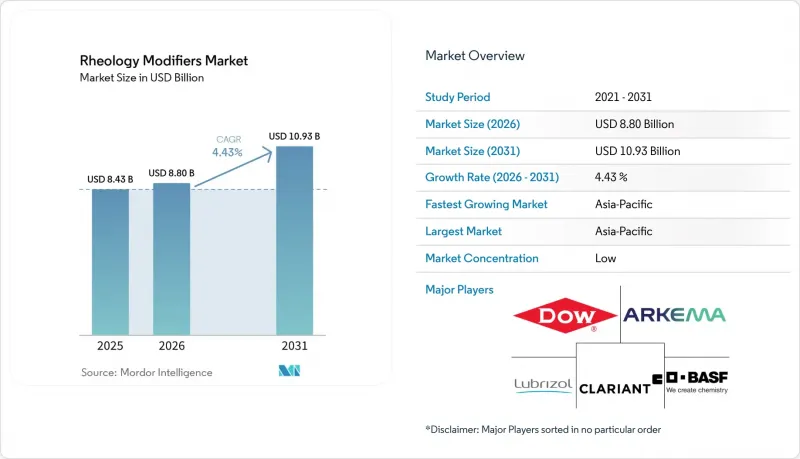
에 따르면 리올로지 개질제 시장 규모는 2025년에 84억 3,000만 달러로 평가되며, 2026년 88억 달러에서 2031년까지 109억 3,000만 달러에 달할 것으로 추정되며, 예측 기간(2026-2031년) 동안 CAGR은 4.43%가 될 전망입니다.
세계 리올로지 개질제 시장의 동향 및 인사이트
저VOC 수성 배합으로의 전환
규제 요건의 변화에 따라 도료에 사용되는 리올로지 개질제에 요구되는 성능 요건도 변화하고 있습니다. 미국 환경보호청(EPA)은 2025년 1월 6일, 에어로졸 도료에 관한 국가 휘발성 유기화합물(VOC) 배출 기준 개정을 최종 확정했습니다. 또한, 미국의 규제 체계에서는 ‘대기정화법’ 제183조(e)항을 통해 건축용 도료에 대해서도 규제가 마련되어 있습니다. 캘리포니아주 사우스코스트 대기질 관리 구역에서는 일부 도료 범주에 대해 1리터당 50그램에 달하는 ‘규칙 1113’의 제한을 적용하고 있습니다. 유럽연합(EU)의 ‘데코페인트 지침’ 및 ‘지속가능성을 위한 화학제품 전략’ 또한 수성 도료 시스템을 권장하고 있습니다. 수성 제품은 고전단 혼합, 온도 변화, 착색제 희석 상황에서도 안정적인 점도를 유지해야 하므로, 리올로지 개질제 시장이 그 혜택을 보고 있습니다.
건설 및 산업 유지보수 분야에서의 페인트·코팅 시장 확대
아시아태평양 전반의 건설 활동은 건축용 및 보호용 코팅에 대한 거대한 수요 기반을 형성하고 있습니다. 인도에서는 2025-26 회계연도에 1,340억 달러 규모의 연방 인프라 예산이 편성되어 교통 및 공공 사업 활동을 지원했습니다. 코팅이 적용되는 각 표면에는 도포 점도의 제어, 흘러내림 방지성, 그리고 적절한 작업 가능 시간이 요구됩니다. 이러한 기능으로 인해 건설 및 산업 유지보수 수요는 레올로지 조절제 시장과 직접적으로 연결되어 있습니다. 산업 자산에 사용되는 보호용 코팅 역시 가혹한 작동 조건 하에서 성능을 발휘해야 합니다.
석유화학, 광물 및 에너지 비용의 변동
리올로지 개질제 생산은 석유화학제품, 광물 및 에너지 투입에 의존합니다. 아크릴산은 알칼리 팽윤성 에멀전(ASE) 및 소수성 개질 알칼리 팽윤성 에멀전(HASE)의 증점제 제조에 사용됩니다. 폴리이소시아네이트는 소수성 개질 에틸렌옥사이드우레탄(HEUR)의 제조에 사용되지만, 유기 점토의 품질은 에너지 집약적인 소성 공정에 좌우됩니다. 원유 가격 및 유럽의 천연가스 가격 상승은 특수 첨가제의 이익률에 즉각적인 압박을 가할 가능성이 있습니다. 건설 업계의 코팅 고객들은 자사의 이익 마진이 제한적이기 때문에 가격 인상에 저항하는 경우가 많습니다. 이로 인해 리올로지 개질제 시장은 가격과 구매 결정 양면에서 단기적인 압박을 받게 될 것입니다.
부문 분석
2025년 기준, 유기계는 리올로지 개질제 시장 규모의 64.23%를 차지하고 있으며, 2031년까지 연평균 성장률(CAGR) 4.86%로 확대될 것으로 예측됩니다. 이 범주에는 셀룰로오스 에테르, 아크릴 코폴리머, 어소시에이티브 폴리우레탄, 천연 검, 그리고 바이오 유래 폴리머가 포함됩니다. 이러한 소재는 탄소계 구조를 활용하여 수상 또는 유상과 상호작용함으로써 점도를 생성합니다. 그 배합 유연성 덕분에 도료, 퍼스널케어, 건축자재, 홈케어 제품 등 폭넓은 분야에서 사용이 가능합니다. 이러한 시장 점유율은 광범위한 점도 및 전단 제어 능력을 갖춘 고분자계 증점제에 대한 오랜 기간의 수요를 반영하고 있습니다. 리올로지 개질제 시장에서는 수성 시스템 및 천연 성분에 대한 수요가 확대됨에 따라 유기 제품이 계속해서 선호되고 있습니다.
무기계 개질제에는 유기 점토, 흄드 실리카, 아타팔자이트, 합성 헥트라이트 등이 포함됩니다. 이들은 고온 용도, 불투명도 부여 및 비수성 시스템에서 여전히 중요한 역할을 하고 있습니다. 배터리용 슬러리와 고고형분 산업용 도료는 무기 재료가 필요한 열적 안정성을 제공하는 주요 용도입니다. 유기계 개질제는 퍼스널케어 분야의 바이오 유래 셀룰로오스 수요와 수성 도료에서의 시너지 증점제 수요에 힘입어 시장 점유율을 확대하고 있습니다. BASF는 2026년 7월, 건축용 도료를 대상으로 바이오매스 균형을 실현한 ‘Rheovis PU 1333 MB’ 및 ‘Rheovis HS 1169 MB’를 출시했습니다. 유변학 개질제 시장은 공급업체들에게 광범위한 유기계 수요와 특수한 무기계 용도 모두에 대응할 수 있는 여지를 제공하고 있습니다.
2025년에는 셀룰로오스계가 31.54%의 점유율을 차지했습니다. 하이드록시에틸셀룰로오스(HEC) 및 카복시메틸셀룰로오스(CMC)는 건축용 도료, 건설용 모르타르 및 퍼스널케어 제품의 배합에 널리 사용되고 있습니다. 이러한 소재는 검증된 성능과 비용 효율성이 뛰어난 점도 제어 기능을 제공합니다. 어소시에이티브 계열은 2031년까지 연평균 성장률(CAGR) 4.98%로 확대될 것으로 예측됩니다. HEUR 및 HASE 제품은 유동성, 평탄성, 붓 및 롤러 도포 작업성, 그리고 피막 형성성을 향상시킬 수 있어 수성 도료 분야에서 채택이 확대되고 있습니다. 이러한 추세는 리올로지 개질제 시장의 수요를 뒷받침하고 있습니다.
아크릴계 화학제품은 ASE 시스템에서의 유연성 덕분에 여전히 중요한 위치를 차지하고 있습니다. 그 성장은 유럽의 미세 플라스틱 규제 및 이와 관련된 배합 재검토 작업으로 인한 압박에 직면해 있습니다. 점토와 흄드 실리카는 배터리용 슬러리 및 고고형분 산업용 도료 분야에서 범위는 좁지만 그 역할을 확대해 나가고 있습니다. 셀룰로오스계 제품은 건설 및 도료 분야에서 신뢰할 수 있는 증점제가 지속적으로 요구됨에 따라 그 입지를 유지하고 있습니다. 또한, 이 부문은 퍼스널케어 및 홈케어용 새로운 바이오 기반 셀룰로오스 유도체로부터도 혜택을 받고 있습니다. 따라서 결합성 폴리머의 채택과 기존 셀룰로오스계 소재의 혁신을 통해 화학 조성의 구성이 변화하고 있습니다.
지역별 분석
아시아태평양은 2025년에 35.70%의 점유율을 차지했으며, 2031년까지 연평균 성장률(CAGR) 5.06%로 확대될 전망입니다. 중국은 대규모 페인트 및 코팅 생산과 건설용 화학제품의 광범위한 소비를 통해 지역 내 수요를 뒷받침하고 있습니다. 일본과 한국은 전자용 흄드 실리카 및 자동차용 코팅 첨가제의 수요를 주도하고 있습니다. 인도는 보호용 및 장식용 코팅 수요가 확대되고 있는 지역입니다. 인도 국도청은 2025-26 회계연도에 인프라 확장을 위해 290억 달러를 지출했습니다. 이로 인해 운송 및 관련 건설 활동에서의 코팅 사용이 촉진되었습니다.
베트남, 인도네시아, 태국을 포함한 아세안(ASEAN) 국가들에서는 산업용 유지보수 도장 분야의 제조 투자 증가에 따라 수요가 확대되고 있습니다. 동남아시아 및 남아시아의 고온 다습한 기후로 인해 안정적인 증점제 성능에 대한 수요가 높아지고 있습니다. 이러한 기후 조건으로 인해 수요는 특수 용도용 관련 등급으로 이동할 가능성이 있습니다. 북미 시장은 휘발성 유기 화합물(VOC) 규제의 영향을 받아 형성된, 성숙하고 기술적으로 고도로 발달한 특징을 가지고 있습니다. 미국 환경보호청(EPA)의 2025년 에어로졸 도료 기준은 해당 지역에서 이미 진행 중인 수성 배합으로의 전환 추세를 더욱 가속화하고 있습니다. 또한, 이 지역에서는 전 세계 퍼스널케어 브랜드를 통해 고품질 바이오 유래 증점제에 대한 수요도 뒷받침되고 있습니다.
유럽에서는 화학제품에 대한 규제와 지속가능성에 대한 우선순위가 높아지면서 제품 선정에 계속해서 영향을 미치고 있습니다. ‘데코페인트 지침’과 ‘지속가능성을 위한 화학제품 전략’은 수성 코팅의 채택을 촉진하고 있습니다. 알케마(Arkema)는 2025년 4월, 유럽 내 아크릴계 증점제 생산 라인을 바이오 유래 원료로 전환했습니다. 남미에서는 브라질과 아르헨티나를 중심으로 건설용 도료 및 퍼스널케어 제품에 대한 수요가 예상됩니다. 중동 및 아프리카의 수요는 걸프 지역의 인프라, 산업용 유지보수용 도료, 그리고 확대되는 건설 활동과 밀접한 관련이 있습니다. 중동의 높은 기온은 열 안정성이 뛰어난 결합형 증점제 및 각 등급의 흄드 실리카의 채택을 촉진하고 있습니다.
기타 혜택:
- 엑셀 형식의 시장 예측(ME) 시트
- 3개월간의 애널리스트 지원
자주 묻는 질문
목차
제1장 소개
- 조사 가정과 시장 정의
- 조사 범위
제2장 조사 방법
제3장 주요 요약
제4장 시장 구도
- 시장 개요
- 시장 성장 촉진요인
- 시장 성장 억제요인
- 밸류체인 분석
- Porter's Five Forces 분석
제5장 시장 규모와 성장 예측
- 유형별
- 화학별
- 형태별
- 용도별
- 지역별
- 아시아태평양
- 중국
- 인도
- 일본
- 한국
- ASEAN 국가
- 기타 아시아태평양 국가
- 북미
- 미국
- 캐나다
- 멕시코
- 유럽
- 독일
- 영국
- 프랑스
- 이탈리아
- 북유럽 국가
- 기타 유럽 국가
- 남미
- 브라질
- 아르헨티나
- 기타 남미 국가
- 중동 및 아프리카
- 사우디아라비아
- 남아프리카공화국
- 기타 중동 및 아프리카 국가
- 아시아태평양
제6장 경쟁 구도
- 시장 집중도
- 전략적 동향
- 시장 점유율·순위 분석
- 기업 개요
- Arkema
- Ashland
- BASF
- BYK-Chemie GmbH
- Cabot Corporation
- Cargill, Incorporated
- CLARIANT
- Croda International Plc
- Dow
- Elementis PLC
- Evonik Industries AG
- LANXESS
- Lubrizol
- Nouryon
- Wacker Chemie AG
제7장 시장 기회와 향후 전망
KSM 26.10.30According to Mordor Intelligence, the rheology modifiers market size was valued at USD 8.43 billion in 2025 and is estimated to grow from USD 8.80 billion in 2026 to reach USD 10.93 billion by 2031, at a CAGR of 4.43% during the forecast period (2026-2031).
Global Rheology Modifiers Market Trends and Insights
Low-VOC Waterborne Formulation Shift
Regulatory requirements are changing the performance needs for rheology modifiers in coatings. The U.S. Environmental Protection Agency finalized amendments to the national volatile organic compound emission standards for aerosol Coatings on January 6, 2025. The U.S. framework also limits architectural coatings through Section 183(e) of the Clean Air Act. California's South Coast Air Quality Management District applies Rule 1113 limits that reach 50 grams per liter for some coating categories. The European Union's Decopaint Directive and its Chemicals Strategy for Sustainability also favor water-based coating systems. The rheology modifiers market benefits because waterborne products require reliable viscosity under high-shear mixing, temperature changes, and colorant dilution.
Expansion of Paints and Coatings in Construction and Industrial Maintenance
Construction activity across the Asia-Pacific region provides a large demand base for architectural and protective coatings. India's USD 134 billion federal infrastructure allocation for 2025-26 supported transport and public works activity. Each coated surface requires controlled application viscosity, sag resistance, and workable open time. These functions link construction and industrial maintenance demand directly to the rheology modifiers market. Protective coatings used on industrial assets also require performance under demanding operating conditions.
Petrochemical, Mineral, and Energy-Cost Volatility
Rheology modifier production depends on petrochemical, mineral, and energy inputs. Acrylic acid is used in alkali-swellable emulsion (ASE) and hydrophobically modified alkali-swellable emulsion (HASE) thickener production. Polyisocyanates are used in Hydrophobically modified Ethylene oxide URethane (HEUR) production, while organoclay quality depends on energy-intensive calcination. Higher crude oil prices or European natural gas costs can quickly pressure specialty additive margins. Coating customers in construction often resist price increases because their own margins are limited. This exposes the rheology modifiers market to short-term pressure on both prices and purchasing decisions.
Other drivers and restraints analyzed in the detailed report include:
- Personal Care Reformulation Toward Sensory and Natural Textures
- Higher-Purity Rheology Control in EV Batteries and Electronics
- Microplastics and Biodegradability Compliance Burden
For complete list of drivers and restraints, kindly check the Table Of Contents.
Segment Analysis
Organic held 64.23% of the rheology modifiers market size in 2025 and is projected to advance at a 4.86% CAGR through 2031. This category includes cellulosic ethers, acrylic copolymers, associative polyurethanes, natural gums, and bio-derived polymers. These materials use carbon-based structures that interact with water or oil phases to build viscosity. Their formulation flexibility supports use across coatings, personal care, construction materials, and home care products. The share reflects long-standing demand for polymer-based thickeners with broad viscosity and shear-control capabilities. The rheology modifiers market continues to favor organic products where waterborne systems and natural ingredient requirements are expanding.
Inorganic modifiers include organoclays, fumed silica, attapulgite, and synthetic hectorite. They remain important for elevated temperature uses, opacity contributions, and non-aqueous systems. Battery slurries and high-solid industrial coatings are key uses where inorganic materials provide the required thermal stability. Organic modifiers are gaining from bio-based cellulose in personal care and associative thickener demand in waterborne coatings. BASF launched biomass-balanced Rheovis PU 1333 MB and Rheovis HS 1169 MB for architectural coatings in July 2026. The rheology modifiers market gives suppliers room to serve both broad organic demand and specialized inorganic applications.
Cellulosic held a 31.54% share in 2025. Hydroxyethyl cellulose (HEC) and carboxymethyl cellulose (CMC) are widely used in architectural paints, construction mortars, and personal care formulations. These materials offer established performance and cost-effective viscosity control. Associative is projected to advance at a 4.98% CAGR through 2031. HEUR and HASE products are gaining in waterborne coatings because they can improve flow, leveling, brush application, roller application, and film formation. This shift supports demand within the rheology modifiers market.
Acrylic chemistry remains important because of its flexibility in ASE systems. Its growth faces pressure from European microplastics requirements and related reformulation work. Clays and fumed silica fill narrower but growing roles in battery slurries and high-solid industrial coatings. Cellulosic products retain their position because construction and coating volumes continue to require dependable thickening. The category also benefits from new bio-based cellulose derivatives for personal care and home care. The chemistry mix is therefore changing through both associative polymer adoption and innovation within established cellulosic materials.
Complete Report Scope:
- By Type
- Organic
- Inorganic
- By Chemistry
- Cellulosic
- Acrylic
- Associative
- Clays
- Fumed Silica
- Other Chemistries
- By Form
- Liquid
- Solid
- By Application
- Paints and Coatings
- Cosmetics and Personal Care
- Adhesives and Sealants
- Inks
- Pharmaceuticals
- Home Care and I&I Products
- Oil and Gas
- Construction
- Other Applications
- By Geography
- Asia-Pacific
- China
- India
- Japan
- South Korea
- ASEAN Countries
- Rest of Asia-Pacific
- North America
- United States
- Canada
- Mexico
- Europe
- Germany
- United Kingdom
- France
- Italy
- NORDIC Countries
- Rest of Europe
- South America
- Brazil
- Argentina
- Rest of South America
- Middle East and Africa
- Saudi Arabia
- South Africa
- Rest of Middle East and Africa
- Asia-Pacific
Geography Analysis
Asia-Pacific held 35.70% share in 2025 and is projected to advance at a 5.06% CAGR through 2031. China supports regional demand through large paint and coatings production and extensive construction chemical consumption. Japan and South Korea add demand for electronics-grade fumed silica and automotive coating additives. India is a growing demand center for protective and decorative coatings. The National Highways Authority of India spent USD 29.0 billion during fiscal 2025-26 on infrastructure expansion. This supported the use of coatings in transport and related construction activities.
ASEAN countries, including Vietnam, Indonesia, and Thailand, add demand as manufacturing investment increases in industrial maintenance painting. High temperatures and humidity in Southeast Asia and South Asia increase the need for stable thickener performance. These climate conditions can shift demand toward specialty associative grades. North America has a mature and technically demanding profile that is shaped by volatile organic compound compliance. The U.S. Environmental Protection Agency's 2025 aerosol coating standards reinforce the region's existing move toward waterborne formulations. The region also supports demand for premium bio-derived thickeners through global personal care brands.
Europe's chemical rules and sustainability priorities continue to influence product selection. The Decopaint Directive and the Chemicals Strategy for Sustainability encourage waterborne coating architectures. Arkema converted its European acrylic thickener lines to bio-sourced inputs in April 2025. South America draws demand from construction coatings and personal care products, led by Brazil and Argentina. The Middle East and Africa demand is linked to Gulf infrastructure, industrial maintenance coatings, and developing construction activity. High ambient temperatures in the Middle East favor thermally stable associative thickeners and fumed silica grades.
- Arkema
- Ashland
- BASF
- BYK-Chemie GmbH
- Cabot Corporation
- Cargill, Incorporated
- CLARIANT
- Croda International Plc
- Dow
- Elementis PLC
- Evonik Industries AG
- LANXESS
- Lubrizol
- Nouryon
- Wacker Chemie AG
Additional Benefits:
- The market estimate (ME) sheet in Excel format
- 3 months of analyst support
TABLE OF CONTENTS
1 Introduction
- 1.1 Study Assumptions and Market Definition
- 1.2 Scope of the Study
2 Research Methodology
3 Executive Summary
4 Market Landscape
- 4.1 Market Overview
- 4.2 Market Drivers
- 4.2.1 Low-VOC Waterborne Formulation Shift
- 4.2.2 Expansion of Paints and Coatings in Construction and Industrial Maintenance
- 4.2.3 Personal Care Reformulation Toward Sensory and Natural Textures
- 4.2.4 Higher-Purity Rheology Control in EV Batteries and Electronics
- 4.2.5 Tropical-Climate Viscosity Stability Requirements
- 4.3 Market Restraints
- 4.3.1 Petrochemical, Mineral, and Energy-Cost Volatility
- 4.3.2 Declining Print Volumes and Conventional Ink Demand
- 4.3.3 Microplastics and Biodegradability Compliance Burden
- 4.4 Value Chain Analysis
- 4.5 Porter's Five Forces Analysis
- 4.5.1 Bargaining Power of Suppliers
- 4.5.2 Bargaining Power of Buyers
- 4.5.3 Threat of New Entrants
- 4.5.4 Threat of Substitutes
- 4.5.5 Competitive Rivalry
5 Market Size and Growth Forecasts (Value)
- 5.1 By Type
- 5.1.1 Organic
- 5.1.2 Inorganic
- 5.2 By Chemistry
- 5.2.1 Cellulosic
- 5.2.2 Acrylic
- 5.2.3 Associative
- 5.2.4 Clays
- 5.2.5 Fumed Silica
- 5.2.6 Other Chemistries
- 5.3 By Form
- 5.3.1 Liquid
- 5.3.2 Solid
- 5.4 By Application
- 5.4.1 Paints and Coatings
- 5.4.2 Cosmetics and Personal Care
- 5.4.3 Adhesives and Sealants
- 5.4.4 Inks
- 5.4.5 Pharmaceuticals
- 5.4.6 Home Care and I&I Products
- 5.4.7 Oil and Gas
- 5.4.8 Construction
- 5.4.9 Other Applications
- 5.5 By Geography
- 5.5.1 Asia-Pacific
- 5.5.1.1 China
- 5.5.1.2 India
- 5.5.1.3 Japan
- 5.5.1.4 South Korea
- 5.5.1.5 ASEAN Countries
- 5.5.1.6 Rest of Asia-Pacific
- 5.5.2 North America
- 5.5.2.1 United States
- 5.5.2.2 Canada
- 5.5.2.3 Mexico
- 5.5.3 Europe
- 5.5.3.1 Germany
- 5.5.3.2 United Kingdom
- 5.5.3.3 France
- 5.5.3.4 Italy
- 5.5.3.5 NORDIC Countries
- 5.5.3.6 Rest of Europe
- 5.5.4 South America
- 5.5.4.1 Brazil
- 5.5.4.2 Argentina
- 5.5.4.3 Rest of South America
- 5.5.5 Middle East and Africa
- 5.5.5.1 Saudi Arabia
- 5.5.5.2 South Africa
- 5.5.5.3 Rest of Middle East and Africa
- 5.5.1 Asia-Pacific
6 Competitive Landscape
- 6.1 Market Concentration
- 6.2 Strategic Moves
- 6.3 Market Share (%)/Ranking Analysis
- 6.4 Company Profiles (includes Global Overview, Market Overview, Core Segments, Financials as available, Strategic Information, Products and Services, and Recent Developments)
- 6.4.1 Arkema
- 6.4.2 Ashland
- 6.4.3 BASF
- 6.4.4 BYK-Chemie GmbH
- 6.4.5 Cabot Corporation
- 6.4.6 Cargill, Incorporated
- 6.4.7 CLARIANT
- 6.4.8 Croda International Plc
- 6.4.9 Dow
- 6.4.10 Elementis PLC
- 6.4.11 Evonik Industries AG
- 6.4.12 LANXESS
- 6.4.13 Lubrizol
- 6.4.14 Nouryon
- 6.4.15 Wacker Chemie AG
7 Market Opportunities and Future Outlook
- 7.1 White-Space and Unmet-Need Assessment


