
|
시장보고서
상품코드
2119340
통신 클라우드 관리형 서비스 : 시장 점유율 분석, 업계 동향 및 통계, 성장 예측(2026-2031년)Telco Cloud Managed Services - Market Share Analysis, Industry Trends & Statistics, Growth Forecasts (2026 - 2031) |
||||||
 Mordor Intelligence
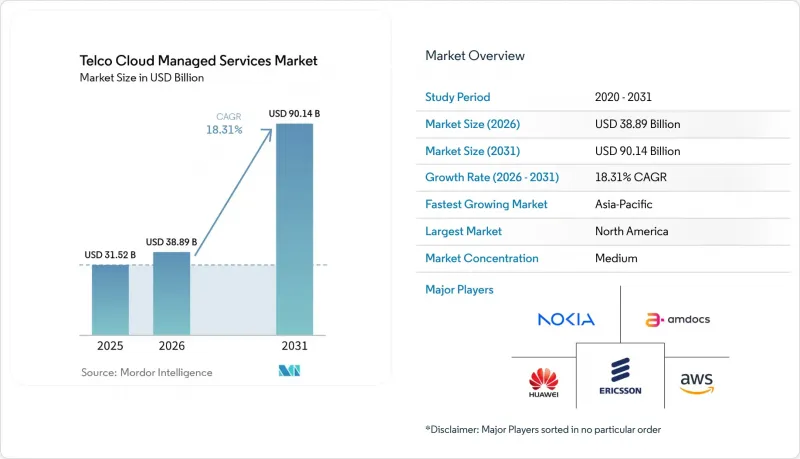
Mordor Intelligence에 의하면, 통신 클라우드 관리형 서비스 시장 규모는 2025년에 315억 2,000만 달러로 평가되었습니다. 2026년 388억 9,000만 달러에서 2031년까지 901억 4,000만 달러에 이를 것으로 예측되며, 2026년부터 2031년까지 CAGR은 18.31%를 나타낼 전망입니다.
본 보고서는 관리형 서비스의 유형(네트워크 서비스 등), 배포 모델(퍼블릭 클라우드 등), 클라우드 서비스 모델(Network as a Service 등), NFV 소프트웨어(오케스트레이션 및 라이프사이클 관리 등), 용도(프라이빗 5G 등), 기업 규모(대기업 및 중소기업), 그리고 지역별로 분류되어 있습니다. 시장 예측은 금액(달러) 기준으로 제시됩니다.
세계의 통신 클라우드 관리형 서비스 시장 동향 및 인사이트
5G 독립형(SA) 및 클라우드 네이티브 네트워크의 구축
5G 독립형(Standalone)의 도입이 시험 단계에서 본격적인 운영 단계로 전환됨에 따라, 통신 클라우드 관리형 서비스 시장은 그 혜택을 누리고 있습니다. NTT 도코모는 2026년 3월, 하이브리드 AWS 환경에서 상용 5G 코어 서비스를 시작했습니다. 이 회사는 에이전트형 AI를 활용하여 도입 시간을 80%, 사고 대응 시간을 50% 단축했습니다. 이 도입 사례는 생산 환경의 클라우드 코어가 엔지니어링, 모니터링 및 사고 관리에 대한 지속적인 요구 사항을 창출하고 있음을 보여줍니다. O2 텔레포니카 역시 자사 데이터센터 내의 AWS Outposts로 프로덕션 규모의 5G 코어 기능을 마이그레이션하여, 클라우드의 확장성과 온사이트 데이터 관리 기능을 결합했습니다. ETSI 표준은 멀티 벤더 클라우드 환경 전반에서 작동하는 네트워크 기능에 대해 공통의 상호 운용성 프레임워크를 제공합니다. 이러한 상황으로 인해 네트워크의 전체 수명 주기에 걸쳐 기술 운영을 관리할 수 있는 제공업체에 대한 수요가 증가하고 있습니다.
하이브리드 및 멀티 클라우드 운영에 대한 기업 수요
기업 고객들은 통신 사업자가 단일 운영 모델을 통해 연결성, 엣지 용량, 클라우드 리소스 및 보안을 조정해 줄 것을 점점 더 기대하고 있습니다. GSMA는 2025년에 통신 사업자가 클라우드 및 보안 서비스를 연결 서비스에 통합함으로써 기업용 기술 서비스 지출 중 약 1조 달러에 달하는 부분을 담당할 수 있을 것이라고 밝혔습니다. 통신 클라우드 관리형 서비스 시장은 서비스 제공업체가 하이브리드 운영을 개별 벤더별로 고객이 직접 통합하도록 하는 대신 관리형 서비스로 패키지화함으로써 확대되고 있습니다. Network as a Service(NaaS) 플랫폼은 네트워크 성능을 보다 광범위한 서비스 제공과 연계할 수 있으므로 이러한 접근 방식을 뒷받침합니다. 또한, 유럽의 규정 준수 요건에서는 기업이 멀티 클라우드의 위험을 문서화할 것을 요구하고 있어, 이로 인해 명확한 운영상 책임 체계를 갖춘 매니지드 아키텍처의 가치가 높아지고 있습니다. 그 결과, 기반이 되는 네트워크와 분리하지 않고 클라우드 운영을 관리할 수 있는 제공업체의 역할이 더욱 중요해지고 있습니다.
레거시 네트워크 통합의 복잡성
통신 클라우드 관리형 서비스 시장은 많은 통신 사업자가 가상 네트워크 기능과 클라우드 네이티브 네트워크 기능을 동시에 운영해야 한다는 제약에 직면해 있습니다. 이러한 혼합 환경은 서비스 범위, 데이터 흐름 및 네트워크 운영의 조정을 복잡하게 만들고 있습니다. 또한, 많은 통신 사업자는 기존의 데이터 도구나 모놀리식 운영 시스템을 계속 보유하고 있어, 이로 인해 실시간 자동화가 더욱 어려워지고 있습니다. 제공업체는 관리형 서비스의 운영 모델을 정의하기 전에 OSS, BSS 및 기업 자원 계획(ERP)과의 연동을 재검토해야 합니다. 고객의 환경이 고도로 맞춤화된 경우, 이러한 작업으로 인해 협상 기간이 길어지고 도입이 지연될 가능성이 있습니다. 또한, 이러한 통합의 부담은 강력한 혁신 역량과 시스템 통합 역량을 갖춘 제공업체에게 유리하게 작용합니다.
부문 분석
2025년, 네트워크 서비스는 통신 클라우드 관리형 서비스 시장 점유율의 20.22%를 차지하며 가장 큰 관리형 서비스 유형이 되었습니다. 이러한 위상은 네트워크 환경이 복잡해짐에 따라, 연결 라이프사이클 관리에서 사업자가 외부 지원에 의존하고 있는 상황을 반영합니다. 클라우드 인프라 서비스는 2026년부터 2031년까지 연평균 성장률(CAGR) 18.46%를 나타낼 것으로 예측됩니다. 이러한 성장은 서비스 제공업체가 인프라를 완전히 소유하기보다는 이용하는 인프라 플랫폼으로의 전환에 기인합니다. 또한, 공급업체가 네트워크 관리와 보안 관리를 하나의 서비스로 통합함에 따라 보안 서비스의 중요성이 높아지고 있습니다. 데이터센터 및 백업 서비스는 분산된 시스템을 중앙 관리 하에 통합하려는 통신 사업자를 지원하고 있습니다.
멀티 클라우드 환경에서는 인프라 계층과 네트워크 계층 전반에 걸친 가시성이 요구되므로, 오케스트레이션 및 서비스 보증 분야가 확대되고 있습니다. 또한, OSS 및 BSS 환경 현대화에 필요한 작업으로 인해 전문 서비스 및 지원 서비스도 혜택을 보고 있습니다. Amdocs와 Lumen Technologies는 2026년 8월, aOS 운영 체제를 활용하여 AWS, Google Cloud, Microsoft Azure에 걸친 관리형 서비스 제휴를 확대했습니다. 이 합의는 단일 프로그램으로 오케스트레이션, 주문 관리, 네트워크 운영 및 변혁 서비스를 포괄할 수 있음을 보여줍니다. ETSI의 NFV 아키텍처는 이러한 서비스 영역 전반에 걸친 상호 운용성에 대한 표준 참조 기준을 제공합니다. 따라서 통신 사업자 대상 클라우드 관리형 서비스 업계는 운영과 변혁의 책임을 결합한 보다 광범위한 계약으로 전환되고 있습니다.
2025년, 프라이빗 클라우드는 도입 모델 부문의 71.56%를 차지했습니다. 이러한 우위는 주로 기밀성이 높은 네트워크 기능에서 공유 퍼블릭 클라우드 용량 사용을 제한하는 데이터 상주 요건과 관련이 있습니다. 하이브리드 클라우드는 2026년부터 2031년까지 연평균 성장률(CAGR) 19.01%를 나타낼 것으로 예측됩니다. 통신 사업자들은 이 모델을 활용하여 규제 대상 워크로드를 자사가 관리하는 환경에 유지하면서, 탄력적인 컴퓨팅 작업은 클라우드 리전에 배치하고 있습니다. O2 Telefonica가 AWS Outposts에서 수행한 5G 코어 프로덕션 배포에서는 자사 데이터센터 내에서 이러한 접근 방식을 채택했습니다. 통신 클라우드 관리형 서비스 시장에서는 이러한 하이브리드 설계의 양측면을 모두 운영할 수 있는 제공업체가 요구되고 있습니다.
퍼블릭 클라우드는 독자적인 클라우드 인프라에 자금을 투자할 수 없는 소규모 통신 사업자에게 점점 더 중요해지고 있습니다. Citymesh는 2026년 2월, 노키아 및 AWS와 제휴하여 공항, 병원, 행사장 등의 기업 사용자를 대상으로 상용 5G 코어 SaaS 서비스를 시작했습니다. 분산형 클라우드 및 엣지 클라우드는 분산형 시설, 클라우드 네이티브 소프트웨어, 그리고 로컬 하드웨어에 의존하기 때문에 도입까지의 과정이 길어집니다. 이러한 모델은 용도이 사용자당에서 컴퓨팅 리소스를 필요로 하는 배포에 적합합니다. 또한, 운영 작업을 소수의 중앙 사이트에 집중시키는 대신 여러 거점에 분산시킵니다. 통신 클라우드 관리형 서비스 시장은 원격 관리, 라이프사이클 지원 및 현지 서비스 보증을 통해 이러한 복잡성을 해결할 수 있습니다.
지역별 분석
2025년, 북미는 통신 클라우드 관리형 서비스 시장 점유율의 37.45%를 차지했습니다. 이 지역에는 하이퍼스케일러의 탄탄한 인프라와 통신 사업자의 성숙한 클라우드 전환 프로그램이 존재합니다. 미국 내 지방 지역의 5G 광대역에 대한 자금 투입으로 인해 관리 서비스에 대한 수요는 주요 대도시권을 넘어 확대되고 있으며, 통신 사업자의 기술 자원이 제한적인 지역에서도 수요가 발생하고 있습니다. 멕시코에서는 모바일 네트워크 현대화가 진행 중이며, 지역 통신 사업자들은 예산 제약 속에서 5G 구축을 추진할 파트너를 모색하고 있습니다. 캐나다에서도 통신 사업자들이 클라우드 및 관리형 서비스 프로그램을 확대함에 따라 수요가 증가하고 있습니다.
아시아태평양은 2026년부터 2031년까지 연평균 성장률(CAGR) 18.51%를 나타낼 것으로 예측됩니다. 일본은 이 성장의 주요 견인차로, NTT 도코모가 AWS를 활용한 하이브리드 5G 코어 네트워크를 도입함으로써 9,100만 명 이상의 가입자에게 서비스를 제공합니다. 한국에서는 제조업용 용도를 위한 프라이빗 5G 관리형 서비스가 확대되고 있습니다. 한편, 인도에서는 관리형 서비스가 Tier 1 통신 사업자 이외의 기업 대상 수직 시장으로 진출함에 따라 성장 기회가 창출되고 있습니다. 중국의 클라우드 네이티브 통신 요건 및 MEC 엣지 클라우드 규격은 클라우드 네이티브 관리형 서비스 투자를 위한 공식적인 프레임워크를 제공합니다. 지역 공급업체들이 보다 체계적인 도입 지원을 필요로 함에 따라, 통신 클라우드 관리형 서비스 시장이 혜택을 보고 있습니다.
유럽 시장은 독일, 영국, 프랑스에 의해 주도되고 있으며, 이들 국가에서는 개인정보 보호 및 사이버 보안 요구 사항이 서비스 설계에 영향을 미치고 있습니다. 유럽연합 집행위원회의 ‘클라우드 주권 프레임워크’는 주권 클라우드 조달 요구 사항 수립을 지원하고 있습니다. 도이치 텔레콤이 Google Cloud 상에서 운영하는 소버린 플랫폼은 외부 키 관리를 통해 통화 상세 기록 및 네트워크 텔레메트리 데이터를 보호하는 방법을 보여주고 있습니다. 남미, 중동 및 아프리카는 통신 클라우드 관리형 서비스 시장에서 장기적인 성장이 예상되는 지역이며, 브라질,사우디아라비아, 남아프리카공화국이 주요 기여국으로 꼽힙니다. 5G 경쟁에서 요구되는 속도로 클라우드 네이티브 전환에 필요한 자금을 지역 통신 사업자가 조달하지 못할 경우, 아웃소싱은 특히 효과적인 수단이 됩니다.
기타 혜택 :
- 엑셀 형식 시장 예측(ME) 시트
- 3개월간의 애널리스트 지원
자주 묻는 질문
목차
제1장 서론
제2장 조사 방법
제3장 주요 요약
제4장 시장 구도
제5장 시장 규모 및 성장 예측
제6장 경쟁 구도
제7장 시장 기회 및 향후 전망
KTH 26.09.10According to Mordor Intelligence, the telco cloud managed services market size was valued at USD 31.52 billion in 2025 and is estimated to grow from USD 38.89 billion in 2026 to reach USD 90.14 billion by 2031, at a CAGR of 18.31% during the forecast period 2026-2031.
This report is Segmented by Managed Service Type (Network Services, and More), Deployment Model (Public Cloud, and More), Cloud Service Model (Network As A Service, and More), NFV Software (Orchestration and Lifecycle Management, and More), Application (Private 5G, and More), Enterprise Size (Large Enterprises, and SMEs), and Geography. The Market Forecasts are Provided in Terms of Value (USD).
Global Telco Cloud Managed Services Market Trends and Insights
5G Standalone And Cloud-Native Network Rollouts
The Telco cloud managed services market benefits as 5G Standalone deployments move from trials into production operations. NTT DOCOMO launched commercial 5G Core services on a hybrid AWS environment in March 2026, using agentic AI to cut deployment time by 80% and incident-response time by 50%. The deployment shows that production cloud cores create continuing requirements for engineering, monitoring, and incident management. O2 Telefonica also moved production-scale 5G core functions to AWS Outposts in its own data center, combining cloud scalability with onsite data controls. ETSI standards provide a shared interoperability framework for network functions that run across multi-vendor cloud environments. ETSI These conditions increase demand for providers that can manage technical operations through the full network lifecycle.
Enterprise Demand For Hybrid And Multi-Cloud Operations
Enterprise customers increasingly expect telecommunications providers to coordinate connectivity, edge capacity, cloud resources, and security through a single operating model. The GSMA stated in 2025 that operators could address close to USD 1 trillion of enterprise technology-services spending by embedding cloud and security services into connectivity offerings. The Telco cloud managed services market gains where service providers package hybrid operations as a managed offering rather than leaving customers to integrate separate vendors. Network as a Service platforms support that approach because they can link network performance to broader service delivery. European compliance obligations also require enterprises to document multi-cloud risks, which raises the value of managed architectures with clear operational accountability. The result is a larger role for providers that can manage cloud operations without separating them from the underlying network.
Legacy Network Integration Complexity
The Telco cloud managed services market faces a constraint because many operators must run virtual and cloud-native network functions at the same time. This mixed environment complicates service scope, data flows, and the coordination of network operations. Many communications providers also retain traditional data tools and monolithic operational systems, which makes real-time automation more difficult. Providers must review OSS, BSS, and enterprise resource planning connections before defining a managed-services operating model. That work can lengthen negotiations and delay implementation where the customer estate is highly customized. The integration burden also favors providers with strong transformation and systems-integration capabilities.
Other drivers and restraints analyzed in the detailed report include:
- AI-Enabled Network Automation And Predictive Operations
- Edge Computing And Low-Latency Workloads
- Data Sovereignty And Cross-Border Compliance Costs
For complete list of drivers and restraints, kindly check the Table Of Contents.
Segment Analysis
Network Services held 20.22% of the Telco cloud managed services market share in 2025, making it the largest managed-service type. The position reflects operators' dependence on external support for connectivity lifecycle management as network estates become more complex. Cloud Infrastructure Services is forecast to grow at a 18.46% CAGR from 2026 to 2031. This growth follows the shift toward infrastructure platforms that service providers consume instead of fully owning. Security Services are also becoming more relevant as suppliers bundle network and security management into one offering. Data Center and Backup Services support operators that are consolidating distributed systems under centralized management.
Orchestration and Service Assurance are expanding because multi-cloud environments require visibility across infrastructure and network layers. Professional and Support Services also benefit from the work needed to modernize OSS and BSS environments. Amdocs and Lumen Technologies extended their managed-services collaboration in August 2026 across AWS, Google Cloud, and Microsoft Azure using the aOS operating system.The agreement illustrates how a single program can cover orchestration, order management, network operations, and transformation services. ETSI's NFV architecture provides a standards reference for interoperability across those service areas. ETSI The Telco cloud managed services industry is therefore moving toward broader contracts that combine operational and transformation responsibilities.
Private Cloud accounted for 71.56% of the deployment-model segment in 2025. Its lead is primarily related to data-residency obligations that limit the use of shared public-cloud capacity for sensitive network functions. Hybrid Cloud is forecast to grow at a 19.01% CAGR from 2026 to 2031. Operators use this model to retain regulated workloads in sovereign environments while placing elastic computing tasks in cloud regions. O2 Telefonica's production 5G core deployment on AWS Outposts used this approach within its own data center. The Telco cloud managed services market needs providers that can operate both sides of this hybrid design.
Public Cloud is becoming more relevant for smaller operators that cannot finance proprietary cloud infrastructure. Citymesh launched a commercial 5G Core SaaS service in February 2026 with Nokia and AWS for enterprise users at airports, hospitals, and venues. Distributed and Edge Cloud have a longer implementation path because they depend on distributed facilities, cloud-native software, and local hardware. These models are suited to deployments where applications need computing resources close to the user. They also add operational tasks across many locations rather than concentrating them in a few central sites. The Telco cloud managed services market can address this complexity through remote management, lifecycle support, and localized service assurance.
Complete Report Scope:
- By Managed Service Type
- Network Services
- Cloud Infrastructure Services
- Security Services
- Data Center and Backup Services
- Orchestration and Service Assurance
- Professional and Support Services
- By Deployment Model
- Public Cloud
- Private Cloud
- Hybrid Cloud
- Distributed and Edge Cloud
- By Cloud Service Model
- Infrastructure as a Service
- Platform as a Service
- Software as a Service
- Network as a Service
- By NFV Software
- Virtual Network Functions and Cloud-Native Network Functions
- Network Functions Virtualization Infrastructure
- Orchestration and Lifecycle Management
- Policy, Assurance, and Analytics Software
- By Application
- Network, Data Storage, and Computing
- Traffic Management and Service Assurance
- Cloud Migration and Transformation
- Cybersecurity and Secure Access Service Edge
- Private 5G and Industry Connectivity
- Edge Computing and IoT Operations
- By Enterprise Size
- Large Enterprises
- Small and Medium-Sized Enterprises
- By Geography
- North America
- United States
- Canada
- Mexico
- South America
- Brazil
- Argentina
- Rest of South America
- Europe
- Germany
- United Kingdom
- France
- Russia
- Rest of Europe
- Asia-Pacific
- China
- Japan
- India
- South Korea
- Australia
- Rest of Asia-Pacific
- Middle East
- Saudi Arabia
- United Arab Emirates
- Turkey
- Rest of Middle East
- Africa
- South Africa
- Nigeria
- Kenya
- Rest of Africa
- North America
Geography Analysis
North America accounted for 37.45% of the Telco cloud managed services market share in 2025. The region has deep hyperscaler infrastructure and mature operator cloud-transformation programs. U.S. funding for rural 5G broadband is extending managed service needs beyond major metropolitan locations, creating demand in regions where operators have limited engineering resources. Mexico is undergoing mobile-network modernization, and regional operators are seeking partners to advance 5G deployment within capital constraints. Canada also adds growing demand as operators broaden their cloud and managed-service programs.
Asia-Pacific is forecast to advance at an 18.51% CAGR from 2026 to 2031. Japan is a key contributor, with NTT DOCOMO's hybrid AWS 5G Core deployment serving more than 91 million subscribers. South Korea is expanding private 5G managed services for manufacturing applications, while India presents a growth opportunity as managed services move into enterprise verticals beyond tier-1 operators. China's cloud-native telecommunications requirements and MEC edge-cloud standard provide formal frameworks for cloud-native managed-service investment. The Telco cloud managed services market benefits as regional providers need support with more structured deployments.
Europe is shaped by Germany, the United Kingdom, and France, where privacy and cybersecurity requirements influence service design. The European Commission's Cloud Sovereignty Framework supports the development of sovereign cloud procurement requirements. Deutsche Telekom's sovereign platform on Google Cloud shows how external key management can protect call-detail records and network telemetry. South America, the Middle East, and Africa are longer-term areas for the Telco cloud managed services market, with Brazil, Saudi Arabia, and South Africa as the primary contributors. Outsourcing is especially relevant where regional operators cannot fund cloud-native transformations at the speed required by 5G competition.
- Amazon Web Services, Inc.
- Microsoft Corporation
- Google LLC
- International Business Machines Corporation
- Telefonaktiebolaget LM Ericsson
- Nokia Corporation
- Huawei Technologies Co., Ltd.
- Cisco Systems, Inc.
- Oracle Corporation
- Broadcom Inc.
- Hewlett Packard Enterprise Company
- Rakuten Symphony, Inc
- ZTE Corporation
- Amdocs Limited
- Mavenir Systems, Inc.
- Wind River Systems, Inc.
- Red Hat, Inc.
- Accenture plc
- Capgemini SE
- Tata Consultancy Services Limited
- NTT DATA Corporation
- Tech Mahindra Limited
Additional Benefits:
- The market estimate (ME) sheet in Excel format
- 3 months of analyst support
TABLE OF CONTENTS
1 INTRODUCTION
- 1.1 Study Assumptions and Market Definition
- 1.2 Scope of the Study
2 RESEARCH METHODOLOGY
3 EXECUTIVE SUMMARY
4 MARKET LANDSCAPE
- 4.1 Market Overview
- 4.2 Impact of Macroeconomic Factors on the Market
- 4.3 Market Drivers
- 4.3.1 5G Standalone and Cloud-Native Network Rollouts
- 4.3.2 Enterprise Demand for Hybrid and Multi-Cloud Operations
- 4.3.3 AI-Enabled Network Automation and Predictive Operations
- 4.3.4 Edge Computing and Low-Latency Workloads
- 4.3.5 Open RAN and Network Function Virtualization Adoption
- 4.3.6 Telco Cloud Operating-Model Outsourcing by Capacity-Constrained CSPs
- 4.4 Market Restraints
- 4.4.1 Legacy Network Integration Complexity
- 4.4.2 Data Sovereignty and Cross-Border Compliance Costs
- 4.4.3 Multi-Vendor Interoperability and Portability Gaps
- 4.4.4 Shortage of Cloud-Native Telecom Engineering Talent
- 4.5 Industry Value Chain Analysis
- 4.6 Regulatory Landscape
- 4.7 Technological Outlook
- 4.8 Porter's Five Forces Analysis
- 4.8.1 Threat of New Entrants
- 4.8.2 Bargaining Power of Suppliers
- 4.8.3 Bargaining Power of Buyers
- 4.8.4 Threat of Substitutes
- 4.8.5 Competitive Rivalry
5 MARKET SIZE AND GROWTH FORECASTS (VALUE)
- 5.1 By Managed Service Type
- 5.1.1 Network Services
- 5.1.2 Cloud Infrastructure Services
- 5.1.3 Security Services
- 5.1.4 Data Center and Backup Services
- 5.1.5 Orchestration and Service Assurance
- 5.1.6 Professional and Support Services
- 5.2 By Deployment Model
- 5.2.1 Public Cloud
- 5.2.2 Private Cloud
- 5.2.3 Hybrid Cloud
- 5.2.4 Distributed and Edge Cloud
- 5.3 By Cloud Service Model
- 5.3.1 Infrastructure as a Service
- 5.3.2 Platform as a Service
- 5.3.3 Software as a Service
- 5.3.4 Network as a Service
- 5.4 By NFV Software
- 5.4.1 Virtual Network Functions and Cloud-Native Network Functions
- 5.4.2 Network Functions Virtualization Infrastructure
- 5.4.3 Orchestration and Lifecycle Management
- 5.4.4 Policy, Assurance, and Analytics Software
- 5.5 By Application
- 5.5.1 Network, Data Storage, and Computing
- 5.5.2 Traffic Management and Service Assurance
- 5.5.3 Cloud Migration and Transformation
- 5.5.4 Cybersecurity and Secure Access Service Edge
- 5.5.5 Private 5G and Industry Connectivity
- 5.5.6 Edge Computing and IoT Operations
- 5.6 By Enterprise Size
- 5.6.1 Large Enterprises
- 5.6.2 Small and Medium-Sized Enterprises
- 5.7 By Geography
- 5.7.1 North America
- 5.7.1.1 United States
- 5.7.1.2 Canada
- 5.7.1.3 Mexico
- 5.7.2 South America
- 5.7.2.1 Brazil
- 5.7.2.2 Argentina
- 5.7.2.3 Rest of South America
- 5.7.3 Europe
- 5.7.3.1 Germany
- 5.7.3.2 United Kingdom
- 5.7.3.3 France
- 5.7.3.4 Russia
- 5.7.3.5 Rest of Europe
- 5.7.4 Asia-Pacific
- 5.7.4.1 China
- 5.7.4.2 Japan
- 5.7.4.3 India
- 5.7.4.4 South Korea
- 5.7.4.5 Australia
- 5.7.4.6 Rest of Asia-Pacific
- 5.7.5 Middle East
- 5.7.5.1 Saudi Arabia
- 5.7.5.2 United Arab Emirates
- 5.7.5.3 Turkey
- 5.7.5.4 Rest of Middle East
- 5.7.6 Africa
- 5.7.6.1 South Africa
- 5.7.6.2 Nigeria
- 5.7.6.3 Kenya
- 5.7.6.4 Rest of Africa
- 5.7.1 North America
6 COMPETITIVE LANDSCAPE
- 6.1 Market Concentration
- 6.2 Strategic Moves
- 6.3 Market Share Analysis
- 6.4 Company Profiles (includes Global Level Overview, Market Level Overview, Core Segments, Financials as available, Strategic Information, Market Rank/Share, Products and Services, Recent Developments)
- 6.4.1 Amazon Web Services, Inc.
- 6.4.2 Microsoft Corporation
- 6.4.3 Google LLC
- 6.4.4 International Business Machines Corporation
- 6.4.5 Telefonaktiebolaget LM Ericsson
- 6.4.6 Nokia Corporation
- 6.4.7 Huawei Technologies Co., Ltd.
- 6.4.8 Cisco Systems, Inc.
- 6.4.9 Oracle Corporation
- 6.4.10 Broadcom Inc.
- 6.4.11 Hewlett Packard Enterprise Company
- 6.4.12 Rakuten Symphony, Inc
- 6.4.13 ZTE Corporation
- 6.4.14 Amdocs Limited
- 6.4.15 Mavenir Systems, Inc.
- 6.4.16 Wind River Systems, Inc.
- 6.4.17 Red Hat, Inc.
- 6.4.18 Accenture plc
- 6.4.19 Capgemini SE
- 6.4.20 Tata Consultancy Services Limited
- 6.4.21 NTT DATA Corporation
- 6.4.22 Tech Mahindra Limited
7 MARKET OPPORTUNITIES AND FUTURE OUTLOOK
- 7.1 White-Space and Unmet-Need Assessment