
|
시장보고서
상품코드
2122818
클라우드 관리형 서비스 시장 : 시장 점유율 분석, 업계 동향 및 통계, 성장 예측(2026-2031년)Cloud Managed Services - Market Share Analysis, Industry Trends & Statistics, Growth Forecasts (2026 - 2031) |
||||||
 Mordor Intelligence
Mordor Intelligence에 의하면, 클라우드 관리형 서비스 시장 규모는 2025년에 1,409억 6,000만 달러로 평가되었고, 2026년 1,540억 8,000만 달러에서 2031년까지 2,403억 9,000만 달러에 이를 것으로 예측되며, 예측 기간(2026-2031년) CAGR은 9.31%를 나타낼 전망입니다.
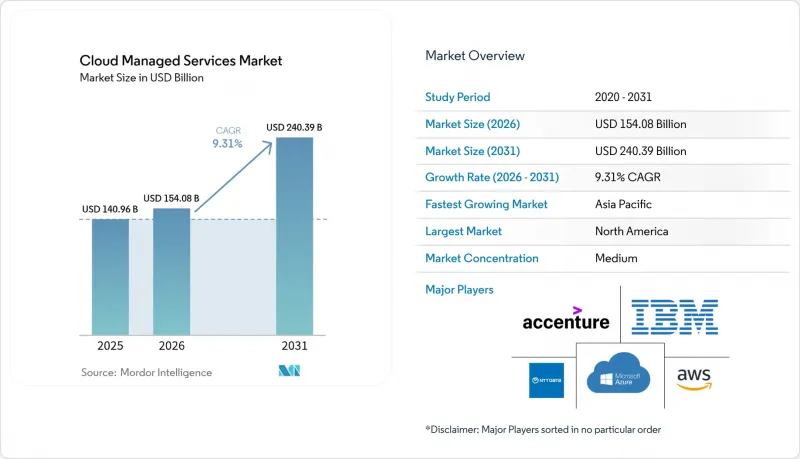
본 보고서는 서비스 유형별(관리형 인프라 서비스, 관리형 네트워크 서비스 등), 도입 형태별(퍼블릭 클라우드, 프라이빗 클라우드, 하이브리드 클라우드), 기업 규모별(대기업 및 중소기업), 최종 사용자 산업별(은행, 금융서비스 및 보험(BFSI), IT 및 통신, 소매 및 전자상거래 등), 그리고 지역별로 분류되어 있습니다. 시장 예측은 금액(달러) 기준으로 제시되어 있습니다.
세계의 클라우드 관리형 서비스 시장 동향 및 인사이트
BFSI 부문의 ‘디지털 퍼스트’ 정책이 아웃소싱을 가속화
은행과 보험사는 현재 관리형 클라우드 서비스를 현대화 로드맵의 핵심으로 삼고 있으며, 이것이 클라우드 관리형 서비스 시장의 성장을 견인하고 있습니다. 2024년 4월, 타타 컨설팅 서비스(TCS)는 AWS와의 제휴를 확대하고, 은행을 위한 클라우드 현대화 패턴에 대해 2만 5,000명의 엔지니어를 양성하겠다고 약속했습니다. 금융 기관들은 생성형 AI 도입, 규정 준수 점검 자동화, 제품 출시 주기 단축을 실현하기 위한 유일한 현실적인 수단으로 외부 파트너를 꼽고 있습니다. 하이브리드 환경 도입을 통해 차세대 코어 시스템과 레거시 플랫폼을 공존시킬 수 있게 되어 운영 위험을 줄일 수 있습니다. 아시아태평양의 은행들은 특히 두드러지는데, 고객 경험 개선이 최우선 과제로 떠오르면서 클라우드 현대화에 할당되는 예산이 비용 절감 목표를 상회하고 있습니다.
기업 내 멀티클라우드 및 하이브리드 환경의 복잡성이 급증
하이브리드 및 멀티 클라우드 도입은 주류가 되었지만, 사내에서 크로스 플랫폼 오케스트레이션을 숙달한 기업은 극소수에 불과합니다. VMware의 보고서에 따르면, 해당 기업의 고객 중 93%가 하이브리드 아키텍처를 장기적으로 유지할 의향을 나타냈습니다. 또한 Nutanix의 조사에 따르면, 2024년에 기업의 95%가 보안 강화 및 혁신 가속화를 목적으로 클라우드 간 용도를 마이그레이션한 것으로 나타났습니다. 그 결과, 전체 클라우드 환경에 걸친 통합 가시성, 워크로드 자동 배치, 비용 거버넌스를 제공하는 파트너에 대한 수요가 급증하고 있으며, 이는 클라우드 관리형 서비스 시장의 추가 성장을 견인하고 있습니다.
끊임없이 이어지는 데이터 유출에 대한 우려와 진화하는 위협 상황
영국의 조사에 따르면, 많은 중소기업은 유연성이나 비용 측면의 이점을 인식하고 있음에도 불구하고 보안상의 취약점을 우려하여 클라우드 이전을 미루고 있습니다. 규정 준수 감사 및 고객 신뢰가 큰 부담으로 작용하고 있어, 엄격한 인증이나 사고 대응 지표를 제시할 수 없는 공급업체의 경우 계약 체결까지의 기간이 길어지고 있습니다.
부문 분석
관리형 인프라 서비스는 계속해서 기반이 되는 프로비저닝을 제공하며, 2025년 매출의 36.92%를 차지하고 있습니다. 반면, 기업들이 지속적인 위협 감지, 제로 트러스트의 철저한 이행, 규정 준수 보고를 우선시함에 따라 관리형 보안 서비스는 연평균 성장률(CAGR) 10.52%로 더 빠르게 성장하고 있습니다. 따라서 관리형 보안 분야의 클라우드 관리형 서비스 시장 규모는 다른 대부분의 부문을 능가하는 속도로 확대될 전망입니다. VikingCloud 플랫폼과 같이 매일 수십억 건의 이벤트를 분석하는 AI 기반 보안 운영 센터는 공격 체류 시간을 단축하고 상관 분석을 자동화함으로써 공급자의 경쟁 우위를 강화합니다. 네트워크, 용도, 백업, 재해 복구 서비스는 복잡한 현대화 프로젝트와 레거시 시스템 지원을 담당하며 안정적인 성장을 유지하고 있습니다.
서비스 제공업체들이 보안을 인프라 및 네트워크 모니터링과 결합하여 전환 비용을 높이는 통합 플랫폼을 구축함에 따라, 그 파급 효과가 클라우드 관리형 서비스 업계 전반으로 확산되고 있습니다. 기업의 구매 담당자들은 통합 대시보드, 일관된 SLA, 멀티 클라우드 환경 전반에 걸친 단일 창을 통한 거버넌스 등의 기능을 중요하게 여기고 있지만, 이러한 기능들은 독립적인 포인트 솔루션으로는 대응하기 어렵습니다.
퍼블릭 클라우드는 하이퍼스케일 가용성 영역과 풍부한 네이티브 도구의 지원을 받아 2025년에도 클라우드 관리형 서비스 시장 점유율 51.42%를 유지했습니다. 한편, 하이브리드 모델은 고객이 지연 시간 제어, 데이터 상주 요건, 비용 최적화의 이점을 추구함에 따라 연평균 성장률(CAGR) 11.23%로 확대되고 있습니다. 노무라 종합연구소의 AWS Outposts 도입을 통해 일본 은행들은 주권 규제를 충족하기 위해 On-Premise에서 AWS 서비스를 실행할 수 있게 되었습니다. 에퀴닉스 재팬과 사쿠라 인터넷의 제휴는 코로케이션 및 GPU 지원 서비스가 AI 워크로드에서 퍼블릭 클라우드의 경제성과 프라이빗 클라우드의 관리성을 어떻게 융합하고 있는지를 보여줍니다. 프라이빗 클라우드의 성장은 여전히 완만하며, 초저지연이나 틈새 규제 대응 사례로 한정되어 있습니다.
각 관리형 서비스 벤더들은 현재 퍼블릭, 프라이빗, 엣지 환경 전반에 걸쳐 일관된 정책 엔진, 비용 대시보드, 가시성을 제공함으로써 클라우드 관리형 서비스 시장에서 차별화를 꾀하고 있습니다. 가동 시간이나 데이터 저장 위치에 관한 엄격한 요구 사항을 가진 고객들은 하이브리드 통합에 대한 공급업체의 전문성을 도입의 필수 조건으로 간주하는 경향이 강해지고 있습니다.
지역별 분석
북미는 여전히 최대 지출 지역으로, 2025년 클라우드 관리형 서비스 시장에서 36.85%의 점유율을 유지했습니다. 조기 도입, 성숙한 파트너 생태계, 그리고 활발한 벤처 자금 조달 환경이 최적화, AI 운영, 규정 준수 자동화에 대한 수요를 뒷받침하고 있습니다. 미국 기업들은 성과 기반 계약을 선호하는 반면, 캐나다 기업들은 국경을 초월한 지리적 근접성을 활용하여 두 지역에 걸친 내결함성을 확보하고 있습니다. 멕시코의 제조업체들은 인더스트리 4.0 프로그램을 지원하기 위해 관리형 엣지 게이트웨이를 통합하고 있습니다.
아시아태평양에서는 정부의 디지털화 지원 및 광대역 접속 확대에 힘입어, 2031년까지 클라우드 관리형 서비스 시장에서 9.41%라는 가장 높은 연평균 성장률(CAGR)을 기록하고 있습니다. Huawei Cloud의 파트너 네트워크는 현재 45,000개사 이상이며, 마켓플레이스에서 제공되는 서비스는 1만 2,000건 이상에 달하고,, 지역 전체의 금융, 통신, AI 스타트업을 연결하고 있습니다. 인도의 주요 IT 기업들은 세계 서비스 수출을 위해 레거시 시스템을 개편하고 있습니다. 일본에서는 높은 신뢰성 기준이 현지 데이터센터를 기반으로 한 하이브리드 환경에 대한 수요를 뒷받침하고 있는 반면, 한국에서는 5G 백본이 엣지 처리를 많이 사용하는 워크로드를 가속화하고 있습니다. 호주의 지리적 고립으로 인해 전 세계 자원과 원활하게 상호 연결되는 로컬 관리 노드에 대한 수요가 높아지고 있으며, OpenText는 2025년에 이 분야에 막대한 투자를 할 예정입니다.
유럽의 복잡한 규제 환경은 데이터 저장 위치 및 지속가능성 관련 실적 측면에서 공급업체 간의 차별화를 촉진하고 있습니다. 독일의 중견 제조업체들은 ‘인더스트리 4.0’을 위해 관리형 서비스를 활용하고 있는 반면, 프랑스와 이탈리아에서는 국가 AI 전략에 따라 퍼블릭 클라우드에 대한 지출이 증가하고 있습니다. 영국의 금융 기관들은 PRA(영국 금융행위규제청)의 기대에 부응하기 위해 통합 위협 관리 제품군을 도입하고 있습니다. 이 지역의 ‘그린 딜’ 및 CSRD(기업 지속가능성 보고 지침)에 따른 보고 의무로 인해, 투명성이 높은 배출량 지표를 갖추지 못한 공급자에 대한 수요는 둔화되고 있습니다. 또한, 마이크로소프트가 데이터센터 전력을 100% 재생에너지로 충당하겠다는 공약은 조달 결정에 영향을 미치고 있습니다.
남미, 중동 및 아프리카는 아직 발전 단계에 있지만 높은 잠재력을 지닌 지역이며, 관리형 서비스는 제한된 현지 인프라를 보완하는 역할을 하고 있습니다. Expereo에 따르면, 지리적으로 분산된 사업 거점 전반에 걸쳐 일관된 용도 성능을 실현하기 위해 SD-WAN 및 SASE에 대한 지출을 확대하는 기업이 늘고 있다고 합니다.
기타 혜택 :
- 엑셀 형식 시장 예측(ME) 시트
- 3개월간의 애널리스트 지원
자주 묻는 질문
목차
제1장 서론
제2장 조사 방법
제3장 주요 요약
제4장 시장 구도
제5장 시장 규모 및 성장 예측
제6장 경쟁 구도
제7장 시장 기회 및 향후 전망
AJY 26.09.07According to Mordor Intelligence, the cloud managed services market size was valued at USD 140.96 billion in 2025 and estimated to grow from USD 154.08 billion in 2026 to reach USD 240.39 billion by 2031, at a CAGR of 9.31% during the forecast period (2026-2031).
This report is Segmented by Service Type (Managed Infrastructure Services, Managed Network Services, and More), Deployment Type (Public Cloud, Private Cloud, Hybrid Cloud), Enterprise Size (Large Enterprise and SMEs), End User Industry (BFSI, IT and Telecom, Retail and E-Commerce, and More), and by Geography. The Market Forecasts are Provided in Terms of Value (USD).
Global Cloud Managed Services Market Trends and Insights
BFSI Digital-First Mandates Intensify Outsourcing
Banks and insurers now place managed cloud services at the core of their modernization roadmaps, driving growth in the cloud managed services Market. In April 2024 Tata Consultancy Services expanded its AWS alliance, pledging to train 25,000 engineers on bank-grade cloud modernization patterns. Institutions view external partners as the only realistic route to embed generative-AI, automate compliance checks and shorten product release cycles. Hybrid set-ups allow next-generation core systems to coexist with legacy platforms, lowering operational risk. Asia-Pacific banks stand out: budget allocations for cloud modernization now outweigh cost-cutting targets as customer-experience gains become paramount.
Surge in Multi-Cloud and Hybrid Complexity Among Enterprises
Hybrid and multi-cloud adoption has become mainstream, yet few firms can master cross-platform orchestration internally. VMware reports that 93% of its customers intend to keep hybrid architectures long term.Nutanix finds that 95% of enterprises shifted applications between clouds in 2024 to improve security or speed innovation. The result is a booming need for partners who deliver unified visibility, automated workload placement, and cost governance across cloud estatess, driving further growth in the Cloud Managed Services Market.
Persistent Data-Breach Anxiety and Evolving Threat Landscape
UK research shows many SMEs still delay cloud migration because of perceived security gaps, even though they acknowledge benefits in flexibility and cost. Compliance audits and customer trust weigh heavily, lengthening deal cycles for providers that cannot produce rigorous certifications and incident-response metrics.
Other drivers and restraints analyzed in the detailed report include:
- Heightened Cyber-Risk and Compliance Push 24/7 Managed Security
- Cost-Optimization Pressure on CIO Budgets (Op-Ex vs Cap-Ex)
- Vendor Lock-In Risks Slow Large-Scale Workload Migration
For complete list of drivers and restraints, kindly check the Table Of Contents.
Segment Analysis
Managed infrastructure services continue to deliver foundational provisioning, capturing 36.92% of 2025 revenue. Yet managed security services grow faster at 10.52% CAGR as firms prioritize continuous threat hunting, zero-trust enforcement and compliance reporting. The cloud managed services market size for managed security will therefore outpace most other segments. AI-driven security operations centers, such as VikingCloud's platform that analyzes billions of events daily, strengthen provider advantage by shortening dwell time and automating correlation. Network, application, backup and disaster-recovery services remain steady, channeling complex modernization projects and legacy support.
Second-order effects ripple across the cloud managed services industry as providers bundle security with infrastructure and network oversight, creating integrated platforms that raise switching costs. Enterprise buyers value unified dashboards, consistent SLAs and single-pane governance across multi-cloud estates features that independent point solutions struggle to match.
The public-cloud option retains 51.42% cloud managed services market share in 2025, anchored by hyperscale availability zones and rich native tooling. The hybrid model, however, accelerates at 11.23% CAGR as clients seek latency control, data residency and cost optimization advantages. Use of AWS Outposts by Nomura Research Institute lets Japanese banks run AWS services on-premises to satisfy sovereignty rules. Equinix Japan's partnership with Sakura Internet illustrates how co-location and GPU-ready services blend public economics with private control for AI workloads. Private-cloud growth remains modest, reserved for ultra-low-latency or niche regulatory cases.
Managed-service vendors now differentiate themselves in the cloud managed services market by offering consistent policy engines, cost dashboards and observability across public, private and edge footprints. Clients with strict uptime or data-location mandates increasingly treat provider proficiency in hybrid integration as a purchase prerequisite.
Complete Report Scope:
- By Service Type
- Managed Infrastructure Services
- Managed Network Services
- Managed Security Services
- Managed Application Services
- Other Service Type
- By Deployment Model
- Public Cloud
- Private Cloud
- Hybrid Cloud
- By Enterprise Size
- Large Enterprises
- Small and Medium Enterprises (SMEs)
- By End-User Industry
- BFSI
- IT and Telecom
- Retail and E-Commerce
- Healthcare and Life Sciences
- Manufacturing
- Government and Public Sector
- Other End-Users
- By Geography
- North America
- United States
- Canada
- Mexico
- South America
- Brazil
- Argentina
- Rest of South America
- Europe
- United Kingdom
- Germany
- France
- Italy
- Spain
- Russia
- Rest of Europe
- Asia-Pacific
- China
- India
- Japan
- South Korea
- Australia
- Rest of Asia-Pacific
- Middle East and Africa
- Saudi Arabia
- United Arab Emirates
- Turkey
- South Africa
- Rest of Middle East and Africa
- North America
Geography Analysis
North America remains the largest spender, retaining 36.85% share of the cloud managed services market in 2025. Early adoption, mature partner ecosystems and a robust venture funding scene sustain demand for optimization, AI operations and compliance automation. US enterprises favor outcome-based contracts, while Canadian firms leverage cross-border proximity for dual-region resilience. Mexican manufacturers integrate managed edge gateways to underpin Industry 4.0 programs.
Asia Pacific records the fastest 9.41% CAGR in the cloud managed services market through 2031 as governments subsidize digitization and broadband access widens. Huawei Cloud's partner network now counts more than 45,000 firms and 12,000 marketplace offers, linking finance, telecom and AI start-ups across the region. India's IT majors revamp legacy estates for global service exports. Japan's high trust threshold spurs demand for hybrid setups backed by local data centers, while South Korea's 5G backbone accelerates edge-heavy workloads. Australia's isolation intensifies calls for local managed nodes that interconnect seamlessly with global resources, an area where OpenText is investing heavily in 2025.
Europe's regulatory mosaic drives provider differentiation on data-residency and sustainability credentials. Germany's Mittelstand manufacturers tap managed services for Industrie 4.0, while French and Italian public-cloud spend rises under national AI strategies. UK financial institutions commission integrated threat-management suites to align with PRA expectations. The region's Green Deal and CSRD reporting dampen demand for providers without transparent emissions metrics; Microsoft's pledge to power data centers with 100% renewable energy influences sourcing decisions.
South America and the Middle East and Africa represent nascent yet high-potential territories where managed services circumvent limited local infrastructure. Expereo notes businesses boosting spending on SD-WAN and SASE to deliver consistent application performance across geographically dispersed operations.
- Amazon Web Services (AWS)
- Microsoft Corp. (Azure Managed Services)
- International Business Machines Corp. (IBM)
- Accenture plc
- Cisco Systems, Inc.
- Huawei Technologies Co., Ltd.
- Ericsson
- Fujitsu Ltd.
- NEC Corp.
- NTT DATA Corp.
- DXC Technology Co.
- Lumen Technologies, Inc.
- Rackspace Technology, Inc.
- Tata Consultancy Services Ltd.
- Wipro Ltd.
- HCLTech
- Capgemini SE
- Cognizant Technology Solutions
- Infosys Ltd.
- Atos SE
Additional Benefits:
- The market estimate (ME) sheet in Excel format
- 3 months of analyst support
TABLE OF CONTENTS
1 INTRODUCTION
- 1.1 Study Assumptions and Market Definition
- 1.2 Scope of the Study
2 RESEARCH METHODOLOGY
3 EXECUTIVE SUMMARY
4 MARKET LANDSCAPE
- 4.1 Market Overview
- 4.2 Market Drivers
- 4.2.1 BFSI digital-first initiatives accelerate managed-cloud outsourcing
- 4.2.2 Surge in multi-cloud and hybrid complexity among enterprises
- 4.2.3 Heightened cyber-risk and compliance push 24/7 managed security
- 4.2.4 Cost-optimization pressure on CIO budgets (Op-Ex vs Cap-Ex)
- 4.2.5 FinOps adoption creates new demand for continuous cloud cost governance
- 4.2.6 Sustainability and green-cloud mandates reshape provider selection
- 4.3 Market Restraints
- 4.3.1 Persistent data-breach anxiety and evolving threat landscape
- 4.3.2 Vendor lock-in risks slow large-scale workload migration
- 4.3.3 Global shortage of certified cloud-architect talent
- 4.3.4 Fragmented data-sovereignty laws inflate compliance cost
- 4.4 Value / Supply-Chain Analysis
- 4.5 Regulatory Landscape
- 4.6 Technological Outlook (Edge, 5G, Gen-AI Ops)
- 4.7 Porters Five Forces Analysis
- 4.7.1 Bargaining Power of Suppliers
- 4.7.2 Bargaining Power of Buyers
- 4.7.3 Threat of New Entrants
- 4.7.4 Threat of Substitutes
- 4.7.5 Intensity of Competitive Rivalry
5 MARKET SIZE AND GROWTH FORECASTS (VALUE)
- 5.1 By Service Type
- 5.1.1 Managed Infrastructure Services
- 5.1.2 Managed Network Services
- 5.1.3 Managed Security Services
- 5.1.4 Managed Application Services
- 5.1.5 Other Service Type
- 5.2 By Deployment Model
- 5.2.1 Public Cloud
- 5.2.2 Private Cloud
- 5.2.3 Hybrid Cloud
- 5.3 By Enterprise Size
- 5.3.1 Large Enterprises
- 5.3.2 Small and Medium Enterprises (SMEs)
- 5.4 By End-User Industry
- 5.4.1 BFSI
- 5.4.2 IT and Telecom
- 5.4.3 Retail and E-Commerce
- 5.4.4 Healthcare and Life Sciences
- 5.4.5 Manufacturing
- 5.4.6 Government and Public Sector
- 5.4.7 Other End-Users
- 5.5 By Geography
- 5.5.1 North America
- 5.5.1.1 United States
- 5.5.1.2 Canada
- 5.5.1.3 Mexico
- 5.5.2 South America
- 5.5.2.1 Brazil
- 5.5.2.2 Argentina
- 5.5.2.3 Rest of South America
- 5.5.3 Europe
- 5.5.3.1 United Kingdom
- 5.5.3.2 Germany
- 5.5.3.3 France
- 5.5.3.4 Italy
- 5.5.3.5 Spain
- 5.5.3.6 Russia
- 5.5.3.7 Rest of Europe
- 5.5.4 Asia-Pacific
- 5.5.4.1 China
- 5.5.4.2 India
- 5.5.4.3 Japan
- 5.5.4.4 South Korea
- 5.5.4.5 Australia
- 5.5.4.6 Rest of Asia-Pacific
- 5.5.5 Middle East and Africa
- 5.5.5.1 Saudi Arabia
- 5.5.5.2 United Arab Emirates
- 5.5.5.3 Turkey
- 5.5.5.4 South Africa
- 5.5.5.5 Rest of Middle East and Africa
- 5.5.1 North America
6 COMPETITIVE LANDSCAPE
- 6.1 Market Concentration
- 6.2 Strategic Moves
- 6.3 Market Share Analysis
- 6.4 Company Profiles (includes Global level Overview, Market level overview, Core Segments, Financials as available, Strategic Information, Market Rank/Share for key companies, Products and Services, and Recent Developments)
- 6.4.1 Amazon Web Services (AWS)
- 6.4.2 Microsoft Corp. (Azure Managed Services)
- 6.4.3 International Business Machines Corp. (IBM)
- 6.4.4 Accenture plc
- 6.4.5 Cisco Systems, Inc.
- 6.4.6 Huawei Technologies Co., Ltd.
- 6.4.7 Ericsson
- 6.4.8 Fujitsu Ltd.
- 6.4.9 NEC Corp.
- 6.4.10 NTT DATA Corp.
- 6.4.11 DXC Technology Co.
- 6.4.12 Lumen Technologies, Inc.
- 6.4.13 Rackspace Technology, Inc.
- 6.4.14 Tata Consultancy Services Ltd.
- 6.4.15 Wipro Ltd.
- 6.4.16 HCLTech
- 6.4.17 Capgemini SE
- 6.4.18 Cognizant Technology Solutions
- 6.4.19 Infosys Ltd.
- 6.4.20 Atos SE
7 MARKET OPPORTUNITIES AND FUTURE OUTLOOK
- 7.1 White-space and Unmet-Need Assessment