
|
시장보고서
상품코드
2119388
협진 모델 : 시장 점유율 분석, 업계 동향 및 통계, 성장 예측(2026-2031년)Collaborative Care Models - Market Share Analysis, Industry Trends & Statistics, Growth Forecasts (2026 - 2031) |
||||||
 Mordor Intelligence
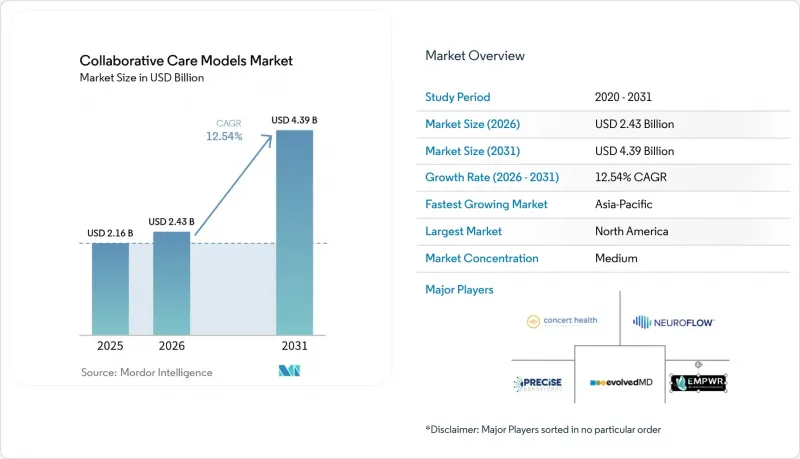
Mordor Intelligence에 의하면, 협진 모델 시장 규모는 2025년 21억 6,000만 달러로 평가되었습니다. 2026년에는 24억 3,000만 달러로 확대되어 2026년부터 2031년에 걸쳐 CAGR 12.54%로 성장을 지속하여, 2031년에는 43억 9,000만 달러에 이를 것으로 예측됩니다.
본 보고서는 배포 방식(웹 기반, 클라우드 기반 등), 용도(지역 주민 대상 케어, 환자 중심 팀 케어 등), 질환(대우울증, 불안 장애 등), 최종 사용자(병원 및 진료소 등), 지역(북미, 유럽 등)별로 분류되어 있습니다. 시장 예측은 금액(달러) 기준으로 제시되어 있습니다.
세계의 협진 모델 시장 동향 및 인사이트
1차 진료에서 행동 건강 관리의 부담 증가
협진 모델 시장은 행동 의학에 대한 수요와 전문공급 간의 격차가 확대됨에 따라 혜택을 보고 있습니다. 1차 진료에서는 기존의 의뢰 경로를 통해 행동 의학 전문의에게 연결되지 못할 가능성이 있는 환자에 대한 대응이 점점 더 늘어나고 있습니다. 미국 보건복지부(HHS) 감사관실은 2025년에 조사 대상 의료 제공업체의 45%가 메디케어 및 메디케이드 신규 환자를 수용할 수 없을 것이라고 밝혔습니다. Shatterproof 및 Bowman Family Foundation의 보고서에 따르면, 2018년부터 2024년에 걸쳐 민간 보험 가입자 중 협력형 진료 모델(CoCM) 이용률이 대상자 10만 명당 12명에서 317명으로 증가한 것으로 기록되었습니다. 이 모델을 통해 컨설턴트 정신과 의사는 직접 의뢰를 통한 진료만으로는 감당할 수 없을 정도로 많은 1차 진료 환자의 사례를 검토할 수 있게 됩니다. 그 결과, 만성 질환과 관련된 우울증, 불안 장애, 행동 장애에는 협력적인 치료가 필요하기 때문에 의료 제공업체, 보험사 및 의료 시스템에는 여전히 제대로 대응하지 못하고 있는 많은 환자층이 남아 있습니다.
가치 기반 보상 및 집단건강관리 보상의 확대
가치 기반 지불 제도는 조직이 행동 건강 통합 프로그램을 평가하는 방식을 변화시키고 있습니다. CMS는 2024년에 ‘행동 건강 혁신(Innovation in Behavioral Health)’ 모델을 출범시켰으며, 뉴욕주, 미시간주, 사우스캐롤라이나주는 2025년 1월부터 7년간의 프로그램을 시작했습니다. 이 모델에는 참여하는 전문 행동 건강 제공업체에 대한 ‘회원 1인당 월액’ 및 ‘성과 기반’ 지급 요소가 포함되어 있습니다. 또한 CMS는 2026년 7월 5일에 ‘ACCESS 모델’을 시작할 예정이며, 이 모델의 지급은 메디케어 수급자의 우울증 및 불안 장애 지표 개선 상황에 연동되도록 되어 있습니다. 따라서 협력형 케어 모델 시장에서는 케어 조정 외에도, 위험 계층화, 측정 및 지불 기관에 대한 보고를 지원하는 플랫폼이 중시되고 있습니다. 2026년 전망에서는 행동 건강 기관이 가치 기반 지불 방식으로 완전히 전환하기 전에 단계적인 품질 지표 개발이 필요하다고 지적되고 있습니다.
보험사별 상환·청구 규정의 불일치
각 주별 지급 기관의 규정은 지역 환자의 요구를 반영하지 못하는 경우가 많아 도입 현황에 편차를 초래하고 있습니다. 2026년 2월, Shatterproof와 The Bowman Family Foundation은 14개 주의 메디케이드 기관 및 대다수의 관리 의료 기관이 CoCM에 대한 환급을 거의 또는 전혀 하지 않고 있다고 보고했습니다. 이 보고서에서는 메디케이드 적용 범위가 전반적인 도입 상황을 예측하는 가장 유력한 지표라는 사실도 밝혀졌습니다. 의료 기관은 대상 임상의, 시간 기준, 사례 수 심사 및 문서화와 관련하여 보험사마다 다른 규정에 직면할 가능성이 있습니다. 이러한 요건들은 행정 업무를 증가시키며, 전담 청구 담당자가 없는 소규모 의료 기관의 경우 이를 관리하기 어려울 수 있습니다. 보험사별 워크플로우를 통합한 공급업체를 활용하면 도입 위험을 줄일 수 있지만, 불균등한 환급은 협진 모델 시장 전체에 여전히 장벽으로 작용하고 있습니다.
부문 분석
2025년 기준, 웹 기반 플랫폼은 협진 모델 시장의 42.37% 점유율을 차지했습니다. 이는 2017년부터 2022년까지의 청구 코드 도입 기간 동안 많은 레지스트리 및 케어 관리 시스템이 채택되었기 때문입니다. 협진 모델 시장에서 이러한 플랫폼이 확립한 워크플로는 이미 직원을 교육하고 이를 기반으로 한 운영 절차를 구축한 의료 시스템 전반에서 지속적인 활용을 뒷받침하고 있습니다. 그러나 일부 레거시 아키텍처에서는 EHR의 실시간 동기화 및 광범위한 분석이 제한되고 있습니다. 클라우드 기반 도입은 2026년부터 2031년에 걸쳐 연평균 성장률(CAGR) 14.76%를 나타낼 것으로 예측됩니다. 의료 시스템은 여러 거점에서 레지스트리에 대한 접근, API 연결성, 분산된 임상 업무 전반에 걸친 업데이트 간소화를 목적으로 클라우드 플랫폼을 선택하고 있습니다.
FHIR 네이티브 연결 및 인구 수준 보고서에 대한 수요가 클라우드 기반 도입에서 협업 치료 모델 시장 규모 확대를 뒷받침하고 있습니다. NeuroFlow는 2026년 2월, 행동 건강 위험 식별, 치료 관리 인프라 및 측정 기반 치료 기능을 통합하여 자사의 ‘IntegrateBH’ 솔루션을 강화했습니다. On-Premise형 시스템은 데이터 상주 요건이나 기존 서버 환경을 갖춘 조직에서 계속해서 사용되고 있습니다. 기타 범주에는 AI 지원 플랫폼 및 제3자 관리형 도입 서비스가 포함됩니다. 이러한 서비스는 자체 관리형 인프라보다 운영 지원을 필요로 하는 의료 기관에 매력적입니다. ASTP/ONC의 시범 사업을 통해 구조화된 행동 건강 데이터 교환을 지원할 수 있는 플랫폼에 대한 수요가 증가할 가능성이 있습니다.
2025년, 인구 기반 케어는 부문 점유율의 39.87%를 차지했습니다. 이는 환자 패널 추적이 우울증 선별 검사 및 인구 건강 보고서를 지원하기 때문입니다. 협진 모델 시장에서 이러한 접근 방식을 통해 케어 팀은 후속 조치가 필요한 환자를 식별하고, 1차 진료 환자 패널 전체에 걸쳐 치료 결과를 모니터링할 수 있게 됩니다. 환자 중심의 팀 케어는 2026년부터 2031년까지 연평균 성장률(CAGR) 13.97%를 나타낼 것으로 예측됩니다. 이 모델에서는 케어 매니저, 사회복지사, 지역 보건 종사자, 1차 진료 의사, 정신과 컨설턴트가 보다 적극적인 협력 과정에 참여합니다. 또한, PHQ-9 및 GAD-7 보고가 보상 모델과 연계됨에 따라, 측정 기반 치료의 중요성도 높아지고 있습니다.
노스웨스턴 메디신은 Concert Health를 활용한 소아용 온라인 지원 서비스를 도입하여, 70개의 1차 진료 클리닉과 500명의 의사를 아우르는 행동 의학 공동 프로그램을 확대했습니다. 이 사례는 프로그램이 시스템 규모에 도달함에 따라 환자 중심 케어가 어떻게 운영상의 필수 요건이 되는지를 보여줍니다. 증거 기반 치료 용도는 치료 경로를 케어 매니저의 워크플로우에 통합합니다. 책임 의료(Accountable Care) 및 치료 조정 기능은 집단 건강 관리 계약을 관리하는 조직을 지원합니다. 따라서 협업형 진료 모델 시장은 수동적인 등록 정보 모니터링에서 환자의 경과를 기록하고 중재를 조정하는 시스템으로 전환되고 있습니다. 표준화된 측정 워크플로는 일관된 임상 기록이 필요한 인증 기관에도 도움을 줍니다.
지역별 분석
북미는 2025년 기준, 확립된 상환 규칙, 도입 자원, 그리고 탄탄한 공급업체 기반에 힘입어 협력형 케어 모델 시장의 43.64% 점유율을 차지했습니다. 협진 모델 시장에서 미국이 지역별 도입의 대부분을 차지하는 이유는 CMS가 청구 절차를 표준화하고 있으며, 의료 시스템이 운영 경험을 축적해 왔기 때문입니다. 또한 AIMS 센터의 프로토콜은 1차 진료 통합을 위한 널리 사용되는 임상 모델을 제공합니다. 캐나다에서는 연방 차원에서 CoCM에 상응하는 직접 청구 제도는 존재하지 않지만, 각 주의 1차 진료 및 정신 건강 체계를 통해 프로그램이 개발되고 있습니다. 멕시코는 여전히 초기 단계에 있으며, 활동은 도시 지역의 학술 기관 및 임상 교류 관계에 집중되어 있습니다.
유럽에서는 1차 진료 구조가 다양하기 때문에 지역 전체에 걸친 일관된 도입이 제한되고 있습니다. 각국의 지급 규정과 지역별 진료 조직이 유럽 내 협력형 진료 모델 시장을 형성하고 있습니다. 독일의 COMET 연구에 따르면, 공동 진료 및 단계적 진료에서는 일반 치료에 비해 환자 1인당 외래 정신건강 서비스 비용이 평균 685유로 더 높았으나, 12개월간의 QALY(질 조정 생존년) 성과는 실질적으로 동등했습니다. 또한 이 연구에서는 의뢰 과정의 마찰을 줄임으로써 심리치료사 및 정신과 의사에 대한 접근성이 개선되었음을 보여주었습니다. 영국의 1차 진료 네트워크 내 정신건강 팀에서는 핵심 구성원들 사이에서 도입이 진행되고 있었으나, 외부 기관의 도입 상황에는 편차가 나타났습니다. 프랑스, 이탈리아, 스페인, 독일 및 기타 국가들은 IMPLEMENTAL 이니셔티브를 통해 지역 내 정신건강 통합을 추진하고 있습니다.
아시아태평양은 2026년부터 2031년까지 연평균 성장률(CAGR) 15.32%를 나타낼 것으로 예측되며, 협력형 치료 모델 시장에서 가장 빠르게 성장하는 지역이 될 전망입니다. 중국은 2025년부터 2027년에 걸쳐 지급시(地級市)에 지역 정신건강 센터를 설립하고 외래 서비스 이용 기회를 확대할 계획을 발표했습니다. 일본은 1차 진료 의사와 노인 정신의학 전문의 간의 협진을 연계하는 지역 진료 체계를 제안하고 있습니다. 인도는 1차 진료 기반이 잘 갖춰져 있는 반면 전문공급이 제한적인 반면, 한국은 디지털 헬스와 정신건강 인식 제고에 투자하고 있습니다. 중동 및 아프리카 및 남미는 여전히 소규모 시장이지만, 1차 진료에 정신건강을 통합하는 것에 관한 WHO 지침은 GCC 국가, 브라질, 남아프리카공화국 정부의 관심을 촉진하고 있습니다.
기타 혜택 :
- 엑셀 형식 시장 예측(ME) 시트
- 3개월간의 애널리스트 지원
자주 묻는 질문
목차
제1장 서론
제2장 조사 방법
제3장 주요 요약
제4장 시장 구도
제5장 시장 규모 및 성장 예측
제6장 경쟁 구도
제7장 시장 기회 및 향후 전망
KTH 26.09.10According to Mordor Intelligence, the collaborative care models market size is expected to grow from USD 2.16 billion in 2025 to USD 2.43 billion in 2026 and is forecast to reach USD 4.39 billion by 2031 at 12.54% CAGR over 2026-2031.
This report is Segmented by Deployment Mode (Web-Based Deployment, Cloud-Based Deployment, and More), by Application (Population-Based Care, Patient-Centered Team Care, and More), by Condition (Major Depressive Disorder, Anxiety Disorders, and More), by End User (Hospitals and Clinics and More), and Geography (North America, Europe, and More). The Market Forecasts are Provided in Terms of Value (USD).
Global Collaborative Care Models Market Trends and Insights
Rising Behavioral Health Burden in Primary Care
The Collaborative Care Models Market benefits from a growing gap between behavioral health demand and specialist availability. Primary care increasingly serves patients who may not reach a behavioral health specialist through conventional referral pathways. The HHS Office of Inspector General found in 2025 that 45% of surveyed providers could not accept new Medicare and Medicaid patients. A Shatterproof and Bowman Family Foundation report recorded a rise in commercially insured CoCM use from 12 to 317 patients per 100,000 eligible individuals between 2018 and 2024. The model allows a consulting psychiatrist to review a larger primary care caseload than direct referral care can support. This leaves providers, payers, and health systems with a substantial unmet population as depression, anxiety, and behavioral conditions linked to chronic disease require coordinated treatment.
Expansion of Value-Based and Population Health Payment
Value-based payment is changing how organizations evaluate behavioral health integration programs. CMS launched the Innovation in Behavioral Health model in 2024, and New York, Michigan, and South Carolina began their 7-year programs in January 2025. The model includes per-member-per-month and outcome-based payment components for participating specialty behavioral health providers. CMS also scheduled the ACCESS model to begin on July 5, 2026, with payment linked to improvements in depression and anxiety measures for Medicare beneficiaries. The Collaborative Care Models Market therefore favors platforms that support risk stratification, measurement, and payer reporting alongside care coordination. A 2026 perspective noted that behavioral health organizations need sequenced quality measure development before moving fully into value-based payment.
Inconsistent Payer Reimbursement and Billing Rules
State payer rules create adoption differences that often do not reflect local patient need. In February 2026, Shatterproof and The Bowman Family Foundation reported that Medicaid agencies and most managed-care organizations in 14 states provided little or no CoCM reimbursement. The report also found that Medicaid coverage was the strongest predictor of overall adoption. Practices may face different payer rules for eligible clinicians, time thresholds, caseload review, and documentation. These requirements add administrative work that smaller practices may struggle to manage without dedicated billing resources. Vendors that incorporate payer-specific workflows can reduce implementation risk, but uneven reimbursement remains a barrier across the Collaborative Care Models Market.
Other drivers and restraints analyzed in the detailed report include:
- Telehealth and Digital Registry Enablement
- Billing Workflow Automation Unlocking Previously Uncaptured Care Activity
- Shortage of Behavioral Health Professionals
For complete list of drivers and restraints, kindly check the Table Of Contents.
Segment Analysis
Web-based platforms held 42.37% of the Collaborative Care Models Market share in 2025 because many registry and care management systems were adopted during the 2017 to 2022 billing code rollout. Within the Collaborative Care Models Market, their established workflows support continued use across health systems that have already trained staff and built operating procedures around them. Some legacy architectures, however, limit real-time EHR synchronization and broad analytics. Cloud-based deployment is forecast to grow at a 14.76% CAGR from 2026 to 2031. Health systems are selecting cloud platforms for multi-site registry access, API connectivity, and simpler updates across distributed clinical operations.
The need for FHIR-native connections and population-level reporting supports the Collaborative Care Models Market size for cloud-based deployment. NeuroFlow expanded its IntegrateBH solution in February 2026 by combining behavioral health risk identification, care management infrastructure, and measurement-based care capabilities. On-premise systems continue to serve organizations with data residency needs or established server environments. The other category includes AI-enabled platforms and third-party managed deployment services. These offerings appeal to practices that want operational support rather than self-managed infrastructure. The ASTP/ONC pilots may increase demand for platforms that can support structured behavioral health data exchange.
Population-based care held 39.87% of the segment share in 2025 because panel tracking supports depression screening measures and population health reporting. Within the Collaborative Care Models Market, it enables care teams to identify patients who need follow-up and monitor outcomes across a primary care panel. Patient-centered team care is forecast to grow at a 13.97% CAGR from 2026 to 2031. This model brings care managers, social workers, community health workers, primary care physicians, and psychiatric consultants into a more active coordination process. Measurement-based treatment is also gaining importance as PHQ-9 and GAD-7 reporting becomes linked to payment models.
Northwestern Medicine expanded collaborative behavioral health programming across 70 primary care clinics and 500 physicians, using Concert Health for virtual pediatric support. The example shows how patient-centered care becomes an operating requirement as programs reach system scale. Evidence-based care applications embed treatment pathways into care manager workflows. Accountable care and care coordination functions serve organizations managing population health contracts. The Collaborative Care Models Market industry is therefore moving beyond passive registry monitoring toward systems that document patient progress and coordinate interventions. Standardized measurement workflows also support accredited facilities that need consistent clinical records.
Complete Report Scope:
- By Deployment
- Web-Based Deployment
- Cloud-Based Deployment
- On-Premise Deployment
- Others (AI-enabled Deployment platforms, Third-Party Managed Deployment Services, etc.)
- By Application
- Population-Based Care
- Patient-Centered Team Care
- Measurement-Based Treatment
- Evidence-Based Care
- Others (Accountable Care, Care Coordination Management, etc.)
- By Condition
- Major Depressive Disorder
- Anxiety Disorders
- Bipolar Disorder
- Substance Use Disorders
- Post-Traumatic Stress Disorder
- Others (ADHD, Obsessive-Compulsive Disorder, etc.)
- By End User
- Hospitals and Clinics
- Ambulatory Care Centers
- Rehabilitation Centers
- Academic and Research Institutes
- Others (Community Mental Health Centers, Accountable Care Organizations, etc.)
- Segmentation by Geography
- North America
- United States
- Canada
- Mexico
- Europe
- Germany
- United Kingdom
- France
- Italy
- Spain
- Rest of Europe
- Asia-Pacific
- China
- Japan
- India
- Australia
- South Korea
- Rest of Asia-Pacific
- Middle East and Africa
- GCC
- South Africa
- Rest of Middle East and Africa
- South America
- Brazil
- Argentina
- Rest of South America
- North America
Geography Analysis
North America held 43.64% of the Collaborative Care Models Market share in 2025, supported by established reimbursement rules, implementation resources, and a developed vendor base. Within the Collaborative Care Models Market, the United States accounts for most regional adoption because CMS has standardized billing pathways, and health systems have accumulated operational experience. The AIMS Center protocol has also provided a widely used clinical model for primary care integration. Canada is developing programs through provincial primary care and mental health frameworks, although it lacks a direct federal CoCM billing equivalent. Mexico remains at an early stage, with activity concentrated in urban academic settings and clinical exchange relationships.
Europe has a varied primary care structure that limits consistent deployment across the region. National payment rules and local care organizations shape the Collaborative Care Models Market in Europe. The German COMET study found that collaborative and stepped care produced mean outpatient mental health service costs EUR 685 higher per patient than usual treatment, with virtually identical 12-month QALY outcomes. The study also showed that the model improved access to psychotherapists and psychiatrists by reducing referral friction. United Kingdom primary care network mental health teams showed strong adoption among core members, while external organizations had more variable uptake. France, Italy, Spain, Germany, and other countries are advancing community mental health integration through the IMPLEMENTAL initiative.
Asia-Pacific is forecast to grow at a 15.32% CAGR from 2026 to 2031, making it the fastest-growing regional component of the Collaborative Care Models Market. China announced a 2025 to 2027 plan to establish prefecture-level regional mental health centers and expand outpatient service availability. Japan has proposed community care arrangements that connect primary care physicians with psychogeriatric consultation. India has a large primary care base and a limited specialist supply, while South Korea has invested in digital health and mental health awareness. The Middle East and Africa and South America remain smaller markets, but WHO guidance on integrating mental health into primary care supports government interest across the GCC, Brazil, and South Africa.
- AIMS Center, University of Washington
- Allied Behavioral Health Integration
- American Well
- Athenahealth
- ChronicCareIQ
- Concert Health
- CrossTx
- eClinicalWorks
- EMPWR
- Epic Systems
- evolvedMD
- Magellan Healthcare
- NeuroFlow
- NextGen Healthcare
- Optum
- Oracle Health
- Precise Behavioral
- Teladoc Health
- Veradigm Inc.
- WellSky
Additional Benefits:
- The market estimate (ME) sheet in Excel format
- 3 months of analyst support
TABLE OF CONTENTS
1 INTRODUCTION
- 1.1 Study Assumptions and Market Definition
- 1.2 Scope of the Study
2 RESEARCH METHODOLOGY
3 EXECUTIVE SUMMARY
4 MARKET LANDSCAPE
- 4.1 Market Overview
- 4.2 Market Drivers
- 4.2.1 Rising Behavioral Health Burden in Primary Care
- 4.2.2 Expansion of Value-Based and Population Health Payment
- 4.2.3 Telehealth and Digital Registry Enablement
- 4.2.4 Billing Workflow Automation Unlocking Previously Uncaptured Care Activity
- 4.2.5 Growing Adoption of Integrated Care Delivery Models Across Health Systems
- 4.2.6 Increasing Government and Payer Support for Mental Health Integration Programs
- 4.3 Market Restraints
- 4.3.1 Inconsistent Payer Reimbursement and Billing Rules
- 4.3.2 Shortage of Behavioral Health Professionals
- 4.3.3 Fragmented Clinical Data and Measurement Workflows
- 4.3.4 High Implementation and Operational Costs for Care Coordination Infrastructure
- 4.4 Value Chain Analysis
- 4.5 Regulatory Landscape
- 4.6 Technological Outlook
- 4.7 Porter's Five Forces Analysis
- 4.7.1 Threat of New Entrants
- 4.7.2 Bargaining Power of Suppliers
- 4.7.3 Bargaining Power of Buyers
- 4.7.4 Threat of Substitutes
- 4.7.5 Competitive Rivalry
5 MARKET SIZE AND GROWTH FORECASTS (VALUE, USD)
- 5.1 By Deployment
- 5.1.1 Web-Based Deployment
- 5.1.2 Cloud-Based Deployment
- 5.1.3 On-Premise Deployment
- 5.1.4 Others (AI-enabled Deployment platforms, Third-Party Managed Deployment Services, etc.)
- 5.2 By Application
- 5.2.1 Population-Based Care
- 5.2.2 Patient-Centered Team Care
- 5.2.3 Measurement-Based Treatment
- 5.2.4 Evidence-Based Care
- 5.2.5 Others (Accountable Care, Care Coordination Management, etc.)
- 5.3 By Condition
- 5.3.1 Major Depressive Disorder
- 5.3.2 Anxiety Disorders
- 5.3.3 Bipolar Disorder
- 5.3.4 Substance Use Disorders
- 5.3.5 Post-Traumatic Stress Disorder
- 5.3.6 Others (ADHD, Obsessive-Compulsive Disorder, etc.)
- 5.4 By End User
- 5.4.1 Hospitals and Clinics
- 5.4.2 Ambulatory Care Centers
- 5.4.3 Rehabilitation Centers
- 5.4.4 Academic and Research Institutes
- 5.4.5 Others (Community Mental Health Centers, Accountable Care Organizations, etc.)
- 5.5 Segmentation by Geography
- 5.5.1 North America
- 5.5.1.1 United States
- 5.5.1.2 Canada
- 5.5.1.3 Mexico
- 5.5.2 Europe
- 5.5.2.1 Germany
- 5.5.2.2 United Kingdom
- 5.5.2.3 France
- 5.5.2.4 Italy
- 5.5.2.5 Spain
- 5.5.2.6 Rest of Europe
- 5.5.3 Asia-Pacific
- 5.5.3.1 China
- 5.5.3.2 Japan
- 5.5.3.3 India
- 5.5.3.4 Australia
- 5.5.3.5 South Korea
- 5.5.3.6 Rest of Asia-Pacific
- 5.5.4 Middle East and Africa
- 5.5.4.1 GCC
- 5.5.4.2 South Africa
- 5.5.4.3 Rest of Middle East and Africa
- 5.5.5 South America
- 5.5.5.1 Brazil
- 5.5.5.2 Argentina
- 5.5.5.3 Rest of South America
- 5.5.1 North America
6 COMPETITIVE LANDSCAPE
- 6.1 Market Concentration
- 6.2 Market Share Analysis
- 6.3 Company Profiles (includes Global Level Overview, Market Level Overview, Core Segments, Financials as available, Strategic Information, Market Rank/Share, Products and Services, Recent Developments)
- 6.3.1 AIMS Center, University of Washington
- 6.3.2 Allied Behavioral Health Integration
- 6.3.3 American Well Corporation
- 6.3.4 athenahealth, Inc.
- 6.3.5 ChronicCareIQ
- 6.3.6 Concert Health
- 6.3.7 CrossTx
- 6.3.8 eClinicalWorks
- 6.3.9 EMPWR
- 6.3.10 Epic Systems Corporation
- 6.3.11 evolvedMD
- 6.3.12 Magellan Healthcare
- 6.3.13 NeuroFlow
- 6.3.14 NextGen Healthcare, Inc.
- 6.3.15 Optum, Inc.
- 6.3.16 Oracle Health
- 6.3.17 Precise Behavioral
- 6.3.18 Teladoc Health, Inc.
- 6.3.19 Veradigm Inc.
- 6.3.20 WellSky
7 MARKET OPPORTUNITIES AND FUTURE OUTLOOK
- 7.1 White-Space and Unmet-Need Assessment