|
시장보고서
상품코드
2119398
전도성 탄소 분산액 : 시장 점유율 분석, 업계 동향 및 통계, 성장 예측(2026-2031년)Conductive Carbon Dispersions - Market Share Analysis, Industry Trends & Statistics, Growth Forecasts (2026 - 2031) |
||||||
 Mordor Intelligence
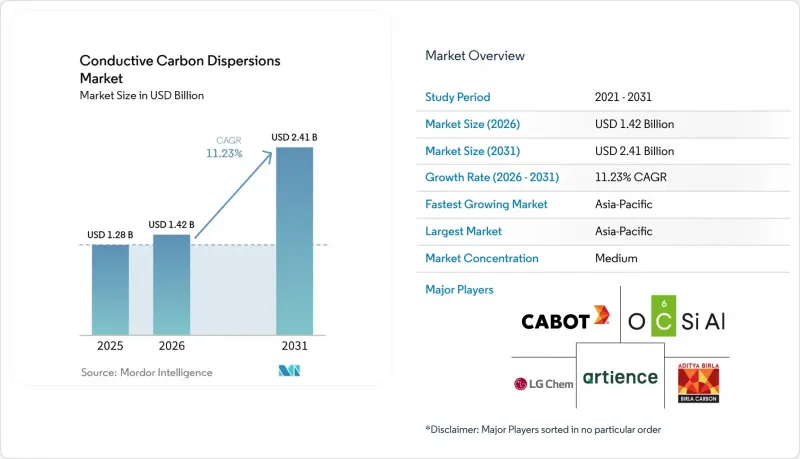
Mordor Intelligence에 의하면, 전도성 탄소 분산액 시장 규모는 2025년에 12억 8,000만 달러로 평가되었습니다. 예측 기간(2026-2031년) CAGR 11.23%로 확대되어 2026년 14억 2,000만 달러에서 2031년에는 24억 달러에 이를 전망입니다.
본 보고서는 전도성 탄소의 유형(카본블랙 분산액, 그래핀 분산액 등), 분산 매체(수성, 용제성 등), 용도(리튬 이온 배터리, 전도성 잉크 등), 지역(아시아태평양, 북미, 유럽, 남미, 중동 및 아프리카)별로 분류되어 있습니다. 시장 전망은 금액(달러) 기준으로 제시되어 있습니다.
세계의 전도성 탄소 분산액 시장 동향 및 인사이트
전기차(EV) 및 전력망용 배터리 전극의 확대
2025년 전 세계 전기차용 배터리 도입량은 1.2 TWh에 달하여, 2024년 대비 30% 가까이 증가했으며, 2020년 대비 7배 이상 확대되었습니다. 셀 출력이 1 TWh 증가할 때마다 양극 및 음극 제조 공정에서 더 많은 전극 슬러리와 전도성 재료가 필요합니다. 국제에너지기구(IEA) 보고서에 따르면, 2025년에 도입된 전 세계 전기차용 배터리 중 인산철리튬(LFP)이 55% 이상을 차지했으며, 고정형 축전지 설비의 90% 이상을 차지했습니다. LFP는 니켈-망간-코발트(NMC)보다 전도성이 낮기 때문에 일반적으로 전극 면적 단위당 첨가제 함량이 많은 경향이 있으며, 배터리 제조업체들이 전극 생산을 확대함에 따라 카본블랙 분산액 수요를 뒷받침하고 있습니다. 전도성 탄소 분산액 시장은 LFP가 여전히 주류 화학 조성인 고정형 에너지 저장 시스템에 대한 수요 증가로 인해 혜택을 보고 있습니다. 캐봇 코퍼레이션은 리튬 이온 배터리 수요가 금세기 말까지 확대될 것으로 예측하며, 이것이 전도성 탄소 분산액 시장 전체에 대한 장기적인 투자를 뒷받침할 것이라고 밝혔습니다.
실리콘이 풍부한 음극 및 고니켈 양극의 채택
실리콘이 풍부한 음극은 리튬화 과정에서 실리콘이 300% 가까이 팽창하기 때문에 기존의 흑연 음극보다 내구성이 뛰어난 전도성 네트워크가 필요합니다. SWCNT와 같이 유연하고 종횡비가 높은 소재는 이러한 팽창 시에도 전기적 경로를 유지하는 데 도움이 됩니다. 카본블랙(CB)과 SWCNT의 질량비를 70 : 30으로 설정한 연구에서는 그 결과 형성된 네트워크가 균열이나 박리 현상 없이 700µm의 코팅을 지탱할 수 있음이 확인되었습니다. 니켈 함량이 높은 NMC811 및 NCA90 양극의 경우에도, 첨가제 함량을 줄이면서 전자 전도 경로를 개선해야 할 필요가 있습니다. 이러한 성능 요건은 첨단 전극 설계를 위해 인증된 CNT 및 하이브리드 분산계를 제공할 수 있는 공급업체에게 비즈니스 기회가 됩니다.
CNT 및 그래핀의 높은 비용과 카본블랙과의 비교
CNT 및 그래핀 분산액과 카본블랙 분산액 간의 가격 차이는 전기차용 배터리 대량 생산 프로그램에서 여전히 큰 장벽으로 작용하고 있습니다. 이러한 비용 대비 성능의 균형은 구매자가 전극의 총비용을 특히 중시하는 LFP 양극 용도에서 특히 큰 과제가 되고 있습니다. IOPscience의 회의록 보고서에 따르면, 2024년 전 세계 MWCNT 산업 생산량은 연간 2만 5,000톤으로 추정되며, 그 대부분은 유동층법 및 부유 촉매법을 이용한 CVD 공정을 통해 생산됩니다. SWCNT의 생산량은 여전히 MWCNT보다 낮은 수준이며, 이는 고부가가치 배터리 형식에서 SWCNT의 높은 가격 책정을 뒷받침하고 있습니다. CNT 및 그래핀 분산액의 가격은 동등한 충전량 기준 카본블랙의 5-15배에 달할 전망입니다. NanoXplore사는 2026년 3분기에 특수 카본블랙의 직접적인 대체품으로 ‘xGnP D-500HP’를 출시했으나, 그래핀의 가격은 여전히 LFP 배터리의 비용 임계치를 상회하고 있습니다. 따라서 가격에 민감한 시장에서는 카본블랙 분산액이 계속해서 중요한 역할을 할 것으로 예상되는 반면, CNT 및 그래핀 제품은 성능을 중시하는 용도를 대상으로 하고 있습니다.
부문별 분석
2025년 기준, 카본블랙 분산액은 전도성 탄소 분산액 시장 점유율의 51.34%를 차지했습니다. 이러한 위상은 배합 기술의 성숙도, 확립된 공급망, 그리고 LFP 양극 슬러리에서의 비용 경쟁력을 반영합니다. 2025년에 출시된 전 세계 전기차(EV) 배터리 중 LFP가 55% 이상을 차지했습니다. LFP는 전도성이 낮기 때문에 더 높은 전도성을 가진 첨가제의 배합량이 필요하며, 이는 카본블랙 배합의 채택을 촉진하고 있습니다. 이 소재 유형은 배터리 제조업체들 사이에서 정착되어 있으며, 기존 공급망에 의해 뒷받침되고 있습니다. CNT 분산액은 실리콘 음극 및 고니켈 양극에서 요구되는 높은 종횡비 네트워크 수요에 힘입어 2031년까지 연평균 성장률(CAGR) 13.45%로 확대될 것으로 예측됩니다. 2024년 전 세계 산업용 CNT 생산량은 연간 2만 5,000톤에 달했으며, 그 대부분은 MWCNT 생산에서 비롯되었습니다.
2025년 4월에 공표된 중국의 T/CAQI 423-2025 규격은 리튬 이온 배터리에 사용되는 CNT 복합 전도성 페이스트의 기술 사양을 규정하고 있습니다. 이 인증 기준은 일관된 제품 품질을 입증할 수 있는 주요 공급업체에 유리하게 작용하므로, 생산 관리와 문서화된 일관성은 중요한 상업적 요소가 됩니다. 그래핀 분산액 및 CNT-그래핀 하이브리드는 시트형과 와이어형 전도성 네트워크를 결합할 수 있는 것으로, 여전히 상용화의 초기 단계에 있습니다. 2026년 연구에 따르면, LFP에 2 wt% 비율로 배합된 다공성 그래핀-탄소 양자점 복합재료는 0.1C에서 159 mAh/g의 용량을 발휘했으며, 3C에서도 그 용량을 유지한 것으로 나타났습니다. NanoXplore사는 자사 제품인 ‘xGnP D-500HP’의 연간 생산 능력이 4,000톤이라고 발표했습니다. 흑연, 탄소 나노섬유 및 하이브리드 시스템은 슈퍼커패시터용 전극이나 전도성 접착제 등 특수 용도에서 계속해서 활용되고 있습니다. CNT와 카본블랙을 결합한 하이브리드 시스템을 통해 공급업체는 단일 탄소 형태로는 충분히 충족할 수 없는 성능 요건을 충족할 수 있게 됩니다. 시장은 까다로운 전극 프로그램을 위해 여러 탄소 소재를 조합한 배합으로 전환되고 있습니다.
지역별 분석
아시아태평양은 2025년 전도성 탄소 분산액 시장 점유율의 33.94%를 차지했으며, 2031년까지 연평균 성장률(CAGR) 12.17%를 나타낼 것으로 예측됩니다. 2025년, 중국은 전 세계 리튬 이온 배터리 생산 능력의 80% 이상을 차지하고 있으며, 이로 인해 현지 분산액 공급업체들은 전극 생산 및 인증 활동에 밀접하게 관여할 수 있는 환경에 있습니다. OCSiAl사의 보고서에 따르면, 해당사와 라이선스 계약을 체결한 중국의 각 파트너사는 2025년 말까지 TUBALL BATT의 연간 생산 능력을 총 5만 2,000톤으로 확대했습니다. 이 지역의 전도성 탄소 분산액 시장은 원자재, 분산액 및 배터리 셀 제조 거점이 인접해 있을 뿐만 아니라, 제품 인증 및 공정 조정 단계에서 셀 제조업체가 공급업체와 협력할 수 있다는 점에서도 혜택을 받고 있습니다. 일본과 한국에서는 고니켈 양극재 및 실리콘 음극 플랫폼에 대한 수요가 증가하고 있으며, 이는 낮은 충전율에서도 전도 경로를 유지할 수 있는 CNT 제품 수요를 견인하고 있습니다. 또한, 해당 지역의 MWCNT 합성 능력과 카본블랙 생산량은 현지 공급업체에 비용 및 물류 측면에서의 우위를 제공합니다.
인도와 아세안은 국내 배터리 제조 정책 및 투자가 지역 내 셀 생산을 뒷받침하고 있어, 함께 신흥 수요 기반을 형성하고 있습니다. 이 수요는 중국, 일본, 한국과 같은 확립된 시장에 비해 발전 초기 단계에 있습니다. 지역 내 생산이 진행됨에 따라 전극 프로그램이 인증 단계를 거치는 과정에서 현지 기술 지원에 대한 수요가 발생할 것으로 예측됩니다. 일반 전극 생산을 위한 소재 공급 경로를 단축하는 것을 목표로 하는 신규 공장은 전도성 탄소 분산액 시장에 긍정적인 영향을 미칠 가능성이 있습니다. 유럽과 미국에서는 북미와 유럽이 배터리 시장의 주요 지역으로 자리 잡고 있으며, 새로운 기가팩토리 프로젝트를 통해 현지 생산이 확대되고 있습니다. 공공 배터리 프로그램의 현지 조달 요건은 지역 전도성 소재 공급업체에 경쟁 우위를 가져다줄 가능성이 있습니다. 유럽의 NMP 규제는 저배출형 및 수성 분산액공급망을 뒷받침하고 있습니다. OCSiAl이 룩셈부르크에 계획 중인 SWCNT 시설은 유럽 고객을 위한 지역적 합성 능력을 구축하는 것을 목표로 하고 있으며, 아시아에 CNT 생산이 집중되어 발생하는 공급 리스크를 해소하는 데 기여할 가능성이 있습니다.
남미, 중동 및 아프리카는 여전히 소규모 시장이지만, 전도성 탄소 공급업체에게는 장기적으로 중요한 시장으로 남아 있습니다. 브라질은 전기차에 대한 세제 혜택과 발전 중인 배터리 기술 생태계를 통해 남미 수요를 주도하고 있지만, 해당 지역의 전극용 분산액 수요는 예측 기간 대부분 동안 수입에 의존하는 상태가 지속될 것으로 예상되므로, 물류 및 공급의 지속성은 지역 구매자들에게 계속해서 중요한 과제로 남을 것입니다. 아르헨티나의 리튬 자원은 중류 가공이 확대되면 향후 배터리 재료 투자의 기반이 될 것입니다. 사우디아라비아는 ‘비전 2030’에 따라 에너지 저장 장치 제조 및 화학 분야에 투자하고 있으며, 기능성 소재에 대한 장기적인 수요의 조짐을 보이고 있습니다. 남아프리카공화국의 리튬, 망간, 코발트 가공 계획은 향후 배터리 제조를 위한 소재 기반을 제공할 것입니다. 이 지역들의 상용 셀 생산은 여전히 장기적인 전망이며, 주요 배터리 생산 거점 이외의 지역에서 전도성 탄소 분산액 시장 규모는 현지 소재 가공이 셀 제조로 발전하는 속도에 좌우될 것입니다.
기타 혜택 :
- 엑셀 형식 시장 예측(ME) 시트
- 3개월간의 애널리스트 지원
목차
제1장 서론
제2장 조사 방법
제3장 개요
제4장 시장 구도
제5장 시장 규모 및 성장 예측
제6장 경쟁 구도
제7장 시장 기회 및 향후 전망
KTHAccording to Mordor Intelligence, the conductive carbon dispersions market size is estimated at USD 1.28 billion in 2025 and is estimated to grow from USD 1.42 billion in 2026 to USD 2.40 billion by 2031, at a CAGR of 11.23% during the forecast period (2026-2031).
This report is Segmented by Conductive Carbon Type (Carbon Black Dispersions, Graphene Dispersions, and More), Dispersion Medium (Water-Based, Solvent-Based, and More), Application (Lithium-Ion Batteries, Conductive Inks, and More), and Geography (Asia-Pacific, North America, Europe, South America, and Middle-East and Africa). The Market Forecasts are Provided in Terms of Value (USD).
Global Conductive Carbon Dispersions Market Trends and Insights
EV and Grid Battery Electrode Expansion
Global EV battery deployment reached 1.2 TWh in 2025, rising nearly 30% from 2024 and more than sevenfold from 2020. Each additional TWh of cell output requires more electrode slurry and more conductive material at the cathode and anode production steps. The International Energy Agency reported that lithium iron phosphate (LFP) accounted for more than 55% of global EV batteries deployed in 2025 and more than 90% of stationary battery storage installations. LFP has lower conductivity than nickel manganese cobalt (NMC) and generally requires higher additive loading per unit of electrode area, supporting demand for carbon black dispersions as battery makers scale electrode production. The conductive carbon dispersions market also benefits from rising demand for stationary storage, where LFP remains the dominant chemistry. Cabot Corporation stated that lithium-ion battery demand is expected to grow through the end of the decade, supporting longer-term investment across the conductive carbon dispersions market.
Silicon-Rich Anode and High-Nickel Cathode Adoption
Silicon-rich anodes require more durable conductive networks than conventional graphite anodes because silicon expands by nearly 300% during lithiation. Flexible, high-aspect-ratio materials such as SWCNTs help preserve electrical pathways through this expansion. A study examining a carbon black (CB)-to-SWCNT mass ratio of 70:30 found that the resulting network supported 700 µm coatings without cracking or delamination. High-nickel NMC811 and NCA90 cathodes also require improved electron pathways at lower additive loadings. These performance requirements create an opportunity for suppliers that can provide qualified CNT and hybrid dispersion systems for advanced electrode designs.
High CNT and Graphene Cost Versus Carbon Black
The price difference between CNT or graphene dispersions and carbon black dispersions remains a major barrier in high-volume EV cell programs. This cost-performance balance is particularly challenging in LFP cathode applications, where buyers focus closely on total electrode cost. An IOPscience conference proceedings report noted global industrial MWCNT output of 25,000 tons per year in 2024, largely from fluidized-bed and floating-catalyst CVD methods. SWCNT production remains lower than that of MWCNTs, supporting its premium pricing in high-value cell formats. CNT and graphene dispersion pricing is 5-15X that of carbon black at equivalent loading levels. NanoXplore launched xGnP D-500HP in fiscal Q3 2026 as a direct alternative to specialty carbon black, but graphene pricing remains above the cost threshold for LFP cells. Carbon black dispersions are therefore expected to remain relevant in price-sensitive markets, while CNT and graphene products are targeted at performance-driven applications.
Other drivers and restraints analyzed in the detailed report include:
- Water-Based and High-Solids Slurry Processing
- Pre-Dispersed Formulation Reducing Mixing and Handling Risk
- CNT Agglomeration and Dispersion Stability Risk
For complete list of drivers and restraints, kindly check the Table Of Contents.
Segment Analysis
Carbon black dispersions held 51.34% of the conductive carbon dispersions market share in 2025. This position reflects formulation maturity, established supply networks, and cost competitiveness in LFP cathode slurry. LFP represented more than 55% of global EV batteries deployed in 2025. Its lower conductivity requires higher conductive-additive loading, which favors carbon black formulations. This material type is well established among battery manufacturers and is supported by existing supply chains. CNT dispersions are forecast to expand at a 13.45% CAGR through 2031, driven by the need for high-aspect-ratio networks in silicon anodes and high-nickel cathodes. Industrial CNT output reached 25,000 tons per year globally in 2024, primarily from MWCNT production.
China's T/CAQI 423-2025 standard, published in April 2025, establishes technical specifications for CNT-composite conductive pastes used in lithium-ion batteries. This qualification benchmark favors larger suppliers that can demonstrate consistent product quality, making production controls and documented consistency important commercial factors. Graphene dispersions and CNT-graphene hybrids remain at an earlier stage of commercialization, though they can combine sheet-like and wire-like conductive networks. A 2026 study reported that a holey graphene-carbon quantum dot composite, at a 2 wt% loading in LFP, delivered 159 mAh/g at 0.1C and maintained capacity at 3C. NanoXplore stated that its xGnP D-500HP product has a production capacity of 4,000 tons per year. Graphite, carbon nanofiber, and hybrid systems continue to serve specialty applications such as supercapacitor electrodes and conductive adhesives. Hybrid CNT and carbon black systems allow suppliers to address performance requirements that no single carbon form meets as effectively. The market is moving toward multi-carbon formulations for demanding electrode programs.
Complete Report Scope:
- By Conductive Carbon Type
- Carbon Black Dispersions
- Carbon Nanotube (CNT) Dispersions
- Graphene Dispersions
- Others (Graphite Dispersions, Carbon Nanofiber Dispersions, Hybrid Carbon Dispersions)
- By Dispersion Medium
- Water-Based
- Solvent-Based
- Others (Bio-Based Systems, Specialty Carrier Systems)
- By Application
- Lithium-Ion Batteries
- Conductive Coatings
- Conductive Inks
- EMI Shielding Materials
- Others (Conductive Adhesives and Sealants, Polymer Compounds, Supercapacitors and Fuel Cells)
- By Geography
- Asia-Pacific
- China
- India
- Japan
- South Korea
- ASEAN Countries
- Rest of Asia-Pacific
- North America
- United States
- Canada
- Mexico
- Europe
- Germany
- United Kingdom
- France
- Italy
- NORDIC Countries
- Rest of Europe
- South America
- Brazil
- Argentina
- Rest of South America
- Middle-East and Africa
- Saudi Arabia
- South Africa
- Rest of Middle-East and Africa
- Asia-Pacific
Geography Analysis
Asia-Pacific accounted for 33.94% of the conductive carbon dispersions market share in 2025 and is forecast to grow at a 12.17% CAGR through 2031. China hosted more than 80% of global lithium-ion battery manufacturing capacity in 2025, giving local dispersion suppliers close access to electrode production and qualification activity. OCSiAl reported that its licensed Chinese partners targeted a combined TUBALL BATT capacity of 52,000 tons per year by the end of 2025. The conductive carbon dispersions market in this region benefits from the proximity of raw materials, dispersion, and battery-cell operations, as well as from the ability of cell makers to work with suppliers during product qualification and process adjustments. Japan and South Korea are adding demand for high-nickel cathode and silicon-anode platforms, which in turn drive demand for CNT products that can maintain conductive pathways at lower loadings. The region's MWCNT synthesis capacity and carbon black output also provide cost and logistics advantages for local suppliers.
India and ASEAN together form an emerging demand base, as domestic battery manufacturing policies and investments encourage regional cell production. This demand is at an earlier stage of development than in the established markets of China, Japan, and South Korea. Regional production is expected to create demand for local technical support as electrode programs progress through qualification. New plants seeking to shorten material supply routes for regular electrode production can benefit the conductive carbon dispersions market. In the West, North America and Europe are the leading battery geographies as new gigafactory projects expand local production. Local-content conditions in public battery programs can create an advantage for regional conductive-material suppliers. European NMP restrictions favor low-emission and water-based dispersion supply chains. OCSiAl's planned Luxembourg SWCNT facility aims to establish regional synthesis capacity for European customers and can help address the supply risk created by the concentration of CNT production in Asia.
South America, the Middle-East, and Africa remain smaller markets but have longer-term relevance for conductive carbon suppliers. Brazil leads South American demand through EV fiscal incentives and a developing battery technology ecosystem, though electrode-grade dispersion demand in the region remains import-dependent through much of the forecast period, keeping logistics and supply continuity important for regional buyers. Argentina's lithium resources provide a future basis for battery-material investment once midstream processing expands. Saudi Arabia is investing in energy storage manufacturing and chemicals under Vision 2030, creating a longer-term demand signal for functional materials. South Africa's plans for lithium, manganese, and cobalt processing provide a materials base for future battery manufacturing. Commercial cell production in these regions remains a longer-term prospect, and the conductive carbon dispersions market size outside the major battery centers will depend on the pace at which local material processing develops into cell manufacturing.
- Arkema
- artience Co., Ltd.
- Birla Carbon
- Cabot Corporation
- CHASM
- Denka Company Limited
- Haydale Plc
- Imerys
- Jiangsu Cnano Technology Co., Ltd
- LG Chem
- Mitsubishi Chemical Corporation
- Nanocyl SA
- NanoXplore Inc.
- OCSiAl
- Resonac Holdings Corporation
- TORAY INDUSTRIES, INC.
Additional Benefits:
- The market estimate (ME) sheet in Excel format
- 3 months of analyst support
TABLE OF CONTENTS
1 Introduction
- 1.1 Study Assumptions and Market Definition
- 1.2 Scope of the Study
2 Research Methodology
3 Executive Summary
4 Market Landscape
- 4.1 Market Overview
- 4.2 Market Drivers
- 4.2.1 EV and Grid Battery Electrode Expansion
- 4.2.2 Higher Energy Density Through Lower Conductive-Additive Loading
- 4.2.3 Silicon-Rich Anode and High-Nickel Cathode Adoption
- 4.2.4 Water-Based and High-Solids Slurry Processing
- 4.2.5 Localized Battery Supply Chains and Qualification Support
- 4.2.6 Pre-Dispersed Formulation Reducing Mixing and Handling Risk
- 4.3 Market Restraints
- 4.3.1 High CNT and Graphene Cost Versus Carbon Black
- 4.3.2 CNT Agglomeration and Dispersion Stability Risk
- 4.3.3 Long Cell-Qualification and Change-Control Cycles
- 4.3.4 Regional Concentration of Battery and Conductive-Carbon Capacity
- 4.4 Value and Supply-Chain Analysis
- 4.5 Porter's Five Forces Analysis
- 4.5.1 Competitive Rivalry
- 4.5.2 Supplier Power
- 4.5.3 Buyer Power
- 4.5.4 Threat of New Entrants
- 4.5.5 Threat of Substitutes
5 Market Size and Growth Forecasts (Value)
- 5.1 By Conductive Carbon Type
- 5.1.1 Carbon Black Dispersions
- 5.1.2 Carbon Nanotube (CNT) Dispersions
- 5.1.3 Graphene Dispersions
- 5.1.4 Others (Graphite Dispersions, Carbon Nanofiber Dispersions, Hybrid Carbon Dispersions)
- 5.2 By Dispersion Medium
- 5.2.1 Water-Based
- 5.2.2 Solvent-Based
- 5.2.3 Others (Bio-Based Systems, Specialty Carrier Systems)
- 5.3 By Application
- 5.3.1 Lithium-Ion Batteries
- 5.3.2 Conductive Coatings
- 5.3.3 Conductive Inks
- 5.3.4 EMI Shielding Materials
- 5.3.5 Others (Conductive Adhesives and Sealants, Polymer Compounds, Supercapacitors and Fuel Cells)
- 5.4 By Geography
- 5.4.1 Asia-Pacific
- 5.4.1.1 China
- 5.4.1.2 India
- 5.4.1.3 Japan
- 5.4.1.4 South Korea
- 5.4.1.5 ASEAN Countries
- 5.4.1.6 Rest of Asia-Pacific
- 5.4.2 North America
- 5.4.2.1 United States
- 5.4.2.2 Canada
- 5.4.2.3 Mexico
- 5.4.3 Europe
- 5.4.3.1 Germany
- 5.4.3.2 United Kingdom
- 5.4.3.3 France
- 5.4.3.4 Italy
- 5.4.3.5 NORDIC Countries
- 5.4.3.6 Rest of Europe
- 5.4.4 South America
- 5.4.4.1 Brazil
- 5.4.4.2 Argentina
- 5.4.4.3 Rest of South America
- 5.4.5 Middle-East and Africa
- 5.4.5.1 Saudi Arabia
- 5.4.5.2 South Africa
- 5.4.5.3 Rest of Middle-East and Africa
- 5.4.1 Asia-Pacific
6 Competitive Landscape
- 6.1 Market Concentration
- 6.2 Strategic Moves
- 6.3 Market Share (%)/Ranking Analysis
- 6.4 Company Profiles (includes Global Overview, Market Overview, Core Segments, Financials as available, Strategic Information, Products and Services, and Recent Developments)
- 6.4.1 Arkema
- 6.4.2 artience Co., Ltd.
- 6.4.3 Birla Carbon
- 6.4.4 Cabot Corporation
- 6.4.5 CHASM
- 6.4.6 Denka Company Limited
- 6.4.7 Haydale Plc
- 6.4.8 Imerys
- 6.4.9 Jiangsu Cnano Technology Co., Ltd
- 6.4.10 LG Chem
- 6.4.11 Mitsubishi Chemical Corporation
- 6.4.12 Nanocyl SA
- 6.4.13 NanoXplore Inc.
- 6.4.14 OCSiAl
- 6.4.15 Resonac Holdings Corporation
- 6.4.16 TORAY INDUSTRIES, INC.
7 Market Opportunities and Future Outlook
- 7.1 White-Space and Unmet-Need Assessment