
|
시장보고서
상품코드
2120786
탄소나노튜브 : 시장 점유율 분석, 업계 동향과 통계, 성장 예측(2026-2031년)Carbon Nanotubes - Market Share Analysis, Industry Trends & Statistics, Growth Forecasts (2026 - 2031) |
||||||
 Mordor Intelligence
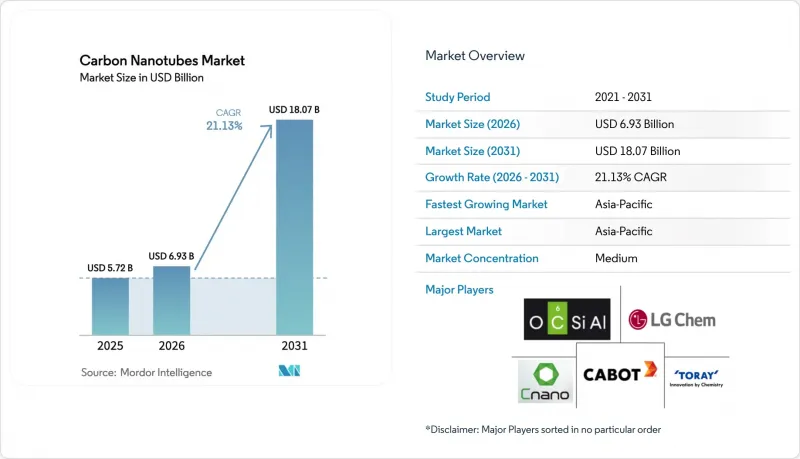
Mordor Intelligence에 따르면 탄소나노튜브 시장 규모는 2025년 57억 2,000만 달러에서 2026년에는 69억 3,000만 달러로 확대되어, 2026년부터 2031년까지 CAGR 21.13%를 기록하며 2031년에는 180억 7,000만 달러에 달할 것으로 예측됩니다.
본 보고서는 종류별(다층 탄소나노튜브, 단층 탄소나노튜브 등), 제조 방법별(화학 기상 증착법(CVD), 고압 일산화탄소법(HiPco) 등), 최종 이용 산업별(전기·전자,에너지, 자동차 등), 및 지역별(아시아태평양, 북미, 유럽 등)로 분류되어 있습니다. 시장 예측은 금액(달러) 및 톤으로 제시되어 있습니다.
세계 탄소나노튜브 시장의 동향 및 인사이트
e-모빌리티 붐이 CNT 수요를 가속화
현재, 전기자동차 배터리 팩에는 충방전 사이클 중에 팽창하는 실리콘·흑연 음극 전체에서 전자의 경로를 유지하기 위해 0.5-2.0 wt%의 CNT가 포함되어 있습니다. LG화학은 한국에 위치한 4개 공장에서 Tier 1 자동차 제조사와의 다년 계약에 따라 연간 6,100톤을 공급하며, 전 세계 플랫폼 출시에 필요한 공급을 확보하고 있습니다. 중국의 신에너지차 계획에 따르면 2025년까지 연간 5만 톤의 CNT 수요가 예상되지만, 장쑤 Cnano의 단일 거점에서의 연간 1만 2,000톤 생산능력은 이미 이 수요를 충족하고 있습니다. 인산철리튬(LFP) 계열 배터리로의 전환이 진행됨에 따라, LFP 셀에는 더 높은 전도성 첨가제의 첨가량이 필요하기 때문에 수요는 더욱 증가하고 있습니다. QuantumScape사와 삼성SDI사의 전고체 배터리 프로토타입에는 나노튜브로 만든 집전체가 탑재되어 있으며, CNT는 2030년대에 걸쳐 과도기적인 솔루션으로 자리매김하고 있습니다.
고에너지 밀도 리튬이온 배터리 및 슈퍼커패시터 생산의 도약
수직으로 배열된 CNT 포레스트는 1,000 m2/g을 초과하는 비표면적을 실현하여 10-15 kW/kg의 슈퍼커패시터 출력 밀도를 가능하게 합니다. Resonac Holdings사는 부하 급증을 완화하고 팩 수명을 연장하는 48V 마일드 하이브리드 모듈용 분산액을 공급하고 있습니다. 실험실 수준의 CNT-황 양극은 400 Wh/kg에 달하지만, 상용화 일정은 폴리설파이드 억제 대책에 달려 있습니다. 금호석유화학은 슈퍼커패시터용으로 금속 함량 100 ppm 미만의 초고순도 등급을 생산하는 연산 1,200톤 규모의 공장을 가동하고 있습니다. 캘리포니아주 및 독일의 전력망 프로젝트에서는 CNT 슈퍼커패시터 뱅크에 대한 실증 시험이 진행 중이며, 비용이 200달러/kWh 미만으로 떨어지면 2030년까지 연간 5,000톤의 수요가 예상됩니다.
EU 및 미국의 직업 독성학 및 나노 규제 강화
유럽화학제품청(ECHA)은 2024년, REACH 부속서 XIV에 근거하여 다층 탄소나노튜브(CNT)를 ‘극도로 우려되는 물질’로 지정했습니다. 이에 따라 연간 1톤 이상을 사용하는 사업자에게는 막대한 비용이 소요되는 허가 신청이 의무화되었습니다. 또한, NIOSH(미국 직업안전보건연구소)는 1µg/m³의 노출 한계치를 설정했습니다. 이에 따라 밀폐된 환경에서의 취급과 실시간 에어로졸 모니터링이 의무화되었으며, 중규모 플랜트의 경우 200만-500만 달러의 추가 설비 투자가 필요하게 되었습니다. 15µm을 초과하는 긴 CNT 섬유는 설치류의 폐에서 석면과 유사한 염증을 유발하는 것으로 확인되었으나, 인간을 대상으로 한 역학 연구는 여전히 제한적입니다. 유럽의 중소기업에서는 규정 준수 비용이 매출의 15%를 초과할 것으로 예상되어, 업계 재편이 가속화되고 있습니다. ISO 80004에 따른 용어 통일은 도움이 되고 있지만, 각국의 도입 상황 차이가 여전히 국경을 넘는 공급망의 걸림돌이 되고 있습니다. 각 제조사는 종횡비를 10:1 미만으로 낮추는 표면 처리 기술에 투자하고 있으며, 초기 체외(in vitro) 시험 결과 이 전략을 통해 세포 독성이 감소하는 것으로 나타났습니다.
부문 분석
다층 탄소나노튜브(MWCNT)는 2025년에 탄소나노튜브 시장 점유율의 90.03%를 차지했으며, 2031년까지 연평균 성장률(CAGR) 20.67%로 확대될 것으로 전망됩니다. kg당 50-300달러의 가격대는 최종 전도성보다 비용 민감도가 우선시되는 배터리, 복합재료, 플라스틱 분야의 수요를 확보하고 있습니다. 단층(SWCNT) 등급은 1,500-2,000달러/kg의 가격대를 형성하고 있어, 순도와 좁은 직경 분포가 중시되는 반도체 및 양자 컴퓨팅 용도로 제한되어 있습니다. OCSiAl사가 개발한 신흥 소층 탄소나노튜브는 SWCNT의 전도성의 70%를 유지하면서도 비용을 40%로 낮추고 있어, 성능을 희생하지 않고 첨가제 사용량을 줄이고자 하는 배터리 제조사들에게 매력적인 선택지가 되고 있습니다. 암체어형 SWCNT는 시트 저항이 100Ω/sq 이하로 떨어지는 시점에서 OLED 전도막으로의 응용이 기대되고 있으며, 이 이정표는 3년 이내에 달성될 것으로 전망됩니다.
공급 확장성 측면에서는 다층 탄소나노튜브(MWCNT)의 원료가 유리합니다. CVD 방식의 메가 플랜트에서는 HiPco나 레이저 어블레이션으로는 달성할 수 없는 생산량을 공급할 수 있기 때문입니다. 기본 시나리오에 따른 수요 전망에 따르면, 다층 탄소나노튜브 제품의 시장 규모는 2031년까지 130억 달러를 넘어설 것으로 예측됩니다. 직경이 커질수록 섬유의 생체 잔류성이 감소하므로 규제 당국의 승인 절차도 원활하게 진행됩니다. 한편, 지적재산권으로 보호되는 정제 기술을 채택한 프리미엄 단일층 탄소나노튜브 제품 라인은 높은 이익률을 유지하며, EBIT 기준 30-40%의 이익률을 자랑합니다. 두 부문에 걸쳐 사업을 영위하는 제조사들은 수익원을 다각화하여 대량 생산되는 범용 제품의 판매를 확보하는 한편, 포토닉스 및 양자 소자와 같은 특수한 틈새 시장을 개척하고 있습니다.
지역별 분석
아시아태평양은 2025년 출하량의 54.45%를 차지하며 주도적인 위치를 차지하고 있으며, 2026년부터 2031년까지 연평균 성장률(CAGR) 21.67%로 확대될 것으로 예측됩니다. 중국 장쑤성에 위치한 연간 1만 2,000톤의 생산능력을 갖춘 Cnano 복합 시설과, 한국 LG화학이 보유한 연간 6,100톤의 생산능력은 CATL, BYD, 삼성SDI, SK이노베이션에 대한 지역 공급망의 핵심 역할을 하고 있습니다. 일본은 도레이의 50억 엔 규모 프리프레그 생산 확대를 활용하여 항공우주 및 반도체용 고순도 제품 라인을 우선시하고 있습니다. 인도는 현재 수입에 의존하고 있지만, PLI 제도에 따른 인센티브로 인해 2028년까지 국내 CVD 프로젝트가 출범할 가능성이 있습니다. 석유화학 원료와의 통합 및 규모의 경제 효과로 인해, 다층 탄소나노튜브 등급의 지역 가격은 1kg당 50-80달러 수준입니다.
북미 시장의 성장은 항공우주, 방위, 에너지 저장 산업의 국내 조달에 좌우되고 있습니다. ‘인플레이션 감축법(Inflation Reduction Act)’의 세액 공제를 통해 배터리 기가팩토리와 병설되는 연간 2,000톤 규모의 신규 생산능력이 지원될 전망입니다. 캐나다의 Raymor사는 수력발전을 동력원으로 하는 저탄소 플라즈마 토치로 제조된 CNT를 판매하고 있으며, 멕시코에서는 자동차 부품 공급업체를 대상으로 분산 및 컴파운딩 서비스를 제공하고 있습니다.
유럽의 CNT 수요는 유럽 배터리 얼라이언스(European Battery Alliance)가 주도하는 현지 생산용 전도성 첨가제 추진에 힘입어 증가하고 있습니다. 나노실(Nanosil)과 아르케마(Arkema)는 에어버스(Airbus) 및 스텔란티스(Stellantis)의 플랫폼을 위해 중규모 공장을 운영하고 있지만, REACH 규정을 준수하기 위한 비용 증가로 인해 소규모 신규 진입 기업들에 압박을 가하고 있습니다. 토마스 스완(Thomas Swan)의 영국 생산 라인은 ITAR 규제로 인해 아시아로부터의 수입이 제한되고 있는 방위 분야의 수요를 확보하고 있습니다. 남미 및 중동 및 아프리카에서는 시장이 점진적으로 성장하고 있으며, 브라질은 농약 용도로 CNT를 수입하고 있고, 사우디아라비아는 ‘비전 2030’의 일환으로 석유화학 산업과의 통합을 검토하고 있습니다.
기타 혜택:
- 엑셀 형식의 시장 예측(ME) 시트
- 3개월간의 애널리스트 지원
목차
제1장 소개
제2장 조사 방법
제3장 주요 요약
제4장 시장 구도
제5장 시장 규모와 성장 예측
제6장 경쟁 구도
제7장 시장 기회와 향후 전망
KSMAccording to Mordor Intelligence, the carbon nanotubes market size is expected to grow from USD 5.72 billion in 2025 to USD 6.93 billion in 2026 and is forecast to reach USD 18.07 billion by 2031 at 21.13% CAGR over 2026-2031.
This report is Segmented by Type (Multi-Walled, Single-Walled, and More), Manufacturing Method (Chemical Vapor Deposition (CVD), High-Pressure Carbon Monoxide (HiPco), and More), End-Use Industry (Electrical and Electronics, Energy, Automotive, and More), and Geography (Asia-Pacific, North America, Europe, and More). Market Forecasts are Provided in Terms of Value (USD) and Volume (Tons).
Global Carbon Nanotubes Market Trends and Insights
E-mobility Boom Accelerating CNT Demand
Electric-vehicle battery packs now incorporate 0.5-2.0 wt% CNTs to maintain electron pathways across silicon-graphite anodes that swell during cycling. LG Chem's four South Korean plants deliver 6,100 tons/year output under multi-year contracts with Tier-1 automakers, locking in supply for global platform launches. China's New Energy Vehicle plan sets a 50,000 tons/year CNT requirement by 2025, already matched by Jiangsu Cnano's 12,000 tons/year single-site capacity. The migration toward lithium-iron-phosphate chemistries intensifies demand because LFP cells need higher conductive-additive loadings. Solid-state prototypes from QuantumScape and Samsung SDI embed nanotube current collectors, positioning CNTs as a bridging solution through the 2030s.
Leap in High-Energy-Density Li-ion and Supercapacitor Production
Vertically aligned CNT forests deliver surface areas above 1,000 m2/g that drive supercapacitor power densities of 10-15 kW/kg. Resonac Holdings supplies dispersions for 48-V mild-hybrid modules that buffer load spikes and extend pack life. Laboratory CNT-sulfur cathodes have reached 400 Wh/kg, though commercial timelines depend on polysulfide mitigation. Kumho Petrochemical operates a 1,200-ton/year plant delivering ultra-pure grades with <100 ppm metals for supercapacitors. Grid projects in California and Germany pilot CNT-supercapacitor banks that could absorb 5,000 tons/year by 2030 once costs fall below USD 200/kWh.
Occupational Toxicology and Nano-Regulation Tightening in EU and US
The European Chemicals Agency listed multi-walled CNTs as substances of very great concern under REACH Annex XIV in 2024, triggering costly authorization filings for users above 1 ton/year. NIOSH set a 1 µg/m3 exposure limit that forces enclosed handling and real-time aerosol monitoring, adding USD 2-5 million in capex for mid-scale plants. Long CNT fibers longer than 15 µm show asbestos-like inflammation in rodent lungs, though human epidemiology remains limited. Smaller European firms see compliance costs topping 15% of revenue, accelerating consolidation. ISO 80004 terminology harmonization helps, but divergent national rollouts still hamper cross-border supply chains. Producers invest in surface treatments that shorten aspect ratios below 10:1, a strategy that early in vitro assays suggest lowers cytotoxicity.
Other drivers and restraints analyzed in the detailed report include:
- Aerospace Push for Ultra-Light Structural Composites
- Additive Manufacturing Integration for Conductive Filaments
- Competition from Graphene and Boron-Nitride Nanotubes in Thermal Apps
For complete list of drivers and restraints, kindly check the Table Of Contents.
Segment Analysis
Multi-walled CNTs commanded 90.03% of carbon nanotubes market share in 2025 and are forecast to advance at a 20.67% CAGR through 2031. Pricing between USD 50-300/kg secures traction in battery, composite, and plastics lines where cost sensitivity overrides ultimate conductivity. Single-walled grades' USD 1,500-2,000/kg prices confine them to semiconductor and quantum-computing uses that prize purity and narrow diameter spread. Emerging few-walled variants from OCSiAl preserve 70% of SWCNT conductivity at 40% of the cost, enticing battery makers aiming to slash additive loadings without sacrificing performance. Armchair SWCNTs target OLED conductive films once sheet resistance falls below 100 Ω/sq, a milestone expected within three years.
Supply scalability favors multi-walled feedstock because CVD mega-plants deliver volumes unattainable with HiPco or laser ablation. The carbon nanotubes market size for multi-walled products is projected to exceed USD 13 billion by 2031 under base-case demand scenarios. Regulatory clearance is smoother as larger diameters reduce fiber biopersistence. Yet premium single-walled lines keep margins high through IP-protected purification, commanding 30-40% EBIT. Producers that straddle both tiers hedge revenue streams, capturing high-volume commodity sales while cultivating specialty niches in photonics and quantum devices.
Complete Report Scope:
- By Type
- Multi-Walled Carbon Nanotubes (MWCNT)
- Single-Walled Carbon Nanotubes (SWCNT)
- Other Types (Armchair, Zigzag, Double-Walled)
- By Manufacturing Method
- Chemical Vapor Deposition (CVD)
- High-Pressure Carbon Monoxide (HiPco)
- Arc Discharge
- Laser Ablation
- By End-Use Industry
- Electrical and Electronics
- Energy
- Automotive
- Aerospace and Defense
- Healthcare
- Other Industries (Textiles, Construction, Plastics and Composites)
- By Geography
- Asia-Pacific
- China
- India
- Japan
- South Korea
- Rest of Asia-Pacific
- North America
- United States
- Canada
- Mexico
- Europe
- Germany
- United Kingdom
- Italy
- France
- Spain
- Rest of Europe
- South America
- Brazil
- Argentina
- Rest of South America
- Middle East and Africa
- Saudi Arabia
- South Africa
- Rest of Middle East and Africa
- Asia-Pacific
Geography Analysis
Asia-Pacific dominated with 54.45% of the 2025 volume and is forecast to rise at a 21.67% CAGR during 2026-2031. China's 12,000-ton/year Jiangsu Cnano complex and South Korea's 6,100 tons/year LG Chem network anchor regional supply pipelines to CATL, BYD, Samsung SDI, and SK Innovation. Japan prioritizes high-purity lines for aerospace and semiconductors, leveraging Toray's ¥5 billion prepreg expansion. India relies on imports today, but incentives under its PLI scheme could spark domestic CVD projects by 2028. Regional pricing sits at USD 50-80/kg for multi-walled grades due to integration into petrochemical feedstocks and scale economies.
North America's market growth is influenced by domestic sourcing from the aerospace, defense, and energy storage industries. Inflation Reduction Act tax credits support potential 2,000-ton/year new capacity colocated with battery gigafactories. Canada's Raymor markets low-carbon plasma-torch CNTs powered by hydropower, while Mexico offers dispersion and compounding services for automotive suppliers.
Europe's captured CNT demand is bolstered by the European Battery Alliance's drive for local conductive additives. Nanocyl and Arkema operate mid-scale plants serving Airbus and Stellantis platforms, yet REACH compliance adds cost layers that pressure smaller entrants. Thomas Swan's U.K. lines secure defense demand where ITAR rules deter Asian imports. South America and the Middle East-Africa are witnessing gradual market growth, with Brazil importing CNTs for agrochemicals and Saudi Arabia studying petrochemical integration as part of Vision 2030.
- Applied Nanostructures, Inc.
- Arkema
- Cabot Corporation
- Carbon Solutions, Inc.
- CHASM
- Cheap Tubes
- Chengdu Organic Chemicals Co., Ltd.
- CNT Co., Ltd.
- FutureCarbon GmbH
- Hanwha Group
- Hyperion Catalysis International
- Jiangsu Cnano Technology Co., Ltd.
- Kumho Petrochemical
- LG Chem
- Meijo Nano Carbon Co.,Ltd
- Nano-C
- Nanocyl SA
- OCSiAl
- Raymor Industries Inc.
- Resonac Holdings Corporation
- Thomas Swan & Co., Ltd.
- Toray Industries, Inc.
- Zyvex Technologies
Additional Benefits:
- The market estimate (ME) sheet in Excel format
- 3 months of analyst support
TABLE OF CONTENTS
1 Introduction
- 1.1 Study Assumptions and Market Definition
- 1.2 Scope of the Study
2 Research Methodology
3 Executive Summary
4 Market Landscape
- 4.1 Market Overview
- 4.2 Market Drivers
- 4.2.1 E-mobility Boom Accelerating CNT Demand
- 4.2.2 Leap in High-Energy-Density Li-ion and Supercapacitor Production
- 4.2.3 Aerospace Push for Ultra-light Structural Composites
- 4.2.4 Desalination and Environmental Sensors Adoption in MEA and Asia
- 4.2.5 Additive Manufacturing Integration for Conductive Filaments
- 4.3 Market Restraints
- 4.3.1 Occupational Toxicology and Nano-regulation in Europe and United States
- 4.3.2 Competition from Graphene and Boron-Nitride Nanotubes in Thermal Apps
- 4.3.3 Patent Thickets Concentrating Licensing Costs
- 4.4 Value Chain Analysis
- 4.5 Porter's Five Forces Analysis
- 4.5.1 Bargaining Power of Suppliers
- 4.5.2 Bargaining Power of Buyers
- 4.5.3 Threat of New Entrants
- 4.5.4 Threat of Substitutes
- 4.5.5 Degree of Competition
- 4.6 Patent Analysis
5 Market Size and Growth Forecasts (Value and Volume)
- 5.1 By Type
- 5.1.1 Multi-Walled Carbon Nanotubes (MWCNT)
- 5.1.2 Single-Walled Carbon Nanotubes (SWCNT)
- 5.1.3 Other Types (Armchair, Zigzag, Double-Walled)
- 5.2 By Manufacturing Method
- 5.2.1 Chemical Vapor Deposition (CVD)
- 5.2.2 High-Pressure Carbon Monoxide (HiPco)
- 5.2.3 Arc Discharge
- 5.2.4 Laser Ablation
- 5.3 By End-Use Industry
- 5.3.1 Electrical and Electronics
- 5.3.2 Energy
- 5.3.3 Automotive
- 5.3.4 Aerospace and Defense
- 5.3.5 Healthcare
- 5.3.6 Other Industries (Textiles, Construction, Plastics and Composites)
- 5.4 By Geography
- 5.4.1 Asia-Pacific
- 5.4.1.1 China
- 5.4.1.2 India
- 5.4.1.3 Japan
- 5.4.1.4 South Korea
- 5.4.1.5 Rest of Asia-Pacific
- 5.4.2 North America
- 5.4.2.1 United States
- 5.4.2.2 Canada
- 5.4.2.3 Mexico
- 5.4.3 Europe
- 5.4.3.1 Germany
- 5.4.3.2 United Kingdom
- 5.4.3.3 Italy
- 5.4.3.4 France
- 5.4.3.5 Spain
- 5.4.3.6 Rest of Europe
- 5.4.4 South America
- 5.4.4.1 Brazil
- 5.4.4.2 Argentina
- 5.4.4.3 Rest of South America
- 5.4.5 Middle East and Africa
- 5.4.5.1 Saudi Arabia
- 5.4.5.2 South Africa
- 5.4.5.3 Rest of Middle East and Africa
- 5.4.1 Asia-Pacific
6 Competitive Landscape
- 6.1 Market Concentration
- 6.2 Strategic Moves
- 6.3 Market Share Analysis
- 6.4 Company Profiles (includes Global level Overview, Market level overview, Core Segments, Financials as available, Strategic Information, Products and Services, Recent Developments)
- 6.4.1 Applied Nanostructures, Inc.
- 6.4.2 Arkema
- 6.4.3 Cabot Corporation
- 6.4.4 Carbon Solutions, Inc.
- 6.4.5 CHASM
- 6.4.6 Cheap Tubes
- 6.4.7 Chengdu Organic Chemicals Co., Ltd.
- 6.4.8 CNT Co., Ltd.
- 6.4.9 FutureCarbon GmbH
- 6.4.10 Hanwha Group
- 6.4.11 Hyperion Catalysis International
- 6.4.12 Jiangsu Cnano Technology Co., Ltd.
- 6.4.13 Kumho Petrochemical
- 6.4.14 LG Chem
- 6.4.15 Meijo Nano Carbon Co.,Ltd
- 6.4.16 Nano-C
- 6.4.17 Nanocyl SA
- 6.4.18 OCSiAl
- 6.4.19 Raymor Industries Inc.
- 6.4.20 Resonac Holdings Corporation
- 6.4.21 Thomas Swan & Co., Ltd.
- 6.4.22 Toray Industries, Inc.
- 6.4.23 Zyvex Technologies
7 Market Opportunities and Future Outlook
- 7.1 White-Space and Unmet-Need Assessment
- 7.2 Increasing Demand for Energy Storage Devices