|
시장보고서
상품코드
2119556
데이터센터 상호연결 경로 인텔리전스 : 시장 점유율 분석, 업계 동향 및 통계, 성장 예측(2026-2031년)Data Center Interconnect Route Intelligence - Market Share Analysis, Industry Trends & Statistics, Growth Forecasts (2026 - 2031) |
||||||
 Mordor Intelligence
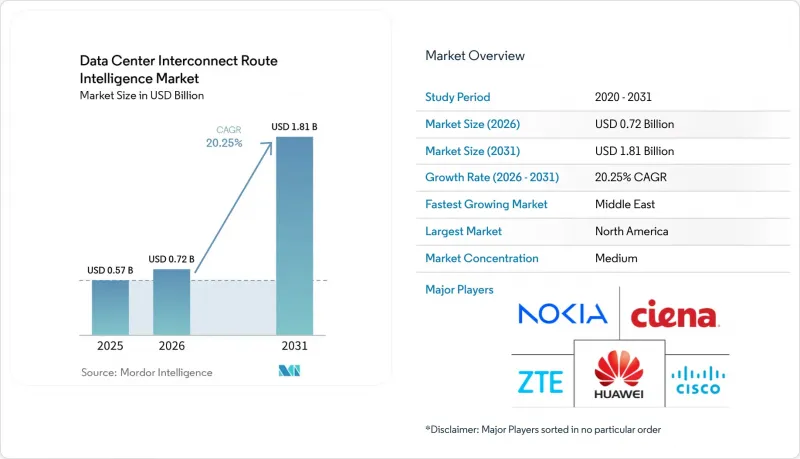
Mordor Intelligence에 의하면, 데이터센터 상호연결 경로 인텔리전스 시장 규모는 2025년 5억 7,000만 달러로 평가되었습니다. 2026년 7억 2,000만 달러에서 2031년까지 18억 1,000만 달러로 확대되고 2026년부터 2031년까지 연평균 복합 성장률(CAGR)은 20.25%를 나타낼 전망입니다.
본 보고서는 솔루션 계층(하드웨어 및 광전송, 경로 인텔리전스 소프트웨어 등), 연결 매체(다크 파이버 등), 데이터 전송 속도(최대 100G, 400G, 800G 등),용도(워크로드 및 데이터 모빌리티 등), 배포 모델(기업 소유 DCI 등), 그리고 지역별로 분류되어 있습니다. 시장 예측은 금액(달러) 기준으로 제시되어 있습니다.
세계의 데이터센터 상호연결 경로 인텔리전스 시장 동향 및 인사이트
AI 및 HPC의 대규모 배포
개별 시설에서는 필요한 전력, 부지 또는 연산 능력을 항상 제공할 수 있는 것은 아니기 때문에 AI 훈련 시스템은 현재 하나의 데이터센터를 넘어 확장되고 있습니다. NVIDIA의 보고서에 따르면, Spectrum-XGS 이더넷은 분리된 사이트 간에 표준 이더넷에 비해 최대 1.9배 더 높은 NCCL 올 리듀스 대역폭을 달성했습니다. Meta는 1GW의 계획 용량을 예상하여 Prometheus 클러스터를 설계하고, 각 리전 쌍마다 16-48 Pbps의 클러스터 간 백본 용량을 갖춘 백엔드 집약을 채택했습니다. 이 설계에서는 MACsec으로 보호되는 BGP, 링크 대역폭 속성 및 불균등 비용 멀티패스 라우팅을 채택하여 클러스터 패브릭 내에서 라우팅 결정을 내리도록 했습니다. KDDI 역시 30km에 걸쳐 분산된 GPU 트레이닝에서 단일 사이트 배포와 동등한 완료 시간을 달성했다고 보고했습니다. 따라서 통신 사업자가 순수 광 스루풋보다 GPU 활용 및 작업 완료를 우선시할 경우, 데이터센터 상호연결 경로 인텔리전스 시장이 그 혜택을 누리게 될 것입니다.
하이퍼스케일러와 네오클라우드의 확대
대규모 클라우드 및 AI 인프라 프로그램으로 인해 광 링크 및 경로 제어 플랫폼에 대한 집중적인 수주가 발생하고 있습니다. 소버린 AI 프로젝트는 용량 계획이 방대하고 조달이 대부분 중앙 집중화되어 있어, 다른 구매 패턴을 만들어내고 있습니다. 사우디아라비아의 Humain사는 2034년까지 6.6GW의 데이터센터용량을 목표로 하고 있으며, 200 MW 규모의 캠퍼스 초기 건설이 진행 중입니다. UAE의 ‘Stargate’는 19.2제곱킬로미터 부지에 5GW 용량을 목표로 하고 있으며, 프로젝트 비용은 300억 달러를 초과합니다. 이러한 동향으로 인해 캠퍼스, 경로, 서비스 제공업체를 아우르는 용량 계획의 필요성이 높아지고 있습니다. 데이터센터 상호연결 경로 인텔리전스 시장은 공급자가 짧은 도입 기간 내에 장비, 소프트웨어 및 통합 서비스를 제공해야 하기 때문에 수년에 걸친 공급업체와의 관계로부터 혜택을 받고 있습니다.
광 인프라 및 경로 인프라의 높은 자본 집약성
사설 DCI 네트워크에는 토목 공사, 광통신 장비, 경로 설계 및 운영에 있어 막대한 초기 투자가 필요합니다. 국제에너지기구(IEA)에 따르면, 인프라 프로젝트는 계획보다 20% 더 오래 걸리고 예산을 최대 80% 초과할 가능성이 있다고 합니다. 이러한 상황은 전용 광 경로 계획을 지연시키고, 소규모 사업자들의 태도를 더욱 신중하게 만드는 요인이 됩니다. 또한, 대용량 그리드 상호 연결의 경우에도 신규 시설 가동 개시 전에 대규모 네트워크 업그레이드가 필요할 수 있습니다. 이러한 제약은 여러 거점에 비용을 분산시킬 만한 규모를 갖추지 못한 기업이나 지역 통신사에게 특히 두드러집니다. 따라서 데이터센터 상호연결 경로 인텔리전스 시장에서는 공급자 관리형 및 코로케이션 기반 옵션이 선호되고 있습니다. 이러한 모델을 통해 인프라 비용의 일부를 전문 공급자에게 전가할 수 있기 때문입니다.
부문 분석
2025년, 하드웨어 및 광전송은 솔루션 계층 매출의 54.73%를 차지하며 데이터센터 상호연결 경로 인텔리전스 시장에서 가장 큰 점유율을 기록했습니다. 이 부문은 ROADM 도입, 코히런트 회선 시스템 업그레이드, 광 증폭기 갱신 및 지속적인 파장 추가에서 계속해서 중심적인 역할을 수행했습니다. Ciena Corporation, Nokia Oyj 및 Coherent Corp.는 하이퍼스케일러, 통신 사업자 및 코로케이션 제공업체의 섀시 기반 및 플러그인 가능한 하드웨어 요구 사항을 충족했습니다. 물리적 용량 증설에는 사이트 전반에 걸친 계획, 설치 및 테스트가 필요하기 때문에 하드웨어 수요는 수년에 걸친 투자 프로그램에 따라 추이를 보였습니다. 또한 기업 및 네오클라우드 사업자가 일상적인 경로 관리를 아웃소싱하기로 선택했을 때도 매니지드 커넥티비티 서비스가 수혜를 입었습니다.
경로 인텔리전스 소프트웨어는 2031년까지 연평균 성장률(CAGR) 21.46%를 나타낼 것으로 예측되며, 이는 해당 부문에서 가장 높은 성장률입니다. 구매자들은 정책 기반 라우팅, 네트워크 디지털 트윈, AI 기반 텔레메트리를 하드웨어 업그레이드와 별개의 구매 항목으로 간주하는 경향이 강해지고 있습니다. Smartoptics는 2026년 1월, 자사의 SoSmart 플랫폼에 파이버 경로 분석 기능과 개선된 용량 계획 기능을 추가하여, 사업자에게 스팬 수준의 손실 정보와 네트워크 전체의 경로 보기를 제공했습니다. 또한 Ciena사는 OFC 2026에서 어슈어런스, 라우팅 및 네트워크 디지털 트윈 검증을 위한 에이전트형 AI 기능을 발표했습니다. OCI MSA가 추진하는 오픈 옵틱스 로드맵은 물리적 인터페이스와 트래픽 제어에 사용되는 소프트웨어의 분리를 더욱 촉진하고 있습니다.
2025년, 파장 서비스는 접속 매체의 수익의 30.45%를 차지하며, 데이터센터 상호연결 경로 인텔리전스 시장의 이 부문에서 가장 큰 점유율을 기록했습니다. 통신 사업자들은 재해 복구 및 가용성 영역 간 연결에서 지연 및 가동 시간에 대한 서비스 수준 보장이 필요한 경우, 관리형 광 경로를 이용했습니다. 다크 파이버는 사설 광 네트워크를 구축하고 용량을 직접 제어하고자 하는 하이퍼스케일러에게 여전히 중요한 존재였습니다. 캐리어 이더넷은 더 낮은 대역폭 임계값에서 엔터프라이즈 배포에 계속 활용되었습니다. 해저 케이블 시스템은 규모는 작지만 대륙 간 클라우드 연결에 있어 전략적으로 중요한 매체로 남아 있었습니다. 마이크로소프트가 계획하고 있는 15,000km에 달하는 중공 코어 광섬유 구축은 이러한 인프라 프로그램이 장기적인 것임을 보여줍니다.
IPoDWDM 및 라우팅된 광 네트워킹은 2031년까지 연평균 성장률(CAGR) 22.69%로 확대될 것으로 예상되며, 이는 모든 연결 매체 중 가장 높은 성장률입니다. 이 아키텍처는 IP 라우팅과 DWDM 전송을 단일 플랫폼에 통합하여 개별 트랜스폰더 계층에 대한 의존도를 낮춥니다. IP Infusion은 네이티브 400G 및 800G ZR·ZR+ 광 모듈을 탑재한 ‘OcNOS 7.0’을 출시하고, 오픈 하드웨어 상에서 서비스 지원 경로를 구현하는 부문 라우팅 기능도 제공했습니다. 1Finity는 2026년 7월, Virtuora를 업데이트하여 L0부터 L3에 이르는 클라우드 네이티브이자 멀티 도메인·멀티 벤더를 지원하는 관리 기능을 제공했습니다. 이러한 도구를 통해 통신 사업자는 여러 벤더의 장비를 아우르며 라우팅 정책을 적용할 수 있게 됩니다.
지역별 분석
2025년, 북미는 전 세계 매출의 36.42%를 차지하며 데이터센터 상호연결 경로 인텔리전스 시장에서 가장 규모가 큰 지역 점유율을 확보했습니다. 미국은 버지니아주 북부, 댈러스, 피닉스, 실리콘밸리에서의 데이터센터 활동을 통해 이러한 위상의 상당 부분을 뒷받침했습니다. AI 클러스터와 멀티캠퍼스 아키텍처로 인해 이들 지역에서 경로 관리 플랫폼에 대한 수요가 증가했습니다. 캐나다에서는 온타리오주 및 퀘벡주에서의 확장으로 수요가 증가했습니다. 멕시코에서는 하이퍼스케일러에 인접한 초기 프로젝트를 통해 경로가 남쪽 방향으로 확장되었습니다. FERC의 RM26-4 명령은 네트워크 업그레이드 비용을 대용량 상호 연결에 배정함으로써 민간 인프라의 의사 결정에 영향을 미쳤습니다.
유럽과 아시아태평양 모두 DCI(데이터센터 간 연결) 수요가 두드러졌으나, 수요 패턴은 서로 달랐습니다. 독일, 프랑스, 네덜란드에서는 데이터 주권 요건에 의해 형성된 고밀도 코로케이션 패브릭과 국경을 넘는 경로에 의존하고 있었습니다. Ekinops는 벨기에 국내 600곳 이상의 거점에 걸쳐 있는 NEURON 네트워크에 대해 Proximus와 10년간의 기본 계약을 체결했으며, 2026년 하반기에 초기 도입을 예정하고 있습니다. NTT-ME는 2026년 1월, 도쿄의 주요 데이터센터 간을 연결하는 저지연·대역폭 보장형 링크 ‘Japan Premium Direct Connect All-Photonics Connect’를 개시했습니다. 중국은 AI 등급의 DCI 인프라에 대해 주권적이며 수직 통합형 접근 방식을 채택한 반면, 인도, 싱가포르, 호주에서는 클라우드 확장에 따라 수요가 증가했습니다.
중동은 2031년까지 연평균 성장률(CAGR) 21.74%를 나타낼 것으로 예측되며, 데이터센터 상호연결 경로 인텔리전스 시장 규모 측면에서 가장 빠르게 성장하는 지역입니다. Stargate UAE는 아부다비에서 5GW의 데이터센터용량을 목표로 하고 있으며, 마이크로소프트는 2029년까지 UAE에 총 152억 달러를 투자할 계획을 세우고 있습니다. 사우디아라비아의 Humain사는 2034년까지 6.6GW를 목표로 하고 있으며, 200 MW 규모의 캠퍼스 건설에 착수했습니다. 이러한 프로젝트에는 대량의 DCI 용량과 신규 시설 간의 조율된 경로 계획이 필요합니다. 아프리카는 여전히 DCI의 초기 단계에 있는 지역으로, 남아프리카공화국, 이집트, 케냐, 나이지리아에서는 케이블 상륙국과 기업의 클라우드 도입이 이를 뒷받침하고 있습니다. 아프리카에서의 경로 인텔리전스 활용은 여전히 Tier 1 통신사의 구축에 집중되어 있습니다.
기타 혜택 :
- 엑셀 형식 시장 예측(ME) 시트
- 3개월간의 애널리스트 지원
자주 묻는 질문
목차
제1장 서론
제2장 조사 방법
제3장 주요 요약
제4장 시장 구도
제5장 시장 규모 및 성장 예측
제6장 경쟁 구도
제7장 시장 기회 및 향후 전망
KTHAccording to Mordor Intelligence, the data center interconnect route intelligence market size is projected to expand from USD 0.57 billion in 2025 and USD 0.72 billion in 2026 to USD 1.81 billion by 2031, registering a CAGR of 20.25% between 2026 and 2031.
This report is Segmented by Solution Layer (Hardware and Optical Transport, Route-Intelligence Software, and More), Connectivity Medium (Dark Fiber, and More), Data Rate (Up To 100G, 400G, 800G, and More), Application (Workload and Data Mobility, and More), Deployment Model (Enterprise-Owned DCI, and More), and Geography. The Market Forecasts are Provided in Terms of Value (USD).
Global Data Center Interconnect Route Intelligence Market Trends and Insights
AI and HPC Scale-Across Deployments
AI training systems now extend across more than 1 data center because individual facilities cannot always provide the required power, land, or compute capacity. NVIDIA reported that Spectrum-XGS Ethernet delivered up to 1.9 times higher NCCL all-reduce bandwidth than standard Ethernet across separated sites. Meta designed its Prometheus cluster for 1 GW of planned capacity and used backend aggregation with 16-48 Pbps of inter-cluster backbone capacity for each regional pair. Its design used MACsec-secured BGP, link-bandwidth attributes, and unequal-cost multipath routing to place route decisions within the cluster fabric. KDDI also reported that distributed GPU training across 30 km achieved completion times comparable to those of a single-site deployment. The data center interconnect route intelligence market, therefore, benefits when operators prioritize GPU use and job completion over raw optical throughput.
Hyperscaler and Neocloud Expansion
Large cloud and AI infrastructure programs are creating concentrated orders for optical links and route-control platforms. Sovereign AI projects add a different buying pattern because their capacity plans are large and their procurement is often centralized. Saudi Arabia's Humain targeted 6.6 GW of data-center capacity by 2034, with initial construction of a 200 MW campus underway. Stargate UAE targeted 5 GW of capacity across a 19.2-square-kilometer site, with project cost exceeding USD 30 billion. These developments increase the need for capacity planning across campuses, routes, and service providers. The data center interconnect route intelligence market gains from multi-year supplier relationships because providers must deliver equipment, software, and integration services within short implementation windows.
High Capital Intensity of Optical and Route Infrastructure
Private DCI networks require significant upfront investment in civil works, optical equipment, route design, and operations. The International Energy Agency stated that infrastructure projects can take 20% longer than planned and can exceed budgets by up to 80%. These conditions can delay plans for dedicated optical routes and make smaller operators more cautious. Large-load grid interconnections can also require substantial network upgrades before new facilities can operate. The restraint is strongest for enterprises and regional carriers that lack the scale to spread costs across many sites. This has supported provider-managed and colocation-based options in the data center interconnect route intelligence market, as these models shift some infrastructure costs to specialized providers.
Other drivers and restraints analyzed in the detailed report include:
- Migration to 400G, 800G, and 1.6T Coherent Interconnects
- Cloud Availability-Zone Replication and Business Continuity
- Fiber, Power, and Permitting Constraints
For complete list of drivers and restraints, kindly check the Table Of Contents.
Segment Analysis
Hardware and Optical Transport accounted for 54.73% of solution-layer revenue in 2025, making it the largest share of the data center interconnect route intelligence market. The segment remained central to ROADM deployments, coherent line-system upgrades, optical amplifier refreshes, and continued wavelength additions. Ciena Corporation, Nokia Oyj, and Coherent Corp. served the chassis-based and pluggable hardware requirements of hyperscalers, carriers, and colocation providers. Hardware demand followed multiyear investment programs because physical capacity additions require planning, installation, and testing across sites. Managed Connectivity Services also benefited when enterprises and neocloud operators chose to outsource day-to-day route management.
Route-Intelligence Software is projected to grow at a 21.46% CAGR through 2031, the fastest rate in this segmentation. Buyers are increasingly treating policy-aware routing, network digital twins, and AI-supported telemetry as purchases that are separate from hardware upgrades. Smartoptics added Fiber Route Analysis and improved capacity planning to its SoSmart platform in January 2026, giving operators span-level loss information and route views across their networks. Ciena also presented agentic AI capabilities for assurance, routing, and network-digital-twin validation at OFC 2026. The open optical roadmap advanced by the OCI MSA further supports a separation between physical interfaces and the software used to control traffic.
Wavelength Services held 30.45% of connectivity-medium revenue in 2025, the largest share within this segmentation of the data center interconnect route intelligence market. Operators used managed optical paths when disaster recovery and availability-zone connections required service-level commitments for latency and uptime. Dark Fiber remained important for hyperscalers that built private optical networks and wanted direct control over capacity. Carrier Ethernet continued to serve enterprise deployments at lower bandwidth thresholds. Submarine Cable Systems remained a smaller but strategically important medium for intercontinental cloud connectivity. Microsoft's planned 15,000 km deployment of hollow-core fiber illustrated the long-cycle nature of such infrastructure programs.
IPoDWDM and Routed Optical Networking are expected to expand at a 22.69% CAGR through 2031, the highest rate among connectivity mediums. The architecture combines IP routing and DWDM transmission on 1 platform, reducing reliance on separate transponder layers. IP Infusion released OcNOS 7.0 with native 400G and 800G ZR and ZR+ optics, along with segment-routing features for service-aware paths on open hardware. 1Finity updated Virtuora in July 2026 to provide cloud-native, multi-domain and multi-vendor management from L0 through L3. These tools allow operators to apply route policies across equipment from more than 1 vendor.
Complete Report Scope:
- By Solution Layer
- Hardware and Optical Transport
- Route-Intelligence Software
- Managed Connectivity Services
- Professional Services and Integration
- By Connectivity Medium
- Dark Fiber
- Wavelength Services
- Carrier Ethernet
- IPoDWDM and Routed Optical Networking
- Submarine Cable Systems
- By Data Rate
- Up to 100G
- 200G and 300G
- 400G
- 800G
- 1.6T and Above
- By Application
- Real-Time Disaster Recovery and Business Continuity
- Shared Data and Resource Clustering
- Workload and Data Mobility
- AI Cluster Federation and GPU Scale-Across
- Cloud Availability-Zone Interconnection
- By Deployment Model
- Enterprise-Owned DCI
- Provider-Managed DCI
- Colocation-Based DCI
- Hybrid and Multi-Cloud DCI
- By Geography
- North America
- United States
- Canada
- Mexico
- South America
- Brazil
- Chile
- Argentina
- Rest of South America
- Europe
- Germany
- United Kingdom
- France
- Netherlands
- Russia
- Rest of Europe
- Asia-Pacific
- China
- India
- Japan
- Singapore
- Australia
- Rest of Asia-Pacific
- Middle East
- United Arab Emirates
- Saudi Arabia
- Qatar
- Turkey
- Rest of Middle East
- Africa
- South Africa
- Egypt
- Kenya
- Nigeria
- Rest of Africa
- North America
Geography Analysis
North America accounted for 36.42% of global revenue in 2025 and held the largest regional share of the data center interconnect route intelligence market. The United States supported most of this position through data-center activity in Northern Virginia, Dallas, Phoenix, and Silicon Valley. AI clusters and multi-campus architectures increased demand for route-management platforms in these locations. Canada added demand through expansion in Ontario and Quebec. Mexico extended routes southward through early hyperscaler-adjacent projects. FERC's RM26-4 order affected private infrastructure decisions by assigning the costs of network upgrades to large-load interconnections.
Europe and Asia-Pacific showed different demand patterns, although both had significant DCI requirements. Germany, France, and the Netherlands relied on dense colocation fabrics and cross-border routes shaped by data-sovereignty requirements. Ekinops secured a 10-year framework agreement with Proximus for the NEURON network across more than 600 Belgian sites, with initial deployment planned for the second half of 2026. NTT-ME launched Japan Premium Direct Connect All-Photonics Connect in January 2026 for low-latency, bandwidth-guaranteed links between major Tokyo data centers. China adopted a sovereign and vertically integrated approach to AI-grade DCI infrastructure, while India, Singapore, and Australia added demand through cloud expansion.
The Middle East is projected to grow at a 21.74% CAGR through 2031 and is the fastest-growing geography in the data center interconnect route intelligence market size. Stargate UAE targeted 5 GW of data-center capacity in Abu Dhabi, and Microsoft planned total UAE investment of USD 15.2 billion through 2029. Saudi Arabia's Humain targeted 6.6 GW by 2034 and began work on 200 MW campuses. These projects require large volumes of DCI capacity and coordinated route planning across new facilities. Africa remained an early-stage DCI region, with South Africa, Egypt, Kenya, and Nigeria supported by cable landing stations and enterprise cloud adoption. Route-intelligence use in Africa remained concentrated in tier-1 carrier deployments.
- Ciena Corporation
- Nokia Oyj
- Huawei Technologies Co., Ltd.
- ZTE Corporation
- Cisco Systems, Inc.
- Juniper Networks, Inc.
- Ekinops S.A.
- ADTRAN Holdings, Inc.
- Ribbon Communications Inc.
- Smartoptics Group AS
- PacketLight Networks Ltd.
- Lumentum Holdings Inc.
- Coherent Corp.
- Fujitsu Limited
- Arista Networks, Inc.
- Broadcom Inc.
- NVIDIA Corporation
Additional Benefits:
- The market estimate (ME) sheet in Excel format
- 3 months of analyst support
TABLE OF CONTENTS
1 INTRODUCTION
- 1.1 Study Assumptions and Market Definition
- 1.2 Scope of the Study
2 RESEARCH METHODOLOGY
3 EXECUTIVE SUMMARY
4 MARKET LANDSCAPE
- 4.1 Market Overview
- 4.2 Market Drivers
- 4.2.1 AI and HPC Scale-Across Deployments
- 4.2.2 Hyperscaler and Neocloud Expansion
- 4.2.3 Migration to 400G, 800G, and 1.6T Coherent Interconnects
- 4.2.4 Cloud Availability-Zone Replication and Business Continuity
- 4.2.5 Edge, 5G, and Distributed Data Center Growth
- 4.2.6 Route-Aware Resilience and Sovereign Infrastructure Planning
- 4.3 Market Restraints
- 4.3.1 High Capital Intensity of Optical and Route Infrastructure
- 4.3.2 Fiber, Power, and Permitting Constraints
- 4.3.3 Multi-Vendor Interoperability and Operational Complexity
- 4.3.4 Route-Level Security, Sovereignty, and Data-Residency Exposure
- 4.4 Impact of Macroeconomic Factors on the Market
- 4.5 Industry Value Chain Analysis
- 4.6 Regulatory Landscape
- 4.7 Technological Outlook
- 4.8 Porter's Five Forces Analysis
- 4.8.1 Threat of New Entrants
- 4.8.2 Bargaining Power of Suppliers
- 4.8.3 Bargaining Power of Buyers
- 4.8.4 Threat of Substitutes
- 4.8.5 Competitive Rivalry
5 MARKET SIZE AND GROWTH FORECASTS (VALUE)
- 5.1 By Solution Layer
- 5.1.1 Hardware and Optical Transport
- 5.1.2 Route-Intelligence Software
- 5.1.3 Managed Connectivity Services
- 5.1.4 Professional Services and Integration
- 5.2 By Connectivity Medium
- 5.2.1 Dark Fiber
- 5.2.2 Wavelength Services
- 5.2.3 Carrier Ethernet
- 5.2.4 IPoDWDM and Routed Optical Networking
- 5.2.5 Submarine Cable Systems
- 5.3 By Data Rate
- 5.3.1 Up to 100G
- 5.3.2 200G and 300G
- 5.3.3 400G
- 5.3.4 800G
- 5.3.5 1.6T and Above
- 5.4 By Application
- 5.4.1 Real-Time Disaster Recovery and Business Continuity
- 5.4.2 Shared Data and Resource Clustering
- 5.4.3 Workload and Data Mobility
- 5.4.4 AI Cluster Federation and GPU Scale-Across
- 5.4.5 Cloud Availability-Zone Interconnection
- 5.5 By Deployment Model
- 5.5.1 Enterprise-Owned DCI
- 5.5.2 Provider-Managed DCI
- 5.5.3 Colocation-Based DCI
- 5.5.4 Hybrid and Multi-Cloud DCI
- 5.6 By Geography
- 5.6.1 North America
- 5.6.1.1 United States
- 5.6.1.2 Canada
- 5.6.1.3 Mexico
- 5.6.2 South America
- 5.6.2.1 Brazil
- 5.6.2.2 Chile
- 5.6.2.3 Argentina
- 5.6.2.4 Rest of South America
- 5.6.3 Europe
- 5.6.3.1 Germany
- 5.6.3.2 United Kingdom
- 5.6.3.3 France
- 5.6.3.4 Netherlands
- 5.6.3.5 Russia
- 5.6.3.6 Rest of Europe
- 5.6.4 Asia-Pacific
- 5.6.4.1 China
- 5.6.4.2 India
- 5.6.4.3 Japan
- 5.6.4.4 Singapore
- 5.6.4.5 Australia
- 5.6.4.6 Rest of Asia-Pacific
- 5.6.5 Middle East
- 5.6.5.1 United Arab Emirates
- 5.6.5.2 Saudi Arabia
- 5.6.5.3 Qatar
- 5.6.5.4 Turkey
- 5.6.5.5 Rest of Middle East
- 5.6.6 Africa
- 5.6.6.1 South Africa
- 5.6.6.2 Egypt
- 5.6.6.3 Kenya
- 5.6.6.4 Nigeria
- 5.6.6.5 Rest of Africa
- 5.6.1 North America
6 COMPETITIVE LANDSCAPE
- 6.1 Market Concentration
- 6.2 Strategic Moves
- 6.3 Market Share Analysis
- 6.4 Company Profiles (includes Global Level Overview, Market Level Overview, Core Segments, Financials as available, Strategic Information, Market Rank/Share, Products and Services, Recent Developments)
- 6.4.1 Ciena Corporation
- 6.4.2 Nokia Oyj
- 6.4.3 Huawei Technologies Co., Ltd.
- 6.4.4 ZTE Corporation
- 6.4.5 Cisco Systems, Inc.
- 6.4.6 Juniper Networks, Inc.
- 6.4.7 Ekinops S.A.
- 6.4.8 ADTRAN Holdings, Inc.
- 6.4.9 Ribbon Communications Inc.
- 6.4.10 Smartoptics Group AS
- 6.4.11 PacketLight Networks Ltd.
- 6.4.12 Lumentum Holdings Inc.
- 6.4.13 Coherent Corp.
- 6.4.14 Fujitsu Limited
- 6.4.15 Arista Networks, Inc.
- 6.4.16 Broadcom Inc.
- 6.4.17 NVIDIA Corporation
7 MARKET OPPORTUNITIES AND FUTURE OUTLOOK
- 7.1 White-Space and Unmet-Need Assessment