|
시장보고서
상품코드
2119576
영국의 히트펌프 : 시장 점유율 분석, 업계 동향 및 통계, 성장 예측(2026-2031년)United Kingdom Heat Pumps - Market Share Analysis, Industry Trends & Statistics, Growth Forecasts (2026 - 2031) |
||||||
 Mordor Intelligence
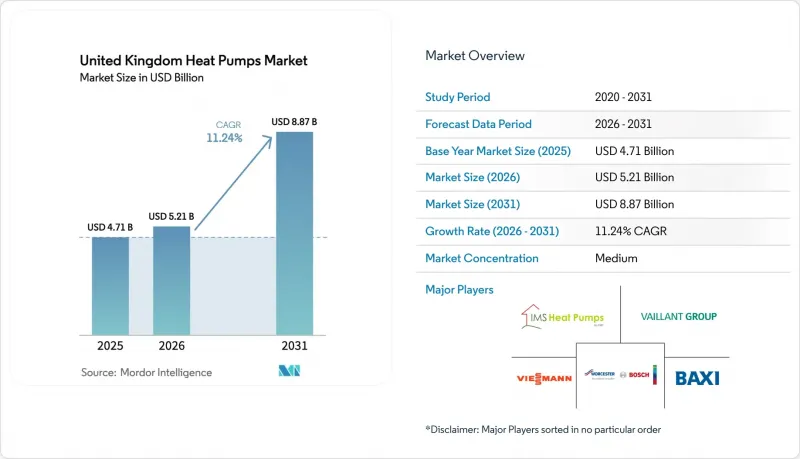
Mordor Intelligence에 의하면, 영국의 히트펌프 시장 규모는 2025년 47억 1,000만 달러로 평가되었습니다. 2026년에는 52억 1,000만 달러로 확대되어 2031년까지 88억 7,000만 달러에 이를 것으로 예상되고 2026년부터 2031년에 걸쳐 CAGR 11.24%로 성장할 전망입니다.
본 보고서는 열원 유형(공기원, 수원, 지하/지열원),정격 출력(10kW 이하, 10kW 초과), 시스템 설계(스플릿 시스템, 기타), 최종 사용자(주거용, 상업용, 기타), 용도(공간 냉난방, 온수 공급, 지역 난방, 공정 및 산업용 가열)별로 분류되어 있습니다. 시장 전망은 금액(미 달러) 기준으로 제시되어 있습니다.
영국의 히트펌프 시장 동향 및 인사이트
정부 규제 및 넷제로 목표
법적 구속력을 갖는 2050년 넷제로법에 따라, 난방 및 온수 공급이 국내 배출량의 37%를 차지함에 따라 열의 탈탄소화가 영국 기후 전략의 핵심으로 자리 잡고 있습니다. 2024년에 도입된 ‘청정 열 시장 메커니즘(Clean Heat Market Mechanism)’은 보일러 제조업체에 연간 판매 대수의 최소 8%를 히트펌프 제품으로 구성하도록 의무화하고 있으며, 가스 전용 제품 라인업에는 규정 준수 비용이 부과됩니다. 2025년에 시행될 ‘퓨처 홈스 스탠다드(Future Homes Standard)’에서는 신축 주택에 대해 2013년 기준치 대비 최대 80%의 탄소 배출량 감축이 요구되며, 이에 따라 향후 신축 주택에는 사실상 히트펌프 도입이 필수화됩니다. 여기에 더해 정부가 2028년까지 연간 60만 대 설치를 목표로 하고 있는 점도 맞물려, 이러한 정책 조치로 인해 제조업체들은 연구 개발의 중점을 응축식 보일러에서 첨단 히트펌프 플랫폼으로 전환할 수밖에 없게 되었습니다. 그 결과, 영국의 히트펌프 시장을 지탱할 지속적이고 장기적인 수요의 조짐이 보이고 있습니다.
보일러 교체 지원금 및 기타 재정적 인센티브
보일러 교체 제도에서는 2024년 10월 공기원 열펌프에 대한 보조금을 7,500파운드(9,500달러)로 인상하여, 일반 주택에서 가스 보일러와의 초기 비용 차이를 3,000-5,000파운드로 축소했습니다. 2025년 3월까지 월간 신청 건수는 전년 동월 대비 88% 증가했으나, 누적 총수는 연간 목표인 60만 대의 7% 미만에 그치고 있어 성장 여지가 크다는 점이 부각되고 있습니다. 스코틀랜드 농촌 지역을 대상으로 한 보조금(최대 9,000파운드) 등 지역별 추가 인센티브로 인해 남북 간 도입률에 격차가 발생하고 있지만, 한편 ‘히트 트레이닝 그랜트(Heat Training Grant)’는 설치 업체의 인증 비용을 충당하는 데 도움이 되고 있습니다. 자금 규모는 확대되었으나, 보조금에 대한 인지도와 설치 업체의 처리 능력이 여전히 병목 현상으로 작용하고 있어, 중기적으로는 금전적 우대 조치가 도입 대수를 지속적으로 촉진할 것으로 시사되고 있습니다.
저렴한 가스 보일러 교체가 주류
가스 보일러 교체 비용은 2,000-3,500파운드인 반면, 공기열원 히트펌프의 경우 보조금 적용 후에도 1만-1만 4,000파운드에 달하고, 초기 비용 차이가 여전히 크며, 자금 사정이 넉넉하지 않은 가구에게는 장벽이 되고 있습니다. 또한, 많은 소유자가 겨울에 기기가 고장 난 후에야 비로소 대응하는 경향이 있어, 행동의 관성에 의해 동종 보일러로의 교체가 고착화되고 있습니다. 6,000-9,000파운드 가격대이면서도 보조금 대상에서 제외된 하이브리드 히트펌프는 단계적인 전환 경로를 제공함으로써 순수 전기화로의 전환을 더욱 복잡하게 만들고 있습니다. ‘클린 히트 마켓 메커니즘(Clean Heat Market Mechanism)’은 제조업체만을 대상으로 하고 있기 때문에 설치 업체는 여전히 불이익을 받지 않고 보일러 교체에 집중할 수 있으며, 그 결과 영국의 히트펌프 시장의 단기적인 전환은 제한적인 수준에 머물고 있습니다.
부문 분석
2025년, 공기원 시스템은 매출의 73.83%라는 압도적인 점유율을 차지했습니다. 한편, 지열 유닛은 2031년까지 연평균 성장률(CAGR) 12.31%라는 놀라운 성장을 달성할 전망입니다. 공기열 시스템이 2025년 매출의 대부분을 차지한 이유는 영국의 일반적인 리모델링 공사에 적합하고, 가장 많은 보조금 대상이기 때문입니다. 주택 고객은 컴팩트한 스플릿 시스템의 형태를 중시하는 반면, 소규모 상업시설 구매자는 부분 부하에 맞추어 출력을 조절하는 인버터 압축기를 중요하게 여깁니다. 하지만 20년 이상 가동되는 학교, 사무실, 물류 센터의 경우, 수명 주기 비용 측면에서 지열식 설계가 점점 더 유리해지고 있습니다. 계절 성능 계수(SPF)가 4.0을 초과할 경우, 운영 비용을 최대 30%까지 절감할 수 있습니다. 폐쇄 루프 방식의 수직 시추 시스템은 도시 지역의 공간 제약을 극복할 수 있으며, 정부 지침에 따라 계획 승인 절차가 간소화됨에 따라 200 kW를 초과하는 프로젝트의 입찰 건수가 증가하고 있습니다. 열 네트워크 개발업체들이 재생 개발 부지에 공유 지중 배열을 도입함에 따라, 영국의 열펌프 시장에서는 2031년까지 지열 이용 보급률이 꾸준히 상승할 것으로 예측됩니다.
공기 대 공기 기술은 여전히 회색 지대에 속하는 틈새 시장이며, 2025년 초까지 약 22만 5,000대가 설치되었지만, ‘청정 열 시장 메커니즘(Clean Heat Market Mechanism)’의 적용 대상에서 제외되어 있습니다. 이 제외 조치가 철회된다면, 특히 온수식 개조가 현실적으로 어려운 공동 주택에서 성장이 가속화될 가능성이 있습니다. 한편, 새로 수립된 심층 지열 로드맵에서는 콘월과 미들랜드가 장기적인 중점 지역으로 지정되었으며, 2030년 이후에도 지역 열 공급망을 위한 베이스로드 열을 공급할 것으로 기대됩니다. 성공적인 실증 프로젝트는 영국 열펌프 시장에 새로운 분야를 개척할 가능성이 있으므로, 투자자들은 시범 사업의 성과를 주시하게 될 것입니다.
2025년에는 10kW 이하 유닛이 수요의 44.26%를 차지했으나, 30kW를 초과하는 시스템은 2031년까지 연평균 성장률(CAGR) 12.78%로 확대될 것으로 예측됩니다. 주거용 규모의 장비, 특히 10kW 이하의 제품은 단독주택이나 소규모 테라스 하우스에서의 점진적인 탈탄소화 추세를 뒷받침하고 있습니다. 교외의 인필 개발 프로젝트에서는 현재 10-20kW 시스템이 공동주택에 도입되어 있어 중앙 플랜트실이 필요 없게 되었습니다. 이는 허가 개발에 규정된 소음 제한을 준수하는 슬림형 실외기를 사용함으로써 가능해졌습니다. 20-30 kW 범위는 초등학교, 요양 시설, 편의점 등에 최적입니다. 이곳에서는 공간 난방과 온수 수요가 동시에 발생하기 때문에 숏 사이클링을 방지하기 위한 버퍼가 필요합니다.
성장의 추세는 30 kW를 초과하는 시스템, 특히 지역 난방 변전소나 산업용 공정 루프용 어레이로 이동하고 있습니다. 다이킨의 64,000개 시스템을 아우르는 ‘그레이터 맨체스터’의 5개년 프레임워크 계약은 지방자치단체의 기후 계획에 따른 대량 조달의 한 예입니다. 80-100°C의 온수를 공급하는 고온 플랫폼은 식품 제조 및 제지 공장에서 가스 보일러를 대체하고 있으며, ‘산업용 열회수 지원 프로그램’은 기업의 자본 예산에 대한 위험을 완화하기 위한 타당성 조사에 공동 투자하고 있습니다. 그 결과, 영국의 히트펌프 시장의 대용량 부문은 2031년까지 전체 시장 성장률을 상회할 것으로 예측되며, 이는 모듈식 및 컨테이너형 설계로공급망 전환을 촉진하고 있습니다.
기타 혜택 :
- 엑셀 형식 시장 예측(ME) 시트
- 3개월간의 애널리스트 지원
자주 묻는 질문
목차
제1장 서론
제2장 조사 방법
제3장 주요 요약
제4장 시장 구도
제5장 시장 규모 및 성장 예측
제6장 경쟁 구도
제7장 시장 기회 및 향후 전망
KTH 26.09.10According to Mordor Intelligence, the United Kingdom heat pumps market size is expected to increase from USD 4.71 billion in 2025 to USD 5.21 billion in 2026 and reach USD 8.87 billion by 2031, growing at a CAGR of 11.24% over 2026-2031.
This report is Segmented by Source Type (Air-Source, Water-Source, and Ground/Geothermal Source), Rated Capacity (Up To 10 KW, and More), System Design (Split System, and More), End-User (Residential, Commercial, and More), Application (Space Heating and Cooling, Water Heating, District Heating, and Process and Industrial Heating). The Market Forecasts are Provided in Terms of Value (USD).
United Kingdom Heat Pumps Market Trends and Insights
Government Regulations and Net-Zero Targets
Legally binding 2050 net-zero legislation places heat decarbonization at the center of the United Kingdom's climate strategy, as space and water heating account for 37% of national emissions. The Clean Heat Market Mechanism, introduced in 2024, obliges boiler brands to ensure heat pumps represent at least 8% of annual sales, embedding a compliance cost on gas-only portfolios. The Future Homes Standard, implemented in 2025, requires new houses to cut carbon emissions by up to 80% relative to 2013 baselines, effectively locking heat pumps into all future residential constructions. Combined with the government's 600,000-unit annual installation target for 2028, these policy levers push manufacturers to redirect R&D away from condensing boilers toward advanced heat-pump platforms. The result is a durable, long-horizon demand signal that anchors the United Kingdom heat pumps market.
Boiler Upgrade Scheme Grants and Other Financial Incentives
The Boiler Upgrade Scheme lifted its air-source grant to GBP 7,500 (USD 9,500) in October 2024, slashing the upfront premium over a gas boiler to GBP 3,000-5,000 for a typical home. Monthly applications rose 88% year-on-year by March 2025, yet the cumulative total still covers less than 7% of the 600,000-unit annual target, underscoring the runway for growth. Additional regional incentives, such as Scotland's rural grant of up to GBP 9,000, create a north-south uptake gradient, while the Heat Training Grant helps defray installer accreditation costs. Although funding pools have been expanded, grant awareness and installer throughput remain gating factors, suggesting financial sweeteners should continue to stimulate volume in the medium term.
Prevalence of Cheaper Gas-Boiler Replacements
Replacing a gas boiler costs GBP 2,000-3,500 versus GBP 10,000-14,000 for an air-source heat pump, even after subsidies, keeping a sizeable upfront premium that deters cash-constrained households. Behavioural inertia reinforces like-for-like boiler swaps, as many owners act only when a unit fails in winter. Hybrid heat pumps, priced between GBP 6,000-9,000 yet ineligible for grants, further complicate pure electrification by offering an incremental pathway. Because the Clean Heat Market Mechanism targets only manufacturers, installer businesses can still focus on boiler replacements without penalty, limiting near-term conversion in the United Kingdom heat pump market.
Other drivers and restraints analyzed in the detailed report include:
- Rising Electricity-Gas Price Differential Favouring Heat Pumps
- Domestic Manufacturing Scale-up via Heat Pump Investment Accelerator
- Shortage of Qualified Heat-Pump Installers
For complete list of drivers and restraints, kindly check the Table Of Contents.
Segment Analysis
In 2025, air-source systems commanded a dominant 73.83% share of the revenue. Meanwhile, ground-source units are on track to achieve a notable 12.31% CAGR through 2031. Air-source units captured the lion's share of 2025's revenue, because they fit typical U.K. retrofits and qualify for the largest subsidy. Residential customers prize the compact split-system form factor, while light-commercial buyers value inverter compressors that modulate to partial loads. Nevertheless, lifecycle economics increasingly favor ground-source designs in schools, offices, and logistics centers that operate for 20-plus years. Seasonal performance factors above 4.0 shave operating costs by up to 30%. Closed-loop vertical borehole systems overcome urban space limits, and government guidance has simplified planning approval, boosting tender volumes for projects above 200 kW. As heat-network developers bundle shared ground arrays into regeneration sites, the United Kingdom heat pumps market is expected to see ground-source penetration rise steadily through 2031.
Air-to-air technology remains a gray-area niche, with roughly 225,000 units installed by early 2025 but excluded from the Clean Heat Market Mechanism. Removal of that exclusion could accelerate growth, especially in flats where hydronic retrofits are impractical. Meanwhile, the emerging deep-geothermal roadmap identifies Cornwall and the Midlands as long-term hot spots, offering baseload heat for district grids beyond 2030. Investors will watch pilot outcomes closely, as successful demonstrators could open a new vertical within the United Kingdom heat pumps market.
In 2025, units up to 10 kW made up 44.26% of the demand, while systems exceeding 30 kW are projected to expand at a CAGR of 12.78% through 2031. Equipment in the residential scale, particularly those up to 10 kW, underscores the gradual decarbonization trend in detached houses and small terrace homes. In suburban infill projects, 10-20 kW systems are now catering to multi-family blocks, eliminating the need for central plant rooms. This is made possible by using low-profile outdoor units that adhere to noise limits set by permitted developments. The 20-30 kW range is ideal for primary schools, care homes, and convenience retail outlets. Here, the simultaneous demands for space heating and domestic hot water necessitate buffers to prevent short cycling.
Growth is shifting toward systems above 30 kW, especially arrays for district-heating substations and industrial process loops. Daikin's five-year Greater Manchester framework, covering 64,000 systems, exemplifies volume procurement aligned with local-authority climate plans. High-temperature platforms that deliver 80-100 °C water are displacing gas boilers in food manufacture and paper mills, and the Industrial Heat Recovery Support program co-funds feasibility studies that derisk corporate capital budgets. As a result, the large-capacity slice of the United Kingdom heat pumps market is forecast to outpace the aggregate growth rate through 2031, reinforcing supply-chain moves toward modular, containerized designs.
Complete Report Scope:
- By Source Type
- Air-Source
- Air-to-Air
- Air-to-Water
- Water-Source
- Surface Water
- Open Loop
- Ground / Geothermal Source
- Closed Loop Vertical
- Closed Loop Horizontal
- Direct Expansion
- Air-Source
- By Rated Capacity
- Up to 10 kW
- 10-20 kW
- 20-30 kW
- Above 30 kW
- By System Design
- Split System
- Monobloc
- Hybrid Heat Pump
- By End-User
- Residential
- Commercial
- Industrial
- Institutional
- By Application
- Space Heating and Cooling
- Water Heating
- District Heating
- Process and Industrial Heating
List of Companies Covered in this Report:
- IMS Heat Pumps
- Vaillant Group
- Baxi Heating UK
- Viessmann Group
- Worcestor Bosch Group
- Ideal Heating
- Zehnder Group
- Daikin Airconditioning UK
- Danfoss
- Kensa Heat Pumps
- Mitsubishi Electric UK
- NIBE Energy Systems
- Panasonic Climate Solutions UK
- LG Electronics UK
- Samsung Climate Solutions UK
- Grant Engineering UK
- Glen Dimplex Heating and Ventilation
- Octopus Energy (Home Energy Tech)
- Midea UK
- Stiebel Eltron UK
Additional Benefits:
- The market estimate (ME) sheet in Excel format
- 3 months of analyst support
TABLE OF CONTENTS
1 INTRODUCTION
- 1.1 Study Assumptions and Market Definition
- 1.2 Scope of the Study
2 RESEARCH METHODOLOGY
3 EXECUTIVE SUMMARY
4 MARKET LANDSCAPE
- 4.1 Market Overview
- 4.2 Market Drivers
- 4.2.1 Government Regulations and Net-Zero Targets
- 4.2.2 Boiler Upgrade Scheme Grants and Other Financial Incentives
- 4.2.3 Recovering Office-Space Demand and HVAC Retrofits
- 4.2.4 Rising Electricity-Gas Price Differential Favouring Heat Pumps
- 4.2.5 Flexible Tariff and Demand-Side Response Integration
- 4.2.6 Domestic Manufacturing Scale-up via Heat Pump Investment Accelerator
- 4.3 Market Restraints
- 4.3.1 Prevalence of Cheaper Gas-Boiler Replacements
- 4.3.2 Shortage of Qualified Heat-Pump Installers
- 4.3.3 Local Distribution-Grid Capacity Constraints
- 4.3.4 Semiconductor and Rare-Earth Magnet Supply Risks
- 4.4 Industry Supply- Chain Analysis
- 4.5 Regulatory Landscape
- 4.6 Technological Outlook
- 4.7 Impact of Macroeconomic Factors on the Market
- 4.8 Porter's Five Forces Analysis
- 4.8.1 Bargaining Power of Suppliers
- 4.8.2 Bargaining Power of Consumers
- 4.8.3 Threat of New Entrants
- 4.8.4 Intensity of Competitive Rivalry
- 4.8.5 Threat of Substitutes
5 MARKET SIZE AND GROWTH FORECASTS (VALUE)
- 5.1 By Source Type
- 5.1.1 Air-Source
- 5.1.1.1 Air-to-Air
- 5.1.1.2 Air-to-Water
- 5.1.2 Water-Source
- 5.1.2.1 Surface Water
- 5.1.2.2 Open Loop
- 5.1.3 Ground / Geothermal Source
- 5.1.3.1 Closed Loop Vertical
- 5.1.3.2 Closed Loop Horizontal
- 5.1.3.3 Direct Expansion
- 5.1.1 Air-Source
- 5.2 By Rated Capacity
- 5.2.1 Up to 10 kW
- 5.2.2 10-20 kW
- 5.2.3 20-30 kW
- 5.2.4 Above 30 kW
- 5.3 By System Design
- 5.3.1 Split System
- 5.3.2 Monobloc
- 5.3.3 Hybrid Heat Pump
- 5.4 By End-User
- 5.4.1 Residential
- 5.4.2 Commercial
- 5.4.3 Industrial
- 5.4.4 Institutional
- 5.5 By Application
- 5.5.1 Space Heating and Cooling
- 5.5.2 Water Heating
- 5.5.3 District Heating
- 5.5.4 Process and Industrial Heating
6 COMPETITIVE LANDSCAPE
- 6.1 Market Concentration
- 6.2 Strategic Moves
- 6.3 Market Share Analysis
- 6.4 Company Profiles (Includes Global Level Overview, Market Level Overview, Core Segments, Financials as Available, Strategic Information, Market Rank/Share, Products and Services, and Recent Developments)
- 6.4.1 IMS Heat Pumps
- 6.4.2 Vaillant Group
- 6.4.3 Baxi Heating UK
- 6.4.4 Viessmann Group
- 6.4.5 Worcestor Bosch Group
- 6.4.6 Ideal Heating
- 6.4.7 Zehnder Group
- 6.4.8 Daikin Airconditioning UK
- 6.4.9 Danfoss
- 6.4.10 Kensa Heat Pumps
- 6.4.11 Mitsubishi Electric UK
- 6.4.12 NIBE Energy Systems
- 6.4.13 Panasonic Climate Solutions UK
- 6.4.14 LG Electronics UK
- 6.4.15 Samsung Climate Solutions UK
- 6.4.16 Grant Engineering UK
- 6.4.17 Glen Dimplex Heating and Ventilation
- 6.4.18 Octopus Energy (Home Energy Tech)
- 6.4.19 Midea UK
- 6.4.20 Stiebel Eltron UK
7 MARKET OPPORTUNITIES AND FUTURE OUTLOOK
- 7.1 White-Space and Unmet-Need Assessment