
|
시장보고서
상품코드
2119065
아프리카의 와이어 및 케이블 : 시장 점유율 분석, 산업 동향 및 통계 데이터, 성장 예측(2026-2031년)Africa Wire and Cable - Market Share Analysis, Industry Trends & Statistics, Growth Forecasts (2026 - 2031) |
||||||
 Mordor Intelligence
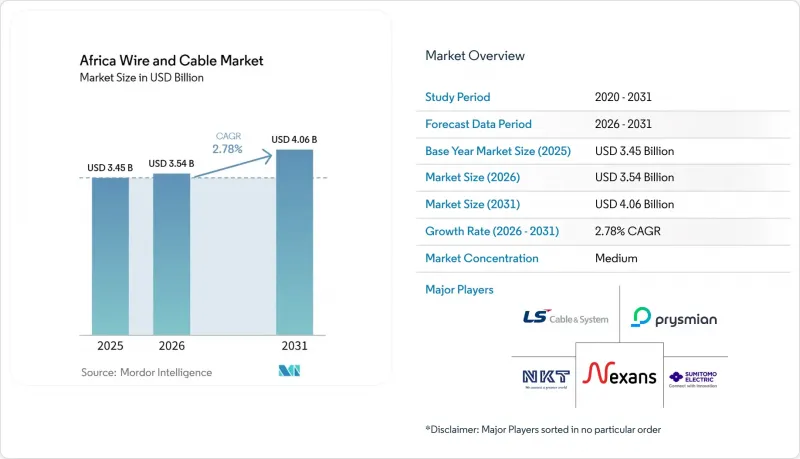
Mordor Intelligence에 의하면, 아프리카의 와이어 및 케이블 시장 규모는 2025년에 34억 5,000만 달러로 평가되었습니다. 2026년 35억 5,000만 달러에서 2031년까지 40억 6,000만 달러에 이를 것으로 추정되고 예측 기간(2026-2031년) CAGR은 2.78%를 나타낼 전망입니다.
본 보고서는 전압(저전압, 중전압, 초고전압), 케이블 유형(전력 케이블, 광섬유 케이블 등), 도체(구리 등), 부설 방법(가공, 지하, 해저), 최종 사용자(건설(주택), 기타),절연(절연재 포함, 절연재 없음), 지역(알제리, 케냐, 모로코, 기타)별로 분류되어 있습니다. 시장 예측은 금액(달러) 기준으로 제시되어 있습니다.
아프리카의 와이어 및 케이블 시장 동향 및 인사이트
국경을 초월한 전력 풀 및 국내 전기화를 위한 다자간 자금 조달
다자간 자금 조달은 지역 전력 풀 전반에 걸친 송전 및 배전 케이블의 장기적인 수요를 뒷받침했습니다. 세계은행은 2025년, 송전망, 국경을 넘는 상호 연결, 그리고 다음 날 시장을 통해 동아프리카 전력 풀(EAPP)을 강화하기 위해 16억 달러의 자금 지원을 승인했습니다. 이 프로그램은 2031년까지 연간 5,000 기가와트시 이상의 국경을 넘는 전력 거래를 지원하기 위해 설계되었습니다. 카메룬-차드 간 연계 사업 또한 세계은행, 아프리카개발은행, 이슬람개발은행, 유럽연합으로부터 공동 자금을 지원받아 CAPP 마스터플랜이 2026년 2분기에 최종 확정되었습니다. 이러한 프로젝트들은 송전선로 건설, 변전소 통합, 그리고 그에 따른 배전망 확장에 대한 수요를 창출했습니다. 지역 프로젝트는 고립된 지역 사업보다 공통된 기술 사양과 장기적인 조달 프로그램이 필요하기 때문에 아프리카의 와이어 및 케이블 시장은 그 혜택을 누렸습니다.
재생에너지 및 계통 연계 케이블 구축
재생에너지에 대한 투자로 인해 발전소와 수요지를 연결하는 케이블 회선의 필요성이 높아졌습니다. 아프리카에서는 2020년부터 2025년에 걸쳐 청정 전력 기술에 340억 달러가 투자되었으며, 이 중 태양광 발전이 52%, 육상 풍력이 25%를 차지했습니다. 많은 태양광 및 풍력 자원이 주요 도시에서 멀리 떨어진 곳에 위치해 있어, 신규 프로젝트마다 송전 수요가 증가합니다. 이러한 추세가 고압 시스템, 계통 연계 및 변전소용 케이블 수요를 뒷받침했습니다. 모로코가 제안한 ‘시라-아틀란틱 회랑’은 15기가와트의 재생에너지 발전 용량과 유럽으로 이어지는 4,800킬로미터에 달하는 해저 케이블 연결을 결합한 프로젝트입니다. 따라서 아프리카의 와이어 및 케이블 시장은 발전 측 연결과 장거리 송전 인프라를 모두 필요로 하는 프로젝트의 혜택을 받았습니다.
구리, 알루미늄, 폴리머의 가격 변동
원자재 비용은 케이블 제조업체와 프로젝트 도급업체에게 여전히 직접적인 상업적 위험 요인이었습니다. 많은 유형의 케이블에서 구리봉이 원자재 비용의 55-65%를 차지하고 있으며, 잠비아와 콩고 민주 공화국 이외의 지역에서는 제련 능력이 제한적이어서 세계 가격 변동의 영향을 받기 쉬웠습니다. 구리 가격은 2025년까지 40% 상승하여 2026년 1월에는 일시적으로 톤당 1만 4,000달러를 넘어섰으나, 이후 톤당 1만 1,980달러까지 하락했습니다. 이러한 가격 변동은 특히 중소 제조업체의 고정 가격 계약 및 운전 자금에 압박을 가했습니다. 알루미늄과 절연재 역시 세계 원자재 가격 및 에너지 가격 변동의 영향을 받아 비용 부담이 더욱 가중되었습니다. 아프리카의 와이어 및 케이블 시장에서는 규정 준수 비용과 물류 비용이 높은 현지 생산 제품에 대해 저가 수입품이 경쟁을 벌이면서 추가적인 압박에 직면했습니다.
부문별 분석
2025년, 저전압 케이블은 주택용 배선, 라스트 마일 배전 및 상업용 건축에 힘입어 아프리카의 와이어 및 케이블 시장 점유율의 56.38%를 차지했습니다. 이러한 기존 수요 기반은 가정과 소규모 사업자를 전력망에 지속적으로 연결해야 할 필요성을 반영한 것입니다. 배전망 확장은 정식 주택, 소매 시설 개발 및 공공시설 정비에 수반되므로 지리적으로 광범위하게 이루어지고 있습니다. 이러한 용도로 인해 수요는 송전 주도형 조달에 비해 집중도가 낮습니다. 배전망 확장에 따라 연장, 교체 및 신규 서비스 연결이 필요해짐에 따라, 저전압 제품은 송전망 업그레이드에서도 계속해서 중요한 역할을 수행했습니다. 중전압 케이블은 산업 시설, 상업 지구, 농업·공업 단지 및 송전망 밀집화 프로그램에 활용되었습니다. 남아프리카, 케냐, 이집트의 국가 표준에 따라, 이러한 용도 분야에서 경쟁하는 공급업체들에게는 표준 준수 능력이 중요해졌습니다.
초고압 및 고압 케이블은 2026년부터 2031년까지 연평균 성장률(CAGR) 3.24%로 확대될 것으로 예상되며, 전압 범주 중 가장 빠르게 성장하는 분야가 될 전망입니다. 이 부문은 특수 도체 및 관련 부속품이 필요한 전력 풀 간 연계선과 재생에너지 회랑에 의해 뒷받침되었습니다. 대규모 송전 계획에서는 변전소, 시험 및 설치에 관한 전문 지식도 필수적이었습니다. 아프리카의 와이어 및 케이블 시장에서 이러한 요인들은 기술적으로 수준 높은 프로젝트 실적과 인증된 품질 관리 시스템을 갖춘 공급업체에 유리하게 작용했습니다.
2025년, 전력 케이블은 아프리카의 와이어 및 케이블 시장 규모의 64.72%를 차지하며 매출 기준 주요 케이블 유형이 되었습니다. 전기화, 송전망 현대화 및 재생에너지 연계가 폭넓은 수요 기반을 뒷받침했습니다. 이 부문은 송전, 배전 및 주요 산업용 전력 수요에 사용되는 핵심 시스템을 공급했습니다. 신호 및 제어 케이블은 정유시설, 광산, 공장 및 기타 공정 운영의 요구 사항을 충족시켰습니다. 동축 케이블 및 데이터 케이블은 구형 통신 시스템과 도시 지역 감시 설비에서 계속해서 중요한 역할을 수행했습니다.
광섬유 케이블은 2031년까지 연평균 성장률(CAGR) 3.37%를 나타낼 것으로 예측되며, 이는 케이블 유형 중 가장 높은 성장률입니다. 해저 시스템의 경우, 해저 케이블이 육지에 상륙한 후 육상 광섬유 경로가 필요했으며, 새로운 데이터 시설에서는 고밀도의 내부 및 외부 광 연결이 요구되었습니다. 또한, 2025년에 콜먼 와이어스 앤 케이블스(Coleman Wires & Cables)사가 오군주에 광섬유 공장을 가동함에 따라 현지 생산의 중요성도 높아졌습니다. 이 공장의 연간 생산 능력은 900만 가닥으로, 아프리카 대륙 전체 광섬유 수요의 최대 50%를 충당하는 것을 목표로 했습니다. 광섬유에 대한 투자로 인해 아프리카의 와이어 및 케이블 시장은 전력 인프라의 범위를 넘어 확장되었으며, 네트워크 사업자, 데이터센터 개발업체, 통신사가 새로운 구매층으로 합류했습니다.
기타 혜택 :
- 엑셀 형식 시장 예측(ME) 시트
- 3개월간의 애널리스트 지원
자주 묻는 질문
목차
제1장 서론
제2장 분석 방법
제3장 주요 요약
제4장 시장 구도
제5장 시장 규모 및 성장률 예측
제6장 경쟁 구도
제7장 시장 기회 및 향후 전망
KTH 26.09.04According to Mordor Intelligence, the Africa wire and cable market size was valued at USD 3.45 billion in 2025 and estimated to grow from USD 3.55 billion in 2026 to reach USD 4.06 billion by 2031, at a CAGR of 2.78% during the forecast period (2026-2031).
This report is Segmented by Voltage (Low, Medium, and Extra- and High-Voltage), Cable Type (Power, Fiber-Optic, and More), Conductor (Copper, and More), Installation (Overhead, Underground, and Submarine), End-User (Construction - Residential, and More), Insulation (Insulated, and Non-Insulated) and Geography (Algeria, Kenya, Morocco, and More). The Market Forecasts are Provided in Terms of Value (USD).
Africa Wire and Cable Market Trends and Insights
Multilateral Financing for Cross-Border Power Pools and National Electrification
Multilateral financing supported long-term demand for transmission and distribution cables across regional power pools. The World Bank approved USD 1.6 billion in 2025 to strengthen the Eastern Africa Power Pool through transmission networks, cross-border interconnection, and a day-ahead market. The program was designed to support more than 5,000 gigawatt-hours of annual cross-border electricity trade by 2031. The Cameroon-Chad interconnection also drew co-financing from the World Bank, the African Development Bank, the Islamic Development Bank, and the European Union, while the CAPP Master Plan was finalized in the second quarter of 2026. These projects created demand during transmission construction, substation integration, and later distribution expansion. The Africa wire and cable market benefited because regional projects require common technical specifications and longer procurement programs than isolated local works.
Renewable Energy and Grid-Connection Cable Build-Out
Renewable energy investment increased the need for cable links between generation sites and demand centers. Africa invested USD 34 billion in clean power technologies from 2020 through 2025, with solar receiving 52% and onshore wind receiving 25%. Many solar and wind resources are located far from major cities, which increases transmission requirements for each new project. This pattern supported demand for high-voltage systems, grid connections, and substation cable. Morocco's proposed Sila Atlantik corridor combined 15 gigawatts of renewable capacity with a planned 4,800-kilometer subsea link to Europe. The Africa wire and cable market, therefore, benefited from projects that required both generation-side connections and long-distance export infrastructure.
Copper, Aluminum, and Polymer Price Volatility
Material costs remained a direct commercial risk for cable producers and project contractors. Copper rod accounted for 55-65% of raw material costs across many cable types, and limited refining outside Zambia and the Democratic Republic of Congo increased exposure to global pricing. Copper prices rose by 40% over 2025 and briefly exceeded USD 14,000 per ton in January 2026 before falling to USD 11,980 per ton. This movement put pressure on fixed-price contracts and working capital, especially for smaller manufacturers. Aluminum and insulation compounds added to the cost burden because they were also subject to global commodity and energy price movements. The Africa wire and cable market faced additional pressure as low-priced imports competed with locally manufactured products, which incurred higher compliance and logistics costs.
Other drivers and restraints analyzed in the detailed report include:
- Fiber Backbone, Submarine Landing, and Data Center Expansion
- Urbanization, Industrialization, and Construction Electrification
- Currency Depreciation and High Project Financing Costs
For complete list of drivers and restraints, kindly check the Table Of Contents.
Segment Analysis
Low-Voltage cable held 56.38% of the Africa wire and cable market share in 2025, supported by residential wiring, last-mile distribution, and commercial construction. This installed-demand base reflected the continuing need to connect households and smaller businesses to electricity networks. Distribution expansion has a broad geographic footprint because it accompanies formal housing, retail development, and public facilities. These applications make demand less concentrated than transmission-led procurement. Low-voltage products also remained important during grid upgrades, as distribution networks require extensions, replacements, and new service connections. Medium-Voltage cable served industrial facilities, commercial districts, agro-industrial parks, and grid densification programs. National requirements in South Africa, Kenya, and Egypt made compliance capability important for suppliers competing in these applications.
Extra- and High-Voltage cable is projected to expand at a 3.24% CAGR from 2026 through 2031, making it the fastest-growing voltage category. The segment was supported by power pool interconnectors and renewable corridors that required specialized conductors and related accessories. Large transmission schemes also depended on substations, testing, and installation expertise. In the Africa wire and cable market, these factors favored suppliers with a record in technically demanding projects and certified quality systems.
Power Cable accounted for 64.72% of the Africa wire and cable market size in 2025, making it the leading cable type by revenue. Electrification, grid renewal, and renewable power connections sustained their broad demand base. This category supplied the primary systems used for transmission, distribution, and major industrial power needs. Signal and Control Cable met requirements in refineries, mining sites, factories, and other process operations. Coaxial and Data Cable remained relevant for legacy telecommunications systems and urban surveillance installations.
Fiber-Optic Cable is projected to grow at a 3.37% CAGR through 2031, the highest rate among cable types. Subsea systems required terrestrial fiber routes after landing, and new data facilities needed dense internal and external optical connections. Local production was also becoming more important, as Coleman Wires and Cables commissioned a fiber-optic plant in Ogun State during 2025. The plant was described as having an annual capacity of 9 million fibers and was intended to serve up to 50% of continental fiber demand. Fiber investment broadened the Africa wire and cable market beyond power infrastructure and brought network operators, data center developers, and telecommunications firms into the buyer base.
Complete Report Scope:
- By Voltage
- Extra- and High-Voltage (Greater Than 35 kV)
- Medium-Voltage (1-35 kV)
- Low-Voltage (Less Than 1 kV)
- By Cable Type
- Power Cable
- Fiber-Optic Cable
- Signal and Control Cable
- Coaxial and Data Cable
- By Conductor Material
- Copper
- Aluminum
- Optical Glass/Polymer
- By Installation
- Overhead
- Underground
- Submarine
- By End-User Vertical
- Construction - Residential
- Construction - Commercial
- Power Infrastructure (Utilities and Renewables)
- Telecommunications and Data Centers
- Oil and Gas and Petrochemicals
- Automotive and Mobility
- Industrial Manufacturing
- By Insulation
- Insulated
- Non-Insulated
- By Country
- Algeria
- Kenya
- Morocco
- South Africa
- Nigeria
- Ghana
- Egypt
- Tanzania
- Rest of Africa
List of Companies Covered in this Report:
- Prysmian S.p.A.
- Nexans S.A.
- Sumitomo Electric Industries, Ltd.
- LS Cable & System Ltd.
- NKT A/S
- Elsewedy Electric S.A.E.
- CBI-electric: african cables
- Aberdare Cables (Pty) Ltd
- Malesela Taihan Electric Cable (M-TEC)
- Coleman Wires and Cables
- East African Cables Plc
- Nigerian Wire and Cable Plc
- MicCom Cables & Wires Ltd
- Riyadh Cables Group Company
- Ducab Group
- Hengtong Optic-Electric Co., Ltd.
- ZTT Group
- Corning Incorporated
- CommScope Holding Company, Inc.
- Nexans Maroc
Additional Benefits:
- The market estimate (ME) sheet in Excel format
- 3 months of analyst support
TABLE OF CONTENTS
1 INTRODUCTION
- 1.1 Study Assumptions and Market Definition
- 1.2 Scope of the Study
2 RESEARCH METHODOLOGY
3 EXECUTIVE SUMMARY
4 MARKET LANDSCAPE
- 4.1 Market Overview
- 4.2 Market Drivers
- 4.2.1 Multilateral Financing for Cross-Border Power Pools and National Electrification
- 4.2.2 Renewable Energy and Grid-Connection Cable Build-Out
- 4.2.3 Fiber Backbone, Submarine Landing, and Data Center Expansion
- 4.2.4 Urbanization, Industrialization, and Construction Electrification
- 4.2.5 Cable Theft, Nontechnical Losses, and Anti-Theft Network Replacement
- 4.2.6 Local-Content Procurement and Import-Substitution Manufacturing
- 4.3 Market Restraints
- 4.3.1 Copper, Aluminum, and Polymer Price Volatility
- 4.3.2 Currency Depreciation and High Project Financing Costs
- 4.3.3 Fragmented Standards, Customs, and Cross-Border Logistics
- 4.3.4 Shortage of High-Voltage Jointing, Testing, and Installation Skills
- 4.4 Industry Supply Chain Analysis
- 4.5 Regulatory Landscape
- 4.6 Technological Outlook
- 4.7 Impact of Macroeconomic Factors on the Market
- 4.8 Investment Analysis
- 4.9 Porter's Five Forces Analysis
- 4.9.1 Bargaining Power of Suppliers
- 4.9.2 Bargaining Power of Buyers
- 4.9.3 Threat of New Entrants
- 4.9.4 Threat of Substitutes
- 4.9.5 Intensity of Competitive Rivalry
5 MARKET SIZE AND GROWTH FORECASTS (VALUE)
- 5.1 By Voltage
- 5.1.1 Extra- and High-Voltage (Greater Than 35 kV)
- 5.1.2 Medium-Voltage (1-35 kV)
- 5.1.3 Low-Voltage (Less Than 1 kV)
- 5.2 By Cable Type
- 5.2.1 Power Cable
- 5.2.2 Fiber-Optic Cable
- 5.2.3 Signal and Control Cable
- 5.2.4 Coaxial and Data Cable
- 5.3 By Conductor Material
- 5.3.1 Copper
- 5.3.2 Aluminum
- 5.3.3 Optical Glass/Polymer
- 5.4 By Installation
- 5.4.1 Overhead
- 5.4.2 Underground
- 5.4.3 Submarine
- 5.5 By End-User Vertical
- 5.5.1 Construction - Residential
- 5.5.2 Construction - Commercial
- 5.5.3 Power Infrastructure (Utilities and Renewables)
- 5.5.4 Telecommunications and Data Centers
- 5.5.5 Oil and Gas and Petrochemicals
- 5.5.6 Automotive and Mobility
- 5.5.7 Industrial Manufacturing
- 5.6 By Insulation
- 5.6.1 Insulated
- 5.6.2 Non-Insulated
- 5.7 By Country
- 5.7.1 Algeria
- 5.7.2 Kenya
- 5.7.3 Morocco
- 5.7.4 South Africa
- 5.7.5 Nigeria
- 5.7.6 Ghana
- 5.7.7 Egypt
- 5.7.8 Tanzania
- 5.7.9 Rest of Africa
6 COMPETITIVE LANDSCAPE
- 6.1 Market Concentration
- 6.2 Strategic Moves
- 6.3 Market Share Analysis
- 6.4 Vendor Positioning Analysis
- 6.5 Company Profiles (includes Global Level Overview, Market Level Overview, Core Segments, Financials as available, Strategic Information, Market Rank/Share, Products and Services, Recent Developments)
- 6.5.1 Prysmian S.p.A.
- 6.5.2 Nexans S.A.
- 6.5.3 Sumitomo Electric Industries, Ltd.
- 6.5.4 LS Cable & System Ltd.
- 6.5.5 NKT A/S
- 6.5.6 Elsewedy Electric S.A.E.
- 6.5.7 CBI-electric: african cables
- 6.5.8 Aberdare Cables (Pty) Ltd
- 6.5.9 Malesela Taihan Electric Cable (M-TEC)
- 6.5.10 Coleman Wires and Cables
- 6.5.11 East African Cables Plc
- 6.5.12 Nigerian Wire and Cable Plc
- 6.5.13 MicCom Cables & Wires Ltd
- 6.5.14 Riyadh Cables Group Company
- 6.5.15 Ducab Group
- 6.5.16 Hengtong Optic-Electric Co., Ltd.
- 6.5.17 ZTT Group
- 6.5.18 Corning Incorporated
- 6.5.19 CommScope Holding Company, Inc.
- 6.5.20 Nexans Maroc
7 MARKET OPPORTUNITIES AND FUTURE OUTLOOK
- 7.1 White-Space and Unmet-Need Assessment