
|
시장보고서
상품코드
2119709
E-reader : 시장 점유율 분석, 업계 동향 및 통계, 성장 예측(2026-2031년)E-Reader - Market Share Analysis, Industry Trends & Statistics, Growth Forecasts (2026 - 2031) |
||||||
 Mordor Intelligence
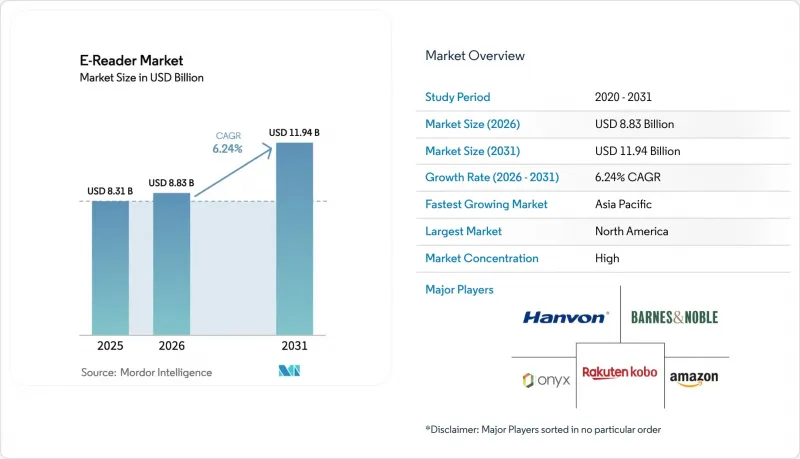
Mordor Intelligence에 의하면, E-reader 시장 규모는 2025년 83억 1,000만 달러로 평가되었습니다. 2026년에는 88억 3,000만 달러로 확대되어 2026년부터 2031년에 걸쳐 CAGR 6.24%로 성장을 지속하여, 2031년에는 119억 4,000만 달러에 이를 것으로 예측됩니다.
본 보고서는 화면 크기(6인치 미만, 6-8인치, 8인치 이상), 디스플레이 기술(E-Ink Carta, E-Ink Kaleido Colour, Sipix, 기타), 연결성(Wi-Fi 전용, Wi-Fi+셀룰러, 기타),유통 채널(온라인 소매, 오프라인 소매, 기타), 최종 사용자(학생·교육 기관, 전문가·기업 등), 지역별로 분류되어 있습니다. 시장 예측은 금액(달러) 기준으로 제시되어 있습니다.
세계의 E-reader 시장 동향 및 인사이트
e-러닝 수강생 수 증가
온라인 및 하이브리드형 프로그램의 확대로 인해 대학과 K-12 학군은 전용 리더기와 호환성이 좋은 디지털 교과서 도입을 서두르고 있습니다. 조달 담당자들은 주석이나 메모를 작성할 수 있도록 스타일러스 입력이 가능한 대형 화면 모델을 선호합니다. 컬러 E-잉크는 백라이트가 있는 LCD 태블릿에 비해 과학 및 수학 교사가 시각적 충실도를 유지하면서 눈의 피로를 줄이는 데 도움이 됩니다. AI 번역 및 텍스트 음성 변환 기능은 다국어 교실에서 기기의 유용성을 더욱 높여줍니다. 예산 담당자들은 또한 디지털 교과서는 매년 재출판할 필요가 없어 총 소유 비용이 낮다는 점도 지적하고 있습니다.
100달러 미만의 합리적인 가격의 보급형 모델
비용이 최적화된 모델은 최소한의 하드웨어와 점차 성숙해 가는 E-ink 공급에 의존하고 있으며, 동남아시아와 라틴아메리카의 첫 구매 사용자들에게도 E-reader 시장을 확대되고 있습니다. 현지 통신 사업자들은 지속적인 수익을 보장하는 기간 한정 컨텐츠 구독을 대가로 하드웨어 보조금을 지원하고 있습니다. 가격 경쟁으로 인해 프리미엄 브랜드는 중급 라인업을 더 신속하게 갱신할 수밖에 없게 되었고, 이로 인해 제품 주기가 단축되며 모듈식 부품의 재사용이 촉진되고 있습니다. 입문급 기기의 보급은 중고 시장도 활성화시켜 기기의 수명을 연장하고 전체 사용자 기반을 확대되고 있습니다.
태블릿 및 대형 화면 스마트폰과의 경쟁
6인치 E-reader는 현재 동영상 스트리밍, 게임 실행, 웹 브라우징이 가능한 6.7인치 스마트폰과 경쟁하고 있습니다. 태블릿 제조업체들은 블루라이트로 인한 눈의 피로를 줄여주는 ‘눈 보호 모드’나 가변 주사율 디스플레이를 도입하여 인체공학적 격차를 좁히고 있습니다. 고소득 지역의 소비자들은 스마트폰 및 태블릿을 모두 소유하고 있는 경우가 많아, 단일 용도의 기기에 대한 필요성이 줄어들고 있습니다. 따라서 소매 프로모션에서는 리더기를 일반적인 정보 및 오락용 기기가 아닌, 집중해서 읽기 위한 보완적인 도구로 포지셔닝하고 있습니다. 브랜드 메시지에서는 현재 집중력을 방해하지 않는 환경과 수 주간 지속되는 배터리 수명을 강조하며 차별화를 꾀하고 있습니다.
부문별 분석
2025년, 6-8인치 크기 대는 E-reader 시장 규모의 67.10%를 차지했습니다. 이는 대부분의 소설이나 삽화가 없는 논픽션 컨텐츠에서 휴대성과 가독성의 균형이 잘 잡혀 있기 때문입니다. 중가대라는 점과 폭넓은 액세서리 생태계가 이 크기 대의 우위를 더욱 공고히 하고 있습니다. 8인치 이상 카테고리는 현재 주석을 달기 위한 넓은 여백이 필요한 학계 관계자나 전문직 구매자들을 끌어들이고 있습니다. 10인치 모델에 탑재된 컬러 디스플레이 기능과 필기 입력 기능은 교과서와의 상호작용 및 도표의 선명도를 높여줍니다. 패널 수율이 향상됨에 따라 평균 판매 가격은 하락하고 있으며, 대형 디스플레이의 5년간 연평균 성장률(CAGR)은 8.18%를 나타낼 것으로 전망됩니다. 6인치 미만 모델은 스마트폰 화면 크기가 이를 상회하여 휴대성의 이점이 상쇄되기 때문에 시장 점유율이 하락하고 있습니다.
보호용 폴리오나 키보드 슬리브와 같은 활기를 띠는 애프터마켓 덕분에 대형 리더기는 하이브리드형 메모용 태블릿으로서의 입지를 확고히 하고 있습니다. 기업의 교육 부서는 안드로이드나 iOS 생태계 전반에 수반되는 주의 산만 위험 없이, 보안이 강화된 기업 서버를 통해 파일이 동기화된다는 점을 높이 평가했습니다. 스타일러스 동봉 및 클라우드 스토리지 패키지는 지속적인 수익을 창출하며, 사용자를 독자적인 주석 형식에 묶어두고 있습니다. 대형 유리 기판의 물류를 관리할 수 있는 경쟁사가 적기 때문에 이익률은 여전히 건실한 수준을 유지하고 있습니다. 엡손과 샤프는 재생 빈도가 낮은 경우에도 펜의 정밀도를 유지하는 특수 터치 층을 공급하고 있습니다.
E-ink Carta는 2025년 출하 대수의 70.95%를 계속 차지했습니다. 이는 이 흑백 플랫폼이 대중 시장용 기기에 적합한 가격대를 유지하면서도 뛰어난 명암비와 몇 주에 달하는 배터리 사용 시간을 실현하고 있기 때문입니다. 규모의 경제 덕분에 100달러 미만의 공격적인 프로모션 가격 책정이 가능해져 대규모 도입 기반이 유지되고 있습니다. 2025년 시점에서 컬러 E-reader 시장 점유율은 여전히 소규모였으나, 학교에서의 태블릿 대체 기기 시범 도입과 만화 출판사의 과거 작품 디지털화가 진행됨에 따라 E-ink Kaleido 부문은 2031년까지 연평균 성장률(CAGR) 9.23%를 나타낼 것으로 예측됩니다. 필름 기반 컬러 필터를 탑재한 Gallery 3 패널은 초기 밝기 저하 문제를 해결했으나, 재생 빈도는 여전히 LCD에 미치지 못하는 상황입니다. SiPix 및 관련 기술은 화소 밀도보다 생체 안정성과 초저전력 소비가 중시되는 사이니지나 산업용 워크플로우에 활용되고 있습니다.
현재 디바이스 제조업체들은 프론트 라이트의 색온도를 미네랄 페이퍼의 색온도에 맞추어 조정하는 환경광 센서를 탑재하여 아날로그적인 독서 경험을 강화하고 있습니다. 펌웨어 업그레이드를 통해 에너지 소비를 억제하는 부분적인 컬러 리프레시 기능이 도입되었습니다. 기업에서는 야외 현장 매뉴얼용으로, LED 가로등 아래에서도 색 재현성을 유지할 수 있는 맞춤형 전면 조명 광도판 도입을 검토하고 있습니다. 이러한 특수한 요구 사항은 규모는 작지만 이익률이 높은 틈새 시장을 창출하여, 부품 공급업체의 수익원을 더욱 다각화하고 있습니다.
지역별 분석
북미는 2025년 E-reader 시장에서 46.05%의 점유율을 차지하며, 계속해서 가장 규모가 큰 지역 기여원이 되었습니다. 이는 높은 재량 지출과 단말기 판매 및 방대한 컨텐츠 카탈로그를 연결하는 통합형 컨텐츠 플랫폼에 힘입은 결과입니다. Kindle의 조기 도입으로 인해 장편 컨텐츠에는 전용 리더기를 선호하는 확고한 사용자 문화가 형성되었습니다. 공공도서관 컨소시엄은 자동으로 만료되는 디지털 대출 서비스를 공동 운영하고 있으며, 이를 통해 납세자의 재구매 비용을 대폭 절감하는 동시에 대출 건수의 성장을 유지하고 있습니다. 소매업체의 보조금 및 트레이드인 프로그램을 통해 기기 교체 주기가 활발하게 유지되고 있어, 태블릿에 의한 시장 잠식을 막고 있습니다.
아시아태평양은 2031년까지 연평균 성장률(CAGR) 7.62%로 가장 빠른 성장을 보이고 있습니다. 중국, 인도, 인도네시아에서는 중산층의 소득 증가와 전국적인 디지털 문해력 향상 노력이 맞물려 시장이 확대되고 있습니다. Onyx Boox와 같은 국내 브랜드는 현지 생산에 대한 세제 혜택을 활용하여 경쟁력 있는 가격을 책정하고 있는 반면, 세계 기업들은 대형 통신사와 제휴하여 스토어 크레딧을 묶음 판매하고 있습니다. 2024년에 6,703억 엔(942억 달러)으로 평가되는 일본의 성숙한 전자책 생태계는 만화 표시에 최적화된 레이아웃을 갖춘 프리미엄 컬러 단말기에 대해 소비자들이 기꺼이 대가를 지불할 의사를 보이고 있습니다. 인도 및 인도네시아의 오지 마을 도서관에 대한 정부의 보조금은 농촌 지역에서의 보급을 더욱 확대되고 있습니다.
유럽에서는 친환경 하드웨어를 우선시하는 ‘EU 일반 제품 안전 규정’의 영향으로 한 자릿수 중반대의 꾸준한 성장이 나타나고 있습니다. 기관 구매자들은 계약을 체결하기 전에 수명 주기 동안의 배출량과 수리 가능성 점수를 신중하게 검토하고 있습니다. 또한, EU의 산림 파괴 규제도 출판사들이 ‘디지털 퍼스트’ 유통 형태로 전환하도록 뒷받침하고 있으며, 간접적으로 E-reader 시장의 확대로 이어지고 있습니다. 스칸디나비아 국가들의 학교 제도에서는 인쇄된 워크북을 폐지하는 학군 전체 단말기 도입 프로그램이 시범적으로 시행되고 있는 반면, 독일 기업에서는 이사회 업무 흐름에 보안 대책이 적용된 리더기가 통합되어 있습니다. 라틴아메리카와 아프리카는 여전히 신흥 시장으로, 하드웨어 가격 하락과 4G 통신 영역 확대로 인해 새로운 타겟층이 개척되고 있습니다. 이 지역에서는 현지 언어 컨텐츠 제휴 및 소액 금융 옵션이 탄력을 받고 있습니다.
기타 혜택 :
- 엑셀 형식 시장 예측(ME) 시트
- 3개월간의 애널리스트 지원
자주 묻는 질문
목차
제1장 서론
제2장 조사 방법
제3장 주요 요약
제4장 시장 구도
제5장 시장 규모 및 성장 예측
제6장 경쟁 구도
제7장 시장 기회 및 향후 전망
KTH 26.09.04According to Mordor Intelligence, the e-Reader market size is expected to grow from USD 8.31 billion in 2025 to USD 8.83 billion in 2026 and is forecast to reach USD 11.94 billion by 2031 at 6.24% CAGR over 2026-2031.
This report is Segmented by Screen Size (Below 6 Inch, 6-8 Inch, Above 8 Inch), Display Technology (E-Ink Carta, E-Ink Kaleido Colour, Sipix and Others), Connectivity (Wi-Fi Only, Wi-Fi + Cellular and More), Distribution Channel (Online Retail, Offline Retail, and More), End-User (Students and Education, Professionals/Enterprise, and More), and Geography. The Market Forecasts are Provided in Terms of Value (USD).
Global E-Reader Market Trends and Insights
Rising e-learning enrolments
Expanding online and hybrid programs push universities and K-12 districts to adopt digital textbooks that pair well with dedicated readers. Procurement teams favour large-format models that accept stylus input for annotation and note-taking. Colour e-ink helps science and math teachers retain visual fidelity while lowering eye strain compared with backlit LCD tablets. AI translation and text-to-speech functions further increase device utility for multilingual classrooms. Budget holders also point to the lower total cost of ownership because digital textbooks remain current without annual reprints.
Affordable entry-level devices below USD 100
Cost-optimized models rely on stripped-down hardware and maturing E-ink supply, bringing the E-Reader market to first-time buyers in Southeast Asia and Latin America. Local telecom operators subsidize hardware in exchange for fixed-term content subscriptions that guarantee recurring revenue. Price competition puts pressure on premium brands to refresh mid-tier lineups more quickly, shortening product cycles and encouraging modular component reuse. Entry-level penetration also feeds second-hand markets, prolonging device lifespans and enlarging the overall user base.
Competition from tablets and large-screen smartphones
Six-inch readers now compete with 6.7-inch phones that stream video, run games, and browse the web. Tablet makers rolled out eye-comfort modes and variable refresh displays that mitigate blue-light fatigue, narrowing the ergonomic gap. Consumers in high-income regions often own both a phone and a tablet, lowering the perceived need for a single-purpose device. Retail promotions, therefore, pitch readers as complementary tools for deep reading rather than general infotainment. Brand messaging now emphasizes distraction-free focus and weeks-long battery life to differentiate.
Other drivers and restraints analyzed in the detailed report include:
- Expansion of self-publishing ecosystems
- Commercialization of colour e-ink for K-12 content
- Hardware limitations constrain feature development
For complete list of drivers and restraints, kindly check the Table Of Contents.
Segment Analysis
The 6-8-inch tier represented 67.10% of the E-Reader market size in 2025 because it balances portability with legibility for most fiction and non-illustrated non-fiction content. Mid-range pricing and broad accessory ecosystems reinforce its dominance. The above 8-inch category now attracts academic and professional buyers who need wide margins for annotation. Colour and handwriting layers on 10-inch models enhance textbook interaction and diagram clarity. As panel yields improve, average selling prices decline, supporting an 8.18% five-year CAGR for large displays. Below 6-inch models lose share as phone screen growth eclipses their size and nullifies portability advantages.
A thriving aftermarket of protective folios and keyboard sleeves positions large readers as hybrid note-taking tablets. Corporate training departments appreciate that files sync over secure enterprise servers without the distraction risk of full Android or iOS ecosystems. Bundled stylus and cloud storage packages drive recurring revenue and tie users into proprietary annotation formats. Margins remain healthy because few competitors can navigate the logistics of big glass substrates. Epson and Sharp supply specialty touch layers that maintain pen precision even at lower refresh rates.
E-ink Carta retained 70.95% of 2025 shipments because the monochrome platform delivers superior contrast and multi-week battery life at cost points suitable for mass market devices. Economies of scale allow aggressive promotional pricing below USD 100, maintaining a sizable installed base. The E-Reader market share for colour remained small in 2025, yet the E-ink Kaleido segment is forecast to clock 9.23% CAGR through 2031 as schools pilot tablet replacements and comics publishers digitize back catalogues. Gallery 3 panels with film-based colour filters solve early brightness loss problems, though refresh rates still trail LCD. SiPix and fringe technologies serve signage and industrial workflows where biostability and ultra-low power matter more than pixel density.
Device makers now integrate ambient light sensors that tune front-light warmth to mineral-paper colour temperatures, reinforcing the analog reading feel. Firmware upgrades push partial colour refresh options that cap energy drain. Enterprises explore custom front-light waveguides that preserve colour fidelity under LED street lighting conditions for outdoor field manuals. Such specialized requirements create smaller but higher margin niches that further diversify revenue streams for component suppliers.
Complete Report Scope:
- By Screen Size
- Below 6 inch
- 6-8 inch
- Above 8 inch
- By Display Technology
- E-ink Carta
- E-ink Kaleido (Colour)
- SiPix and Others
- By Connectivity
- Wi-Fi only
- Wi-Fi + Cellular
- Bluetooth-only / Offline sync
- By Distribution Channel
- Online Retail
- Offline Retail
- Institutional / Bulk Procurement
- By End-user
- Students and Education
- Professionals / Enterprise
- Leisure and General Public
- By Geography
- North America
- United States
- Canada
- Mexico
- Europe
- United Kingdom
- Germany
- France
- Italy
- Rest of Europe
- Asia-Pacific
- China
- Japan
- India
- South Korea
- Rest of Asia
- Middle East
- Israel
- Saudi Arabia
- United Arab Emirates
- Turkey
- Rest of Middle East
- Africa
- South Africa
- Egypt
- Rest of Africa
- South America
- Brazil
- Argentina
- Rest of South America
- North America
Geography Analysis
North America remained the largest regional contributor with a 46.05% 2025 share of the E-Reader market, buoyed by high discretionary spending and integrated content platforms that couple device sales with vast catalogues. Early Kindle adoption fostered an entrenched user culture that favours dedicated readers for long-form content. Public library consortia syndicate digital loans that automatically expire, saving taxpayers substantial restocking costs and sustaining circulation growth. Retail subsidies and trade-in programs keep upgrade cycles brisk, cushioning the market against tablet cannibalization.
Asia-Pacific delivers the fastest growth at a 7.62% CAGR through 2031. Rising middle-class income intersects with nationwide digital literacy campaigns in China, India, and Indonesia. Domestic brands such as Onyx Boox leverage local manufacturing tax incentives to price competitively, while global players partner with telecom giants to bundle storefront credits. Japan's mature e-book ecosystem, valued at JPY 670.3 billion (USD 94.2 billion) in 2024, illustrates a willingness to pay for premium colour devices with manga-optimized layouts. Government subsidies for remote village libraries in India and Indonesia further widen rural adoption.
Europe shows steady mid-single digit expansion under the influence of the EU General Product Safety Regulation, which prioritizes environmentally responsible hardware. Institutional buyers weigh lifecycle emissions and repairability scores before awarding contracts. The EU Deforestation Regulation also nudges publishers toward digital first distribution, indirectly expanding the E-Reader market. Scandinavian school systems pilot district wide device programs that eliminate printed workbooks, while German corporates integrate secure readers into board meeting workflows. Latin America and Africa remain emerging opportunities, where falling hardware prices and expanding 4G coverage unlock new addressable segments. Local language content partnerships and micro-financing options gain traction in these regions.
- Amazon .com, Inc.
- Rakuten Group, Inc. (Kobo)
- Barnes and Noble, LLC
- PocketBook International SA
- Onyx International Inc. (BOOX)
- Hanvon Technology Co., Ltd.
- Bookeen SAS
- ECTACO Inc.
- Sony Group Corporation
- Apple Inc.
- ReMarkable AS
- Boyue Shenzhen Technology Co., Ltd.
- Fujitsu Limited
- Huawei Technologies Co., Ltd.
- Xiaomi Corporation
- Bigme Corporation
- Dasung Tech Co., Ltd.
- Tolino Alliance GmbH and Co. KG
- Energy Sistem Technology, S.A.
- Arta Tech sp. z o.o.
Additional Benefits:
- The market estimate (ME) sheet in Excel format
- 3 months of analyst support
TABLE OF CONTENTS
1 INTRODUCTION
- 1.1 Study Assumptions and Market Definition
- 1.2 Scope of the Study
2 RESEARCH METHODOLOGY
3 EXECUTIVE SUMMARY
4 MARKET LANDSCAPE
- 4.1 Market Overview
- 4.2 Market Drivers
- 4.2.1 Rising e-Learning enrolments
- 4.2.2 Affordable entry-level devices below US$100
- 4.2.3 Expansion of self-publishing and digital-first titles
- 4.2.4 Commercialisation of colour e-ink for K-12 content
- 4.2.5 Institutional paper-reduction sustainability mandates
- 4.2.6 Device-content subscription bundles by telecoms
- 4.3 Market Restraints
- 4.3.1 Competition from tablets and large-screen smartphones
- 4.3.2 Limited multifunction capability of e-ink hardware
- 4.3.3 Single-supplier bottleneck for e-ink display modules
- 4.3.4 Restrictive DRM ecosystems curbing regional uptake
- 4.4 Industry Value-Chain Analysis
- 4.5 Regulatory Landscape
- 4.6 Technological Outlook
- 4.7 Porter's Five Forces Analysis
- 4.7.1 Bargaining Power of Buyers
- 4.7.2 Bargaining Power of Suppliers
- 4.7.3 Threat of New Entrants
- 4.7.4 Threat of Substitutes
- 4.7.5 Intensity of Competitive Rivalry
5 MARKET SIZE AND GROWTH FORECASTS (VALUE)
- 5.1 By Screen Size
- 5.1.1 Below 6 inch
- 5.1.2 6-8 inch
- 5.1.3 Above 8 inch
- 5.2 By Display Technology
- 5.2.1 E-ink Carta
- 5.2.2 E-ink Kaleido (Colour)
- 5.2.3 SiPix and Others
- 5.3 By Connectivity
- 5.3.1 Wi-Fi only
- 5.3.2 Wi-Fi + Cellular
- 5.3.3 Bluetooth-only / Offline sync
- 5.4 By Distribution Channel
- 5.4.1 Online Retail
- 5.4.2 Offline Retail
- 5.4.3 Institutional / Bulk Procurement
- 5.5 By End-user
- 5.5.1 Students and Education
- 5.5.2 Professionals / Enterprise
- 5.5.3 Leisure and General Public
- 5.6 By Geography
- 5.6.1 North America
- 5.6.1.1 United States
- 5.6.1.2 Canada
- 5.6.1.3 Mexico
- 5.6.2 Europe
- 5.6.2.1 United Kingdom
- 5.6.2.2 Germany
- 5.6.2.3 France
- 5.6.2.4 Italy
- 5.6.2.5 Rest of Europe
- 5.6.3 Asia-Pacific
- 5.6.3.1 China
- 5.6.3.2 Japan
- 5.6.3.3 India
- 5.6.3.4 South Korea
- 5.6.3.5 Rest of Asia
- 5.6.4 Middle East
- 5.6.4.1 Israel
- 5.6.4.2 Saudi Arabia
- 5.6.4.3 United Arab Emirates
- 5.6.4.4 Turkey
- 5.6.4.5 Rest of Middle East
- 5.6.5 Africa
- 5.6.5.1 South Africa
- 5.6.5.2 Egypt
- 5.6.5.3 Rest of Africa
- 5.6.6 South America
- 5.6.6.1 Brazil
- 5.6.6.2 Argentina
- 5.6.6.3 Rest of South America
- 5.6.1 North America
6 COMPETITIVE LANDSCAPE
- 6.1 Market Concentration
- 6.2 Strategic Moves
- 6.3 Market Share Analysis
- 6.4 Company Profiles (includes Global level Overview, Market level overview, Core Segments, Financials as available, Strategic Information, Market Rank/Share for key companies, Products and Services, and Recent Developments)
- 6.4.1 Amazon .com, Inc.
- 6.4.2 Rakuten Group, Inc. (Kobo)
- 6.4.3 Barnes and Noble, LLC
- 6.4.4 PocketBook International SA
- 6.4.5 Onyx International Inc. (BOOX)
- 6.4.6 Hanvon Technology Co., Ltd.
- 6.4.7 Bookeen SAS
- 6.4.8 ECTACO Inc.
- 6.4.9 Sony Group Corporation
- 6.4.10 Apple Inc.
- 6.4.11 ReMarkable AS
- 6.4.12 Boyue Shenzhen Technology Co., Ltd.
- 6.4.13 Fujitsu Limited
- 6.4.14 Huawei Technologies Co., Ltd.
- 6.4.15 Xiaomi Corporation
- 6.4.16 Bigme Corporation
- 6.4.17 Dasung Tech Co., Ltd.
- 6.4.18 Tolino Alliance GmbH and Co. KG
- 6.4.19 Energy Sistem Technology, S.A.
- 6.4.20 Arta Tech sp. z o.o.
7 MARKET OPPORTUNITIES AND FUTURE OUTLOOK
- 7.1 White-space and Unmet-Need Assessment