

|
시장보고서
상품코드
2119760
전자 시프트 운영 관리 솔루션 시장 : 점유율 분석, 업계 동향과 통계, 성장 예측(2026-2031년)Electronic Shift Operations Management Solutions - Market Share Analysis, Industry Trends & Statistics, Growth Forecasts (2026 - 2031) |
||||||
 Mordor Intelligence
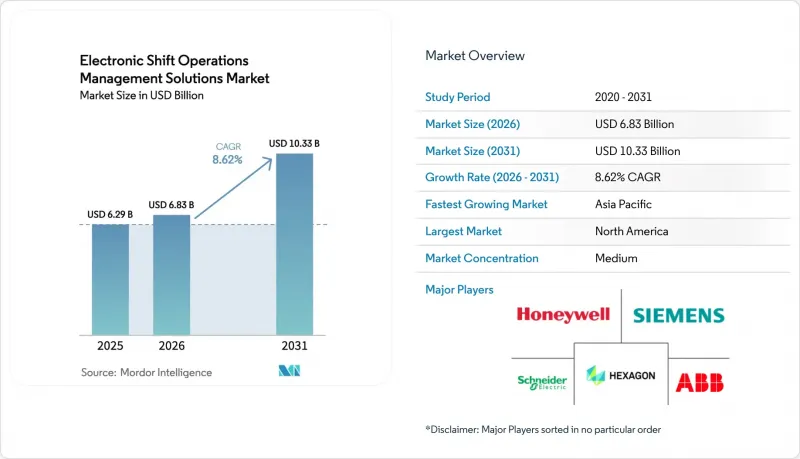
에 의하면, 전자 시프트 운영 관리 솔루션 시장 규모는 2025년 62억 9,000만 달러에서 2026년에는 68억 3,000만 달러로 확대되어 2026년부터 2031년까지 CAGR 8.62%로 성장을 지속하여, 2031년에는 103억 3,000만 달러에 이를 것으로 예측됩니다.
본 보고서는 용도별(제한된 가동 조건(LCO) 추적, 관리 및 규정 준수 등), 최종 사용자 산업별(석유 및 가스, 화학제품 및 석유화학제품 등), 도입 형태별(클라우드 기반, On-Premise형, 하이브리드형), 조직 규모별(대기업 및 중소기업), 지역별로 분류되어 있습니다.
세계 전자 시프트 운영 관리 솔루션 시장 동향 및 인사이트
에너지 및 유틸리티 분야 수요 증가
에너지 사업자들은 정전 위험을 최소화하고 유지보수 비용을 절감하는 것을 목표로 하고 있습니다. 아르곤 국립연구소(Argonne National Laboratory)의 추정에 따르면, AI 기반 송전망 유지보수 소프트웨어를 통해 작업자의 현장 방문을 최대 66%까지 줄일 수 있다고 합니다. 이에 따라 유틸리티 사업자들은 재생에너지의 변동성 속에서도 송전망의 신뢰성을 유지하기 위해 인력 스케줄링과 자산 관련 인사이트를 통합한 플랫폼을 우선적으로 도입하고 있습니다. Shiftboard의 에너지 분야 특화 솔루션 제품군은 규정 준수 추적 및 비상 시프트 관리가 업계의 요구에 맞추어 어떻게 구성되어 있는지를 보여줍니다. 유틸리티 사업자들이 스프레드시트 사용을 중단하고 실시간 규칙 기반 스케줄링을 도입함에 따라, 이러한 요인들이 전자 시프트 운영 관리 솔루션 시장을 견인하고 있습니다.
미션 크리티컬 업무의 자동화 및 통합
인더스트리 4.0 이니셔티브를 통해 공장 현장의 제어 시스템과 기업 소프트웨어 간의 경계가 사라지면서, 통합된 시프트 인계 시스템이 추진되고 있습니다. PPG의 디지털 도장 라인에서는 GE Vernova의 iFIX를 도입하여 생산성을 30% 향상시켰습니다. Bosch Connected Industry의 ‘Shift Book’ 역시 작업자의 데이터 수집을 자동화함으로써 유사한 성과를 거두고 있습니다. 이러한 사례들은 통합 솔루션이 전자 시프트 운영 관리 솔루션 시장에서 표준화되고 있는 이유를 여실히 보여줍니다.
높은 초기 도입 비용 및 전환 비용
라이선싱, 통합 및 교육에 드는 비용은 예산에 제약이 있는 기업에게 장벽이 되고 있습니다. FHI Works사의 추정에 따르면, 창고 내 숨겨진 인건비는 생산성을 40% 저하시킬 가능성이 있습니다. SaaS 모델은 설비 투자를 줄여주지만, 업무 차질에 대한 우려로 인해 의사 결정이 지연되면서 중소규모 사업자 사이에서 전자 시프트 운영 관리 솔루션 시장의 즉각적인 확산이 저해되고 있습니다.
부문 분석
2025년, 전자 시프트 운영 관리 솔루션 시장 규모 중 20억 6,000만 달러는 ‘인력 자격 인증 및 스케줄링’ 분야가 차지하고 있으며, 운영자의 자격이 안전성에 직접적인 영향을 미치기 때문에 이 분야는 여전히 시장의 기반을 이루고 있습니다. 유틸리티, 정유시설, 제약 공장에서는 역량 매트릭스를 활용하여 직원이 변화하는 규제 요건을 확실하게 충족할 수 있도록 하고 있습니다. Kahuna사의 소프트웨어는 자격 인증과 시프트을 대조하여 자격이 없는 직원에게 업무가 배정되는 것을 방지합니다. 만료일이 임박한 면허에 대한 자동 알림 기능과 결합함으로써, 이러한 도구는 감사 위험과 가동 중지 시간을 줄여줍니다.
예측 시프트 분석 시장은 규모는 작지만 연평균 성장률(CAGR) 11.05%를 나타낼 것으로 전망됩니다. AI 모델은 날씨, 수요, 자산 상태에 대한 신호에 따라 일정을 조정하여 초과 근무 비용을 절감하는 동시에 직원 만족도를 높입니다. 광업 분야의 조기 도입 기업들은 분석과 디지털 트윈을 결합하여 운반 트럭의 가동 현황을 기반으로 인력 수요를 예측했습니다. 분석이 일상적인 시프트 계획에 통합됨에 따라, 이러한 시너지 효과로 인해 전자 시프트 운영 관리 솔루션 시장은 확대되고 있습니다.
관리 및 규정 준수 모듈은 로그북과 절차 체크리스트를 디지털화하고, 바인더를 타임스탬프가 포함된 전자 기록으로 대체함으로써 꾸준히 성장하고 있습니다. 추적 및 제어 대시보드는 경보, KPI 차트, 작업자 위치 정보를 하나의 인터페이스에 통합함으로써 감독자의 상황 인식을 확대합니다. 원자력 발전소나 화학 플랜트에서 필수적인 ‘제한 운전 조건’ 추적은 규제 당국이 매개변수의 지속적인 기록을 요구함에 따라 그 중요성이 커지고 있습니다. 통합된 용도 스택을 제공하는 벤더들은 교차 판매의 시너지 효과를 활용하여 시장 내 입지를 강화하고 있습니다.
석유 및 가스 부문은 2025년 전자 시프트 운영 관리 솔루션 시장 규모 중 16억 8,000만 달러를 차지하고 있으며, 이는 복잡한 작업 허가 규정과 위험한 작업 환경을 반영한 것입니다. 업스트림 부문에서 Skedulo를 도입함으로써 안전 지표가 향상되는 동시에 배정 시간이 단축되었습니다. 정유업체에서는 디지털 시프트 로그를 제어실 콘솔에 통합하고, 사고 데이터 및 유지보수 메모를 연동함으로써 규제 당국에 대한 보고를 원활하게 하고 있습니다.
금속, 광업, 소재 업계는 자율 주행 트럭 및 원격 지하 운영에서 사람에 의한 동기화된 감독이 요구되기 때문에 연평균 10.55%의 성장이 예상됩니다. 바릭(Barrick)사의 터콰이즈 리지(Turquoise Ridge) 광산에서는 첨단 스케줄링을 적용해 광석 처리량을 늘리고, 분석 기반의 시프트가 투자 대비 효과를 입증했습니다. 화학, 유틸리티, 자동차 산업에서는 각각 고유한 규정 준수 요건과 린(Lean) 생산 요구에 힘입어 도입이 급속히 진행되고 있습니다.
제약 및 생명과학 공장에서는 임박한 GMP 변경에 앞서 디지털 로그북과 전자 배치 기록을 통합하기 위한 투자가 진행되고 있습니다. 군 및 방위 분야 사용자들은 중복성과 안전한 오프라인 모드를 중시하고 있으며, 이로 인해 견고한 시스템의 도입이 촉진되고 있습니다. 안전 문화와 추적성 측면에서 산업 전반에 걸쳐 공통점이 존재함으로써, 수평형 플랫폼 공급업체에게 비즈니스 기회가 창출되고 있으며, 전자 시프트 운영 관리 솔루션 시장의 침투가 확대되고 있습니다.
지역별 분석
북미는 2025년 전자 시프트 운영 관리 솔루션 시장 규모에서 22억 8,000만 달러를 창출하며 36.25%의 점유율을 유지했습니다. 이는 OSHA, FDA 및 FERC의 엄격한 규제 요건에 힘입은 결과입니다. 미국의 정유시설에서는 디지털 로그북을 분산 제어 시스템에 통합하고 있는 반면, 캐나다의 유틸리티 회사에서는 AI를 활용한 작업자 배치를 통해 정전 관리의 현대화가 진행되고 있습니다. 하네웰이 2026년까지 3개의 사업체로 분할할 계획은 고객과의 보다 긴밀한 관계를 구축하기 위한 지역별 전문화를 보여줍니다.
아시아태평양은 연평균 성장률(CAGR) 11.05%로 가장 급격한 성장을 보이며, 2031년까지 전자 시프트 관리 솔루션 시장에 15억 6,000만 달러를 추가할 것으로 전망됩니다. 중국의 공장에서는 의사결정권자의 92%가 이미 클라우드에서 워크로드를 호스팅하고 있어 클라우드 스케줄링이 채택되고 있습니다. 인도의 화학 업계에서는 대역폭 부족을 극복하기 위해 하이브리드 모델이 도입되고 있는 반면, 일본 기업들은 ‘사회 5.0’ 목표에 따라 도입을 추진하고 있습니다. 그럼에도 불구하고 IBM에 따르면, 이 지역 기업의 71%가 디지털 프로젝트를 가치로 전환하는 데 어려움을 겪고 있으며, 이것이 통합 업체에 대한 수요를 부추기고 있습니다.
유럽은 독일의 ‘인더스트리 4.0’ 로드맵과 영국 제약 업계의 현대화에 힘입어 꾸준한 성장을 이어가고 있습니다. EU GMP 부속서 1 준수 일정에 따라 무균 플랜트에서의 디지털 로그북 도입이 가속화되고 있습니다. 프랑스의 원자력 발전소들은 고가용성 On-Premise형 아키텍처를 추구하고 있으며, 이탈리아의 제조업체들은 MES 제품군 내에 시프트 대시보드를 통합하고 있습니다. 남미, 중동 및 아프리카에서는 광업 및 석유화학 업계가 제어실 업그레이드를 진행함에 따라 새로운 활기가 나타나고 있으며, 전자 시프트 운영 관리 솔루션 시장의 영향력이 새로운 영역으로 확대되고 있습니다.
기타 혜택:
- 엑셀 형식 시장 예측(ME) 시트
- 3개월간의 애널리스트 지원
자주 묻는 질문
목차
제1장 서론
제2장 조사 방법
제3장 개요
제4장 시장 구도
제5장 시장 규모와 성장 예측
제6장 경쟁 구도
제7장 시장 기회와 향후의 동향
JHS 26.09.03According to Mordor Intelligence, the electronic shift operations management solutions market size is expected to grow from USD 6.29 billion in 2025 to USD 6.83 billion in 2026 and is forecast to reach USD 10.33 billion by 2031 at 8.62% CAGR over 2026-2031.
This report is Segmented by Application (Limited Condition of Operation (LCO) Tracking, Administration and Compliance, and More), End-User Industry (Oil and Gas, Chemicals and Petrochemicals, and More), Deployment Mode (Cloud-Based, On-Premise, and Hybrid), Organization Size (Large Enterprises and Small and Mid-Sized Enterprises), and Geography.
Global Electronic Shift Operations Management Solutions Market Trends and Insights
Rising Demand Across Energy and Utilities
Energy operators seek to minimize outage risk and reduce maintenance costs. Argonne National Laboratory estimates that AI-enabled grid maintenance software can cut crew visits by up to 66%. Utilities, therefore, prioritize platforms that merge workforce scheduling with asset insights to keep grids reliable amid renewable variability. Shiftboard's energy-focused suite showcases how compliance tracking and emergency roster management are packaged for sector needs. These factors buoy the Electronic Shift Operations Management Solutions market as utilities retire spreadsheets in favor of real-time, rule-based scheduling.
Automation and Integration of Mission-Critical Operations
Industry 4.0 initiatives dissolve the divide between plant-floor controls and enterprise software, fueling unified shift-handover systems. PPG's digital paint lines achieved 30% productivity gains via GE Vernova's iFIX deployment. Bosch Connected Industry's Shift Book demonstrates similar gains by automating data capture for operators. These examples illustrate why integrated solutions become standard in the Electronic Shift Operations Management Solutions market.
High Initial Installation and Switching Costs
Licensing, integration, and training outlays deter budget-constrained firms. FHI Works estimates hidden warehouse labor costs can erode productivity by 40%. While SaaS models defray capital expenses, fear of disruption slows decisions, restraining immediate Electronic Shift Operations Management Solutions market uptake among smaller operators.
Other drivers and restraints analyzed in the detailed report include:
- Adoption of Cloud-Native Shift Platforms
- Regulatory Push for Digital Logbooks and Safety Compliance
- Shortage of Skilled Technical Workforce
For complete list of drivers and restraints, kindly check the Table Of Contents.
Segment Analysis
Personnel Qualification and Scheduling contributed USD 2.06 billion to the Electronic Shift Operations Management Solutions market size in 2025 and remained the cornerstone because operator credentials directly influence safety. Utilities, refineries, and pharmaceutical plants leverage competency matrices to ensure staff meet evolving regulatory mandates. Kahuna's software aligns certifications with shift rosters, preventing unqualified assignments. Coupled with automated reminders for expiring licenses, such tools reduce audit risk and downtime.
Predictive Shift Analytics, though smaller, is poised for an 11.05% CAGR. AI models adapt schedules to weather, demand, and asset-health signals, trimming overtime costs and elevating employee satisfaction. Early adopters in mining pair analytics with digital twins to forecast labor needs against haul-truck availability. This synergy enlarges the Electronic Shift Operations Management Solutions market as analysis becomes embedded within day-to-day shift planning.
Administrative and Compliance modules grow steadily by digitizing logbooks and procedure checklists, replacing binders with timestamped e-records. Tracking and Control Dashboards broaden situational awareness for supervisors, integrating alarms, KPI charts, and crew locations in one interface. Limited Condition of Operation tracking, vital in nuclear and chemical plants, gains ground as regulators demand continuous parameter logging. Vendors that deliver a unified application stack tap cross-selling synergies, reinforcing market stickiness.
The oil and gas sector held USD 1.68 billion of the Electronic Shift Operations Management Solutions market size in 2025, reflecting complex permit-to-work rules and hazardous conditions. Skedulo's use in upstream operations improved safety metrics while shrinking dispatch times. Refiners embed digital shift logs into control-room consoles, linking incident data and maintenance notes to facilitate regulatory reporting.
Metals, mining, and materials are set to expand 10.55% annually as autonomous trucks and remote underground operations demand synchronized human oversight. Barrick's Turquoise Ridge mine applied advanced scheduling to raise ore throughput, showcasing ROI for analytics-driven rosters. Chemicals, utilities, and automotive industries sustain significant adoption, each propelled by distinct compliance or lean-manufacturing imperatives.
Pharmaceutical and life-science plants invest ahead of looming GMP changes, integrating digital logbooks with electronic batch records. Military and defense users emphasize redundancy and secure offline modes, prompting ruggedized deployments. Cross-industry parallels in safety culture and traceability create avenues for horizontal platform vendors, broadening the Electronic Shift Operations Management Solutions market penetration.
Complete Report Scope:
- By Application
- Limited Condition of Operation (LCO) Tracking
- Administration and Compliance
- Tracking and Control Dashboards
- Personnel Qualification and Scheduling
- Predictive Shift Analytics
- By End-user Industry
- Oil and Gas
- Chemicals and Petrochemicals
- Energy and Utilities
- Automotive and Transportation
- Military and Defense
- Pharmaceuticals and Life Sciences
- Metals, Mining and Materials
- Other End-user Industries
- By Deployment Mode
- Cloud-Based
- On-Premise
- Hybrid
- By Organization Size
- Large Enterprises
- Small and Mid-sized Enterprises (SMEs)
- By Geography
- North America
- United States
- Canada
- Mexico
- South America
- Brazil
- Argentina
- Chile
- Rest of South America
- Europe
- Germany
- United Kingdom
- France
- Italy
- Spain
- Russia
- Rest of Europe
- Asia-Pacific
- China
- India
- Japan
- South Korea
- Singapore
- Malaysia
- Australia
- Rest of Asia-Pacific
- Middle East and Africa
- Middle East
- United Arab Emirates
- Saudi Arabia
- Turkey
- Rest of Middle East
- Africa
- South Africa
- Nigeria
- Rest of Africa
- Middle East
- North America
Geography Analysis
North America generated USD 2.28 billion from the Electronic Shift Operations Management Solutions market size in 2025 and maintained a 36.25% share, underpinned by rigorous OSHA, FDA, and FERC mandates. US refineries integrate digital logbooks into distributed control systems, while Canadian utilities modernize outage management with AI-assisted crew dispatch. Honeywell's plan to split into three entities by 2026 illustrates regional specialization aimed at higher customer intimacy.
Asia-Pacific posts the steepest climb at an 11.05% CAGR, adding USD 1.56 billion to the Electronic Shift Operations Management Solutions market by 2031. Chinese factories adopt cloud scheduling as 92% of decision-makers already host workloads in the cloud. India's chemicals sector implements hybrid models to overcome bandwidth gaps, while Japanese firms align implementations with Society 5.0 objectives. Nonetheless, IBM notes 71% of regional firms struggle to translate digital projects into value, fueling demand for integrators.
Europe follows with consistent growth, driven by Germany's Industry 4.0 roadmaps and the United Kingdom's pharmaceutical modernization. EU GMP Annex 1 compliance timelines hasten digital logbook rollouts in sterile plants. France's nuclear fleet pursues resilient on-premise architectures, and Italy's manufacturers embed shift dashboards within MES suites. South America and the Middle East and Africa show emerging momentum as mining and petrochemicals upgrade control rooms, expanding the Electronic Shift Operations Management Solutions market footprint to new frontiers.
- ABB Ltd.
- Hexagon AB (HxGN Shift Operations)
- Honeywell International Inc.
- Siemens AG (Siemens Xcelerator)
- Schneider Electric SE
- Emerson Electric Co.
- General Electric Co. (GE Digital)
- IBM Corporation
- AVEVA Group plc
- Aspen Technology Inc.
- Yokogawa Electric Corporation
- PTC Inc.
- Dassault Systemes SE
- Oracle Corporation
- SAP SE
- ServiceNow Inc.
- UKG Inc. (Kronos)
- WorkForce Software LLC
- Fluke Reliability (eMaint)
- Rockwell Automation Inc.
- NICE Ltd. (CXone Workforce Engagement)
- Infor Inc.
- Aptean Industrial Manufacturing ERP
- Conmitto Inc.
- Trinoor LLC
- Globorise Technologies LLC
Additional Benefits:
- The market estimate (ME) sheet in Excel format
- 3 months of analyst support
TABLE OF CONTENTS
1 INTRODUCTION
- 1.1 Study Assumptions and Market Definition
- 1.2 Scope of the Study
2 RESEARCH METHODOLOGY
3 EXECUTIVE SUMMARY
4 MARKET LANDSCAPE
- 4.1 Market Overview
- 4.2 Market Drivers
- 4.2.1 Rising demand across energy and utilities
- 4.2.2 Automation and integration of mission-critical operations
- 4.2.3 Adoption of cloud-native shift platforms
- 4.2.4 Regulatory push for digital logbooks and safety compliance
- 4.2.5 AI-driven predictive scheduling and LLM copilots
- 4.2.6 Digital-twin convergence for real-time shift analytics
- 4.3 Market Restraints
- 4.3.1 High initial installation and switching costs
- 4.3.2 Shortage of skilled technical workforce
- 4.3.3 Heightened cyber-risk in critical infrastructure
- 4.3.4 Legacy OT/IT data-silo integration hurdles
- 4.4 Industry Value Chain Analysis
- 4.5 Regulatory Landscape
- 4.6 Technological Outlook
- 4.7 Industry Attractiveness - Porter's Five Forces Analysis
- 4.7.1 Bargaining Power of Buyers
- 4.7.2 Bargaining Power of Suppliers
- 4.7.3 Threat of New Entrants
- 4.7.4 Threat of Substitutes
- 4.7.5 Intensity of Competitive Rivalry
- 4.8 Impact of Macroeconomic Factors on the Market
5 MARKET SIZE AND GROWTH FORECASTS (VALUES)
- 5.1 By Application
- 5.1.1 Limited Condition of Operation (LCO) Tracking
- 5.1.2 Administration and Compliance
- 5.1.3 Tracking and Control Dashboards
- 5.1.4 Personnel Qualification and Scheduling
- 5.1.5 Predictive Shift Analytics
- 5.2 By End-user Industry
- 5.2.1 Oil and Gas
- 5.2.2 Chemicals and Petrochemicals
- 5.2.3 Energy and Utilities
- 5.2.4 Automotive and Transportation
- 5.2.5 Military and Defense
- 5.2.6 Pharmaceuticals and Life Sciences
- 5.2.7 Metals, Mining and Materials
- 5.2.8 Other End-user Industries
- 5.3 By Deployment Mode
- 5.3.1 Cloud-Based
- 5.3.2 On-Premise
- 5.3.3 Hybrid
- 5.4 By Organization Size
- 5.4.1 Large Enterprises
- 5.4.2 Small and Mid-sized Enterprises (SMEs)
- 5.5 By Geography
- 5.5.1 North America
- 5.5.1.1 United States
- 5.5.1.2 Canada
- 5.5.1.3 Mexico
- 5.5.2 South America
- 5.5.2.1 Brazil
- 5.5.2.2 Argentina
- 5.5.2.3 Chile
- 5.5.2.4 Rest of South America
- 5.5.3 Europe
- 5.5.3.1 Germany
- 5.5.3.2 United Kingdom
- 5.5.3.3 France
- 5.5.3.4 Italy
- 5.5.3.5 Spain
- 5.5.3.6 Russia
- 5.5.3.7 Rest of Europe
- 5.5.4 Asia-Pacific
- 5.5.4.1 China
- 5.5.4.2 India
- 5.5.4.3 Japan
- 5.5.4.4 South Korea
- 5.5.4.5 Singapore
- 5.5.4.6 Malaysia
- 5.5.4.7 Australia
- 5.5.4.8 Rest of Asia-Pacific
- 5.5.5 Middle East and Africa
- 5.5.5.1 Middle East
- 5.5.5.1.1 United Arab Emirates
- 5.5.5.1.2 Saudi Arabia
- 5.5.5.1.3 Turkey
- 5.5.5.1.4 Rest of Middle East
- 5.5.5.2 Africa
- 5.5.5.2.1 South Africa
- 5.5.5.2.2 Nigeria
- 5.5.5.2.3 Rest of Africa
- 5.5.5.1 Middle East
- 5.5.1 North America
6 COMPETITIVE LANDSCAPE
- 6.1 Market Concentration
- 6.2 Strategic Moves
- 6.3 Market Share Analysis
- 6.4 Company Profiles (includes Global level Overview, Market level overview, Core Segments, Financials as available, Strategic Information, Market Rank/Share for key companies, Products and Services, and Recent Developments)
- 6.4.1 ABB Ltd.
- 6.4.2 Hexagon AB (HxGN Shift Operations)
- 6.4.3 Honeywell International Inc.
- 6.4.4 Siemens AG (Siemens Xcelerator)
- 6.4.5 Schneider Electric SE
- 6.4.6 Emerson Electric Co.
- 6.4.7 General Electric Co. (GE Digital)
- 6.4.8 IBM Corporation
- 6.4.9 AVEVA Group plc
- 6.4.10 Aspen Technology Inc.
- 6.4.11 Yokogawa Electric Corporation
- 6.4.12 PTC Inc.
- 6.4.13 Dassault Systemes SE
- 6.4.14 Oracle Corporation
- 6.4.15 SAP SE
- 6.4.16 ServiceNow Inc.
- 6.4.17 UKG Inc. (Kronos)
- 6.4.18 WorkForce Software LLC
- 6.4.19 Fluke Reliability (eMaint)
- 6.4.20 Rockwell Automation Inc.
- 6.4.21 NICE Ltd. (CXone Workforce Engagement)
- 6.4.22 Infor Inc.
- 6.4.23 Aptean Industrial Manufacturing ERP
- 6.4.24 Conmitto Inc.
- 6.4.25 Trinoor LLC
- 6.4.26 Globorise Technologies LLC
7 MARKET OPPORTUNITIES AND FUTURE TRENDS
- 7.1 White-Space and Unmet-Need Assessment


