

|
시장보고서
상품코드
2119816
아시아태평양의 기유 : 시장 점유율 분석, 업계 동향 및 통계, 성장 예측(2026-2031년)Asia Pacific Base Oil - Market Share Analysis, Industry Trends & Statistics, Growth Forecasts (2026 - 2031) |
||||||
 Mordor Intelligence
Mordor Intelligence에 의하면, 아시아태평양의 기유 시장 규모는 2025년에 1,742만 톤으로 평가되었습니다. 2026년 1,775만 톤에서 2031년까지 1,949만 톤에 이를 것으로 추정되고 예측 기간(2026-2031년) CAGR은 1.89%를 나타낼 전망입니다.
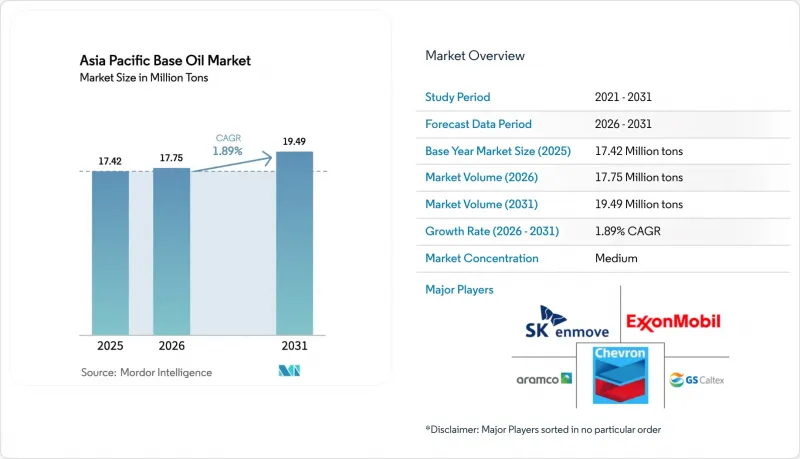
본 보고서는 유형별(그룹 I, 그룹 II, 그룹 III, 그룹 IV, 기타 유형), 용도별(엔진 오일, 변속기 오일·기어 오일, 금속 가공용 윤활유, 작동유, 그리스, 기타), 지역별(중국, 인도, 일본, 한국, 아세안, 기타 아시아태평양)로 분류되어 있습니다. 시장 전망은 수량(톤) 기준으로 제시되어 있습니다.
아시아태평양의 기유 시장 동향 및 인사이트
배기가스 규제가 강화됨에 따라 그룹 I에서 그룹 II 기유로 전환이 진행되고 있습니다.
인도의 BS VI 및 중국의 ‘중국 6’ 기준에서는 황 함량이 10ppm으로 제한되어 있어, 이에 따라 혼합 업체들은 그룹 I 기유을 폐지하고 더 깨끗한 그룹 II 대체품으로 전환할 수밖에 없습니다. 엑슨모빌(ExxonMobil)의 싱가포르 레지드 업그레이드 프로젝트는 이러한 수요에 부응하기 위해 2025년 9월, 하루 2만 배럴의 그룹 II 생산 능력을 추가했습니다. 초고점도지수 오일용 일본 JASO GLV-2 규격에 따라 하이브리드 차량용으로는 그룹 III의 채택이 진행되고 있습니다. 인도의 농촌 지역이나 중국의 내륙 지역에서는 가격에 민감한 부문에서 여전히 그룹 I에 의존하고 있어, 2028년까지 지속될 병행 공급망이 형성되고 있습니다. 중견 정유사들은 경쟁력을 유지하기 위해 하이드로크래커 개조를 급속도로 추진하고 있으나, 현금 흐름 제약으로 인해 연안 지역 자산에 대한 업그레이드는 제한적인 수준에 머물고 있습니다.
중국과 인도에서의 고성능 자동차용 윤활유 수요 증가
중국에서는 2024년에 3,020만 대의 자동차가 생산되었으며, 터보차저가 장착된 엔진의 비율은 생산 대수의 60%를 넘어 2020년의 45%에서 증가했습니다. 터보차저가 장착된 엔진은 고온에서 작동하기 때문에 각 OEM 업체들은 산화를 방지하기 위해 그룹 II 또는 그룹 III 오일을 지정하고 있습니다. 인도의 승용차 판매 대수는 2025 회계연도에 420만 대에 달했으며, 그중 SUV가 신규 등록의 48%를 차지했습니다. 마르티 스즈키 등 자동차 제조업체들은 엔진에 API SP 규격의 오일을 출고 시 주입하고 있어, 이로 인해 애프터마켓은 프리미엄 등급 오일로 한정되고 있습니다. 이러한 추세로 인해 그룹 I 오일의 잠재적 수요층은 축소되고 있으며, 현재는 주로 대형 디젤 차량용으로 공급되고 있습니다.
전기차(EV) 보급 가속화가 내연기관용 윤활유의 장기적인 수요를 억제
배터리식 전기차(BEV)는 가솔린 차량에 비해 윤활유 사용량이 70% 적습니다. 이러한 경향은 중국에서 가장 두드러지며, 중국에서는 2024년 전기차 판매 대수가 950만 대에 달하고, 승용차 판매 대수의 35%를 차지했습니다. 태국에서는 2024년에 전기차의 가격 평준화가 달성되었으며, 인도의 이륜차 전기화율도 급속히 높아지고 있습니다. 상용 트럭 및 오프로드 차량에서는 여전히 내연기관(ICE)이 주류를 이루고 있지만, 승용차용 윤활유 수요는 계속해서 감소하여 아시아태평양의 기유 시장의 장기적인 성장에 상한선을 가져올 것입니다.
부문 분석
2025년, 그룹 II는 배기가스 규제에 따른 저유황 원료에 대한 수요에 힘입어 아시아태평양의 기유 시장의 38.05%를 차지했습니다. 그룹 III의 아시아태평양의 기유 시장 규모는 터보차저 및 하이브리드 파워트레인 요구 사항에 힘입어 모든 등급 중 가장 높은 연평균 성장률(CAGR) 3.30%로 확대될 것으로 예측됩니다. 엑슨모빌(ExxonMobil)의 신제품 ‘EHC 340 MAX’는 과거 브라이트 스톡에 의존하던 부문을 대상으로 한 초중질 그룹 II 등급입니다. 페트로나스(Petronas)와 펠타미나(Pertamina)가 인도네시아에서 계획 중인 일일 생산량 800톤 규모의 그룹 III 플랜트는 지역 내 공급 다각화를 한층 더 심화시킬 것입니다. 그룹 II와 그룹 III의 마진 격차는 톤당 150-200달러까지 축소되어, 블렌더는 과도한 비용 부담 없이 용도를 전환할 수 있게 되었습니다.
기존 그룹 I의 생산 능력은 현재 틈새 시장인 대형 디젤차용 및 산업용 윤활유를 뒷받침하고 있지만, 시장 점유율은 계속해서 하락하고 있습니다. Indian Oil Corp(Indian Oil Corporation)의 파니파트(Panipat) 플랜트 개보수와 HPCL의 LOBS 설비 업그레이드로 인해, 2026년까지 그룹 I 처리량의 상당 부분이 그룹 II와 그룹 III로 전환되어 이러한 추세가 가속화될 것입니다. 그룹 IV의 PAO는 지역 전체 생산량의 5% 이하에 그치고 있지만, 항공우주 부문에서는 프리미엄 가격을 유지하고 있으며, 한편 그룹 V의 나프텐계 오일은 안정적인 특수 용도 부문에서 수요가 있습니다. 새로운 수소 처리 설비의 가동이 고품질 제품에 대한 수요를 초과할 경우 공급 과잉의 위험은 남아 있겠지만, 중국 내륙 지역의 정유시설 합리화를 통해 2029년까지 수익성이 낮은 그룹 I 자산이 도태될 가능성이 있습니다.
기타 혜택
- 엑셀 형식 시장 예측(ME) 시트
- 3개월간의 애널리스트 지원
자주 묻는 질문
목차
제1장 서론
제2장 조사 방법
제3장 주요 요약
제4장 시장 구도
제5장 시장 규모 및 성장 예측
제6장 경쟁 구도
제7장 시장 기회 및 향후 전망
KTH 26.09.10According to Mordor Intelligence, the Asia Pacific base oil market size was valued at 17.42 million tons in 2025 and is estimated to grow from 17.75 million tons in 2026 to reach 19.49 million tons by 2031, at a CAGR of 1.89% during the forecast period (2026-2031).

This report is Segmented by Type (Group I, Group II, Group III, Group IV, and Other Types), Application (Engine Oils, Transmission and Gear Oils, Metalworking Fluids, Hydraulic Fluids, Greases, and Other Applications), and Geography (China, India, Japan, South Korea, ASEAN Countries, and Rest of Asia-Pacific). The Market Forecasts are Provided in Terms of Volume (Tons).
Asia Pacific Base Oil Market Trends and Insights
Growing Shift from Group I to Group II Base Stocks Due to Tightening Emission Norms
India's BS VI and China 6 standards limit sulfur to 10 ppm, forcing blenders to abandon Group I stocks for cleaner Group II alternatives. ExxonMobil's Singapore Resid Upgrade Project added 20,000 barrels per day of Group II capacity in September 2025 to serve this demand. Japan's JASO GLV-2 spec for ultra-high-viscosity-index oils is pushing Group III adoption in hybrids. Rural India and inland China still rely on Group I for price-sensitive segments, creating a parallel supply chain that will persist until 2028. Mid-tier refiners are fast-tracking hydrocracker revamps to stay relevant, yet cash-flow constraints limit upgrades to coastal assets.
Rising Demand for High-Performance Automotive Lubricants in China and India
China produced 30.2 million vehicles in 2024, with turbocharged engines exceeding 60% of output, up from 45% in 2020. Turbocharged units run hotter, so OEMs specify Group II or Group III oils to prevent oxidation. India's passenger-vehicle sales reached 4.2 million units in fiscal 2025, with SUVs claiming 48% of registrations. Carmakers such as Maruti Suzuki pre-fill engines with API SP oils, locking the aftermarket into premium grades. This preference compresses the addressable pool for Group I stocks, which now serve mostly heavy-duty diesel fleets.
Accelerating EV Penetration Curbing Long-Term ICE-Lubricant Demand
Battery-electric vehicles need 70% less lubricant than gasoline cars, a reality most visible in China, where EV sales reached 9.5 million units in 2024, equal to 35% of passenger-car volume. Thailand hit EV price parity in 2024, and India's two-wheeler electrification rate is scaling fast. Commercial trucks and off-highway gear remain ICE-dominated, but passenger-car lubricant pools will continue shrinking, setting a ceiling on long-term Asia Pacific Base Oil market growth.
Other drivers and restraints analyzed in the detailed report include:
- OEM-Driven Drain-Interval Extensions Favouring Premium Group III/IV Stocks
- Adoption of Re-Refined Base Oils Under Circular-Economy Policies
- Persistent Oversupply in Heavy Grades (SN 500/Bright Stock) Depressing Prices
For complete list of drivers and restraints, kindly check the Table Of Contents.
Segment Analysis
Group II held 38.05% of the Asia Pacific base oil market in 2025, owing to emission-driven demand for low-sulfur stocks. The Asia Pacific Base Oil market size for Group III is forecast to expand at a 3.30% CAGR, the fastest among all grades, propelled by turbocharged and hybrid powertrain requirements. ExxonMobil's new EHC 340 MAX extra-heavy Group II grade targets sectors that once relied on bright stock. Petronas and Pertamina's planned 800-tons-per-day Group III plant in Indonesia will deepen regional supply diversity. Margin gaps between Group II and Group III have narrowed to USD 150-200 per ton, encouraging blenders to switch applications without prohibitive cost penalties.
Legacy Group I capacity now supports niche heavy-duty diesel and industrial fluids, but continues to lose share. Indian Oil Corporation's Panipat revamp and HPCL's LOBS upgrades will convert significant Group I throughput into Group II and Group III by 2026, accelerating the trend. Group IV PAO remains below 5% of regional volume yet commands premium pricing in aerospace, while Group V naphthenics serve stable specialty segments. Overcapacity risks persist if new hydrofinish units outpace high-grade demand, but refinery rationalization in inland China may remove marginal Group I assets by 2029.
Complete Report Scope:
- ByType
- Group I
- Group II
- Group III
- Group IV
- Other Types (Grouo V, Naphthenic Oil)
- By Application
- Engine Oils
- Transmission and Gear Oils
- Metalworking Fluids
- Hydraulic Fluids
- Greases
- Other Applications (Food-grade, Process Oils)
- By Geography
- China
- India
- Japan
- South Korea
- ASEAN Countries
- Rest of Asia-Pacific
List of Companies Covered in this Report:
- Chevron Corporation
- CNOOC
- Ergon, Inc.
- Exxon Mobil Corporation.
- GS Caltex Corporation
- HP Lubricants
- Indian Oil Corporation Ltd.
- Neste
- Petronas Lubricants International
- Phillips 66 Company
- Repsol
- Saudi Arabian Oil Co.
- Sinopec Corp
- SK On Co., Ltd.
Additional Benefits:
- The market estimate (ME) sheet in Excel format
- 3 months of analyst support
TABLE OF CONTENTS
1 Introduction
- 1.1 Study Assumptions and Market Definition
- 1.2 Scope of the Study
2 Research Methodology
3 Executive Summary
4 Market Landscape
- 4.1 Market Overview
- 4.2 Market Drivers
- 4.2.1 Growing shift from Group I to Group II base stocks due to tightening emission norms
- 4.2.2 Rising demand for high-performance automotive lubricants in China and India
- 4.2.3 OEM-driven drain-interval extensions favouring premium Group III/IV stocks
- 4.2.4 Adoption of re-refined base oils under circular-economy policies
- 4.2.5 Surge in two-wheeler delivery fleets accelerating low-viscosity engine-oil uptake
- 4.3 Market Restraints
- 4.3.1 Accelerating EV penetration curbing long-term ICE-lubricant demand
- 4.3.2 Persistent oversupply in heavy grades (SN 500/BS) depressing prices
- 4.3.3 Quality-perception barriers limiting re-refined base-oil adoption
- 4.4 Value Chain Analysis
- 4.5 Porter's Five Forces
- 4.5.1 Bargaining Power of Suppliers
- 4.5.2 Bargaining Power of Buyers
- 4.5.3 Threat of New Entrants
- 4.5.4 Threat of Substitutes
- 4.5.5 Degree of Competition
5 Market Size and Growth Forecasts (Volume)
- 5.1 ByType
- 5.1.1 Group I
- 5.1.2 Group II
- 5.1.3 Group III
- 5.1.4 Group IV
- 5.1.5 Other Types (Grouo V, Naphthenic Oil)
- 5.2 By Application
- 5.2.1 Engine Oils
- 5.2.2 Transmission and Gear Oils
- 5.2.3 Metalworking Fluids
- 5.2.4 Hydraulic Fluids
- 5.2.5 Greases
- 5.2.6 Other Applications (Food-grade, Process Oils)
- 5.3 By Geography
- 5.3.1 China
- 5.3.2 India
- 5.3.3 Japan
- 5.3.4 South Korea
- 5.3.5 ASEAN Countries
- 5.3.6 Rest of Asia-Pacific
6 Competitive Landscape
- 6.1 Market Concentration
- 6.2 Strategic Moves
- 6.3 Market Share/Ranking Analysis
- 6.4 Company Profiles (includes Global level Overview, Market level overview, Core Segments, Financials as available, Strategic Information, Products and Services, and Recent Developments)
- 6.4.1 Chevron Corporation
- 6.4.2 CNOOC
- 6.4.3 Ergon, Inc.
- 6.4.4 Exxon Mobil Corporation.
- 6.4.5 GS Caltex Corporation
- 6.4.6 HP Lubricants
- 6.4.7 Indian Oil Corporation Ltd.
- 6.4.8 Neste
- 6.4.9 Petronas Lubricants International
- 6.4.10 Phillips 66 Company
- 6.4.11 Repsol
- 6.4.12 Saudi Arabian Oil Co.
- 6.4.13 Sinopec Corp
- 6.4.14 SK On Co., Ltd.
7 Market Opportunities and Future Outlook
- 7.1 White-space and unmet-need assessment
- 7.2 Growing Awareness on Renewable Base-Oils


