

|
시장보고서
상품코드
2119829
항문암 : 시장 점유율 분석, 업계 동향 및 통계, 성장 예측(2026-2031년)Anal Cancer - Market Share Analysis, Industry Trends & Statistics, Growth Forecasts (2026 - 2031) |
||||||
 Mordor Intelligence
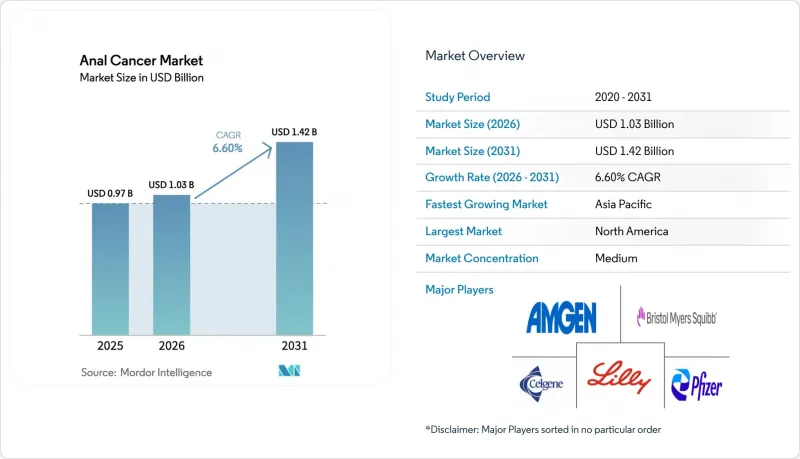
Mordor Intelligence에 의하면, 2026년 항문암 시장 규모는 10억 3,000만 달러로 추정되고 2025년 9억 7,000만 달러에서 확대해, 2031년에는 14억 2,000만 달러에 이를 것으로 예측됩니다.
2026-2031년 동안의 연평균 성장률(CAGR)은 6.60%가 될 것으로 전망됩니다.
본 보고서는 암 유형(상피내암, 편평상피암, 기타), 질병 단계(1-2기, 3기, 4기, 재발 질환),치료 유형(화학요법, 외과 수술, 기타), 최종 사용자(병원 및 클리닉, 연구·학술 기관, 기타 최종 사용자), 지역(북미, 기타)별로 분류되어 있습니다. 시장 예측은 금액(달러)으로 표시되어 있습니다.
세계의 항문암 시장 동향 및 인사이트
HPV 관련 항문암 발생률 증가
연간 환자 수 증가율은 현재 여성 2.9%, 남성 1.6%에 달하며, 2021년에는 65세 이상 백인 여성에서 10만 명당 11.4건의 사례가 기록되었습니다. 종양의 90% 이상이 발암성 HPV 균주를 보유하고 있기 때문에 백신 접종 프로그램은 예방 수단인 동시에 장기적인 수요를 좌우하는 요인이 되고 있습니다. 현재 미국의 선별검사 지침에서는 고령 여성의 대부분이 대상에서 제외되어 있어, 진단 격차가 확대되고 있습니다. 이러한 상황으로 인해 시장 진출기업들은 HRA(고해상도 항문경 검사) 서비스 확충을 서두르고 있습니다. 기존에는 저위험군으로 여겨졌던 계층에서 발병률이 상승함에 따라 치료 가능한 환자층이 확대되고, 항문암 시장의 기초 수술 건수가 증가하고 있습니다. 이에 따라 병원 시스템은 보다 광범위한 선별 검사 권고에 대응할 수 있도록 교육 및 설비 투자를 추진하고 있습니다.
HPV 양성 종양에 대한 면역요법 연구 개발 자금
HPV 양성 종양에서는 치료 반응을 예측할 수 있는 면역 세포의 밀집된 침윤이나 PD-L1 발현이 확인되므로, 체크포인트 억제제에 대한 자금 유입이 계속되고 있습니다. ‘키트루다’의 호조로운 매출은 면역요법과 화학방사선요법을 결합한 병용요법에 대한 신뢰를 강화하며, 각사가 동반 바이오마커의 공동 개발을 추진하는 원동력이 되고 있습니다. 장기적인 자금 조달 사이클은 북미와 유럽에서의 공동 임상시험을 뒷받침하고 있으며, 일본과 호주의 시험 기관에서도 피험자 등록이 진행되고 있습니다. 산업 분석가들은 바이오마커를 통한 치료법의 확대로 5년 생존율이 향상되고 치료 기간이 장기화됨에 따라, 항문암 시장의 지속적인 수익 성장이 뒷받침될 것으로 전망하고 있습니다.
고액의 치료비와 전신성 부작용
면역요법의 연간 치료비는 종종 15만 달러를 초과하며, 입원 및 지지 요법을 포함하면 진행성 암의 총 치료비는 20만 달러를 넘어섭니다. 이상반응 관리를 위해 추가 자원이 필요하며, 3차 의료기관 이외에서는 부족하기 쉬운 다학제적 전문 지식이 요구됩니다. 사전 승인 절차의 장벽으로 인해 치료 시작이 지연되고, 의료 제공업체에게는 행정적 부담이 가중되고 있습니다. 브라질과 인도의 보험사는 일부에 한해 보험 혜택을 제공하고 있어, 환자들은 경제적 부담을 감수해야 하며, 이는 약물의 보급을 제한하고 항문암 시장의 성장을 저해하고 있습니다.
부문 분석
2025년에는 편평상피암이 항문암 시장의 79.84%를 차지했으며, 2031년까지의 매출 전망을 뒷받침하고 있습니다. 상피내암은 병변을 조기에 발견하는 HRA 프로그램의 확대를 배경으로 연평균 성장률(CAGR) 7.14%로 성장을 지속하고 있습니다. 한편, 흑색종은 여전히 틈새 시장이지만, 점막 부위에서 체크포인트 억제제의 성공 사례로부터 혜택을 받고 있습니다. 편평상피종양은 HPV 16형 및 18형과 밀접한 관련이 있어 안정적인 환자 유입이 확보되고 있으며, 화학방사선요법이 표준 치료법으로 확립되어 있습니다. 선암과 기저세포암의 아형에 대해서는 대장암 및 피부종양학의 진보를 활용하여 치료 경로의 정교화가 진행되고 있습니다. 분자 프로파일링 기술의 발전으로 조직 유형에 관계없이 치료에 활용할 수 있는 돌연변이가 규명되었으며, 향후 항문암 시장을 확대할 가능성이 있는 정밀 치료의 추가 옵션이 제시되고 있습니다.
상피내암 증가는 백신 접종에 대한 인식 제고도 반영하고 있습니다. 백신 접종을 받은 집단에서는 침윤성 종양의 발생이 적고 전암성 병변의 비율이 높기 때문에 선택적 절제 수술이 시행되고 있습니다. 병리 검사실에서 디지털 영상 분석을 도입함에 따라 검출 감도가 향상되어 조기 치료 건수가 증가하고 있습니다. 한편, 바이러스성 발암 유전자의 발현에 관한 중개 연구는 차세대 백신 부스터 개발에 기여하고 있으며, 장기적인 발생률을 낮출 가능성이 있는 것으로 여겨지는 동시에, 항문암 시장과 관련된 모니터링 및 진단 하위 부문을 확대시킬 가능성이 있습니다.
2025년 진단 사례 중 3기 질환이 50.88%를 차지했으며, 이는 진행된 단계에서 발견되는 추세를 여실히 보여주고 있어, 이것이 적극적인 다학제적 치료를 촉진하는 요인이 되고 있습니다. 생존율 향상으로 인해 구제 요법이 필요한 지연성 재발 사례가 드러남에 따라, 재발성 질환은 연평균 성장률(CAGR) 7.23%로 시장 성장을 주도하고 있습니다. 1-2기 환자의 경우, 지침에 따른 화학방사선요법을 통해 5년 생존율이 85%에 달하며, 조기 단계 치료에 대한 신뢰가 높아지고 있습니다. 직장암에서 성공을 거두고 있는 토탈 네오어드저반트 요법의 통합은 3기를 대상으로 활발히 연구되고 있으며, 항문암 시장에서 전이로의 진행을 억제하는 것을 목표로 하고 있습니다.
4기 사례 수는 적지만, 환자 1인당 의료비를 끌어올리며 업계의 관심을 면역요법 병용 요법에 집중시키고 있습니다. 2025년 ‘Zynyz’의 승인은 전이성 질환 관리에 있어 PD-1 억제제를 핵심으로 하는 치료법을 확립하는 것이며, 종양 용해성 바이러스 및 IL-15 작용제를 결합한 3제 병용 요법을 촉진할 가능성이 있습니다. 전국 등록 제도를 통한 임상 데이터 수집으로 재발 동태에 대한 이해가 깊어지고, 보조 요법의 임상시험 설계에 도움이 될 것으로 보임에 따라, 첨단 치료를 포함한 항문암 시장 규모는 계속해서 확대될 것으로 전망됩니다.
지역별 분석
북미는 체계적인 선별 검사, 폭넓은 보험 적용, 혁신적인 치료법 시장 출시 기간을 단축하는 FDA의 패스트트랙 제도를 배경으로, 2025년에도 항문암 시장의 40.42% 점유율을 유지했습니다. 미국에 기반을 둔 암 센터들이 주요 임상시험의 대부분을 수행하고 있어, 국내에서 새로운 치료법의 도입을 가속화하고 있습니다. 그러나 방사선 치료 서비스에 대한 보험 환급액 삭감이 임박해 있어, 이로 인해 의료기관의 이익률이 하락하고 의료기기 교체가 둔화될 가능성이 있습니다. 캐나다의 보편적 백신 접종 프로그램은 이미 항문생식기 사마귀 발생률을 낮추고 있으며, 향후 발병률 감소가 예상되어 장기적인 치료 건수 증가세를 둔화시킬 가능성이 있습니다.
유럽에서는 각국의 의료 제도가 화학방사선요법 프로토콜을 표준화하고 약제 가격 협상을 진행 중이기 때문에 큰 시장 규모를 차지하고 있습니다. EMA의 ‘가다실 9’ 승인은 예방 대책을 뒷받침하고 있으며, 이탈리아에서는 입찰을 통해 HPV 백신 가격이 1회당 30유로 미만으로 책정되었습니다. 동유럽 국가들에서는 면역요법에 대한 접근이 지연되고 있어, EU의 ‘암 퇴치 계획’이 해소하고자 하는 양극화된 치료 결과가 나타나고 있습니다. 1995년부터 2022년에 걸쳐 유럽 전체의 암 환자 수는 58% 증가했으며, 암 의료 인프라에 대한 지속적인 수요가 확실시되고 있습니다.
아시아태평양은 보험 적용 범위 확대, HPV 백신 접종률 향상, 미치료 환자 수가 다수 존재함에 따라 연평균 성장률(CAGR) 7.49%로 가장 빠르게 성장하고 있는 지역입니다. 일본에서는 연간 1,056건의 신규 사례가 보고되고 있으며, 10년에 걸친 프로그램 중단을 겪은 후 긴급한 백신 접종 캠페인이 요구되고 있습니다. 중국 내 수십억 달러 규모의 HPV 백신 시장 잠재력은 현지 제조업체들이 WHO 사전 인증을 취득하도록 촉진하고 있으며, 이를 통해 비용 절감과 접종률 향상이 기대됩니다. 인도는 인력 부족을 해소하기 위해 방사선 종양학 연수 컨소시엄에 투자하고 있으며, 이는 항문암 시장에 필수적인 선형 가속기 및 계획 시스템에 대한 지역적 수요를 촉진하고 있습니다.
기타 혜택
- 엑셀 형식 시장 예측(ME) 시트
- 3개월간의 애널리스트 지원
자주 묻는 질문
목차
제1장 서론
제2장 조사 방법
제3장 주요 요약
제4장 시장 구도
제5장 시장 규모 및 성장 예측
제6장 경쟁 구도
제7장 시장 기회 및 향후 전망
KTH 26.09.10According to Mordor Intelligence, anal cancer market size in 2026 is estimated at USD 1.03 billion, growing from 2025 value of USD 0.97 billion with 2031 projections showing USD 1.42 billion, growing at 6.60% CAGR over 2026-2031.
This report is Segmented by Cancer Type (Carcinoma In-Situ, Squamous Cell Carcinoma, and More), Disease Stage (Stage I-II, Stage III, Stage IV, Recurrent Disease), Treatment Type (Chemotherapy, Surgery, and More), End-User (Hospitals and Clinics, Research and Academic Institutes, Other End-Users), and Geography (North America, and More). The Market Forecasts are Provided in Terms of Value (USD).
Global Anal Cancer Market Trends and Insights
Rising HPV-Linked Anal Cancer Incidence
Annual case growth now reaches 2.9% in women and 1.6% in men, with white women over 65 registering 11.4 cases per 100,000 in 2021 . More than 90% of tumors harbor oncogenic HPV strains, making vaccination programs both a preventive tool and a long-run demand modulator. Current US screening guidelines omit most older women, widening a diagnostic gap that pushes market participants to expand HRA services. Rising incidence in previously low-risk segments enlarges the treatable population and elevates baseline procedure volumes for the anal cancer market. Hospital systems therefore invest in training and equipment to accommodate wider screening recommendations.
R&D Funding for HPV-Positive Tumor Immunotherapy
Checkpoint inhibitors continue to attract capital as HPV-positive tumors display dense immune infiltration and PD-L1 expression that predict response. Keytruda's strong sales reinforce confidence in combination protocols that merge immunotherapy with chemoradiation, spurring companies to co-develop companion biomarkers. Long-term funding cycles favor collaborative trials in North America and Europe, but sites in Japan and Australia are also enrolling. Industry analysts expect expanded biomarker-guided regimens to lift five-year survival and lengthen treatment courses, supporting sustained revenue growth in the anal cancer market.
High Treatment Cost and Systemic Side-Effects
Annual immunotherapy bills often exceed USD 150,000, pushing total care costs for advanced disease above USD 200,000 when hospitalizations and supportive therapy are included. Adverse-event management further raises resource needs, demanding multidisciplinary expertise that is scarce outside tertiary centers. Prior-authorization hurdles prolong treatment starts, adding administrative overhead for providers. Insurers in Brazil and India offer partial coverage only, forcing patients into financial toxicity that limits drug uptake and restrains the anal cancer market.
Other drivers and restraints analyzed in the detailed report include:
- Acceptance of Chemoradiation Organ-Preservation Protocols
- Reimbursement Expansion for Checkpoint Inhibitors
- Low Disease Prevalence Limiting ROI for New Entrants
For complete list of drivers and restraints, kindly check the Table Of Contents.
Segment Analysis
Squamous cell disease captured 79.84% of the anal cancer market share in 2025 and anchors revenue visibility through 2031. Carcinoma in situ enjoys 7.14% CAGR on the back of expanding HRA programs that intercept lesions earlier, while melanoma remains niche but benefits from checkpoint-inhibitor successes reported in mucosal sites. Squamous tumors' strong link to HPV 16 and 18 secures stable patient inflow and standardizes chemoradiation regimens. Adenocarcinoma and basal-cell variants leverage advances in colorectal and dermatologic oncology to refine care pathways. Improving molecular profiling identifies action-able mutations across histologies, hinting at future precision-therapy add-ons that could enlarge the anal cancer market.
Carcinoma in situ growth also reflects rising vaccination awareness; vaccinated cohorts present fewer invasive tumors and more pre-invasive lesions, prompting elective ablation procedures. As pathology labs integrate digital image analysis, detection sensitivity climbs and reinforces early-treatment volumes. Meanwhile, translational research into viral oncogene expression informs next-generation vaccine boosters, potentially shrinking long-term incidence yet enlarging surveillance and diagnostic subsegments tied to the anal cancer market.
Stage III disease accounted for 50.88% of 2025 diagnoses, underscoring late detection trends that fuel aggressive multimodal regimens. Recurrent disease leads growth at 7.23% CAGR as improved survival unmask late failures requiring salvage approaches. Patients with Stage I-II disease benefit from 85% five-year survival under guideline-directed chemoradiation, reinforcing confidence in early-stage management. Integration of total neoadjuvant therapy, successful in rectal cancer, is under active investigation for Stage III, aiming to curb progression to metastasis within the anal cancer market.
Stage IV presentations, although fewer, drive per-patient spending and focus industry attention on immunotherapeutic combinations. The 2025 Zynyz approval establishes a PD-1 backbone for metastatic management and may catalyze triplet regimens with oncolytic viruses or IL-15 agonists. Clinical data collection through national registries improves understanding of relapse kinetics and informs adjuvant-trial design, supporting continued expansion of the anal cancer market size for advanced therapeutics.
Complete Report Scope:
- By Cancer Type
- Carcinoma In-Situ
- Squamous Cell Carcinoma
- Melanoma
- Adenocarcinoma
- Basal Cell Carcinoma
- Other Cancer Types
- By Disease Stage
- Stage I-II
- Stage III
- Stage IV
- Recurrent Disease
- By Treatment Type
- Chemotherapy
- Surgery
- Radiation Therapy
- Immunotherapy
- By End-User
- Hospitals and Clinics
- Research and Academic Institutes
- Other End-Users
- By Geography
- North America
- United States
- Canada
- Mexico
- Europe
- Germany
- United Kingdom
- France
- Italy
- Spain
- Rest of Europe
- Asia-Pacific
- China
- Japan
- India
- Australia
- South Korea
- Rest of Asia-Pacific
- Middle East and Africa
- GCC
- South Africa
- Rest of Middle East and Africa
- South America
- Brazil
- Argentina
- Rest of South America
- North America
Geography Analysis
North America retained 40.42% of the anal cancer market share in 2025 on the strength of organized screening, robust payer coverage, and FDA fast-track pathways that cut time-to-market for innovations. U-S-based cancer centers execute most pivotal trials, accelerating domestic uptake of new regimens. Yet looming reimbursement cuts for radiation services could reduce provider margins and slow hardware upgrades. Canada's universal vaccine program already lowered anogenital wart rates, foreshadowing future incidence declines that may temper long-term procedure growth.
Europe contributes significant volume as national health systems standardize chemoradiation protocols and negotiate drug pricing. EMA's approval of Gardasil 9 underpins prevention policy, with tendering driving HPV vaccine prices below EUR 30 per dose in Italy. Eastern European nations lag in immunotherapy access, creating two-tier outcomes that the EU Beating Cancer Plan aims to narrow. Pan-European cancer cases rose 58% between 1995 and 2022, ensuring sustained demand for oncologic infrastructure.
Asia-Pacific is the fastest-growing region at 7.49% CAGR, fueled by expanding insurance coverage, increasing HPV immunization, and large untreated populations. Japan documents 1,056 new cases yearly and faces urgent catch-up vaccination drives after a decade-long program pause. China's multi-billion-dollar HPV vaccine opportunity motivates local manufacturers to pursue WHO pre-qualification, which would slash costs and boost uptake. India invests in radiation-oncology training consortia to mitigate staffing deficits, fostering regional demand for linear accelerators and planning systems essential to the anal cancer market.
- Merck
- Bristol-Myers Squibb
- Roche
- Pfizer
- GlaxoSmithKline
- Johnson & Johnson
- Novartis
- Amgen
- Eli Lilly and Company
- Abbvie
- Sanofi
- AstraZeneca
- Regeneron Pharmaceuticals
- Incyte Corp.
- BeiGene Ltd.
- Clovis Oncology
- Arcus Biosciences
- Innovent Biologics
- Genmab
- ZIOPHARM Oncology
Additional Benefits:
- The market estimate (ME) sheet in Excel format
- 3 months of analyst support
TABLE OF CONTENTS
1 Introduction
- 1.1 Study Assumptions & Market Definition
- 1.2 Scope of the Study
2 Research Methodology
3 Executive Summary
4 Market Landscape
- 4.1 Market Overview
- 4.2 Market Drivers
- 4.2.1 Rising Incidence Of HPV-Linked STDs & Anal Cancer
- 4.2.2 Increasing R&D Funding For HPV-Positive Tumor Immunotherapy
- 4.2.3 Growing Acceptance of Chemoradiation Organ-Preservation Protocols
- 4.2.4 Reimbursement Expansion for Checkpoint Inhibitors
- 4.2.5 AI-Guided Molecular Profiling Accelerating Trial Recruitment
- 4.2.6 Launch Of High-Resolution Anoscopy Screening Clinics
- 4.3 Market Restraints
- 4.3.1 High Treatment Cost & Systemic Side-Effects
- 4.3.2 Low Disease Prevalence Limiting ROI For New Entrants
- 4.3.3 Shortage Of Pelvic Radiation Oncologists
- 4.3.4 Reimbursement Gaps For Preventive HRA Screening
- 4.4 Regulatory Landscape
- 4.5 Technological Outlook
- 4.6 Porters Five Forces Analysis
- 4.6.1 Bargaining Power of Suppliers
- 4.6.2 Bargaining Power of Buyers
- 4.6.3 Threat of New Entrants
- 4.6.4 Threat of Substitutes
- 4.6.5 Intensity of Competitive Rivalry
5 Market Size & Growth Forecasts (Value, USD)
- 5.1 By Cancer Type
- 5.1.1 Carcinoma In-Situ
- 5.1.2 Squamous Cell Carcinoma
- 5.1.3 Melanoma
- 5.1.4 Adenocarcinoma
- 5.1.5 Basal Cell Carcinoma
- 5.1.6 Other Cancer Types
- 5.2 By Disease Stage
- 5.2.1 Stage I-II
- 5.2.2 Stage III
- 5.2.3 Stage IV
- 5.2.4 Recurrent Disease
- 5.3 By Treatment Type
- 5.3.1 Chemotherapy
- 5.3.2 Surgery
- 5.3.3 Radiation Therapy
- 5.3.4 Immunotherapy
- 5.4 By End-User
- 5.4.1 Hospitals and Clinics
- 5.4.2 Research and Academic Institutes
- 5.4.3 Other End-Users
- 5.5 By Geography
- 5.5.1 North America
- 5.5.1.1 United States
- 5.5.1.2 Canada
- 5.5.1.3 Mexico
- 5.5.2 Europe
- 5.5.2.1 Germany
- 5.5.2.2 United Kingdom
- 5.5.2.3 France
- 5.5.2.4 Italy
- 5.5.2.5 Spain
- 5.5.2.6 Rest of Europe
- 5.5.3 Asia-Pacific
- 5.5.3.1 China
- 5.5.3.2 Japan
- 5.5.3.3 India
- 5.5.3.4 Australia
- 5.5.3.5 South Korea
- 5.5.3.6 Rest of Asia-Pacific
- 5.5.4 Middle East and Africa
- 5.5.4.1 GCC
- 5.5.4.2 South Africa
- 5.5.4.3 Rest of Middle East and Africa
- 5.5.5 South America
- 5.5.5.1 Brazil
- 5.5.5.2 Argentina
- 5.5.5.3 Rest of South America
- 5.5.1 North America
6 Competitive Landscape
- 6.1 Market Concentration
- 6.2 Market Share Analysis
- 6.3 Company Profiles (includes Global level Overview, Market level overview, Core Segments, Financials as available, Strategic Information, Market Rank/Share for key companies, Products & Services, and Recent Developments)
- 6.3.1 Merck & Co. Inc.
- 6.3.2 Bristol Myers Squibb
- 6.3.3 F. Hoffmann-La Roche
- 6.3.4 Pfizer Inc.
- 6.3.5 GlaxoSmithKline plc
- 6.3.6 Johnson & Johnson (Janssen)
- 6.3.7 Novartis AG
- 6.3.8 Amgen Inc.
- 6.3.9 Eli Lilly and Company
- 6.3.10 AbbVie Inc.
- 6.3.11 Sanofi SA
- 6.3.12 AstraZeneca plc
- 6.3.13 Regeneron Pharmaceuticals
- 6.3.14 Incyte Corp.
- 6.3.15 BeiGene Ltd.
- 6.3.16 Clovis Oncology
- 6.3.17 Arcus Biosciences
- 6.3.18 Innovent Biologics
- 6.3.19 Genmab A/S
- 6.3.20 ZIOPHARM Oncology
7 Market Opportunities & Future Outlook
- 7.1 White-Space & Unmet-Need Assessment


