|
시장보고서
상품코드
2120293
유럽의 데이터센터 전력 시장 : 점유율 분석, 업계 동향과 통계, 성장 예측(2026-2032년)Europe Data Center Power - Market Share Analysis, Industry Trends & Statistics, Growth Forecasts (2026 - 2032) |
||||||
 Mordor Intelligence
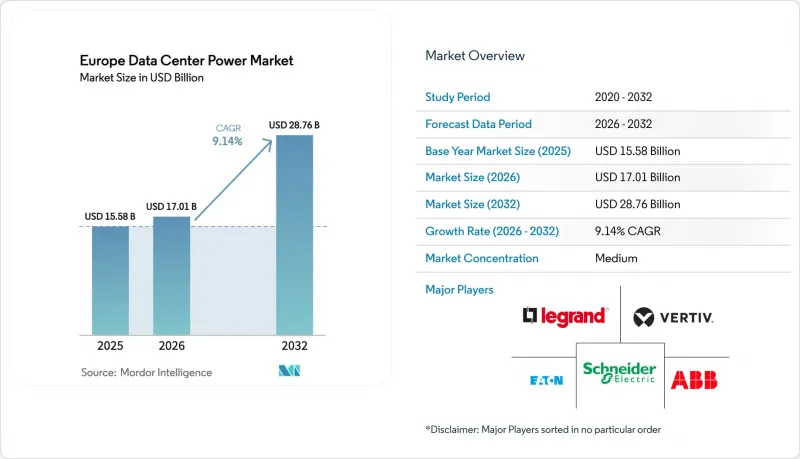
Mordor Intelligence에 의하면, 유럽의 데이터센터 전력 시장 규모는 2025년 155억 8,000만 달러에서 2026년에는 170억 1,000만 달러로 확대되어 2026-2032년 CAGR 9.14%로 성장을 지속하여, 2032년까지 287억 6,000만 달러에 이를 것으로 예측됩니다.
본 보고서는 솔루션 유형(전력 배전, 전원 백업), 서비스(설계 및 컨설팅 등), 데이터센터 유형(코로케이션, 하이퍼스케일 등), 최종 사용자 산업(은행, 금융서비스 및 보험(BFSI), IT 및 통신, 기타),전력 용량(3MW 초과, 기타), 티어 기준(Tier I·II, 기타), 지역(독일, 영국, 기타)별로 분류되어 있습니다. 시장 전망은 금액(달러) 기준으로 제시되어 있습니다.
유럽 데이터센터 전력 시장 동향 및 인사이트
하이퍼스케일 및 메가 데이터센터 도입 확대
하이퍼스케일 사업자들은 소규모 전력 공급 구역과 유사한 캠퍼스를 건설하고 있으며, 300-500 MW 규모의 전력 연결 계약을 일상적으로 체결하고 있을 뿐만 아니라, 경우에 따라 공급의 지속성을 확보하기 위해 부지 내에 복합 사이클 발전소를 개발하고 있습니다. 마이크로소프트의 43억 유로 규모 이탈리아 확장 및 아마존의 유럽 전역에 걸친 수 기가와트 규모의 거점 확장은 전력 회사와의 직접 계약 모델이 기존의 코로케이션 임대를 대체하고 있음을 보여줍니다. AI 훈련 클러스터의 평균 랙 전력 밀도는 2027년까지 500-1,000kW에 달할 전망이며, 액체 냉각 루프로 인한 펌프 부하 증가로 인해 시설 전체의 전력 소비량이 20-30% 증가하게 될 것입니다. 지멘스 에너지의 보고서에 따르면, 2024년 가스터빈 수주 잔고 14GW 중 60%가 데이터센터용이며, 이는 인프라 규모가 전례 없이 확대되고 있음을 여실히 보여줍니다. 각 전력사는 송전선로 강화를 서두르고 있지만, 지역별 송전망의 부하 문제는 여전히 지속되고 있으며, 독일 규제 당국은 중요 인프라에 대한 허가 절차를 신속히 처리하고 있는 반면, 네덜란드에서는 전력 부족을 겪고 있는 지자체에서 건설 일시 중단 조치가 시행되고 있습니다.
클라우드 컴퓨팅과 OTT 트래픽의 급증
유럽의 데이터센터는 2022년에 45-65 TWh의 전력을 소비했으며, 4K/8K 스트리밍, 생성형 AI, 증강현실(AR) 서비스의 보급에 따라 2035년까지 소비량이 3배로 늘어날 전망입니다. 주요 스포츠 행사 시 OTT 트래픽이 급증함에 따라, 사업자들은 플리커(전압 변동) 없이 순간적으로 전체 부하를 감당할 수 있는 UPS 라인을 설치할 수밖에 없습니다. 지연을 줄이기 위해 각 하이퍼스케일러 기업들은 스페인, 이탈리아, 동유럽 각지에 엣지 노드를 구축하고 있습니다. 각 마이크로 시설에는 정밀한 전압 조정 기능을 갖춘 500kW-3MW의 모듈형 전원 블록이 필요합니다. EU 통신 지침에서는 네트워크화된 미디어 플랫폼에 대해 99.9%의 가동률을 의무화하고 있으며, 이에 따라 급속 방전 주기에 대응하는 리튬 이온 또는 나트륨 이온 방식의 설계를 통해 기존 회전식 UPS 장치의 교체가 가속화되고 있습니다.
전력 및 냉각 설비 개조에 따른 고액의 초기 설비 투자(CAPEX)
기존 데이터센터를 100 kW 랙으로 전환하려면 배전반, 버스웨이, 배전 케이블을 모두 교체해야 하므로, 대부분의 경우 1 kW당 1,000달러의 비용이 듭니다. 인플레이션으로 인해 2023년부터 2024년까지 유럽의 건축자재 가격은 23% 상승했으며, 현재는 전기 설비만으로도 건설 예산의 25%를 차지하고 있습니다. 변압기나 고속 회로 차단기의 리드타임이 12-18개월에 달하기 때문에 수익 인식이 지연되어 중견 제공업체의 현금 흐름에 부담이 되고 있습니다.
부문별 분석
2025년, AI 클래스의 고밀도화에 대응하기 위해 사업자들이 개폐 장치 및 버스웨이의 업그레이드를 가속화한 결과, 배전 시스템은 유럽 데이터센터 전력 시장 규모의 73.35%를 차지했습니다. 이 부문에서는 상용 전원, 배터리, 연료전지 등 각 전원 간을 5밀리초 미만으로 전환하는 지능형 배전반이 현재 표준으로 자리 잡고 있습니다. 백업 부문(시장 규모의 26.65%)에서는 UPS 도입이 여전히 견조하지만, 디젤 발전기는 새로운 제로 배출 규제를 충족하는 수소 스택 및 대형 배터리 뱅크에 시장 점유율을 빼앗기고 있습니다. 슈나이더 일렉트릭의 리튬이온 방식 ‘Galaxy VL’과 Vertiv의 트리늄 연료전지 방식 UPS는 보다 깨끗하고 고밀도인 백업으로의 전환을 상징하는 제품입니다.
설계 및 컨설팅 서비스는 가장 빠르게 성장하는 하위 부문으로, CPU/GPU 혼합 부하에 맞추어 조정된 전기·기계 통합 설계를 원하는 고객 수요에 힘입어 연평균 성장률(CAGR) 9.97%로 성장하고 있습니다. 통합 계약업체에 따르면, 프로젝트 수주 잔고는 2027년까지 이어지고 있으며, 출하 전에 공장에서 테스트가 가능한 모듈식 2-4 MW 블록을 중심으로 표준화가 진행되고 있습니다. 이러한 전환을 통해 현장 작업 부담이 줄어드는 동시에 품질 관리도 향상될 것입니다. 이는 유럽의 기술 인력 부족을 고려할 때 매우 중요한 요소입니다.
2025년, 코로케이션은 유럽 데이터센터 전력 시장에서 47.40%의 매출 점유율을 유지했습니다. 이는 기업들이 복잡한 전기 설비 개보수에 자금을 투입하기보다 AI 지원 공간을 임대하는 것을 선호하기 때문입니다. 멀티테넌트형 시설에서는 독일의 PUE 1.2 미만 규제 등 규정 준수 비용을 더 광범위한 고객 기반이 분담할 수 있으므로, 비용 대비 효율성 측면에서 우위를 점하고 있습니다. 엣지 및 마이크로 시설은 규모는 작지만, 20밀리초를 초과하는 지연을 허용할 수 없는 5G, 자율주행, 스마트 제조의 도입으로 인해 연평균 성장률(CAGR) 9.74%라는 가장 빠른 성장세를 보이고 있습니다.
하이퍼스케일 자체 건설은 여전히 매우 중요합니다. 마이크로소프트의 아일랜드 캠퍼스나 NTT의 프랑크푸르트 확장 프로젝트는 400kV 이중 급전선과 부지 내 터빈을 갖춘, 전력 회사와의 직접 제휴 모델의 좋은 예입니다. 이러한 투자를 통해 사업자는 혼잡한 공공 송전망의 영향을 받지 않을 뿐만 아니라, 수소, 배터리, 플라이휠을 결합한 하이브리드 시스템을 실험할 수 있게 됩니다. 코로케이션 전문 업체와 자체 구축형 하이퍼스케일러 간의 경쟁 격차는 양측 모두 조립식 전원 코어와 첨단 모니터링 시스템을 도입함에 따라 점차 좁혀지고 있습니다.
기타 혜택:
- 엑셀 형식 시장 예측(ME) 시트
- 3개월간의 애널리스트 지원
자주 묻는 질문
목차
제1장 서론
제2장 조사 방법
제3장 개요
제4장 시장 구도
제5장 시장 규모와 성장 예측
제6장 경쟁 구도
제7장 시장 기회와 향후 전망
JHS 26.09.03According to Mordor Intelligence, the Europe data center power market size is expected to grow from USD 15.58 billion in 2025 to USD 17.01 billion in 2026 and is forecast to reach USD 28.76 billion by 2032 at 9.14% CAGR over 2026-2032.
This report is Segmented by Solution Type (Power Distribution, Power Backup), Service (Design and Consulting, and More), Data Center Type (Colocation, Hyperscale, and More), End-User Industry (BFSI, IT and Telecom, and More), Power Capacity (greater Than 3 MW and More), Tier Standard (Tier I and II, and More), and Geography (Germany, UK, and More). The Market Forecasts are Provided in Terms of Value (USD).
Europe Data Center Power Market Trends and Insights
Rising adoption of hyperscale and mega data centers
Hyperscale operators are building campuses that resemble small utility districts, routinely contracting for 300-500 MW utility connections and, in some cases, developing on-site combined-cycle plants to assure supply continuity. Microsoft's EUR 4.3 billion Italian expansion and Amazon's multi-gigawatt footprint across Europe demonstrate how direct-to-utility models are displacing traditional colocation leasing. Average rack power density is poised to reach 500-1,000 kW for AI training clusters by 2027, driving a 20-30% uptick in facility-wide power draw because liquid cooling loops add pumping penalties. Siemens Energy reported that 60% of its 14 GW gas turbine backlog in 2024 was earmarked for data centers, underscoring the unprecedented infrastructure scale. Utilities are racing to reinforce transmission corridors, yet localized grid stress persists, prompting regulators in Germany to fast-track critical infrastructure permits while the Netherlands enforces moratoriums in power-scarce municipalities.
Surge in cloud computing and OTT traffic
European data centers drew 45-65 TWh in 2022 and are on track to triple consumption by 2035 as 4K/8K streaming, generative AI, and augmented-reality services proliferate. OTT spikes during marquee sporting events oblige operators to install UPS lines that can instantaneously assume full load without flicker. To curtail latency, hyperscalers are standing up edge nodes across Spain, Italy, and Eastern Europe; each micro facility requires 500 kW-3 MW modular power blocks with precise voltage regulation. EU telecom directives enforce 99.9% uptime for networked media platforms, accelerating the refresh of legacy rotary UPS units with lithium-ion or sodium-ion designs that support rapid discharge cycles.
High upfront CAPEX for power and cooling retrofits
Transitioning legacy halls to 100 kW racks often costs USD 1,000 per kW, as switchboards, busways, and distribution cabling must all be replaced. Inflation lifted European construction inputs by 23% between 2023-2024, and electrical gear alone now represents 25% of build budgets. Transformers and high-speed breakers carry 12-18-month lead times, delaying revenue recognition and straining cash flow for mid-tier providers.
Other drivers and restraints analyzed in the detailed report include:
- Stringent PUE / energy-efficiency mandates
- Utility-scale renewable PPAs stabilizing power costs
- Grid-capacity bottlenecks in Tier-1 metros
For complete list of drivers and restraints, kindly check the Table Of Contents.
Segment Analysis
Power distribution systems generated 73.35% of the Europe data center power market size in 2025 as operators accelerated switchgear and busway upgrades to accommodate AI-class densities. Within this segment, intelligent switchboards that toggle between utility, battery, and fuel-cell sources in <5 milliseconds are now standard. UPS adoption remains strong within the 26.65% backup category, but diesel gensets are losing share to hydrogen stacks and large-format battery banks that fulfill emerging zero-emission mandates. Schneider Electric's lithium-ion Galaxy VL and Vertiv's trinium fuel-cell UPS are emblematic of the pivot toward cleaner, denser backup.
Design and consulting services are the fastest-growing sub-segment, rising at a 9.97% CAGR as clients demand holistic electrical-plus-mechanical designs tuned for mixed CPU/GPU loads. Integration contractors report project backlogs stretching to 2027, encouraging standardization around modular 2-4 MW blocks that can be factory-tested before shipment. This shift reduces on-site labor while enabling better quality control, a vital consideration given Europe's technician shortfall.
Colocation retained 47.40% revenue share of the Europe data center power market in 2025 because enterprises prefer renting AI-ready space versus funding complex electrical overhauls. Multi-tenant facilities amortize compliance costs-such as Germany's PUE <1.2 rule-across broader customer bases, creating a price-performance edge. Edge and micro facilities, although smaller, are scaling fastest at 9.74% CAGR thanks to 5G, autonomous mobility, and smart-manufacturing deployments that cannot tolerate >20-millisecond latency.
Hyperscale self-builds remain pivotal; Microsoft's Irish campus and NTT's Frankfurt expansion exemplify direct utility partnership models that attach dual 400 kV feeds and on-site turbines. These investments insulate operators from congested public grids while enabling experimentation with hydrogen, battery, and flywheel hybrids. The competitive gap between colocation specialists and do-it-yourself hyperscalers is narrowing as both adopt prefabricated power cores and advanced monitoring suites.
Complete Report Scope:
- By Type
- By Solution
- Power Distribution Solutions
- Power Backup Solutions
- By Service
- Design and Consulting
- System Integration
- Support and Maintenance
- By Solution
- By Data Center Type
- Colocation Facilities
- Enterprise / Edge / Micro DC
- Hyperscale / Self-built Facilities
- By End-User Industry
- BFSI
- IT and Telecom
- Government and Defense
- Manufacturing and Industrial
- Media and Entertainment
- Healthcare and Life Sciences
- Retail and E-commerce
- By Power Capacity
- less than equal to 500 kW
- 501 kW - 1 MW
- 1.1 - 3 MW
- greater than 3 MW
- By Tier Standard
- Tier I and II
- Tier III
- Tier IV
- By Geography
- Germany
- United Kingdom
- France
- Netherlands
- Ireland
- Spain
- Italy
- Nordic (Denmark, Sweden, Norway, Finland)
- Poland
List of Companies Covered in this Report:
- ABB Ltd
- Schneider Electric
- Vertiv Group
- Eaton Corp. (incl. Tripp Lite)
- Legrand SA (Raritan, Starline)
- nVent Electric (Enlogic)
- Siemens AG
- Cummins Inc.
- Caterpillar Inc.
- Generac Power Systems
- Mitsubishi Electric
- Delta Electronics
- Huawei Technologies
- Piller Power Systems
- Kohler Co.
- LayerZero Power Systems
- Socomec Group
- Panduit Corp.
- Riello UPS
- Power Innovations International
- Powin Energy
- Bloom Energy
- AEG Power Solutions
- Rolls-Royce (MTU Onsite Energy)
- APC by Schneider
Additional Benefits:
- The market estimate (ME) sheet in Excel format
- 3 months of analyst support
TABLE OF CONTENTS
1 INTRODUCTION
- 1.1 Study Assumptions and Market Definition
- 1.2 Scope of the Study
2 RESEARCH METHODOLOGY
3 EXECUTIVE SUMMARY
4 MARKET LANDSCAPE
- 4.1 Market Overview
- 4.2 Market Drivers
- 4.2.1 Rising adoption of hyperscale and mega data centers
- 4.2.2 Surge in cloud computing and OTT traffic
- 4.2.3 Stringent PUE / energy-efficiency mandates
- 4.2.4 Utility-scale renewable PPAs stabilising power costs
- 4.2.5 Edge-AI micro DC rollout in rural and secondary cities
- 4.2.6 On-prem green-hydrogen fuel cells for grid-constrained DCs
- 4.3 Market Restraints
- 4.3.1 High upfront CAPEX for power and cooling retrofits
- 4.3.2 Grid-capacity bottlenecks in Tier-1 metros
- 4.3.3 Shortage of certified high-voltage technicians
- 4.3.4 Water-based cooling's hidden power-penalty scrutiny
- 4.4 Value / Supply-Chain Analysis
- 4.5 Regulatory Landscape
- 4.6 Technological Outlook
- 4.7 Porter's Five Forces Analysis
- 4.7.1 Bargaining Power of Suppliers
- 4.7.2 Bargaining Power of Buyers
- 4.7.3 Threat of New Entrants
- 4.7.4 Threat of Substitutes
- 4.7.5 Intensity of Competitive Rivalry
- 4.8 Geopolitical Impact on DC Infrastructure
5 MARKET SIZE AND GROWTH FORECASTS (VALUE, USD)
- 5.1 By Type
- 5.1.1 By Solution
- 5.1.1.1 Power Distribution Solutions
- 5.1.1.2 Power Backup Solutions
- 5.1.2 By Service
- 5.1.2.1 Design and Consulting
- 5.1.2.2 System Integration
- 5.1.2.3 Support and Maintenance
- 5.1.1 By Solution
- 5.2 By Data Center Type
- 5.2.1 Colocation Facilities
- 5.2.2 Enterprise / Edge / Micro DC
- 5.2.3 Hyperscale / Self-built Facilities
- 5.3 By End-User Industry
- 5.3.1 BFSI
- 5.3.2 IT and Telecom
- 5.3.3 Government and Defense
- 5.3.4 Manufacturing and Industrial
- 5.3.5 Media and Entertainment
- 5.3.6 Healthcare and Life Sciences
- 5.3.7 Retail and E-commerce
- 5.4 By Power Capacity
- 5.4.1 less than equal to 500 kW
- 5.4.2 501 kW - 1 MW
- 5.4.3 1.1 - 3 MW
- 5.4.4 greater than 3 MW
- 5.5 By Tier Standard
- 5.5.1 Tier I and II
- 5.5.2 Tier III
- 5.5.3 Tier IV
- 5.6 By Geography
- 5.6.1 Germany
- 5.6.2 United Kingdom
- 5.6.3 France
- 5.6.4 Netherlands
- 5.6.5 Ireland
- 5.6.6 Spain
- 5.6.7 Italy
- 5.6.8 Nordic (Denmark, Sweden, Norway, Finland)
- 5.6.9 Poland
6 COMPETITIVE LANDSCAPE
- 6.1 Market Share Analysis
- 6.2 Company Profiles (includes Global level Overview, Market level overview, Core Segments, Financials as available, Strategic Information, Market Rank/Share for key companies, Products and Services, and Recent Developments)
- 6.2.1 ABB Ltd
- 6.2.2 Schneider Electric
- 6.2.3 Vertiv Group
- 6.2.4 Eaton Corp. (incl. Tripp Lite)
- 6.2.5 Legrand SA (Raritan, Starline)
- 6.2.6 nVent Electric (Enlogic)
- 6.2.7 Siemens AG
- 6.2.8 Cummins Inc.
- 6.2.9 Caterpillar Inc.
- 6.2.10 Generac Power Systems
- 6.2.11 Mitsubishi Electric
- 6.2.12 Delta Electronics
- 6.2.13 Huawei Technologies
- 6.2.14 Piller Power Systems
- 6.2.15 Kohler Co.
- 6.2.16 LayerZero Power Systems
- 6.2.17 Socomec Group
- 6.2.18 Panduit Corp.
- 6.2.19 Riello UPS
- 6.2.20 Power Innovations International
- 6.2.21 Powin Energy
- 6.2.22 Bloom Energy
- 6.2.23 AEG Power Solutions
- 6.2.24 Rolls-Royce (MTU Onsite Energy)
- 6.2.25 APC by Schneider
7 MARKET OPPORTUNITIES AND FUTURE OUTLOOK
- 7.1 White-space and Unmet-Need Assessment