

|
시장보고서
상품코드
2120310
마이크로스피어 시장 : 점유율 분석, 업계 동향과 통계, 성장 예측(2026-2031년)Microspheres - Market Share Analysis, Industry Trends & Statistics, Growth Forecasts (2026 - 2031) |
||||||
 Mordor Intelligence
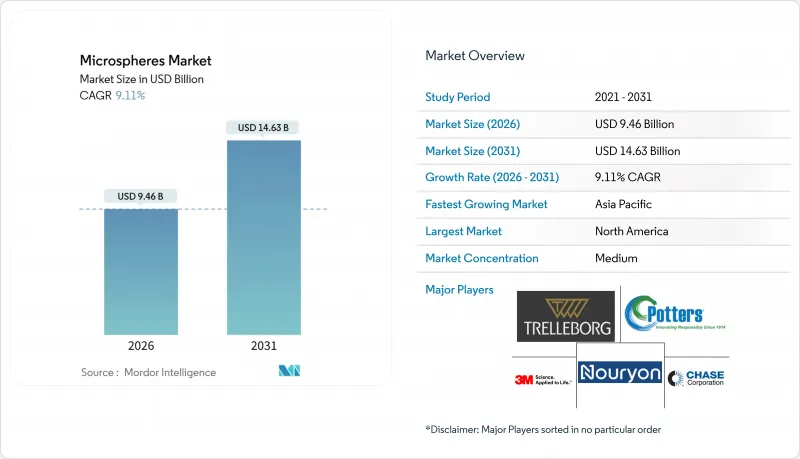
Mordor Intelligence에 의하면, 마이크로스피어 시장 규모는 2026년에 94억 6,000만 달러로 추정되고 있어 예측 기간(2026-2031년)에서 CAGR 9.11%로 확대되어 2031년에는 146억 3,000만 달러에 이를 전망입니다.
본 보고서는 원재료(유리, 폴리머, 세라믹, 플라이애시, 금속, 기타), 유형(중공 및 실체), 용도(자동차, 항공우주, 화장품, 석유 및 가스,페인트 및 코팅, 의료 기술, 복합재료, 기타), 지역(아시아태평양, 북미, 유럽, 남미, 중동 및 아프리카)별로 분류되어 있습니다. 시장 예측은 금액(미화) 기준으로 제시되어 있습니다.
세계 마이크로스피어 시장 동향 및 인사이트
첨단 의료 영상 진단 및 표적 약물 전달 분야의 활용 확대
이트륨-90 유리 마이크로스피어는 간세포암 치료에서 경동맥 방사선 색전술의 골드 스탠다드로 부상하고 있습니다. 이는 LEGACY 임상시험 및 DOORwaY90 연구에서 강조된 바와 같이, 보스턴 사이언티픽(Boston Scientific)의 ‘TheraSphere’ 및 서텍스(Sartex)의 ‘SIR-Spheres’에서 보여준 놀라운 성과에 이은 것입니다. 2024년에는 ‘Eye90’과 같은 조영제를 탑재한 폴리머 스피어가 인간을 대상으로 한 최초의 안전성 평가를 무사히 통과하여 시술 중 가시성이 강화되었습니다. 한편, PLGA로 코팅된 탄소 나노입자는 림프절 타투법에서 전임상 검증에 성공하여, 기존 염료를 대체할 무독성 대안을 제공합니다. FDA의 510(k) 승인 절차는 상용화를 가속화하지만, 입자 직경 및 방사성 핵종에 대한 엄격한 시험이 요구됩니다. 이러한 요건은 마이크로스피어 시장에서 정확성의 중요성을 부각시키고 있습니다. 또한, 병원에서 국소 치료의 도입이 확대됨에 따라, 유리 마이크로스피어 공급업체에게는 지속적인 수익원이 확고해지며 확대되고 있습니다.
전기차 및 항공우주용 복합재료의 경량화 추진
전기자동차 배터리 팩을 계기로, 각 OEM 업체들은 중공 유리 마이크로스피어의 채택을 추진하고 있습니다. 이러한 마이크로스피어를 열가소성 수지 하우징이나 언더바디 실드에 통합함으로써, 각 OEM 업체들은 내충격성을 저해하지 않으면서 부품의 질량을 대폭 줄이는 데 성공하고 있습니다. 3M사의 K 시리즈 및 S 시리즈 버블은 높은 인장 탄성률을 갖춘 경량 완성 부품의 실현을 위한 길을 열어가고 있습니다. 주요 항공우주 제조업체들은 현재 레이돔이나 페어링 등의 용도를 위해 마이크로스피어를 충전한 신택스 폼을 채택하고 있습니다. 보잉 787과 에어버스 A350에 이어, 이러한 혁신적인 기술은 차세대 항공기에도 도입되고 있습니다. 수지의 점도 저하, 유전 특성 향상, 공극률 감소와 같은 장점이 중공 유형의 매력을 높여, 마이크로스피어 시장의 지속적인 성장을 확실하게 하고 있습니다.
아크릴로니트릴 및 유리용 소다회 가격 변동
2025년 6월, 미국의 아크릴로니트릴 가격은 보합세를 보였으나, 중국에서는 더 저렴한 가격을 기록했습니다. 한편, 유럽에서는 프로파일렌 공급 부족으로 인해 폴리머 마이크로스피어의 이익률이 압박받자 가격이 급등했습니다. 한편, 중국과 튀르키예 양국의 소다회 규제로 인해 유리 마이크로스피어 생산업체들의 비용 변동이 심화되고 있습니다. 현물 구매자들은 분기 내의 급격한 가격 변동에 어려움을 겪고 있으며, 이는 신택스 폼 및 부력 모듈 프로젝트의 수익성을 더욱 복잡하게 만들고 있습니다.
부문별 분석
유리는 2026년 매출의 47.71%를 차지하며, 2031년까지 연평균 성장률(CAGR) 10.83%로 다른 원자재보다 높은 성장률을 보일 것으로 예측됩니다. 이러한 성장의 두 가지 주요 요인은 이트륨-90을 이용한 방사선 색전술용 비드와 항공우주 및 심해 시추용 신택스 복합재료에 사용되는 중공 소다석회 구입니다. 또한, 유리는 도로 표지용 굴절률에 관한 AASHTO M 247 규격의 요건을 충족하여 기본적인 수요량을 유지하고 있습니다. 폴리머 등급이 2위를 차지하고 있으며, 2024년 12월 누리옹(Nouryon)사가 출시한 바이오 유래의 ‘Expancel BIO’는 팽창률을 저해하지 않으면서도 지속가능성 감사 요건을 충족하고 있습니다. 세라믹, 플라이애쉬, 금속 재질의 미세 구체는 각각 고압 프로판트, 저비용 경량 콘크리트, 고밀도 부품의 적층 성형과 같은 틈새 수요를 충족시키고 있으며, 마이크로스피어 시장 전체에서 다양한 원자재 선택지를 확보하고 있습니다.
규제 준수가 선정 기준을 형성하고 있습니다. ISO 13320의 레이저 회절법을 통해 입자 직경이 확인되고, ISO 11357의 DSC(차열 분석)를 통해 팽창 온도 프로파일이 측정됨으로써, 공급망 전반에 품질 관리 기준이 정착되고 있습니다. 따라서 마이크로스피어 업계에서는 소재의 폭이 넓고 엄격한 분석 능력을 겸비한 제조업체가 높이 평가받고 있습니다. EU에서 새로 도입된 나노 물질 금지 조치(규정 2024/858)는 스티렌·아크릴레이트계 나노코폴리머를 규제하고 있어, 수요는 더 큰 입자 크기의 폴리머나 유리 제품으로 이동하고 있습니다. 유리 제조업체는 실리카의 수직 통합의 혜택을 받고 있어 소다회 가격 변동의 영향을 덜 받게 되었습니다. 반면, 폴리머 제조업체는 아크릴로니트릴 가격 변동 위험을 헤지하거나 바이오 유래 제조 공정을 채택해야 합니다. 그 결과, 마이크로스피어 시장에서 유리의 점유율은 향후 10년 동안 상승할 전망이며, 특히 종양학, 항공우주용 복합재료, 스마트 시티 인프라 분야에서 두드러질 것입니다.
지역별 분석
북미는 2026년 매출의 39.62%를 차지했습니다. 의료기기 산업이 집중된 미네소타주와 매사추세츠주는 방사선 색전술용 비드 시장을 주도하고 있습니다. 한편, 시애틀과 위치타의 복합재료 산업 거점에서는 차세대 항공기 동체를 위한 유리 버블 수요가 증가하고 있습니다. 누리온(Nurion)은 그린베이에서 사업을 확장하고, 미시간주 및 온타리오주 시장을 위한 전기차용 실란트의 현지 공급망을 구축했습니다. 미국 국방부(DoD)의 도로 표지 규격 개정에 따라 각 주 교통국(DOT)을 통한 유리 비드의 안정적인 조달이 보장되고 있습니다. 또한, 캐나다 오일샌드 유정의 시멘트 충진 및 멕시코 자동차 내장재 용도로 인해 마이크로스피어 시장에서 북미의 우위가 더욱 공고해지고 있습니다.
아시아태평양은 2031년까지 연평균 성장률(CAGR) 11.89%를 나타낼 것으로 예측됩니다. 중국의 전기차(EV) 생산 대수 증가는 배터리 하우징용 유리 비드 수요를 끌어올리고 있습니다. 상하이에 본사를 둔 클레락스(Crelax)는 시장의 다양한 수요를 반영하여 유리, 폴리머, 세라믹, 금속 등 폭넓은 유형의 비즈를 제공합니다. 일본의 크레하(Kureha)는 도쿄와 휴스턴에 연구개발 거점을 두고, 전 세계 복합재료 제조업체들이 새로운 등급의 인증을 획득할 수 있도록 지원하고 있습니다. 인도에서는 국도상의 반사형 도로 표지판 도입이 확대됨에 따라 유리 비드 수입이 증가하고 있습니다. 한국에서는 반도체 클린룸의 필터 검증에 고체 폴리머 구형체가 활용되고 있습니다. 또한, 아세안(ASEAN)이 자동차 부품의 핵심 지역으로 부상하고 있는 것은 마이크로스피어 시장에 더 큰 성장 가능성을 가져다주고 있습니다.
유럽에서는 화장품에 폴리머 마이크로비즈 사용을 금지하는 규정 2023/2055와 펠릿의 비산을 규제하는 규정 2025/2365와 같은 과제에 직면해 있습니다. 독일의 자동차 OEM 기업들은 전기차 배터리 케이스에 팽창성 미립자를 적용하고 있으나, REACH 규정 준수에 따른 비용이 설비 투자의 과제로 대두되고 있습니다. 프랑스 항공우주 업계의 주요 기업들은 마이크로스피어가 충전된 프리프레그로의 전환을 추진하고 있으며, 영국의 해상 풍력 발전 업계에서는 신탁스폼(Syntax Foam)으로 제작된 부력 모듈이 활용되고 있습니다. 누리용의 순도스발 공장은 유럽 내 바이오 유래 등급 수요를 충족하는 데 있어 매우 중요한 역할을 하고 있습니다. 남미, 중동 및 아프리카를 합친 세계 시장 점유율은 작지만, 브라질의 프레솔트층 시추 활동과 사우디아라비아의 도로 안전 대책으로 인해 수요가 산발적으로 급증하고 있어, 지리적으로 다양한 마이크로스피어 시장이 형성되고 있습니다.
기타 혜택:
- 엑셀 형식 시장 예측(ME) 시트
- 3개월간의 애널리스트 지원
자주 묻는 질문
목차
제1장 서론
제2장 조사 방법
제3장 개요
제4장 시장 구도
제5장 시장 규모와 성장 예측
제6장 경쟁 구도
제7장 시장 기회와 향후 전망
JHS 26.09.03According to Mordor Intelligence, the microspheres market size is estimated at USD 9.46 billion in 2026, and is expected to reach USD 14.63 billion by 2031, at a CAGR of 9.11% during the forecast period (2026-2031).
This report is Segmented by Raw Material (Glass, Polymer, Ceramics, Fly Ash, Metallic, and Others), Type (Hollow and Solid), Application (Automotive, Aerospace, Cosmetics, Oil and Gas, Paints and Coatings, Medical Technology, Composites, and Others), and Geography (Asia-Pacific, North America, Europe, South America, and Middle-East and Africa). The Market Forecasts are Provided in Terms of Value (USD).
Global Microspheres Market Trends and Insights
Increasing Application in Advanced Medical Imaging and Targeted Drug Delivery
Yttrium-90 glass microspheres have emerged as the gold standard for transarterial radioembolization in treating hepatocellular carcinoma. This follows the impressive outcomes demonstrated in Boston Scientific's TheraSphere and Sirtex's SIR-Spheres, as highlighted in the LEGACY trial and the DOORwaY90 study. In 2024, polymer spheres, like Eye90, which carry contrast agents, successfully navigated first-in-human safety assessments, bolstering intraprocedural visualization. Meanwhile, PLGA-encapsulated carbon nanoparticles achieved preclinical validation for lymph-node tattooing, offering a non-toxic alternative to conventional dyes. While the FDA's 510(k) pathway expedites commercialization, it demands stringent testing on particle size and radionuclides. This requirement underscores the need for precision in the microspheres market. Furthermore, as hospitals increasingly adopt localized therapies, it solidifies and boosts the recurring revenue streams for suppliers of glass microspheres.
Lightweighting Push in Electric Vehicle and Aerospace Composites
Electric-vehicle battery packs are prompting OEMs to turn to hollow glass microspheres. By integrating these microspheres into thermoplastic housings and underbody shields, OEMs are achieving a significant reduction in component mass without sacrificing impact resistance. 3M's K- and S-series bubbles are paving the way for lightweight finished parts with high tensile moduli. Major aerospace players are now turning to microsphere-filled syntactic foams for applications like radomes and fairings. Following the lead of the Boeing 787 and Airbus A350, these innovations are making their way into next-generation airframes. The advantages of lower resin viscosity, enhanced dielectric properties, and reduced voids bolster the appeal of hollow variants, ensuring continued growth for the microspheres market.
Volatile Acrylonitrile and Glass-Grade Soda-Ash Prices
In June 2025, U.S. prices for acrylonitrile remained steady, while in China, it was more affordable. However, European prices surged, driven by propylene shortages that tightened margins for polymer microspheres. Meanwhile, restrictions on soda ash in both China and Turkey have intensified cost fluctuations for producers of glass microspheres. Spot buyers are grappling with significant price swings within the quarter, adding complexity to the project economics of syntactic foams and buoyancy modules.
Other drivers and restraints analyzed in the detailed report include:
- Surge in Reflective and Insulating Road-Marking Paints for Smart-City Projects
- Decentralized 3-D Microfluidic Fabrication Boosting Custom Sphere Demand
- Tightening Bans on Microplastics in Cosmetics
For complete list of drivers and restraints, kindly check the Table Of Contents.
Segment Analysis
Glass held 47.71% of 2026 revenue and is forecast to outpace other raw materials at 10.83% CAGR through 2031. Its dual pull comes from yttrium-90 radioembolization beads and hollow soda-lime spheres used in syntactic composites for aerospace and deepwater drilling. Glass also satisfies AASHTO M 247 mandates for road-marking refractive index, preserving a baseline volume stream. Polymer grades rank second; Nouryon's bio-attributed Expancel BIO launch in December 2024 meets sustainability audits without compromising expansion ratios. Ceramic, fly-ash, and metallic spheres each address niche needs-high-pressure proppants, low-cost lightweight concrete, and additive manufacturing of dense parts-ensuring a diversified raw-material palette across the microspheres market.
Regulatory compliance shapes preferences: ISO 13320 laser diffraction confirms particle-size, while ISO 11357 DSC profiles expansion temperatures, embedding quality discipline across supply chains. The microspheres industry, therefore, rewards producers that pair material breadth with analytical rigor. Emerging EU nano-material bans (Regulation 2024/858) restrict styrene-acrylate nano-copolymers, redirecting demand to larger-sized polymer or glass options. Glass producers benefit from vertical silica integration, insulating them from soda-ash volatility. Polymer players, however, must hedge acrylonitrile swings or adopt bio-routes. Consequently, glass's share within the microspheres market is likely to rise through the decade, especially in oncology, aerospace composites, and smart-city infrastructure.
Complete Report Scope:
- By Raw Material
- Glass
- Polymer
- Ceramics
- Fly Ash
- Metallic
- Others
- By Type
- Hollow
- Solid
- By Application
- Automotive
- Aerospace
- Cosmetics
- Oil and Gas
- Paints and Coatings
- Medical Technology
- Composites
- Others
- By Geography
- Asia-Pacific
- China
- India
- Japan
- South Korea
- ASEAN Countries
- Rest of Asia-Pacific
- North America
- United States
- Canada
- Mexico
- Europe
- Germany
- United Kingdom
- Italy
- France
- Rest of Europe
- South America
- Brazil
- Argentina
- Rest of South America
- Middle-East and Africa
- Saudi Arabia
- South Africa
- Rest of Middle-East and Africa
- Asia-Pacific
Geography Analysis
North America generated 39.62% of 2026 revenue. Minnesota and Massachusetts, with their concentrated medical-device clusters, bolster the market for radioembolization beads. Meanwhile, composite hubs in Seattle and Wichita are fueling the demand for glass bubbles in next-generation airframes. Nouryon expanded in Green Bay, establishing local supply lines for EV sealants catering to markets in Michigan and Ontario. Updated road-marking specifications from the DoD ensure consistent procurement of glass beads by state DOTs. Additionally, Canadian oil-sands well-cementing and automotive interiors in Mexico further solidify North America's dominant position in the microspheres market.
Asia Pacific is forecast to log an 11.89% CAGR to 2031. China's production of EV units boosts the demand for glass bubbles in battery housings. Crerax, based in Shanghai, provides a range of spheres - glass, polymer, ceramic, and metallic - reflecting the market's demand diversity. Kureha from Japan operates research and development hubs in both Tokyo and Houston, assisting global composites clients in qualifying new grades. India's push for reflective road markings on national highways is driving up glass-bead imports. In South Korea, solid polymer spheres are being utilized for filter validation in semiconductor cleanrooms. Furthermore, ASEAN's emergence as a hub for automotive components adds another layer of growth potential for the microspheres market.
Europe faces challenges with Regulation 2023/2055, which prohibits polymer microbeads in cosmetics, and Regulation 2025/2365, which enforces controls on pellet loss. While German automotive OEMs are incorporating expandable spheres into EV battery enclosures, the costs associated with REACH compliance are raising capital expenditure challenges. Aerospace leaders in France are turning to microsphere-filled prepregs, and the offshore wind industry in the U.K. is utilizing syntactic-foam buoyancy modules. Nouryon's facility in Sundsvall is playing a pivotal role in meeting Europe's demand for bio-attributed grades. Although South America and the Middle-East and Africa collectively hold a smaller share of the global market, Brazil's pre-salt drilling activities and road-safety initiatives in Saudi Arabia are generating sporadic surges in demand, ensuring a geographically diverse microspheres market.
- 3M
- Bangs Laboratories Inc.
- Chase Corporation
- Cospheric LLC
- Crerax Science and Technology Co. Ltd.
- Kureha Corporation
- Luminex Corporation (Diasorin Spa)
- Matsumoto Yushi-seiyaku Co. Ltd
- Merck KGaA
- Merit Medical Systems
- Momentive
- Mo-sci Corporation (Heraeus Holdings)
- Nouryon
- Potters Industries LLC
- PQ Corporation
- Siemens Healthineers AG
- Trelleborg AB
Additional Benefits:
- The market estimate (ME) sheet in Excel format
- 3 months of analyst support
TABLE OF CONTENTS
1 Introduction
- 1.1 Study Assumptions and Market Definition
- 1.2 Scope of the Study
2 Research Methodology
3 Executive Summary
4 Market Landscape
- 4.1 Market Overview
- 4.2 Market Drivers
- 4.2.1 Increasing application in advanced medical imaging and targeted drug delivery
- 4.2.2 Lightweighting push in Electric vehicle and aerospace composites
- 4.2.3 Surge in reflective and insulating road-marking paints for smart-city projects
- 4.2.4 Decentralised 3-D microfluidic fabrication boosting custom sphere demand
- 4.2.5 Adoption in additive-manufactured concrete for off-planet construction
- 4.3 Market Restraints
- 4.3.1 Volatile acrylonitrile and glass-grade soda-ash prices
- 4.3.2 Tightening bans on micro-plastics in cosmetics
- 4.3.3 Capacity bottlenecks in expandable-microsphere blowing-agent supply
- 4.4 Value Chain Analysis
- 4.5 Porter's Five Forces
- 4.5.1 Bargaining Power of Suppliers
- 4.5.2 Bargaining Power of Buyers
- 4.5.3 Threat of New Entrants
- 4.5.4 Threat of Substitutes
- 4.5.5 Degree of Competition
- 4.6 Pricing Analysis
5 Market Size and Growth Forecasts (Value)
- 5.1 By Raw Material
- 5.1.1 Glass
- 5.1.2 Polymer
- 5.1.3 Ceramics
- 5.1.4 Fly Ash
- 5.1.5 Metallic
- 5.1.6 Others
- 5.2 By Type
- 5.2.1 Hollow
- 5.2.2 Solid
- 5.3 By Application
- 5.3.1 Automotive
- 5.3.2 Aerospace
- 5.3.3 Cosmetics
- 5.3.4 Oil and Gas
- 5.3.5 Paints and Coatings
- 5.3.6 Medical Technology
- 5.3.7 Composites
- 5.3.8 Others
- 5.4 By Geography
- 5.4.1 Asia-Pacific
- 5.4.1.1 China
- 5.4.1.2 India
- 5.4.1.3 Japan
- 5.4.1.4 South Korea
- 5.4.1.5 ASEAN Countries
- 5.4.1.6 Rest of Asia-Pacific
- 5.4.2 North America
- 5.4.2.1 United States
- 5.4.2.2 Canada
- 5.4.2.3 Mexico
- 5.4.3 Europe
- 5.4.3.1 Germany
- 5.4.3.2 United Kingdom
- 5.4.3.3 Italy
- 5.4.3.4 France
- 5.4.3.5 Rest of Europe
- 5.4.4 South America
- 5.4.4.1 Brazil
- 5.4.4.2 Argentina
- 5.4.4.3 Rest of South America
- 5.4.5 Middle-East and Africa
- 5.4.5.1 Saudi Arabia
- 5.4.5.2 South Africa
- 5.4.5.3 Rest of Middle-East and Africa
- 5.4.1 Asia-Pacific
6 Competitive Landscape
- 6.1 Market Concentration
- 6.2 Strategic Moves
- 6.3 Market Share(%)/Ranking Analysis
- 6.4 Company Profiles (includes Global-level Overview, Market-level Overview, Core Segments, Financials, Strategic Info, Products and Services, Recent Developments)
- 6.4.1 3M
- 6.4.2 Bangs Laboratories Inc.
- 6.4.3 Chase Corporation
- 6.4.4 Cospheric LLC
- 6.4.5 Crerax Science and Technology Co. Ltd.
- 6.4.6 Kureha Corporation
- 6.4.7 Luminex Corporation (Diasorin Spa)
- 6.4.8 Matsumoto Yushi-seiyaku Co. Ltd
- 6.4.9 Merck KGaA
- 6.4.10 Merit Medical Systems
- 6.4.11 Momentive
- 6.4.12 Mo-sci Corporation (Heraeus Holdings)
- 6.4.13 Nouryon
- 6.4.14 Potters Industries LLC
- 6.4.15 PQ Corporation
- 6.4.16 Siemens Healthineers AG
- 6.4.17 Trelleborg AB
7 Market Opportunities and Future Outlook
- 7.1 White-space and Unmet-need Assessment


