

|
시장보고서
상품코드
2121856
북미의 마취제 : 시장 점유율 분석, 업계 동향과 통계, 성장 예측(2026-2031년)North America Anesthesia Drugs - Market Share Analysis, Industry Trends & Statistics, Growth Forecasts (2026 - 2031) |
||||||
 Mordor Intelligence
Mordor Intelligence에 따르면 2026년 북미의 마취제 시장 규모는 31억 6,000만 달러로 추정되고 있으며, 2025년 30억 6,000만 달러에서 확대하며, 2031년에는 37억 1,000만 달러에 달할 것으로 예측됩니다.
2026-2031년 동안의 연평균 성장률(CAGR)은 3.27%에 달할 것으로 전망됩니다.
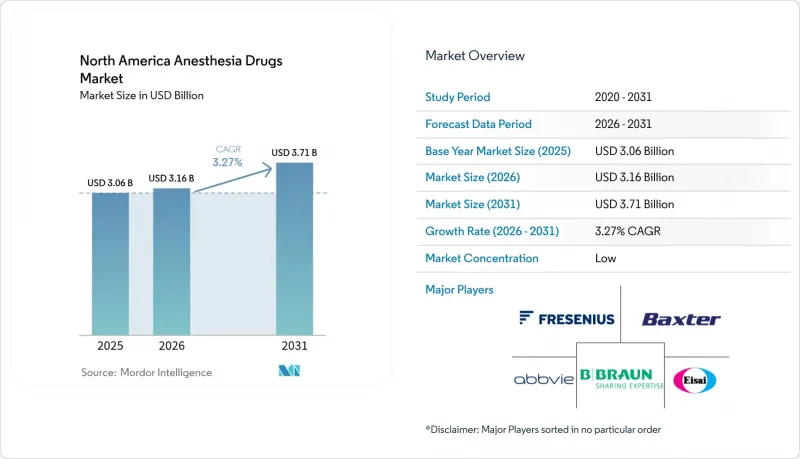
이 보고서에서는 산업을 약물 유형(전신마취제, 국소마취제), 투여 경로(흡입, 주사, 기타), 용도(일반 외과수술, 성형 수술, 기타), 최종사용자(병원, 기타), 지역(미국, 캐나다, 멕시코)별로 분류하고 있습니다. 시장 규모와 전망은 금액(달러)으로 표시되어 있습니다.
북미 마취제 시장의 동향 및 인사이트
수술 건수 증가
이 지역 전체적으로 수술 건수는 계속 증가하고 있으며, 메디케어 보고서에 따르면 2024년에는 수급자 1인당 수술 건수가 전년 대비 5.7% 증가할 것으로 전망됩니다. 외래 수술 센터(ASC)에서는 2033년에 수술 건수가 22% 증가할 것으로 예측되어, 즉효성 마취제에 대한 수요가 높아지고 있습니다. 65세 이상의 환자층은 더 복잡한 수술을 받는 경향이 있으며, 이로 인해 마취 투여 시간이 길어지고 약제 소비량이 증가하고 있습니다. 성형 수술은 현재 연간 130억 달러 규모의 시장을 형성하고 있으며, 성형 클리닉에서는 수술 후 메스꺼움을 억제하기 위해 개별 환자에 맞춘 약제 사용이 확대되고 있습니다.
제약 기업의 연구개발 투자 확대
제약 기업은 마취제 파이프라인에 사상 최대 규모의 자금을 투입하고 있으며, 애브비(AbbVie)는 약 90종의 화합물을 보유하고 있고, 2024년 매출 563억 달러를 임상 프로그램의 자금원으로 삼고 있습니다. 화이자는 112건의 파이프라인 프로젝트 중 64건을 신규 화합물로 꼽으며, 폭넓은 신약 개발의 추진력을 입증하고 있습니다. FDA는 2025년 1월, Journavx(수제트리긴)을 승인했습니다. 이는 비오피오이드계 약물로, 수술 전후 통증 관리 프로토콜을 혁신하고 오피오이드 병용을 억제할 가능성이 있습니다.
전신마취제의 부작용 및 안전성에 대한 우려
FDA의 약물 모니터링 데이터에 따르면 2004-2022년 사이에 세보플루란과 관련된 이상반응이 1,126건 보고되었으며, 그 범위는 심방세동에서 악성 고열증에 이르기까지 다양합니다. 소아를 대상으로 한 모니터링에서는 뇌증 등의 새로운 신호가 밝혀져, 임상의들에게 신중한 대응이 요구되고 있습니다. NHS(영국 국민보건서비스)가 데스플루란의 단계적 폐지를 계획하고 있는 것과 같은 환경적 움직임으로 인해 익숙하다는 장점이 있음에도 불구하고 병원들은 대체 약제로의 전환을 강요받고 있습니다. 이러한 요인들로 인해 심폐 프로파일이 더 좁은 것으로 알려진 새로운 분자들이 주목받고 있지만, 이를 도입하기 위해서는 비용이 많이 드는 교육 프로그램이 필요할 가능성이 있습니다.
부문 분석
2025년, 북미 마취제 시장 점유율 중 전신 마취제가 69.88%를 차지했습니다. 프로포폴의 신속한 작용이 이러한 우위를 지원하고 있지만, 주사시 통증과 심혈관계 변동을 줄여주는 시프로폴이 임상의들의 관심을 모으고 있습니다. 데스플루란의 사용이 온실가스 규제로 인해 감소 추세를 보이고 있음에도 불구하고 세보플루란은 소아 환자에서 주요 흡입 마취제로서의 위상을 유지하고 있습니다. 덱스메데토미진은 호흡 안정성이 필수적인 각성 하 시술 및 중환자 치료 분야에서 그 역할을 확대하고 있습니다. 레미펜타닐은 단시간 외래 수술에서 초단시간 작용형 오피오이드로서 역할을 수행하고 있는 반면, 미다졸람은 범용성이 높은 항불안 보조제로서의 입지를 유지하고 있습니다.
국소 마취제는 연평균 성장률(CAGR) 3.80%로 성장하고 있으며, 이는 전체 부문 중 가장 빠른 속도로, 오피오이드 의존도를 낮추는 국소 마취의 혜택을 받고 있습니다. 부피바카인은 정형외과 및 산부인과 분야에서 지속적인 진통 작용으로 주도적인 위치를 차지하고 있습니다. 로피바카인은 심장 독성 위험이 낮아 고위험 환자군에서 척추 마취의 1순위 약물로 자리 잡고 있습니다. 리도카인은 침윤 마취에서 여전히 필수적이지만, 현재는 정맥내 구역 마취에서도 용도가 확대되고 있습니다. 초음파 유도 기술의 보급으로 국소 마취제의 적응증이 확대되면서 총 소비량이 증가하고 있습니다. 2026-2031년에 북미 마취제 시장에서 국소 마취제 시장 규모는 산업 전체를 상회하는 속도로 확대될 것으로 예측됩니다.
2025년, 북미 마취제 시장에서 흡입제는 62.94%의 점유율을 차지했습니다. 이는 휘발성 마취제에 대응할 수 있는 수술실 인프라가 잘 갖춰져 있기 때문입니다. 세보플란은 예측 가능한 약동학 특성으로 인해 주요 위치를 확립하고 있습니다. 박스터(Baxter)사가 푸에르토리코에 충전 및 마무리 라인에 대한 투자를 단행하여 지역내 재고 확보를 도모함에 따라 공급업체의 집중도가 높아지고 있습니다. 그러나 환경 정책에 따라 완전 정맥내 마취로의 전환이 가속화되고 있습니다.
주사제는 외래 수술 센터(ASC)나 ERAS(조기 수술 후 회복) 프로토콜에서 정밀한 투여량 조절이 중요시됨에 따라 연평균 성장률(CAGR) 4.10%를 기록하고 있습니다. 프로포폴이 여전히 주류를 이루고 있지만, 시프로폴과 레미마졸람에 대한 FDA의 새로운 승인으로 인해 선택지가 다양해질 전망입니다. 북미 마취제 시장에서 주사제 시장 규모는 2031년까지 19억 3,000만 달러에 달할 것으로 예상되며, 이는 임상의들이 신속한 투여를 선호하는 경향을 반영합니다. 즉시 사용 가능한 바이알은 투약 실수나 오염을 줄여 수요를 지원하고 있습니다. 외용 및 경피 투여 경로는 여전히 틈새 시장으로 남아 있지만, 지질 나노입자형 리도카인 제형 및 피부 패치의 혁신으로 인해 새로운 수입원이 열릴 가능성이 있습니다.
기타 혜택
- 엑셀 형식의 시장 예측(ME) 시트
- 3개월간의 애널리스트 지원
자주 묻는 질문
목차
제1장 서론
제2장 조사 방법
제3장 개요
제4장 시장 구도
제5장 시장 규모와 성장 예측
제6장 경쟁 구도
제7장 시장 기회와 향후 전망
KSA 26.09.03According to Mordor Intelligence, North America anesthesia drugs market size in 2026 is estimated at USD 3.16 billion, growing from 2025 value of USD 3.06 billion with 2031 projections showing USD 3.71 billion, growing at 3.27% CAGR over 2026-2031.
This report Segments the Industry Into by Drug Type (General Anesthesia Drugs, Local Anesthesia Drugs), by Route of Administration (Inhalation, Injection, and More), by Application (General Surgeries, Cosmetic Surgeries, and More), End User (Hospitals and More), and Geography (United States, Canada, Mexico). The Market Sizes and Forecasts are Provided in Terms of Value (USD).
North America Anesthesia Drugs Market Trends and Insights
Increasing Number of Surgeries
Surgical episodes across the region keep rising, with Medicare reporting 5.7% annual gains in procedures per beneficiary during 2024. ASCs anticipate a 22% lift in procedure counts by 2033, reinforcing demand for fast-acting anesthesia formulations. The 65-plus cohort undergoes more complex operations, which lengthen anesthetic exposure and elevate drug consumption. Cosmetic interventions now generate USD 13 billion yearly, expanding use of tailored agents that limit postoperative nausea in aesthetic clinics .
Growing R&D Investment by Pharmaceutical Companies
Pharma sponsors channel record sums into anesthesia pipelines, with AbbVie overseeing roughly 90 active compounds and USD 56.3 billion in 2024 revenue that funds clinical programs. Pfizer lists 64 novel entities among 112 pipeline projects, underscoring broad discovery momentum. The FDA cleared Journavx (suzetrigine) in January 2025, a non-opioid that could reshape perioperative pain protocols and curb opioid co-administration .
Adverse Effects & Safety Concerns of General Anesthetics
FDA pharmacovigilance tallied 1,126 sevoflurane adverse events between 2004 and 2022, ranging from atrial fibrillation to malignant hyperthermia. Pediatric surveillance uncovered novel signals such as encephalopathy, prompting clinician caution. Environmental moves like the NHS plan to phase out desflurane pressure hospitals to substitute agents despite familiarity advantages. These factors favor newer molecules that claim narrower cardio-respiratory profiles but may require costly education programs.
Other drivers and restraints analyzed in the detailed report include:
- Shift Toward Outpatient/Ambulatory Surgeries Driving Demand for Ultra-Short-Acting Anesthetics
- Rapid Adoption of AI-Enabled Anesthesia Monitoring Improving Drug Utilization Efficiency
- Stringent FDA & DEA Regulations on Controlled Substances
For complete list of drivers and restraints, kindly check the Table Of Contents.
Segment Analysis
General anesthetics accounted for 69.88% of the North America anesthesia drugs market share in 2025. Propofol's rapid onset underpins this lead, yet ciprofol is gaining clinician interest because it mitigates injection pain and cardiovascular swings. Sevoflurane remains the dominant inhaled choice for pediatric cases even as desflurane usage fades under green-house gas scrutiny. Dexmedetomidine enjoys expanding roles in awake procedures and intensive care where respiratory stability is vital. Remifentanil provides ultra-short opioid support for brief ambulatory cases, whereas midazolam remains a versatile anxiolytic adjunct.
Local anesthetics advance at a 3.80% CAGR, the fastest among all segments, and they benefit from regional blocks that reduce opioid reliance. Bupivacaine leads for its prolonged analgesia in orthopedic and obstetric settings. Ropivacaine's lower cardiotoxic risk makes it the spinal agent of choice for high-risk populations. Lidocaine, still indispensable for infiltration, now sees extended uses in intravenous regional anesthesia. Ultrasound-guided techniques broaden indications for locals, raising total consumption. The North America anesthesia drugs market size for local agents is projected to swell at a volume pace that outstrips the overall sector during 2026-2031.
Inhalation drugs held 62.94% of the North America anesthesia drugs market in 2025 due to operating room infrastructure geared toward volatile agents. Sevoflurane's predictable kinetics underpin its primacy. Supplier concentration is rising after Baxter invested in Puerto Rico fill-finish lines that secure regional stocks. Environmental policies, however, accelerate substitution into total intravenous anesthesia.
Injectables are recording a 4.10% CAGR as ASCs and ERAS pathways reward precise titration. Propofol remains the anchor but fresh FDA clearance for ciprofol and remimazolam will diversify options. The North America anesthesia drugs market size for injectable agents is expected to reach USD 1.93 billion by 2031, reflecting clinician preference for rapid turnover. Ready-to-use vials reduce medication errors and contamination, sustaining demand. Although topical and transdermal routes stay niche, innovation in liposomal lidocaine foams and dermal patches could open incremental revenue.
Complete Report Scope:
- By Drug Type
- General Anesthesia Drugs
- Propofol
- Sevoflurane
- Desflurane
- Dexmedetomidine
- Remifentanil
- Midazolam
- Other General Anesthesia Drugs
- Local Anesthesia Drugs
- Bupivacaine
- Ropivacaine
- Lidocaine
- Chloroprocaine
- Prilocaine
- Benzocaine
- Other Local Anesthesia Drugs
- General Anesthesia Drugs
- By Route of Administration
- Inhalation
- Injection (IV/IM)
- Other Routes (Topical, Transdermal, etc.)
- By Application
- General Surgeries
- Cosmetic Surgeries
- Dental Surgeries
- Other Applications
- By End User
- Hospitals
- Ambulatory Surgical Centers
- Other End Users
- By Geography
- United States
- Canada
- Mexico
List of Companies Covered in this Report:
- Abbvie
- Baxter
- Fresenius
- Pfizer
- Aspen Pharmacare Holdings Ltd.
- B. Braun
- Eisai
- Avet Pharmaceuticals
- Roche
- Novartis
- Hikma Pharmaceuticals
- Viatris
- Piramal Group
- Teva Pharmaceutical Industries
- CSL Vifor
- Sun Pharmaceuticals Industries
Additional Benefits:
- The market estimate (ME) sheet in Excel format
- 3 months of analyst support
TABLE OF CONTENTS
1 Introduction
- 1.1 Study Assumptions & Market Definition
- 1.2 Scope of the Study
2 Research Methodology
3 Executive Summary
4 Market Landscape
- 4.1 Market Overview
- 4.2 Market Drivers
- 4.2.1 Increasing number of surgeries
- 4.2.2 Growing R&D investment by pharmaceutical companies
- 4.2.3 Shift toward outpatient/ambulatory surgeries driving demand for ultra-short-acting anesthetics
- 4.2.4 Rapid adoption of AI-enabled anesthesia monitoring improving drug utilization efficiency
- 4.2.5 AI-enabled anesthesia monitoring
- 4.2.6 Commercialization of next-gen agents (e.g., ciprofol/HSK3486) offering improved safety profiles
- 4.3 Market Restraints
- 4.3.1 Adverse effects & safety concerns of general anesthetics
- 4.3.2 Stringent FDA & DEA regulations on controlled substances
- 4.3.3 Limited domestic production of sevoflurane/propofol APIs risks periodic shortages
- 4.3.4 Supply-chain vulnerability for critical APIs (e.g., propofol, sevoflurane)
- 4.4 Value / Supply-Chain Analysis
- 4.5 Regulatory Landscape
- 4.6 Technological Outlook
- 4.7 Porter's Five Forces Analysis Analysis
- 4.7.1 Threat of New Entrants
- 4.7.2 Bargaining Power of Buyers
- 4.7.3 Bargaining Power of Suppliers
- 4.7.4 Threat of Substitutes
- 4.7.5 Intensity of Competitive Rivalry
5 Market Size & Growth Forecasts (Value - USD million)
- 5.1 By Drug Type
- 5.1.1 General Anesthesia Drugs
- 5.1.1.1 Propofol
- 5.1.1.2 Sevoflurane
- 5.1.1.3 Desflurane
- 5.1.1.4 Dexmedetomidine
- 5.1.1.5 Remifentanil
- 5.1.1.6 Midazolam
- 5.1.1.7 Other General Anesthesia Drugs
- 5.1.2 Local Anesthesia Drugs
- 5.1.2.1 Bupivacaine
- 5.1.2.2 Ropivacaine
- 5.1.2.3 Lidocaine
- 5.1.2.4 Chloroprocaine
- 5.1.2.5 Prilocaine
- 5.1.2.6 Benzocaine
- 5.1.2.7 Other Local Anesthesia Drugs
- 5.1.1 General Anesthesia Drugs
- 5.2 By Route of Administration
- 5.2.1 Inhalation
- 5.2.2 Injection (IV/IM)
- 5.2.3 Other Routes (Topical, Transdermal, etc.)
- 5.3 By Application
- 5.3.1 General Surgeries
- 5.3.2 Cosmetic Surgeries
- 5.3.3 Dental Surgeries
- 5.3.4 Other Applications
- 5.4 By End User
- 5.4.1 Hospitals
- 5.4.2 Ambulatory Surgical Centers
- 5.4.3 Other End Users
- 5.5 By Geography
- 5.5.1 United States
- 5.5.2 Canada
- 5.5.3 Mexico
6 Competitive Landscape
- 6.1 Market Concentration
- 6.2 Market Share Analysis
- 6.3 Company Profiles (includes Global level Overview, Market level overview, Core Segments, Financials as available, Strategic Information, Market Rank/Share for key companies, Products & Services, and Recent Developments)
- 6.3.1 AbbVie Inc.
- 6.3.2 Baxter International Inc.
- 6.3.3 Fresenius SE & Co. KGaA (Fresenius Kabi)
- 6.3.4 Pfizer Inc.
- 6.3.5 Aspen Pharmacare Holdings Ltd.
- 6.3.6 B. Braun SE
- 6.3.7 Eisai Co. Ltd.
- 6.3.8 Avet Pharmaceuticals Inc.
- 6.3.9 F. Hoffmann-La Roche Ltd.
- 6.3.10 Novartis AG (Sandoz)
- 6.3.11 Hikma Pharmaceuticals PLC
- 6.3.12 Viatris Inc. (Mylan)
- 6.3.13 Piramal Pharma Solutions
- 6.3.14 Teva Pharmaceutical Industries Ltd.
- 6.3.15 CSL Vifor
- 6.3.16 Sun Pharmaceutical Industries Ltd.
7 Market Opportunities & Future Outlook
- 7.1 White-space & Unmet-Need Assessment


