

|
시장보고서
상품코드
2113687
마취제 : 시장 점유율 분석, 업계 동향 및 통계, 성장 예측(2026-2031년)Anesthesia Drugs - Market Share Analysis, Industry Trends & Statistics, Growth Forecasts (2026 - 2031) |
||||||
 Mordor Intelligence
Mordor Intelligence에 의하면, 마취제 시장 규모는 2025년 75억 달러로 평가되었습니다. 2026년 77억 7,000만 달러에서 2031년까지 93억 달러로 확대되고 2026년부터 2031년에 걸쳐 CAGR 3.65%를 나타낼 전망입니다.
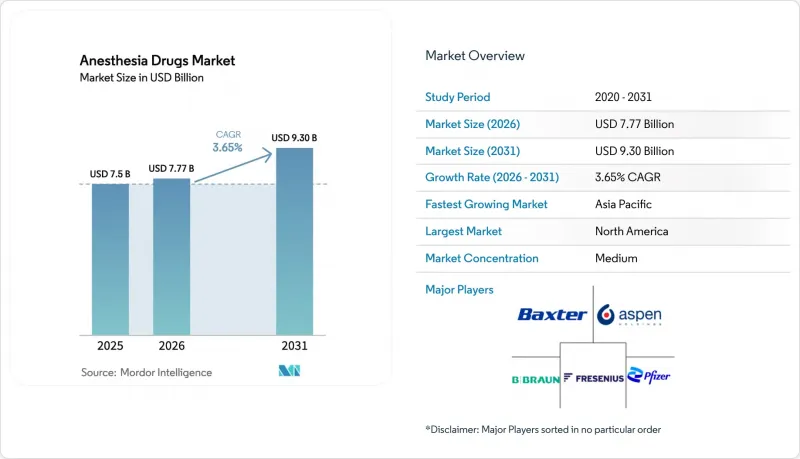
본 보고서는 약제 유형(전신마취제 (프로포폴, 세보플루란 등) 및 국소마취제), 투여 경로(흡입, 주사 등), 용도(일반외과, 성형·재건외과 등), 최종 사용자(병원, 전문 클리닉 등), 지역(북미 등)별로 분류되어 있습니다. 시장 예측은 금액(달러) 기준으로 제시되어 있습니다.
세계의 마취제 시장 동향 및 인사이트
수술 건수 증가가 마취제 소비를 견인
예정되어 있던 정형외과 및 비만 치료 수술이 팬데믹으로 인한 수술 지연을 해소하면서, 신경근 차단제 및 장시간 작용형 약물에 대한 수요를 끌어올리고 있습니다. 미국 마취과학회(ASA)의 추정에 따르면, 2024년 중반 시점에서 미국에는 여전히 120만 건의 연기된 수술이 대기 목록에 남아 있는 것으로 나타났습니다. 병원에서는 수술 일정을 연장하고 있으며, 이로 인해 직원 교대에 따른 지연을 줄일 수 있고 사용량을 예측하기 쉬운 약물의 소비량이 증가하고 있습니다. 일본과 한국에서는 고령화가 진행되고 있으며, 수술 후 섬망의 위험을 줄이기 위해 고령자용 프로토콜에서 벤조디아제핀계 약물 대신 덱스메데토미딘이 점점 더 많이 사용되고 있습니다.
신규 고정 용량 마취제 복합제의 신속한 승인
2024년부터 2025년에 걸쳐 미국 식품의약국(FDA)이 3건의 승인을 내렸으며, 프로포폴·케타민 복합제 및 세보플란·아산화질소 복합제가 도입되었습니다. 이로 인해 의료 기관은 단일 공급업체와의 계약에 묶이게 되어, 제네릭 의약품에 의한 시장 침식을 막을 수 있게 되었습니다. 임상의들은 투여량의 미세 조정에 대한 유연성을 선호하기 때문에 도입이 예상보다 늦어지고 있지만, 외래수술센터(ASC)에서는 준비 시간을 30-40% 단축하고 간호사의 진정 업무 흐름을 효율화하는 것을 중시하고 있습니다. WHO의 사전 승인을 통해 수입 경로가 확보된 후, EU 및 APAC 시장에서도 도입이 진행될 전망입니다.
수술 후 인지 기능 장애에 대한 우려가 마취제 선택을 제약
고령 환자에 대한 정맥 내 전신 마취로의 전환이 진행되고 있습니다. 이는 휘발성 마취제에 대한 장기 노출과 인지 기능 저하 사이에 관찰상 연관성이 나타났기 때문입니다. 미국노인의학회의 최신 지침에서는 벤조디아제핀계 약물의 사용을 최소화할 것을 권고하고 있습니다. 그러나 2025년 메타분석에 따르면 마취 깊이 모니터링을 실시한 경우 통계적으로 유의미한 차이가 나타나지 않아, 비용 중심의 의료 시스템에서 약물 목록 변경이 정체되고 있습니다.
부문 분석
2025년, 전신마취제는 전체 마취제 시장의 60.56%를 차지했습니다. 세보플루란은 마스크를 통한 도입 마취 분야에서 주도적인 위치를 차지하고 있으나, 그 성장의 상당 부분은 데스플루란으로부터의 대체에 기인한 것이지 순 증가에 의한 것은 아닙니다. 덱스메데토미진은 신경과 및 중환자실(ICU) 분야에서 입지를 강화하고 있으며, 레미펜타닐은 로봇 수술실에서 프리미엄 위치를 유지하고 있습니다. 초음파 유도 신경 차단으로 인해 수술 후 오피오이드 사용량이 최대 50% 감소함에 따라 국소 마취제 수요가 증가하고 있습니다.
지역별 마취 기법이 ERAS 프로토콜과 융합됨에 따라, 마취제 시장에서는 계속해서 재균형이 진행되고 있습니다. 장시간 작용형 신경 차단에서는 부피바카인이 주류를 이루는 반면, 로피바카인은 산과 분야에서 점유율을 확대되고 있습니다. 리도카인은 치과 및 피부과에서 단시간 시술 시 여전히 널리 사용되고 있습니다. 클로로프로카인은 대사가 빠르다는 특징으로 인해 외래수술센터(ASC)에서 다시 주목받고 있으나, 그 도입은 전문 시설로 한정되어 있습니다.
2025년에는 주사제가 매출의 70.53%를 차지했습니다. 신경외과 및 수술 중 모니터링 사례에서 TIVA(전신 정맥 마취)가 표준화됨에 따라 주사제 마취제 시장 규모는 확대되고 있습니다. 덱스메데토미딘은 인공호흡기 사용을 줄여주는 특성으로 인해 ICU(중환자실)에서 가장 빠르게 성장하고 있는 정맥 주사 요법입니다. 프로포폴 지질 에멀전은 콜드체인 물류가 필요하기 때문에 여전히 공급 제약이 남아 있습니다.
흡입 마취제는 아시아태평양의 소아과 및 당일 수술 현장에서의 세보플루란 수요에 힘입어 2031년까지 연평균 성장률(CAGR) 7.85%를 나타낼 것으로 예측됩니다. 제네릭 의약품의 출시로 접근성은 확대되고 있지만, 제조의 복잡성으로 인해 공급업체의 수는 제한적입니다. 외용제 및 경피 흡수제는 안정적인 시장을 유지하고 있으며, 수술 건수에 영향을 주지 않으면서 만성 통증이나 소아 정맥 천자와 같은 틈새 분야에서 활용되고 있습니다.
지역별 분석
북미는 연간 약 5,000만 건의 수술 건수를 배경으로 2025년에 마취제 시장의 38.13%를 차지했습니다. 특허로 보호되는 주사제 및 브랜드 제네릭 의약품으로 인해 고가 대가 유지되고 있지만, 프로포폴은 2024년에 100mg 바이알당 2달러 미만으로 떨어져 이익률을 압박했습니다. 캘리포니아주와 뉴욕주의 환경 규제로 인해 흡입 마취제의 처방 목록이 위협받고 있지만, 클리닉에서의 미용 의료 수요가 자비 진료 부문을 보호하고 있습니다.
아시아태평양은 마취제 시장에서 지역별 최고 연평균 성장률(CAGR)인 8.51%를 나타낼 것으로 예측됩니다. 중국에서는 2024년에 약 8,000만 건의 수술이 이루어졌으며, 연간 6-8%의 속도로 확대되고 있습니다. 인도에서는 마취과 의사 부족에도 불구하고 2급 및 3급 도시에서 수술실 수용 능력이 확대되고 있습니다. 싱가포르, 일본, 한국의 주요 의료 거점에서는 레미마졸람과 덱스메데토미딘이 채택되고 있는 반면, 지방 의료 기관에서는 기존 약물에 의존하고 있습니다.
유럽에서는 비용 절감과 혁신의 균형이 잡혀 있습니다. 독일의 분산형 시스템이 처방량을 끌어올리고 있는 반면, 영국의 중앙집권적 조달 체제로 인해 프로포폴 가격은 세계 최저 수준을 기록하고 있습니다. 데스플루란 사용 금지 및 EU 내 단계적 폐지 움직임이 흡입 마취제 수요 구조를 재편하고 있습니다. 남유럽 및 동유럽에서는 초음파 진단 장비의 부족과 연수 체계의 미비로 인해 국소 마취의 도입이 지연되고 있습니다. 중동 및 아프리카, 남미와 같은 비교적 소규모 시장에서는 인프라 격차와 환율 변동이 마취제에 대한 광범위한 접근을 방해하고 있습니다.
기타 혜택 :
- 엑셀 형식 시장 예측(ME) 시트
- 3개월간의 애널리스트 지원
자주 묻는 질문
목차
제1장 서론
제2장 조사 방법
제3장 주요 요약
제4장 시장 구도
제5장 시장 규모 및 성장 예측
제6장 경쟁 구도
제7장 시장 기회 및 향후 전망
KTH 26.08.26According to Mordor Intelligence, the anesthesia drugs market size is projected to expand from USD 7.5 billion in 2025 and USD 7.77 billion in 2026 to USD 9.30 billion by 2031, registering a CAGR of 3.65% between 2026 to 2031.
This report is Segmented by Drug Type (General Anesthesia Drugs [Propofol, Sevoflurane, and More] and Local Anesthesia Drugs), Route of Administration (Inhalation, Injection, and More), Application (General Surgery, Plastic & Reconstructive Surgery, and More), End User (Hospitals, Specialty Clinics, and More), and Geography (North America, and More). The Market Forecasts are Provided in Terms of Value (USD).
Global Anesthesia Drugs Market Trends and Insights
Increasing Number of Surgeries Driving Anesthetic Agent Consumption
Elective orthopedic and bariatric cases are clearing pandemic backlogs, lifting volume for neuromuscular blockers and longer-acting agents. The American Society of Anesthesiologists estimated 1.2 million deferred U.S. procedures still in queue mid-2024. Hospitals extend operating schedules, which raises consumption of predictable-offset drugs that reduce turnover delays. Japan and South Korea confront aging populations, and geriatric protocols increasingly substitute dexmedetomidine for benzodiazepines to cut postoperative delirium risk.
Rapid Approvals of Novel Fixed-Dose Anesthetic Combinations
Three U.S. FDA approvals between 2024 and 2025 introduced propofol-ketamine and sevoflurane-nitrous blends, locking institutions into single-supplier contracts that resist generic erosion. Uptake is slower than expected because clinicians prefer titration flexibility, yet ASCs value 30-40% prep-time savings and streamlined nurse sedation workflows. EU and APAC markets follow after WHO prequalification clears import pathways.
Post-Operative Cognitive Dysfunction Concerns Constraining Agent Selection
Academic centers pivot toward total intravenous anesthesia for elderly patients after observational links between prolonged volatile exposure and cognitive decline. Updated American Geriatrics Society guidelines advise minimizing benzodiazepines. Yet a 2025 meta-analysis found no statistical difference when depth monitoring was applied, stalling formulary switches in cost-sensitive systems.
Other drivers and restraints analyzed in the detailed report include:
- Shift to Ambulatory and Office-Based Procedures Reshaping Anesthetic Demand
- Growth of Robotic-Assisted Surgery Requiring Deeper Sedation
- Volatile-Agent Greenhouse Impact Regulations Tightening
For complete list of drivers and restraints, kindly check the Table Of Contents.
Segment Analysis
General anesthesia drugs accounted for 60.56% of the anesthesia drugs market in 2025. Sevoflurane leads mask inductions, but much of its growth replaces desflurane rather than generating net volume. Dexmedetomidine strengthens its neuro- and ICU niche, and remifentanil retains premium positioning in robotic suites. Local agents strengthen as ultrasound-guided nerve blocks cut postoperative opioid use by up to 50%.
The anesthesia drugs market continues to rebalance as regional techniques converge with ERAS protocols. Bupivacaine dominates long-acting blocks, while ropivacaine gains obstetric share. Lidocaine remains common for short dental and dermatological procedures. Chloroprocaine revives in ASCs for its rapid metabolism, though adoption remains limited to specialist centers.
Injectables represented 70.53% revenue in 2025. The anesthesia drugs market size for injectables benefits from standardized TIVA in neurosurgery and intraoperative monitoring cases. Dexmedetomidine is the fastest-growing infusion therapy in ICUs thanks to ventilator-sparing properties. Supply constraints linger because propofol's lipid emulsion requires cold-chain logistics.
Inhalation agents are projected to grow at a 7.85% CAGR through 2031, driven by sevoflurane in pediatric and day-surgery settings across Asia-Pacific. Generic launches widen access, but manufacturing complexity caps supplier count. Topical and transdermal formats remain stable, serving chronic-pain and pediatric venipuncture niches without encroaching on surgical volume.
Complete Report Scope:
- By Drug Type
- General Anaesthesia Drugs
- Propofol
- Sevoflurane
- Desflurane
- Dexmedetomidine
- Remifentanil
- Midazolam
- Other General Anaesthesia Drugs
- Local Anaesthesia Drugs
- Bupivacaine
- Ropivacaine
- Lidocaine
- Chloroprocaine
- Prilocaine
- Benzocaine
- Other Local Anaesthesia Drugs
- General Anaesthesia Drugs
- By Route of Administration
- Injection
- Inhalation
- Topical & Transdermal
- By Application
- General Surgery
- Plastic & Reconstructive Surgery
- Cosmetic / Aesthetic Procedures
- Dental Procedures
- Obstetric & Gynecologic Surgery
- Other Applications
- By End User
- Hospitals
- Ambulatory Surgical Centers
- Specialty Clinics
- By Geography
- North America
- United States
- Canada
- Mexico
- Europe
- Germany
- United Kingdom
- France
- Italy
- Spain
- Rest of Europe
- Asia-Pacific
- China
- Japan
- India
- Australia
- South Korea
- Rest of Asia-Pacific
- Middle East & Africa
- GCC
- South Africa
- Rest of Middle East & Africa
- South America
- Brazil
- Argentina
- Rest of South America
- North America
Geography Analysis
North America commanded 38.13% of the anesthesia drugs market in 2025 on roughly 50 million annual procedures. Patent-protected injectables and branded generics sustain premium pricing, yet propofol fell below USD 2 per 100 mg vial in 2024, compressing margins. Environmental legislation in California and New York threatens inhalation formularies while office-based cosmetic demand insulates cash-pay segments.
Asia-Pacific is projected to register an 8.51% CAGR, the highest regional pace for the anesthesia drugs market. China recorded about 80 million surgeries in 2024, expanding 6-8% annually, and India adds OR capacity across tier-2 and tier-3 cities despite anesthesiologist shortages. Premium hubs in Singapore, Japan, and South Korea adopt remimazolam and dexmedetomidine, whereas rural facilities rely on older agents.
Europe balances cost containment with innovation. Germany's decentralized system drives volume, while the U.K.'s centralized procurement delivers the world's lowest propofol prices. Desflurane bans and pending EU phase-outs reshape inhalation demand. Southern and Eastern Europe lag in regional anesthesia adoption due to fewer ultrasound systems and training deficits. Smaller Middle East, Africa, and South American markets face infrastructure gaps and currency volatility that hinder broad anesthetic access.
- Abbott Laboratories
- Abbvie
- Aspen Pharmacare Holdings Ltd.
- B. Braun
- Baxter
- Dr. Reddy's Laboratories
- Fresenius
- Hikma Pharmaceuticals
- Jiangsu Hengrui Pharma
- Maruishi Pharmaceutical Co. Ltd.
- Sandoz Group
- PAION AG
- Pfizer
- Piramal Critical Care
- Sagent Pharmaceuticals
- Teva Pharmaceutical Industries
- Viatris
Additional Benefits:
- The market estimate (ME) sheet in Excel format
- 3 months of analyst support
TABLE OF CONTENTS
1 Introduction
- 1.1 Study Assumptions & Market Definition
- 1.2 Scope of the Study
2 Research Methodology
3 Executive Summary
4 Market Landscape
- 4.1 Market Overview
- 4.2 Market Drivers
- 4.2.1 Increasing number of surgeries (elective & trauma)
- 4.2.2 Rapid approvals of novel fixed-dose anaesthetic combos
- 4.2.3 Shift to ambulatory & office-based procedures
- 4.2.4 Growth of robotic-assisted surgery requiring deeper sedation
- 4.2.5 Peri-operative ERAS protocols boosting short-acting agents
- 4.2.6 AI-driven closed-loop anaesthesia delivery systems
- 4.3 Market Restraints
- 4.3.1 Post-operative cognitive dysfunction concerns
- 4.3.2 Volatile-agent greenhouse impact regulations tightening
- 4.3.3 Shortage of fellowship-trained anaesthesiologists in LMICs
- 4.3.4 Supply-chain volatility for key APIs
- 4.4 Supply-Chain Analysis
- 4.5 Regulatory Landscape
- 4.6 Technological Outlook
- 4.7 Porter's Five Forces Analysis
- 4.7.1 Threat of New Entrants
- 4.7.2 Bargaining Power of Buyers/Consumers
- 4.7.3 Bargaining Power of Suppliers
- 4.7.4 Threat of Substitute Products
- 4.7.5 Intensity of Competitive Rivalry
5 Market Size & Growth Forecasts (Value, USD)
- 5.1 By Drug Type
- 5.1.1 General Anaesthesia Drugs
- 5.1.1.1 Propofol
- 5.1.1.2 Sevoflurane
- 5.1.1.3 Desflurane
- 5.1.1.4 Dexmedetomidine
- 5.1.1.5 Remifentanil
- 5.1.1.6 Midazolam
- 5.1.1.7 Other General Anaesthesia Drugs
- 5.1.2 Local Anaesthesia Drugs
- 5.1.2.1 Bupivacaine
- 5.1.2.2 Ropivacaine
- 5.1.2.3 Lidocaine
- 5.1.2.4 Chloroprocaine
- 5.1.2.5 Prilocaine
- 5.1.2.6 Benzocaine
- 5.1.2.7 Other Local Anaesthesia Drugs
- 5.1.1 General Anaesthesia Drugs
- 5.2 By Route of Administration
- 5.2.1 Injection
- 5.2.2 Inhalation
- 5.2.3 Topical & Transdermal
- 5.3 By Application
- 5.3.1 General Surgery
- 5.3.2 Plastic & Reconstructive Surgery
- 5.3.3 Cosmetic / Aesthetic Procedures
- 5.3.4 Dental Procedures
- 5.3.5 Obstetric & Gynecologic Surgery
- 5.3.6 Other Applications
- 5.4 By End User
- 5.4.1 Hospitals
- 5.4.2 Ambulatory Surgical Centers
- 5.4.3 Specialty Clinics
- 5.5 By Geography
- 5.5.1 North America
- 5.5.1.1 United States
- 5.5.1.2 Canada
- 5.5.1.3 Mexico
- 5.5.2 Europe
- 5.5.2.1 Germany
- 5.5.2.2 United Kingdom
- 5.5.2.3 France
- 5.5.2.4 Italy
- 5.5.2.5 Spain
- 5.5.2.6 Rest of Europe
- 5.5.3 Asia-Pacific
- 5.5.3.1 China
- 5.5.3.2 Japan
- 5.5.3.3 India
- 5.5.3.4 Australia
- 5.5.3.5 South Korea
- 5.5.3.6 Rest of Asia-Pacific
- 5.5.4 Middle East & Africa
- 5.5.4.1 GCC
- 5.5.4.2 South Africa
- 5.5.4.3 Rest of Middle East & Africa
- 5.5.5 South America
- 5.5.5.1 Brazil
- 5.5.5.2 Argentina
- 5.5.5.3 Rest of South America
- 5.5.1 North America
6 Competitive Landscape
- 6.1 Market Concentration
- 6.2 Market Share Analysis
- 6.3 Company Profiles (includes Global level Overview, Market level overview, Core Segments, Financials as available, Strategic Information, Market Rank/Share, Products & Services, Recent Developments)
- 6.3.1 Abbott Laboratories
- 6.3.2 AbbVie Inc.
- 6.3.3 Aspen Pharmacare Holdings Ltd.
- 6.3.4 B. Braun Melsungen AG
- 6.3.5 Baxter International Inc.
- 6.3.6 Dr. Reddy's Laboratories
- 6.3.7 Fresenius SE & Co. KGaA
- 6.3.8 Hikma Pharmaceuticals plc
- 6.3.9 Jiangsu Hengrui Pharma
- 6.3.10 Maruishi Pharmaceutical Co. Ltd.
- 6.3.11 Sandoz AG
- 6.3.12 PAION AG
- 6.3.13 Pfizer Inc.
- 6.3.14 Piramal Critical Care
- 6.3.15 Sagent Pharmaceuticals
- 6.3.16 Teva Pharmaceutical Industries Ltd.
- 6.3.17 Viatris Inc.
7 Market Opportunities & Future Outlook
- 7.1 White-space & unmet-need assessment


