
|
시장보고서
상품코드
2120341
메가 데이터센터 : 시장 점유율 분석, 업계 동향 및 통계, 성장 예측(2026-2031년)Mega Data Center - Market Share Analysis, Industry Trends & Statistics, Growth Forecasts (2026 - 2031) |
||||||
 Mordor Intelligence
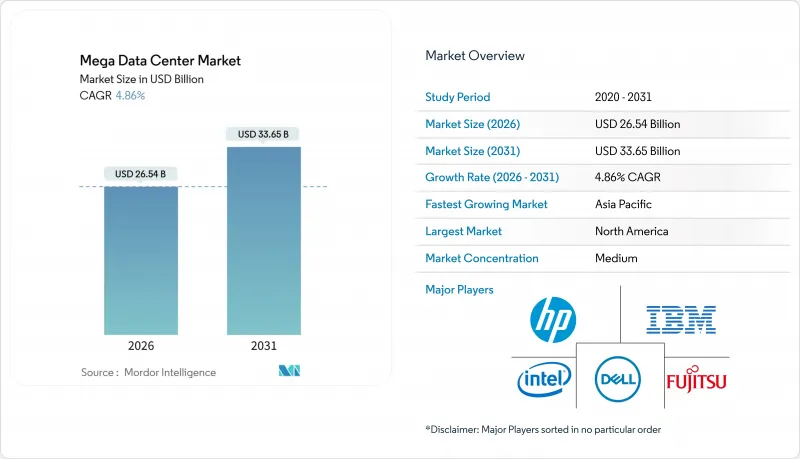
Mordor Intelligence에 의하면, 메가 데이터센터 시장 규모는 2026년에 265억 4,000만 달러에 이르고, 2031년까지 336억 5,000만 달러에 이를 것으로 예상되며, 예측 기간 중 연평균 복합 성장률(CAGR)은 4.86%를 나타낼 전망입니다.
본 보고서는 솔루션별(스토리지, 네트워크, 서버, 보안 등), 데이터센터 유형별(하이퍼스케일 자체 구축형, 하이퍼스케일 코로케이션형), 냉각 기술별(공기 냉각, 액체 냉각),및 지역별(북미, 남미, 유럽, 아시아태평양, 중동 및 아프리카)로 분류되어 있습니다. 시장 전망은 금액(미 달러) 기준으로 제시되어 있습니다.
세계의 메가 데이터센터 시장 동향 및 인사이트
AI 및 ML 분야의 연산 밀도 요구 사항의 폭발적인 증가
2025년에는 대규모 언어 모델 훈련 실행 시 클러스터당 2만개 이상의 GPU를 사용하는 규모로 확대되었으며, 개별 랙의 부하는 120kW에 달했습니다. 이로 인해 사업자들은 리어 도어 방식의 열교환기나 직접 투 칩 콜드 플레이트로의 전환을 불가피하게 되었습니다. 이러한 액체 냉각 솔루션은 틈새 시장에서 불과 1년 만에 신규 도입의 18%를 차지하게 되었으며, 단일 사이트에서 200메가와트를 초과하는 전력 계약을 가능하게 했습니다. 가속기의 교체 주기가 24개월로 단축되면서 자본 회전이 가속화되었기 때문에 사업자들은 현재 3년간의 총 소유 비용(TCO)을 최적화하는 설계를 진행하고 있습니다. 그 결과, 열 설계, 전기 인프라 및 업그레이드 빈도가 캠퍼스 규모에서 통합적으로 설계되는 새로운 균형이 형성되었습니다.
메가 시설 내 BFSI 워크로드 배치 증가
미국, 유럽연합(EU), 싱가포르의 사이버 복원력 규정 개정에 따라 각 트랜잭션 노드에 하드웨어 보안 모듈을 탑재하고 1초 미만의 감사 추적을 의무화함에 따라, 분산형 아키텍처는 중요한 은행 업무 워크로드에서 규정 준수 요건을 충족하지 못하게 되었습니다. 그 결과, 주요 금융 그룹들은 2025년에 핵심 뱅킹 프로세스의 40%를 메가 시설로 이전하여 위험의 집중화와 사고 대응의 신속화를 도모했습니다. 규제 당국은 현재 스트레스 테스트에서 기반이 되는 데이터센터의 복원력 지표를 검증할 의향을 밝히고 있으며, 이러한 전환 경로는 전략적 로드맵에 반영되었습니다.
높은 자본 비용 및 설치 비용
전형적인 메가 캠퍼스의 예산은 10억 달러를 초과하며, 액체 냉각, 이중화된 변전소, 생체 인식 보안이 현재 필수 항목으로 자리 잡고 있습니다. 유럽에서는 건축 기준의 엄격화와 ESG 인증으로 인해 2024년 이후 기본 비용이 15% 증가했으며, 많은 개발업자들이 다단계 개발 캠퍼스나 세일 앤 리스백(Sale-and-Leaseback)을 통한 자금 조달로 방향을 전환하고 있습니다. 철강, 반도체, 노동력에 대한 인플레이션 압력이 위험을 가중시키고 있어, 자본 시장에 대한 접근성이 풍부한 사업자들로 시장 진입이 제한되고 있습니다.
부문 분석
2025년 매출 중 스토리지 솔루션이 43.54%를 차지하며, 메가 데이터센터 시장에서 모든 솔루션 유형 중 가장 큰 시장 점유율을 기록했습니다. 오브젝트 스토리지 및 NVMe-over-fabric 아키텍처는 기존 SAN 시스템에 비해 70% 더 높은 IOPS를 실현하여, 페타바이트 규모의 AI 리포지토리에 1밀리초 미만의 액세스를 가능하게 했습니다. 이러한 성능 향상은 실시간 추론에 매우 중요하며, 스토리지를 메가 데이터센터 시장의 핵심 축으로 자리매김하게 했습니다. 보안 솔루션은 모든 서버에 하드웨어 기반 인증 기능을 통합하는 제로 트러스트 프레임워크에 힘입어 2031년까지 5.67%라는 가장 높은 연평균 성장률(CAGR)을 나타낼 전망입니다. 각 벤더들은 현재 침입 감지 및 생체 인증을 통한 액세스를 통합 플랫폼에 통합하고 있으며, 이는 소프트웨어 전용 모델에서 벗어나고 있음을 반영합니다. 하이퍼스케일러와 스토리지 업계 선도 기업들이 공동으로 개발한 레퍼런스 아키텍처는 사전에 검증된 번들 제품을 중시하는 조달 동향을 보여주고 있으며, 이를 통해 도입 주기가 단축되고 엔지니어링상의 리스크가 감소합니다.
NVMe-over-fabric의 성능 우위는 와트당 처리량 향상으로 인해 트랜잭션당 냉각 여력이 감소하므로, 이는 직접적으로 영업이익으로 이어집니다. 보안 측면에서는 NIST SP 800-207 및 ISO 27001 인증과 같은 규제 요건이 프리미엄 가격 책정을 뒷받침하여, 서버 및 네트워크 분야의 상품화로부터 이익률을 보호하고 있습니다. 보드 수준에 내장된 하드웨어 보안 모듈(HSM)은 지연 시간 오버헤드를 제거하므로 BFSI(은행 및 금융 및 보험) 및 국방 분야 고객에게 매력적입니다. 전반적으로, 스토리지와 보안의 통합 요구를 충족하는 솔루션 제공업체야말로 메가 데이터센터 시장의 증분 수익을 확보하는 데 가장 유리한 위치에 있습니다.
지역별 분석
북미는 2025년 매출의 39.74%를 차지하며, 하이퍼스케일러의 지속적인 설비 투자와 성숙한 공급 생태계를 바탕으로 메가 데이터센터 시장에서 가장 큰 점유율을 확보했습니다. 버지니아 북부는 여전히 세계에서 가장 고밀도 컴퓨팅 클러스터이지만, 텍사스, 오리건, 애리조나의 신흥 건설 지역은 위험을 분산시키고 재생에너지 포트폴리오를 활용하고 있습니다. 캐나다와 멕시코는 파급 수요와 정부의 인센티브 혜택을 누리고 있는 반면, 미국의 규제 당국은 인허가 취득에 유리한 환경을 유지하고 있습니다. 송전망 혼잡과 물 사용을 둘러싼 지역 사회의 반발이 장벽으로 작용하고 있으며, 이에 따라 사업자들은 폐쇄형 냉각 및 현장 발전 도입을 추진하고 있습니다.
아시아태평양은 2031년까지 연평균 성장률(CAGR) 6.02%로 확대될 것으로 예측되며, 메가 데이터센터 시장 증가분에서 가장 빠른 성장을 주도할 지역이 될 전망입니다. 중국의 국가 클라우드 계획과 인도의 디지털 공공 인프라 구상은 데이터 주권법에 따라 AI 워크로드를 현지화하는 대규모 도입의 기반이 되고 있습니다. 일본과 한국은 AI 전용 캠퍼스에 투자하고 있으며, 호주는 해당 지역의 재해 복구 허브로서의 입지를 확고히 하고 있습니다. 싱가포르와 뭄바이에서는 토지 및 전력 공급이 제한적이기 때문에 개발업체들은 2선 도시나 단계적 확장을 염두에 두고 설계된 모듈형 캠퍼스로 눈을 돌리고 있습니다.
유럽의 성장세는 2025년에 kW시당 평균 0.15유로(kW시당 0.17달러)에 달한 전력 비용에 의해 제약을 받고 있습니다. 신규 데이터센터용량은 재생에너지 보급률이 높아 한계 비용을 낮추고, 서늘한 기후로 인해 자연 공랭식 운영 기간이 연장되는 스칸디나비아 국가들과 아일랜드에 집중되어 있습니다. 독일, 프랑스, 영국은 계속해서 안정적인 투자를 유치하고 있지만, 지역 주민들의 반대로 인해 인허가 취득에 시간이 걸리고 있습니다. 유럽연합(EU)의 규제 환경은 세계에서 가장 엄격하며, 폐열 재활용과 무수(zero water) 설계를 의무화하고 있어 전 세계의 모범 사례에 영향을 미치고 있습니다.
기타 혜택 :
- 엑셀 형식 시장 예측(ME) 시트
- 3개월간 애널리스트의 지원
자주 묻는 질문
목차
제1장 서론
제2장 조사 방법
제3장 주요 요약
제4장 시장 구도
제5장 시장 규모 및 성장 예측
제6장 경쟁 구도
제7장 시장 기회 및 향후 전망
KTH 26.09.10According to Mordor Intelligence, the mega data center market size reached USD 26.54 billion in 2026 and is projected to reach USD 33.65 billion by 2031, reflecting a 4.86% CAGR during the forecast period.
This report is Segmented by Solution (Storage, Networking, Server, Security, and More), Data Center Type (Hyperscale Self-Build, and Hyperscale Colocation), Cooling Technology (Air-Based Cooling, and Liquid-Based Cooling), and Geography (North America, South America, Europe, Asia-Pacific, and Middle East and Africa). The Market Forecasts are Provided in Terms of Value (USD).
Global Mega Data Center Market Trends and Insights
Explosive AI and ML Compute Density Requirements
Large-language-model training runs exceeded 20,000 GPUs per cluster in 2025, pushing individual rack loads to 120 kilowatts and driving operators toward rear-door heat exchangers and direct-to-chip cold plates. These liquid solutions went from niche status to 18% of new installs within a year, enabling single-site power contracts of over 200 megawatts. Shorter 24-month accelerator refresh cycles intensify capital turnover, so operators now optimize designs for three-year total cost of ownership. The result is a new equilibrium in which thermal design, electrical infrastructure, and upgrade cadence are co-engineered at the campus scale.
Rising BFSI Workload Placement in Mega Facilities
Updated cyber-resilience rules in the United States, European Union, and Singapore mandated hardware security modules at each transaction node and sub-second audit trails, making distributed architectures non-compliant for critical banking workloads. Consequently, leading financial groups moved 40% more core-banking processes into mega facilities in 2025, pursuing risk centralization and faster incident response. Regulators now hint that stress tests will examine underlying data-center resilience metrics, locking this migration pathway into strategic roadmaps.
High Capital and Installation Costs
Typical mega campus budgets exceed USD 1 billion, with liquid cooling, redundant substations, and biometric security now mandatory line items. In Europe, tighter building codes and ESG certifications have added 15% to baseline costs since 2024, pushing many developers toward multi-phase campuses or sale-leaseback financing. Inflationary pressure on steel, semiconductors, and labor compounds risk, limiting participation to entities with deep capital market access.
Other drivers and restraints analyzed in the detailed report include:
- Accelerated Cloud-Service Capacity Buildouts
- Energy-Efficient Liquid-Cooling Adoption Wave
- Escalating Utility Power Costs and Scarcity
For complete list of drivers and restraints, kindly check the Table Of Contents.
Segment Analysis
Storage solutions accounted for 43.54% of 2025 revenue, yielding the single-largest market share for any solution type in the mega data center market. Object storage and NVMe-over-fabric architectures delivered 70% more IOPS than legacy SAN systems, enabling sub-millisecond access to petabyte-scale AI repositories. This performance uplift is critical for real-time inference, making storage a foundational pillar of the mega data center market. Security solutions are on track for the fastest 5.67% CAGR to 2031, propelled by zero-trust frameworks that bake hardware-rooted attestation into every server. Vendors now integrate intrusion detection and biometric access into unified platforms, reflecting a pivot from software-only models. Collaborative reference architectures between hyperscalers and storage leaders signal a procurement landscape that values pre-validated bundles, shortening deployment cycles and reducing engineering risk.
The performance edge of NVMe-over-fabric translates directly into operating income because higher throughput per watt reduces the cooling headroom required per transaction. On the security front, regulatory mandates such as NIST SP 800-207 and ISO 27001 certifications support premium pricing, cushioning margins against commoditization in server and networking segments. Hardware security modules embedded at board level eliminate latency overheads, appealing to BFSI and defense clients. Overall, solution providers that align with integrated storage-and-security demand are best positioned to capture incremental mega data center market revenue.
Complete Report Scope:
- By Solution
- Storage
- Networking
- Server
- Security
- Other Solutions
- By Data Center Type
- Hyperscale Self-Build
- Hyperscale Colocation
- By Cooling Technology
- Air-Based Cooling
- Liquid-Based Cooling
- By Geography
- North America
- United States
- Canada
- Mexico
- South America
- Brazil
- Argentina
- Rest of South America
- Europe
- Germany
- France
- United Kingdom
- Italy
- Spain
- Rest of Europe
- Asia-Pacific
- China
- Japan
- India
- South Korea
- Australia
- Rest of Asia-Pacific
- Middle East and Africa
- Middle East
- Saudi Arabia
- United Arab Emirates
- Turkey
- Rest of Middle East
- Africa
- South Africa
- Egypt
- Nigeria
- Rest of Africa
- Middle East
- North America
Geography Analysis
North America accounted for 39.74% of 2025 revenue, securing the largest share of the mega data center market amid sustained hyperscaler capital outlays and a mature supply ecosystem. Northern Virginia remains the world's densest cluster of compute, but emerging build zones in Texas, Oregon, and Arizona diversify risk and tap renewable portfolios. Canada and Mexico are benefiting from spillover demand and government incentives, while U.S. regulatory bodies maintain a favorable permitting environment. Grid congestion and community pushback over water use add friction, prompting operators to adopt closed-loop cooling and on-site generation.
Asia-Pacific is forecast to expand at a 6.02% CAGR through 2031, making it the fastest contributor to the incremental mega data center market. China's national cloud program and India's digital-public-infrastructure initiative anchor large deployments that localize AI workloads in line with data-sovereignty laws. Japan and South Korea invest in AI-focused campuses, while Australia positions itself as a disaster recovery hub for the region. Limited land and power in Singapore and Mumbai push developers toward tier-two cities and modular campuses designed for phased expansion.
Europe's trajectory is moderated by electricity costs that averaged EUR 0.15 per kilowatt-hour (USD 0.17 per kilowatt-hour) in 2025. New capacity gravitates to Scandinavia and Ireland, where renewable penetration lowers marginal costs and cooler climates extend free-air-cooling windows. Germany, France, and the United Kingdom continue to attract steady investment, though local opposition extends permitting timelines. The European Union's regulatory environment is the strictest globally, mandating waste-heat reuse and water-neutral designs, thereby influencing global best practices.
- Amazon Web Services Inc.
- Microsoft Corporation
- Google LLC
- Meta Platforms Inc.
- Alibaba Cloud
- Cisco Systems Inc.
- Dell Technologies Inc.
- Fujitsu Ltd.
- Hewlett-Packard Enterprise Company
- IBM Corporation
- Intel Corporation
- Juniper Networks Inc.
- Schneider Electric SE
- Vertiv Group Corporation
- Digital Realty Trust Inc.
- Equinix Inc.
- NTT Ltd.
- Vantage Data Centers LLC
- CyrusOne LLC
- CoreWeave Inc.
Additional Benefits:
- The market estimate (ME) sheet in Excel format
- 3 months of analyst support
TABLE OF CONTENTS
1 INTRODUCTION
- 1.1 Study Assumptions and Definitions
- 1.2 Scope of the Study
2 RESEARCH METHODOLOGY
3 EXECUTIVE SUMMARY
4 MARKET LANDSCAPE
- 4.1 Market Overview
- 4.2 Market Drivers
- 4.2.1 Increasing Demand for Data Center Consolidation
- 4.2.2 Rising BFSI Workload Placement in Mega Facilities
- 4.2.3 Explosive AI and ML Compute Density Requirements
- 4.2.4 Accelerated Cloud-Service Capacity Buildouts
- 4.2.5 Energy-Efficient Liquid-Cooling Adoption Wave
- 4.2.6 On-Site Microgrid Generation to Bypass Grid Bottlenecks
- 4.3 Market Restraints
- 4.3.1 High Capital and Installation Costs
- 4.3.2 Escalating Utility Power Costs and Scarcity
- 4.3.3 Community Backlash Over Water and Land Footprint
- 4.3.4 30-Month Lead Times for HV Transformers and Switchgear
- 4.4 Industry Supply-Chain Analysis
- 4.5 Regulatory Landscape
- 4.6 Technological Outlook
- 4.7 Porter's Five Forces Analysis
- 4.7.1 Threat of New Entrants
- 4.7.2 Bargaining Power of Suppliers
- 4.7.3 Bargaining Power of Buyers
- 4.7.4 Threat of Substitutes
- 4.7.5 Intensity of Competitive Rivalry
- 4.8 Impact of Macroeconomic Factors on the Market
5 MARKET SIZE AND GROWTH FORECASTS (VALUE)
- 5.1 By Solution
- 5.1.1 Storage
- 5.1.2 Networking
- 5.1.3 Server
- 5.1.4 Security
- 5.1.5 Other Solutions
- 5.2 By Data Center Type
- 5.2.1 Hyperscale Self-Build
- 5.2.2 Hyperscale Colocation
- 5.3 By Cooling Technology
- 5.3.1 Air-Based Cooling
- 5.3.2 Liquid-Based Cooling
- 5.4 By Geography
- 5.4.1 North America
- 5.4.1.1 United States
- 5.4.1.2 Canada
- 5.4.1.3 Mexico
- 5.4.2 South America
- 5.4.2.1 Brazil
- 5.4.2.2 Argentina
- 5.4.2.3 Rest of South America
- 5.4.3 Europe
- 5.4.3.1 Germany
- 5.4.3.2 France
- 5.4.3.3 United Kingdom
- 5.4.3.4 Italy
- 5.4.3.5 Spain
- 5.4.3.6 Rest of Europe
- 5.4.4 Asia-Pacific
- 5.4.4.1 China
- 5.4.4.2 Japan
- 5.4.4.3 India
- 5.4.4.4 South Korea
- 5.4.4.5 Australia
- 5.4.4.6 Rest of Asia-Pacific
- 5.4.5 Middle East and Africa
- 5.4.5.1 Middle East
- 5.4.5.1.1 Saudi Arabia
- 5.4.5.1.2 United Arab Emirates
- 5.4.5.1.3 Turkey
- 5.4.5.1.4 Rest of Middle East
- 5.4.5.2 Africa
- 5.4.5.2.1 South Africa
- 5.4.5.2.2 Egypt
- 5.4.5.2.3 Nigeria
- 5.4.5.2.4 Rest of Africa
- 5.4.5.1 Middle East
- 5.4.1 North America
6 COMPETITIVE LANDSCAPE
- 6.1 Market Concentration
- 6.2 Strategic Moves
- 6.3 Market Share Analysis
- 6.4 Company Profiles (includes Global Level Overview, Market Level Overview, Core Segments, Financials, Strategic Information, Market Rank/Share, Products and Services, Recent Developments)
- 6.4.1 Amazon Web Services Inc.
- 6.4.2 Microsoft Corporation
- 6.4.3 Google LLC
- 6.4.4 Meta Platforms Inc.
- 6.4.5 Alibaba Cloud
- 6.4.6 Cisco Systems Inc.
- 6.4.7 Dell Technologies Inc.
- 6.4.8 Fujitsu Ltd.
- 6.4.9 Hewlett-Packard Enterprise Company
- 6.4.10 IBM Corporation
- 6.4.11 Intel Corporation
- 6.4.12 Juniper Networks Inc.
- 6.4.13 Schneider Electric SE
- 6.4.14 Vertiv Group Corporation
- 6.4.15 Digital Realty Trust Inc.
- 6.4.16 Equinix Inc.
- 6.4.17 NTT Ltd.
- 6.4.18 Vantage Data Centers LLC
- 6.4.19 CyrusOne LLC
- 6.4.20 CoreWeave Inc.
7 MARKET OPPORTUNITIES AND FUTURE OUTLOOK
- 7.1 White-Space and Unmet-Need Assessment