
|
시장보고서
상품코드
2123314
하이퍼스케일 데이터센터 시장 : 점유율 분석, 업계 동향과 통계, 성장 예측(2026-2031년)Hyperscale Data Center - Market Share Analysis, Industry Trends & Statistics, Growth Forecasts (2026 - 2031) |
||||||
 Mordor Intelligence
Mordor Intelligence에 의하면, 하이퍼스케일 데이터센터 시장 규모는 2026년에 2,054억 8,000만 달러가 되어, 2031년까지 5,961억 달러에 이를 것으로 예측되며, CAGR은 23.74%가 될 전망입니다.
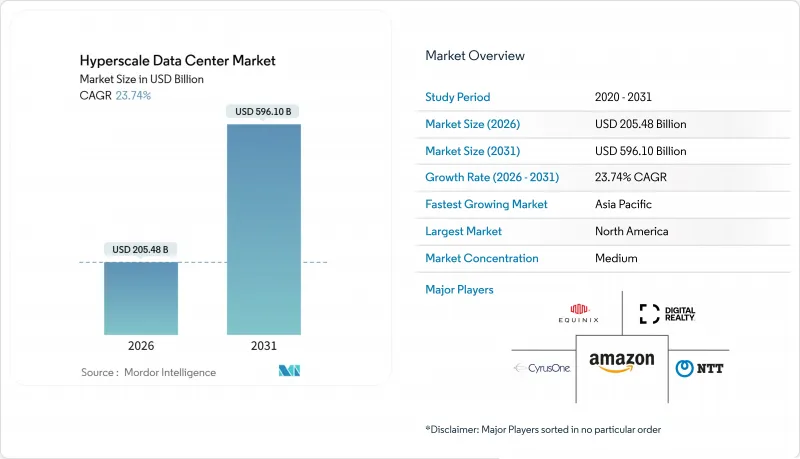
본 보고서는 구성 요소(IT 인프라, 전기 인프라, 기계 인프라, 일반 건설), 티어 유형(Tier 3, Tier 4) 및 지역(북미, 유럽, 아시아태평양, 남미, 중동 및 아프리카)별로 분류되어 있습니다. 시장 예측은 금액(달러) 기준으로 제시되어 있습니다.
세계 하이퍼스케일 데이터센터 시장 동향 및 인사이트
50kW를 초과하는 랙이 필요한 GPU 중심의 AI 및 ML 워크로드의 폭발적인 증가
대규모 언어 모델의 훈련으로 인해 랙당 부하가 50kW를 훨씬 초과하는 수준에 도달했으며, 이 수준에서는 공랭식 냉각을 경제적으로 유지할 수 없게 되었습니다. 알리바바 클라우드는 2025년에 9분기 연속으로 AI 제품 매출이 3자리 수 성장을 기록하며, GPU 집약형 용량에 대한 지속적인 수요가 높음을 입증하고 있습니다. 미국의 각 하이퍼스케일러 기업들은 100kW급 캐비닛을 지원하는 ‘직접 투 칩(Direct-to-Chip)’ 방식의 액체 냉각 및 후면 도어형 열교환기를 도입하여, 액체 냉각 인프라에 대한 투자 회수 기간을 단축하고 있습니다. 이러한 도입으로 유휴 용량이 감소하고 전력 사용 효율이 향상되면서, 액체 냉각 공급망을 장악한 사업자로 경쟁 우위가 이동하고 있습니다. 신속한 개조가 불가능한 시설은 AI 훈련 워크로드 입찰에서 탈락하여 하이퍼스케일 데이터센터 시장에서의 점유율이 하락하고 있습니다.
유럽 내 하이퍼스케일 클라우드 제공업체의 소버린 클라우드 전개
현재 유럽 각국 정부는 기밀 데이터 관리를 국내에 거점을 둔 사업체에 의무화하고 있으며, 이에 따라 Amazon Web Services, Microsoft Azure, Google Cloud는 독일, 프랑스, 네덜란드에 소버린 환경을 구축하고 있습니다. GDPR(EU 개인정보보호규정), 독일의 BSI C5, 프랑스의 SecNumCloud와 같은 프레임워크를 준수하는 것은 건설 비용을 상승시키고 공사 기간을 연장시키고 있지만, 한편으로는 규제 대상인 테넌트에게 프리미엄 가격을 제시할 수 있게 해주고 있습니다. 블랙스톤이 디지털 리얼티와 70억 달러 규모의 합작 투자를 출범시켜 프랑크푸르트와 파리에 캠퍼스를 건설하는 사례는 이러한 규제 요건을 충족하기 위해 재분배된 자본의 규모를 여실히 보여줍니다. 현지 인허가 취득 및 전력망과의 협상에 능숙한 사업자들은 수익성이 높은 소버린 리스 계약을 확보하고 있으며, 이는 하이퍼스케일 데이터센터 시장 전체의 성장을 뒷받침하고 있습니다.
건조 지역에서의 증발 냉각을 위한 물 사용 제한
캘리포니아주, 애리조나주, 네바다주에서 발생한 심각한 가뭄으로 인해 수도 당국은 산업용수 소비량에 상한선을 설정할 수밖에 없었습니다. 스페인의 에브로 강 유역에서도 2024년에 기록적인 저수위를 기록한 데 따라 유사한 제한이 도입되어, 데이터센터는 설치 및 운영 비용이 높은 폐쇄형 액체 냉각 시스템으로의 전환을 강요받고 있습니다. 장기적인 재생수 공급 계약을 체결하지 않은 시설은 여름 성수기에 사용 제한 명령을 받을 위험이 있어, 서비스 수준 계약(SLA) 이행이 위협받을 우려가 있습니다. 그 결과, 신규 프로젝트에서는 재생수, 연안 해수 담수화, 또는 공랭식 칠러가 우선적으로 채택되고 있으며, 이에 따라 시장 진입에 필요한 자본 비용이 상승하면서 하이퍼스케일 데이터센터 시장의 성장이 둔화되고 있습니다.
부문 분석
전기 인프라 시장은 2026년부터 2031년까지 연평균 성장률(CAGR) 24.65%로 성장할 전망이며, 사업자들이 50-100kW 랙을 지원하기 위해 배전 시스템을 개편함에 따라 하이퍼스케일 데이터센터 시장 전체의 성장률을 상회할 것으로 보입니다. GPU 클러스터에서 무정전 전원 장치(UPS), 리튬 이온 배터리 스트링 및 모듈식 개폐 장치가 필수화됨에 따라, 전기 인프라에 할당되는 하이퍼스케일 데이터센터 시장 규모는 급격히 확대될 것으로 예측됩니다. 정격 출력 2,250kW에서 3메가와트까지 확장 가능한 이튼(Eaton)사의 9395XC UPS는 고밀도이면서 유지보수 부담이 적은 백업 전원을 원하는 하이퍼스케일러 수요를 충족시키는 대표적인 장비입니다. IT 인프라는 2025년에 매출의 48.43%를 차지할 것으로 예상되지만, 가속기 비용을 상각하기 위해 서버의 교체 주기가 장기화되면서 그 상대적인 성장세는 둔화되고 있습니다. 기계 인프라 분야에서는 직접 투 칩(Direct-to-Chip) 냉각으로의 전환이 진행되고 있어 초기 투자는 증가하지만, 전력 사용 효율 향상으로 인해 장기적인 운영 비용은 절감되고 있습니다. 일반 건설 부문의 이익률은 철강 가격 변동과 숙련된 인력 부족으로 인해 여전히 압박을 받고 있지만, 데이터센터의 정보 관리 소프트웨어는 유휴 용량을 활용함으로써 시장 점유율을 확대되고 있습니다.
통신 사업자들은 구리 및 반도체 투입 비용이 더욱 치솟기 전에 가격을 고정하기 위해, 리드 타임이 18-24개월인 전기 기기를 사전 발주하는 것이 전략적으로 필수적이라고 보고 있습니다. 공장에서 통합된 전원 스키드나 현장에서 시운전 팀을 제공하는 벤더는 높은 이익률을 확보하고 있습니다. 한편, 각 하이퍼스케일러 기업들은 벤더 락인을 피하기 위해 버스웨이 및 배터리 화학 조성에 관한 개방형 사양을 크라우드소싱하고 있으며, 이로 인해 범용 부품의 이익률이 압박받고 있습니다. 그 결과, 탄탄한 서비스 포트폴리오와 신속한 도입이 가능한 모듈을 보유한 전기 인프라 공급업체는 예측 기간 동안 하이퍼스케일 데이터센터 시장에서 점유율을 확대할 수 있는 입장에 있습니다.
지역별 분석
북미는 2025년 하이퍼스케일 데이터센터 시장의 40.43%를 차지하며, 그 배경에는 버지니아주 북부의 유례없는 광섬유 밀도와 견고한 송전망 상호 연결이 있습니다. Amazon Web Services, Microsoft, Google의 지속적인 메가 캠퍼스 구축에 더해, Blackstone의 250억 달러 규모의 개발 파이프라인이 이 지역의 세계적 우위를 더욱 공고히 하고 있습니다. 그러나 남서부 지역의 냉각수 사용 제한과 캘리포니아주의 폭염 관련 인허가 지연으로 인해 신규 건설은 태평양 연안 북서부 및 텍사스주로 점차 이동하고 있습니다. 이 지역들은 풍부한 수력 발전과 전력 시장 규제 완화로 인해 균등화 비용이 낮습니다. 리스 동향을 살펴보면, 각 하이퍼스케일러 기업들이 100메가와트 규모의 전체 단계를 사전에 확보하고 있어, 이로 인해 소매 코로케이션 수요가 밀려나는 한편, 재생에너지에 관한 전력 구매 계약이 고정화되고 있습니다.
아시아태평양은 중국의 AI 인프라 급속한 확대, 인도의 디지털 결제 붐, 그리고 싱가포르의 소버린 클라우드 요건에 힘입어 2031년까지 연평균 성장률(CAGR) 24.57%를 나타낼 것으로 예측됩니다. 알리바바가 3년 동안 3,800억 위안(530억 달러)을 투자하겠다고 약속한 것은 중국이 국내 컴퓨팅 규모 확대에 주력하고 있음을 뒷받침합니다. 싱가포르에서는 토지 부족과 열세로 인해 신규 공급이 제한되고 있어, 초과 수요가 조호르와 바탐으로 흘러가고 있습니다. 인도의 데이터 현지화 규제와 주 차원의 우대 조치로 인해 뭄바이와 벵갈루루에서 티어 4 그린필드 및 브라운필드 건설이 촉진되고 있습니다. 한편, 일본에서는 현장 재생에너지 할당 제도로 인해 도쿄와 오사카의 프로젝트 공사 기간이 길어지고 있으며, 전력 공급이 풍부한 홋카이도와 규슈로 성장이 이동하고 있습니다. 전반적으로, 수 메가와트 규모의 전력 블록을 확보하고 다양한 인허가 제도를 성공적으로 헤쳐나갈 수 있는 사업자가 확대되는 하이퍼스케일 데이터센터 시장을 장악하게 될 것입니다.
유럽, 중동 및 아프리카에서는 각각 다른 동향이 나타나고 있습니다. 유럽의 소버린 클라우드 정책으로 인해 독일, 프랑스, 네덜란드, 아일랜드 간에 수요가 분산되고 있으며, 투자 요건은 부풀어 올랐지만 프리미엄 가격 책정이 가능해졌습니다. 블랙스톤과 디지털 리얼티가 추진하는 70억 달러 규모의 합작 사업은 규제를 준수하는 캠퍼스로의 자본 집중을 여실히 보여주고 있습니다. 중동에서는 사우디아라비아의 ‘NEOM 디지털 밸리’와 UAE의 아부다비 클러스터가 면세 조치와 신속한 인허가 절차를 활용하여 하이퍼스케일 테넌트를 유치하고 있으며, 이 지역을 대륙 간 트래픽의 가교로 자리매김하고 있습니다. 남미는 브라질이 주도하고 있으며, 풍부한 풍력 및 태양광 자원이 탄소 중립 목표와 부합하지만, 환율 변동은 여전히 장벽으로 작용하고 있습니다. 아프리카의 초기 수요는 남아프리카공화국과 나이지리아에 집중되어 있으며, 그 확대는 송전망 구축과 해저 케이블 상륙에 달려 있습니다. 이러한 동향들이 맞물리면서, 지역별로 고유한 기회와 위험을 수반하는 다극적인 하이퍼스케일 데이터센터 시장이 형성되고 있습니다.
기타 혜택:
- 엑셀 형식 시장 예측(ME) 시트
- 3개월간의 애널리스트 지원
자주 묻는 질문
목차
제1장 서론
제2장 조사 방법
제3장 주요 요약
제4장 시장 구도
제5장 시장 규모와 성장 예측
제6장 경쟁 구도
제7장 시장 기회와 향후 전망
JHS 26.09.07According to Mordor Intelligence, the hyperscale data center market size stands at USD 205.48 billion in 2026 and is projected to reach USD 596.10 billion by 2031, reflecting a 23.74% CAGR.
This report is Segmented by Component (IT Infrastructure, Electrical Infrastructure, Mechanical Infrastructure, and General Construction), Tier Type (Tier 3, and Tier 4), and Geography (North America, Europe, Asia-Pacific, South America, and Middle East and Africa). The Market Forecasts are Provided in Terms of Value (USD).
Global Hyperscale Data Center Market Trends and Insights
Exploding GPU-Centric AI and ML Workloads Requiring Greater Than 50 Kilowatt Racks
Training large language models is pushing per-rack loads well past 50 kilowatts, a level at which air cooling becomes economically untenable. Alibaba Cloud logged triple-digit AI product revenue growth for nine consecutive quarters in 2025, underscoring sustained appetite for GPU-dense capacity. U.S. hyperscalers are deploying direct-to-chip liquid cooling and rear-door heat exchangers that support 100-kilowatt cabinets, compressing the payback period on liquid infrastructure investments. These deployments shrink stranded capacity and improve power-usage efficiency, shifting competitive advantage toward operators that master liquid-cooling supply chains. Facilities that cannot retrofit quickly are losing bids for AI training workloads, eroding their share of the hyperscale data center market.
Hyperscale Cloud Providers' Sovereign-Cloud Roll-outs in Europe
European governments now require nationally domiciled entities to control sensitive data, prompting Amazon Web Services, Microsoft Azure, and Google Cloud to build sovereign environments in Germany, France, and the Netherlands. Compliance with GDPR, Germany's BSI C5, and France's SecNumCloud frameworks is inflating construction costs and extending timelines, but it also commands premium pricing from regulated tenants. Blackstone's USD 7 billion joint venture with Digital Realty to erect campuses in Frankfurt and Paris exemplifies the scale of capital redirected to meet these mandates. Operators adept at local permitting and grid negotiations are capturing higher-margin sovereign leases, lifting overall growth in the hyperscale data center market.
Water-Usage Restrictions for Evaporative Cooling in Arid Regions
Severe drought in California, Arizona, and Nevada has forced water authorities to impose volumetric caps on industrial consumption. Spain's Ebro River basin adopted similar limits after record-low flow rates in 2024, compelling data centers to transition to closed-loop liquid systems that cost more to install and run. Sites without long-term reclaimed-water contracts risk curtailment orders during summer peaks, threatening service-level agreements. New projects, therefore, prioritize recycled water, coastal desalination, or air-cooled chillers, raising the capital cost of entry and moderating growth in the hyperscale data center market.
Other drivers and restraints analyzed in the detailed report include:
- FinTech Real-Time Payment Mandates Accelerating Tier 4 Demand
- 5G Edge-Core Consolidation Creating Regional Hub Requirements
- GPU supply-chain bottlenecks limiting rack-level density expansion
For complete list of drivers and restraints, kindly check the Table Of Contents.
Segment Analysis
Electrical Infrastructure is on track to grow at a 24.65% CAGR from 2026 to 2031, eclipsing overall hyperscale data center market growth as operators overhaul power distribution to support 50-100 kilowatt racks. The hyperscale data center market size devoted to Electrical Infrastructure is projected to rise sharply as uninterruptible power supply systems, lithium-ion battery strings, and modular switchgear become mandatory for GPU clusters. Eaton's 9395XC UPS, rated at 2,250 kilowatts and scalable to 3 megawatts, typifies equipment that aligns with hyperscaler demand for high-density, low-maintenance backup power. IT Infrastructure, despite accounting for 48.43% of revenue in 2025, is experiencing longer server refresh cycles to amortize accelerator costs, which tempers its relative momentum. Mechanical Infrastructure is pivoting toward direct-to-chip cooling, increasing upfront capital but lowering long-term operating expense via reduced power-usage effectiveness. General Construction margins remain under pressure from steel-price volatility and skilled-labor shortages, while data center information management software gains share by unlocking stranded capacity.
Operators see a strategic imperative to pre-order electrical gear with 18-24-month lead times, locking in pricing before copper and semiconductor inputs inflate further. Vendors offering factory-integrated power skids and on-site commissioning teams command premium margins. Meanwhile, hyperscalers are crowd-sourcing open specifications for busways and battery chemistries to avoid vendor lock-in, which compresses margins for commodity components. Consequently, Electrical Infrastructure suppliers with strong service portfolios and rapid-deployment modules are positioned to gain hyperscale data center market share over the forecast period.
Complete Report Scope:
- By Component
- IT Infrastructure
- Server Infrastructure
- Storage Infrastructure
- Network Infrastructure
- Electrical Infrastructure
- Power Distribution Units
- Transfer Switches and Switchgears
- UPS Systems
- Generators
- Other Electrical Infrastructure
- Mechanical Infrastructure
- Cooling Systems
- Racks
- Other Mechanical Infrastructure
- General Construction
- Core and Shell Development
- Installation and Commisioning Services
- Design Engineering
- Fire Detection, Suppression and Physical Security
- DCIM/BMS Solutions
- IT Infrastructure
- By Tier Type
- Tier 3
- Tier 4
- By Geography
- North America
- United States
- Canada
- Mexico
- Europe
- United Kingdom
- Germany
- Netherlands
- France
- Ireland
- Rest of Europe
- Asia-Pacific
- China
- India
- Singapore
- Japan
- Australia
- Indonesia
- Rest of Asia-Pacific
- South America
- Brazil
- Chile
- Rest of South America
- Middle East and Africa
- Middle East
- United Arab Emirates
- Saudi Arabia
- Turkey
- Rest of Middle East
- Africa
- South Africa
- Nigeria
- Rest of Africa
- Middle East
- North America
Geography Analysis
North America retained 40.43% of the hyperscale data center market in 2025, underpinned by Northern Virginia's unprecedented fiber density and robust grid interconnects. Continued mega-campus launches by Amazon Web Services, Microsoft, and Google, coupled with Blackstone's USD 25 billion development pipeline, reinforce the region's global preeminence. Cooling-water restrictions in the Southwest and heat-related permitting delays in California, however, are shifting incremental builds toward the Pacific Northwest and Texas, where abundant hydropower and deregulated electricity markets lower levelized costs. Leasing dynamics show hyperscalers pre-committing to entire 100-megawatt phases, crowding out retail colocation demand and locking in power-purchase agreements for renewable energy.
Asia-Pacific is forecast to post a 24.57% CAGR through 2031, driven by China's AI infrastructure surge, India's digital-payments boom, and Singapore's sovereign-cloud requirements. Alibaba's pledge to invest RMB 380 billion (USD 53 billion) over three years underscores China's focus on domestic compute scale. Land scarcity and heat taxes are limiting fresh supply in Singapore, pushing overflow demand to Johor and Batam. India's data-localization rules and state-level incentives are facilitating Tier 4 greenfield and brownfield builds in Mumbai and Bengaluru. Meanwhile, Japan's on-site renewable quotas lengthen project timelines in Tokyo and Osaka, steering growth to power-rich Hokkaido and Kyushu. Overall, operators capable of securing multi-megawatt power blocks and navigating heterogeneous permitting regimes will capture the expanding hyperscale data center market.
Europe, the Middle East, and Africa display divergent trajectories. European sovereign-cloud policies fragment demand across Germany, France, the Netherlands, and Ireland, inflating investment requirements but enabling premium pricing. Blackstone and Digital Realty's USD 7 billion joint venture illustrates the concentration of capital into compliant campuses. In the Middle East, Saudi Arabia's NEOM Digital Valley and the UAE's Abu Dhabi clusters use tax holidays and rapid permitting to lure hyperscale tenants, positioning the region as an intercontinental traffic bridge. South America is led by Brazil, where abundant wind and solar resources align with carbon-neutral mandates, though currency volatility remains a hurdle. Africa's nascent demand centers on South Africa and Nigeria; expansion depends on grid upgrades and subsea cable landings. Collectively, these dynamics create a multi-polar hyperscale data center market with region-specific opportunities and risks.
- Digital Realty Trust, Inc.
- Equinix, Inc.
- Amazon Web Services, Inc.
- NTT Ltd.
- CyrusOne Inc.
- Quality Technology Services (QTS)
- Vantage Data Centers LLC
- Microsoft Corporation
- Alphabet Inc. (Google)
- Meta Platforms, Inc.
- Alibaba Group Holding Ltd.
- Tencent Holdings Ltd.
- Baidu, Inc.
- Oracle Corporation
- International Business Machines Corporation
- Switch, Inc.
- STACK Infrastructure
- Flexential Corp.
- Iron Mountain Data Centers
- OVHcloud
Additional Benefits:
- The market estimate (ME) sheet in Excel format
- 3 months of analyst support
TABLE OF CONTENTS
1 INTRODUCTION
- 1.1 Study Assumptions and Market Definition
- 1.2 Scope of the Study
2 RESEARCH METHODOLOGY
3 EXECUTIVE SUMMARY
4 MARKET LANDSCAPE
- 4.1 Market Overview
- 4.2 Market Drivers
- 4.2.1 Exploding GPU-Centric AI and ML Workloads Requiring >50 kW Racks in the United States and China
- 4.2.2 Hyperscale Cloud Providers' "Sovereign Cloud" Roll-outs in Europe
- 4.2.3 FinTech Real-Time Payment Mandates Accelerating Tier IV Demand in Singapore and India
- 4.2.4 5G Edge-Core Consolidation Creating Regional Hub Requirements in the Nordics and Oceania
- 4.2.5 Liquid-Cooled Modular Skids Enabling Brownfield Retrofits in India
- 4.2.6 Tax Incentives for Hyperscale Campuses in Saudi Arabia's NEOM Digital Valley
- 4.3 Market Restraints
- 4.3.1 Water-Usage Restrictions for Evaporative Cooling in the Western United States and Spain
- 4.3.2 GPU Supply-Chain Bottlenecks Limiting Rack-Level Density Expansion
- 4.3.3 Rising Heat-Tax and Carbon Levies in the Netherlands, Singapore and Germany
- 4.3.4 Mandatory On-site Renewable Quotas in Japan's New Green Energy Act
- 4.4 Industry Supply-Chain Analysis
- 4.5 Regulatory and Compliance Outlook
- 4.6 Technological Outlook, Liquid Cooling, Direct-to-Chip, Modular Builds
- 4.7 Impact of Macroeconomic Factors on the Market
- 4.8 Porter's Five Forces Analysis
- 4.8.1 Bargaining Power of Suppliers
- 4.8.2 Bargaining Power of Buyers
- 4.8.3 Threat of New Entrants
- 4.8.4 Threat of Substitutes
- 4.8.5 Competitive Rivalry
5 MARKET SIZE AND GROWTH FORECASTS (VALUE)
- 5.1 By Component
- 5.1.1 IT Infrastructure
- 5.1.1.1 Server Infrastructure
- 5.1.1.2 Storage Infrastructure
- 5.1.1.3 Network Infrastructure
- 5.1.2 Electrical Infrastructure
- 5.1.2.1 Power Distribution Units
- 5.1.2.2 Transfer Switches and Switchgears
- 5.1.2.3 UPS Systems
- 5.1.2.4 Generators
- 5.1.2.5 Other Electrical Infrastructure
- 5.1.3 Mechanical Infrastructure
- 5.1.3.1 Cooling Systems
- 5.1.3.2 Racks
- 5.1.3.3 Other Mechanical Infrastructure
- 5.1.4 General Construction
- 5.1.4.1 Core and Shell Development
- 5.1.4.2 Installation and Commisioning Services
- 5.1.4.3 Design Engineering
- 5.1.4.4 Fire Detection, Suppression and Physical Security
- 5.1.4.5 DCIM/BMS Solutions
- 5.1.1 IT Infrastructure
- 5.2 By Tier Type
- 5.2.1 Tier 3
- 5.2.2 Tier 4
- 5.3 By Geography
- 5.3.1 North America
- 5.3.1.1 United States
- 5.3.1.2 Canada
- 5.3.1.3 Mexico
- 5.3.2 Europe
- 5.3.2.1 United Kingdom
- 5.3.2.2 Germany
- 5.3.2.3 Netherlands
- 5.3.2.4 France
- 5.3.2.5 Ireland
- 5.3.2.6 Rest of Europe
- 5.3.3 Asia-Pacific
- 5.3.3.1 China
- 5.3.3.2 India
- 5.3.3.3 Singapore
- 5.3.3.4 Japan
- 5.3.3.5 Australia
- 5.3.3.6 Indonesia
- 5.3.3.7 Rest of Asia-Pacific
- 5.3.4 South America
- 5.3.4.1 Brazil
- 5.3.4.2 Chile
- 5.3.4.3 Rest of South America
- 5.3.5 Middle East and Africa
- 5.3.5.1 Middle East
- 5.3.5.1.1 United Arab Emirates
- 5.3.5.1.2 Saudi Arabia
- 5.3.5.1.3 Turkey
- 5.3.5.1.4 Rest of Middle East
- 5.3.5.2 Africa
- 5.3.5.2.1 South Africa
- 5.3.5.2.2 Nigeria
- 5.3.5.2.3 Rest of Africa
- 5.3.5.1 Middle East
- 5.3.1 North America
6 COMPETITIVE LANDSCAPE
- 6.1 Market Concentration
- 6.2 Strategic Moves
- 6.3 Market Share Analysis
- 6.4 Company Profiles (includes Global Level Overview, Market Level Overview, Core Segments, Financials as available, Strategic Information, Market Rank/Share, Products and Services, Recent Developments)
- 6.4.1 Digital Realty Trust, Inc.
- 6.4.2 Equinix, Inc.
- 6.4.3 Amazon Web Services, Inc.
- 6.4.4 NTT Ltd.
- 6.4.5 CyrusOne Inc.
- 6.4.6 Quality Technology Services (QTS)
- 6.4.7 Vantage Data Centers LLC
- 6.4.8 Microsoft Corporation
- 6.4.9 Alphabet Inc. (Google)
- 6.4.10 Meta Platforms, Inc.
- 6.4.11 Alibaba Group Holding Ltd.
- 6.4.12 Tencent Holdings Ltd.
- 6.4.13 Baidu, Inc.
- 6.4.14 Oracle Corporation
- 6.4.15 International Business Machines Corporation
- 6.4.16 Switch, Inc.
- 6.4.17 STACK Infrastructure
- 6.4.18 Flexential Corp.
- 6.4.19 Iron Mountain Data Centers
- 6.4.20 OVHcloud
7 MARKET OPPORTUNITIES AND FUTURE OUTLOOK
- 7.1 White-Space and Unmet-Need Assessment