|
시장보고서
상품코드
2120443
폐암 치료제 : 시장 점유율 분석, 업계 동향 및 통계, 성장 예측(2026-2031년)Lung Cancer Therapeutics - Market Share Analysis, Industry Trends & Statistics, Growth Forecasts (2026 - 2031) |
||||||
 Mordor Intelligence
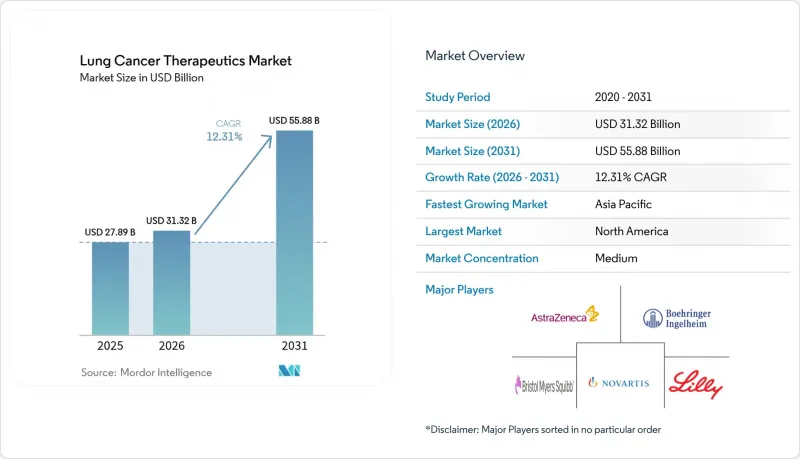
Mordor Intelligence에 의하면, 폐암 치료제 시장 규모는 2025년 278억 9,000만 달러로 평가되었습니다. 2026년에는 313억 2,000만 달러로 확대되어 2026년부터 2031년에 걸쳐 CAGR 12.31%로 성장을 지속하여, 2031년에는 558억 8,000만 달러에 이를 것으로 예측됩니다.
본 보고서는 질환 유형(비소세포폐암, 소세포폐암, 기타), 치료법(화학요법 등), 약물 분류(저분자 약물, 생물학적 제제 및 바이오시밀러), 유통 경로(병원 약국 등), 치료 단계(1차 치료법 등), 지역(북미 등)별로 분류되어 있습니다. 시장 예측은 금액(달러) 기준으로 제시되어 있습니다.
세계의 폐암 치료제 시장 동향 및 인사이트
면역종양학 및 표적 치료의 급속한 확산
체크포인트 억제제와 새로운 표적 치료제를 병용함으로써 기존 화학요법을 능가하는 생존율을 달성하고 있습니다. 타룰라타맙과 같은 이중 특이성 T세포 엔게이저는 다제내성을 가진 소세포폐암 사례에서 40%의 객관적 반응률을 보이고 있는 반면,다포타맙-델크스테칸 등의 항체-약물 복합체는 EGFR 변이 양성 비소세포폐암에서 45%의 반응률을 달성하고 있습니다. 2024년 한 해에만 13개의 폐암 적응증이 FDA의 신속 승인 절차를 통과하며, 시판까지의 주기가 단축되고 경쟁이 격화되었습니다. 각 개발사가 면역 활성화와 돌연변이 특이적 억제를 결합하여 회피 기전을 억제하려는 가운데, 병용 요법이 파이프라인의 주류를 차지하고 있습니다. 현재 바이오마커에 기반한 환자 선별이 1차 치료 결정의 대부분을 이끌고 있으며, 더 높은 반응 깊이와 더 긴 무악화 기간을 실현하고 있습니다. 새로운 치료법이 1차 치료로서의 입지를 확고히 함에 따라, 화학요법은 단독 요법이 아닌 다제 병용 프로토콜 내의 핵심 요법으로서의 역할로 전환되고 있습니다.
정밀 의학에서의 바이오마커 검사 보급
종합적인 분자 프로파일링이 조직학에 기반한 환자 선별을 대체하고 있습니다. ‘Oncomine Dx Express Test’와 같은 FDA 승인 진단 키트로 뒷받침되는 차세대 염기서열 분석 패널은 지역 암 전문의들 사이에서 표준으로 자리 잡고 있습니다. 치료에 활용 가능한 돌연변이에는 EGFR, ALK, ROS1, KRAS, HER2, MET, BRAF가 포함되며, 현재 비소세포폐암 사례의 60% 이상에서 치료 선택의 근거가 되고 있습니다. 액체 생검을 통해 실시간 내성 모니터링이 확대되면서, 임상적 진행 전에 치료법을 전환할 수 있게 되었습니다. 시퀀싱 비용의 감소와 보험 적용 범위 확대로 인해, 고소득 아시아태평양 시장에서는 바이오마커 검사가 일상 진료에 정착되고 있습니다. 검사 패널의 확대는 표적 치료제 시장에 새로운 상업적 틈새 시장을 창출하며, 검사의 보급과 의약품 개발 간의 선순환을 강화하고 있습니다.
고액의 치료비와 가격 책정 압력
연간 치료비는 종종 20만 달러를 초과하여, 보험사와 환자에게 큰 부담이 되고 있습니다. 듀르발맙의 구매 가격은 생존 기간 연장 효과가 입증되었음에도 불구하고 전 세계적인 보급을 둔화시켰습니다. 또한, 자원이 제한된 지역에서는 비용 대비 효과 분석 결과 불리한 비율이 나타나고 있습니다. 펨브롤리주맙 및 니볼마브의 바이오시밀러 개발 파이프라인은 가격 결정력을 약화시킬 것으로 예상되며, 원개발사는 가치 기반 거래를 할 수밖에 없을 것입니다. 병용 요법은 비용을 증가시키며, 수년에 이르는 치료 기간은 예산에 미치는 영향을 더욱 확대시킵니다. 유럽 및 라틴아메리카의 기준 가격 제도는 가격 인하에 대한 기대를 높이고 있습니다. 제약사는 치료 성과 보증이나 단계적 가격 책정으로 대응하고 있지만, 저소득 국가에서는 여전히 접근성 격차가 남아 있습니다.
부문 분석
비소세포폐암은 광범위한 바이오마커에 기반한 치료 선택지와 높은 발병률에 힘입어, 2025년 폐암 치료제 시장 매출의 76.68%를 차지했습니다. 소세포폐암 부문은 시장 규모는 작지만, 퍼스트-인-클래스 이중 특이성 항체인 탈라타마브와 체크포인트 억제제의 추가로 인해 2031년까지 연평균 성장률(CAGR) 13.05%로 시장 평균을 상회하는 성장이 예상됩니다. 따라서 소세포폐암 치료제 시장 규모는 낮은 출발점에서 급속히 확대될 것으로 예측됩니다. EGFR 및 KRAS 억제제 등 비소세포폐암(NSCLC)에 대한 정밀의료 접근 방식 덕분에, NSCLC 부문의 규모는 여전히 크지만, 파이프라인의 성장세에 힘입어 소세포폐암(SCLC)은 ‘소홀히 여겨지던 분야’에서 ‘유망한 기회’로 분명히 전환되고 있습니다.
SCLC 분야의 지속적인 혁신으로 인해 기존의 생존율 격차는 줄어들고 있습니다. 탈라타마브는 다제내성 환자군에서 40%의 객관적 반응률을 달성했으며, 듀르발마브는 국소기 폐암에서 전체 생존 기간의 중앙값을 55.9개월로 끌어올렸습니다. NSCLC 파이프라인에서는 내성을 다시 억제하기 위해 HER2 및 MET 억제제에 더해 항체-약물 복합체(ADC)가 추가되어, 매출 규모 측면에서 선도적인 위치를 유지하고 있습니다. 이 두 부문은 전문 기업을 유치하는 동시에 기존 기업들이 포트폴리오를 확대하도록 유도하는 다각화를 보여주고 있습니다.
2025년 매출액 중 화학요법이 여전히 42.74%를 차지했지만, 면역요법은 연평균 성장률(CAGR) 13.02%로 확대될 것으로 예측되어 화학요법 단독 요법에 대한 의존도는 낮아질 전망입니다. 체크포인트 억제제는 PD-L1 양성 폐암의 1차 치료에 도입되었으며, 이중 특이성 항체는 소세포폐암(SCLC)의 2차 치료 프로토콜에서 중심적인 역할을 수행하고 있습니다. 폐암 치료제 시장 중 면역요법이 차지하는 규모는 향후 10년 동안 2배로 증가할 것으로 예측됩니다. 표적 치료제는 명확하게 정의된 바이오마커에 초점을 맞추어 안정적인 한 자릿수 중반대의 성장을 이어가고 있습니다.
병용 요법이 증가하고 있습니다. 두르발마브와 화학요법의 병용은 국소기 소세포폐암(SCLC)에서 생존 기간을 연장시키는 반면, 화학요법과 면역요법(IO)의 병용은 비소세포폐암의 1차 치료에서 주류를 이루고 있습니다. T세포 활성화제나 항체-약물 복합체(ADC)가 파이프라인에 풍부해짐에 따라, 면역요법의 적용 범위는 바이오마커가 부족한 환자층으로 확대되어 잠재적 수요를 늘리는 동시에, 안전성 관리 기준을 재구축하고 있습니다.
지역별 분석
2025년, 북미는 전 세계 매출의 38.62%를 차지했습니다. 선진적인 임상시험 인프라 덕분에 연구 결과를 임상 현장에 신속하게 도입할 수 있습니다. 보험 제도를 통해 고가의 치료법이 보장되고 있지만, 바이오시밀러의 등장을 앞두고 가격 협상이 더욱 치열해지고 있습니다. 학술 기관은 진료 지침의 업데이트를 가속화하여 도입 곡선을 가파르게 유지하고 있습니다. 캐나다와 멕시코는 국경을 초월한 임상시험을 통해 참여하고 있으며, 환자의 접근성을 확대되고 있습니다.
아시아태평양은 연평균 성장률(CAGR) 13.34%를 기록하며 주요 성장 동력으로 자리 잡고 있습니다. 중국에서는 보험 적용 범위 확대와 국내 혁신이 맞물려 그동안 억제되었던 수요를 자극하고 있습니다. 일본에서는 우선 치료제 심사 기간을 6개월로 단축하는 프로그램이 가속화되고 있으며, 호주에서는 미충족 의료 수요가 있는 암에 대해 신속 승인 절차를 활용하고 있습니다. 인도 및 동남아시아에서는 3차 의료 기관에 NGS 패널을 도입하여 진단 능력을 확대되고 있습니다. 경제 발전과 도시 지역의 대기 오염이 맞물려 폐 질환의 부담을 가중시키고 있으며, 이로 인해 환자 수가 지속적으로 증가하고 있습니다.
유럽에서는 한 자릿수 중반대의 꾸준한 성장이 나타나고 있습니다. EMA(유럽의약품청)의 통합 승인 절차에 따라 시장 출시 시기가 동시에 이루어지는 속도가 빨라지고 있지만, 보험 급여 결정은 여전히 국가마다 다릅니다. 의료기술평가기관은 가치 기준에 중점을 두고 있으며, 제조업체에게 관리형 시장 진입 계약 체결을 촉구하고 있습니다. 동유럽 시장은 암 의료 인프라를 위한 EU 결속 기금을 통해 다른 지역을 따라잡고 있습니다. 영국에서는 브렉시트를 계기로 병행 승인 절차가 도입되었으나, 상호 승인 제도를 통해 대부분공급 경로가 유지되고 있습니다.
기타 혜택 :
- 엑셀 형식 시장 예측(ME) 시트
- 3개월간의 애널리스트 지원
자주 묻는 질문
목차
제1장 서론
제2장 조사 방법
제3장 주요 요약
제4장 시장 구도
제5장 시장 규모 및 성장 예측
제6장 경쟁 구도
제7장 시장 기회 및 향후 전망
KTH 26.09.10According to Mordor Intelligence, the lung cancer therapeutics market size is expected to grow from USD 27.89 billion in 2025 to USD 31.32 billion in 2026 and is forecast to reach USD 55.88 billion by 2031 at 12.31% CAGR over 2026-2031.
This report is Segmented by Disease Type (Non-Small Cell Lung Cancer, Small Cell Lung Cancer, Others), Treatment Modality (Chemotherapy, and More), Drug Class (Small-Molecule Drugs, Biologics and Biosimilars), Distribution Channel (Hospital Pharmacies, and More), Line of Therapy (First-Line, and More), and Geography (North America, and More). The Market Forecasts are Provided in Terms of Value (USD).
Global Lung Cancer Therapeutics Market Trends and Insights
Rapid Adoption of Immuno-Oncology & Targeted Therapies
Checkpoint inhibitors combined with novel targets lift survival beyond legacy chemotherapy. Bispecific T-cell engagers such as tarlatamab post 40% objective responses in heavily pre-treated small-cell cases, while antibody-drug conjugates like datopotamab deruxtecan reach 45% responses in EGFR-mutated non-small-cell disease . Thirteen lung cancer indications cleared the FDA's accelerated pathway during 2024 alone, compressing launch cycles and intensifying rivalry . Combination regimens dominate pipelines as developers marry immune activation with mutation-specific blockade to blunt escape mechanisms. Biomarker-driven selection now guides most first-line decisions, enabling higher response depths and longer progression-free intervals. As new modalities gain first-line status, chemotherapy shifts toward a backbone role within multi-agent protocols rather than standalone therapy.
Precision-Medicine Biomarker Testing Uptake
Comprehensive molecular profiling is replacing histology-based selection. Next-generation sequencing panels, supported by FDA-cleared diagnostics such as the Oncomine Dx Express Test, are becoming standard for community oncologists . Actionable alterations cover EGFR, ALK, ROS1, KRAS, HER2, MET, and BRAF, now informing choices for more than 60% of non-small-cell cases. Liquid biopsy expands real-time resistance monitoring, allowing therapy switches before clinical progression. Declining sequencing costs, along with payer reimbursement, embed biomarker testing into routine care across higher-income Asia-Pacific markets. Wider panels create additional commercial niches for targeted agents, reinforcing a virtuous cycle of test adoption and drug development.
High Therapy Costs & Pricing Pressures
Annual courses often exceed USD 200,000, straining payers and patients. Durvalumab's acquisition price slowed global uptake despite survival benefit, with cost-effectiveness analyses finding unfavorable ratios in resource-constrained regions. Biosimilar pipelines for pembrolizumab and nivolumab are expected to erode pricing power, forcing originators into value-based deals. Combination regimens compound cost, and multi-year therapy durations magnify budget impact. Reference pricing frameworks in Europe and Latin America intensify discount expectations. Manufacturers respond by offering outcome guarantees and tiered pricing, yet access gaps persist in low-income countries.
Other drivers and restraints analyzed in the detailed report include:
- Emerging Cell & RNA-Based Therapy Pipeline
- Expanding Healthcare Reimbursement Coverage
- Looming Patent Cliffs for Blockbuster Drugs
For complete list of drivers and restraints, kindly check the Table Of Contents.
Segment Analysis
Non-small cell disease generated 76.68% of 2025 revenue within the lung cancer therapeutics market share, benefiting from broad biomarker-driven options and high incidence. The small-cell segment holds a smaller base yet is forecast to outpace at 13.05% CAGR through 2031, fueled by the first-in-class bispecific tarlatamab and checkpoint additions. The lung cancer therapeutics market size for small-cell therapy is therefore projected to climb swiftly from a low anchor point. Precision approaches in NSCLC, such as EGFR and KRAS inhibitors, keep that segment sizeable, but pipeline momentum is visibly shifting SCLC from neglect to opportunity.
Continued SCLC innovation narrows historic survival gaps. Tarlatamab reached 40% objective responses in heavily pre-treated cohorts, and durvalumab pushed median overall survival to 55.9 months in limited-stage settings. NSCLC pipelines add HER2 and MET inhibitors plus antibody-drug conjugates to re-intercept resistance, keeping volume leadership intact. Together, both segments illustrate a diversification that attracts specialized players while pushing incumbents to broaden portfolios.
Chemotherapy still accounted for 42.74% of 2025 revenue, yet immunotherapy is projected to climb at 13.02% CAGR, eroding monotherapy chemo reliance. Checkpoint inhibitors moved into first-line PD-L1-positive care, and bispecifics headline second-line SCLC protocols. The lung cancer therapeutics market size allocated to immunotherapy is forecast to double over the decade. Targeted agents add steady mid-single-digit growth by focusing on well-defined biomarkers.
Combination regimens are rising. Durvalumab plus chemotherapy extended survival in limited-stage SCLC, while chemo-IO combos dominate non-small cell first-line practice. As pipelines fill with T-cell engagers and antibody-drug conjugates, immunotherapy's reach broadens into biomarker-low populations, enlarging addressable demand while reshaping safety management norms.
Complete Report Scope:
- By Disease Type
- Non-Small Cell Lung Cancer (NSCLC)
- Small Cell Lung Cancer (SCLC)
- Others
- By Treatment Modality
- Chemotherapy
- Immunotherapy
- Targeted Therapy
- By Drug Class
- Small-Molecule Drugs
- Biologics and Biosimilars
- By Distribution Channel
- Hospital Pharmacies
- Retail Pharmacies
- Online Pharmacies
- By Line of Therapy
- First-Line
- Second-Line
- Third-Line and Beyond
- By Geography
- North America
- United States
- Canada
- Mexico
- Europe
- Germany
- United Kingdom
- France
- Italy
- Spain
- Rest of Europe
- Asia-Pacific
- China
- Japan
- India
- Australia
- South Korea
- Rest of Asia-Pacific
- Middle East and Africa
- GCC
- South Africa
- Rest of Middle East and Africa
- South America
- Brazil
- Argentina
- Rest of South America
- North America
Geography Analysis
North America generated 38.62% of global revenue in 2025. Advanced trial infrastructure enables rapid translation from study to practice. Insurance systems fund high-cost regimens, though price negotiations tighten as biosimilars loom. Academic centers accelerate guideline updates, keeping adoption curves steep. Canada and Mexico participate through cross-border trials, widening patient access.
Asia-Pacific is the chief growth engine at 13.34% CAGR. China's reimbursement expansion and local innovation double-team to unlock suppressed demand. Japan's accelerated programs shorten review to 6 months for priority therapies, while Australia leverages expedited pathways for unmet-need cancers. India and Southeast Asia scale diagnostic capacity, installing NGS panels in tertiary hospitals. Economic development and urban pollution jointly increase lung burden, sustaining volume growth.
Europe exhibits steady mid-single-digit gains. Centralized EMA approvals speed simultaneous market launches, but reimbursement decisions remain country specific. Health technology assessment bodies focus on value thresholds, nudging manufacturers toward managed-entry agreements. Eastern European markets catch up through EU cohesion funding for oncology infrastructure. Brexit triggered parallel pathways in the United Kingdom, yet mutual recognition maintains most supply routes.
- Roche
- AstraZeneca
- Merck
- Bristol-Myers Squibb
- Pfizer
- Boehringer Ingelheim
- Eli Lilly and Company
- Novartis
- Johnson & Johnson
- Abbvie
- Amgen
- Sanofi
- Takeda Pharmaceuticals
- Daiichi Sankyo
- BeiGene
- Exelixis
- Innovent Biologics
- Clovis Oncology
- Blueprint Medicines
Additional Benefits:
- The market estimate (ME) sheet in Excel format
- 3 months of analyst support
TABLE OF CONTENTS
1 Introduction
- 1.1 Study Assumptions & Market Definition
- 1.2 Scope of the Study
2 Research Methodology
3 Executive Summary
4 Market Landscape
- 4.1 Market Overview
- 4.2 Market Drivers
- 4.2.1 Increasing prevalence of lung cancer
- 4.2.2 Rising pollution & smoking rates
- 4.2.3 Rapid adoption of immuno-oncology & targeted therapies
- 4.2.4 Expanding healthcare reimbursement coverage
- 4.2.5 Precision-medicine driven biomarker testing uptake
- 4.2.6 Emerging cell & RNA-based therapies pipeline
- 4.3 Market Restraints
- 4.3.1 High therapy costs & pricing pressures
- 4.3.2 Severe immune-related adverse events
- 4.3.3 Looming patent cliffs for blockbuster drugs
- 4.3.4 Limited biopsy access in low-resource settings
- 4.4 Value / Supply-Chain Analysis
- 4.5 Regulatory Landscape
- 4.6 Porter's Five Forces Analysis
- 4.6.1 Threat of New Entrants
- 4.6.2 Bargaining Power of Buyers
- 4.6.3 Bargaining Power of Suppliers
- 4.6.4 Threat of Substitutes
- 4.6.5 Competitive Rivalry
5 Market Size & Growth Forecasts (Value, USD)
- 5.1 By Disease Type
- 5.1.1 Non-Small Cell Lung Cancer (NSCLC)
- 5.1.2 Small Cell Lung Cancer (SCLC)
- 5.1.3 Others
- 5.2 By Treatment Modality
- 5.2.1 Chemotherapy
- 5.2.2 Immunotherapy
- 5.2.3 Targeted Therapy
- 5.3 By Drug Class
- 5.3.1 Small-Molecule Drugs
- 5.3.2 Biologics and Biosimilars
- 5.4 By Distribution Channel
- 5.4.1 Hospital Pharmacies
- 5.4.2 Retail Pharmacies
- 5.4.3 Online Pharmacies
- 5.5 By Line of Therapy
- 5.5.1 First-Line
- 5.5.2 Second-Line
- 5.5.3 Third-Line and Beyond
- 5.6 By Geography
- 5.6.1 North America
- 5.6.1.1 United States
- 5.6.1.2 Canada
- 5.6.1.3 Mexico
- 5.6.2 Europe
- 5.6.2.1 Germany
- 5.6.2.2 United Kingdom
- 5.6.2.3 France
- 5.6.2.4 Italy
- 5.6.2.5 Spain
- 5.6.2.6 Rest of Europe
- 5.6.3 Asia-Pacific
- 5.6.3.1 China
- 5.6.3.2 Japan
- 5.6.3.3 India
- 5.6.3.4 Australia
- 5.6.3.5 South Korea
- 5.6.3.6 Rest of Asia-Pacific
- 5.6.4 Middle East and Africa
- 5.6.4.1 GCC
- 5.6.4.2 South Africa
- 5.6.4.3 Rest of Middle East and Africa
- 5.6.5 South America
- 5.6.5.1 Brazil
- 5.6.5.2 Argentina
- 5.6.5.3 Rest of South America
- 5.6.1 North America
6 Competitive Landscape
- 6.1 Market Concentration
- 6.2 Market Share Analysis
- 6.3 Company Profiles (includes Global level Overview, Market level overview, Core Segments, Financials as available, Strategic Information, Market Rank/Share for key companies, Products & Services, and Recent Developments)
- 6.3.1 F. Hoffman La Roche Ltd.
- 6.3.2 AstraZeneca
- 6.3.3 Merck & Co.
- 6.3.4 Bristol-Myers Squibb
- 6.3.5 Pfizer
- 6.3.6 Boehringer Ingelheim
- 6.3.7 Eli Lilly
- 6.3.8 Novartis
- 6.3.9 Johnson & Johnson (Janssen)
- 6.3.10 AbbVie
- 6.3.11 Amgen
- 6.3.12 Sanofi
- 6.3.13 Takeda
- 6.3.14 Daiichi Sankyo
- 6.3.15 BeiGene
- 6.3.16 Exelixis
- 6.3.17 Innovent Biologics
- 6.3.18 Clovis Oncology
- 6.3.19 Blueprint Medicines
7 Market Opportunities & Future Outlook
- 7.1 White-space & Unmet-Need Assessment