|
시장보고서
상품코드
2120449
미국의 약물전달 디바이스 : 시장 점유율 분석, 업계 동향 및 통계, 성장 예측(2026-2031년)United States Drug Delivery Devices - Market Share Analysis, Industry Trends & Statistics, Growth Forecasts (2026 - 2031) |
||||||
 Mordor Intelligence
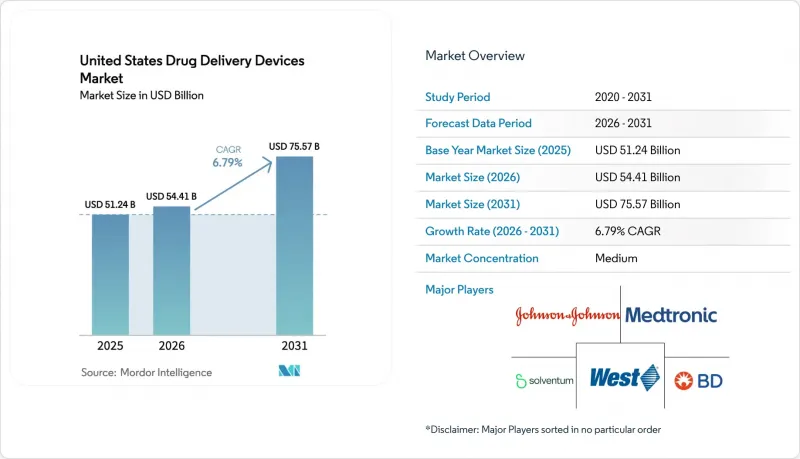
Mordor Intelligence에 의하면, 미국의 약물전달 디바이스 시장 규모는 2025년 512억 4,000만 달러로 평가되었습니다. 2026년에는 544억 1,000만 달러로 확대되어 2031년까지 755억 7,000만 달러에 이를 것으로 예상되고 2026-2031년에 걸쳐 CAGR 6.79%로 성장할 전망입니다.
본 보고서는 기기 유형(주사용 투여 기기, 흡입 투여 기기, 경피 투여 기기, 안구 내 투여 기기, 경구 서방형 제제, 기타), 투여 경로(정맥 내, 피하, 피내, 경구, 기타),용도·치료 분야(종양학, 당뇨병, 호흡기 질환, 기타), 최종 사용자(병원, 외래수술센터(ASC), 재택치료 시설, 전문 클리닉), 지역별로 분류되어 있습니다. 시장 예측은 금액(달러)으로 표시되어 있습니다.
미국의 약물전달 디바이스 시장 동향 및 인사이트
만성 질환 유병률 증가
2024년에는 약 3,840만 명의 미국인이 당뇨병 진단을 받았으며, CDC(미국 질병통제예방센터)는 2050년까지 성인 3명 중 1명이 당뇨병 진단을 받을 것으로 예측했습니다. 이에 따라 지속 혈당 모니터,인슐린 펌프, GLP-1 자동 주사기에 대한 장기적인 수요가 증가하고 있습니다. 2024년에는 암 신규 발병 건수가 200만 건을 넘어섰으며, 화학요법용 포트 카테터 시스템 및 휴대용 주입 펌프의 사용이 계속해서 높은 수준을 유지하고 있습니다. 심혈관 질환은 1억 2,700만 명의 성인에게 영향을 미치고 있으며, 재입원을 줄여주는 항응고제 펜과 약물 방출형 스텐트의 사용이 증가하고 있습니다. 만성 호흡기 질환 및 자가면역 질환 환자 증가로 인해, 미국의 약물전달 디바이스 시장은 내구성이 뛰어나고 환자 스스로 관리할 수 있는 형태로 변화하고 있습니다. 이러한 누적된 영향으로 인해 기준선 치료 건수가 수년에 걸쳐 증가할 것이며, 예측 기간을 훨씬 넘어 안정적인 출하량이 예상됩니다.
자가 투여 및 재택치료에 대한 관심 증가
CMS(미국 의료보험 및 의료서비스 센터)는 2025년에 재택 수액 요법용 독립적인 보상 코드를 도입했습니다. 이로 인해 기존 결제 감액 조치가 해소되었으며, 의료 제공업체에게는 웨어러블 주사기나 커넥티드 펌프를 착용한 안정된 환자를 퇴원시킬 수 있는 경제적 인센티브가 주어졌습니다. 같은 해, 메디케어 어드밴티지 가입자 수는 3,300만 명을 돌파했으며, 각 보험 플랜은 응급실 내원을 줄이기 위해 의료기기 공급과 원격 의료 모니터링을 신속하게 결합했습니다. 미국간호사협회(ANA)는 2026년까지 7만 8,000명의 정규 간호사(RN) 인력이 부족할 것으로 예측하고 있으며, 이는 투여 책임을 환자에게 이전하는 기술의 보급을 더욱 촉진하고 있습니다. 이에 대응하여 의료기기 제조업체들은 고령자의 실수율을 줄여주는 바늘 수납 창과 음성 안내 기능을 갖춘 사용자 중심의 자동 주사기를 개발했습니다. 이러한 동향들이 맞물리면서 미국의 약물 투여 기기 시장은 편의성과 원격 가시성을 중시하는 재택 중심의 치료 경로로 전환되고 있습니다.
FDA의 엄격한 규제 요건
2024년에 발표된 사이버 보안 지침에서는 모든 무선 기기의 승인 조건으로 SBOM(소프트웨어 구성 관리) 및 위협 모델링 자료 제출이 의무화되었으며, 이로 인해 개발 주기가 6-12개월 연장되고 플랫폼당 200만-500만 달러의 추가 비용이 발생하고 있습니다. 복합 제품의 심사에서는 선행 기기가 존재하는 경우에도 인체공학적 타당성 검증이 필수이며, 중대한 사고 발생 후 30일 이내에 시판 후 조사 보고서를 제출해야 합니다. 소규모 혁신 기업들은 인력 확보 및 문서 작성의 부담으로 어려움을 겪고 있으며, 파이프라인 진행 속도가 둔화되면서 미국의 약물전달 디바이스 산업은 통합의 방향으로 나아가고 있습니다. 또한, 실세계 데이터(Real-world evidence)의 중요성도 점점 더 커지고 있어, 제품은 24개월 이내에 일상적인 임상 현장에서의 성능을 입증해야 하며, 이로 인해 시장 출시 비용이 상승하고 있습니다.
부문별 분석
2025년에는 주사용 플랫폼이 매출의 43.27%를 차지하며, 출하 대수 82억 대로 미국의 약물전달 디바이스 시장 점유율의 기반을 다졌습니다. BD Libertas 및 Enable enFuse와 같은 웨어러블 주사기는 현재 5-50mL의 생물학적 제제를 지원하며, 과거에는 점적 주입용 의자에 국한되었던 치료법에서 피하 투여의 길을 열어주고 있습니다. 경구 서방형 시스템은 2025년 매출에서 차지하는 비중이 18%에 그치겠지만, Rybelsus가 흡수 촉진제와 병용함으로써 펩타이드가 소화관 통과를 견딜 수 있음을 입증했기 때문에 2031년 연평균 성장률(CAGR)은 7.32%로 모든 카테고리를 웃도는 속도로 성장할 전망입니다.
주사제의 과거(2019-2025년) 평균 연평균 성장률(CAGR)은 5.8%였으나, 2026-2031년에는 바이오시밀러 출시와 GLP-1 제제에 대한 수요 증가에 따라 소폭 상승할 전망입니다. 스마트 센서는 복약 순응도를 향상시켰으나, 보험 적용 범위의 통일이 지연되면서 도입이 더뎌지고 있습니다. 경피 투여 및 안과용 기기는 합산 시장 점유율이 10% 이하에 그치고 있으나, 내원 횟수를 줄임으로써 프리미엄 가격 책정을 실현하고 있으며, 제넨텍사의 노인성 황반변성(AMD) 치료제 ‘수스비모’의 연 2회 보충 투여가 그 대표적인 사례입니다.
정맥 내 투여는 주로 병원에서의 화학요법이나 TPN(정맥 내 영양) 투여량에 힘입어 2025년 시장 규모의 36.83%를 차지했으나, 보험사가 적절한 생물학적 제제를 재택 치료로 전환함에 따라 그 예측 연평균 성장률(CAGR)은 5.2%에 그칠 전망입니다. 피하 투여는 새로운 재택 점적 요법 코드에 따라 보험 적용이 되는 대용량 패치 펌프의 보급에 힘입어 연평균 7.69%의 성장이 예상됩니다. 피내 투여는 여전히 틈새 시장으로 남아 있지만, 마이크로니들 백신 패치는 2024년에 ‘획기적인 의료기기(Breakthrough Device)’ 인증을 획득했습니다. 경구 투여는 안정적인 기반을 유지하고 있는 반면, 폐내 투여와 경피 투여는 COPD 및 만성 통증 등 특정 환자층을 대상으로 하여 한 자릿수 중반대의 성장률을 유지하고 있습니다.
기타 혜택
- 엑셀 형식 시장 예측(ME) 시트
- 3개월간의 애널리스트 지원
자주 묻는 질문
목차
제1장 서론
제2장 조사 방법
제3장 주요 요약
제4장 시장 구도
제5장 시장 규모 및 성장 예측
제6장 경쟁 구도
제7장 시장 기회 및 향후 전망
KTH 26.09.04According to Mordor Intelligence, the United States drug delivery devices market size is expected to increase from USD 51.24 billion in 2025 to USD 54.41 billion in 2026 and reach USD 75.57 billion by 2031, growing at a CAGR of 6.79% over 2026-2031.
This report is Segmented by Device Type (Injectable, Inhalation, Transdermal, Ocular, Oral Controlled-Release, Other), Route of Administration (Intravenous, Subcutaneous, Intradermal, Oral, Others), Application (Oncology, Diabetes, Respiratory, and More), End User (Hospitals, Ascs, Home-Healthcare, Specialty Clinics), and Geography. The Market Forecasts are in Value (USD).
United States Drug Delivery Devices Market Trends and Insights
Rising Prevalence of Chronic Diseases
Nearly 38.4 million Americans lived with diagnosed diabetes in 2024, and the CDC projects one in three adults will carry the diagnosis by 2050, intensifying long-term demand for continuous glucose monitors, insulin pumps, and GLP-1 autoinjectors. Cancer incidence surpassed 2 million new cases in 2024, sustaining high utilisation of port-a-cath systems and ambulatory infusion pumps for chemotherapy. Cardiovascular disease affects 127 million adults, prompting increased use of anticoagulant pens and drug-eluting stents that mitigate hospital readmissions. Chronic respiratory conditions and a growing autoimmune population are driving the United States drug delivery devices market toward durable, patient-managed formats. The cumulative effect is a multiyear lift in baseline procedure volumes, supporting predictable unit shipments well beyond the forecast horizon.
Growing Preference for Self-Administration & Home Healthcare
CMS introduced stand-alone reimbursement codes for home infusion therapy in 2025, neutralising historical payment penalties and giving providers an economic incentive to discharge stable patients with wearable injectors and connected pumps. Medicare Advantage enrollment crossed 33 million members the same year, and plans rapidly bundled device supplies with telehealth monitoring to cut emergency-department visits. The American Nurses Association forecasts 78,000 unfilled RN positions by 2026, further encouraging technologies that shift dosing responsibility to patients. Device makers answered with user-centred autoinjectors featuring needle-retraction windows and audible cues that reduce error rates among seniors. Collectively, these trends pivot the United States drug delivery devices market toward home-centric care pathways that reward simplicity and remote visibility.
Stringent FDA Regulatory Requirements
Cybersecurity guidance released in 2024 makes an SBOM and threat-modeling dossier a condition of clearance for any wireless device, extending development cycles 6-12 months and adding USD 2-5 million per platform. Combination product reviews now require human factors validation even when predicate devices exist, and post-market surveillance reporting is mandatory within 30 days of serious incidents. Smaller innovators struggle with the staffing and documentation load, slowing pipeline velocity and nudging the United States drug delivery devices industry toward consolidation. Real-world evidence is also becoming increasingly important; products must demonstrate performance in routine practice within 24 months, which escalates launch costs.
Other drivers and restraints analyzed in the detailed report include:
- Connected Smart Devices Improve Adherence & Outcomes
- Biologics Capacity Boom Drives Demand for Advanced Containers
- Recalls & Device Malfunctions Undermine Confidence
For complete list of drivers and restraints, kindly check the Table Of Contents.
Segment Analysis
Injectable platforms generated 43.27% revenue in 2025, anchoring the United States drug delivery devices market share with 8.2 billion units shipped. Wearable injectors such as BD Libertas and Enable enFuse now handle 5-50 mL biologics, opening subcutaneous routes for therapies once limited to infusion chairs. Oral controlled-release systems, although only 18% of 2025 revenue, will outpace all categories at 7.32% CAGR to 2031 because Rybelsus proved peptides can survive GI transit when paired with absorption enhancers.
The historical CAGR for injectables averaged 5.8% during 2019-2025, but steps up slightly over 2026-2031 as biosimilar launches and GLP-1 demand intensify. Smart sensors improved adherence, but adoption lags pending uniform payer coverage. Transdermal and ocular devices together remain below 10% share but win premium pricing where they reduce clinic visits, exemplified by Genentech's twice-yearly Susvimo refills for AMD.
Intravenous delivery captured 36.83% of the 2025 value, primarily through hospital chemotherapy and TPN volumes, yet its forecast CAGR tails at 5.2% as payers reroute suitable biologics to the home. Subcutaneous delivery will grow 7.69% annually, driven by the scaling of large-volume patch pumps reimbursed under new home-infusion codes. Intradermal remains niche, though microneedle vaccine patches secured Breakthrough Device status in 2024. Oral routes hold a stable base, while pulmonary and transdermal routes serve targeted populations like COPD and chronic pain, sustaining mid-single-digit growth.
Complete Report Scope:
- Device Type
- Injectable Delivery Devices
- Inhalation Delivery Devices
- Transdermal Delivery Devices
- Ocular Delivery Devices
- Oral Controlled-Release Systems
- Other Device Types (Implantable Drug Delivery Devices, Nasal Delivery Devices, etc.)
- Route of Administration
- Intravenous
- Subcutaneous
- Intradermal
- Oral
- Others (Pulmonary, Transdermal, etc.)
- Application / Therapeutic Area
- Oncology
- Diabetes
- Respiratory Diseases
- Cardiovascular Diseases
- Auto-immune Diseases
- Other Applications (Infectious Diseases, CNS Disorders, etc.)
- End User
- Hospitals
- Ambulatory Surgical Centers
- Home-Healthcare Settings
- Specialty Clinics
List of Companies Covered in this Report:
- 3M
- Abbvie
- Amgen
- AstraZeneca
- Beckton Dickinson
- Boston Scientific
- Eli Lilly and Company
- Gerresheimer
- Insulet
- Johnson & Johnson
- Medtronic
- Novartis
- Pfizer
- Sanofi
- Tandem Diabetes Care
- Teva Pharmaceutical Industries
- West Pharmaceutical Services
Additional Benefits:
- The market estimate (ME) sheet in Excel format
- 3 months of analyst support
TABLE OF CONTENTS
1 Introduction
- 1.1 Study Assumptions & Market Definition
- 1.2 Scope of the Study
2 Research Methodology
3 Executive Summary
4 Market Landscape
- 4.1 Market Overview
- 4.2 Market Drivers
- 4.2.1 Rising Prevalence of Chronic Diseases
- 4.2.2 Growing Preference for Self-Administration & Home Healthcare
- 4.2.3 Connected Smart Devices Improve Adherence & Outcomes
- 4.2.4 Biologics Capacity Boom Drives Demand for Advanced Containers
- 4.2.5 Value-Based Care Models Favor Long-Acting Implants
- 4.2.6 Expanding Biologics Pipeline Necessitating Advanced Parenteral Delivery Platforms
- 4.3 Market Restraints
- 4.3.1 Stringent FDA Regulatory Requirements
- 4.3.2 Recalls & Device Malfunctions Undermine Confidence
- 4.3.3 Raw-Material Bottlenecks in Medical-Grade Polymers
- 4.3.4 Rising Needlestick Injury Litigation Elevating Liability Insurance Premiums
- 4.4 Regulatory Landscape
- 4.5 Technological Outlook
- 4.6 Porter's Five Forces Analysis
- 4.6.1 Threat of New Entrants
- 4.6.2 Bargaining Power of Buyers
- 4.6.3 Bargaining Power of Suppliers
- 4.6.4 Threat of Substitute Products
- 4.6.5 Intensity of Competitive Rivalry
5 Market Size & Growth Forecasts
- 5.1 Device Type
- 5.1.1 Injectable Delivery Devices
- 5.1.2 Inhalation Delivery Devices
- 5.1.3 Transdermal Delivery Devices
- 5.1.4 Ocular Delivery Devices
- 5.1.5 Oral Controlled-Release Systems
- 5.1.6 Other Device Types (Implantable Drug Delivery Devices, Nasal Delivery Devices, etc.)
- 5.2 Route of Administration
- 5.2.1 Intravenous
- 5.2.2 Subcutaneous
- 5.2.3 Intradermal
- 5.2.4 Oral
- 5.2.5 Others (Pulmonary, Transdermal, etc.)
- 5.3 Application / Therapeutic Area
- 5.3.1 Oncology
- 5.3.2 Diabetes
- 5.3.3 Respiratory Diseases
- 5.3.4 Cardiovascular Diseases
- 5.3.5 Auto-immune Diseases
- 5.3.6 Other Applications (Infectious Diseases, CNS Disorders, etc.)
- 5.4 End User
- 5.4.1 Hospitals
- 5.4.2 Ambulatory Surgical Centers
- 5.4.3 Home-Healthcare Settings
- 5.4.4 Specialty Clinics
6 Competitive Landscape
- 6.1 Market Concentration
- 6.2 Market Share Analysis
- 6.3 Company Profiles (includes Global Level Overview, Market Level Overview, Core Segments, Financials as Available, Strategic Information, Market Rank/Share for Key Companies, Products & Services, and Recent Developments)
- 6.3.1 3M
- 6.3.2 AbbVie Inc.
- 6.3.3 Amgen Inc.
- 6.3.4 AstraZeneca plc
- 6.3.5 Becton, Dickinson and Company
- 6.3.6 Boston Scientific Corporation
- 6.3.7 Eli Lilly and Company
- 6.3.8 Gerresheimer AG
- 6.3.9 Insulet Corporation
- 6.3.10 Johnson & Johnson
- 6.3.11 Medtronic plc
- 6.3.12 Novartis AG
- 6.3.13 Pfizer Inc.
- 6.3.14 Sanofi S.A.
- 6.3.15 Tandem Diabetes Care Inc.
- 6.3.16 Teva Pharmaceutical Industries Ltd.
- 6.3.17 West Pharmaceutical Services Inc.
7 Market Opportunities & Future Outlook
- 7.1 White-space & Unmet-Need Assessment