

|
시장보고서
상품코드
2120451
체외 독성 시험 : 시장 점유율 분석, 업계 동향 및 통계, 성장 예측(2026-2031년)In Vitro Toxicology Testing - Market Share Analysis, Industry Trends & Statistics, Growth Forecasts (2026 - 2031) |
||||||
 Mordor Intelligence
Mordor Intelligence에 의하면, 체외 독성 시험 시장 규모는 2025년에 130억 6,000만 달러로 평가되었습니다. 2026년 144억 3,000만 달러에서 2031년까지 237억 6,000만 달러에 이를 것으로 예상되며, 예측 기간(2026-2031년) CAGR은 10.49%를 나타낼 전망입니다.
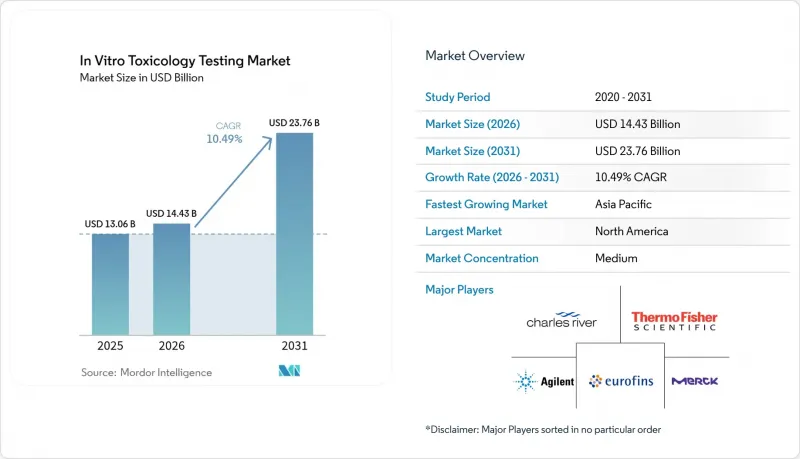
본 보고서는 기술별(세포 배양, 고처리량 등), 방법별(세포 분석, 생화학 분석 등), 용도별(전신 독성학 등), 최종 사용자별(제약 업계 등), 지역별(북미, 유럽, 아시아태평양, 중동 및 아프리카, 남미)로 분류되어 있습니다. 시장 전망은 금액(달러) 기준으로 제시되어 있습니다.
세계의 체외 독성 시험 시장 동향 및 인사이트
전임상 연구에서의 동물 실험 반대
윤리적 압력과 규제상의 금지 조치로 인해 동물 실험은 계속해서 대체되고 있습니다. 독성학회(Society of Toxicology)는 유럽의 엄격한 화장품 지침 및 FDA 현대화법 2.0에 따라 비동물 접근법이 정당화되었다고 지적합니다. 기업들이 이러한 규정을 준수함에 따라, 검증된 체외분석(In-Vitro Assays)법에 대한 수요가 가속화되고 있습니다. 다국적 기업들은 현재 대체 방법을 전 세계 신청 서류에 통합하여 지역 간 통합된 워크플로우를 구축하고 있습니다. 이러한 추세는 분석법의 유효성 검증을 가속화하기 위해 참조 데이터를 공유하는 민관 파트너십의 추진으로 이어지고 있습니다. 사회적 인식이 높아짐에 따라 투자자들은 동물 실험을 수행하지 않는 시험 서비스를 제공하는 기업을 더욱 지지하고 있습니다.
체외 독성 시험의 눈부신 발전
3D 오가노이드, 마이크로플루이딕스 기술 및 단일 세포 분석 분야의 획기적인 발전으로 인해 인간과 관련성이 높은 더 풍부한 데이터를 얻을 수 있게 되었습니다. 마이크로플루이딕스 기술을 활용한 ‘폐 온 칩(lung-on-a-chip)’ 모델은 기존의 기액 계면 시험보다 더 높은 처리량으로 입자상 물질의 독성을 평가할 수 있게 되었습니다. 실시간 이미징 및 AI와 결합함으로써 과학자들은 노출 후 몇 시간 이내에 발생하는 미세한 표현형 변화를 포착할 수 있습니다. 이러한 도구는 설치류 모델로는 종종 불충분한 발달 신경독성 등 복잡한 평가 지표에 대한 규제 당국의 의사 결정을 지원합니다. 프로토콜이 성숙해짐에 따라, CRO는 여러 분석법을 통합하여 기전에 대한 종합적인 인사이트력을 제공함으로써 프로젝트당 수익을 높이고 있습니다.
자가면역 및 면역 자극을 판별할 수 없는 체외 모델의 한계
정교한 3D 조직조차도 면역 체계의 완전한 복잡성을 재현하지는 못하고 있습니다. AZoLifeSciences는 혈관이나 림프 조직의 구성 요소를 갖추지 않은 오가노이드에서는 사이토카인 폭풍을 예측하기 어렵다고 강조합니다. 따라서 바이오의약품 개발자들은 여전히 in vivo 시험으로 분석을 보완하고 있습니다. 신흥 다기관 온칩 시스템은 유망하지만, 재현성과 규제 당국의 타당성 확인이 여전히 과제로 남아 있어 보급을 저해하고 있습니다.
부문 분석
2025년, 체외 독성 시험 시장에서 세포 배양은 성숙한 프로토콜과 사용자의 폭넓은 숙련도를 바탕으로 43.35%라는 최대 점유율을 유지했습니다. 이 부문의 강점은 탐색적 스크리닝, 효능 분석, 규제 당국에 대한 신청 등 폭넓은 용도에 대응할 수 있는 범용성에 있습니다. 세포 배양 응용 분야의 체외 독성 시험 시장 규모는 CRISPR를 이용한 유전자 편집 균주 및 AI를 활용한 이미징 등의 기술적 진보로 인해 새로운 메커니즘의 규명이 가능해짐에 따라, 2031년까지 91억 2,000만 달러를 넘어설 것으로 예측됩니다. 새롭게 등장한 3D 구조체는 인간의 장기를 보다 충실하게 재현하며, 2차원 단층 배양에서 흔히 나타나는 위음성 결과를 줄여줍니다.
전사체학, 단백질체학, 대사체학에 이르는 오믹스(OMICS) 접근법은 2031년까지 13.61%라는 가장 높은 연평균 성장률(CAGR)을 기록했습니다. 시퀀싱 비용의 급격한 하락과 단일 세포 분석의 발전으로 인해 제약, 생명공학 및 학계에서의 채택이 확대되고 있습니다. 다중 오믹스 계층의 통합을 통해 표현형 스크리닝을 보완하는 시스템 수준의 독성학적 시그니처를 얻을 수 있게 되었으며, 오믹스는 차세대 안전성 평가 파이프라인의 초석으로서 입지를 확고히 하고 있습니다. 데이터 세트의 확대에 따라, 오믹스 지문을 이용하여 학습된 머신러닝 모델은 구조-활성 상관관계를 정교화하고, 신약 개발의 초기 단계에서 특이적인 독성을 예측할 수 있게 되었습니다.
2025년에는 세포 분석법이 체외 독성 시험 시장의 35.72%를 차지했습니다. 형광 리포터 시스템과 자동 현미경은 세포 사멸, 산화 스트레스, DNA 손상에 관한 정량적 데이터를 제공하며, 규제 당국에 제출하는 자료의 기초가 되고 있습니다. 동시에, 인실리코 기술은 최소한의 추가 비용으로 가상 라이브러리를 스크리닝하는 클라우드 기반 머신러닝 플랫폼에 힘입어 가장 큰 수익 증가를 가져올 것으로 예측됩니다.
인실리코 도구를 활용한 체외(in vitro) 독성 시험 시장 규모는 제약 포트폴리오의 합리화와 데이터가 풍부한 컴퓨터 기반 증거에 대한 규제 당국의 수용에 힘입어 2026년부터 2031년까지 연평균 성장률(CAGR) 14.03%로 확대되고 있습니다. 생화학적 분석법과 ex vivo 표본은 경로 특이적인 의문에 대한 해답을 지속적으로 제공하는 동시에, 예측 모델의 타당성이 확립되지 않은 복잡한 종말점에서 가교 도구로서의 역할을 계속해서 수행하고 있습니다.
지역별 분석
북미는 대체 방법에 대한 FDA의 자금 지원과 1인당 높은 연구개발비에 힘입어 2025년에는 매출의 47.10%를 차지하며 체외 독성 시험 시장을 주도했습니다. 미국의 체외 독성 시험 시장 규모는 AI를 활용한 고처리량 플랫폼의 급속한 보급과 첨단 진단법에 대한 유리한 보험 환급 환경에 힘입어 성장하고 있습니다. 실험실 개발 검사(LDT)에 관한 규제의 명확화는 엄격하기는 하지만, 검증된 체외 기술에 대한 공식적인 승인을 시사하고 있습니다.
아시아태평양은 가장 성장세가 두드러지는 지역으로, 2026년부터 2031년까지 연평균 성장률(CAGR) 12.36%를 나타낼 것으로 예측됩니다. 다국적 기업들은 방대한 환자 기반과 비용 효율적인 인력 풀을 활용하기 위해 지역별 혁신 허브를 설립하고 있습니다. 이러한 요인들이 복합적으로 작용하여 전 세계 규제 기준을 충족하는 예측 안전성 솔루션에 대한 현지 수요를 높이고 있습니다.
유럽은 엄격한 동물 실험 금지 조치와 선진적인 화학 물질 안전 지침에 힘입어 견고하게 2위를 유지하고 있습니다. 유럽 집행위원회가 2024년 11월에 발표한 동물 실험 폐지를 위한 로드맵은 ‘오르간 온 칩(organ-on-a-chip)’ 및 멀티오믹스 분석법의 조기 도입을 뒷받침하고 있습니다. 지역 컨소시엄은 검증 절차를 표준화하여 기업들에게 보다 원활한 신청 경로를 제공합니다. 한편, 남미와 중동 및 아프리카의 신흥 시장에서는 헬스케어 인프라와 의약품 안전성 감시 체계가 성숙해짐에 따라 꾸준한 확산세가 나타나고 있으며, 검사 키트 공급업체와 서비스 제공업체에게 장기적인 성장 전망이 열리고 있습니다.
기타 혜택 :
- 엑셀 형식 시장 예측(ME) 시트
- 3개월간 애널리스트 지원
자주 묻는 질문
목차
제1장 서론
제2장 조사 방법
제3장 주요 요약
제4장 시장 구도
제5장 시장 규모 및 성장 예측
제6장 경쟁 구도
제7장 시장 기회 및 향후 전망
KTH 26.09.10According to Mordor Intelligence, the in vitro toxicology testing market size was valued at USD 13.06 billion in 2025 and estimated to grow from USD 14.43 billion in 2026 to reach USD 23.76 billion by 2031, at a CAGR of 10.49% during the forecast period (2026-2031).
This report is Segmented by Technology (Cell Culture, High Throughput, and More), Method (Cellular Assay, Biochemical Assay, and More), Application (Systemic Toxicology, and More), End User (Pharmaceutical Industry, and More), and Geography (North America, Europe, Asia-Pacific, Middle East & Africa, South America). The Market Forecasts are Provided in Terms of Value (USD).
Global In Vitro Toxicology Testing Market Trends and Insights
Opposition to the Usage of Animals in Pre-clinical Research
Ethical pressure and regulatory bans continue to displace animal studies. The Society of Toxicology notes that Europe's strict cosmetics directive and the FDA Modernization Act 2.0 have legitimized non-animal approaches. As companies align with these rules, demand for validated in vitro assays accelerates. Multinational firms now embed alternative methods into global submission dossiers, creating unified workflows across regions. The trend also catalyzes public-private partnerships that share reference data to speed assay validation. Rising social awareness further encourages investors to favor firms offering cruelty-free testing services.
Significant Advancements In-vitro Toxicology Assays
Breakthroughs in 3D organoids, microfluidics, and single-cell analytics deliver richer human-relevant data. Microfluidic lung-on-chip models now evaluate particulate toxicity with higher throughput than classical air-liquid interface tests. Combined with real-time imaging and AI, scientists can capture subtle phenotypic changes hours after exposure. These tools support regulatory decision-making for complex endpoints such as developmental neurotoxicity, where rodent models often fall short. As protocols mature, CROs integrate assay bundles to provide full mechanistic insights, boosting their revenue per project.
Incapability of In-vitro Models to Determine Autoimmunity and Immunostimulation
Even sophisticated 3D tissues lack full immune complexity. AZoLifeSciences underscores that organoids without vascular and lymphoid components struggle to predict cytokine storms. Biologics developers therefore still complement assays with in vivo studies. Emerging multi-organ-on-chip systems show promise, but reproducibility and regulatory validation remain ongoing challenges, delaying widespread adoption.
Other drivers and restraints analyzed in the detailed report include:
- Increasing Awareness Regarding Drug Product Safety
- Rising Demand for Personalized Medicine
- Stringent Regulatory Framework for the In-vitro Tests
For complete list of drivers and restraints, kindly check the Table Of Contents.
Segment Analysis
Cell culture retained the largest share at 43.35% of in vitro toxicology testing market in 2025, benefiting from mature protocols and broad user familiarity. The segment's strength lies in its versatility across exploratory screens, potency assays, and regulatory submissions. The in vitro toxicology testing market size for Cell Culture applications is projected to remain above USD 9.12 billion by 2031 as enhancements such as CRISPR-edited lines and AI-assisted imaging unlock new mechanistic insights. Emerging 3D constructs further emulate human organs, reducing false negatives often seen with two-dimensional monolayers.
OMICS approaches, spanning transcriptomics, proteomics, and metabolomics, recorded the fastest CAGR at 13.61% to 2031. Rapid declines in sequencing costs and advances in single-cell analytics broaden adoption among pharma, biotech, and academia. The integration of multi-omics layers offers systems-level toxicological signatures that complement phenotypic screens, positioning OMICS as a cornerstone of next-generation safety pipelines. As datasets grow, machine-learning models trained on OMICS fingerprints refine structure-activity relationships and predict idiosyncratic toxicities earlier in drug discovery.
Cellular assays commanded 35.72% of the in vitro toxicology testing market share in 2025. Fluorescent reporter systems and automated microscopy supply quantitative data on apoptosis, oxidative stress, and DNA damage, underpinning regulatory-grade submissions. Concurrently, in-silico techniques are projected to generate the highest revenue increment, propelled by cloud-based machine-learning platforms that screen virtual libraries at minimal incremental cost.
The in vitro toxicology testing market size for in-silico tools is growing with CAGR 14.03% between 2026 and 2031, driven by pharmaceutical portfolio rationalization and regulatory acceptance of data-rich computational evidence. Biochemical assays and ex-vivo preparations continue to address pathway-specific questions and serve as bridging tools for complex endpoints where predictive models lack validation.
Complete Report Scope:
- By Technology
- Cell Culture
- High Throughput
- Molecular Imaging
- OMICS
- 3D Cell Culture & Organoids
- By Method
- Cellular Assay
- Biochemical Assay
- In-Silico
- Ex-Vivo
- By Application
- Systemic Toxicology
- Dermal Toxicity
- Endocrine Disruption
- Ocular Toxicity
- Other Applications
- By End User
- Pharmaceutical Industry
- Biotechnology & CROs
- Diagnostics
- Academic & Research Institutes
- By Geography
- North America
- United States
- Canada
- Mexico
- Europe
- Germany
- United Kingdom
- France
- Italy
- Spain
- Rest of Europe
- Asia-Pacific
- China
- Japan
- India
- Australia
- South Korea
- Rest of Asia-Pacific
- Middle East & Africa
- GCC
- South Africa
- Rest of Middle East & Africa
- South America
- Brazil
- Argentina
- Rest of South America
- North America
Geography Analysis
North America led the in vitro toxicology testing market with 47.10% revenue in 2025, supported by FDA funding for alternative methods and high R&D spend per capita. The in vitro toxicology testing market size in the United States is driven by rapid adoption of AI-guided high-throughput platforms and a favorable reimbursement environment for advanced diagnostics. Regulatory clarity around laboratory-developed tests, although stringent, signals official endorsement of validated in vitro technologies.
Asia-Pacific is the fastest-growing region, forecast at 12.36% CAGR from 2026 to 2031. Multinational firms establish regional innovation hubs to tap the vast patient base and cost-effective talent pool. These factors collectively elevate local demand for predictive safety solutions that meet global regulatory criteria.
Europe holds a firm second place, bolstered by stringent animal-test bans and progressive chemical-safety directives. The European Commission's November 2024 roadmap to eliminate animal studies propels early adoption of organ-on-chip and multi-omics assays. Regional consortia standardize validation pathways, offering companies smoother submission routes. Meanwhile, emerging markets in South America and the Middle East & Africa witness steady uptake as healthcare infrastructure and pharmacovigilance frameworks mature, presenting long-term growth prospects for test kit suppliers and service providers.
- Charles River
- Thermo Fisher Scientific
- Eurofins
- SGS
- Merck
- Agilent Technologies
- Abbott Laboratories
- Bio-Rad Laboratories
- Danaher
- GE HealthCare Technologies Inc.
- Intertek Group
- Quest Diagnostics
- Catalent
- Evotec
- WuXi AppTec Co. Ltd.
- Cyprotex Ltd.
- Promega
- MB Research Laboratories
- Gentronix Ltd.
- BioIVT
Additional Benefits:
- The market estimate (ME) sheet in Excel format
- 3 months of analyst support
TABLE OF CONTENTS
1 Introduction
- 1.1 Study Assumptions & Market Definition
- 1.2 Scope of the Study
2 Research Methodology
3 Executive Summary
4 Market Landscape
- 4.1 Market Overview
- 4.2 Market Drivers
- 4.2.1 Opposition to the Usage of Animals in Pre-clinical Research
- 4.2.2 Significant Advancements In-vitro Toxicology Assays
- 4.2.3 Increasing Awareness Regarding Drug Product Safety
- 4.2.4 Rising Demand for Personalized Medicine
- 4.2.5 Growth in High-Throughput Screening Technologies
- 4.2.6 Regulatory Push for Animal-Free Testing
- 4.3 Market Restraints
- 4.3.1 Incapability of In-vitro Models to Determine Autoimmunity and Immunostimulation
- 4.3.2 Stringent Regulatory Framework for the In-vitro Tests
- 4.3.3 Limited Predictive Accuracy for Complex Systemic Toxicities
- 4.3.4 Data Management & Integration Challenges
- 4.4 Porter's Five Forces Analysis
- 4.4.1 Threat of New Entrants
- 4.4.2 Bargaining Power of Buyers
- 4.4.3 Bargaining Power of Suppliers
- 4.4.4 Threat of Substitutes
- 4.4.5 Intensity of Competitive Rivalry
5 Market Size & Growth Forecasts (Value in USD)
- 5.1 By Technology
- 5.1.1 Cell Culture
- 5.1.2 High Throughput
- 5.1.3 Molecular Imaging
- 5.1.4 OMICS
- 5.1.5 3D Cell Culture & Organoids
- 5.2 By Method
- 5.2.1 Cellular Assay
- 5.2.2 Biochemical Assay
- 5.2.3 In-Silico
- 5.2.4 Ex-Vivo
- 5.3 By Application
- 5.3.1 Systemic Toxicology
- 5.3.2 Dermal Toxicity
- 5.3.3 Endocrine Disruption
- 5.3.4 Ocular Toxicity
- 5.3.5 Other Applications
- 5.4 By End User
- 5.4.1 Pharmaceutical Industry
- 5.4.2 Biotechnology & CROs
- 5.4.3 Diagnostics
- 5.4.4 Academic & Research Institutes
- 5.5 By Geography
- 5.5.1 North America
- 5.5.1.1 United States
- 5.5.1.2 Canada
- 5.5.1.3 Mexico
- 5.5.2 Europe
- 5.5.2.1 Germany
- 5.5.2.2 United Kingdom
- 5.5.2.3 France
- 5.5.2.4 Italy
- 5.5.2.5 Spain
- 5.5.2.6 Rest of Europe
- 5.5.3 Asia-Pacific
- 5.5.3.1 China
- 5.5.3.2 Japan
- 5.5.3.3 India
- 5.5.3.4 Australia
- 5.5.3.5 South Korea
- 5.5.3.6 Rest of Asia-Pacific
- 5.5.4 Middle East & Africa
- 5.5.4.1 GCC
- 5.5.4.2 South Africa
- 5.5.4.3 Rest of Middle East & Africa
- 5.5.5 South America
- 5.5.5.1 Brazil
- 5.5.5.2 Argentina
- 5.5.5.3 Rest of South America
- 5.5.1 North America
6 Competitive Landscape
- 6.1 Market Concentration
- 6.2 Market Share Analysis
- 6.3 Company Profiles (includes Global level Overview, Market level overview, Core Segments, Financials as available, Strategic Information, Market Rank/Share for key companies, Products & Services, and Recent Developments)
- 6.3.1 Charles River Laboratories International Inc.
- 6.3.2 Thermo Fisher Scientific Inc.
- 6.3.3 Eurofins Scientific SE
- 6.3.4 SGS SA
- 6.3.5 Merck KGaA
- 6.3.6 Agilent Technologies Inc.
- 6.3.7 Abbott Laboratories
- 6.3.8 Bio-Rad Laboratories Inc.
- 6.3.9 Danaher Corporation
- 6.3.10 GE HealthCare Technologies Inc.
- 6.3.11 Intertek Group plc
- 6.3.12 Quest Diagnostics Inc.
- 6.3.13 Catalent Inc.
- 6.3.14 Evotec SE
- 6.3.15 WuXi AppTec Co. Ltd.
- 6.3.16 Cyprotex Ltd.
- 6.3.17 Promega Corporation
- 6.3.18 MB Research Laboratories
- 6.3.19 Gentronix Ltd.
- 6.3.20 BioIVT LLC
7 Market Opportunities & Future Outlook
- 7.1 White-space & Unmet-Need Assessment


