

|
시장보고서
상품코드
2120489
차세대 시퀀싱(NGS) : 시장 점유율 분석, 업계 동향 및 통계, 성장 예측(2026-2031년)Next-generation Sequencing (NGS) - Market Share Analysis, Industry Trends & Statistics, Growth Forecasts (2026 - 2031) |
||||||
 Mordor Intelligence
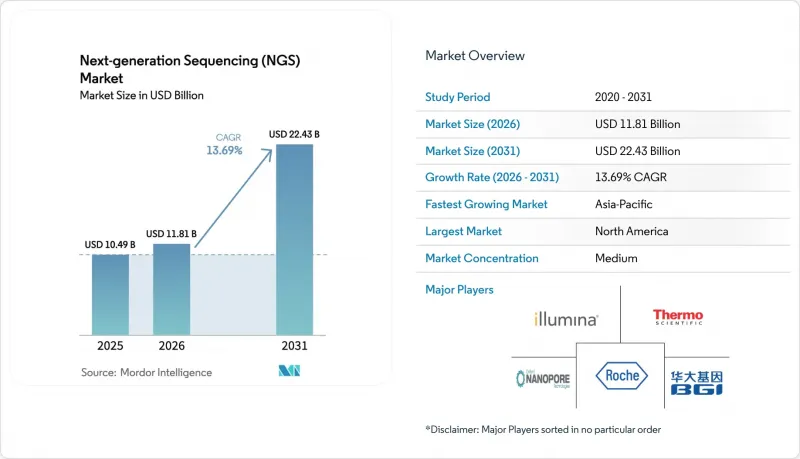
Mordor Intelligence에 의하면, 차세대 시퀀싱(NGS) 시장 규모는 2025년에 104억 9,000만 달러로 평가되었습니다. 2026년에 118억 1,000만 달러에 달하고, 2031년까지 224억 3,000만 달러에 이를 것으로 예측되며, 2026-2031년에 걸쳐 CAGR 13.69%로 성장할 전망입니다.
본 보고서는 시퀀싱 유형별(전장 유전체 시퀀싱, 기타), 제품 유형별(장비, 시약 및 소모품, 서비스), 용도별(신약 개발·맞춤형 의료, 기타), 최종 사용자별(병원·의료기관, 기타), 지역별(북미, 유럽, 기타)로 분류되어 있습니다. 시장 전망은 금액(달러) 기준으로 제시되어 있습니다.
세계의 차세대 시퀀싱(NGS) 시장 동향 및 인사이트
정밀 의학 및 동반 진단의 도입 가속화
표적 치료와 관련된 동반 진단을 통해 차세대 염기서열 분석이 종양학 워크플로우에 통합되고 있으며, 이 기술은 조사 도구에서 보험 적용 대상인 임상 서비스로 전환되고 있습니다. 미국 FDA는 2024년부터 2025년에 걸쳐 폐암, 유방암, 악성 흑색종 등 고형암을 대상으로 하는 14건의 NGS 기반 동반 진단 검사에 대해 ‘획기적 치료법(Breakthrough Designation)’을 부여했습니다. 메디케어의 2025년 종합적 유전체 프로파일링 적용 범위 확대에 따라 사전 승인 장벽이 해소되면서 병원 검사실의 검사 건수가 증가했습니다. 순환 종양 DNA를 검출하는 액체 생검 분석법은 치료 초기 단계에 점차 도입되고 있으며, Guardant Health와 Foundation Medicine은 2025년에 검사 의뢰 건수가 두 자릿수 증가를 기록했다고 보고했습니다. 유럽의 승인 절차는 다소 완만한 속도로 진행되고 있지만, 유럽집행위원회가 2024년에 제안한 체외진단용 의료기기 규정 간소화안은 2027년 이후 승인 절차가 가속화될 것임을 시사하고 있습니다. 이러한 규제 동향이 맞물리면서 NGS는 실험적인 선택지가 아닌, 임상 현장의 주류로 자리 잡아가고 있습니다.
유전체당 비용의 지속적인 하락 및 처리량 향상
2025년에는 고처리량 장비를 이용한 전체 유전체 시퀀싱 비용이 500달러 미만으로 떨어지면서, 공중보건 시스템에서의 집단 선별 검사가 경제적으로 실현 가능해졌습니다. Ultima Genomics는 2024년, 동료 심사를 거친 연구를 통해 100달러에 유전체 분석을 실현해 보였으며, 이로 인해 기존 기업들은 시약 가격 분리 및 수익 모델 재검토를 강요받게 되었습니다. Illumina사의 ‘NovaSeq X’는 1회 실행당 16테라베이스의 처리 능력을 발휘하여, 검사실이 매주 수천 건의 검체를 처리할 수 있게 해줍니다. 엘레멘트 바이오사이언스(Element Biosciences)의 반도체 기반 ‘AVITI’ 플랫폼은 시약 소비량을 30% 줄여, 절감된 비용을 사용자에게 직접 환원하고 있습니다. 이러한 효율성 향상으로 인해, 그동안 전체 유전체 시퀀싱을 일상적인 진단에 사용하기에는 너무 비싸다고 여겼던 중소득 국가에서의 도입이 가속화되고 있습니다.
임상용 NGS에 관한 전 세계 규제 상황의 분절화
FDA, EU의 IVDR, 아시아태평양 규제 당국 간에 승인 절차가 서로 다르기 때문에 지역별 검증이 필요하며, 이에 따라 시장 출시까지의 기간과 비용이 증가하고 있습니다. FDA가 2024년에 발표한 ‘실험실 개발 검사(LDT)’에 관한 초안은 감독 체제를 강화하는 내용으로, 학술 의료 센터 측에서는 이것이 혁신을 저해할 가능성이 있다는 우려를 표명하고 있습니다. 유럽의 IVDR 적용 기한이 2027년까지 연장됨에 따라 수백 가지의 검사법이 불확실한 상태에 놓여 있습니다. 한편, 중국 규제 당국은 국내 임상 검사를 요구하고 있어, 이로 인해 시장 출시까지의 기간이 최대 24개월이나 지연되고 있습니다. 2025년에 도입된 일본의 조건부 승인 제도에는 여전히 명확한 시판 후 요건이 부족하여 중소기업 시장 진입을 가로막고 있습니다. 여러 버전의 검사법을 유지하는 것은 규모의 경제를 저해하며, 규제 대응 자원이 풍부한 기업에 유리하게 작용합니다.
부문별 분석
보험사들이 희귀질환 진단에 전체 엑솜 시퀀싱을 채택하고, 단일 유전자 검사에서 종합적인 패널 검사로 예산을 전환함에 따라, 2031년까지 해당 부문은 연평균 성장률(CAGR) 14.23%를 나타낼 것으로 예측됩니다. 표적 재시퀀싱은 종양학 패널에 힘입어 2025년에는 차세대 시퀀싱 시장 점유율의 38.09%를 차지했으나, 엑솜 비용이 검체당 200달러 아래로 떨어지면서 그 가격 경쟁력은 점차 약화되고 있습니다. 전장 유전체 시퀀싱은 구조적 변이 진단에 있어 여전히 표준으로 자리 잡고 있지만, 데이터 양이 30배 증가함에 따라 병원의 IT 자원에 부담이 가중되고 있습니다. RNA 시퀀싱은 면역종양학 분야에서 주목을 받고 있으며, 공간 전사체학 매출액은 2025년에 1억 8,000만 달러에 달했습니다.
차세대 시퀀싱 시장에서는 희귀질환 검사법이 연구 단계에서 보험 적용 의료로 전환되고 있으며, 엑솜 검사가 1차 진단법으로 자리 잡아가고 있습니다. 2025년 FDA가 최초의 엑솜 기반 신경발달장애 검사를 승인함에 따라 이러한 전환은 확고해졌습니다. 지역 병원들이 바이오정보학의 간소화를 요구하는 가운데, 단순한 처리 능력만을 제공하는 벤더보다 턴키 방식의 분석 파이프라인을 제공하는 벤더가 지지를 얻고 있습니다.
2025년에는 시약 및 소모품이 차세대 시퀀싱 시장 규모의 69.88%를 차지했으나, 2031년까지는 장비 부문이 연평균 성장률(CAGR) 14.39%로 시장 규모를 확대될 전망입니다. 시료 전처리 기능을 통합한 벤치탑형 시스템은 수작업 시간을 단축하고 진료 현장의 도입 장벽을 낮춥니다. Element Biosciences와 Singular Genomics는 독자적인 ‘면도기와 면도날’ 모델을 뛰어넘는 개방형 시약 설계를 채택하고 있습니다. Illumina사의 2025년 시약 중립 모드는 상호 운용성에 대한 수요 증가를 반영한 것입니다.
서비스 부문은 가장 규모가 작은 부문이지만, 제약 기업들이 대규모 시퀀싱을 고성능 센터에 외주화함에 따라 확대되고 있습니다. Tecan 및 Hamilton의 자동화 플랫폼은 시약 낭비를 줄여 소모품 매출 성장을 억제하고 있습니다. 오픈 케미스트리로의 전환은 특히 자원이 제한된 학술 기관에서 사용자 기반을 확대하는 한편, 이익률을 압박하고 있습니다.
지역별 분석
북미는 종합적인 유전체 프로파일링에 대한 메디케어 적용 범위 확대와 동반 진단제에 대한 FDA의 신속 승인 절차 도입에 힘입어 2025년 매출의 41.90%를 차지했습니다. 캐나다는 2025년에 소아 희귀질환 시퀀싱에 4,500만 캐나다 달러(약 3,300만 달러)를 투자한 반면, 멕시코는 약리유전학 역량을 확충했습니다. 그러나 유전 상담 및 생물정보학 부문에서 연구 지향적 인력 부족 문제를 해결하기 위한 비용 상환은 여전히 과제로 남아 있어 성장을 둔화시키고 있습니다.
아시아태평양은 세계 최고 수준인 연평균 성장률(CAGR) 14.21%로 확대될 것으로 전망됩니다. 중국의 ‘제14차 5개년 계획’에서는 2027년까지 유전체 인프라 구축에 12억 달러를 배정하고 있으며, 선전 국립 유전자 은행은 2025년 중반까지 80만 유전체을 돌파했습니다. 일본은 국내 데이터 거주 의무를 부과하고 있어, 이로 인해 장비 판매가 현지 시설에 집중되고 있습니다. 한편, 인도는 2028년까지 10만 유전체의 염기서열 분석을 달성할 계획입니다. 호주와 한국은 2024-2025년에 걸쳐 유전성 질환 시퀀싱에 대한 보험 환급 정책을 추진하여 지역 수요를 더욱 부추기고 있습니다.
유럽의 성장은 IVDR(체외진단용 의료기기 규정)로의 전환 지연으로 인해 둔화되고 있으며, 이로 인해 2025년까지 수백 건의 실험실 개발 검사가 규제상 불확실한 상황에 놓였습니다. 독일은 2024년에 종양 프로파일링에 대한 법정 보험 적용 범위를 확대하여 연간 8만 건의 검사가 추가되었으나, 환급률은 여전히 원가 회수 수준에 미치지 못하고 있습니다. 영국의 유전체 의료 서비스는 2025년에 10만 건의 전체 유전체 분석을 완료하고, 2027년까지 그 수를 두 배로 늘릴 계획입니다. 프랑스의 국가 계획에 따르면 12개 지역 플랫폼에 6억 7,000만 유로(7억 3,000만 달러)를 지원할 예정이지만, 조달 지연으로 인해 도입은 2025년 하반기로 미뤄졌습니다.
중동과 라틴아메리카는 절대적인 시행 건수에서는 뒤처져 있지만, 프로젝트 단위로 볼 때 급속한 확산이 나타나고 있습니다. 사우디아라비아의 유전체 프로그램과 아랍에미리트의 데이터 주권 관련 규정은 현지 역량 강화를 촉진하고 있습니다. 브라질은 2024년에 NGS를 활용한 결핵 약물 내성 검사 시범 사업을 실시하여, 자금 조달이 안정화되면 공중보건 분야에서 응용이 가능함을 보여주었습니다.
기타 혜택
- 엑셀 형식 시장 예측(ME) 시트
- 3개월간의 애널리스트 지원
자주 묻는 질문
목차
제1장 서론
제2장 조사 방법
제3장 주요 요약
제4장 시장 구도
제5장 시장 규모 및 성장 예측
제6장 경쟁 구도
제7장 시장 기회 및 향후 전망
KTH 26.09.04According to Mordor Intelligence, the next-generation sequencing market size is projected to be USD 10.49 billion in 2025, USD 11.81 billion in 2026, and reach USD 22.43 billion by 2031, growing at a CAGR of 13.69% from 2026 to 2031.
This report is Segmented by Type of Sequencing (Whole Genome, and More), Product Type (Instruments, Reagents and Consumables, and Services), Application (Drug Discovery and Personalized Medicine, and More), End User (Hospitals and Healthcare Institutions, and More), and Geography (North America, Europe, and More). Market Forecasts are Provided in Terms of Value (USD).
Global Next-generation Sequencing (NGS) Market Trends and Insights
Accelerating Adoption of Precision Medicine and Companion Diagnostics
Companion diagnostics linked to targeted therapies are embedding next-generation sequencing into oncology workflows, converting the technology from a research tool to a reimbursable clinical service. The U.S. FDA granted breakthrough designation to 14 NGS-based companion tests during 2024-2025, covering solid tumors such as lung, breast, and melanoma. Medicare's 2025 coverage expansion for comprehensive genomic profiling eliminated prior-authorization hurdles, boosting test volumes in hospital laboratories. Liquid-biopsy assays that detect circulating tumor DNA are being integrated into earlier treatment lines, with Guardant Health and Foundation Medicine reporting double-digit growth in requisitions in 2025. Although European approvals proceed more slowly, the European Commission's 2024 proposal to streamline in-vitro diagnostic regulation signals faster clearance pathways after 2027. Collectively, these regulatory trends establish NGS as a clinical mainstay rather than an experimental option.
Continuous Decline in Cost Per Genome and Throughput Gains
Whole-genome sequencing costs fell below USD 500 in 2025 on high-throughput instruments, making population screening economically feasible for public health systems. Ultima Genomics validated a USD 100 genome in peer-reviewed studies during 2024, forcing incumbents to unbundle reagent pricing and rethink revenue models. Illumina's NovaSeq X delivers 16 terabases per run, enabling laboratories to process thousands of samples weekly. Element Biosciences' semiconductor-based AVITI platform reduces reagent consumption by 30%, translating cost savings directly to users. These efficiencies are accelerating adoption in middle-income countries that previously considered whole-genome sequencing too expensive for routine diagnostics.
Fragmented Global Regulatory Landscape for Clinical NGS
Divergent approval pathways across the FDA, EU IVDR, and APAC agencies necessitate region-specific validations, which increase time-to-market and costs. The FDA's 2024 draft on laboratory-developed tests adds oversight that academic medical centers argue may curb innovation. Europe's IVDR extensions to 2027 leave hundreds of assays in limbo, while China's regulators demand domestic clinical trials, lengthening launches by up to 24 months. Japan's conditional approval pathway introduced in 2025 still lacks precise post-market requirements, discouraging smaller firms. Maintaining multiple assay versions dilutes economies of scale and favors companies with deep regulatory resources.
Other drivers and restraints analyzed in the detailed report include:
- Expansion of Population-Scale Genomics Programs
- On-Cartridge Sequencing Workflows for Point-of-Care Testing
- High Capital Outlay for Long-Read & Spatial Platforms
For complete list of drivers and restraints, kindly check the Table Of Contents.
Segment Analysis
Whole-exome sequencing is projected to grow at a 14.23% CAGR to 2031 as insurers adopt it for rare-disease diagnostics, redirecting budgets from single-gene tests to comprehensive panels. Targeted resequencing held 38.09% of the next-generation sequencing market share in 2025, driven by oncology panels, yet falling exome costs below USD 200 per sample erode its price advantage. Whole-genome sequencing remains the benchmark for structural variants, although the 30-fold increase in data volume strains hospital IT resources. RNA sequencing is gaining traction in immuno-oncology, and spatial transcriptomics reached USD 180 million in sales in 2025.
The next-generation sequencing market is witnessing rare-disease pathways transition from research to reimbursed care, validating exome tests as first-tier diagnostics. The FDA's approval of the first exome-based neurodevelopmental test in 2025 solidified this transition. Vendors offering turnkey analysis pipelines are gaining favor over those selling raw capacity alone, as community hospitals seek simplicity in bioinformatics.
Reagents and consumables captured 69.88% of the next-generation sequencing market size in 2025, but instruments will outpace at 14.39% CAGR through 2031. Benchtop systems that integrate sample prep cut hands-on time and lower point-of-care adoption barriers. Element Biosciences and Singular Genomics employ open-reagent designs that undercut proprietary razor-and-blade models. Illumina's 2025 reagent-neutral mode acknowledges growing demand for interoperability.
Services, although the smallest segment, are expanding as pharmaceutical sponsors outsource large-scale sequencing to high-throughput centers. Automation platforms from Tecan and Hamilton reduce reagent waste, compressing consumable revenue growth. The shift toward open chemistry compresses margins while broadening the user base, especially among resource-constrained academic institutions.
Complete Report Scope:
- By Type of Sequencing
- Whole Genome Sequencing
- Targeted Resequencing
- Whole Exome Sequencing
- RNA Sequencing
- ChIP Sequencing
- De Novo Sequencing
- Methyl Sequencing
- By Product Type
- Instruments
- Reagents And Consumables
- Services
- By Application
- Drug Discovery And Personalized Medicine
- Genetic Screening
- Diagnostics
- Agriculture And Animal Research
- Other Applications (Epigenomics, Metagenomics, Transcriptomics)
- By End User
- Hospitals And Healthcare Institutions
- Academics
- Pharmaceuticals And Biotechnology Companies
- Geography
- North America
- United States
- Canada
- Mexico
- Europe
- Germany
- United Kingdom
- France
- Italy
- Spain
- Rest Of Europe
- Asia-Pacific
- China
- Japan
- India
- South Korea
- Australia
- Rest Of Asia-Pacific
- Middle-East And Africa
- GCC
- South Africa
- Rest Of Middle East And Africa
- South America
- Brazil
- Argentina
- Rest Of South America
- North America
Geography Analysis
North America contributed 41.90% of 2025 revenue, supported by Medicare coverage for comprehensive genomic profiling and the FDA's expedited approval pathway for companion diagnostics. Canada invested CAD 45 million (approximately USD 33 million) in pediatric rare-disease sequencing in 2025, while Mexico expanded its pharmacogenomic capacity. However, reimbursement remains a challenge to addressing research-oriented workforce shortages in genetic counseling and bioinformatics, tempering growth.
Asia-Pacific is forecast to expand at a 14.21% CAGR, the highest globally. China's 14th Five-Year Plan earmarked USD 1.2 billion for genomic infrastructure through 2027, and the Shenzhen National Gene Bank surpassed 800,000 genomes by mid-2025. Japan mandates domestic data residency, channeling instrument sales to local facilities, while India plans to reach 100,000 sequenced genomes by 2028. Australia and South Korea advanced reimbursement policies for hereditary disease sequencing in 2024-2025, further fueling regional demand.
Europe's growth is moderated by IVDR transition delays, which have placed hundreds of lab-developed tests in regulatory limbo through 2025. Germany expanded statutory insurance coverage for tumor profiling in 2024, adding 80,000 tests annually, yet reimbursement rates remain below cost recovery. The U.K. Genomic Medicine Service completed 100,000 whole genomes in 2025 and plans to double by 2027. France's national plan committed EUR 670 million (USD 730 million) to 12 regional platforms, though procurement delays pushed installations into late 2025.
The Middle East and Latin America trail in absolute volumes but register rapid project-based uptake. Saudi Arabia's Genome Program and the UAE's data-sovereignty rules incentivize local capacity. Brazil piloted NGS-based TB drug-resistance testing in 2024, demonstrating potential public health applications if funding remains stable.
- 10x Genomics Inc.
- Agilent Technologies
- BGI Genomics Co. Ltd.
- Bio-Rad Laboratories
- Element Biosciences Inc.
- Eurofins
- Roche
- Fulgent Genetics Inc.
- Guardant Health
- Illumina
- Macrogen
- Oxford Nanopore Technologies Plc
- Pacific Biosciences Of California Inc.
- PerkinElmer
- QIAGEN
- Singular Genomics Systems Inc.
- SOPHiA GENETICS SA
- Thermo Fisher Scientific
- Twist Bioscience Corp.
- Ultima Genomics Inc.
Additional Benefits:
- The market estimate (ME) sheet in Excel format
- 3 months of analyst support
TABLE OF CONTENTS
1 Introduction
- 1.1 Study Assumptions & Market Definition
- 1.2 Scope of the Study
2 Research Methodology
3 Executive Summary
4 Market Landscape
- 4.1 Market Overview
- 4.2 Market Drivers
- 4.2.1 Accelerating Adoption of Precision Medicine & Companion Diagnostics
- 4.2.2 Continuous Decline in Cost Per Genome & Throughput Gains
- 4.2.3 Expansion of Population-Scale Genomics Programs
- 4.2.4 On-Cartridge Sequencing Workflows for Point-of-Care Testing
- 4.2.5 Sovereign Genomic Data Centers Demanding Localized NGS Capacity
- 4.2.6 Carbon-Neutral Sequencing Initiatives Influencing Procurement
- 4.3 Market Restraints
- 4.3.1 Fragmented Global Regulatory Landscape for Clinical NGS
- 4.3.2 High Capital Outlay for Long-Read & Spatial Platforms
- 4.3.3 Consumable Supply-Chain Vulnerabilities Post-Export Controls
- 4.3.4 Algorithmic Bias in AI-Based Variant Calling & Liability Risks
- 4.4 Regulatory Outlook
- 4.5 Technological Landscape
- 4.6 Porter's Five Forces Analysis
- 4.6.1 Bargaining Power of Buyers
- 4.6.2 Bargaining Power of Suppliers
- 4.6.3 Threat of New Entrants
- 4.6.4 Threat of Substitutes
- 4.6.5 Intensity of Competitive Rivalry
5 Market Size & Growth Forecasts (Value, USD)
- 5.1 By Type of Sequencing
- 5.1.1 Whole Genome Sequencing
- 5.1.2 Targeted Resequencing
- 5.1.3 Whole Exome Sequencing
- 5.1.4 RNA Sequencing
- 5.1.5 ChIP Sequencing
- 5.1.6 De Novo Sequencing
- 5.1.7 Methyl Sequencing
- 5.2 By Product Type
- 5.2.1 Instruments
- 5.2.2 Reagents And Consumables
- 5.2.3 Services
- 5.3 By Application
- 5.3.1 Drug Discovery And Personalized Medicine
- 5.3.2 Genetic Screening
- 5.3.3 Diagnostics
- 5.3.4 Agriculture And Animal Research
- 5.3.5 Other Applications (Epigenomics, Metagenomics, Transcriptomics)
- 5.4 By End User
- 5.4.1 Hospitals And Healthcare Institutions
- 5.4.2 Academics
- 5.4.3 Pharmaceuticals And Biotechnology Companies
- 5.5 Geography
- 5.5.1 North America
- 5.5.1.1 United States
- 5.5.1.2 Canada
- 5.5.1.3 Mexico
- 5.5.2 Europe
- 5.5.2.1 Germany
- 5.5.2.2 United Kingdom
- 5.5.2.3 France
- 5.5.2.4 Italy
- 5.5.2.5 Spain
- 5.5.2.6 Rest Of Europe
- 5.5.3 Asia-Pacific
- 5.5.3.1 China
- 5.5.3.2 Japan
- 5.5.3.3 India
- 5.5.3.4 South Korea
- 5.5.3.5 Australia
- 5.5.3.6 Rest Of Asia-Pacific
- 5.5.4 Middle-East And Africa
- 5.5.4.1 GCC
- 5.5.4.2 South Africa
- 5.5.4.3 Rest Of Middle East And Africa
- 5.5.5 South America
- 5.5.5.1 Brazil
- 5.5.5.2 Argentina
- 5.5.5.3 Rest Of South America
- 5.5.1 North America
6 Competitive Landscape
- 6.1 Market Concentration
- 6.2 Market Share Analysis
- 6.3 Company Profiles {(Includes Global Level Overview, Market Level Overview, Core Segments, Financials as Available, Strategic Information, Market Rank/Share for Key Companies, Products & Services, and Recent Developments)}
- 6.3.1 10x Genomics Inc.
- 6.3.2 Agilent Technologies Inc.
- 6.3.3 BGI Genomics Co. Ltd.
- 6.3.4 Bio-Rad Laboratories Inc.
- 6.3.5 Element Biosciences Inc.
- 6.3.6 Eurofins Scientific SE
- 6.3.7 F. Hoffmann-La Roche Ltd.
- 6.3.8 Fulgent Genetics Inc.
- 6.3.9 Guardant Health Inc.
- 6.3.10 Illumina Inc.
- 6.3.11 Macrogen Inc.
- 6.3.12 Oxford Nanopore Technologies Plc
- 6.3.13 Pacific Biosciences Of California Inc.
- 6.3.14 PerkinElmer Inc.
- 6.3.15 Qiagen N.V.
- 6.3.16 Singular Genomics Systems Inc.
- 6.3.17 SOPHiA GENETICS SA
- 6.3.18 Thermo Fisher Scientific Inc.
- 6.3.19 Twist Bioscience Corp.
- 6.3.20 Ultima Genomics Inc.
7 Market Opportunities & Future Outlook
- 7.1 White-Space & Unmet-Need Assessment


