|
시장보고서
상품코드
2120521
유전용 화학제품 : 시장 점유율 분석, 업계 동향 및 통계, 성장 예측(2026-2031년)Oilfield Chemicals - Market Share Analysis, Industry Trends & Statistics, Growth Forecasts (2026 - 2031) |
||||||
 Mordor Intelligence
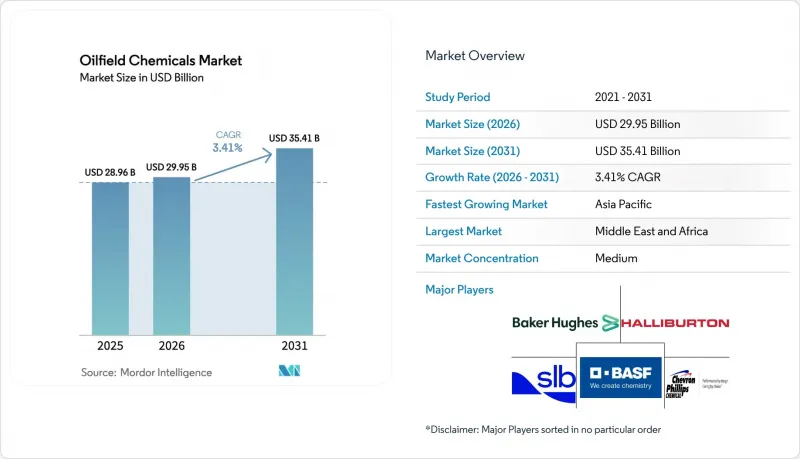
Mordor Intelligence에 의하면, 유전용 화학제품 시장 규모는 2025년 289억 6,000만 달러로 평가되었습니다. 2026년에는 299억 5,000만 달러로 확대되어 2031년까지 354억 1,000만 달러에 이를 것으로 예상되고 2026-2031년에 걸쳐 CAGR 3.41%로 성장할 전망입니다.
본 보고서는 화학제품 유형별(살생물제, 부식 방지제, 탈유화제, 폴리머,계면활성제, 기타), 용도별(시추·시멘트 주입, 생산, 유정 자극, 석유 증산, 워크오버·컴플리션), 지역별(아시아태평양, 북미, 유럽, 남미, 중동 및 아프리카)로 분류되어 있습니다. 시장 예측은 금액(미 달러) 기준으로 제시되어 있습니다.
세계의 유전용 화학제품 시장 동향 및 인사이트
셰일가스 탐사·생산의 확대
마르셀러스 분지와 헤인즈빌 분지의 드라이 가스 생산량이 사상 최고치를 기록함에 따라, 2025년에도 마찰 저감제, 점토 안정제, 살균제의 사용량은 높은 수준을 유지했습니다. 각 사업자들은 투여 효율이 향상되고 있음에도 불구하고, 횡굴의 길이를 계속 연장하고, 스테이지 수를 늘리며, 유정당 화학제품 총 소비량을 증가시키고 있습니다. 아르헨티나의 바카 무에르타에서는 2024-2025년에 걸쳐 50억 달러 이상의 업스트림 부문 자본이 유입되었으며, 해당 광구의 고온·고점토 특성에 맞추어 조제된 맞춤형 슬릭 워터 시스템이 채택되었습니다. 중국 쓰촨 분지의 셰일 상업화 노력은 물 부족 문제에 직면해 있어, 각 생산 기업들은 담수 사용량을 최대 70%까지 줄일 수 있는 발포형 및 무수형 파쇄 유체를 검토하고 있습니다. 성숙기에 접어든 북미 유전 지역에서는 배럴당 화학제품 사용량이 지속적으로 감소하고 있지만, 이 세 지역의 셰일 개발 성장만으로도 유전용 화학제품 시장의 상당 부분을 지탱하고 있습니다.
운송 부문의 석유계 연료 수요 증가
항공, 해운, 장거리 트럭 운송 분야에서 비용 경쟁력을 갖춘 배터리 대체 수단이 존재하지 않기 때문에 전 세계 액체 연료 수요는 견조한 추세를 보이고 있습니다. 인도의 석유화학 통합 프로젝트는 추가적인 원유 수요를 창출하고 있으며, 첫 원유 생산을 훨씬 넘어서는 기간 동안 신뢰할 수 있는 유량 보장용 화학제품이 요구되고 있습니다. 중동의 국영 석유 기업들은 저비용 원유 생산을 유지하며, 부식, 스케일, 유화 제어용 생산 화학제품에 대한 안정적인 수요를 확보하고 있습니다. 전동화가 진행되고 있는 지역에서도 기존 차량들이 여전히 디젤 연료와 제트 연료 수요를 뒷받침하고 있어, 기존 유정과 신규 유정 모두에서 유전용 화학제품 시장을 지탱하고 있습니다. 그 결과, 생산 화학제품에 대한 지출은 생산량 감소 관리에 맞추어 증가하고 있으며, 사업자가 신규 시추 대신 화학제품을 통한 개입을 통해 생산량을 일정 수준으로 유지하는 데 도움이 되고 있습니다.
청정 에너지 및 전기화로의 세계적 전환
쉘(Shell)은 석유 생산량을 2024년 수준으로 상한을 설정하고, 매년 150억 달러를 저탄소 사업에 할당하고 있습니다. BP는 2030년까지 탄화수소 생산량을 25% 감축할 계획이며, 이러한 움직임으로 인해 시추 예산이 삭감되고, 결과적으로 화학제품 수요도 감소하게 될 것입니다. 토탈에너지스는 자본 지출의 40%를 재생에너지에 할당하고 있으며, 기존에 대량의 자극용 화학 물질을 필요로 했던 신규 유정에 대한 자금 지원을 제한하고 있습니다. 국제에너지기구(IEA)의 ‘넷 제로(Net Zero)’ 시나리오에 따르면, 2025년 이후 업스트림 부문에 대한 투자가 감소할 것으로 예측되며, 이는 유전용 화학제품 시장에 구조적인 역풍이 될 것입니다. 기존 유정에 있어 생산용 화학제품은 여전히 필수적이지만, 신규 유정의 수가 감소하면 성장의 상한선은 낮아질 것입니다.
부문별 분석
부식 억제제는 2025년 매출의 33.56%를 차지하여, 자산 보존용 화학제품이 여전히 유전용 화학제품 시장에서 가장 큰 점유율을 차지하고 있음이 확인되었습니다. 이러한 우위는 노후화된 자산의 수분 함량 및 산성 가스 함량 증가와 관련이 있으며, 이러한 상황은 배관을 부식시켜 예기치 못한 가동 중단 위험을 초래합니다. 대조적으로, 바이오 유래 계면활성제는 지속가능성에 관한 규제가 강화되는 데다 금융 기관들이 친환경 배합을 높이 평가하고 있어, 포트폴리오 내에서 가장 빠른 속도인 연평균 성장률(CAGR) 4.82%를 나타낼 것으로 예측됩니다. 폴리머 부문의 유전용 화학제품 시장 규모는 사업자들이 플로우백수를 더 많이 재활용하게 되면서 단계별 증점제 사용량이 감소함에 따라 정체 상태를 보이고 있지만, 나노 복합재료 첨가제를 둘러싼 폴리머 기술 혁신을 통해 저투여량으로 높은 효율을 실현함으로써 성장 회복을 목표로 하고 있습니다.
유화 분산제는 승무원 교대나 악천후로 인해 인력에 의한 개입 없이 95%의 분리 효율을 유지할 수 있는 화학 물질이 요구되는 해양 생산에서 필수적입니다. 스케일, 파라핀, 아스팔텐 억제제는 브라질과 서아프리카 심해의 장거리 타이백을 보호하고 있으며, 수량 증가가 주목받는 카테고리에 미치지 못하더라도 안정적인 하위 부문으로 자리 잡고 있습니다. 나노기술을 응용한 부식 방지제는 현장 검사 결과, 투여량을 20% 줄이면서도 피막 밀도를 향상시킨 것으로 나타났으며, 이러한 제품의 규모 확대에 따라 이익률 향상 여지가 있음을 시사합니다. 전반적으로 화학제품의 다양화는 공급업체가 주기적인 시추 침체로 인한 수익 타격을 완화하는 데 도움이 되는 동시에, 부식 방지 제품이 누리고 있는 유전용 화학제품 시장 내 점유율 우위를 유지하는 데에도 기여하고 있습니다.
지역별 분석
2025년에는 중동 및 아프리카가 세계 수요의 28.36%를 차지했습니다. 이는 내식성과 황화수소 제거 기능을 갖춘 제제를 필요로 하는 Saudi Aramco의 자프라 가스 계획과 ADNOC의 사워 가스 프로젝트가 주도한 결과입니다. 쿠웨이트와 이라크에서는 물 침투율을 80% 이상으로 끌어올리는 물 주입이 확대되면서 스케일 억제제 및 유화 파괴제에 대한 수요가 증가하고 있습니다. 나이지리아와 앙골라의 심해 개발에서는 40킬로미터에 달하는 타이백 구간에서 왁스와 하이드레이트의 위험을 관리하기 위해 해저 주입 시스템과 장기 체류형 억제제가 채택되고 있습니다. 이 지역의 유전용 화학제품 시장 규모는 국영 석유 회사들이 낮은 채굴 비용의 자산을 보호하고 지속가능성 목표를 달성하기 위해 디지털 투여를 통합해 나감에 따라 그 성장세를 유지할 것으로 전망됩니다.
아시아태평양은 중국의 다칭과 지린에서 폴리머 주입이 확대되고, 인도의 크리슈나-고다바리 분지에서 심해 시추가 진행됨에 따라 2031년까지 연평균 성장률(CAGR) 4.94%를 나타낼 것으로 예측됩니다. 인도네시아와 말레이시아는 높은 수분 함유율과 높은 염분 함량을 가진 원유에 특화된 화학 물질을 필요로 하는 한계 유전의 EOR(증산)을 추진하고 있습니다. 일본, 한국, 태국은 해양 작업용 특수 첨가제를 수입하고 있으며, 베트남에서는 생태계에 민감한 지역에서 바이오 시추 유체의 사용이 의무화되는 개척 탐사가 주목을 받고 있습니다. 이러한 프로젝트들은 지역 정책이 점차 저탄소 에너지로 전환되고 있는 상황 속에서도 고객 기반을 확대하고, 유전용 화학제품 시장을 뒷받침하고 있습니다.
북미는 여전히 중요한 지역입니다. 미국은 퍼미안 분지에서 하루 500만 배럴 이상의 원유 생산을 유지하고 있으며, 이는 마찰 저감제, 살균제, 스케일 억제제에 대한 대량 수요를 견인하고 있습니다. 캐나다의 오일샌드에서는 한랭지용 파이프라인에 적합한 유화방지제 및 부식방지제의 주문이 꾸준히 들어오고 있습니다. 멕시코의 얕은 바다 재개발에는 비용 대비 효과가 높은 자극용 화학제품이 필요하지만, 재정적 제약으로 인해 성장에는 한계가 있습니다. 유럽의 북해에서는 생산량 감소에도 불구하고 규제 요건이 강화되면서, 사업자들은 바이오 유래 첨가제로의 전환을 강요받고 있습니다. 러시아의 석유 및 가스 부문은 여전히 중요하지만, 서유럽의 특수 화학제품에 대한 접근을 제한하는 제재의 영향을 받고 있어 국내 대체품에 대한 수요가 발생하고 있습니다. 남미의 성장은 여전히 브라질의 프레스솔트층에 의존하고 있으며, 이 지역에서는 종합 서비스 기업들에게 수년에 걸친 화학제품 공급 계약이 체결되고 있습니다. 이러한 지역별 다양한 상황이 유전용 화학제품 시장 전체의 수익원 다각화를 뒷받침하고 있습니다.
기타 혜택
- 엑셀 형식 시장 예측(ME) 시트
- 3개월간의 애널리스트 지원
자주 묻는 질문
목차
제1장 서론
제2장 조사 방법
제3장 주요 요약
제4장 시장 구도
제5장 시장 규모 및 성장 예측
제6장 경쟁 구도
제7장 시장 기회 및 향후 전망
KTH 26.09.04According to Mordor Intelligence, the oilfield chemicals market size is expected to increase from USD 28.96 billion in 2025 to USD 29.95 billion in 2026 and reach USD 35.41 billion by 2031, growing at a CAGR of 3.41% over 2026-2031.
This report is Segmented by Chemical Type (Biocides, Corrosion Inhibitors, Demulsifiers, Polymers, Surfactants, and More), Application (Drilling and Cementing, Production, Well Stimulation, Enhanced Oil Recovery, and Workover and Completion), and Geography (Asia-Pacific, North America, Europe, South America, Middle East and Africa). The Market Forecasts are Provided in Terms of Value (USD).
Global Oilfield Chemicals Market Trends and Insights
Increased Shale Gas Exploration And Production
Record dry-gas volumes from the Marcellus and Haynesville basins sustained high usage of friction reducers, clay stabilizers, and biocides in 2025. Operators continue to extend lateral lengths, increasing stage counts and raising total chemical consumption per well even as dosage efficiencies improve. Argentina's Vaca Muerta attracted more than USD 5 billion in upstream capital during 2024-2025, with custom slickwater systems formulated for the play's high-temperature, high-clay profile. China's push to commercialize Sichuan Basin shale faces water scarcity, so producers are trialing foamed and waterless fracturing fluids that cut freshwater requirements by up to 70%. Shale growth in these three regions alone underpins a sizable tranche of the oilfield chemicals market, even though per-barrel chemical intensity continues to decline in mature North American plays.
Rising Demand For Petroleum-Based Fuels From Transportation
Global liquids demand remains resilient because aviation, shipping, and long-haul trucking lack cost-competitive battery alternatives. Petrochemical integration projects in India pull additional crude volumes that require reliable flow-assurance chemistries well beyond first oil. National oil companies in the Middle East protect low-cost barrels, ensuring a steady call on production chemicals for corrosion, scale, and emulsion control. Even in electrifying regions, legacy fleets still anchor diesel and jet fuel demand, sustaining the oilfield chemicals market in legacy and incremental wells alike. As a result, production chemical spending grows in line with base-decline management, helping operators hold plateau rates through chemical intervention rather than fresh drilling.
Global Shift Toward Clean Energy And Electrification
Shell has capped oil output at 2024 levels and redirects USD 15 billion each year toward low-carbon ventures. BP plans a 25% reduction in hydrocarbon production by 2030, a move that trims drilling budgets and, by extension, chemical demand. TotalEnergies earmarks 40% of capital for renewables, limiting funds for green-field wells that historically pull large volumes of stimulation chemicals. The International Energy Agency's Net Zero scenario projects falling upstream investment beyond 2025, a structural headwind for the oilfield chemicals market. While production chemicals remain essential for existing wells, the growth ceiling is lower when fewer new wells enter the mix.
Other drivers and restraints analyzed in the detailed report include:
- Expansion Of Deep- And Ultra-Deep-Water Projects Needing Advanced Chemistries
- Growth In CO2-EOR And CCUS Projects Requiring Compatible Chemicals
- Crude-Price Volatility Curbing Upstream Investment
For complete list of drivers and restraints, kindly check the Table Of Contents.
Segment Analysis
Corrosion inhibitors retained 33.56% of 2025 revenue, confirming that asset-integrity chemistries remain the largest slice of the oilfield chemicals market. This dominance is linked to higher water cut and acid gas content in aging assets, conditions that corrode tubulars and threaten unplanned outages. In contrast, bio-based surfactants are projected to grow at a 4.82% CAGR, the fastest pace within the portfolio, as sustainability covenants tighten, coupled with financiers rewarding environmentally preferred formulations. The oilfield chemicals market size for polymers has plateaued because operators recycle more flowback water, reducing required viscosifier loads per stage, yet polymer innovation around nanocomposite additives aims to restore growth through higher efficiency at lower dosage.
Demulsifiers are indispensable in offshore production, where crew changes and rough weather can require chemicals that maintain 95% separation efficiency without intervention. Scale, paraffin, and asphaltene inhibitors protect long tiebacks in Brazilian and West African deepwater, making them a stable subsegment even if volume growth lags high-profile categories. Nanotechnology-enhanced corrosion inhibitors have shown field results of 20% lower dosage yet improved film density, indicating room for margin expansion as these products scale. Altogether, chemical-type diversification helps suppliers cushion revenue against cyclical drilling downturns while preserving the oilfield chemicals market share lead enjoyed by corrosion-control products.
Complete Report Scope:
- By Chemical Type
- Biocides
- Corrosion Inhibitors
- Demulsifiers
- Polymers
- Surfactants
- Other Chemical Types (Scale Inhibitors, Paraffin and Asphaltene Inhibitors, etc.)
- By Application
- Drilling and Cementing
- Production (Flow Assurance and Asset Integrity)
- Well Stimulation
- Enhanced Oil Recovery
- Workover and Completion
- By Geography
- Asia-Pacifc
- China
- India
- Japan
- South Korea
- ASEAN Countries
- Rest of Asia-Pacific
- North America
- United States
- Canada
- Mexico
- Europe
- Germany
- United Kingdom
- France
- Italy
- Russia
- NORDIC Countries
- Rest of Europe
- South America
- Brazil
- Argentina
- Rest of South America
- Middle East and Africa
- Saudi Arabia
- United Arab Emirates
- Iran
- Iraq
- South Africa
- Algeria
- Nigeria
- Rest of Middle East and Africa
- Asia-Pacifc
Geography Analysis
Middle East and Africa commanded 28.36% of global demand in 2025, anchored by Saudi Aramco's Jafurah gas program and ADNOC's sour-gas projects that require corrosion-resistant and hydrogen-sulfide-scavenging formulations. Kuwait and Iraq expand water-floods that push water cut above 80%, elevating demand for scale inhibitors and demulsifiers. Deepwater Nigeria and Angola developments rely on subsea injection systems and long-residence inhibitors to manage wax and hydrate risks in 40-kilometer tiebacks. The oilfield chemicals market size in the region will keep momentum as national oil companies protect low lifting-cost assets and integrate digital dosing to hit sustainability targets.
Asia-Pacific is forecast to grow at a 4.94% CAGR through 2031, thanks to China's expanding polymer floods at Daqing and Jilin and India's deepwater drilling in the Krishna-Godavari Basin. Indonesia and Malaysia pursue marginal-field EOR that needs tailor-made chemicals for high-water-cut, high-salinity crudes. Japan, South Korea, and Thailand import specialty additives for offshore workovers, and Vietnam attracts frontier exploration that mandates bio-based drilling fluids in ecologically sensitive zones. These projects widen the customer base and bolster the oilfield chemicals market even as regional policy moves gradually toward lower-carbon energy.
North America remains pivotal because the United States maintains crude output above 5 million barrels per day in the Permian Basin, driving large offtake of friction reducers, biocides, and scale inhibitors. Canada's oil sands generate steady orders for demulsifiers and corrosion inhibitors suitable for cold-weather pipelines. Mexico's shallow-water redevelopment needs cost-effective stimulation chemicals, although fiscal constraints cap growth. Europe's North Sea faces declining production yet rising regulatory demands, pushing operators toward bio-based additives. Russia's sector remains significant but is constrained by sanctions that limit access to Western specialty chemicals, creating room for domestic equivalents. South America's growth continues to hinge on Brazil's pre-salt, which awards multiyear chemical supply contracts to integrated service companies. This geographic mosaic underpins diversification of revenue streams across the oilfield chemicals market.
- Albemarle Corporation
- Ashland
- Baker Hughes Company
- BASF
- CES Energy Solutions Corp.
- ChampionX
- Clariant
- Croda International plc
- Chevron Phillips Chemical Company LLC
- Dow
- Elementis plc
- Flotek Industries, Inc.
- Halliburton
- Huntsman International LLC
- Innospec Oilfield Services
- Kemira
- SNF Floerger
- MPRC
- Ecolab
- Nouryon
- SLB (Schlumberger Limited)
- Solvay
- The Lubrizol Corporation
- Weatherford
- Zirax
Additional Benefits:
- The market estimate (ME) sheet in Excel format
- 3 months of analyst support
TABLE OF CONTENTS
1 Introduction
- 1.1 Study Assumptions and Market Definition
- 1.2 Scope of the Study
2 Research Methodology
3 Executive Summary
4 Market Landscape
- 4.1 Market Overview
- 4.2 Market Drivers
- 4.2.1 Increased shale gas exploration and production
- 4.2.2 Rising demand for petroleum-based fuels from transportation
- 4.2.3 Expansion of deep- and ultra-deep-water projects needing advanced chemistries
- 4.2.4 Growth in CO2-EOR and CCUS projects requiring compatible chemicals
- 4.2.5 Bio-based, low-toxicity formulations tied to ESG-linked finance criteria
- 4.3 Market Restraints
- 4.3.1 Global shift toward clean energy and electrification
- 4.3.2 Crude-price volatility curbing upstream investment
- 4.3.3 PFAS / hazardous-chem regulation tightening and compliance cost rise
- 4.3.4 Raw-material (barite, bromine) supply shocks and pricing spikes
- 4.4 Value Chain Analysis
- 4.5 Regulatory Landscape
- 4.6 Technological Outlook
- 4.7 Porter's Five Forces
- 4.7.1 Bargaining Power of Suppliers
- 4.7.2 Bargaining Power of Buyers
- 4.7.3 Threat of New Entrants
- 4.7.4 Threat of Substitutes
- 4.7.5 Degree of Competition
5 Market Size and Growth Forecasts (Value)
- 5.1 By Chemical Type
- 5.1.1 Biocides
- 5.1.2 Corrosion Inhibitors
- 5.1.3 Demulsifiers
- 5.1.4 Polymers
- 5.1.5 Surfactants
- 5.1.6 Other Chemical Types (Scale Inhibitors, Paraffin and Asphaltene Inhibitors, etc.)
- 5.2 By Application
- 5.2.1 Drilling and Cementing
- 5.2.2 Production (Flow Assurance and Asset Integrity)
- 5.2.3 Well Stimulation
- 5.2.4 Enhanced Oil Recovery
- 5.2.5 Workover and Completion
- 5.3 By Geography
- 5.3.1 Asia-Pacifc
- 5.3.1.1 China
- 5.3.1.2 India
- 5.3.1.3 Japan
- 5.3.1.4 South Korea
- 5.3.1.5 ASEAN Countries
- 5.3.1.6 Rest of Asia-Pacific
- 5.3.2 North America
- 5.3.2.1 United States
- 5.3.2.2 Canada
- 5.3.2.3 Mexico
- 5.3.3 Europe
- 5.3.3.1 Germany
- 5.3.3.2 United Kingdom
- 5.3.3.3 France
- 5.3.3.4 Italy
- 5.3.3.5 Russia
- 5.3.3.6 NORDIC Countries
- 5.3.3.7 Rest of Europe
- 5.3.4 South America
- 5.3.4.1 Brazil
- 5.3.4.2 Argentina
- 5.3.4.3 Rest of South America
- 5.3.5 Middle East and Africa
- 5.3.5.1 Saudi Arabia
- 5.3.5.2 United Arab Emirates
- 5.3.5.3 Iran
- 5.3.5.4 Iraq
- 5.3.5.5 South Africa
- 5.3.5.6 Algeria
- 5.3.5.7 Nigeria
- 5.3.5.8 Rest of Middle East and Africa
- 5.3.1 Asia-Pacifc
6 Competitive Landscape
- 6.1 Market Concentration
- 6.2 Strategic Moves
- 6.3 Market Share(%)/Ranking Analysis
- 6.4 Company Profiles {(includes Global level Overview, Market level overview, Core Segments, Financials as available, Strategic Information, Market Rank/Share, Products and Services, Recent Developments)}
- 6.4.1 Albemarle Corporation
- 6.4.2 Ashland
- 6.4.3 Baker Hughes Company
- 6.4.4 BASF
- 6.4.5 CES Energy Solutions Corp.
- 6.4.6 ChampionX
- 6.4.7 Clariant
- 6.4.8 Croda International plc
- 6.4.9 Chevron Phillips Chemical Company LLC
- 6.4.10 Dow
- 6.4.11 Elementis plc
- 6.4.12 Flotek Industries, Inc.
- 6.4.13 Halliburton
- 6.4.14 Huntsman International LLC
- 6.4.15 Innospec Oilfield Services
- 6.4.16 Kemira
- 6.4.17 SNF Floerger
- 6.4.18 MPRC
- 6.4.19 Ecolab
- 6.4.20 Nouryon
- 6.4.21 SLB (Schlumberger Limited)
- 6.4.22 Solvay
- 6.4.23 The Lubrizol Corporation
- 6.4.24 Weatherford
- 6.4.25 Zirax
7 Market Opportunities and Future Outlook
- 7.1 White-space and Unmet-Need Assessment
- 7.2 Digitally enabled "intelligent chemistry" programs lowering OPEX and emissions