

|
시장보고서
상품코드
2120547
헬스케어 EDI : 시장 점유율 분석, 업계 동향 및 통계, 성장 예측(2026-2031년)Healthcare EDI - Market Share Analysis, Industry Trends & Statistics, Growth Forecasts (2026 - 2031) |
||||||
 Mordor Intelligence
Mordor Intelligence에 의하면, 헬스케어 EDI 시장 규모는 2025년 47억 2,000만 달러로 평가되었습니다. 2026년에는 52억 달러로 확대되어 2026년부터 2031년에 걸쳐 CAGR 10.16%로 성장을 지속하여, 2031년에는 84억 4,000만 달러에 이를 것으로 예측됩니다.
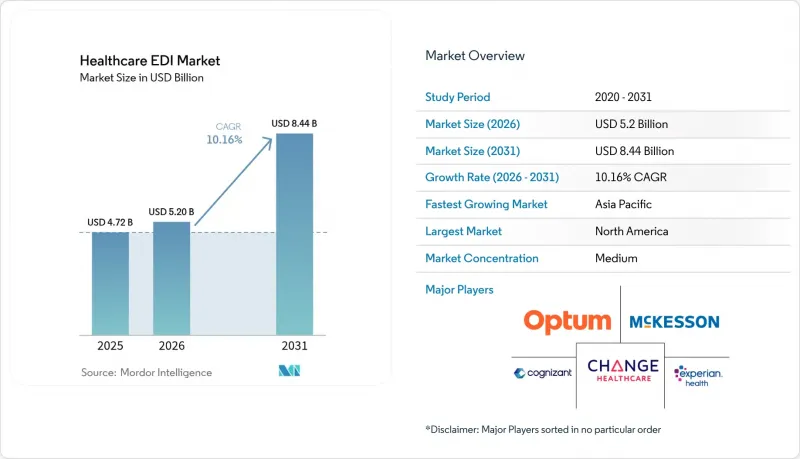
본 보고서는 구성 요소(소프트웨어, 하드웨어, 서비스), 거래 유형(청구 관리(837/835) 등), 제공 형태(웹 및 클라우드 기반 EDI 등), 최종 사용자(의료 제공업체 등), 그리고 지역별로 분류되어 있습니다. 시장 예측은 금액(달러)으로 표시되어 있습니다.
세계의 헬스케어 EDI 시장 동향 및 인사이트
HIPAA 의무화 및 전 세계 규제 추진
미국에서는 여전히 HIPAA에 기반한 거래가 의무화되어 있으며, 의료 서비스 제공업체와 보험사는 표준화된 EDI 형식을 통해 청구, 지급 명세서 및 피보험자 자격 데이터를 교환해야 합니다. CMS가 버전 8010으로의 직접 전환을 검토하고 있다는 사실은 기존의 모호함을 해소하는 현대화된 프레임워크 구축이 시급함을 여실히 보여줍니다. 유럽과 아시아의 유사한 규제 요건은 공통된 구문으로 수렴되고 있으며, 이는 다국적 기업의 도입 일정을 단축하는 동시에 헬스케어 EDI 시장의 연평균 성장률(CAGR)에 약 2.8%를 기여하고 있습니다. 수출 주도형 아시아 헬스테크 공급업체, 특히 한국과 대만의 기업들은 이러한 일관성을 활용하여 북미 및 유럽 경제 지역(EEA) 내 거래 파트너들로부터의 수용을 확대되고 있습니다.
강화되는 의료비 억제 압력
의료 기관은 종이 기반 처리와 비교하여 전자 거래 1건당 평균 2.7달러를 절감하고, 처리 시간을 82% 단축하고 있습니다. 환급액 감소로 인해 이익률이 압박받는 가운데, 수익 주기 관리자들은 풀 스위트 EDI를 필수적인 업무 요건으로 인식하기 시작했습니다. 사전 승인 검증 및 송금 데이터의 자동 전표를 자동화하는 시스템을 도입함으로써 관리 비용 센터에서 15-30%의 비용 절감이 실현되어, 헬스케어 EDI 시장의 성장 추세를 뒷받침하고 있습니다.
데이터 보안 및 개인정보 침해
2025년 2월 발생한 체인지 헬스케어(Change Healthcare)에 대한 랜섬웨어 공격은 전미의 보험 청구 업무에 혼란을 초래했으며, 유나이티드헬스 그룹(UnitedHealth Group)이 65억 달러의 구제 지급을 앞당기게 하는 사태를 불러왔습니다. 이러한 영향으로 거래 라우팅 및 암호화 계층에 대한 감시가 강화되었고, 리스크 회피 성향이 강한 의료 제공업체들의 EDI 도입 속도가 둔화되어 잠재적 연평균 성장률(CAGR)이 1.2포인트 하락했습니다.
부문 분석
2025년에도 소프트웨어는 헬스케어 EDI 시장의 중추로 남아, 조직들이 클라우드 지원 클리어링하우스 엔진을 표준화해 나가는 가운데 총 매출의 55.30%를 차지했습니다. 반면, 서비스 하위 부문은 사내 전문 지식의 부족과 끊임없이 진화하는 규정 준수 요건의 영향으로 2031년까지 연평균 성장률(CAGR) 12.22%로 확대되고 있습니다. 매핑, 파트너 온보딩, 연중무휴 24시간 거래 모니터링을 제공하는 컨설팅 기업들은 적극적인 디지털화 전략을 추진하는 중규모 시스템의 중요한 기술 격차를 메우고 있습니다.
관리형 서비스에 대한 의존도가 높아지고 있는 것은 X12, HL7 FHIR 및 독자적인 API를 통합한 복합 워크플로우의 고도화가 진행되고 있음을 반영합니다. 각 공급업체들은 데이터 관리, 예외 처리 및 지속적인 테스트를 외부 전문가에게 의뢰하고 있습니다. 헬스케어 EDI 시장의 서비스 제공 규모는 2031년까지 32억 5,000만 달러를 넘어설 것으로 예상되지만, 한편 가상화 게이트웨이가 랙형 모뎀을 대체함에 따라 하드웨어 설치 규모는 축소되고 있습니다.
2025년, 헬스케어 EDI 시장에서 청구 관리의 매출 점유율은 47.60%를 차지하여, 현금 흐름 유지에 있어 그 중요성이 부각되었습니다. 그럼에도 불구하고, 의료 시스템이 EDI를 활용하여 재고를 합리화하고 치솟는 의료기기 비용을 억제함에 따라 공급망 거래는 연평균 성장률(CAGR) 10.92%로 성장을 지속하고 있습니다. 자동화된 발주서, ASN 피드 및 위탁 재고 알림을 통해 재고 부족이 감소하고 운전 자본이 확보됨에 따라, 공급망 EDI는 CFO에게 전략적 수단으로서의 입지를 강화하고 있습니다.
IoT 원격 측정 기술과 EDI 메시지 세트를 연동함으로써, 온도에 민감한 생물학적 제제의 유효 기간을 실시간으로 추적하고 폐기물을 줄일 수 있습니다. 이러한 융합으로 인해 조달 부서와 생의학 공학 부서의 팀이 공동 거버넌스 협의회를 설립하는 움직임이 진행되고 있으며, 헬스케어 EDI 시장 전반에 걸쳐 네트워크 전체에 걸친 통합적인 데이터 가시성에 대한 수요가 증가하고 있습니다.
지역별 분석
북미는 HIPAA 의무화 및 성숙한 클리어링하우스 네트워크에 힘입어 2025년 매출의 42.60%를 차지하며 계속해서 주도적인 위치를 유지하고 있습니다. 메디케어의 종량제 청구 건의 거의 전부가 전자적으로 처리되고 있어, 헬스케어 EDI 시장의 높은 기준을 확립하고 있습니다. ‘상호 운용성 및 사전 승인에 관한 최종 규정’에 따라 디지털화 요건이 강화되면서, 민간 보험사들은 예외 처리 자동화를 추진하고 있으며, 소규모 의료 제공업체 그룹을 대상으로 한 비즈니스 기회가 확대되고 있습니다.
아시아태평양은 중국, 인도, 인도네시아의 건강보험 급속한 확대와 정부 주도의 광범위한 클라우드 도입 정책에 힘입어 연평균 성장률(CAGR) 11.74%라는 가장 높은 성장률을 보이고 있습니다. 모바일 퍼스트 도입으로 진료소는 기존의 모뎀 인프라를 우회할 수 있게 되어 시장 침투가 가속화되고 있습니다. 한국 등 경제권에서의 전자 청구서 의무화는 의료 데이터 교환에 대한 지출 확대로 이어져, 2031년까지 해당 지역의 헬스케어 EDI 시장 규모를 17억 8,000만 달러로 끌어올릴 전망입니다.
유럽에서는 도입 방식에 다양성이 나타나고 있습니다. 독일은 DRG(진단 관련군)에 기반한 보상 체계 내에서 통일된 조달·교환 시스템을 확대하고 있는 반면, 영국은 임상 사건을 청구 가능한 EDI 스탭으로 변환하는 국경을 초월한 EHR(전자건강기록) 연동을 우선시하고 있습니다. 스칸디나비아 국가들은 환자 신원 확인을 효율화하는 전국적인 전자 신분증 시스템의 혜택을 누리고 있습니다. 이러한 노력들이 결합되어 유럽은 헬스케어 EDI 시장 매출 측면에서 지역별 2위의 규모를 유지하고 있습니다.
기타 혜택 :
- 엑셀 형식 시장 예측(ME) 시트
- 3개월간의 애널리스트 지원
자주 묻는 질문
목차
제1장 서론
제2장 조사 방법
제3장 주요 요약
제4장 시장 구도
제5장 시장 규모 및 성장 예측
제6장 경쟁 구도
제7장 시장 기회 및 향후 전망
KTH 26.09.10According to Mordor Intelligence, the healthcare EDI market size is expected to grow from USD 4.72 billion in 2025 to USD 5.2 billion in 2026 and is forecast to reach USD 8.44 billion by 2031 at 10.16% CAGR over 2026-2031.
This report is Segmented by Component (Software, Hardware, and Services), by Transaction Type (Claims Management (837/835) and More), by Mode of Delivery (Web- and Cloud-Based EDI and More), by End User (Healthcare Providers and Others), and Geography. The Market Forecasts are Provided in Terms of Value (USD).
Global Healthcare EDI Market Trends and Insights
Mandated HIPAA and global regulatory push
HIPAA transactions remain obligatory in the United States, compelling providers and payers to exchange claims, remittances and eligibility data through standardized EDI formats. CMS deliberations on skipping directly to Version 8010 underscore the urgency of a modernized framework that removes legacy ambiguities. Similar mandates in Europe and Asia are converging toward common syntaxes, compressing implementation timelines for multinationals and contributing roughly 2.8 percentage points to the Healthcare EDI market CAGR. Export-driven Asian health-tech vendors, particularly in South Korea and Taiwan, leverage this alignment to gain trading-partner acceptance in North America and the European Economic Area.
Rising healthcare cost-containment pressures
Healthcare organizations save an average of USD 2.7 per electronic transaction versus paper, trimming 82% of processing time. With reimbursement erosion squeezing margins, revenue-cycle managers increasingly view full-suite EDI as a non-negotiable operating requirement. Deployments that automate pre-authorization validation and auto-post remittance data deliver 15-30% cost reductions in administrative cost centers, reinforcing the Healthcare EDI market growth narrative.
Data security and privacy breaches
The February 2025 Change Healthcare ransomware attack disrupted claims nationwide and forced UnitedHealth Group to advance USD 6.5 billion in relief payments. Fallout heightened scrutiny of transaction routing and encryption layers, denting EDI rollout velocity among risk-averse providers and shaving 1.2% points from potential CAGR.
Other drivers and restraints analyzed in the detailed report include:
- Cloud-enabled SaaS EDI adoption
- Shift to value-based care revenue-cycle efficiency
- High implementation and integration cost
For complete list of drivers and restraints, kindly check the Table Of Contents.
Segment Analysis
Software remained the backbone of the Healthcare EDI market in 2025, generating 55.30% of total revenue as organizations standardized on cloud-ready clearinghouse engines. The services sub-segment, however, is expanding at a 12.22% CAGR through 2031, propelled by scarce in-house expertise and ever-evolving compliance mandates. Consultancies providing mapping, partner onboarding, and 24/7 transaction monitoring fill critical skill gaps for midsize systems pursuing aggressive digital agendas.
Growing reliance on managed services also reflects the rising sophistication of composite workflows that merge X12, HL7 FHIR, and proprietary APIs. Providers are turning to external specialists for data stewardship, exception handling, and continuous testing. The Healthcare EDI market size for service offerings is forecast to eclipse USD 3.25 billion by 2031, while the hardware footprint contracts as virtualized gateways replace rack-based modems.
Claims management held 47.60% revenue share of the Healthcare EDI market in 2025, underlining its centrality in cash-flow preservation. Nevertheless, supply-chain transactions are registering an 10.92% CAGR as health systems exploit EDI to rationalize inventory and tame rising device costs. Automated purchase orders, ASN feeds, and consignment stock alerts trim stock-outs and free working capital, positioning supply-chain EDI as a strategic lever for CFOs.
Interlacing IoT telemetry with EDI message sets offers real-time expiry tracking for temperature-sensitive biologics, reducing waste. This convergence is nudging procurement and biomedical engineering teams into joint governance councils, intensifying demand for integrated network-wide data visibility across the Healthcare EDI market.
Complete Report Scope:
- By Component
- Software
- Hardware
- Services
- By Transaction Type
- Claims Management (837/835)
- Healthcare Supply-Chain (810/856)
- Others (Referral, Authorization, and more)
- By Mode of Delivery
- Web and Cloud-based EDI
- EDI VAN
- Mobile EDI
- Other Modes of Delivery
- By End User
- Healthcare Providers
- Medical Devices and Pharmaceutical Industry
- Payers
- Other End Users
- By Geography
- North America
- United States
- Canada
- Mexico
- South America
- Brazil
- Argentina
- Rest of South America
- Europe
- United Kingdom
- Germany
- France
- Italy
- Spain
- Nordics
- Rest of Europe
- Middle East and Africa
- GCC
- Israel
- South Africa
- Rest of Middle East and Africa
- Asia-Pacific
- China
- India
- Japan
- South Korea
- ASEAN
- Australia
- New Zealand
- Rest of Asia-Pacific
- North America
Geography Analysis
North America retained leadership with 42.60% of 2025 revenue, underpinned by HIPAA mandates and mature clearinghouse networks. Nearly all Medicare fee-for-service claims flow electronically, establishing a high baseline for the Healthcare EDI market. The Interoperability and Prior Authorization Final Rule intensifies digital requirements, nudging commercial payers toward automated exception handling and widening the addressable opportunity across smaller provider groups.
Asia-Pacific delivers the fastest growth at 11.74% CAGR, buoyed by rapid health-insurance expansion and extensive government cloud initiatives in China, India, and Indonesia. Mobile-first adoption allows clinics to bypass legacy modem infrastructure, accelerating penetration. Mandatory e-invoicing rules in economies such as South Korea cascade into accelerated healthcare data-exchange spending, lifting the regional Healthcare EDI market size toward USD 1.78 billion by 2031.
Europe showcases diverse adoption curves. Germany scales unified procurement exchanges within its DRG reimbursement framework, while the United Kingdom prioritizes cross-border EHR linkages that convert clinical events into billing-ready EDI stubs. Scandinavia benefits from nationwide electronic ID systems that streamline patient eligibility checks. Collectively, these initiatives maintain Europe's role as the second-largest regional contributor to the Healthcare EDI market revenue.
- Change Healthcare
- Optum Inc.
- McKesson Corporation
- Cognizant
- GE Healthcare
- Experian Health
- Allscripts Healthcare Solutions Inc.
- Siemens Healthineers AG
- SSI Group Inc.
- Quadax Inc.
- Tallan Inc.
- Waystar
- Edifecs
- NextGen Healthcare
- Cerner (Oracle Health)
- DataTrans Solutions
- Axway
- OpenText
- Synertec
Additional Benefits:
- The market estimate (ME) sheet in Excel format
- 3 months of analyst support
TABLE OF CONTENTS
1 INTRODUCTION
- 1.1 Study Assumptions and Market Definition
- 1.2 Scope of the Study
2 RESEARCH METHODOLOGY
3 EXECUTIVE SUMMARY
4 MARKET LANDSCAPE
- 4.1 Market Overview
- 4.2 Market Drivers
- 4.2.1 Mandated HIPAA and global regulatory push
- 4.2.2 Rising healthcare cost-containment pressures
- 4.2.3 Cloud-enabled SaaS EDI adoption
- 4.2.4 Shift to value-based care revenue-cycle efficiency
- 4.2.5 AI-driven auto-coding boosts EDI data integrity
- 4.2.6 Blockchain payer-provider pilots integrating EDI
- 4.3 Market Restraints
- 4.3.1 Data security and privacy breaches
- 4.3.2 High implementation and integration cost
- 4.3.3 Skilled EDI workforce shortages
- 4.3.4 FHIR APIs eroding legacy EDI demand
- 4.4 Value Chain Analysis
- 4.5 Impact of Macroeconomic Factors on the Market
- 4.6 Regulatory or Technological Outlook
- 4.7 Porter's Five Forces Analysis
- 4.7.1 Threat of New Entrants
- 4.7.2 Bargaining Power of Buyers
- 4.7.3 Bargaining Power of Suppliers
- 4.7.4 Threat of Substitutes
- 4.7.5 Competitive Rivalry
- 4.8 Pricing Analysis
5 MARKET SIZE AND GROWTH FORECASTS (VALUE)
- 5.1 By Component
- 5.1.1 Software
- 5.1.2 Hardware
- 5.1.3 Services
- 5.2 By Transaction Type
- 5.2.1 Claims Management (837/835)
- 5.2.2 Healthcare Supply-Chain (810/856)
- 5.2.3 Others (Referral, Authorization, and more)
- 5.3 By Mode of Delivery
- 5.3.1 Web and Cloud-based EDI
- 5.3.2 EDI VAN
- 5.3.3 Mobile EDI
- 5.3.4 Other Modes of Delivery
- 5.4 By End User
- 5.4.1 Healthcare Providers
- 5.4.2 Medical Devices and Pharmaceutical Industry
- 5.4.3 Payers
- 5.4.4 Other End Users
- 5.5 By Geography
- 5.5.1 North America
- 5.5.1.1 United States
- 5.5.1.2 Canada
- 5.5.1.3 Mexico
- 5.5.2 South America
- 5.5.2.1 Brazil
- 5.5.2.2 Argentina
- 5.5.2.3 Rest of South America
- 5.5.3 Europe
- 5.5.3.1 United Kingdom
- 5.5.3.2 Germany
- 5.5.3.3 France
- 5.5.3.4 Italy
- 5.5.3.5 Spain
- 5.5.3.6 Nordics
- 5.5.3.7 Rest of Europe
- 5.5.4 Middle East and Africa
- 5.5.4.1 GCC
- 5.5.4.2 Israel
- 5.5.4.3 South Africa
- 5.5.4.4 Rest of Middle East and Africa
- 5.5.5 Asia-Pacific
- 5.5.5.1 China
- 5.5.5.2 India
- 5.5.5.3 Japan
- 5.5.5.4 South Korea
- 5.5.5.5 ASEAN
- 5.5.5.6 Australia
- 5.5.5.7 New Zealand
- 5.5.5.8 Rest of Asia-Pacific
- 5.5.1 North America
6 COMPETITIVE LANDSCAPE
- 6.1 Market Concentration
- 6.2 Strategic Moves
- 6.3 Market Share Analysis
- 6.4 Company Profiles (includes Global-level Overview, Market-level Overview, Core Segments, Financials as available, Strategic Information, Market Rank/Share, Products & Services, Recent Developments)
- 6.4.1 Change Healthcare
- 6.4.2 Optum Inc.
- 6.4.3 McKesson Corporation
- 6.4.4 Cognizant
- 6.4.5 GE Healthcare
- 6.4.6 Experian Health
- 6.4.7 Allscripts Healthcare Solutions Inc.
- 6.4.8 Siemens Healthineers AG
- 6.4.9 SSI Group Inc.
- 6.4.10 Quadax Inc.
- 6.4.11 Tallan Inc.
- 6.4.12 Waystar
- 6.4.13 Edifecs
- 6.4.14 NextGen Healthcare
- 6.4.15 Cerner (Oracle Health)
- 6.4.16 DataTrans Solutions
- 6.4.17 Axway
- 6.4.18 OpenText
- 6.4.19 Synertec


