

|
시장보고서
상품코드
2120561
장갑 재료 : 시장 점유율 분석, 업계 동향 및 통계, 성장 예측(2026-2031년)Armor Materials - Market Share Analysis, Industry Trends & Statistics, Growth Forecasts (2026 - 2031) |
||||||
 Mordor Intelligence
Mordor Intelligence에 의하면, 장갑 재료 시장 규모는 2025년 144억 8,000만 달러로 평가되었습니다. 2026년에는 154억 8,000만 달러로 확대되어 2026-2031년에 걸쳐 CAGR 6.93%로 성장을 지속하여, 2031년에는 216억 3,000만 달러에 이를 것으로 예측됩니다.
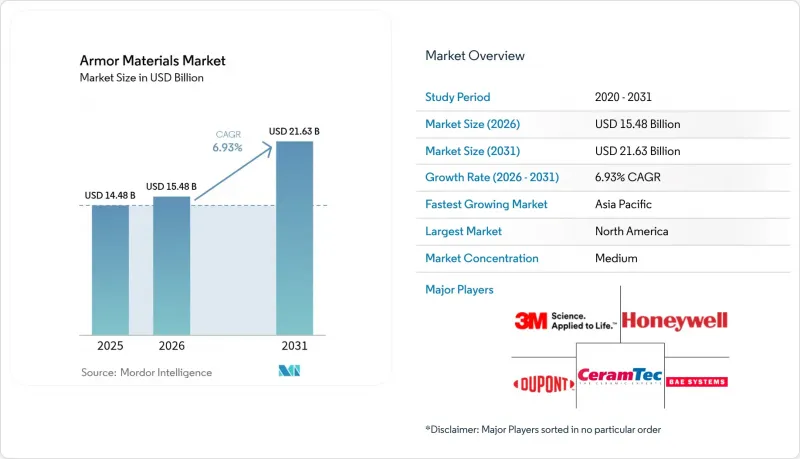
본 보고서에서는 산업을 제품 유형별(금속·합금, 세라믹·복합재료, 파라아라미드 섬유, 기타),용도별(방탄복, 차량 장갑, 기타), 최종 사용자별(국방, 국토안보·법 집행 기관, 민간·상업), 지역별(아시아태평양, 북미, 유럽, 남미, 중동 및 아프리카)로 분류하고 있습니다. 시장 예측은 금액(달러) 기준으로 제시되어 있습니다.
세계의 장갑 재료 시장 동향 및 인사이트
방탄복 및 첨단 무기 개발
Angel Armor의 2024년형 ‘Truth SNAP’ 플레이트 시스템은 자기 결합을 통해 모듈성을 실현하는 동시에, 불과 0.65파운드에 불과한 초경량 플레이트가 사용자의 기동성을 유지함을 입증했습니다. UHMWPE·탄소섬유 강화 플라스틱(CFRP) 등의 하이브리드 적층재는 기존 적층재에 비해 뒷면 변형을 28% 감소시켰으며, 다중 소재 적층 구조가 경량화되었음에도 레벨 IV의 방호 성능에 필적함을 입증했습니다. 실지 검사를 통해 세라믹·UHMWPE 하이브리드 소재가 여러 차례의 피탄에 견디는 것이 확인된 한편, 알루미늄·티타늄·카바이드 금속 매트릭스 복합 소재는 압연 균질 장갑에 비해 탄도 한계 속도를 30% 향상시키는 것으로 밝혀졌습니다. 이러한 혁신을 통해 장갑 소재 시장의 성능 상한선이 높아졌으며, 생존성을 저해하지 않으면서 더 경량화된 구성으로의 조달이 진행되고 있습니다.
국내 치안에 대한 우려 고조
연방 및 주 자금은 지방 기관에 직접 배분되고 있습니다. FBI의 ‘레거시 방탄복 프로그램’을 통해 이미 70만 달러 상당의 방탄판과 방탄조끼가, 이전에는 경찰관의 41%에게 방탄 장비 착용 의무가 없었던 소규모 경찰서에 제공되었습니다. 미국 국토안보부는 2025 회계연도에 1,074억 달러의 예산을 요청했으며, 여기에는 방호 장비 업그레이드에 10억 800만 달러를 배정하는 보조금이 포함되어 있습니다. 유럽 및 아시아 일부 지역의 유사한 정책은 구매 주기를 가속화하여 장갑 재료 시장의 성장세를 지속시키고 있습니다.
티타늄·붕소 카바이드 원자재 가격 변동에 따른 생산 비용 상승
2025년 미국 지질조사국(USGS)의 개요 보고서에 따르면, 티타늄 스폰지를 포함한 전략 금속의 현물 가격은 극소수의 생산자에 공급이 집중되어 있어 빈번하게 변동하고 있습니다. 한편, GAO(정부감사원)의 데이터에 따르면, 국방부는 99건의 자재 부족을 기록했으며, 이는 2019년 대비 167% 급증한 수치입니다. 특히 붕소 탄화물의 경우, 반복적으로 ‘단일 공급원’으로 지적되고 있습니다. 공급업체가 추가 요금을 부과하는 가운데, 장갑 제조업체들은 원가 가산 계약에 대응하는 데 어려움을 겪고 있으며, 계약 조건이 신속하게 조정되는 경우는 드물기 때문에 장갑 재료 시장 전체의 이익률이 압박받고 있습니다.
부문별 분석
2025년에도 금속과 합금이 매출의 51.30%를 차지했으나, 세라믹 및 복합재료 부문이 연평균 성장률(CAGR) 7.05%로 방호 재료 시장 전체를 견인하고 있습니다. 현재 실리콘 카바이드 타일은 밀도가 3.2g/cm3 이하이면서도 동등한 탄도 저항성을 실현하여, 전투원의 몸통용 장비 키트 1세트당 무게를 수 Kg 줄이고 있습니다. 계단식 하프 랩 접합 설계에 관한 연구 결과에 따르면, 최적화된 세라믹 형태라면 더 얇은 두께로도 미군의 규격을 완벽하게 충족한다는 것이 확인되었습니다. 그 결과, 조달 기관은 사양을 경량 플레이트에 맞게 재조정하고 있으며, 이러한 동향이 장갑 재료 시장공급업체 구성을 재편하고 있습니다.
구조용 세라믹은 UHMWPE 지지재와 호환성이 뛰어나며, 여러 차례의 피격에 대한 내성을 35% 향상시켰습니다. 또한, Elium 열가소성 수지를 사용한 케블라·UHMWPE 적층재에 대한 병행 조사에서는 에너지 흡수량이 25% 향상되고 무게가 22.44% 감소한 것으로 확인되었으며, 이를 통해 법 집행 기관은 피로 부담을 늘리지 않고도 순찰 시간을 연장할 수 있게 되었습니다. 파라아라미드 섬유의 채택은 꾸준히 증가하고 있지만, UHMWPE-textiles는 뛰어난 인장 강도와 개선된 열 노화 특성 덕분에 현재 가장 빠르게 보급되고 있습니다. 이러한 동향들이 맞물려 투자가 기존 강재에서 하이브리드 적층재로 이동하고 있으며, 이는 장갑 재료 시장이 첨단 복합 소재로 전환되는 추세를 확고히 하고 있습니다.
지역별 분석
북미는 미국의 국방 예산과 활발한 연구 개발에 힘입어 2025년 매출의 37.40%를 차지했습니다. 공군 연구소(AFRL)에서 진행 중인 프로그램을 통해 고엔트로피 합금 및 나노 엔지니어링 세라믹 분야의 획기적인 기술이 직접 생산에 반영되어, 기술 상용화까지의 기간이 단축되고 있습니다. 연방 정부의 ‘바이 아메리칸(Buy American)’ 법은 지역 공급업체를 더욱 보호하여 장갑 재료 시장의 안정화에 기여하고 있습니다.
아시아태평양은 연평균 성장률(CAGR) 7.20%로 가장 빠르게 성장하고 있는 지역입니다. 중국은 국산 실리콘 카바이드 소결 기술에 막대한 자원을 투입하고 있는 반면, 인도의 국방연구개발기구(DRDO)는 고온 기후에 최적화된 섬유 강화 폴리머 복합재료 개발을 추진하고 있습니다. 한국과 호주의 병행된 해군 조달로 인해 내식성 장갑강 및 복합재 선미 인서트에 대한 수요가 증가하면서, 해당 지역의 고객 기반이 확대되고 있습니다.
유럽은 전략 광물 확보에 고심하고 있습니다. EU의 ‘중요 원료법’은 2030년까지 국내 가공률 40%, 재활용률 15%를 목표로 하고 있으며, 이에 따라 붕소 카바이드 회수 및 티타늄 스크랩 고도화를 위한 새로운 투자가 촉진되고 있습니다. ‘영구적 구조적 협력(PESCO)’ 체제를 통한 국경 간 협력으로 차세대 헬멧 프로그램이 가속화되고 있으며, 예산이 부족한 상황임에도 불구하고 장갑 소재 시장은 혁신성을 유지하고 있습니다.
중동 및 아프리카에서는 한 자릿수 중반대의 성장을 기록하고 있습니다. 조달은 즉석 폭발 장치(IED) 대책용 차량 키트와 에너지 시설용 주변 방호 시설에 중점을 두고 있습니다. 또한 아랍에미리트(UAE) 등 일부 국가들은 계획 중인 근우주 관광을 위한 미세 운석 방어 연구에도 자금을 지원하고 있어, 장갑 소재 시장을 신흥 항공우주 부문으로 확대되고 있습니다.
기타 혜택
- 엑셀 형식 시장 예측(ME) 시트
- 3개월간의 애널리스트 지원
자주 묻는 질문
목차
제1장 서론
제2장 조사 방법
제3장 주요 요약
제4장 시장 구도
제5장 시장 규모 및 성장 예측
제6장 경쟁 구도
제7장 시장 기회 및 향후 전망
KTH 26.09.04According to Mordor Intelligence, the armor materials market size is expected to grow from USD 14.48 billion in 2025 to USD 15.48 billion in 2026 and is forecast to reach USD 21.63 billion by 2031 at 6.93% CAGR over 2026-2031.
This report Segments the Industry by Product Type (Metal and Alloy, Ceramic and Composite, Para-Aramid Fiber, and More), Application (Body Armor, Vehicle Armor, and More), End User (Defense, Homeland Security and Law-Enforcement, and Civil and Commercial), and Geography (Asia-Pacific, North America, Europe, South America, Middle East and Africa). The Market Forecasts are Provided in Terms of Value (USD).
Global Armor Materials Market Trends and Insights
Development of body armor & advanced weapons
Angel Armor's 2024 Truth SNAP plate system demonstrated how magnetic couplings deliver modularity while plates as light as 0.65 lb keep operators agile. Hybrid lay-ups such as UHMWPE/carbon-fiber reinforced plastic (CFRP) now achieve 28% lower back-face deformation than legacy laminates, proving that multi-material stacks can equal Level IV protection at lower mass. Field trials confirm that ceramic-UHMWPE hybrids survive multiple hits, while aluminum-titanium-carbide metal-matrix composites boost ballistic-limit velocity by 30% versus rolled homogeneous armor. These innovations increase the performance ceiling of the armor materials market and push procurement toward lighter configurations without sacrificing survivability.
Increasing homeland-security concerns
Federal and state funding flows directly to local agencies. The FBI Legacy Body Armor Program has already transferred nearly USD 700,000 in plates and vests to small departments where 41% of officers previously had no mandatory-wear policy. The U.S. Department of Homeland Security is requesting USD 107.4 billion for FY 2025, including grants that earmark USD 1.008 billion for protective equipment upgrades. Similar schemes in Europe and parts of Asia accelerate purchase cycles and sustain volume growth for the armor materials market.
Volatile titanium & boron-carbide feedstock prices
The 2025 U.S. Geological Survey summaries note frequent spot-price swings for strategic metals, including titanium sponge, caused by concentrated supply in a handful of producers. Meanwhile, GAO data show that the Department of Defense recorded 99 material shortfalls, a 167% jump versus 2019, with boron-carbide repeatedly flagged as "single-source". As suppliers impose surcharges, armor makers wrestle with cost-plus contracts that seldom adjust quickly, eroding margins across the armor materials market.
Other drivers and restraints analyzed in the detailed report include:
- Rising incidence of asymmetric warfare & IED threats
- Accelerated Modernization of Naval Fleets
- Stringent export-control regulations
For complete list of drivers and restraints, kindly check the Table Of Contents.
Segment Analysis
Metals and alloys retained 51.30% of sales in 2025, yet ceramic & composite lines are pacing the overall armor materials market at a 7.05% CAGR. Silicon-carbide tiles now deliver like-for-like ballistic resistance at densities below 3.2 g/cm3, trimming war-fighter loadouts by several kilograms per torso kit. Study results on staggered half-lap joint designs confirm that optimized ceramic shapes yield full compliance with U.S. military protocols at lower thickness. Consequently, procurement agencies recalibrate specifications toward lighter plates, a trend that reshapes supplier mix within the armor materials market.
Structural ceramics partner well with UHMWPE backings, producing multi-hit capability gains of 35%. Parallel research into Kevlar/UHMWPE laminates using Elium thermoplastic resin recorded 25% higher energy absorption and a 22.44% weight reduction, helping law-enforcement agencies extend patrol duration without fatigue penalties. Growth in para-aramid fiber adoption remains steady, but UHMWPE fibers now post the fastest uptake due to superior tensile strength and improved thermal aging properties. Together, these dynamics shift investment from traditional steel to hybrid stacks, cementing the armor materials market's pivot toward advanced composites.
Complete Report Scope:
- By Product Type
- Metal and Alloy
- Ceramic and Composite
- Para-aramid Fiber
- Ultra-high-molecular-weight Polyethylene (UHMWPE)
- Other Product Types (e.g., fiberglass, carbon, nano-enhanced)
- By Application
- Body Armor
- Vehicle Armor
- Aerospace
- Marine Armor
- Civil Armor
- By End User
- Defense
- Homeland Security and Law-Enforcement
- Civil and Commercial
- By Geography
- Asia-Pacific
- China
- India
- Japan
- South Korea
- Rest of Asia-Pacific
- North America
- United States
- Canada
- Mexico
- Europe
- Germany
- United Kingdom
- France
- Italy
- Spain
- Rest of Europe
- South America
- Brazil
- Argentina
- Rest of South America
- Middle East and Africa
- Saudi Arabia
- South Africa
- Rest of Middle East and Africa
- Asia-Pacific
Geography Analysis
North America captured 37.40% of 2025 revenue, anchored by the U.S. defense budget and vigorous R&D. Ongoing Air Force Research Laboratory programs funnel breakthroughs in high-entropy alloys and nano-engineered ceramics straight into production, shortening technology-transition timelines. Federal Buy-American statutes further insulate regional suppliers and stabilize the armor materials market.
Asia-Pacific is the fastest-growing cluster at a 7.20% CAGR. China funnels substantial resources into indigenous silicon-carbide sintering, while India's DRDO advances fiber-reinforced polymer composites tailored for hot climates. Parallel naval procurement in South Korea and Australia boosts demand for corrosion-resistant armor steels and composite bow inserts, broadening the regional customer base.
Europe grapples with strategic-mineral access. The EU Critical Raw Materials Act targets 40% domestic processing and 15% recycling rates by 2030, prompting fresh investment in boron-carbide recovery and titanium-scrap upgrading. Cross-border collaboration under the Permanent Structured Cooperation (PESCO) framework accelerates next-generation helmet programs, keeping the armor materials market innovative despite tight budgets.
The Middle East and Africa record mid-single-digit growth. Procurement centers on counter-IED vehicle kits and perimeter fortifications for energy installations. Nations such as the UAE also fund micrometeoroid shielding research for planned near-space tourism, extending the armor materials market into emergent aerospace domains.
- 3M
- Arconic
- ArmorSource, LLC
- ATI Inc.
- BAE Systems
- CeramTec GmbH
- CoorsTek Inc.
- CPS Technologies
- dsm-firmenich
- DuPont
- Honeywell International Inc.
- HS HYOSUNG ADVANCED MATERIALS
- JPS Composite Materials
- Koninklijke Ten Cate BV
- Morgan Advanced Materials
- NP Aerospace
- Plasan
- PPG Industries, Inc.
- Rochling SE & Co. KG
- SafeGuard Armor
- Saint-Gobain
- Schunk Carbon Technology
- Tata Steel
- Teijin Aramid
Additional Benefits:
- The market estimate (ME) sheet in Excel format
- 3 months of analyst support
TABLE OF CONTENTS
1 Introduction
- 1.1 Study Assumptions and Market Definition
- 1.2 Scope of the Study
2 Research Methodology
3 Executive Summary
4 Market Landscape
- 4.1 Market Overview
- 4.2 Market Drivers
- 4.2.1 Development of body armor and advanced weapons
- 4.2.2 Increasing homeland security concerns
- 4.2.3 Rising incidence of asymmetric warfare and IED threats elevating demand for blast-resistant vehicle armor
- 4.2.4 Expansion of commercial spaceflight and near-space tourism requiring micrometeoroid-shielding materials
- 4.2.5 Accelerated modernization of naval fleets driving need for corrosion-resistant armor steels
- 4.3 Market Restraints
- 4.3.1 Volatile titanium and boron-carbide feedstock prices inflating production costs
- 4.3.2 Stringent export-control regulations limiting cross-border technology transfer
- 4.3.3 Recycling and end-of-life challenges for composite armor materials
- 4.4 Value Chain Analysis
- 4.5 Porter's Five Forces
- 4.5.1 Bargaining Power of Suppliers
- 4.5.2 Bargaining Power of Buyers
- 4.5.3 Threat of New Entrants
- 4.5.4 Threat of Substitute Products and Services
- 4.5.5 Degree of Competition
5 Market Size and Growth Forecasts (Value)
- 5.1 By Product Type
- 5.1.1 Metal and Alloy
- 5.1.2 Ceramic and Composite
- 5.1.3 Para-aramid Fiber
- 5.1.4 Ultra-high-molecular-weight Polyethylene (UHMWPE)
- 5.1.5 Other Product Types (e.g., fiberglass, carbon, nano-enhanced)
- 5.2 By Application
- 5.2.1 Body Armor
- 5.2.2 Vehicle Armor
- 5.2.3 Aerospace
- 5.2.4 Marine Armor
- 5.2.5 Civil Armor
- 5.3 By End User
- 5.3.1 Defense
- 5.3.2 Homeland Security and Law-Enforcement
- 5.3.3 Civil and Commercial
- 5.4 By Geography
- 5.4.1 Asia-Pacific
- 5.4.1.1 China
- 5.4.1.2 India
- 5.4.1.3 Japan
- 5.4.1.4 South Korea
- 5.4.1.5 Rest of Asia-Pacific
- 5.4.2 North America
- 5.4.2.1 United States
- 5.4.2.2 Canada
- 5.4.2.3 Mexico
- 5.4.3 Europe
- 5.4.3.1 Germany
- 5.4.3.2 United Kingdom
- 5.4.3.3 France
- 5.4.3.4 Italy
- 5.4.3.5 Spain
- 5.4.3.6 Rest of Europe
- 5.4.4 South America
- 5.4.4.1 Brazil
- 5.4.4.2 Argentina
- 5.4.4.3 Rest of South America
- 5.4.5 Middle East and Africa
- 5.4.5.1 Saudi Arabia
- 5.4.5.2 South Africa
- 5.4.5.3 Rest of Middle East and Africa
- 5.4.1 Asia-Pacific
6 Competitive Landscape
- 6.1 Market Concentration
- 6.2 Strategic Moves (Mergers and Acquisitions, JV, Agreements)
- 6.3 Market Share Analysis
- 6.4 Company Profiles (includes Global-level Overview, Market-level Overview, Core Segments, Financials, Strategic Info, Market Rank/Share, Products and Services, Recent Developments)
- 6.4.1 3M
- 6.4.2 Arconic
- 6.4.3 ArmorSource, LLC
- 6.4.4 ATI Inc.
- 6.4.5 BAE Systems
- 6.4.6 CeramTec GmbH
- 6.4.7 CoorsTek Inc.
- 6.4.8 CPS Technologies
- 6.4.9 dsm-firmenich
- 6.4.10 DuPont
- 6.4.11 Honeywell International Inc.
- 6.4.12 HS HYOSUNG ADVANCED MATERIALS
- 6.4.13 JPS Composite Materials
- 6.4.14 Koninklijke Ten Cate BV
- 6.4.15 Morgan Advanced Materials
- 6.4.16 NP Aerospace
- 6.4.17 Plasan
- 6.4.18 PPG Industries, Inc.
- 6.4.19 Rochling SE & Co. KG
- 6.4.20 SafeGuard Armor
- 6.4.21 Saint-Gobain
- 6.4.22 Schunk Carbon Technology
- 6.4.23 Tata Steel
- 6.4.24 Teijin Aramid
7 Market Opportunities and Future Outlook
- 7.1 White-space and Unmet-Need Assessment
- 7.2 Increasing Defense Budgets


