

|
시장보고서
상품코드
2120570
북미의 카본블랙 : 시장 점유율 분석, 업계 동향 및 통계, 성장 예측(2026-2031년)North America Carbon Black - Market Share Analysis, Industry Trends & Statistics, Growth Forecasts (2026 - 2031) |
||||||
 Mordor Intelligence
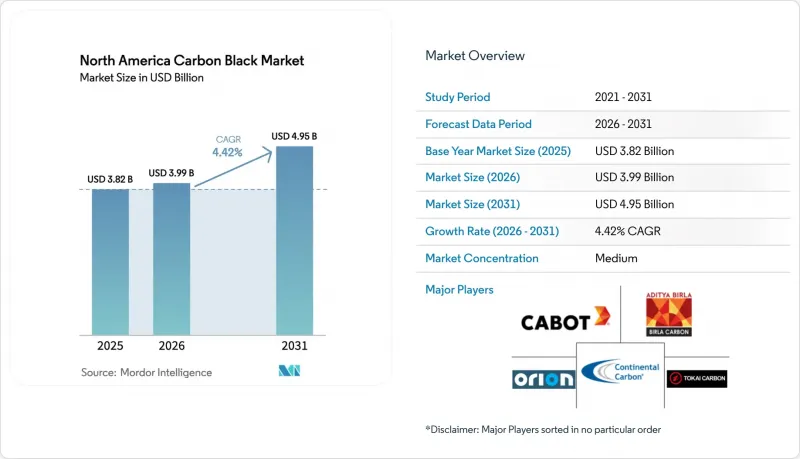
Mordor Intelligence에 의하면, 북미의 카본블랙 시장 규모는 2025년 38억 2,000만 달러로 평가되었습니다. 2026년 39억 9,000만 달러에서 2031년까지 49억 5,000만 달러로 확대되고 2026년부터 2031년까지 연평균 복합 성장률(CAGR)은 4.42%를 나타낼 전망입니다.
본 보고서는 제조 공정별(퍼니스 블랙, 가스 블랙 등), 등급별(표준 등급, 특수 등급 등), 용도별(타이어·공업용 고무, 플라스틱 등), 최종 사용자 산업별(자동차 및 운송, 포장, 건축 및 건설 등), 지역별(미국, 캐나다, 멕시코)로 분류되어 있습니다. 시장 전망은 금액(달러) 기준으로 제시되어 있습니다.
북미의 카본블랙 시장 동향 및 인사이트
고 SA(표면 활성도) 퍼니스 블랙이 필요한 와이드 베이스 전기차용 타이어 수요 급증
전기차용 타이어는 더 무거운 차량 중량, 순간적인 토크 및 낮은 구름 저항 요건을 충족해야 합니다. 그 결과, 컴파운더들은 인열 강도 향상과 히스테리시스 감소로 이어지는 비표면적이 100 m2/g를 초과하는 N100 및 N200 시리즈 퍼니스 블랙을 지정하고 있습니다. 테슬라, 리비안, 디트로이트 3사 및 신규 진출기업들의 미국 내 전기차 생산 대수는 2027년까지 연간 300만 대를 넘어설 전망이며, 이는 이러한 고성능 등급에 대한 수요를 더욱 끌어올릴 것입니다. 2025년 캐보트(Cabot)사가 ‘PROPEL E8’을 출시한 것은 이러한 제품에 대한 시장 수요를 뒷받침하는 것이었습니다. 또한, ZC 러버(ZC Rubber)사의 멕시코 살티요 공장은 2025년 하반기 생산 확대 이후, 해당 지역에 와이드베이스 타이어 및 전기차용 순정 타이어를 대량으로 공급하게 될 것입니다. 캐나다의 ‘청정 연료 규제’ 역시 저탄소 집약형 운송 시나리오가 전동화를 가속화함에 따라 추가적인 호재로 작용하고 있습니다. 이러한 동향들이 맞물려 북미의 카본블랙 시장의 기본 성장 궤도가 상향 조정되는 동시에 평균 판매 가격도 상승할 전망입니다.
저비용 데칸터 오일공급이 생산자의 이익률을 끌어올리고 있습니다.
멕시코만 연안의 유동층 분해 설비에서 얻어지는 데칸팅 오일은 퍼니스 블랙 반응 설비에 필요한 방향족 함량, 낮은 회분, 그리고 높은 BMCI 지수를 갖추고 있습니다. 텍사스주 및 루이지애나주의 주요 정유시설의 가동률은 2024년부터 2025년에 걸쳐 높은 수준을 유지했으며, 허리케인으로 인한 가동 중단이 있었음에도 불구하고 원료 가격은 10년 평균보다 훨씬 낮은 수준을 유지했습니다. 도카이 카본의 빅 스프링, 보거, 아디스 각 공장군은 이러한 비용 측면의 이점을 직접 누리고 있으며, 타이어 OEM 각사가 더욱 엄격한 이전가격 산정식을 협상하고 있는 상황에서도 지역 평균을 상회하는 이익률을 유지하고 있습니다. 반면, 캐나다와 멕시코에서는 생산자들이 디칸팅 오일을 수입하거나 규모가 작고 최적화되지 않은 국내 정유시설에 의존하고 있기 때문에 이러한 비용 측면의 우위는 그리 두드러지지 않습니다. 단기적으로는 이러한 호조인 원료 환경이 설비 가동률 결정을 뒷받침하며, 북미의 카본블랙 시장의 당분간 건전성을 지탱하고 있습니다.
멕시코만 연안 지역의 가동 중단에 따른 원료 가격 변동
허리케인, 계획된 턴어라운드, 그리고 원유 처리 구성의 변경으로 인해 FCCU의 생산량이 주기적으로 억제되어, 몇 주 만에 데칸트 오일의 현물 가격이 30-50% 상승할 수 있습니다. 도카이 카본의 2025년 전망에 따르면, 영업이익이 전년 대비 6.1% 감소하는 주요 이유 중 하나로 원료 가격 급등이 꼽히고 있습니다. 오리온 엔지니어드 카본즈(Orion Engineered Carbons)는 장기 고정 가격 계약이 없기 때문에 원유 가격이 급등할 경우 가격 전가 시차가 발생하여 이익률이 압박을 받게 됩니다. 2027년 이후에는 새로운 정유시설 프로젝트나 원유에서 화학제품으로의 전환에 따라 가격 변동이 완화될 가능성이 있지만, 북미의 카본블랙 시장에 있어 단기적인 위험은 여전히 심각합니다.
부문 분석
2025년 북미의 카본블랙 시장에서 용광로법(퍼니스 블랙) 부문 시장 규모는 전체의 85.12%를 차지했습니다. 2031년까지의 연평균 성장률(CAGR)은 4.73%로 전망되며, 이는 타이어, 호스, 벨트,잉크, 플라스틱용으로 N100-N900 등급을 생산할 수 있는 이 공정의 유연성에 힘입은 것입니다. Orion Engineered Carbons사는 텍사스주 라포트에 위치한 전기차용 타이어 컴파운드를 대상으로 하는 2억 1,590만 달러 규모의 고비표면적 생산 라인을 활용하고 있습니다. 가스용, 램프용 및 열용 카본블랙은 전도성 코팅, 미술용 안료, 초고순도 반도체 패키징 분야에서 틈새 역할을 수행하며 그 중요성을 유지하고 있습니다.
모노리스 머티리얼즈(Monolith Materials)는 획기적인 보완 기술을 제공합니다. 이 회사의 메탄 열분해 공정을 통해 연간 1만 4,000톤의 화석 연료 비유래 카본블랙을 생산하고, 수소를 부산물로 생성함으로써 스코프 1 배출량을 제로로 만들고 있습니다. 굿이어(Goodyear)는 2025년에 이 소재를 사용한 타이어를 상용화했습니다. 현재 북미의 카본블랙 시장에서는 비용과 규모에 최적화된 기존의 용광로식 반응 장치와, ESG 성과에 최적화된 저탄소 열분해 장치라는 두 가지 경로가 공존하고 있습니다. 향후 2027년까지 모노리스(Monolith)사의 ‘올리브 크릭 2(Olive Creek 2)’ 확장 프로젝트가 5만 6,000톤으로 순조롭게 규모를 확대한다면, 탄소 강도에 대한 경쟁사 벤치마킹이 재검토되어 기존 기업의 투자 우선순위에 영향을 미칠 가능성이 있습니다.
2025년 시점에서 북미의 카본블랙 시장의 판매량 중 77.78%를 표준 등급이 차지했으나, 특수 등급, 전도성 등급 및 ESD 등급은 2031년까지 연평균 성장률(CAGR) 5.26%를 기록하며 더 큰 성장 격차를 보일 전망입니다. Cabot사의 ‘VULCAN XC’ 및 Orion사의 ‘PRINTEX’ 브랜드는 전도성 이용 사례를 주도하고 있으며, 리튬 이온 배터리 양극재 및 반도체 트레이용으로 체적 저항률 1옴·cm 미만을 실현하고 있습니다. 수요를 견인하는 요인으로는 전기차(EV)용 배터리 셀의 급속한 확대와 ESD 대책이 적용된 인프라가 필요한 하이퍼스케일 데이터센터의 건설을 들 수 있습니다.
표준 제품은 여전히 타이어 분야의 주력 제품이지만, 신형 차량 플랫폼과 자율주행용 센서 어레이의 등장으로 인해 OEM 각사는 주류 컴파운드에서도 분산성이 더 높고 PAH 함량이 적은 카본을 지정하고 있습니다. ‘BLACK PEARLS 4350’과 같은 식품 접촉용 특수 제품은 미국 FDA가 정한 벤조(a)피렌의 한계치인 5 ppb를 충족합니다. 국경을 초월한 전자상거래의 확대에 따라 각 컨버터 업체들은 더욱 엄격한 기준 준수를 요구받고 있으며, 특수 제품 시장 침투율은 서서히 상승하고 있어 북미의 카본블랙 시장의 수익 구성을 끌어올리고 있습니다.
기타 혜택 :
- 엑셀 형식 시장 예측(ME) 시트
- 3개월간의 애널리스트 지원
자주 묻는 질문
목차
제1장 서론
제2장 조사 방법
제3장 주요 요약
제4장 시장 구도
제5장 시장 규모 및 성장 예측
제6장 경쟁 구도
제7장 시장 기회 및 향후 전망
KTH 26.09.10According to Mordor Intelligence, the North America carbon black market size is projected to expand from USD 3.82 billion in 2025 and USD 3.99 billion in 2026 to USD 4.95 billion by 2031, registering a CAGR of 4.42% between 2026 to 2031.
This report is Segmented by Process Type (Furnace Black, Gas Black, and More), Grade (Standard Grade, Specialty, and More), Application (Tires and Industrial Rubber, Plastics, and More), End-User Industry (Automotive and Transportation, Packaging, Building and Construction, and More), and Geography (United States, Canada, Mexico). The Market Forecasts are Provided in Terms of Value (USD).
North America Carbon Black Market Trends and Insights
Surging Demand for Wide-Base EV Tires Needing High-SA Furnace Blacks
Electric-vehicle tires must accommodate heavier curb weight, instant torque, and low rolling-resistance requirements. As a result, compounders specify N100 and N200 series furnace blacks with surface areas above 100 m2/g, which improve tear strength and lower hysteresis. U.S. EV output from Tesla, Rivian, the Detroit Three, and new entrants is set to exceed 3 million units annually by 2027, ratcheting up demand for these high-performance grades. Cabot's PROPEL E8 launch in 2025 validated the commercial pull for such products, and ZC Rubber's Saltillo plant in Mexico will channel large volumes of wide-base and OE EV tires into the region after ramp-up in late 2025. Canada's Clean Fuel Regulations also add momentum because lower carbon-intensity transportation scenarios accelerate electrification. In aggregate, these dynamics raise the baseline growth path for the North America carbon black market while lifting average selling prices.
Low-Cost Decant Oil Availability Elevating Producer Margins
Decant oil from Gulf Coast fluid-catalytic-cracking units delivers the aromatic content, low ash, and high BMCI index required for furnace-black reactors. Utilization across major Texas and Louisiana refineries remained high through 2024-2025, keeping feedstock prices well below the 10-year average despite hurricane-related outages. Tokai Carbon's cluster of Big Spring, Borger, and Addis plants directly benefits from this cost angle, supporting above-regional average margins even as tire OEMs negotiate tougher transfer-price formulas. The cost edge is less pronounced in Canada and Mexico, where producers either import decant oil or rely on smaller, less optimized domestic refineries. Over the short term, the favorable feedstock environment buttresses capacity utilization decisions and underpins the near-term health of the North America carbon black market.
Feedstock Price Volatility on Gulf-Coast Shutdowns
Hurricanes, planned turnarounds, and crude-slate shifts periodically curtail FCCU output, pushing decant-oil spot prices 30-50% higher within weeks. Tokai Carbon's 2025 outlook cited feedstock inflation among the chief reasons operating profit could fall 6.1% year-over-year. Orion Engineered Carbons has no long-term fixed-price contracts, so lagged pass-through mechanisms dent margins when oil spikes. Although new refinery projects and crude-to-chemicals configurations might temper volatility beyond 2027, near-term risk remains material for the North America carbon black market.
Other drivers and restraints analyzed in the detailed report include:
- Canadian Tire-Label Regulations Boosting Specialty Grades
- Recovered Carbon Black Uptake Under OEM ESG Mandates
- Silica-Silane Substitution in Passenger Treads
For complete list of drivers and restraints, kindly check the Table Of Contents.
Segment Analysis
The North America carbon black market size for the furnace-black segment accounted for 85.12% of the total volume in 2025. Growth to 2031 is set at a 4.73% CAGR, buoyed by the process's flexibility in generating N100-N900 grades for tires, hoses, belts, inks, and plastics. Orion Engineered Carbons is capitalizing on a USD 215.9 million high-surface-area line at La Porte, Texas, that targets EV tire compounds. The niche roles of gas, lamp, and thermal blacks in conductive coatings, artist pigments, and ultraclean semiconductor packaging keep them relevant.
Monolith Materials offers a disruptive complement: its methane-pyrolysis route yields 14,000 t per annum of fossil-free carbon black and coproduces hydrogen, eliminating Scope 1 emissions. Goodyear commercialized tires using this material in 2025. The North America carbon black market now features a dual pathway-traditional furnace reactors optimized for cost and scale, and low-carbon pyrolysis units optimized for ESG performance. Over time, the successful scale-up of Monolith's Olive Creek 2 expansion to 56,000 t by 2027 could recalibrate competitive benchmarks on carbon intensity and influence investment priorities among incumbents.
Standard grades represented 77.78% of North America's carbon black market volume in 2025, but specialty, conductive, and ESD grades will capture a larger growth delta by logging a 5.26% CAGR to 2031. Cabot's VULCAN XC and Orion's PRINTEX brands dominate conductive use cases, reaching bulk resistivity below 1 ohm-cm for lithium-ion cathodes and semiconductor trays. Demand tailwinds include rapid EV battery cell expansion and hyperscale data-center build-outs requiring ESD-safe infrastructure.
Standard products remain the tire workhorses, yet new vehicle platforms and autonomous-driving sensor arrays are pushing OEMs to specify higher-dispersion and lower-PAH blacks even in mainstream compounds. Specialty food-contact variants such as BLACK PEARLS 4350 satisfy benzo[a]pyrene limits of 5 ppb set by the U.S. FDA. As cross-border e-commerce pushes converters to harmonize with the stricter standard, specialty penetration inches upward, lifting the revenue mix of the North America carbon black market.
Complete Report Scope:
- By Process Type
- Furnace Black
- Gas Black
- Lamp Black
- Thermal Black
- By Grade
- Standard Grade Carbon Black
- Specialty Carbon Black
- Conductive and ESD Carbon Black
- By Application
- Tires and Industrial Rubber Products
- Plastics
- Toners and Printing Inks
- Coatings
- Textile Fibers
- Other Applications
- By End-User Industry
- Automotive and Transportation
- Packaging
- Building and Construction
- Electrical and Electronics
- Textile and Apparel
- Others
- By Geography
- United States
- Canada
- Mexico
List of Companies Covered in this Report:
- Cabot Corporation
- Birla Carbon
- Orion Engineered Carbons S.A.
- Continental Carbon Company
- Tokai Carbon Co., Ltd. (including Cancarb)
- Mitsubishi Chemical Corporation
- OMSK Carbon Group
- PCBL Limited
- Imerys
- Monolith Inc.
- Pyrolyx AG
- Koppers Inc.
- Sid Richardson Carbon & Energy Co.
- International China Rubber Investment Holding Co., Ltd.
Additional Benefits:
- The market estimate (ME) sheet in Excel format
- 3 months of analyst support
TABLE OF CONTENTS
1 Introduction
- 1.1 Study Assumptions and Market Definition
- 1.2 Scope of the Study
2 Research Methodology
3 Executive Summary
4 Market Landscape
- 4.1 Market Overview
- 4.2 Market Drivers
- 4.2.1 Surging Demand for Wide-Base EV Tires Needing High-SA Furnace Blacks
- 4.2.2 Low-Cost Decant Oil Availability Elevating Producer Margins
- 4.2.3 Canadian Tire-Label Regulations Boosting Specialty Grades
- 4.2.4 Recovered Carbon Black Uptake under OEM ESG Mandates
- 4.2.5 On-Site Modular Carbon Black Units for Tire Makers
- 4.3 Market Restraints
- 4.3.1 Feedstock Price Volatility on Gulf-Coast Shutdowns
- 4.3.2 Silica-Silane Substitution in Passenger Treads
- 4.3.3 Competition from Tire-Pyrolysis Derived Fillers
- 4.4 Value Chain Analysis
- 4.5 Porter's Five Forces
- 4.5.1 Bargaining Power of Suppliers
- 4.5.2 Bargaining Power of Buyers
- 4.5.3 Threat of New Entrants
- 4.5.4 Threat of Substitutes
5 Market Size and Growth Forecasts (Value)
- 5.1 By Process Type
- 5.1.1 Furnace Black
- 5.1.2 Gas Black
- 5.1.3 Lamp Black
- 5.1.4 Thermal Black
- 5.2 By Grade
- 5.2.1 Standard Grade Carbon Black
- 5.2.2 Specialty Carbon Black
- 5.2.3 Conductive and ESD Carbon Black
- 5.3 By Application
- 5.3.1 Tires and Industrial Rubber Products
- 5.3.2 Plastics
- 5.3.3 Toners and Printing Inks
- 5.3.4 Coatings
- 5.3.5 Textile Fibers
- 5.3.6 Other Applications
- 5.4 By End-User Industry
- 5.4.1 Automotive and Transportation
- 5.4.2 Packaging
- 5.4.3 Building and Construction
- 5.4.4 Electrical and Electronics
- 5.4.5 Textile and Apparel
- 5.4.6 Others
- 5.5 By Geography
- 5.5.1 United States
- 5.5.2 Canada
- 5.5.3 Mexico
6 Competitive Landscape
- 6.1 Market Concentration
- 6.2 Strategic Moves
- 6.3 Market Share/Ranking Analysis
- 6.4 Company Profiles (includes Global-level Overview, Market-level Overview, Core Segments, Financials as available, Strategic Information, Products and Services, Recent Developments)
- 6.4.1 Cabot Corporation
- 6.4.2 Birla Carbon
- 6.4.3 Orion Engineered Carbons S.A.
- 6.4.4 Continental Carbon Company
- 6.4.5 Tokai Carbon Co., Ltd. (including Cancarb)
- 6.4.6 Mitsubishi Chemical Corporation
- 6.4.7 OMSK Carbon Group
- 6.4.8 PCBL Limited
- 6.4.9 Imerys
- 6.4.10 Monolith Inc.
- 6.4.11 Pyrolyx AG
- 6.4.12 Koppers Inc.
- 6.4.13 Sid Richardson Carbon & Energy Co.
- 6.4.14 International China Rubber Investment Holding Co., Ltd.
7 Market Opportunities and Future Outlook
- 7.1 White-space and Unmet-Need Assessment
- 7.2 Growth in the Adoption of Electric Cars


