

|
시장보고서
상품코드
2120590
유방 영상 진단 : 시장 점유율 분석, 업계 동향 및 통계, 성장 예측(2026-2031년)Breast Imaging - Market Share Analysis, Industry Trends & Statistics, Growth Forecasts (2026 - 2031) |
||||||
 Mordor Intelligence
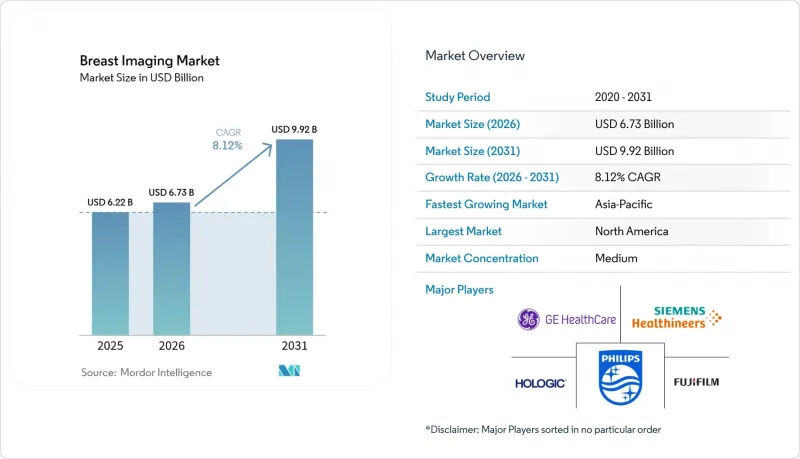
Mordor Intelligence에 의하면, 2026년 유방 영상 진단 시장 규모는 67억 3,000만 달러로 추정되고 2025년 62억 2,000만 달러에서 확대해, 2031년에는 99억 2,000만 달러에 이를 것으로 예측됩니다.
2026년부터 2031년까지 연평균 성장률(CAGR) 8.12%로 성장할 것으로 전망됩니다.
본 보고서는 영상 진단법(유방촬영술, 유방 초음파 검사, 유방 MRI, 영상 유도 유방 생검, 분자 유방 영상), 기술(이온화 방사선 기술, 비이온화 방사선 기술), 진료 단계(스크리닝, 진단, 중재·치료), 최종 사용자(병원, 영상진단센터 등) 및 지역별로 분류되어 있습니다. 시장 예측은 금액(달러) 기준으로 제시되어 있습니다.
세계의 유방 영상 진단 시장 동향 및 인사이트
유방암 유병률 증가
위험에 노출된 여성 인구의 확대가 첨단 영상 진단에 대한 수요를 뒷받침하고 있습니다. 미국암협회는 2024년에 미국에서 31만 720건의 신규 침윤성 유방암 사례와 4만 2,250명의 사망자가 발생했으며, 조기 발견의 중요성을 뒷받침하고 있습니다. 발병률은 동유럽에서 가장 빠르게 증가하고 있는 반면, 비만 증가와 초산 연령의 고령화로 인해 신흥 경제국에서 선별 검사 대상자층이 확대되고 있습니다. 인구 고령화로 인해 검사 수검자 수가 증가하고 있습니다. 이는 폐경 후 위험이 급격히 높아지기 때문이며, 이로 인해 계획 담당자들은 검진 수용 능력 확대와 더 높은 감도의 장비로 교체해야 하는 압박을 받고 있습니다. 정기적인 검진은 5년 생존율을 향상시키며, 보험사들도 이를 임의 지출이 아닌 비용 절감책으로 인식하는 경향이 강해지고 있습니다.
3D/DBT 유방촬영술의 급속한 보급
디지털 유방 토모신테시스(DBT)는 조직의 중첩으로 인한 아티팩트를 줄여, 위양성으로 인한 재검사율을 최대 15%까지 감소시킵니다. 개정된 EU 지침에서는 정기 검진 시 DBT 채택을 권장하고 있으며, 공공 의료 기관에서 2D 장비를 전면적으로 교체하는 움직임이 확대되고 있습니다. 미국에서는 메디케어 보상 삭감에도 불구하고 DBT가 환자들로부터 지지를 얻고 있으며, 의료 법적 위험을 경감하기 위해 의료 기관들은 여전히 업그레이드를 추진하고 있습니다. 트라이아지 알고리즘과 결합함으로써 DBT는 판독 시간을 단축하고 처리 능력을 향상시킵니다. 이를 통해 각 의료기관은 건당 보상액 감소를 일일 검사 건수 증가로 상쇄할 수 있게 됩니다.
DBT 시스템의 높은 초기 비용
모든 기능을 갖춘 스캐너의 정가는 40만-60만 달러로, 독립형 의료기관의 설비 투자 예산을 압박하고 있습니다. 2024년 11.72%, 2025년 9.67%에 이르는 연속적인 메디케어 보상 삭감은 투자 회수 계산에 어려움을 주었습니다. 벤더 측은 트레이드인 크레딧이나 사용량에 따른 금융 플랜으로 대응하고 있지만, 가격에 민감한 지역에서는 도입이 진전되지 않아 노후화된 2D 장비의 교체가 지연되고 있습니다.
부문 분석
유방촬영술은 2025년 매출의 38.12%를 차지하며, DBT가 모달리티 구성을 재편하는 가운데서도 유방 영상 진단 시장의 기반을 지탱했습니다. 3D로의 업그레이드 경로는 2031년까지 연평균 성장률(CAGR) 12.38%를 뒷받침하고 있으며, 이는 침윤성 암의 검출 성능이 우수함을 강조하는 유럽연합 집행위원회의 선별 검사 지침에 의해 뒷받침되고 있습니다. 유방 초음파 검사는 고밀도 조직이나 고위험군에서 방사선 피폭 없이 평가를 가능하게 하므로 주요 보조 검사로 자리 잡았습니다. 자기공명영상법(MRI)은 유전적 위험이 있는 집단에서 골드 스탠다드로서의 지위를 유지하고 있지만, 비용 및 조영제와 관련된 장벽에 직면해 있습니다.
영상 유도 생검의 워크플로는 진단용 영상과 원활하게 통합되어, 유방촬영술, 초음파 또는 MRI 유도 하의 조직 채취를 효율화하고 있습니다. 진공 보조 시스템은 진단 정확도와 환자의 편안함을 향상시키는 한편, 클립 삽입 기술의 발전은 외과적 위치를 정확히 파악하는 데 도움을 주고 있습니다. 분자 유방 영상(MBI)은 다른 검사법으로 확정적인 결과를 얻을 수 없는 경우 표적화된 해결책으로서 여전히 유용하지만, 방사선 피폭이 광범위한 활용을 제한하고 있습니다. 각 검사법에 AI를 결합함으로써 진단의 일관성이 향상되고 관찰자 간 편차가 감소하고 있으며, 알고리즘에 의한 지원이 일상 진료에 더욱 정착되고 있습니다.
이온화 방사선을 사용하는 플랫폼은 여전히 전 세계 매출의 61.74%를 차지하고 있으며, 각국의 검진 프로그램에서 그 보급이 널리 이루어지고 있음을 다시 한번 입증하고 있습니다. 그러나 보험사 및 환자의 인식이 방사선을 사용하지 않는 솔루션으로 전환됨에 따라, 비전리 방사선 모달리티는 2031년까지 연평균 성장률(CAGR) 10.29%를 나타낼 것으로 전망됩니다. 자동 유방 초음파 검사(ABUS)와 조영 초음파 검사는 휴대형 스캔을 넘어 확장되어 재현성과 민감도에 대한 우려를 해소하고 있습니다. 고자기장 MRI 시스템은 해부학적 세부 묘사도를 더욱 높이는 한편, 단축된 프로토콜을 통해 검사 시간과 비용을 절감합니다.
인공지능(AI)은 촬영 매개변수를 최적화하여 이온화 방사선 검사 시 피폭량을 줄이며, 하이브리드 워크스테이션은 두 기술 분야를 융합하여 의심스러운 유방촬영술 영상에 대한 2차 초음파 검사를 제안하고 있습니다. 초기 투자 비용은 여전히 MRI가 더 높지만, 방사선 관련 규제 준수 부담이 경감됨에 따라 수명 주기 비용이 절감됩니다. 예측 기간 동안 시장 경쟁은 이온화 방사선 피폭량을 최소화하거나 제로로 유지하면서 진단 능력을 제공할 수 있는지에 달려 있을 것으로 보입니다.
지역별 분석
북미는 2025년 매출의 35.98%를 차지했습니다. 유방 영상 진단 시장은 2024년 9월에 시행된 연방 정부의 고밀도 유방에 대한 통지 의무화의 혜택을 받고 있으며, 이로 인해 추가 초음파 검사 및 MRI 수요가 증가하고 있습니다. 알고리즘의 조기 승인 및 벤처 자금 지원이 광범위한 도입을 뒷받침하고 있어, AI 도입은 이곳에서 가장 빠르게 성숙하고 있습니다. 그러나 포화 상태에 이른 도입 기반에서 교체 수요가 주류를 이루고 있어 성장은 완만해지고 있습니다.
이어 유럽에서는 선별 검사의 보급률이 높으며, 현재 DBT를 권장하는 통일된 임상 지침이 마련되어 있습니다. ‘유럽 인공지능법’은 조화로운 승인 절차를 규정하고 있어 검증 기간은 길어지겠지만, 최종적으로는 단일 디지털 시장이 형성될 것입니다. 공중보건 기관이 갱신 주기의 비용을 공동 부담하고 있으며, 경쟁 입찰을 통해 수량에 따른 할인이 촉진됨에 따라 중규모 진료소로의 접근성도 확대되고 있습니다.
아시아태평양은 10.61%라는 가장 높은 연평균 성장률(CAGR)을 보이고 있습니다. 중국에서는 정부의 보험 제도를 통해 수백만 명의 여성을 대상으로 2년마다 유방촬영술 검사가 실시되고 있으며, 한편 인도의 ‘아유슈만 바라트’ 계획에서는 지방 도시로 이동식 검진 차량이 파견되고 있습니다. 중산층을 대상으로 한 인식 제고 캠페인과 국제 NGO와의 제휴를 통해 검진 대상 범위는 더욱 확대되고 있습니다. 설비 투자는 1급 대도시에서 지방 중심 도시로 이동하고 있으며, 그곳에서는 휴대용 초음파 진단 장치나 보급형 MRI를 통해 합리적인 가격의 서비스가 제공되고 있습니다. 규제 차이는 여전히 존재하지만, 현지 생산에 대한 우대 조치로 인해 세계 벤더들이 합작 사업에 진출하고 있습니다.
중동 및 아프리카 및 남미는 매출액 면에서는 뒤처지고 있지만, 안정적인 한 자릿수 성장을 기록하고 있습니다. 석유 수출국인 걸프 국가들은 공공 의료 기관을 위해 고급 검사 장비 세트를 구매하는 반면, 사하라 이남 아프리카에서는 이동식 검진 차량이나 기부금에 의존하고 있습니다. 브라질에서는 공공 검진 체계 확충이 진행되고 있으나, 보험 환급 처리가 지연되면서 DBT의 전면적인 도입이 제약을 받고 있습니다.
기타 혜택 :
- 엑셀 형식 시장 예측(ME) 시트
- 3개월간의 애널리스트 지원
자주 묻는 질문
목차
제1장 서론
제2장 조사 방법
제3장 주요 요약
제4장 시장 구도
제5장 시장 규모 및 성장 예측
제6장 경쟁 구도
제7장 시장 기회 및 향후 전망
KTH 26.09.10According to Mordor Intelligence, the breast imaging market size in 2026 is estimated at USD 6.73 billion, growing from 2025 value of USD 6.22 billion with 2031 projections showing USD 9.92 billion, growing at 8.12% CAGR over 2026-2031.
This report is Segmented by Imaging Technique (Mammography, Breast Ultrasound, Breast MRI, Image-Guided Breast Biopsy, Molecular Breast Imaging), Technology (Ionizing Technology, Non-Ionizing Technology), Stage of Care (Screening, Diagnostic, Interventional/Therapeutic), End User (Hospitals, Diagnostic Imaging Centers, and More), and Geography. The Market Forecasts are Provided in Terms of Value (USD).
Global Breast Imaging Market Trends and Insights
Growing prevalence of breast cancer
An expanding at-risk female population sustains demand for advanced imaging. The American Cancer Society predicts 310,720 new invasive cases and 42,250 deaths in the United States during 2024, reinforcing the value of early detection. Incidence climbs fastest in Eastern Europe, while rising obesity and later first-birth age widen the screening cohort across emerging economies. Ageing demographics amplify volumes because risk escalates steeply after menopause, driving planners to enlarge capacity and upgrade to higher-sensitivity tools. Regular screening improves five-year survival, and payers increasingly treat it as a cost-saving measure rather than a discretionary expense.
Rapid uptake of 3-D/DBT mammography
Digital breast tomosynthesis reduces tissue-overlap artefacts and lowers false-positive callbacks by up to 15% Updated EU guidelines recommend DBT for routine screening, prompting wholesale replacement of 2-D units in public fleets. Providers in the United States still upgrade despite Medicare fee cuts because DBT attracts patient preference and mitigates medicolegal risk. When paired with triage algorithms, DBT shortens interpretation time and lifts throughput, enabling centres to balance lower unit reimbursement with higher daily exam counts.
High upfront cost of DBT systems
Full-featured scanners list between USD 400,000 and USD 600,000, stretching capital budgets for independent sites. Consecutive Medicare fee cuts of 11.72% in 2024 and 9.67% in 2025 erode payback calculations. Vendors counter with trade-in credits and usage-based financing, yet adoption lags in price-sensitive regions, slowing replacements of ageing 2-D fleets.
Other drivers and restraints analyzed in the detailed report include:
- AI-powered image analysis boosts workflow efficiency
- Portable handheld ultrasound broadens access
- Shortage of sub-specialty radiologists
For complete list of drivers and restraints, kindly check the Table Of Contents.
Segment Analysis
Mammography produced 38.12% of 2025 revenue, anchoring the breast imaging market even as DBT reshapes modality mix. The 3-D upgrade path supports a 12.38% CAGR to 2031, validated by European Commission screening guidance that highlights superior invasive-cancer detection. Breast ultrasound persists as the leading adjunct, providing radiation-free evaluation in dense tissue and in high-risk cohorts. Magnetic resonance imaging (MRI) retains gold-standard status for hereditary risk populations but faces cost and contrast-agent barriers.
Image-guided biopsy workflows integrate seamlessly with diagnostic imaging, streamlining tissue sampling under mammographic, ultrasound, or MRI guidance. Vacuum-assisted systems improve diagnostic yield and patient comfort, while clip-placement advances aid surgical localization. Molecular breast imaging (MBI) remains a targeted problem-solver when other modalities deliver inconclusive results, though radiation exposure limits broad use. AI overlays on each technique raise diagnostic consistency and cut observer variability, further embedding algorithmic support in daily practice.
Ionizing platforms still account for 61.74% of global sales, reaffirming their ubiquity in national screening programs. Yet non-ionizing modalities post a 10.29% CAGR through 2031 as payer and patient sentiment shifts toward radiation-free solutions. Automated breast ultrasound (ABUS) and contrast-enhanced ultrasound expand beyond handheld scans, addressing reproducibility and sensitivity concerns. High-field MRI systems push anatomic detail higher, while abbreviated protocols shorten table time and cost.
Artificial intelligence reduces exposure in ionizing studies by optimizing acquisition parameters, and hybrid workstations suggest second-look ultrasound for suspicious mammograms, blending both technology classes. Capital costs still tilt higher for MRI, but lifecycle savings accrue from reduced regulatory compliance on radiation. Over the forecast horizon, market competition will likely hinge on delivering diagnostic power with minimal or no ionizing dose.
Complete Report Scope:
- By Imaging Technique
- Mammography
- Breast Ultrasound
- Breast MRI
- Image-guided Breast Biopsy
- Molecular Breast Imaging (MBI)
- By Technology
- Ionizing Technology
- Non-Ionizing Technology
- By Stage of Care
- Screening
- Diagnostic
- Interventional / Therapeutic
- By End User
- Hospitals
- Diagnostic Imaging Centers
- Ambulatory Surgery Centers
- By Geography
- North America
- United States
- Canada
- Mexico
- Europe
- Germany
- United Kingdom
- France
- Italy
- Spain
- Rest of Europe
- Asia-Pacific
- China
- Japan
- India
- Australia
- South Korea
- Rest of Asia-Pacific
- Middle East and Africa
- GCC
- South Africa
- Rest of Middle East and Africa
- South America
- Brazil
- Argentina
- Rest of South America
- North America
Geography Analysis
North America produced 35.98% of 2025 revenue. The breast imaging market benefits from federally mandated dense-breast notifications effective September 2024, which lift demand for supplemental ultrasound and MRI. AI adoption matures fastest here because early algorithm clearances and venture funding support broad deployment. Growth moderates, however, because replacement purchases dominate a saturated installed base.
Europe follows with high screening penetration and unified clinical guidelines that now recommend DBT. The European Artificial Intelligence Act sets a harmonised approval path, lengthening validation but ultimately creating a single digital market. Public health agencies co-finance refresh cycles, and competitive tenders encourage volume-based discounts that widen access to mid-sized clinics.
Asia-Pacific shows the strongest 10.61% CAGR. Government insurance schemes in China fund biennial mammograms for millions of women, while India's Ayushman Bharat drives mobile vans into secondary cities. Middle-class awareness campaigns and international NGO partnerships further widen screening coverage. Capital spending migrates from tier-one metros to provincial hubs, where handheld ultrasound and entry-level MRI enable affordable services. Regulatory heterogeneity persists, but local manufacturing incentives attract global vendors into joint ventures.
The Middle East & Africa and South America trail in revenue but post steady single-digit growth. Oil-exporting Gulf states buy premium suites for public centres, whereas sub-Saharan Africa relies on mobile vans and donor funding. Brazil expands public screening capacity, but reimbursement lags, restraining wholesale adoption of DBT.
- Hologic
- GE Healthcare
- Siemens Healthineers
- Fujifilm Holdings Corp.
- Koninklijke Philips
- Canon
- iCAD Inc.
- Delphinus Medical Technologies
- Gamma Medica
- CMR Naviscan Corp.
- Agfa-Gevaert
- Carestream Health
- Planmed
- Aurora Imaging Technology
- Micrima Ltd.
- SonoCine Inc.
- KUB Technologies
- Bracco Imaging S.p.A.
- Paragon Biosciences (Clarix Imaging)
- Zebra Medical Vision
Additional Benefits:
- The market estimate (ME) sheet in Excel format
- 3 months of analyst support
TABLE OF CONTENTS
1 Introduction
- 1.1 Study Assumptions and Market Definition
- 1.2 Scope of the Study
2 Research Methodology
3 Executive Summary
4 Market Landscape
- 4.1 Market Overview
- 4.2 Market Drivers
- 4.2.1 Growing Prevalence Of Breast Cancer
- 4.2.2 Rapid Adoption Of 3-D/DBT Mammography
- 4.2.3 AI-Powered Image-Analysis Improves Workflow Efficiency
- 4.2.4 Expansion Of Portable, Handheld Ultrasound For Remote Screening
- 4.2.5 Government-Mandated Dense-Breast Notification Laws
- 4.2.6 Rapid Roll-Out Of Contrast-Enhanced Mammography (CEM)
- 4.3 Market Restraints
- 4.3.1 High Upfront Cost Of Digital Breast Tomosynthesis Systems
- 4.3.2 Shortage Of Sub-Specialty Radiologists In Emerging Markets
- 4.3.3 Cyber-Security Risks For Cloud-Connected Imaging Modalities
- 4.3.4 Limited Third-Party Reimbursement For Advanced Breast-Imaging Modalities
- 4.4 Value / Supply-Chain Analysis
- 4.5 Regulatory Landscape
- 4.6 Technology Outlook
- 4.7 Porter's Five Forces Analysis
- 4.7.1 Bargaining Power of Suppliers
- 4.7.2 Bargaining Power of Buyers
- 4.7.3 Threat of New Entrants
- 4.7.4 Threat of Substitutes
- 4.7.5 Intensity of Competitive Rivalry
5 Market Size and Growth Forecasts (Value-USD)
- 5.1 By Imaging Technique
- 5.1.1 Mammography
- 5.1.2 Breast Ultrasound
- 5.1.3 Breast MRI
- 5.1.4 Image-guided Breast Biopsy
- 5.1.5 Molecular Breast Imaging (MBI)
- 5.2 By Technology
- 5.2.1 Ionizing Technology
- 5.2.2 Non-Ionizing Technology
- 5.3 By Stage of Care
- 5.3.1 Screening
- 5.3.2 Diagnostic
- 5.3.3 Interventional / Therapeutic
- 5.4 By End User
- 5.4.1 Hospitals
- 5.4.2 Diagnostic Imaging Centers
- 5.4.3 Ambulatory Surgery Centers
- 5.5 By Geography
- 5.5.1 North America
- 5.5.1.1 United States
- 5.5.1.2 Canada
- 5.5.1.3 Mexico
- 5.5.2 Europe
- 5.5.2.1 Germany
- 5.5.2.2 United Kingdom
- 5.5.2.3 France
- 5.5.2.4 Italy
- 5.5.2.5 Spain
- 5.5.2.6 Rest of Europe
- 5.5.3 Asia-Pacific
- 5.5.3.1 China
- 5.5.3.2 Japan
- 5.5.3.3 India
- 5.5.3.4 Australia
- 5.5.3.5 South Korea
- 5.5.3.6 Rest of Asia-Pacific
- 5.5.4 Middle East and Africa
- 5.5.4.1 GCC
- 5.5.4.2 South Africa
- 5.5.4.3 Rest of Middle East and Africa
- 5.5.5 South America
- 5.5.5.1 Brazil
- 5.5.5.2 Argentina
- 5.5.5.3 Rest of South America
- 5.5.1 North America
6 Competitive Landscape
- 6.1 Market Concentration
- 6.2 Market Share Analysis
- 6.3 Company profiles (includes Global level Overview, Market level overview, Core Segments, Financials as available, Strategic Information, Market Rank/Share for key companies, Products and Services, and Recent Developments)
- 6.3.1 Hologic Inc.
- 6.3.2 GE HealthCare
- 6.3.3 Siemens Healthineers
- 6.3.4 Fujifilm Holdings Corp.
- 6.3.5 Koninklijke Philips N.V.
- 6.3.6 Canon Inc.
- 6.3.7 iCAD Inc.
- 6.3.8 Delphinus Medical Technologies
- 6.3.9 Gamma Medica
- 6.3.10 CMR Naviscan Corp.
- 6.3.11 Agfa-Gevaert Group
- 6.3.12 Carestream Health
- 6.3.13 Planmed Oy
- 6.3.14 Aurora Imaging Technology
- 6.3.15 Micrima Ltd.
- 6.3.16 SonoCine Inc.
- 6.3.17 KUB Technologies
- 6.3.18 Bracco Imaging S.p.A.
- 6.3.19 Paragon Biosciences (Clarix Imaging)
- 6.3.20 Zebra Medical Vision
7 Market Opportunities & Future Outlook
- 7.1 White-space & Unmet-need Assessment


