
|
시장보고서
상품코드
2120611
북미의 프로세스 자동화 : 시장 점유율 분석, 업계 동향 및 통계, 성장 예측(2026-2031년)North America Process Automation - Market Share Analysis, Industry Trends & Statistics, Growth Forecasts (2026 - 2031) |
||||||
 Mordor Intelligence
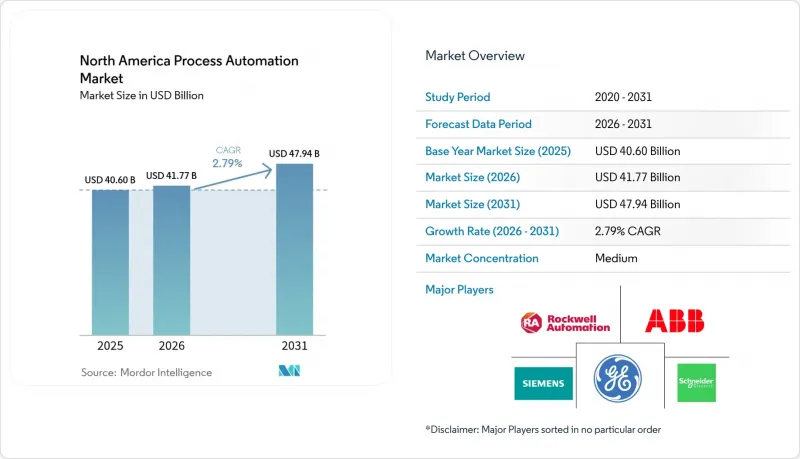
Mordor Intelligence에 의하면, 북미의 프로세스 자동화 시장 규모는 2025년 406억 달러로 평가되었습니다. 2026년 417억 7,000만 달러에서 2031년까지 479억 4,000만 달러로 확대되고 2026-2031년까지 연평균 복합 성장률(CAGR)은 2.79%를 나타낼 전망입니다.
본 보고서는 통신 프로토콜별(유선, 무선), 시스템 유형별(하드웨어, 소프트웨어), 구성 요소별(하드웨어, 소프트웨어, 서비스), 배포 모드별(On-Premise, 클라우드·엣지), 최종 사용자 산업별(석유 및 가스,화학제품 및 석유화학제품, 전력·유틸리티, 상하수도, 기타), 지역별로 분류되어 있습니다. 시장 예측은 금액(달러) 기준으로 제시되어 있습니다.
북미의 프로세스 자동화 시장 동향 및 인사이트
에너지 효율 및 운영 비용 절감에 대한 관심 증가
프로세스 제조업체들은 자동화를 배출량 감축의 수단으로 재정의하고 있습니다. 미국 에너지부가 발표한 ‘2024년 산업 탈탄소화 로드맵’에서는 2030년까지 산업의 에너지 집약도를 10%-15% 감축하겠다는 목표가 제시되어 있으며, 화학 및 정제 자산에 대한 고도화된 공정 제어와 실시간 최적화가 우선 과제로 꼽히고 있습니다. 캐나다의 오일샌드 사업자들은 2030년까지 톤당 170캐나다달러의 법정 탄소 가격 적용에 직면해 있으며, 이에 따라 증기 발생기 내의 연소 공기 비율과 급수 조성을 조정하는 엣지 분석이 도입되어 합성 원유 1배럴당 최대 5%의 천연가스 사용량 감축을 실현하고 있습니다. 다변수 제어 장치를 사용하여 증류 및 열교환기 네트워크를 미세 조정하고 있는 걸프 코스트 지역의 시설에서는 18개월 이하의 투자 회수 기간이 확인되었습니다. 이러한 초기 성과에 힘입어 2026년 자본 예산은 단순한 생산 능력 확대가 아닌, 디지털 기술을 통한 병목 현상 해소로 방향을 전환하고 있습니다.
안전 계장 시스템에 대한 수요 증가
2024년부터 2025년에 걸쳐 잇달아 발생한 정유시설 및 화학 플랜트 사고로 인해 규제 당국의 모니터링이 강화되었습니다. 미국 화학 안전 및 위험 조사 위원회(CSB)는 몇 건의 화재가 안전 무결성 수준(SIL)의 불충분한 검증에 기인한다고 지적하며, 온라인 진단을 가능하게 하는 스마트 포지셔너를 통한 공압식 트립 시스템의 개조를 촉진했습니다. OSHA(미국 직업안전보건청)의 공정 안전 관리(PSM) 준수를 위해서는 현재 문서화된 검증 검사가 요구되고 있으며, 이에 따라 보안이 강화된 OPC-UA 게이트웨이를 통해 기존 DCS 네트워크와 연동되는 통합형 안전 컨트롤러의 구매가 촉진되고 있습니다. 제약 및 식품 가공 업체들이 무균 충전 및 알레르기 유발 물질 관리에 대한 규제 요건을 충족하기 위해 유사한 아키텍처를 채택하고 있는 만큼, 각 벤더들은 안전용 PLC 수주가 두 자릿수 성장을 보이고 있다고 보고하고 있습니다.
막대한 초기 설비 투자 및 통합의 복잡성
독자적인 사양의 DCS 플랫폼에서 종합적으로 전환하는 데는 사이트당 5,000만 달러 이상의 비용이 소요될 수 있으며, 이 금액은 기업의 재무 부서가 요구하는 투자 회수 기간과 양립할 수 없습니다. 미국 연료 및 석유화학 제조업체 협회의 조사에 따르면, 정유시설의 62%가 전환에 따른 위험이나 시운전 중 이중 가동 필요성을 이유로 클라우드 히스토리안 도입을 미루고 있는 것으로 나타났습니다. 브라운필드 플랜트의 경우, 대다수가 레거시 필드버스 네트워크에 의존하고 있어 최신 엣지 디바이스와 연동할 때 고가의 프로토콜 변환기가 필요하기 때문에 단계적인 턴어라운드로 대응할 경우 프로젝트 기간이 7년에 달하기도 합니다.
부문별 분석
2025년, 유선 네트워크는 북미의 프로세스 자동화 시장 점유율의 61.19%를 차지했습니다. 이러한 우위는 안전상 중요한 인터록 및 고속 제어를 지원하는 확고히 자리 잡은 HART, PROFIBUS, Foundation Fieldbus 루프에서 비롯됩니다. 그러나 WirelessHART 및 ISA 100.11a 호환 장치는 연평균 성장률(CAGR) 3.11%로 확대될 것으로 예측됩니다. 이는 본질 안전 인증을 받은 트랜스미터를 통해 Class I Division 1 구역 내 도입이 가능해지며, 1미터당 3,000달러나 드는 배관 설치가 필요 없어지기 때문입니다. 쉘(Shell)사의 노코(Norco) 정유시설에서는 400대의 무선 트랜스미터를 도입하여 패킷 신뢰성을 99.5%로 유지하면서 설치 작업을 60% 줄였습니다. 이와 동시에, 엣지 게이트웨이가 유선 및 무선 데이터를 정규화함으로써, 예측 알고리즘이 전송 매체에 관계없이 센서의 드리프트를 감지할 수 있게 되었습니다. NFPA 70 규정 개정에 따라, 위험 평가에서 신호의 무결성이 확인된 경우 무선 장치의 사용이 허용되어 이러한 공존이 공식적으로 인정되었습니다.
IEC 61511에서는 결정론적 지연이 요구되므로, 비상 차단 밸브, 버너 관리 시스템, 압축기의 서지 방지 제어에서는 여전히 유선 연결이 필수적입니다. 그 결과, 북미의 프로세스 자동화 시장에서는 무선이 중요한 유선 루프를 대체하는 것이 아니라, 이를 보완하는 하이브리드 토폴로지가 유지되고 있습니다. 현재 프로젝트 팀은 3D 디지털 트윈을 사용하여 무선 주파수의 전파를 모델링하고, 열 작업 허가를 발급하기 전에 간섭을 미연에 방지하고 있습니다.
2025년 매출의 58.43%를 하드웨어가 차지했지만, 2031년까지는 소프트웨어가 3.56%라는 가장 높은 연평균 성장률(CAGR)을 나타낼 전망입니다. 시중에서 판매되는 범용 하드웨어에서 작동하는 개방형 표준 컨트롤러가 독자 사양의 DCS 캐비닛의 가격 결정력을 약화시키고 있습니다. 구독형 고급 공정 제어 제품군을 통해 사업자는 설비 투자를 하지 않고도 새로운 기능을 활용할 수 있게 되었습니다. 이러한 추세는 다변수 컨트롤러를 도입하여 증기 수요를 6% 절감한 펄프 및 제지 공장에서 뚜렷하게 드러납니다. 한편, 제약 기업들이 FDA의 데이터 무결성 지침을 준수하기 위해 전자 배치 기록(EBR)을 채택함에 따라 북미의 제조 실행 시스템(MES)용 프로세스 자동화 시장 규모는 확대되고 있습니다.
사이버 보안 조치가 강화된 SCADA로의 업그레이드는 활발한 업데이트 주기를 형성하고 있습니다. 이는 많은 중류 파이프라인 시스템이 랜섬웨어의 표적이 되기 쉬운 지원이 종료된 운영 체제에서 여전히 가동되고 있기 때문입니다. 각 벤더사는 현재 보안이 강화된 리눅스에서 호스팅되는 가상 머신 내에 SCADA 커널을 통합하고 있으며, 이를 통해 패치 적용 기간을 대폭 단축하고 신속한 재해 복구를 지원하고 있습니다. 진단 기능이 내장된 스마트 센서는 교정 주기를 연장하고, 자본 설비에서 디지털 라이프사이클 서비스로의 전환을 촉진하고 있습니다.
기타 혜택
- 엑셀 형식 시장 예측(ME) 시트
- 3개월간의 애널리스트 지원
자주 묻는 질문
목차
제1장 서론
제2장 조사 방법
제3장 주요 요약
제4장 시장 구도
제5장 시장 규모 및 성장 예측
제6장 경쟁 구도
제7장 시장 기회 및 향후 전망
KTH 26.09.04According to Mordor Intelligence, the North America process automation market size is projected to expand from USD 40.60 billion in 2025 and USD 41.77 billion in 2026 to USD 47.94 billion by 2031, registering a CAGR of 2.79% between 2026 to 2031.
This report is Segmented by Communication Protocol (Wired, and Wireless), System Type (Hardware, and Software), Component (Hardware, Software, and Services), Deployment Mode (On-Premises, and Cloud and Edge), End-User Industry (Oil and Gas, Chemical and Petrochemical, Power and Utilities, Water and Wastewater, and More), and Geography. The Market Forecasts are Provided in Terms of Value (USD).
North America Process Automation Market Trends and Insights
Rising Focus on Energy-Efficiency and OpEx Reduction
Process manufacturers are recasting automation as an emissions-cutting tool. The U.S. Department of Energy's 2024 Industrial Decarbonization Roadmap outlines a 10%-15% reduction target for industrial energy intensity by 2030, prioritizing advanced process control and real-time optimization for chemical and refining assets. Canadian oil-sands operators face a legislated carbon price of CAD 170 per tonne by 2030, prompting the rollout of edge analytics that adjust combustion-air ratios and feedwater chemistry inside steam generators, trimming natural-gas use by up to 5% per barrel of synthetic crude. Payback periods under 18 months have been documented at Gulf Coast facilities that fine-tune distillation and heat-exchanger networks through multivariable controllers. These early wins are steering 2026 capital budgets toward digital debottlenecking rather than pure capacity expansions.
Heightened Demand for Safety-Instrumented Systems
A string of refinery and chemical-plant incidents in 2024-2025 elevated regulatory scrutiny. The U.S. Chemical Safety and Hazard Investigation Board linked several fires to inadequate safety-integrity-level verification, spurring retrofits of pneumatic trip systems with smart positioners that enable online diagnostics. Compliance with OSHA Process Safety Management now requires documented proof tests, driving purchases of integrated safety controllers that interface with existing DCS networks through secure OPC-UA gateways. Vendors report double-digit order growth for safety PLCs as pharmaceutical and food processors adopt the same architectures to satisfy sterile-fill and allergen-control mandates.
High Upfront CapEx and Integration Complexity
Comprehensive migrations from proprietary DCS platforms can exceed USD 50 million per site, a sum that clashes with payback horizons demanded by corporate finance teams. An American Fuel and Petrochemical Manufacturers survey found that 62% of refineries defer cloud historians because of cutover risks and the need for dual operations during commissioning. Brownfield plants often rely on legacy fieldbus networks that necessitate costly protocol converters when interfacing with modern edge devices, stretching project timelines to seven years when tackled in phased turnarounds.
Other drivers and restraints analyzed in the detailed report include:
- Proliferation of Industrial IoT Platforms
- Shift Toward Predictive and Prescriptive Maintenance Analytics
- Operational Cybersecurity Talent Deficit
For complete list of drivers and restraints, kindly check the Table Of Contents.
Segment Analysis
Wired networks held 61.19% of North America process automation market share in 2025. Their dominance stems from entrenched HART, PROFIBUS, and Foundation Fieldbus loops that anchor safety-critical interlocks and high-speed controls. WirelessHART and ISA100.11a devices, however, are forecast to expand at a 3.11% CAGR as intrinsic-safety-certified transmitters allow deployment inside Class I Division 1 areas, eliminating conduit runs that can cost USD 3,000 per meter. Shell's Norco refinery used 400 wireless transmitters to cut installation labour by 60% while maintaining 99.5% packet reliability. In parallel, edge gateways normalize wired and wireless data so that predictive algorithms detect sensor drift regardless of medium. Regulatory updates to NFPA 70 have formalized this coexistence by permitting wireless devices where risk assessments validate signal integrity.
Wired links remain indispensable for emergency shutdown valves, burner-management systems, and compressor anti-surge controls because IEC 61511 demands deterministic latency. Consequently, the North America process automation market retains a hybrid topology in which wireless augments, rather than replaces, critical hardwired loops. Project teams now model radio-frequency propagation in 3-D digital twins to pre-empt interference before issuing hot-work permits.
Hardware generated 58.43% of 2025 revenue, yet software is projected to register the leading 3.56% CAGR through 2031. Open-standard controllers running on commercial off-the-shelf hardware are eroding the pricing power of proprietary DCS cabinets. Subscription-based advanced process control suites mean operators can unlock new functionality without capital projects, a trend exemplified by pulp and paper mills that deploy multivariable controllers to shave 6% off steam demand. Meanwhile, North America process automation market size for manufacturing execution systems is rising as pharmaceutical firms embrace electronic batch records to comply with FDA data-integrity guidance.
Cyber-hardened SCADA upgrades form a brisk replacement cycle because many midstream pipeline systems still run on unsupported operating systems vulnerable to ransomware. Vendors now package SCADA kernels inside virtual machines hosted on hardened Linux, slashing patch windows and supporting rapid disaster recovery. Smart sensors with embedded diagnostics lengthen calibration intervals, reinforcing the shift from capital equipment toward digital lifecycle services.
Complete Report Scope:
- By Communication Protocol
- Wired
- Wireless
- By System Type
- Hardware
- Scada
- Distributed Control System (Dcs)
- Programmable Logic Controller (Plc)
- Human-Machine Interface (Hmi)
- Process Safety Systems
- Valves And Actuators
- Electric Motors
- Sensors And Transmitters
- Software
- Advanced Process Control (Arc, Mvc, Inferential)
- Data Analytics And Reporting
- Manufacturing Execution Systems (Mes)
- Other Software
- Hardware
- By Component
- Hardware
- Software
- Services
- By Deployment Mode
- On-Premises
- Cloud And Edge
- By End-User Industry
- Oil And Gas
- Chemical And Petrochemical
- Power And Utilities
- Water And Wastewater
- Food And Beverage
- Pulp And Paper
- Pharmaceutical
- Other End-User Industry
- By Country
- United States
- Canada
- Mexico
List of Companies Covered in this Report:
- Abb Ltd.
- Siemens Ag
- Schneider Electric Se
- General Electric Company
- Rockwell Automation, Inc.
- Emerson Electric Co.
- Mitsubishi Electric Corporation
- Honeywell International Inc.
- Omron Corporation
- Fuji Electric Co., Ltd.
- Delta Electronics, Inc.
- Yokogawa Electric Corporation
- Phoenix Contact Gmbh & Co. Kg
- Bosch Rexroth Ag
- Beckhoff Automation Gmbh & Co. Kg
- Festo Se & Co. Kg
- Endress+Hauser Group Services Ag
- Aspen Technology, Inc.
- Aveva Group Plc
- Azbil Corporation
Additional Benefits:
- The market estimate (ME) sheet in Excel format
- 3 months of analyst support
TABLE OF CONTENTS
1 INTRODUCTION
- 1.1 Study Assumptions And Market Definition
- 1.2 Scope Of The Study
2 RESEARCH METHODOLOGY
3 EXECUTIVE SUMMARY
4 MARKET LANDSCAPE
- 4.1 Market Overview
- 4.2 Market Drivers
- 4.2.1 Rising Focus On Energy-Efficiency And Opex Reduction
- 4.2.2 Heightened Demand For Safety-Instrumented Systems
- 4.2.3 Proliferation Of Industrial Iot Platforms
- 4.2.4 Shift Toward Predictive And Prescriptive Maintenance Analytics
- 4.2.5 Carbon-Intensity Penalties Accelerating Digital Process Control
- 4.2.6 Demand For Fenceless Cobots In Hybrid Process Lines (under-reported)
- 4.3 Market Restraints
- 4.3.1 High Upfront Capex And Integration Complexity
- 4.3.2 Brown-Field Interoperability Challenges
- 4.3.3 Operational Cybersecurity Talent Deficit
- 4.3.4 Long-Term Service-Contract Lock-Ins Limiting Vendor Switch
- 4.4 Industry Value-Chain Analysis
- 4.5 Regulatory Landscape And Standards
- 4.6 Technological Outlook
- 4.7 Porter's Five Forces Analysis
- 4.7.1 Bargaining Power Of Suppliers
- 4.7.2 Bargaining Power Of Buyers
- 4.7.3 Threat Of New Entrants
- 4.7.4 Threat Of Substitutes
- 4.7.5 Intensity Of Competitive Rivalry
- 4.8 Impact Of Macroeconomic Factors On The Market
- 4.9 Industrial-Automation Hot-Spots Analysis (United States And Canada)
- 4.10 Pandemic Recovery Themes (V-Shape, Mid-Range, Slump)
- 4.11 United States - Base-Variable End-User Performance
- 4.12 Canada - Base-Variable End-User Performance
- 4.13 Supply-Related Challenges And Policy Stimulus
5 MARKET SIZE AND GROWTH FORECASTS (VALUE)
- 5.1 By Communication Protocol
- 5.1.1 Wired
- 5.1.2 Wireless
- 5.2 By System Type
- 5.2.1 Hardware
- 5.2.1.1 Scada
- 5.2.1.2 Distributed Control System (Dcs)
- 5.2.1.3 Programmable Logic Controller (Plc)
- 5.2.1.4 Human-Machine Interface (Hmi)
- 5.2.1.5 Process Safety Systems
- 5.2.1.6 Valves And Actuators
- 5.2.1.7 Electric Motors
- 5.2.1.8 Sensors And Transmitters
- 5.2.2 Software
- 5.2.2.1 Advanced Process Control (Arc, Mvc, Inferential)
- 5.2.2.2 Data Analytics And Reporting
- 5.2.2.3 Manufacturing Execution Systems (Mes)
- 5.2.2.4 Other Software
- 5.2.1 Hardware
- 5.3 By Component
- 5.3.1 Hardware
- 5.3.2 Software
- 5.3.3 Services
- 5.4 By Deployment Mode
- 5.4.1 On-Premises
- 5.4.2 Cloud And Edge
- 5.5 By End-User Industry
- 5.5.1 Oil And Gas
- 5.5.2 Chemical And Petrochemical
- 5.5.3 Power And Utilities
- 5.5.4 Water And Wastewater
- 5.5.5 Food And Beverage
- 5.5.6 Pulp And Paper
- 5.5.7 Pharmaceutical
- 5.5.8 Other End-User Industry
- 5.6 By Country
- 5.6.1 United States
- 5.6.2 Canada
- 5.6.3 Mexico
6 COMPETITIVE LANDSCAPE
- 6.1 Market Concentration
- 6.2 Strategic Moves
- 6.3 Market Share Analysis
- 6.4 Company Profiles (includes Global Level Overview, Market Level Overview, Core Segments, Financials As Available, Strategic Information, Market Rank/Share, Products And Services, Recent Developments)
- 6.4.1 Abb Ltd.
- 6.4.2 Siemens Ag
- 6.4.3 Schneider Electric Se
- 6.4.4 General Electric Company
- 6.4.5 Rockwell Automation, Inc.
- 6.4.6 Emerson Electric Co.
- 6.4.7 Mitsubishi Electric Corporation
- 6.4.8 Honeywell International Inc.
- 6.4.9 Omron Corporation
- 6.4.10 Fuji Electric Co., Ltd.
- 6.4.11 Delta Electronics, Inc.
- 6.4.12 Yokogawa Electric Corporation
- 6.4.13 Phoenix Contact Gmbh & Co. Kg
- 6.4.14 Bosch Rexroth Ag
- 6.4.15 Beckhoff Automation Gmbh & Co. Kg
- 6.4.16 Festo Se & Co. Kg
- 6.4.17 Endress+Hauser Group Services Ag
- 6.4.18 Aspen Technology, Inc.
- 6.4.19 Aveva Group Plc
- 6.4.20 Azbil Corporation
7 MARKET OPPORTUNITIES AND FUTURE OUTLOOK
- 7.1 White-Space And Unmet-Need Assessment