|
시장보고서
상품코드
2120614
인도의 네트워크 보안 및 사이버 리스크 관리 : 시장 점유율 분석, 업계 동향 및 통계, 성장 예측(2026-2031년)India Network Security And Cyber Risk Management - Market Share Analysis, Industry Trends & Statistics, Growth Forecasts (2026 - 2031) |
||||||
 Mordor Intelligence
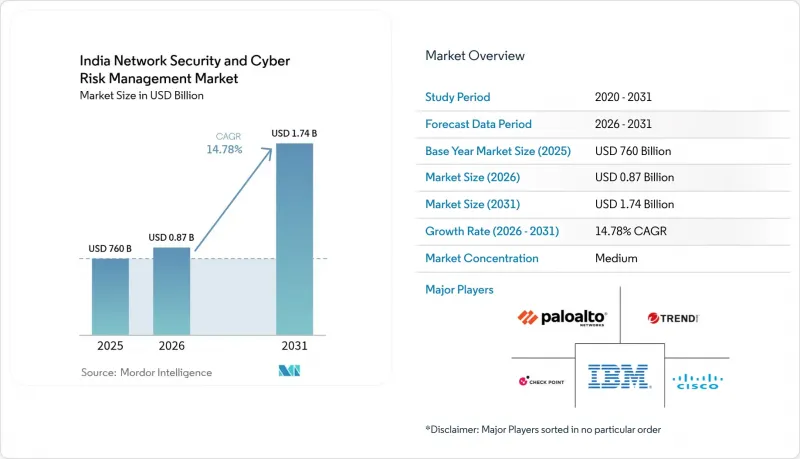
Mordor Intelligence에 의하면, 인도의 네트워크 보안 및 사이버 리스크 관리 시장 규모는 2025년 7억 6,000만 달러로 평가되었습니다. 2026년에는 8억 7,230만 달러로 확대되어 2026-2031년에 걸쳐 CAGR 14.78%로 성장을 지속하여, 2031년에는 17억 4,000만 달러에 이를 것으로 예측됩니다.
본 보고서는 부문별(보안 정보 및 이벤트 관리(SIEM), 기타), 솔루션별(암호화, ID 및 액세스 관리(IAM), 기타), 서비스별(네트워크 보안, 기타),최종 사용자 산업별(은행, 금융서비스 및 보험(BFSI), 정부·국방, 기타), 배포 방식별(On-Premise, 기타)로 분류되어 있습니다. 시장 예측은 금액(달러) 기준으로 제시되어 있습니다.
인도의 네트워크 보안 및 사이버 리스크 관리 시장 동향 및 인사이트
핀테크 거래 확대에 따른 공격 표면 확대
2023년, 인도의 핀테크 플랫폼에서는 42만 9,847건의 사이버 사고가 기록되었습니다. 공격은 공격자의 침입 경로를 증가시키는 오픈 API나 타사 통합 기능을 빈번하게 표적으로 삼고 있습니다. 23만 달러 상당의 디지털 골드가 유출된 아디티아 빌라 캐피탈(Aditya Bilra Capital)의 정보 유출 사건은 상호 연결된 서비스 제공업체로 인해 발생하는 연쇄적인 위험을 여실히 보여줍니다. DPDP 2023 준수를 위해서는 암호화, 감사 추적, 침해 통지가 요구되며, 이로 인해 핀테크 기업들은 AI 기반 이상 감지 기능을 갖춘 고급 SIEM 플랫폼 도입을 서둘러야 합니다. 경쟁 압박으로 인해 기능의 신속한 출시가 촉진되고 있지만, 새로운 통합이 이루어질 때마다 공격 표면은 확대됩니다. 그 결과, 최고정보보안책임자(CISO)는 고객 거래를 보호하고 인도의 네트워크 보안 및 사이버 리스크 관리 시장 전반에서 신뢰를 유지하기 위해 지속적인 모니터링, 마이크로 세분화, ID 중심 제어를 우선시하고 있습니다.
인도 OEM 펌웨어의 제로데이 공급망 공격
CERT-In은 Android 11-14를 실행하는 삼성 기기를 포함한 현지 OEM 펌웨어에서 여러 가지 심각한 취약점을 지적했으며, 이러한 취약점은 임의의 코드 실행이나 기밀 데이터 유출을 가능하게 합니다. 2024년 인도 은행을 표적으로 한 랜섬웨어 공격에서는 Jenkins 서버에 내장된 CVE-2024-23897을 악용해 결제 게이트웨이에 침입을 시도했으며, 펌웨어 결함이 공급망 전체로 파급되는 실태가 드러났습니다. 인더스트리 4.0 기기의 보급으로 인해, 특히 수출 지향적인 제조 거점에서는 이러한 위험이 더욱 커지고 있습니다. 이에 따라 기업들은 조달 워크플로우에 펌웨어 무결성 검사, 공급업체 감사 스코어카드, 지속적인 취약점 스캔을 통합하고 있습니다. 공급망 보안 강화에 따라 SIEM 및 SOAR 플랫폼과 통합된 엔드포인트 감지 및 대응(EDR) 도구에 대한 수요가 증가하고 있으며, 이는 인도의 네트워크 보안 및 사이버 리스크 관리 시장의 성장을 뒷받침하고 있습니다.
40만 명의 숙련된 사이버 보안 전문가 부족
인도에서는 2027년까지 100만 명의 사이버 보안 전문가가 필요할 것으로 예상되지만, 현재 즉시 업무에 투입될 수 있는 기술을 갖춘 인력은 30만 명에 그쳐 40만 명의 인력 부족이 발생하고 있습니다. 이 미충족 수요의 절반은 BFSI(은행 및 금융 및 보험) 부문에서만 차지하고 있어, 인건비 상승과 사내 팀의 부담 증가를 초래하고 있습니다. 기업들은 부족한 인력을 보충하기 위해 MDR(Managed Detection and Response) 제공업체에 아웃소싱하거나 AI를 활용한 자동화 도입을 점점 더 확대되고 있습니다. 마이크로소프트의 ‘CyberShikshaa’와 같은 정부 주도의 노력을 통해 사회적으로 취약한 계층의 기술 향상이 도모되고 있지만, 연간 인재 배출 수는 여전히 시장 수요를 밑돌고 있습니다. 이로 인해 기술 인력 부족이 중소기업의 제로 트러스트(Zero Trust) 등 고도화된 아키텍처 도입을 지연시키고, 인도의 네트워크 보안 및 사이버 리스크 관리 시장의 성장세를 둔화시키고 있습니다.
부문별 분석
2025년, SIEM 부문은 인도의 네트워크 보안 및 사이버 리스크 관리 시장 규모의 28.12%를 차지했으며, 이는 CERT-In의 요구 사항을 충족하는 통합 로그 분석 및 자동 알림에 대한 조직의 요구를 반영한 것입니다. 대기업의 경우, SIEM을 SOAR와 통합하여 플레이북을 오케스트레이션함으로써 대응 시간과 감사 부담을 줄이고 있습니다. 중견 기업은 자본 투자를 피하기 위해 클라우드 호스팅형 SIEM 구독을 선호하고 있습니다. 한편, 하이브리드 업무 환경에서 신원 확인이 새로운 경계선이 됨에 따라 IGA 솔루션은 연평균 성장률(CAGR) 17.18%로 성장하고 있습니다. 자동화된 프로비저닝과 위험 기반 접근 권한 검토를 통해 사용자 라이프사이클 관리의 효율성이 향상되고 규정 준수 보고가 개선됩니다.
두 부문의 성장은 멀티 클라우드 환경에서 통합적인 가시성에 대한 수요에서 비롯됩니다. 각 벤더는 이상 감지를 위해 머신 러닝 모델을 통합하고 있으며, 시장과의 연동을 통해 SaaS, 컨테이너, IoT 각 계층에서 텔레메트리 데이터를 수집하고 있습니다. 디지털 공급망이 심화됨에 따라 고객들은 SIEM, XDR, 신원 확인 거버넌스를 결합한 플랫폼을 선호하는 경향을 보이고 있으며, 이는 인도의 네트워크 보안 및 사이버 리스크 관리 시장을 재정의할 통합 보안 운영으로의 전환을 시사합니다.
2025년, ID 및 액세스 관리(IAM)는 인도의 네트워크 보안 및 사이버 리스크 관리 시장에서 31.05%의 점유율을 유지하며, 특권 액세스 제어에서 싱글 사인온에 이르기까지 모든 부문의 기반이 되었습니다. 상세한 액세스 로그를 의무화하는 규제 조항으로 인해 IAM 플랫폼의 정착이 더욱 가속화되고 있습니다. 한편, 제로 트러스트 네트워크 액세스(ZTNA)는 원격 근무 정책과 5G 엣지 연결에 힘입어 18.05%라는 가장 높은 연평균 성장률(CAGR)을 기록하고 있습니다. ZTNA는 지속적인 검증, 마이크로 세분화, 컨텍스트 기반 조치를 통해 경계 기반 VPN을 대체할 것입니다.
기업들이 포스트 양자 위협에 대비하고 DPDP 규정 준수를 추진함에 따라, 암호화 및 DLP에 대한 수요가 증가하고 있습니다. 구매 기업들은 통합된 정책 엔진 하에서 IAM, ZTNA, 암호화를 통합한 솔루션 제품군을 점점 더 많이 채택하고 있습니다. 이러한 통합으로 운영상의 오버헤드가 감소하고, MSME(중소·영세 기업)의 도입이 가속화되며, 인도의 네트워크 보안 및 사이버 리스크 관리 시장 전반에 걸쳐 수익 기회가 확대되고 있습니다.
기타 혜택
- 엑셀 형식 시장 예측(ME) 시트
- 3개월간의 애널리스트 지원
자주 묻는 질문
목차
제1장 서론
제2장 조사 방법
제3장 주요 요약
제4장 시장 구도
제5장 시장 규모 및 성장 예측
제6장 경쟁 구도
제7장 시장 기회 및 향후 동향
KTH 26.09.04According to Mordor Intelligence, the India network security and cyber risk management market size is expected to grow from USD 760 million in 2025 to USD 872.3 million in 2026 and is forecast to reach USD 1.74 billion by 2031 at 14.78% CAGR over 2026-2031.
This report is Segmented by Segment (Security Information and Event Management (SIEM), and More), Solution (Encryption, Identity and Access Management (IAM), and More), Service (Network Security, and More), End-User Industry (BFSI, Government and Defence, and More), and Deployment Mode (On-Premise, and More). The Market Forecasts are Provided in Terms of Value (USD).
India Network Security And Cyber Risk Management Market Trends and Insights
FinTech Transaction-Sprawl Intensifying Attack Surface
Indian FinTech platforms recorded 429,847 cyber incidents in 2023, with exploits frequently targeting open APIs and third-party integrations that multiply entry points for attackers. The Aditya Birla Capital breach, which siphoned USD 0.23 million in digital gold, illustrates cascading risks created by interconnected service providers. Compliance with DPDP 2023 demands encryption, audit trails and breach notification, pushing FinTechs toward advanced SIEM platforms with AI-based anomaly detection. Competitive pressures encourage rapid feature releases, yet every new integration widens the attack surface. Consequently, chief information security officers prioritize continuous monitoring, micro-segmentation and identity-centric controls to protect customer transactions and sustain trust across the India network security and cyber risk management market.
Zero-Day Supply-Chain Exploits on Indian OEM Firmware
CERT-In has flagged multiple critical vulnerabilities in local OEM firmware, including Samsung devices running Android 11-14, enabling arbitrary code execution and sensitive-data exfiltration . A 2024 ransomware campaign against Indian banks leveraged CVE-2024-23897 embedded in Jenkins servers to breach payment gateways, underscoring how firmware flaws propagate across supply chains . Proliferation of Industry 4.0 devices magnifies this exposure, especially in export-oriented manufacturing hubs. Enterprises, therefore, embed firmware-integrity checks, vendor-audit scorecards, and continuous vulnerability scanning in procurement workflows. Tightening supply-chain security raises demand for endpoint detection and response tools integrated with SIEM and SOAR platforms, reinforcing growth in the India network security and cyber risk management market.
Shortage of 400k Skilled Cyber-Security Professionals
India requires 1 million cybersecurity professionals by 2027, yet only 300,000 people currently possess employable skills, creating a 400,000-person gap. BFSI alone accounts for half of this unmet demand, which raises labor costs and stretches internal teams . Organizations increasingly outsource to Managed Detection and Response providers and deploy AI-based automation to compensate for missing talent. Government initiatives like Microsoft's CyberShikshaa upskill underrepresented groups, yet annual output remains below market needs. Skills scarcity thereby slows implementation of sophisticated architectures such as zero-trust among small and mid-size enterprises, tempering the growth trajectory of the India network security and cyber risk management market.
Other drivers and restraints analyzed in the detailed report include:
- Mandatory CERT-In Six-Hour Breach-Reporting Rule
- Rising Cloud-Native Adoption Among MSMEs
- Fragmented State-Level Data-Protection Enforcement
For complete list of drivers and restraints, kindly check the Table Of Contents.
Segment Analysis
The SIEM segment generated 28.12% of the India network security and cyber risk management market size in 2025, reflecting organizations' need for centralized log analytics and automated alerts that satisfy CERT-In mandates. Large enterprises integrate SIEM with SOAR to orchestrate playbooks, reducing response times and audit overhead. Mid-sized firms prefer cloud-hosted SIEM subscriptions to avoid capital expenditure. Meanwhile, IGA solutions compound at a 17.18% CAGR as identity becomes the new perimeter in hybrid workplaces. Automated provisioning and risk-based access reviews improve user-lifecycle efficiency and compliance reporting.
Growth in both segments stems from demand for unified visibility in multi-cloud environments. Vendors embed machine-learning models for anomaly detection, while marketplace integrations pull telemetry from SaaS, container and IoT layers. As digital supply chains deepen, customers favor platforms that combine SIEM, XDR and identity governance, signaling a shift toward converged security operations that will redefine the India network security and cyber risk management market.
Identity and Access Management retained a 31.05% share of the India network security and cyber risk management market in 2025, anchoring everything from privileged-access controls to single sign-on. Regulatory clauses requiring granular access logs further entrench IAM platforms. Yet Zero Trust Network Access posts the fastest 18.05% CAGR, propelled by remote-work policies and 5G edge connectivity. ZTNA replaces perimeter-based VPNs with continuous verification, micro-segmentation, and contextual policies.
Encryption and DLP gain traction as enterprises prepare for post-quantum threats and DPDP compliance, respectively. Buyers increasingly adopt solution suites that integrate IAM, ZTNA, and encryption under unified policy engines. This convergence reduces operational overhead and accelerates adoption among MSMEs, expanding revenue opportunities across the India network security and cyber risk management market.
Complete Report Scope:
- By Segment
- Security Information and Event Management (SIEM)
- Secure Web Gateway (SWG)
- Identity Governance and Administration (IGA)
- Enterprise Content-Aware Data Loss Prevention (DLP)
- By Solution
- Encryption
- Identity and Access Management (IAM)
- Data Loss Protection (DLP)
- Intrusion Detection/Prevention (IDS/IPS)
- Zero-Trust Network Access (ZTNA)
- By Service
- Network Security
- Endpoint Security
- Wireless Security
- Cloud Security
- Managed Detection and Response (MDR)
- By End-user Industry
- BFSI
- Government and Defence
- Healthcare
- IT and Telecom
- Retail and E-Commerce
- Manufacturing
- By Deployment Mode
- On-premise
- Cloud-based
List of Companies Covered in this Report:
- Cisco Systems Inc.
- Palo Alto Networks Inc.
- IBM Corporation
- Check Point Software Technologies Ltd.
- Trend Micro Inc.
- Fortinet Inc.
- Sophos Group plc
- Safe Security (Safe Security Pvt Ltd., formerly Lucideus)
- Quick Heal Technologies Ltd.
- Tata Communications Ltd.
- Wipro Ltd. (Cybersecurity and Risk Services)
- HCL Technologies Ltd.
- Infosys Ltd.
- Instasafe Technologies Pvt Ltd.
- XenArmor Security Solutions
- ArrayShield Technologies Pvt Ltd.
- Data Resolve Technologies Pvt Ltd.
- Netrika Consulting India Pvt Ltd.
- Mirox Cybersecurity and Technology Pvt Ltd.
- Cyberoam Technologies Pvt Ltd. (a Sophos Company)
Additional Benefits:
- The market estimate (ME) sheet in Excel format
- 3 months of analyst support
TABLE OF CONTENTS
1 INTRODUCTION
- 1.1 Market Definition and Study Assumptions
- 1.2 Scope of the Study
2 RESEARCH METHODOLOGY
3 EXECUTIVE SUMMARY
4 MARKET LANDSCAPE
- 4.1 Market Overview
- 4.2 Market Drivers
- 4.2.1 FinTech transaction-sprawl intensifying attack surface
- 4.2.2 Zero-day supply-chain exploits on Indian OEM firmware
- 4.2.3 Mandatory CERT-In six-hour breach-reporting rule
- 4.2.4 Rising cloud-native adoption among MSMEs
- 4.2.5 5G private?network roll-outs in smart-manufacturing hubs
- 4.2.6 Generative-AI driven phishing and deep-fake prevention spend
- 4.3 Market Restraints
- 4.3.1 Shortage of 400k skilled cyber-security professionals
- 4.3.2 Fragmented state-level data-protection enforcement
- 4.3.3 High TCO of zero-trust architectures for SMEs
- 4.3.4 Legacy OT systems in critical infrastructure
- 4.4 Value Chain Analysis
- 4.5 Evaluation of Critical Regulatory Framework
- 4.6 Impact Assessment of Key Stakeholders
- 4.7 Technological Outlook
- 4.8 Porter's Five Forces Analysis
- 4.8.1 Bargaining Power of Suppliers
- 4.8.2 Bargaining Power of Consumers
- 4.8.3 Threat of New Entrants
- 4.8.4 Threat of Substitutes
- 4.8.5 Intensity of Competitive Rivalry
- 4.9 Impact of Macro-economic Factors
5 MARKET SIZE AND GROWTH FORECASTS (VALUE)
- 5.1 By Segment
- 5.1.1 Security Information and Event Management (SIEM)
- 5.1.2 Secure Web Gateway (SWG)
- 5.1.3 Identity Governance and Administration (IGA)
- 5.1.4 Enterprise Content-Aware Data Loss Prevention (DLP)
- 5.2 By Solution
- 5.2.1 Encryption
- 5.2.2 Identity and Access Management (IAM)
- 5.2.3 Data Loss Protection (DLP)
- 5.2.4 Intrusion Detection/Prevention (IDS/IPS)
- 5.2.5 Zero-Trust Network Access (ZTNA)
- 5.3 By Service
- 5.3.1 Network Security
- 5.3.2 Endpoint Security
- 5.3.3 Wireless Security
- 5.3.4 Cloud Security
- 5.3.5 Managed Detection and Response (MDR)
- 5.4 By End-user Industry
- 5.4.1 BFSI
- 5.4.2 Government and Defence
- 5.4.3 Healthcare
- 5.4.4 IT and Telecom
- 5.4.5 Retail and E-Commerce
- 5.4.6 Manufacturing
- 5.5 By Deployment Mode
- 5.5.1 On-premise
- 5.5.2 Cloud-based
6 COMPETITIVE LANDSCAPE
- 6.1 Market Concentration
- 6.2 Strategic Moves
- 6.3 Market Share Analysis
- 6.4 Company Profiles (includes Global level Overview, Market level overview, Core Segments, Financials as available, Strategic Information, Market Rank/Share for key companies, Products and Services, and Recent Developments)
- 6.4.1 Cisco Systems Inc.
- 6.4.2 Palo Alto Networks Inc.
- 6.4.3 IBM Corporation
- 6.4.4 Check Point Software Technologies Ltd.
- 6.4.5 Trend Micro Inc.
- 6.4.6 Fortinet Inc.
- 6.4.7 Sophos Group plc
- 6.4.8 Safe Security (Safe Security Pvt Ltd., formerly Lucideus)
- 6.4.9 Quick Heal Technologies Ltd.
- 6.4.10 Tata Communications Ltd.
- 6.4.11 Wipro Ltd. (Cybersecurity and Risk Services)
- 6.4.12 HCL Technologies Ltd.
- 6.4.13 Infosys Ltd.
- 6.4.14 Instasafe Technologies Pvt Ltd.
- 6.4.15 XenArmor Security Solutions
- 6.4.16 ArrayShield Technologies Pvt Ltd.
- 6.4.17 Data Resolve Technologies Pvt Ltd.
- 6.4.18 Netrika Consulting India Pvt Ltd.
- 6.4.19 Mirox Cybersecurity and Technology Pvt Ltd.
- 6.4.20 Cyberoam Technologies Pvt Ltd. (a Sophos Company)
7 MARKET OPPORTUNITIES AND FUTURE TRENDS
- 7.1 White-space and Unmet-need Assessment